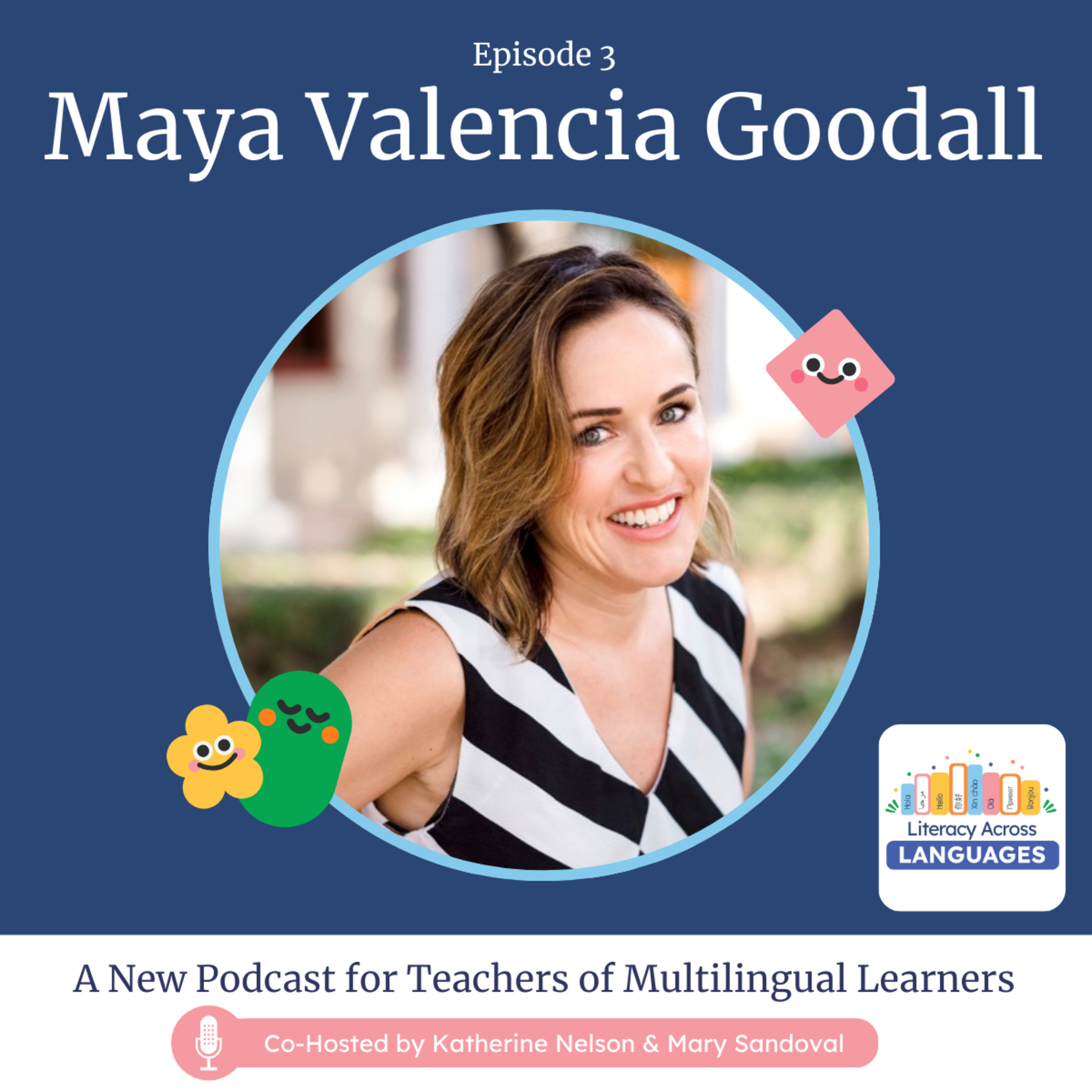
E3 - The Heart of Multilingual Education: Language, Literacy, & Identity
35m 43s
The podcast "Literacy Across Languages" explores the intersection of bilingualism and literacy, advocating for inclusive education where every student can develop strong reading skills. Maya Valencia Goodall discusses her multilingual education journey, highlighting the significance of heritage languages and collaborative support for multilingual learners. The integration of structured literacy and second language acquisition research is emphasized to enhance students' language and reading skills. Teachers are advised to offer comprehensible input, encourage speaking practice, and connect oral language development to literacy instruction across all content areas.
Transcription
6149 Words, 35141 Characters
Everyone is invited to this party of bilingualism, no matter how you enter. The point is that everybody gets to experience the sense of belonging, everyone. - Welcome to Literacy Across Languages. I'm Mary, an educator, instructional coach, and committed advocate for multilingual learners. - And I'm Catherine, a multilingual literacy specialist and author of Early Reader Materials. - Passionate about developing reading and language together. - Since we first met as teachers back in 2014, our multilingual students have shown us that literacy and language belong together. That understanding and our belief that literacy is every child's right has shaped our work ever since. - With this podcast, we'll explore how the science of reading and the science of language acquisition come together to help every student become a confident, capable reader. - We speak with experts and educators to dig into the research and share practical ideas you can use right away. Together, we can make literacy for every language learner a reality. - Hi, educators, it's Mary. Thanks for joining us on Literacy Across Languages. Today we're so excited to share our conversation with Maya Valencia Goodall. Maya is a pioneering force in education driven by a singular mission to ensure that every student, regardless of their linguistic background, receives the literacy and language instruction they both need and deserve. As co-creator of OLA, Online Language and Literacy Academy, co-founder of Lingual Learning and co-creator of Lexia English within Rosetta Stone and Lexia Learning, her journey has been defined by innovation, impact, and unwavering dedication to empowering diverse learners. Today, she continues to shape the educational landscape as a leader in the design and enhancement of the Online Elementary Reading Academy at co-learning. Maya's legacy is a testament to her extraordinary commitment to educational excellence. In this episode, Maya unpacks how we can redefine success in language learning. Maya shares her inspiring journey into multilingual education, highlighting the power of heritage languages, the intersection of structured literacy and second language acquisition, and the vital role of professional learning for teachers. She reminds us that supporting multilingual learners starts with collaboration, celebration, and a deep respect for every student's identity. Let's jump into our conversation with Maya. Maya, hello and welcome to Literacy Across Languages. We are so glad you're here. Thank you so much for having me. So, Maya, as we get started with our conversation, we really enjoy hearing everyone's journey into the work of multilingual education. Would you share yours with us? Yes. Well, it's a long story, but I'll start with the very beginning. So, a story that I like to tell is of my childhood growing up, hearing about how my grandmother would be punished at school for speaking our heritage language, which was Spanish. She would actually have to put her hands up on the desk and she would get a tap, or maybe a little harder, with the ruler to teach her to stop doing that. And she internalized that lesson, and so she did. She, although she could speak Spanish, she remained bilingual and actually had jobs as a translator later. She made it a mission to make sure that we all knew English at the expense of our heritage language. She learned and internalized that the heritage language wasn't as valuable as English. And so, I did grow up speaking English. My mom grew up speaking English. And it wasn't until I was an adult that I had the opportunity to learn Spanish, actually, in university. And I was so excited to do that because I always felt like, you know, that I had a little distance between myself and my identity. I always felt there was something more about my identity that was just beyond kind of like a gauzy wall, just right over there that I couldn't quite grasp. And so, once I did have the opportunity to learn Spanish, and I will always be a Spanish learner. I was actually with one of my friends who learned English as a second language. And she asked me recently, like, what does it mean when all your bases are covered? And I said, oh, I was explained that lithium to her. And she said, did you know what that means? I said, yes, but if you gave me an idiom like that in Spanish, I would need someone to help me, you know, think it through. So, and she said, you know, I'm still always learning English. And that's how I feel about Spanish. She's like, yes, I'm bilingual. And I'm always learning. But anyway, once I did have that opportunity to learn, I felt more connected with my own heritage and realized my identity was always there, even though I was expressing it just in one language. But of course, becoming bilingual and since then, trilingual has changed my identity in positive ways, it really opens up a lot. So, in terms of my own personal journey, that's me. And then I extended that into education, into the education space. That's the second part of what I've done over time. Thank you so much for sharing that. In many ways, I can relate to that identity piece. My family is from Peru and we came to this country when I was a little girl. And although I did grow up in a bilingual household, I certainly wrestled, you know, as a young girl, as a teenager, like, who am I? Am I Peruvian? Am I American? I speak one language here, but not in the other place. And so I feel like that story and how it connects to our identities. You know, we think about the students in our classroom. So, thank you so much for sharing that because it really is the beginning of that relationship. But building when our students walk through the door. I think the most important thing about all of our stories is instead of seeing it from a deficit or a disadvantage is to, you know, like, celebrate all the opportunities. Just listening to you now is like, what a gift, you know, to be able to have the two languages and speaking languages and have different identities that you get to express in different places. And it's just us, like you said, in our relationships with our students to express it in the asset orientation and really give the students the understanding that all that makes you unique, all that makes you who you are is something to be celebrated. And I know we say that there's posters in our classrooms that say those types of things, but really just dropping in and reminding someone that those things that can appear to make us separate and different actually are the things that bring us together. I keep thinking about, after you shared that story, how your grandmother must have felt in the classroom, knowing that her language was not welcomed there, can you speak a little bit more about how the way that others view English learners or language learners of any sort, but especially English learners? And how that affects their identity as learners, how does the learning change when they have a teacher who values and supports all the languages that that student speaks? - Yeah, that's a really good question. I mean, it's hard for me to say what's in the minds of others, but what I like to think is that people have the best of intentions. And so the intention behind that was to make sure that my grandmother, and I think the intention that other teachers have is to make sure that the kids are successful. And so, you know, the marker of success is what a monolingual looks like, being able to speak English, read, write, and speak in English. And that's the only kind of template that we're working from. Then I think the best intention there was to, you know, make sure like, oh my God, I want you to know English. Like this is super important for you to be successful and to be able to, you know, be the person that you want to be here where we are in an English-speaking country. I think when we change the model of the template to think about someone and knowing that people can learn how to read, write, and speak in two languages at the same time, that the human brain is completely capable of that and actually capable of more than two languages at the same time, but we'll keep it to being bilingual. That when that template is the marker of success, then it opens up opportunities for teachers to see more asset and all the cognitive assets, the background knowledge, you know, everything that the student brings, all the language infrastructure, their entire linguistic repertoire, then becomes, you know, feeding ground for, you know, what can be achieved in the classroom. So I do like to think that although those practices were, you know, did end up being harmful, I think that the intention wasn't to be harmful, but the intention was to assist and to help. And I think that people still have that same intention today, even if they don't have the template of bilingualism. And so that's something that we get to share, right? That's what you guys do, that's what I do, is just talk about just redefining the template of success. Thank you so much for sharing that Maya, as you're discussing and describing this as a template, I'm thinking of teachers and school leaders who really want some practical tips as to what that looks like to have an asset-based mindset, to have an asset-based approach. Would you describe that a little bit about what practices we might see in classrooms and schools that embrace multilingualism and embrace a mindset that our students are, not empty vessels that they have many funds of knowledge. Yes, thank you, that's a great question. And I think the first thing to remember is that language has to be taught. And so even for the first language, when the baby comes home and the caregivers and the community is supporting that baby, they are talking, they are practicing language, they are providing repetition, they are actually giving explicit experience with the language to the baby. And all of that seems natural because we do as human beings provide that naturally, it's something that we know to do without necessarily talking about it or reading about or needing the philosophy, it's just we will do that. And so it appears that it's natural, but however we are providing a lot of experience, language experience, that is very necessary in order to learn language. So if that's true for the first language, it's also true for the second language. The second language has to be explicitly taught, it has to be intentionally taught. And so number one, understanding that all students coming to school to us, whether they speak English or Spanish or another language, it means that they have a language, it means that their brains have already learned a language, it means that they're capable, and so you can recognize that capability and those funds of knowledge. While they might not be able to describe the syntax or past, present, or the kind of prosody or domains of discourse, they couldn't say what those are, they know what they are, and they use them actually. And so just recognizing that a full language already exists and that we can, and it's still growing, 'cause, you know, for talking about like someone who's just coming to school, and in fact, language is something that can continue to grow all throughout one's life. So really, it's something that will continue to grow. So we think about it from that aspect, and then we also understand that the students have to have experience with English. If English happens to be the language of our instruction and what we're expecting them to learn, they have to have experience with it, and what I mean by that is they have to have opportunities for speaking practice. And I know that sounds so simple, but many of us have adhered to a different philosophy for a long time, that the teachers do the providing of the language, and that eventually the students will then produce the language that they're hearing. And that is partly true, and it mimics what we just described in terms of at home. But if we also return to the idea of the baby, we think about the baby, and we understand that they start creating sounds right away. Those sounds may not be morphemes, the smallest unit of meaning in a language, but they are trying to produce the morphemes, and they're practicing and practicing and mimicking and mimicking. There's lots that are taking place, a baby is not silent, right? They are constantly practicing with us, until they start to form the language that they're being exposed to. So the same thing has to be replicated at school. Yes, we have to give the comprehensible input, and we have to provide ample opportunity for the students to practice the language of instruction. The same is true for teaching in Spanish, or for, you know, in a dual immersion scenario. We have to give the students that opportunity to actually practice speaking. It cannot be overstated. It has to be thoughtful, it has to be mindful, it has to be purposeful, and it has to connect to the text that we're reading, but it has to happen. And that means a lot more speaking should be taking place in classrooms than what we see today. I love that you're emphasizing that oral language piece, and not having a silent classroom, making sure that the kids are talking. And I also really like how you're relating it back to that first language acquisition that I think most people are familiar with from children in their lives. And it's just making me think as you're talking about those earliest kind of cooing sounds from babies, they're producing output, but they're also eliciting more input for themselves. As a responsive caregiver, you're going to be modeling back. Oh, you almost said it right, but it's a little different, or I don't understand what you mean. Can you say it again? And I think those are, like you said, things that come very naturally to us with young children and infants, but are not as common in the classroom. So I just really appreciate you highlighting that. And across your career, you've been a really strong advocate for bringing together structure literacy and the research base from second language acquisition. And that's one of the goals of our podcast as well. And we're wondering, do you see certain areas where there's a lot of overlap, where teachers are able to kind of get double the bang for their back, where they're developing English language skills alongside literacy skills? - Yes, so exciting. I love the bridge between second language acquisition and structured literacy. We have so much evidence from structured literacy. And what I love about what's happening in the research is that cognitive science and neuroscience is now contributing to what we've already know about structured literacy and how to break down the language for reading. What they're teaching us is that the language processing center for both written language and spoken language is in the same place in the brain. And so the brain is doing the same thing in terms of creating meaning out of either spoken language or the written language. And we understand that the spoken language is the foundation. You have to have an understanding of the spoken language. You have to understand how it's used. You have to understand, you know, again, the order, syntax, you have to understand the pragmatics. You have to understand how to use the language and spoken before it can make sense from text because really what we're doing is we're processing spoken language as we're reading it. And so even though we use it kind of in a different formality on the text, it's still in the same place in terms of processing language. And so again, kind of going back to that oral language practice every part of reading, if we're thinking about phonemic awareness, we're thinking about phonics, we're thinking about then, you know, those foundational skills, how they apply to decoding, all of that is reinforced and also buttressed by the oral language practice. So you're having your students practice speaking out loud, practice full complete sentences, practice using words, those rhyming techniques, all the different things that you do with oral language is going to positively affect the ability to learn how to read or decode that text. And at the same time, comprehend the text that they're reading. It's interesting to me and that language has been parsed apart. It does have to be taught on its own, but it's always in connection with reading. And so I love that you're filling that space of that bridge from language to reading. And then the most exciting thing is back again from reading to language, because once you learn how to read and you understand enough, then you are then able to read. And you can then build up your language capacity. So that reciprocal nature back and forth is like the most exciting part. And back to what I was saying earlier about all of us continuing to learn language throughout our lives, especially if as we become more and more adept at reading and we spend more time reading, it actually helps our language growth. - Yeah, we couldn't agree with humor, Maya, you know, really thinking about how language and literacy are so synergistic, right? One is feeding the other in terms of their development. And I'm just thinking about, you know, your emphasis with that comprehensible input, but then of course giving students a space to practice, right? We need both. And we often have said that, you know, separating those two things can create more challenges for our students. But as I'm thinking about, you know, the unique roles that teachers take, classroom teacher, reading specialist, ELD teachers, you know, we live often within our own teacher preparation or within the own professional learning that we've had. So sometimes I think misconceptions arise. Would you speak a little bit about some of those misconceptions regarding these two bodies of research? - I think that in structured literacy, there has been a focus directly going to the foundational skills and comprehension. Even though it's always been there, like if you look at an infographic, let's say from the International Dislexy Association, it's one of the best infographics that they have on structured literacy, the what and the how, and breaking it down. You will see language there. You will see, it will say domains of language. But because we also had this other research talking about comprehensible input, I think the interpretation was that the teacher is providing the modeling. The teacher is providing the thick glows. The teacher is providing the language inputs, which of course has to happen. But the other side of that coin, which is the students producing the modeling, the students producing the think allows, the students producing new ideas, that somehow wasn't uplifted in the way that it needed to be. And so I think it's, you know, the teacher's now just thinking everything that they know about reading, teaching reading, and everything they know about language learning remains. You keep that, and then you add this other new thing. And it's not really new. It's just maybe a new practice that we're doing is really thinking about how we have the students practice language in a way that is going to through line to the text that they're also going to be asked to read. And so every, and I mean that in every content area, math, science, social studies, all teachers are reading teachers, and all teachers are language teachers. They're really doing everything within the content that they're teaching. So it's a matter of getting to know your content and how it sounds out loud, what the expectation of the students would be if they were going to be asked to speak about the content, and then providing the scaffolds for them. In fact, all of your students will benefit from this. Not just your students who are learning English as a second language, but also your monolingual students. Because as we know, we can up level our language all the time, all throughout our lives. And so as you're doing this instruction, everybody will benefit from this. But it is thinking about what the language of your content is and how you're going to scaffold that for your students. - Yeah, and I think it's really a unique space at that K12 level where so much of the curriculum revolves around those foundational literacy skills. It's not as content heavy as some of the older grades, which content I think is kind of a natural delivery for language learning. So I guess we're wondering if a teacher's brand new to working with multilingual learners, say it's a literacy specialist. And because I used to hear this a lot when I was teaching was, you know, I'm a literacy specialist. I don't know how to work with a student who can't speak English. They have to learn English. The oral language is the foundation of literacy. They need to have a certain proficiency level before. We can provide reading intervention. And vice versa, I think a lot of English language teachers have gotten used to a certain way of providing English language instruction and maybe are new to structured literacy. So I guess my question for you is, are there two small shifts that you could suggest for a teacher who is brand new to working with an English learner who is also learning to read? Maybe one tip for how to build literacy and one tip for how to build language alongside it. - I would think that for a teacher who is working with someone who is brand new to their experience with English, first is that the mental, the paradigm shift. I think it cannot be overstated as paramount that the student A can learn how to read right and speak in two languages. It is completely possible. There's so much data. I mean, you can just think about other countries. In fact, the data is exponential that many human beings do this and the human being that is sat before you can also do that. So that's number one. It's really important to understand that this can be done. It's done all the time. The second thing is to think about reading as language on the page. And so all reading teachers understand the benefit of a read aloud. Reading teachers understand the benefit of making sounds, breaking sounds, putting them back together. And so really uplifting that and really thinking about that as part of your language teaching. And perhaps adding some more sentence structure around it. I mean, if you're gonna break down the sound at Apple, like make sure that the student knows what an Apple is. Right, so you're gonna have some visuals there. You might even say, you know, I like apples. I like yellow apples, red apples, green apples. All of those things make sense. They're likely talking about apples in the month of September at school anyway. And so it's just making sure that there's a little bit more language context around what it is you're doing. In those K1 classes, I think those are the easiest because there's a lot of oral language that is already happening. And so you can just add a little bit more, especially when it comes to the comprehension. Making sure that if you're doing rhyming and you're rhyming words that means something, that the kids know what, you know, they have a picture of the, you know, mat and a hat and they can see those things. And so they could, they just understand that those are words and they can name those words. And then maybe later use them in a full sentence. This is a hat, that is a mat, that kind of thing. It's just, it's really just adding a little bit more. And then I think the same thing for the language teacher. I think I'm going to hold out a little bit for the language teacher though. And I'm going to say that because if the language teacher is focusing on oral language and they are really doubling down on oral language and having the student actually produce language for themselves, speak out loud with their own thoughts, you know, scaffold it so that maybe they're doing some repetitions and then get them to the place where the students are actually expressing themselves. The more you have of that, the easier it will be for the reading teacher later. So I'm going to say that the reading teacher probably needs to add some language to their instruction and the language teacher, it can help, you know, if they know what the reading teacher is going to be talking about, reading about what they're going to be studying, then the language teacher can help sort of uplift those sounds, uplift those more themes, uplift those phonemes, that kind of thing for sure. You know, make that connection absolutely. But I would say, you know, really spending the time with oral language is the return on that time investment is going to be exponential for the reading teacher, especially if they're doing things in tandem. Yeah, collaboration is so important, right? Everyone, like you said, is learning language, but everyone in the building and a school ecosystem, right? We are all teachers of language and reading, like you said. I want to think a little bit about your work with OLA and the importance of professional learning for educators. When you created OLA, what gaps in professional development were you hoping to fill for teachers? And so here's the second part of the question. What do you hear teachers telling you now that they need the most when it comes to serving their multilingual learners? Yeah, so, you know, before creating OLA, my co-founder and I, we created curriculum for teachers to use in the classroom. And the curriculum was really, like, almost like recipe cards for getting all of this talking going in the class. Like, how do I actually break it down? You know, what should I scaffold for the learners? How should I get the students into different configurations, pairs, threes, four, who should do talk first? Who should talk second? What kinds of things should they be holding in their hands? That was the curriculum. And in that curriculum, we noticed we're actually training all the teachers to understand how second language acquisition happens. Like, we provide a curriculum for all teachers, but the training really asks us to make that connection to what is, you know, how does someone learn a second language? And then how do we connect that to what, you know, how we're teaching how to read, specifically if it's structured literacy based? So that's really where the idea came from in terms of wanting to provide the professional development that does both things. Both my co-founder and I had seen, we've trained a lot of structured literacy. And we knew that the conversation sort of started right after language acquisition. So like, assume that the majority of your class was monolingual, wrote the narrative of professional development from the point of view that your class was monolingual. If you have a, you know, a second language learner in your class, or if you have someone who has dyslexia or if then statements, right? And they were sort of, you know, on the periphery, but this kind of idea that the majority of your class would be monolingual on grade level, here's what you do. And so what we wanted to do was actually provide a professional development that was geared more towards the reality of classrooms, which is most likely all of your students are second language acquisition learners or at least a large majority of them. Some students might be English language variety speakers, in which case you're also providing language. And then, you know, you might have some students who have dyslexia or other language-based needs and all the foundation of language that you can provide for them is going to be meaningful. So how do I do that while I'm also teaching the components of structured literacy? And oh, by the way, work very well together. There are not, you know, kind of two different entities that you're trying to make fit. In fact, the science reveals that these two things go beautifully together are in beautiful alignment. So the professional development that we wanted to create was to show that alignment and to show exactly step-by-step what to do and how you get from language to reading and back again from reading to language. And so that's what Ola is really about. I think what I'm hearing that teachers want more and more is what you touched on earlier is, how do I speak if I'm an ELD teacher? How do I speak? What kinds of questions do I ask? Or how do I share with my ELA teacher what I'm doing so that it makes sense so that, you know, when they ask me questions or tell me what they're doing, then I can help support it and back and forth again. I think just making sure that, you know, everyone has the support they need to communicate with their counterparts and showing the through line of oral language and the through line of comprehension and how everyone can work on that together. I still think that there's this concept of separation and that we're doing two different things. And so, you know, now I think drilling down further into the nuance of the work that all of us are doing is trying to help that conversation and help, you know, that bridge that we talked about or, you know, sort of just make that road a little bit less bumpy and smoother for the communication. Thank you so much. I love what you're saying about integrating all of the people who are working together to make sure that we're all working toward the same goals for the student because I definitely think that, you know, we've become such experts in our own little area of knowledge that we have so much we can share with each other, but it takes reaching out to colleagues and being vulnerable and saying, you know, I don't know everything about what you teach, here's what I've noticed and I really love that you're bringing that focus to the fact that we are all reading teachers and language teachers and if we don't have those tools yet, there are ways to develop them so that we can meet the needs of students. You have a lot going on right now, but I guess we're wondering, is there anything you'd like to share about what's next or coming down the pipeline for you? Yeah, so I just recently had an article published in Language Magazine that's, you know, talking more about this concept and really diving deep into how to connect the ELD teacher and the ELA teacher and really making that bridge. So that's one of the things that just recently happened and what's coming next is a lot of presentations were doing a presentation at the International Dislexia Association and really trying to make sure that the multilingual voice through researchers, through advocates, through, you know, curriculum, developers and designers that those of us who are multilingual, who have that experience, that lived experience and or come through it through our identity markers, that we have an opportunity to really uplift the voice in structure, literacy and language. And so we're doing that likely there'll be an article around that again, just uplifting the voices of the researchers who have the lived experience and also that is what they're dedicated to, this bridge that we're talking about between language and literacy and those are some of the projects that we have coming next. And then in terms of core learning, you know, we are working with many different states to make sure that teachers have the professional development that their state legislation has, you know, now required and that, you know, that might not feel so great, but the idea is to make sure that everyone does have the support that they need to be able to build on what they already know and then also be able to work with their colleagues and be more efficient. So we're working with multiple states across the United States to make sure that the professional development that centers language and literacy together gets in the hands of the teachers and administrators around the United States. Maya, that sounds like such incredible work and we are big fans of your work and the message that you're sharing here today, but also in more public spaces like LinkedIn and, you know, as we're closing out today, we really are here to support, advocate and uplift our multilingual learners. Would you share what your favorite thing is about working in the multilingual education field or working with multilingual learners? Favorite thing, this is, that's funny. I don't know if I could pick just one thing, but I think it's just the opportunity to make sure that sense of deficit or, you know, there's something wrong with me, that feeling, that we just don't pass it on. That's really what motivates me. I know that you asked me that question about my grandmother and yes, it was a painful time. It was a painful lesson and it doesn't have to be that way and I think that's what really just motivates me is the idea that, you know, what we're doing, the work that all of us are doing is just making sure that that doesn't, practice doesn't have to go on, that we can actually change that template of success and for future generations, just make it easier for everyone. The other thing I like to say is, if you're a modeling world teacher, you still have the power to give the gift of bilingualism to someone else. And so you can still participate in this. And so that's really motivating and exciting for me. - Yeah, that's so beautiful and we are so thankful. We are inspired today by our conversation with you. We've learned so much and you've given us so much to think about. So thank you so much for being here and spending time with us today. - Thank you so much for having me. It's been an extreme pleasure. - Thank you, Maya. - High listeners, it's Mary again. Before you go, I wanted to take a moment to wrap up the learning and highlight the big ideas and strategies you can use with your students right away. As we reflect on Maya's insights, we are reminded that supporting multilingual learners starts with seeing language as a string and not a barrier. When we value students heritage languages and connect structured literacy with meaningful language use, we open the door for every language learner to grow. So we'll leave you with this invitation. Think about one purposeful step that you could take to build literacy for every language learner in your classroom. You might create a moment in your classroom where students can use all their languages to communicate and make meaning around concepts they are learning. Or you could teach students a new talk routine that will engage and elevate the use of language in the classroom. Then repeat it across the entire day to create consistency and more opportunities for language production. Or take some time to notice, name, and record what your English learners can do in the classroom. These strengths are building blocks for instruction and writing them down helps document progress. Leave a comment and let us know how it goes. If you share our passion for multilingual literacy, join us in spreading the word. Like, subscribe, and share this episode with fellow educators to keep the learning going. (upbeat music)
Podcast Summary
Key Points:
- The podcast "Literacy Across Languages" focuses on bilingualism and literacy, aiming to help every student become a confident reader.
- Maya Valencia Goodall shares her journey into multilingual education, emphasizing the importance of heritage languages and collaboration in supporting multilingual learners.
- The integration of structured literacy and second language acquisition research can benefit students by reinforcing connections between language and reading skills.
- Teachers are encouraged to provide comprehensible input and ample opportunities for students to practice speaking, connecting oral language development to literacy.
Summary:
The podcast "Literacy Across Languages" explores the intersection of bilingualism and literacy, advocating for inclusive education where every student can develop strong reading skills. Maya Valencia Goodall discusses her multilingual education journey, highlighting the significance of heritage languages and collaborative support for multilingual learners. The integration of structured literacy and second language acquisition research is emphasized to enhance students' language and reading skills.
Teachers are advised to offer comprehensible input, encourage speaking practice, and connect oral language development to literacy instruction across all content areas.
FAQs
Literacy Across Languages explores how reading science and language acquisition can help students become confident readers.
The hosts are Mary, an educator and instructional coach, and Catherine, a multilingual literacy specialist and author.
Maya's mission is to ensure that every student, regardless of their linguistic background, receives the necessary literacy and language instruction.
Maya highlights the need to celebrate students' uniqueness and the value of their diverse identities in the learning process.
Maya emphasizes the importance of providing opportunities for speaking practice, recognizing students' existing language proficiency, and creating a language-rich environment.
Maya discusses how structured literacy and second language acquisition share a brain processing center, emphasizing the importance of oral language practice in developing reading skills.
Chat with AI
Loading...
Pro features
Go deeper with this episode
Unlock creator-grade tools that turn any transcript into show notes and subtitle files.
 PodcastTranscript AI