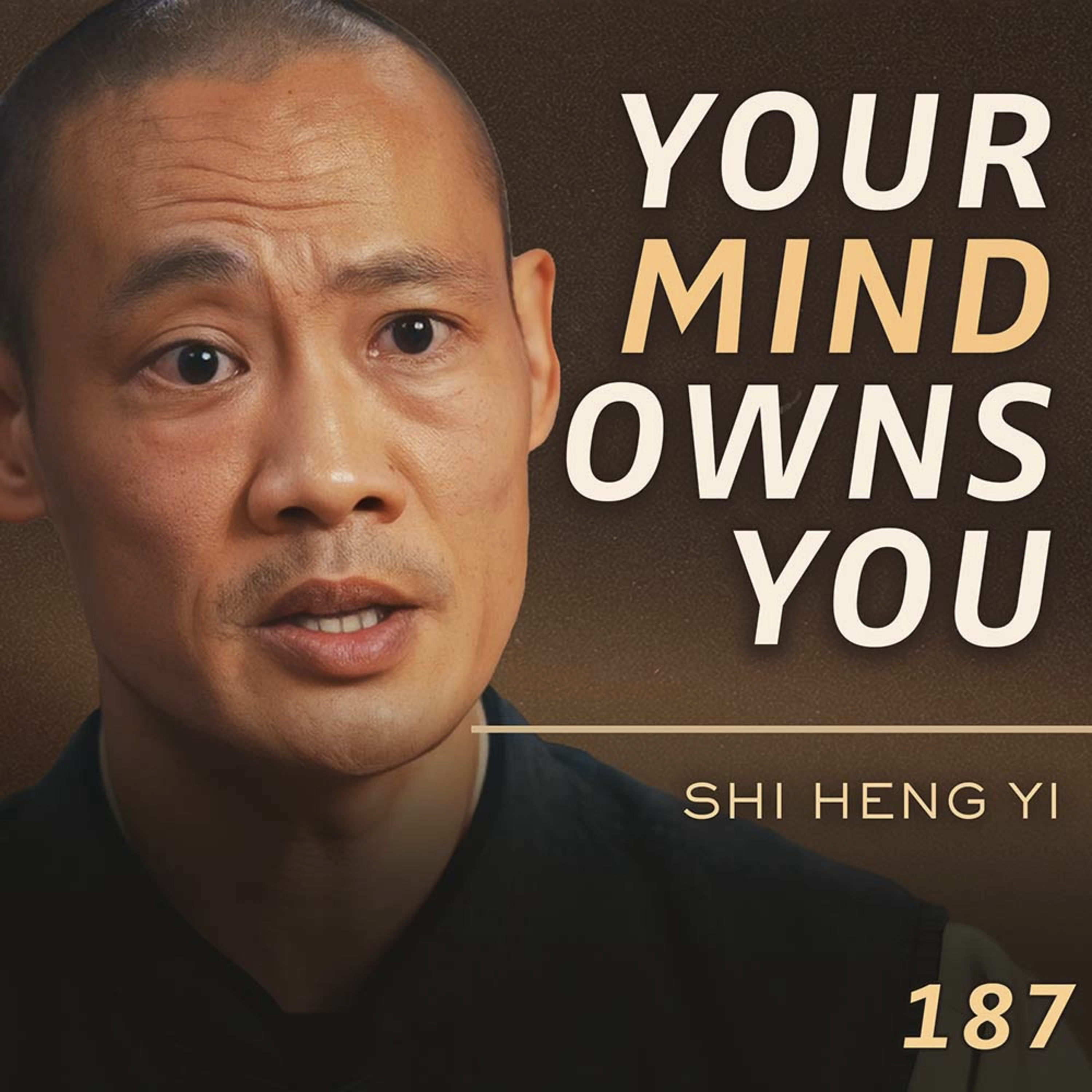
E187 - Shi Heng Yi: Shaolin Master’s Guide to Self-Mastery & Inner Stability
from Know Thyself
137m 46s
The discussion explores the paradox of modern life: increased external comfort coexists with widespread internal discomfort, anxiety, and loneliness. The root cause is identified as the fundamental human desire to be "someone," which leads to seeking safety and fulfillment through external achievements like education, career, and wealth. However, true safety and well-being are internal states that cannot be guaranteed by external conditions, as evidenced by global crises that strip away superficial security. The solution lies in self-mastery—turning inward to cultivate self-awareness and discipline. Drawing from Shaolin martial arts and ancient teachings, the path involves training both body and mind, understanding that energy follows thought, and learning to observe rather than identify with every mental impulse. This practice empowers individuals to take responsibility for their own well-being, reducing dependency on external circumstances and finding stability from within. Ultimately, the goal is to unlock the "master" inside by consciously choosing one's focus and developing the resilience to thrive amidst life's challenges.
The reason why we suffer throughout this lifetime is because we want to be someone. I had parents that came as refugees from Vietnam running away from war with the idea of finding safety in a foreign country. Do your education get a proper job, learn some proper money that was the idea of my parents? Nevertheless, with the age of four, I got acquainted with the practice of the martial arts. I can do all of these things. I'm a high achiever, but this one? Number satisfied. Yes, on the outside it looks great. There, it doesn't look great at all. No matter how I felt, there was literally nobody I could somehow share with. So I just kept it for myself. Everything I started building up, started to crumble. Then I was sitting there and asking, and then what? I stopped my traveling, I stopped social media, and literally was just sitting with myself. Truth can never be spoken. And to yourself, then the universe speaks to you. Hey everyone, welcome back to the Noless Health podcast. Our guest today is a 35th generation Shaolin master and founder and headmaster of the Shaolin Temple Europe. He has been steeped in a practice for over 1500 years known as the Shaolin Way, and he has been sharing practices through his talks, his books, his teachings about connecting the mind and the body. Thank you so much for being here today. Andrei, thank you very much for the invitation. Let's see what this is going to go now. Let's see. The mystery is ahead of us. What I'd like to start is that it feels like we live in a time with more external comforts than ever before. And yet it seems like we're more internally uncomfortable than ever before. Why do you think that is? I can't right now tell you why, but let's start with some very, very obvious observations that we have. I mean, while we are having this talk right now, I mean on some parts of the world, you know, the media is like broadcasting it all over. We have wars going on, we have missiles and bombs falling down. But interestingly also, and this is maybe where many people at the moment feel something is just about to shift or there is a shift going on. And just by looking what is this type of shift? I mean, we see, for example, let's just take it, yeah, Dubai. What was it known for? What type of people go there? What was your view upon going into such a country? If you have your financial means, there is nothing that you cannot get in Dubai, right? But right now in these circumstances, the last thing you're thinking about is spending your money in any type of luxury. Let's put it like this. And why is that? Because very clearly, this life right now is showing you that there's one essential point missing. And if that is not there, it really doesn't matter anymore what you are aiming at, which is safety. The current situation, whatever it is, it is just displaying to you very clearly once safety is gone. You have way other problems and things to deal with, then figuring out where to spend your money in. And so it comes ultimately also to this point of safety. What is it that makes you feel safe? What takes your safety away? And already being with this term of safety, now sometimes also some of your podcasts already, it is the title of your series of your podcast, No Dyself, meaning who is it ultimately that either misses the safety or that feels the safety. And to make it like really quick, and then we can afterwards talk about it a long time, identifying yourself with this, walking through this lifetime, you'll always be afraid of losing this one. That's the starting point. So let's keep diving in. You would think that through the times of modernity, the more technology, the more access to food at a doorstep, the more affluence would correlate to increase in well-being. And yet we see the loneliness epidemic we see, anxiety through the roof, teenage suicide, all of these markers indicate an internal poverty, so to speak, amidst an external abundance. And I think when you're referring to exploring, what is it and who do we identify with, it's getting to the heart of the matter. And so I'd love to just keep on diving a little bit deeper here with you. You said it already. There's never been a time where you seemingly could spend so much of your time being in comfort also based on what nowadays we have available. Nevertheless, how it looks on the inside when we right now make this separation of how does it look on the outside, how do people feel on the inside? Apparently the approach of giving you more comfort, more technology, more possibilities on the outside doesn't seem to fill up something that internally more and more feels like getting either lost or all of these outside things don't even fill up that lack, that longing that apparently, if you're sensitive at some point, realize there is more important things for me to have this feeling of thriving and living and feeling actually full, feeling grateful about walking on this earth. So number one is the approach that maybe a lot of people nowadays are looking at the approach of building financial wells or in general, that there's always something more to reach. I mean, it's been going on like this since forever, almost, but at the same time it doesn't seem to get better. And then on the other side, we have more and more of the modern age, spiritualities coming, we have more and more people apparently tracing back to the ancient teachings that there must be something hidden that there is already the answer. And well, maybe yes, and this is where this whole idea comes from, that you won't find the answer outside of yourself. And continuously start running searching for something in the hope that it's going to bring you the fulfillment that you are eventually wanting to feel it. Apparently this approach right now is not working. And therefore, I appreciate very much also the possibility of these podcasts like yours, where just different perspectives are being shown and especially also throughout all the different guests that you're having. So the bottom line is also to make it clear. There is a nice, nice image which is on the top of the mountain there you're going to get the clarity, but there is not one way to get there. Yeah, in a way this idea of there is something to climb here, but there is not one path that moves up there. Therefore, which teacher is right, which tradition is right. The one that at some point maybe resonates with you and that you also start walking from beginning until end. And yes, so it seems like so much of your work is aimed at exploring the path to self mastery. And people that are listening to this podcast have various different traditions and lineages and ways in which they've turned inwards essentially. How would you define self mastery and the uniqueness of the shell and path as a distinct way up the mountain, so to speak? Okay. So maybe I have to jump a little bit back into the past in order to build a little bit this framework. This framework, why do I think it's important if somebody would see this podcast like right now.
and looks at me. So, I do assume there is a lot of projection, okay? He's Asian dressed, he has a shaved hat. Yeah, he talks about all this spirituality and about knowing yourself. So, apparently, he has never worked outside in the world with the normal problems that we all have. That's why he can be somewhere at his temple or hide inside the mountains or in the forest in order to reflect upon life. Well, first of all, that is a projection. It is not what I am. And therefore, jumping back a little bit, my journey started like the journey of many other people as well, meaning I had parents that came as refugees from Vietnam to Europe because in Vietnam, they were running away from the regime and of the consequences of war at that time with the idea of finding safety and stability in a foreign country. So, now already it's like important to acknowledge. So, you have two human beings, my father and my mother, running away from their home country in order to look for safety in a foreign country. So, this idea of safety was very, very deep embedded into the mindset of my parents. Therefore, their focus in educating me and my brother was based upon no matter what you do. First of all, the important part is, do your education, go to school, qualify yourself, get a proper job, earn some proper money, and this financial wealth is going to give you some stability. So, that was the idea of my parents. Therefore, I went the whole academic system until I studied two times also for the sake of my parents. Nevertheless, with the age of four, simultaneously, I got acquainted for the first time in my life with what is known nowadays as Shaolin Kung Fu, meaning the practice of the martial arts. So, growing up now as a boy, as a child, as a teenager, growing up, I always had like two areas in my life, academic education, and then also training myself, training the body, training the martial arts. And already having all the stress and all the pressure of you need to deliver good grades, you need to be good at school. Of course, it puts me under pressure. And so, sometimes this pressure, I just felt very, very naturally, I was looking forward going into the training and releasing some of the energy that just like starts to build up during normal life. And now, a little bigger jump after finishing my studies now, when the time has come, where I had to actually decide what am I going to do for my living, let's say. I was just thinking, "Okay, what is it that I can do the best? What is it that I feel like this world needs and that I can in a way provide?" And more than having the knowledge from the school and then studying more than this type of knowledge was actually the knowledge and the experience that I had in the field of martial arts, and also meaning to actually know how to train, regulate, adjust myself, and just have some good knowledge about myself. And this all was happening now in Germany in Europe. Meaning, I grew up seeing how the market, how the business world is developing, what is it that is concerning for the people and more and more that was the time where burnout was such a big topic. And I just felt like, "Okay, if the people would just know about the possibilities of using your body literally as a medicine in order to take some effect on the psyche, on the mental states, they would probably be less stressed and would be able to deal better with their life, whatever they are doing." And this was the starting point where I started founding the Schoulin Temple Europe with the idea of just spreading simple, simple practices. You don't need to be a martial artist, you don't need to go into a temple, you can just do some basic exercises to get more movement into your daily life. That is what actually kicked off everything. And then now jumping more far together with the COVID times, with all the restrictions, everybody was at home, you were not allowed to travel anywhere. So this is then suddenly where all the online teachings and what I was sharing five, six years prior to that start to somehow being spread in the world. And then everything just went its course. Yeah. And meanwhile, and meanwhile, it's mostly like this, that when I'm invited somewhere, that primarily I start sharing something by words, but actually the field of where I was coming from, was simply the field of martial arts. If stress management seems to be the doorway into a lot of different modalities, and potentially Schoulin or martial arts practices, what later down the line, decades down the line, is the core and the essence of really what the goal of the practice is. Conceptually, I understood very, very early, there is no way in trying to change the ideas of my parents. There is no way in even trying to invest my energy and trying to figure out what people in my surrounding are expecting from me, or having ideas what am I supposed to do with my life. In that field of stress management, I also realized very, very quickly, people getting stressed by the phone calls they receive, people getting stressed by the emails they receive. And so I just felt like all the time. So I wake up in the morning, have a very great day. Then I just look at that phone, I just open like my laptop, read something, suddenly my life quality, my great day is gone. And I just felt like that that just doesn't make sense. This is not the way of how I imagine to live my life, being so dependent upon what type of impulses. I am exposed to, like meaning whatever is happening there on the outside, I don't want to be so much influenced that all these things can take away my well-being eventually. And so that means very clearly, I cannot rely my own well-being the way of how I feel based on what is happening on the outside. First of all, I can't fix it. So very rationally thinking, there was only one solution. It has something to do about me. I need to somehow find the key to regulate myself, to be able and learn to cope with everything that this world is throwing at me. And so there I understood for myself that there is a similarity between the physical and martial art training. It's like if I'm placing on my mind, okay, I want to do some proper push-ups. My aim is to do 200 push-ups. Nobody's going to help you. It is you, yourself, who needs to go through the pain, who needs to go through the training, who is the one who needs to motivate yourself, find your own purpose in why am I doing this? There is nobody else out there helping you to achieve what you are setting on the mind. And just similar like this, development of your physical form. I felt okay. It is also the mental qualities. It is also the mind capabilities that I felt like they also need to be properly trained and developed. And this is the similarity that until today, I'm trying to share with the people where many times you heard also maybe, the term discipline. Every proper martial artist has for sure that amount of discipline, being able to push through the difficult times,
Because we know first it's difficult, then it becomes easy. And same also sometimes for the mind. It's in the beginning difficult to stay away and tame yourself from temptations. But on the long run it's going to be good for you. And this is like what I like to view this whole path in and why eventually what I try to like. In the way of how I try to name it was self-mastery. The only to look for a master, a teacher outside of you, you have the key. It's literally like we all have our own master sitting inside of us. He just needs to be cultivated. We just need to nourish him, give him the proper thoughts, give him the proper energy, give him the proper training, then that master comes out. Yes. And that means taking your life in your own hands again, stop relying too much on the outside. This is your life. That's why you need to be responsible for it. That is the whole idea behind it. It feels like so much of the path is this progression from unconsciousness to consciousness, from compulsivity and reactiveness to responding to choice. And if we were to have any shot at so to speak unlocking the master within us, there is this saying or phrase about chi follows ye that I would love for you to speak to it because it seems like right now we're giving our energy, our life, our attention to so many things externally and not giving self the opportunity it has to be examined and inquire about it and to grow awareness in it. And so what does that mean? So in the field of martial arts, especially when it comes to the field of so-called nowadays, so-called internal martial arts, which means you are having different methods, you are different practices that are aiming in, cultivating something very, I would call it, refined about yourself. So refined, that's sometimes we call it even you're at the level of chi, so sensing the bioelectricity of your body. And this bioelectricity or the energies of the body, it is said, chi follows ye. In that sense meaning attention or intention, attention, intention meaning thought. Energy follows your thoughts. Now just keep that in mind and we make a little jump into some Buddhist teachings that also has a very nice line up it says, what's your thoughts because they will become your words. Watch your words because they will become your action. Watch your actions because they will become your behavior. Watch your behavior because they will become your habits. Watch your habits because it will become your character. Watch the character because it will become your destiny. Putting now that long chain of what I just said together with the idea of energy follows intention, there is some similarity. If something in this world you want to create, creation needs energy. So ultimately where does this energy come from? It comes ultimately from thought. So now we have to ask ourselves first of all, are you at all times aware of what are you thinking? This is number one. This is where in all the traditional ancient teachings you have to practice us that are aiming in, finding a space or being in a space where you can literally see your own thoughts. And that means it's already one step ahead of what is happening nowadays in the world. What is happening is you think and that's why what you are thinking, you think that's you. So you think you are your thoughts. A thought is popping up. So that's what I'm supposed to do. Blindly following the thought. Now the problem with this is that you have no power. What type of thought is popping up? It is an everlasting experiment in trying to figure out what is going to be the next thought that is going to pop up now in ten seconds. You can't predict what type of thought is coming up. And therefore in the ancient teachings there is one, let's call it, one method, which just says like this. Number one, distance yourself from the idea that you are your thoughts. This is where it comes from, you are not your thoughts. Even if right now for many people it might be a concept, I'm not talking about concept, but you can still use it. You are not your thoughts. In the moment you are able to tap into this reality. Then you can let the thoughts come and at the same time you can see thoughts go. That means you are at the space that at all times is just unmoving. Now thoughts, energy creation, this taking it back also meaning on whichever thought you are getting hooked on. This is what you create. And this is why to be aware and conscious whether you are willingly by your own, how I say, if you are consciously choosing a thought or if you are by habit being hooked by a thought is a big difference. This is how it then ultimately translates into. Why is it that some people, let's say, get things done in a proper way, and other people let's say try and try and try, but some of them seem to get lost. It's exactly because you cannot trust all sorts that come every day into your mind, because it's not your choice. Hey fam, quick share. I often get asked about my skin and how I got that glow. And I do think it's largely lifestyle driven things like diet, stress, exercise, sleep. But I also use a couple of products that I know I can trust while keeping my routine minimal. One brand I love is one skin born from over a decade of longevity research. One skin's OS01 peptide is proven to target the visible size of aging, helping you unlock your healthiest skin now and as you age. What makes it different is that OS01 is the first ingredient proven to target senescent cells, which are the key driver of wrinkles, fine lines, and loss of elasticity. It's been validated in four peer reviewed clinical studies. The company was founded by an all-woman team of PhDs in stem cell biology and skin regeneration. So basically it's the good stuff. And I use it because I care about what's happening under the service, not just on top of it. For a limited time, try one skin with 15% off using code "no-layself" at 1skin.co/no-layself. That's 15% off with code "no-layself" at 1skin.co/no-layself. After you're purchased, they'll ask where you heard about them and you can let them know we sent you. Appreciate it. And I'll catch you on the next one. I'm curious your thoughts on, like I think the more that you gain awareness of that. The more painful it becomes to not be living from that place because you refer to this distinction between choosing your thoughts or in essence your thoughts choosing you. It's like regurgitation of past conditioning and stimulus from our parents and society that keeps on living its own self. Instead of me living my own free life to choose the path I want to go on. And I think the more that you become aware of that, it becomes. I definitely have at different parts of my journey become sort of indignated about that realization. And a bit rebellious to the unconscious parts of me. And I think that's so much seen in the shallow and spirit as well. You referred earlier how you very much so use the body to free the mind and the interplay between the two. And I think the body is. In some circles put so much emphasis on in terms of in the health and wellness space. But not really understanding how energy, body and mind are all connected.
and acted in and interplaying at a deep level. So thoughts you have on the Shaolin way and spirit. So one reason why is expression of Shaolin spirit in the first place somehow was spread into the world. Was simply like this, spirit, why is it called spirit because it doesn't have a form? It doesn't have a form. So meaning also, how can I demonstrate to you a Shaolin spirit? What does a Shaolin spirit exactly? What is it exactly? I can't tell you. Meaning it is something formless. You might now say, or what I would like to emphasize is it is more like a quality. It is like something that is guiding you. No matter what you are doing, it's not about the what, it's about the how. As long as the how is being maintained, no matter what you do, it always follows the same type of spirit. So, and what is one essential, essential point of this Shaolin spirit, for example? It is that there is more to this life. Then what meets the eye, that is where it already starts with. So meaning if you are living this life right now and only believe in what you see, I would say, okay, that might not be exactly what I would have wished for you to understand about the Shaolin spirit. So number one is the openness of mind that is more to this existence than what we see in the world. So then of course, because Shaolin is so close connected to the martial art field, another quality, therefore, is also. This life is not here to give you pleasantness at all times. You are not being born into this world and just like walks through this lifetime, like it would be Disneyland. This is not happening. What you are facing, what every human being at some level is facing is difficulties. So difficulties in the fields of Shaolin martial arts, nothing new. No difficulties, no growth. So what is like the how again, about this approach? It is to really embedding and trying to integrate it into your life. There will come hard times. I won't give up. But because I keep this consistency and I keep this trust, something about me starts to elevate, something about me starts to grow. I'm starting to transform. But by accepting that pain and suffering to some extent is part of this existence, that already removes the idea of what nowadays, let's say, I just felt like it is propagated, that it's a one-directional, it's a one-direction street, where it's about better, higher, more beautiful, good, health, growth. Yeah? That is one part of the truth. What about the second one? And there I simply feel like it is, you're creating your fantasy in your mind, how this life is supposed to be, then you're being faced with the reality of how life on Earth right now really is, and then you're wondering why you're having such a difficult time. It's because you focus all the time on 50% of the truth. You had a preference. You had a preference for the gentle, nice, and pleasant things. So, and one area of Shaolin spirit, like I said, is again, we need both. It's not just that we need both. We are going to face both. That's where you also know it's not just the Shaolin spirit, the Taoists way before that, they have the Yin and Yang symbol. Right? And even other religions, other cultures, they have the devil and the angel, or the demon and the Buddha. Two sides of the same coin. So, how do you translate these two sides of the same coin? Yes, this is you. It's the same of what's happening nowadays also in the world, where to the public, you show the glorious and shiny side of you, what about the other side? And it is existing. From the outside, and people might see from the more commercial perspective of the Shaolin warriors or exuding extreme self-mastery over their physical body, which is one side of things. But you've alluded to throughout, and you do through your book, and your talks about it not being just what we do, but the consciousness in which what we do, and who we are being while we do what we do in the world. And I think this kind of gets to the heart of Buddha and the cultivation of the virtues. Because when you see that, everything is infused with the consciousness in which we do it, then we do turn that gaze inward and examine the motivations and the intentions behind our actions. We live in a world that is very much so externally outward perceiving from social media, and society lens were very programmed to think of the appearance of a thing, and not as much the essence of a thing. And so, as we examine those two sides of the same coin within us, and we desire to embive more of those virtues, which are going to benefit self and others more consistently. I would just love for you to set the stage of what those virtues are, give us a roadmap of what are those qualities that we can continue to develop. OK. Prior to that, I think there's something also like, worse mentioning. So my journey, I would say, like this, started with the physical, the physical training of the Shaolin practices. At some point in my teenage years, why I stayed with this type of practice was very clearly that even for me, it was so interesting actually to to understand, ah, OK, there is that development of skill in the physical area, but is happening traditionally from a temple. All of this being developed in a temple, therefore Shaolin temple. So it was not just about right now becoming skillful with the body. My question was, what does it has to do with that temple area, with that temple name inside of there? So, and after some research, you all, you will just know that it is a Shaolin temple, meaning there is the Buddhist teaching or more precisely what nowadays is known as Zen. It's the foundation of everything that this temple is bringing out into the world. This is how it's supposed to be. Now, when I realized this, which was in my 20s, and I went on Google and put in Shaolin, what I witnessed for myself was, OK, it's physical abilities, it's performance, it's demonstration, it's show, it's fighting, where's the Zen part? Where's the Zen part? And I for myself that time didn't find it. I also didn't find teachers at that time that could in an understanding way for me tell me what is the Zen aspect of it. So therefore I started to somehow shape my own path, figuring out what does all this physicality has to do with Zen, with the core, what it is supposed to be. So, and meanwhile, after spending 36 years along this way, and walking through everything that I walked through, also meaning like, yeah, it's not that I only have friends in this world, let's put it like this, yeah. But I just cannot, I don't like so much to support anymore this idea of showing Shaolin only in the way of physicality. because I'm feeling that by doing so.
so much of real value is being taken away from what people associate nowadays with Shaolin. Because it's never going to happen that 8 billion people in this world are going to practice Shaolin martial arts. Because maybe based on the way of how they live their life, based on what type of obligations they have, but there is one thing that 8 billion people have in common. And it is this one thing that the Zen aspect is dealing with. This is why I feel like this is way more important meanwhile regarding everything that is going on, then sharing with somebody, how to inhale, how to exhale, how to make a punch, how to make a kick, how to move a form. And my Master simply just tells me, "What would you do if tomorrow you cannot move anymore? What did all the training of the martial art help you if from tomorrow on you're not able to move anymore? Buddy, you cannot use." So where's the helping benefit? Well, they can only be one if you have practiced or understood something. That it all comes from mind. That the key to answer a lot of things in this world is by understanding more about, you know it, you had so many guests here, it always comes down to the same. This one. Who am I? What am I? This is the essence. Also meaning right now because you ask about the virtues along the way of know-dyself, along the way of figuring out what you are. There's one important part along this way. There is no standard to it. As soon as we set a standard having a conceptual idea how something is supposed to be is not. And therefore, why I mentioned this, these virtues that I also mentioned in these books, and that you also find freely, freely already on the web. You can take them of course as a guideline, but at some point, even 14 virtues have nothing to do with this one. This is the essential point. It makes me think of the references you give to Star Wars and the Force, meaning you could come to know who you are, understand the energy that you are, and yet there isn't quite a standard in how it's going to be used. You could, you know, the morality or the virtues is something that you choose to cultivate. But he also this picture, yeah. They both have discovered the Force. The one uses it in how you would call it in a compassionate and lightful way. And the other one uses it in a different destructive and maybe like evil way. Still, both of them have still something in common. They are just fueling the Force with their thoughts. So it's not ultimate stage. The one does good, the other does bad. There is still separation in that whole idea. So meaning, no thinking, no thought is the way. Thought is already creating a type of container, is already creating a type of a type of standout. And something's telling me, no, one step too early. So for those of us that can see very clearly that we have both the light and the dark within us. And we want to be more like a light walker or Yoda instead of a Sith Lord or Darth Vader. We walk us through the journey of examining what those virtues are and then how one could put into practice in their daily life. That and then maybe sharing your own lens where it's been difficult or how showed up. A very practical one is to really look at your own actions. Whatever you are doing to whoever you are talking to, for who are you doing it? Why are you saying something? Meaning, if you are always doing things, saying things, and ultimately the, how you call it, the beneficiary is yourself. Less of that. This is where in many traditions the idea comes in of community work. Investing your own life energy in truly benefiting others. Not doing it in order to hear from all of them. Thank you. You made it all possible. That's again the wrong way, yeah. But the idea of investing your lifetime and just bringing it out. This is one very effective way in putting into practice that whole idea of we are connected. And this is not an ego trip on this earth. So therefore to donate, to help, to do community work, and always observe yourself for who are you doing this. And I, me, should not like pop up there. This is one of these things. Yeah, the difference between service to self or service to others being the dominant energy or focus. I heard you say that there's only one way to become free, and that's to become transparent. Yes. What do you mean by that? The reason why we suffer and have problems throughout this lifetime is because we want to be someone. We want to make ourselves a name. We want to have some type of acknowledgement. The easy way, no, it's not the easy way. Transparent meaning. You're fine with being no one. You're fine with being nothing. And now it sounds super paradox, especially right now being in LA and mentioning that one. Being no one. This is not what the culture in the West is built upon. It's always built upon do something with your lifetime become someone. But the problem is, again, you are creating an avatar. You are creating a persona. You are creating a role. You are creating an identity. But whoever brought us here, whatever brought us here, I cannot believe that this power brought us here incomplete for you to figure out along the way what you need to create. Meaning, the more you try to become someone, the more unauthentic you become. Because you're moving away of what you are all the time. And this is why, again and again, I love it. And it's a super interesting journey. And this is where also in the traditional teachings, there is the illusion of the self, the illusion of the eye, the artificial creation of the self. No-die self, which self? Exactly, which self? And there, this is where all these interesting things come from, who's the doer? To who are all the thoughts coming from? From where do the thoughts come? Where do the thoughts go afterwards? Nothing and no one. That's why I do feel like transparent describes it also very much in that way. I mean, we also have this expression of just go with the flow, right? But let's just imagine. Let's just imagine right now, like, there is a stream, right now, like flowing through this room, there's a stream, whatever type of stream it is. What would it mean to go with the flow? Why the both of us are like sitting here? It means to not take our own ideas about myself right now, so
important that I'm getting stiff and hard of how I am. The more I want to actually really realize where is the flow, where does the flow want to take me, what you need to do is literally get transparent, release all of this, dilute yourself. That would be the way of, "Ah, now you are being, now the flow, just you just go with the flow." But the harder I'm here, this is my idea, this is my life, this is what I think, this is what I want, then it just means you are surrounded by the flow all the time, but you're not being taken with the flow, you're not going with the flow, why? Because you are resisting it, resisting it by your own mind, by your own ideas. That's why this whole idea of empty yourself. Then the universe speaks to you. I'm curious where this is shown up in your life, because I think the tendency to identify it with something as self and identity of sorts is so deeply ingrained. Even the idea of someone who is becoming empty or living in a noble path that can become an identity in and of itself, the ego is so slippery and elusive in that way. I feel like the way you're referring to becoming transparent is like, "There's no place within self, I'm not willing to look and meet and stare into the darkness," so to speak. How is that shown up for you? Like, probably ten years ago, like the name Shahang Yi or even Shaolin Spirits, wasn't so well known as it is nowadays. So along this journey, starting also with COVID, how I say this, of course it was nice at some point to say, "Okay, nice, like the followers are growing and some recognition and some appreciation from everyone and so many possibilities and you're being invited here, you're being invited there." In the beginning, it was nice, but at some point, I also started literally really thinking, "Okay, so meanwhile, I'm invited here. The doors are wide open, so I could literally visualize in my head already where this whole journey might go if it would be up to my mind." Meaning, "Okay, I can make more events, I can have more podcasts, I can join more television shows, I would maybe even make it easily to somehow join maybe in some movie." And then I was contemplating. Okay, let's just imagine all of this is happening. And then I literally was sitting there and asking, and then what? Literally, and then what? And this was like one starting point where I literally said, "Okay, there's no point in really pushing more forward, like more followers, more events and whatsoever, because I already could sense and see for myself. This is not the way." Yeah, and then simultaneously on the outside, I would say, different things started happening. So meaning also, I had to restructure the temple that I was building up for many, many years, like a lot of conflict started to happen there. I needed to interfere again. So what I literally saw in front of my eyes was that everything I started building up in a way started to crumble. From the inside, it started to crumble. Then many other incidents also happened that literally put in front of my eyes, no matter what you're building up, it can be done like this very quick. Also, now I don't want to make it too big, but in the same way of when I was following some martial art practitioners, martial art masters, I always thought like this. So when I would follow you with all everything that you were teaching me, and you would be, let's say, my master. So the best that can happen to me is that I'm actually going to become you. I'm going to become you if I follow all your advice exactly in the way of what you are telling me. And just like this, I also thought about all the teachers, all the masters that I had in my life and was then asking, "Hmm. So if I follow this path longer, I'm going to be this. If I follow that path, I'm going to be him." So it's all been done already. So that means my inner urge of like staying with one teacher, for example, also was not fulfilling anymore. And ultimately, what I then started realizing, okay, everything on the outside just started to be so, I don't know how to say meaningless. Outside was very meaningless for me. And then I can't tell you why, but it just happened to be like this. That despite everything that was going on on the outside, I just then had my time or took my time to just be with myself. Not being distracted too much anymore about the outside, I stopped my traveling, I stopped being too much on social media and literally was just sitting with myself. And this is where slowly, slowly, slowly, some lights maybe went on. Some lights about, okay, why is this all happening on the outside? Yeah, it's because everything you're doing carries consequences. And the more you push something one sideedly on the one side, it's just a question of time until there is another type of force bringing it or bringing it front of your eyes that it's about balance, balance, not one-sidedness. So and therefore, I started consciously and willingly actually to start and letting go, letting go of a lot of things. And now sitting here and being able to tell you this, I just have to say right away, because it feels light. What's up everyone? One thing that reliably brings me a sense of joy in the morning is having a morning ritual with a warm, nourishing drink to start my day, but I personally don't drink anything with a lot of caffeine. And that's why I love mud water. You've probably heard me share a bunch about their OG blends, which are made with cacao, functional mushrooms, and adapogenic herbs. So you can get natural energy support and focus, but without the reckless caffeination of coffee. However, if you are not ready to leave coffee behind, I entirely get it. That's why they just launched a low-cafe coffee made with arabica beans, althianine, and the same functional mushrooms, only 45 milligrams of caffeine. And research shows that's a sweet spot enough to support focus and mood and reaction time without the anxiety or the crash of a normal cup of Joe. So whether you're breaking the cycle with the OG blend or using off the hard stuff with their new coffee, mud water makes it super easy to fix your fix. And now they're also available at Target and Sprouts Nationwide. If you want to give them a try, go to mudwater.com/noob. And grab your starter kit. Right now, our community gets up to 43% off your entire order, plus a free, rechargeable, froth or an free shipping that's m-u-d-w-t-r.com/noob. I hope you enjoy as much as I do back to the show. I think we all want to feel that light. That lightness. You know, we want to. And it's interesting to examine the parts of us that we're feeding, and then the given moment that are bringing us more towards that lightness, or we get identified with the success that the relative success we're having or. I'm curious for you to list, if you would, what virtues come to mind as those are the aspects of self that we want to nourish and feed. What are those? Whatever comes to mind? Trust. One of them, I would definitely say trust, or is not mentioned exactly like this in the virtues or belief. But now belief in terms of. not believing something because you have evidence. But before even having evidence, having something so strongly in your mind that you do not need any type of proof to still have something unbroken about you. And this one, for example, the belief or the. the belief that there is more to what meets the eye, that one I regard as a very, very important quality to look into. In the same way, I would say what makes yourself light, is like stop comparing yourself, stop comparing yourself to anyone, and also learn too. On the one side, you could call it have respect for other beings and also learn to be happy for other people's growth, because to be competitive, how I say, sometimes you're the winner, but sometimes you're the loser. But this is not a proper state of mind that I would say would be worse to continuously develop it. Where else? Consistency. Consistency of staying true for, let's say, for what you regard as being true. What else? Well, one thing that I've heard you share a good amount about is commitment. Which I think a lot of people struggle with in the stay-in-age commitment. It's a good one. It is a good one. It is not namely in one of the virtues right now, but it's still good that we mention it. I feel like people don't have a problem to make commitments, but sometimes those commitments are being broken in the moments where it would make sense to have that commitment, which is when it gets tough, when it gets difficult. But this is again, let's take the commitment of staying true to, staying true to your better half, staying true to your wife, staying true to your partner. It's very easy to stay with somebody who all the time behaves in the way of how you expect that person to behave. And it's very difficult to, at some point, despite all the ego and all the triggers coming up inside of you to still figure out why would you stay? And I just can maybe tell you from this perspective, the biggest transformation, the biggest internal transformation is happening when you're under fire. And therefore every time you find somebody in your life that is prodding and poking, yeah? It's very nice. It doesn't feel nice, but it is the transformation that does the most to you. And I cannot deny that it even has a very, very high, I would call it spiritual quality to it, because I don't know how to say. As long as there's something to trigger, it just means there's something inside of me, there's something inside of you that stops you from feeling that freedom that you're supposed to, to sense. So it's good that you know there is still something to do. Yeah. And therefore I really feel like sometimes this type of commitment in having a proper training partner, it's quite nice. Yeah, so when you find a training partner, stay. Training partner in the temple setting, in the life setting, like more of accountability, are you referring to the physicality of the training or just like any relationship that can be that, any type of relationship. Yeah. So of course when it comes to the training in the field of martial arts, of course would be nice to have a super good training partner there as well. And this is why having a type of brotherhood, it's not the helps. This is where the whole idea of community comes into play. Yeah. Yes. I think it's so important to rewrite our thoughts around challenges, being a bad thing, you're like really shining light on how they're the most, you could say spiritually dense, like the most growth and possibility for transformation in those moments. It's easy to be nice to strangers. It's difficult in moments when you're triggered by a family member at Thanksgiving to, to, to, to buy those virtues, so to speak. One aspect that feels very predominant in the way that I see you and the way that I see the shallow path also is this level of self-control. Now, I'm curious for you just to share whatever comes to mind in regards to self-control and what is the balance? What is the dance between healthy regulation of thoughts and emotions so that you don't identify yourself as them? And where it leads too much into or where it can be suppression of emotion. What do you think about that? Thank you for mentioning this example. It's the perfect one for me. So, unconsciously and maybe without even knowing, I'm extremely good in keeping all type of energies for me. So, regardless of why do I keep them for me? I would say that thanks to the education of my parents on the one side but also due to the training and in the way of how that whole martial art system is being, let's say, being taught. It's very clear that in those areas in these Asian traditions you always have this very clear master's student relationship. Meaning, the commands come from top to down. The only thing you're supposed to do is to follow the instructions. It's not so important how you feel as long as you fulfill the orders of your superiors. So, that means until today, I would say Asian culture is not very well known for being able to openly communicate emotionally with any other beings, especially when simultaneously you are a martial art practitioner. So, what did it mean for me on the long run growing up with this? It meant that, for example, no matter how I felt, there was literally nobody ever in my surroundings I could somehow share with what I felt. So, I just kept it for myself. The result of all of this is that my endurance of taking, suffering and pain is extremely high. My level of resilience is extremely high. Therefore, I think it's one of the reasons why in the first place, until today, I'm still standing and why all of these things were happening, because I can easily go and push forward. But at the same time, what I felt is, I'm a high achiever. I can do all of these things, but this one, never satisfied. Something's missing. So, my example is, suppression of energy, suppression of emotions is not the way. It's not the way, which made it extremely hard for me to open up. To open up, which is still like a process which is ongoing, but where I'm also very, very grateful for the people that I have where I can open up to. And this is, for example, like a topic right now. I'm happy that you're mentioning it. But in the way of how, like, Shaolin nowadays is being propagated. This one doesn't play a role at all. It is interesting that the people can do all the acrobatics and all the great stuff. Yes, on the outside, it looks great. And this is not how it's supposed to be. So, therefore, really paying attention, how did the past shape you? And this is therefore why sometimes it's just necessary to look into the past again in order to resolve it. And this is probably nothing that nowadays you would say what Shaolin is known for.
Hmm. So how do you, because people give what seems like conflicting advice. One says, "Feel, feel all your feelings." Some other might see a more stern, stoic individual saying, "Don't be swayed by the whims of your emotional state." So what to do? Surely there's a middle way. Yes. It's undeniable that we are conditioned. Our body is conditioned the way of how we are thinking is conditioned. This is the part that we refer to as "This is karma." There are habits, meanwhile, of living so long on this earth, habits that we carry along with us. So now, of course, you could say, "So we need to do healing our whole life until all of our negative habits and all of our negative triggers are being removed." That's why people apparently go on a healing journey their whole life. This is the one area. The other area is, like you just said, to maybe. to suppress or just get yourself out of the circumstances that anything could actually arise that would give you a hard time. And the middle way is the one where you just start realizing that this one has no karma. This one is the one for which all of the things appear and disappear again. And as long as you somehow learn to not get hooked upon them, I think this is the shortcut. This is the shortcut. At least this is the past that right now I feel the most resonance with. Because something is just telling me, like, again searching, again trying to look for something that apparently right now I don't have a "No, no, no, no." Now, meanwhile, I really feel like enough. Why? Because I do think that the answer must be here right now. And after, like, just contemplating and being like really present, there's something that I literally sense. There is a type of stability that is present at all times. And regardless of what comes up or disappears again, there is a type of stability. That's it. And to practice just maybe to stay more in that state is already very, very helpful. It feels like there is a big interplay in the way that you write also about these different dynamics, how it's important to have that stability within yourself, and then also have the adaptability, the structure and the freedom. And I feel like we have this programming that, like, freedom means you can do what you want, when you want, how you want, with who you want, as much as you want. And one who goes down that path experiences a lot of lethargy and not an experience of freedom. So I would love to get your perspective on how freedom is truly born through structure. Okay. This book was written in a time where I was still in the space of achieving, going forward, moving, doing, and all of this. So meaning it's an extremely helpful book for this lifetime that right now you are having in this form. It helps you, let's say, it helps you in this lifetime. It won't help you if you stay with that for everything else that is still there. Yeah, so just don't get me wrong. Now, one of the core sharing that I also mentioned in this book is exactly this. How does freedom and structure, how can you understand that they fit together? And there I used to tell the story of how even in our temple, you normally have a very structured daily schedule. That's what I mean at what time do we get up? At what time is the break first? At what time is the training taking place? At what time are we having working hours? At what time is lunch? At what time is dinner? What time are you supposed to go into bed? Similar like military structure. What is the whole idea of this? That you take from whoever joins this structure, you take away the necessity to even think about what needs to be done. What needs to be done? It's written on the plan. So what is your job actually to learn at some point? Because let's just imagine you would come as a visitor and join us a little bit in the temple and you have your daily structure here already. So it's very likely that if you come, you're not going to like that schedule. You still feel tired in the morning, nevertheless, it's wake up time. You don't feel like doing the training, but it's training time. And so what you are being faced with all the time is with your thoughts. All the time your body is living the structure, but your mind is having a lot of resistance against it. So are you free? No. You are enslaved by the mind. But after some time, when you start to literally give up your resistance, which happens by consistency. First week, you still fight against the schedule. Second week, you might even feel that, oh cool, actually it's not so bad. Third week, fourth week, we actually start to really go into the structure, surrender into the structure. And suddenly all sorts have disappeared. So what is it that has happened? Even so it looks so rigid, but you inside are just free. And this is the first type of understanding that. The true freedom is that one that you could even be in jail. Your body is in jail, the important part is that the mind is not supposed to be there. And out here in the world, it's exactly the opposite. You have the possibility of traveling the world and going everywhere and having so much comfort, but you're still enslaved because of that one. So which one is the freedom? And this is what we understand or what I try to share a little bit in the past that really going into like a structured day removes the thinking. And when that happens, sort free space, it feels good. From time to time, it really feels good. This is the whole practice of it and why I also feel like from time to time, it's good to make this experience. Because the alternative is you have 24 hours to freely decide what you want to do and what time you want to eat, what you eat. Does it make you free? No. I love that distinction between the physical versus the mental enslavement. You know, we presume freedom is this physical autonomy and yet so many of us suffer with our mind feeling like it is anything but free. And what's sad is that so many of us grow up in an education system where we are not taught the simple mechanics of how the body and mind work and function. Simple things about the breath that we just like never taught. And so what I thought would be really fun to do is it's a bit unique because we haven't really done this on the podcast yet. So this is kind of first to step out for those that are listening, probably hop over to check out the visual, but I thought we could go outside. So it should be about sunset right now and maybe you can share a couple practices with us all that would help us understand our body and our breath a bit more. Absolutely. Let's do it. Brilliant idea. Let's go. Okay. Alright, so here we are. What are we going to do? So I mean, Andrea, you asked me, you want me to smash some bricks, which is not a problem at all. But I think I would just like to guide you through a little bit of what is it really that at the end you're putting it all all together that makes this more easily possible. possible actually to break.
Which means, for example, does the breast matter? Absolutely. Because with our breathing, we do have an effect on what in the field of martial arts we sometimes call "chi" or "energy". So therefore, I would say, let's just start very, very easily. Both feet approximately shoulder-wide. I think I'm ready for this. Yes, get ready. And what is the intended purpose of these practices and the bricks mashing as when people observe it? It shows that you are able to literally deliver power. So deliver power is the one thing, also demonstrates that your fist or your so-called body weapons have a certain strength. But for right now, very easy, let's just do some inhalation, exhalation in order to synchronize breast and body from here. Inhale. Just like chest level, exhale. Inhale. And out. Just continue with this pattern of inhaling, exhaling, but simultaneously sense inside of the body and release all unnecessary tension. Drop the shoulders, drop the tailbone, make the knees a little bit softer. Now this time we're inhaling in the same way, but exhaling both palms to the front. Just stretching the fingers, inhaling, come back, exhaling down. Now just relax a moment. So you see at some point the breathing is in, out, in, out, in, out. In that means it becomes very natural that however the body is moving, it is always accompanied by the breath. Still like in, out. So this is like a typical practice where when you repeat it more and more every day, very slowly with patience, breath and movement start to literally synchronize, which is important for example when we try this. All sense, let's say it's just stretch, inhale, out, in, out. Now you see for example if I like display it with my body, when I open, see, body is completely open. Legs are like stretched, fingers are stretched. This is all inhalations. It's like I inhale, fill up my body on the exhalation even if I make it slow. You know, I see I start to shrink. The volume of my body starts to get small in, out, in, out. So this is the same, yeah. For example really practicing no resistance, no nothing, but I can feel when you do this terrifying more often, you can literally feel, I just call it, did it arrive or not? Yeah, I can't like literally explain now what is it that is arriving. I just know. It has arrived. I just know, yeah, because it's also like, I show you a little bit, if you just like hold my hands like now, see, if you like, just feel, you see, I would actually say my, it's, I'm empty. No, if you touch me, I'm like empty. No, it's like you're just touching me on the outside, but I'm empty when I'm here. Now now it's different. Now it's like empty again. This is now you know I'm here. And it's this very, very subtle shift, which is also happening what I'm paying attention on when I smash these bricks. So that means I don't want to let's say, hit it. And in the moment of hitting, this is empty. I want it to be as full as it can be. And this is being done on the one side by being able to regulate your breath, synchronizing body and movement. So and now of course the other part, the other truth is you won't smash these if like your, how I say this, if your bone structures, yeah, it's not really conditioned, let's say. Yeah, you got some strong bone density there. Like now I'm sorry, you asked me for it. Yeah, I think my assistant told me you wanted to actually try some iron bars. Here we go. You're lucky I'm right now not in my full training, but just want you to like literally feel for yourself. Yeah. What like sometimes the human body is really capable of. So just take from here this part of the body, which means this area and we just like slowly do this. So right now for example, I'm just telling you, this is now like I have, there's no intention, there is no real energy in there. Now I just give you the first stage of when I start to put intention in. How many stages are there? Now let me give you second. Okay. Yeah. Yeah, you sense already. Yeah. It's absolutely not comfortable. No. Yeah. It's like having an iron bar or something. Yeah. And this is just like if you do this on a regular basis, yeah. It's not only that you do all of this with the mind. It is real training of having a training partner and doing this type of exercise, yeah. Always every day together with a training partner. And then the body just starts to really develop tissue, additional tissue, which makes it really, really solid. And after this type of conditioning, then for what are these things used to really just demonstrate, okay, you can do it. So yeah, I don't know if you want me to do it now. So yeah, we can bring it. So let's see. We got a couple of bricks. So you replace a brick, something like this. So for example, yeah, just if I make it like it as a dry practice, it's the same like I showed you before, inhale, exhale, inhale, exhale. And what I'm paying attention to right now is just I needed to be full. I needed to be full. So therefore, no, I just do some concentration. [BLANK_AUDIO] [BLANK_AUDIO] [BLANK_AUDIO] [BLANK_AUDIO] This is definitely American mate. [LAUGH] >> Look at how the outside one is. >> [LAUGH] >> You're like in this truck.
- The two of us are already getting ready. - Wherever you get this one from, tell them it's a really good quality. - I'm definitely not trying that now. - Like for example, what we regard as forms, at some point when you practice like the martial arts, it's similar like a choreography that in the beginning, it's like you have different moves than you merge them together and then they become like a sequence. And the nice part about it is that after some time, you're actually getting into a type of flow where there's no thinking anymore. - Give you for example simple flow, we can do together. - Okay. - Stay here. - From here. Bring the hands to the front. One, two, three, four, five, let me show you this from here. One, two, three, four, five. This is like one type of sequence that we can do. Front, down, up, out, yeah. Let's try this together. Okay. One, two, three, four, five, down. One time. And to the front. One, two, down, front, down. - Something like that. - Something, let's try from here. One, turn the body to the left side. - Okay. - Left side. Right leg, step out. Open. Step in. - Okay. - This is make two movements from here. Step out. Step in. - Okay, step in. Okay. - Step out, both arms also pointing outwards. Left leg straight. And from here, both arms rotate, rotate, rotate, rotate, rotate, right leg, step in small. Yeah, go out. - Yeah. - Now here, for example, pay attention to the way of how the hands are moving. Rotate, rotate, rotate here, now you're here. - Okay. - You see this, a rotation of arms, step out. Remember the rotation, this direction, step in. Out. In. - Yeah. - Yes. Rotate. - Yes. Now just have a look, for example. - Yeah. - The whole idea is, like on a philosophical point of view, we want to use the body as one unit, as one. So look, went. - You see, this is the movement we just did. But look how everything is here. Here. So when my, when my center, center, shoulder, waist, move, everything move. When I open my center, one, and this is for example, how then, until now everything is gentle, gentle. But using this idea of we have high, therefore we have low. We have left, therefore we have right. We have closed, therefore we have open. We have soft, therefore we have heart. And this is where then, you can just practice how to release energy. - What is the point of these choreographed movements? What are you cultivating? What's the intention? And how could somebody take one of these practices they saw, or maybe others that you share in your book and online? What are they cultivating? So on the one side, it is while doing all of this thing, no thinking. So definitely I don't have right now any type of problem that's outside of where I am right now. So it means you really learn to focus on the one side. But then the way how to move the body is in, you know, the idea is that we're using everything as like one unit, like in harmony. And what it does, therefore, when the body is in harmony, your energetic system also starts eventually to adjust itself and become harmonious. Like what sometimes we call the meridians, the channels or the energy in your chakras, however you call it, by using the body. You're naturally harmonizing all of it, which eventually means what is the benefit? You're not sitting the whole day, not using the body, and therefore all the energy inside the body starts to get crazy in having thoughts that are not useful and helpful at all. So you start to create crazy thoughts because you haven't used your body to help you regulate your energies. So what is the first thing that happens that people will realize in daily life when they start doing movements more, you feel more balanced, you feel more harmonious in a very natural way. No esoteric component to it, just very naturally, you have a body, therefore, use it. And in a different way that typical exercise might, so like what physical exercise lifting weights compared to some of these more, some of these practices that perhaps have a more energetic component to it. I think it comes from the fact of that you don't have any type of, let's say, machinery, there is nothing else that you are working with, only with yourself. You work with your own movements, with your own body, with your own joints, with your own breasts, with your own mind. That's all you need. Mind, body, energy, meaning breasts. And so this is the idea why, you know, it's available to everyone. I would say this is the easiest and most affordable, the most quickest way of doing something for yourself. Yeah, that was challenging too. Like a few of those movements, I was like, out of breath after doing a few of them, which I think I'm in decent shape. So cool, well, let's go. I have some questions. Let's go back in the studio and let's chat more about this. Cool. All right. Don't hit me too hard. That was hard, man. The forearms. Fun, fun. It's like a recess when you're a kid. You get to go outside and play. And it's so very fascinating and just impressive also. I think it was so attractive initially to what people see online with chalin monks is these incredible physical feats, breaking bricks, and woods and metals. And it's very inspiring to see how far this body can be pushed with a level of mastery. I've also seen some crazy things online, whether or not they're real with people doing stuff with their chi. And you can also feel it. Like there's obviously a real dense physicality to the movements when you exert yourself in a certain way. But there's an energetic component that, from maybe more of a scientific lens, it feels a bit woo. But I think in the real practice, you feel so immediately. And I'm just curious for you to share your thoughts on that component, that component, the chi and the energy. Let's all of these things of break.
making the stuff and all this apparently superhuman feature. After all, you see humans doing the things here. So, first of all, meaning, why is it superhuman? It is humans right now doing it. It is just that. Many of these people have just dedicated a lot of their lifetime in cultivating something through consistency, maybe even through passion. And this is the ingredient for just about a lot of things when it comes to, if you really want to achieve something, that's just the way to go. But now, in this field of martial arts, we call it having a skill developing a skill. But there are other areas in this world where you are also like completely amazed by what are people able to do, which have now nothing to do with martial arts, but it's still very, very impressive. So, it is nice, of course, to look at all these things. It is also nice to be in the training sometimes and like show off a little bit what you have learned, what you can do, all of these things. But, and now it's important again, in the context of that one, it's rather counterproductive even, I would say. Why? Because you are trying to develop and create something that more and more just literally strengthen your sense of false self, if you don't pay attention. But core teaching is not about that. And this is the part where I would just say, you can train all of these things, it is fun in a way, but don't forget the essence of why are you training all of these things. And the why is to maybe help you to use all of these things as a bridge, as a bridge, meaning to, to at some point make the jump from the physical, physical and visual aspects to something that cannot be seen. But okay, anyhow, it's fun for sure. Super fun. I would love to come next time in Europe, if you're at the top of our love. Absolutely. Yeah, I love just being a student and there's so much to absorb there. For everybody that's listening right now, what's one thing you would teach them about the breath in a very practical sense that they can carry with them? So, also this is one thing that I mentioned in the book also. We can live without a lot of things in this world. We can't live without the breath. But the breath is so undermined in terms of we literally don't pay any attention to it and just think it's about in and out. Okay, so what is the first thing people can do? It's not just in and out. What you can pay attention on is how much in, how much out, or how fast in, how fast out, or how, let's say, how deep actually do you follow the breath entering through the nose inside of the body? This is where you hear about abdominal breathing, reverse breathing, dantian breathing. Doesn't matter. The whole idea is by practicing becoming more aware, the breath can actually travel quite deep. This is how it feels into the body. Then it is not just a shallow breathing which is related to the chest and the lungs. It actually becomes the fuel for the whole body. And these are all things. How the breasts can actually also be a very nice meditation object. Meaning something to put your mind on and just follow the flow of breath. Just walk through the day, follow the flow of breath. Why is this very helpful? Because through the breathing you can adjust, at least, and regulate quite a lot also about all different types of imbalances that people nowadays have. I wonder how much of the imbalances and illnesses and sickness and disease could be really regulated and supported by simple understanding of our breath. It's not only the breast, it is the whole lifestyle itself. This is why in traditional teachings, there are literally three areas to really pay attention on you. It's your lifestyle. It is the way of what are you breathing and literally it is the diet to boil it down. You want to make some big changes in your life, those three areas. What is your lifestyle meaning? What time do you wake up? What time do you go to bed? What are you in what type of surroundings are you spending your time in? Second of all, everything related to the breath. Do you have a developed breath? Do you breathe shallow? Do you smoke anything like this? And number three is your diet. All these three things together makes a big, big amount of how do you feel on an average day? What problems, mental and psychological and physical problems are you facing? I do feel like those three areas is something where you can directly look into. It seems like so much of the advice, the conversation, the inspiration, the ideas that we're sharing are all aiming towards alignment in some context in some way, in some fashion. And the eightfold path is very much so referring to the various different aspects to find that a level of alignment for right speech and thought and action. What does right in that context mean to take it to one example, like right view? What does that mean for you? Let me try to remake it not to complicated for people and especially not to religious for people also because the noble eightfold path is often related to Buddhism and still many people in this world are believing that Buddhism is a religion or Buddhism is let's say a way of life. But as for my understanding in the first place, it is a practice. It is a practice. And what is this practice aiming at? And therefore let's jump very, very clearly back. What is the aim of Buddhism? Let's say to liberate ourself, to transcend the cycle of birth and death. Why? Because if you don't transcend it, you suffer. So meaning what's the purpose of Buddhism to not suffer anymore? What is the reason why we human suffer? Greed? We want more than we need. Hate? We reject sometimes or have resistance against what we are facing. But the third one, very interestingly, is called ignorance. And now ignorance forward. Ignorance for the reality, the truth of how things are. And this ignorance meaning as long as you identify yourself with this, with the body and the mind. You are ignorant. You are ignorant for how the things truly are. Now we are living in the 21st century. And it feels super strange now for me to sit here and try to convey to the audience also that there might be the possibility that what you regarded as self and identity up to this point is not the way how it is. And if you continue to ignore this statement, the chances are high, you continue to suffer. And now based upon these three views right now, read hate ignorance. This is where a step by step instruction for example is starting with the noble hateful past. So if people want to know, so what am I supposed to do now? Like practical wise, like step by step guide. It is exactly this. Watch.
your view, how are you viewing yourself into this world? The right way, the perfect way of viewing yourself embedded into this nature. Because if you have a false view already, if you're looking at the world with false eyes, then everything that follows afterwards is not based on truth anymore, it is again based on your thinking, based on your own imagination. Therefore, meaning the consequences of false speech, of false action, of false behavior is just going to follow. Yeah. So, what's the way to do? I do feel like taking your time and literally opening the space and the possibility how come that the audience right now is watching this podcast with a very, very clear title, "No Dyself." And me sitting here trying to already, for the last four podcasts, keep telling the same stuff over and over again that I feel like something is shifting in this world. And it's all the question about realizing it's different. Yeah, and I don't know how else to say this. So, I wouldn't say it's a coincidence for whoever is watching this episode right now. Seeing this one, seeing you, seeing me and listening to whatever they were listening right now. And that is at least from my side now also the final message here. To continuously walk right now in this lifetime and always just looking for new input, new input, new input, new input. But not actually taking really into consideration what is right in front of your eyes. This is also ignorant. It's already here. It's has already been spoken many, many, many times. And that's why looking for more knowledge and for more information, but none of that putting it into real experience and practice. And real life is not helpful at all in us just going to bring you nowhere. So therefore listening to one podcast and really trying to maybe go into it and deeply contemplating about the content of what just has been said sometimes is more useful than just waiting for the next podcast to come and look for more input just to like distract your mind. I think that's an important reminder because especially, I mean, I love listening to podcasts. I'm sure people let listen to mine, listen to many others and they hear these words and. There's these insights and words that can be shared, but the experience is what essentially can't be transmitted. And so kind of comes back to I feel like that reminder you're giving everyone to like put it into practice into your own life. The for me like cultivating right view or like the to view things as they are is like one of my strongest aims and desires in life. To me, it's deeply painful to be living life in my own prism of imagination and coloring circumstance based off my own prejudice. And I think something I'd love to get your perspective on is there are clear blockers throughout time that many different individuals have come to realize that are consistent throughout humanity and the way this human mind and body is set up. And you refer to the five hindrances. There's many different ways and frameworks to explore what are the consistent blockages are blockers to accessing archer self. I think it's really important to go in and out and I know you have shared many times and different podcasts and whatnot, but I think it's important to keep sharing. Prior of me traveling to the US for example and also like knowing already in preparation, they're going to be so many people asking me questions. I also consulted with with my teacher and I seem to see kept on telling me be careful the more you talk the more you talk the more you try to explain how this life is functioning. You're actually misleading the people. He always told me talk less talk less and just how I say it just a talk less don't try to answer questions of each individual you need to break the question. And I was contemplating then at some point like what do you exactly mean and he just told me like this if you have 50 podcasts you're going to receive minimum 50 different questions and I could continue in this lifetime answering these questions. First of all most of the time these questions are always asked because the individual who is asking. How I say this. Actually knows the answer already the question is the answer. Second point he said is don't focus on the question. Why always try to point back and ask. Where's the question coming from and where is the question returning back. This is the answer to all the questions. So stop trying to give everyone a single key to unlock their one question. Just try to give them the master key. Which is not even me giving to you which is you just realizing for yourself by figuring out where did that question for example come from. And where it will go. That is the state to stay and then nothing needs to be done anymore. Too many question. So I think it's not just a question. I think it's not just a question. It can never be true. That's why it said can't read it to get it. It can only be transmitted sometimes. And when you're lucky enough it just happens. Without any recipe of how did you get there. It just happens. I agree I think that especially in the podcast space. It's a delicate balance right because here we are supposed to be talking on a podcast. And it's a balance at least for me you know as someone who's asking questions. Surely if the seeking and the question asking is sincere then surely there would become a point in which one no longer wonders about the same questions. So for me I'm in my own inquiry of like what questions are being asked that I think will actually provide a useful framework that eventually will have to fall away. But will be useful in the meantime for those listening. Where is my genuine seeking coming from? Where are my actual questions? I think that a question well phrased is an answer half given when you actually know what it is you're actually asking. It's a whole art form and something I'm passionate about. And so I fully resonate with you and I do think that these frameworks. With the context that you just gave allows people to find that reference point and pinpoint it in their own experience right not take it as a doctrine that just they add into their mind but when it comes to sensory desire. You know and how that how that clouds our mind to like pinpoint that name it when it arises in the moment so. I would love to still go through these 500s if you're down. All of them. All of them. Sensory desire. Aversion. So I think that will like monkey mind let's say. All this.
and all view them as clouds covering the sky. Very simple like this. Five hindrances of what in that story of, or how I named it was, you're on the journey up on the hill. Let's say you have a mission, you have a goal, a very clear mission you have. And there are five hindrances that would actually stop you or make it difficult for you to continue your clear path. Why? Because when those five hindrances appear, they are covering your view. You're starting to lose the path what you initially wanted. But now in the Buddhist context, those who are named the five hindrances, like we just named them before, meaning you are very, very easily irritated by temptation. They are all type of temptation. Temptation to the eye, temptation to the nose, temptation to the ears, doesn't matter. Like you are getting lost into the pleasantness of life. The sensory experience. The sensory experience, this is the one part. So that means in practical ways, pay attention of what on a daily basis is pulling your awareness or your thoughts on what are you getting hooked that you would actually feel like here, but isn't it a nice thing? Yeah, of course it's a nice thing. That's why it's easy to get you hooked, but the devil is not stupid. (laughs) The devil has a very, very nice ways of tempting you. That's why it's not so easy to sometimes. Say no. Okay? This is, for example, this idea of what is it on a daily basis that easily hooks your mind, even though you think, yeah, but isn't it something beautiful to follow my passion, to follow that call whatsoever? This is the one type of cloud that takes you away from the way. The second one is that I described as, let's say, ill will or a version, meaning, something happens in your life that literally you don't like. It feels unpleasant to you, but because of this unpleasantness, you start to create something in order to push all of these things away from you. So you're trying to reject something and not accepting the fact of, it is how it is. It's raining right now. It is really difficult to walk. It's not pleasant, I know, but you can't stop right now. Either you continue your path or you're getting, again, hooked away by the negative thinking that this situation that you're in right now should be different. But should be is thinking. So again, regardless if you're being hooked by pleasant thoughts or you are trying to reject unpleasant thoughts, they all have one thing in common again. We are talking about thoughts again. And this just continues even with the hindrance number three, restlessness. It's not finding clarity or peace of mind because you continuously jump like the monkey mind from branch to branch very restless. But what is it actually that is restless? Mind is restless. Number four hindrance, heaviness, heaviness of mind. Like maybe if I can express it like very, very demotivated, a very feeling like trapped. I go, dull, smoking too much pot, something like this. Don't want to get into movement again, but also state of mind. And number five, doubting. Meaning already killing the idea because before it even started growing, these type of things. So what are these five hindrances ultimately? They are just different states of the mind that can make it difficult for you to continue that path. And what I'm trying to tell you, what I actually didn't want to like come up with these five is because just make it simple. There is just one state of mind necessary to maintain and then you don't need to count anymore because even mentioning the five, it's just the five where you can categorize a lot of other sorts into it. But it is a concept, but the whole idea is like this. There's nothing. And in this nothingness, from time to time, something arises. And the reality of things is whatever starts to rise also disappears. And where are you back then? Into nothing. Next thing comes up, same nature. Disappeared. Something pleasant comes, that pleasantness will disappear. Something unpleasant arises, that unpleasantness would also disappear. One sort arise, that sort will disappear. Many sorts arise, many sorts will disappear. As long as you don't lose the proper perspective, it doesn't matter which of those five comes. You just need to remember the starting point. And this is why I appreciate so much this very, very direct way of what Zen is known for. Yeah? This is exactly why at some point Zen teaching was, let's say, developed because many other Buddhist traditions, the five, the four, the eight, the thirty, six, the one hundred, eight, this, the twelve, this, so you learn, you learn and intellectualize things. And Zen just tell you, wake up. Nothing? Something? Nothing? That's it. This is what to keep. I like it. Very direct. Yeah. That was so well said, I think, as we circling back to the beginning of this conversation referred to the progression of the path, you know, what seems like kind of an esoteric term, raising your consciousness is going from in practical sense, this cloud of state of mind, to the essence of who we are, that experience of nothingness. And I've heard you share a bit about like increasing our sensitivity, our capacity to listen to the subtleties, the way that our mind is frequently called and to buy any of these hindrances. So what are your thoughts and how one can increase their sensitivity and ability to listen? This is again where I feel like the idea of staying more with yourself helps, which at least from the way of how I try to share is being done deal with your body. Do something with the body. This is the starting point of what sometimes is being called turn inwards again, like speaking in pictures. It's like this in the morning, you're like still sleeping, but he's still sleeping, mind is also still sleeping, then you wake up. So from that moment on, all your awareness literally starts to go outside of you. You see something that is outside of you. You hear something that's outside of you. You smell something that's outside of you. So if you don't pay attention, that means your whole awareness, the whole day long, is just busy with something that is outside of you. And so how come I don't hear what is going on and I don't feel and I don't see what goes on really like inside of me? Yeah, because you're busy with all this stuff outside there. That's why turn the view inwards. How? Simple things like this. Stay with yourself. sense the air.
That's why I said before, how long do you inhale? How long do you exhale? How quick do you inhale? How quick do you exhale? You can only answer this if you are there where the breath is. And where is your breath normally? There where life is taking place. No breath, no life. Therefore, breath equals life. Therefore, so much traditions take the breath as the meditation object. Because it answers or it carries a lot of simple truth in the essence of the breath itself. Yeah, there's a simplicity to it as well that needs no doctrine to follow. That's why I love Anapana when they teach early on in Bapasana. There's just an immediacy to paying attention to the breath, which I find is very accessible for everybody because we're all breathing. As you have risen your own sensitivity, your own ability to listen, what's one thing that you have noticed that you completely missed before about life, about the self, anything that comes to mind? Yeah. There is no inside, there is no outside. Sensing is not just sensing how I say, it's not just sensing like, you sense the room right now. Normally people would say, it's outside, it's outside of the body, that's true. But it's not outside of you. It's outside of the body, but it's not outside of you. And this is the interesting part. There's all of this just appears for you. It's just somehow it happened to be that we think this is me. And I think it's not. I think it's this. How does that change how you live, that awareness? Nothing to lose, nothing to win. Yes, it's very simple. However, nothing to lose, nothing to win, and it's just whatever is there, it's supposed to be exactly like this. Good. Just literally like when you really just ask yourself, as far as you can sink back into your childhood into the past, both of us, we didn't look the way of how we look right now. We didn't dress the way of how we dress. We didn't possess the knowledge that maybe we possess today. We didn't have the ideas that meanwhile we are creating with the mind, but if you would just like sink back, if in the past we would have sit together like this. Everything that we would have be surrounded with would be different. And something would be exactly the same as it is right now, exactly the same. Nothing that could be added, nothing that could be taken away from it, exactly the same. And there is something always changing. The houses that we live in, our body starts to change. That pops up in the mind, something starts to change, but something is always the same and has never changed. This is maybe never born, never dying. If it is that, nothing to lose. In the third Zen Patriarch, they open with the great way is not difficult for those with no preferences. And it reminds me just of what you said of when you had this experience of there is no inside, no outside, nothing to lose, nothing to win. That is freedom. Kind of, yeah. It is like then we are no longer under the constant tyranny of thinking that our ideal life is somewhere externally to be acquired. It is here right now, living it in the moment. All these practices, the understanding of the hindrances, the eightfold path, the practices of the breath, I think all these have just been incredible reminders to come back into that realization. Yeah. They definitely have their place and are very useful, but only if you just really know what is their place. And I think they are just like bridges, but you need to at some point go to the other shore. If you had 60 seconds to share one message with humanity, simple, simple ask, what would it be? Listen to this podcast very carefully, because everything that needs to be said is inside this one. Anything more to be added. Yeah. Exactly that one. All right, fantastic. We need to put that at the beginning. I think people will be eager to hear what was said. Shaking me, it's been such a pleasure. I love the variance and the differences and who I get to sit across from different paths, different walks of life. But there are certain ones that are a bit more special to me because they carry a level of energetic transmission, you could say, that is more deeply felt for me, I think for sure our audience and community when someone is living what they're sharing. And that's we're all on varying degrees of that level of embodiment and integration, but I feel it with you very deeply. And I think that you're doing incredible work with your book, with your channel, with the temple, with everything that you're doing. So we will leave links down in the description where people can find your book and all the work that you're up to in the world. And that's it. Do you have any other thoughts or things you'd like to share before we head out? Yes, please make some advertising for the brick company you has made because it was a real hard hit up. I have to take some responsibility for that. We should have found something harder to set them up against. Those bricks though, man, they're made of something. You need to find who makes them and have them sponsor the podcast. Thank you very much, Henry. Yeah, thank you. Until next time, be well.
Podcast Summary
Key Points:
The root of suffering is the desire to be "someone," leading to a disconnect between external success and internal fulfillment.
Modern life offers unprecedented external comfort but often results in internal discomfort, anxiety, and a sense of lack, as safety and well-being cannot be secured through material means alone.
True well-being and self-mastery come from turning inward, cultivating self-awareness, and taking responsibility for one's own mental and physical state, rather than relying on external validation or circumstances.
Practices like martial arts and mindfulness teach that energy follows intention (thought), and distancing oneself from identifying with every thought is key to conscious creation and inner stability.
The path involves disciplined training of both body and mind to develop an internal "master" or self-regulation, enabling one to navigate external stresses without losing inner peace.
Summary:
The discussion explores the paradox of modern life: increased external comfort coexists with widespread internal discomfort, anxiety, and loneliness. The root cause is identified as the fundamental human desire to be "someone," which leads to seeking safety and fulfillment through external achievements like education, career, and wealth. However, true safety and well-being are internal states that cannot be guaranteed by external conditions, as evidenced by global crises that strip away superficial security.
The solution lies in self-mastery—turning inward to cultivate self-awareness and discipline. Drawing from Shaolin martial arts and ancient teachings, the path involves training both body and mind, understanding that energy follows thought, and learning to observe rather than identify with every mental impulse. This practice empowers individuals to take responsibility for their own well-being, reducing dependency on external circumstances and finding stability from within.
Ultimately, the goal is to unlock the "master" inside by consciously choosing one's focus and developing the resilience to thrive amidst life's challenges.
FAQs
External comforts like technology and affluence often fail to address an internal longing for meaning and safety, leading to feelings of emptiness and disconnection.
Safety is a fundamental human need; when it is missing, external achievements lose their significance, highlighting the need to understand what truly provides security.
Martial arts train the body and mind, offering tools to regulate stress, build discipline, and cultivate inner resilience independent of external circumstances.
Self-mastery involves taking responsibility for your life by cultivating inner awareness and discipline, rather than relying on external validation or solutions.
It means that energy follows intention or thought; by consciously directing your thoughts, you can shape your actions, habits, and ultimately your destiny.
Distancing yourself from identifying with every thought allows you to observe them without being controlled, leading to greater mental clarity and conscious choice.
Chat with AI
Loading...
Pro features
Go deeper with this episode
Unlock creator-grade tools that turn any transcript into show notes and subtitle files.
 PodcastTranscript AI