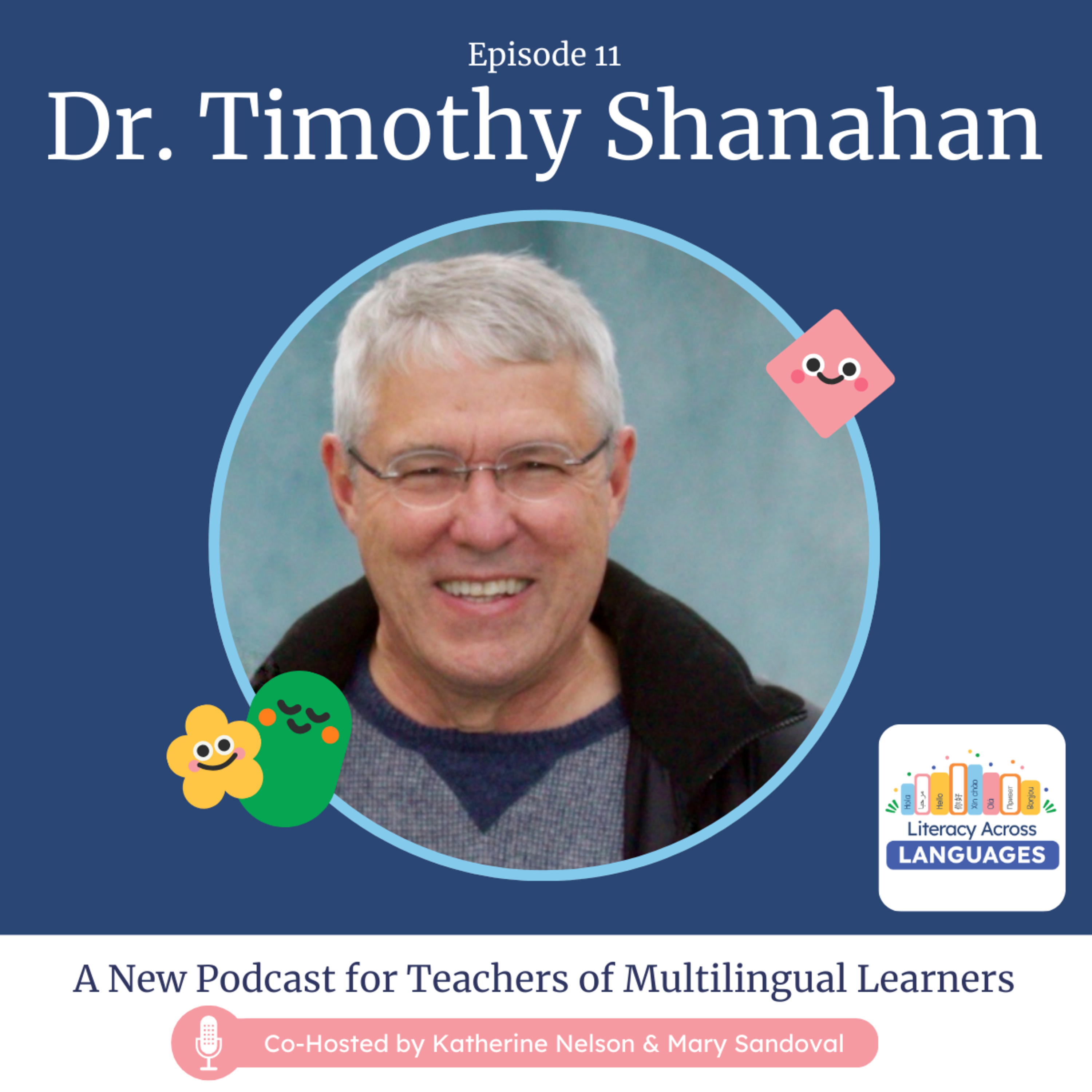
E11 - Equity Through Access: Teaching Grade Level Texts With Scaffolds
47m 41s
The discussion emphasizes that effective literacy instruction for multilingual learners involves teaching the same core skills as for native English speakers, but with strategic adjustments to support language acquisition. Dr. Shanahan highlights that while phonics and comprehension strategies benefit all students, language development is especially critical for multilingual learners. He argues against the widespread practice of matching students to lower-level texts, noting that this differentiates curriculum rather than instruction and can hinder long-term progress. Instead, educators should use grade-level materials for almost all students, providing scaffolds like peer discussion in home languages or targeted vocabulary support. This approach ensures equitable access to challenging content and helps close achievement gaps, rather than perpetuating them through leveled reading systems. The key is maintaining high expectations while adapting teaching methods to meet diverse needs.
Unlike with vocabulary where we might teach kids to use context or to use a dictionary or to break the word down into meaningful parts, when it comes to sentences, kids are on their own usually. What if we identify sentences that we think are going to trip kids up? S sentences that are particularly long, sentences with a lot of internal punctuation, sentences that have parentheses in them. Passive voice, all these things that can complicate a sentence, I'm not only helping them to understand this text, I'm giving them tools to use when they're reading other texts. The payoff of that is really for everybody, but the effect sizes are more likely to be larger for multi-langual kids than for the other kids. Welcome to Literacy Across Languages. I'm Mary, an educator, instructional coach, and committed advocate for multi-lingual learners. And I'm Catherine, a multi-lingual literacy specialist and author of Early Reader Materials. Passionate about developing reading and language together. Since we first met as teachers back in 2014, our multi-lingual students have shown us that literacy and language belong together. That understanding and our belief that literacy is every child's right has shaped our work ever since. With this podcast, we'll explore how the science of reading and the science of language acquisition come together to help every student become a confident, capable reader. We speak with experts and educators to dig into the research and share practical ideas you can use right away. Together, we can make literacy for every language learner a reality. Hi, it's Catherine. Thanks for joining us on Literacy Across Languages. Today, Mary and I are honored to share our conversation with Dr. Timothy Shanahan, one of the most influential voices in literacy education and research. Dr. Shanahan is a distinguished professor emeritus at the University of Illinois at Chicago. Previously, he was director of reading for the Chicago Public Schools. He is author or editor of more than 300 publications, including the book, Leveled Reading, Leveled Lives, published by Harvard Education Press in 2025. His research emphasizes the connections between learning to read and learning to write, literacy in the disciplines, and improvement of reading achievement. He chaired the National Literacy Panel on Language Minority, Children, and Youth, and is a former first grade teacher. In this episode, Dr. Shanahan addresses one of the biggest shifts happening in literacy instruction right now. As educators move toward science of reading practices, many are also rethinking the longstanding practice of matching students to texts at their supposed reading level. Dr. Shanahan argues that when we differentiate the curriculum instead of the instruction, giving some students easier texts while others get grade level work, we're not actually helping struggling readers catch up. Instead, we're guaranteeing they'll fall farther behind. For multilingual students, the same principle applies. Instead of changing the texts we use, Dr. Shanahan challenges us to change how we teach them, building the language and skills students need to access grade level content. So without further ado, let's dive into our conversation with Dr. Shanahan. Dr. Shanahan, welcome to literacy across languages. We are so excited to have you here today. Thank you. I'm honored to be here. I look forward to the discussion. We'd love to hear from you, Dr. Shanahan. You've had a very long career, very much involved in some monumental works. And we'd love to hear your story. What brought you to the work of education? You know, I didn't intend to be a teacher. In fact, I was like one of those kids who didn't actually like school very much and tried not to attend it too often. But when I was a teen, I for some reason signed up to do some volunteer tutoring in the inner city near the university where I went. And so I was I must have been 18 years old. I I signed up for this not understanding that everybody else who would sign up for what one would be a young lady. And two would be somebody who was an education major and had classes in teaching reading and the night before I went out to do my tutoring. It kind of occurred to me. I had absolutely no idea what I was doing. So I went to the library and I started reading up and spent several hours reading up on what can you do to teach somebody to read. And I kind of interested in it and you know, one thing led to another and I ended up befriending a professor at the university who was doing a lot of work in school districts and he would take me with him. And so even though I was only 18 and 19 years old, I was actually out consulting with teachers and reading all this stuff. And so it just made sense at some point to become an education major and to go off and be a real teacher and not the kind of fugitive teacher that I was. So what it did is it gave me in some ways a longer career in reading than would be typical of people in our field. You know, most people go out and they become a teacher and then they might get interested in special education or reading or some other specialization. Well, you know, I started there. I've been doing this now for just about 60 years getting close. You're just a wealth of knowledge and you co-chaired the National Literacy Panel for language minority children and youth. And that's especially relevant to the work that Mary and I are interested in literacy for multilingual learners. What did that work reveal about what multilingual learners need specifically from text in order to develop literacy skills and also English proficiency alongside that? Sure. Well, you know, it's a huge long report and a lot of people contributed to it. There's a ton of information and it's still that's used by various educators and policy makers. For me, some of the things that I learned, you know, I must admit I was somebody who I would say was skeptical, I guess, would be a good word. I was skeptical about the notion of teaching kids in their home language. You know, if you want kids to learn English, why aren't you teaching them English? You know, I think you can see why somebody might wonder that or question that. But certainly just like every other review that is looked at the research on this or the individual studies that have been done. It's very clear that starting kids out in their home language, that's very useful. One of the things that the studies were showing us was not only was it important for the schools to use the children's language. But it was also the kids who did best parents were trying to use English at home. So you go, wait a minute. What's going on here? And I think a lot of that might be what you're really doing is creating a comfort level for the students that, gee, you know, my parents want me to learn English and the school was being respectful of my language. And wow, everybody's kind of looking out for me on this. And I think that's probably very important. That notion of mutual respect. And when it isn't possible to start with a child's home language. And sometimes it isn't. That respect is still hugely important. And so find in ways of communicating that would really matter. And so that was one kind of thing that I learned. Another kind of thing that I learned is the things that matter for teaching native speakers matter for the second language students as well decode in skills. You have to have them. And you're going to read English, whether you're you're coming to English from an English language background or some other language background. It's pretty essential. The language abilities that are needed, you know, vocabulary and syntax and all that. They're the same. The differences tend to be in the weightings. So for example, you'll find everything that we know that if you teach it to native speakers, it improves their literacy. If there are studies on the study show, those same things benefit the multilingual kids. And that's that's pretty important. But as I say, then you got to kind of drill down a little bit because it's not quite that simple. It's not just the same curriculum. What is the same curriculum in a way. But when you look, you'll see things like. Phonics instruction is beneficial for those multilingual kids, but the payoffs are smaller. The effect sizes aren't as big as they are with the native English speakers. Well, what about something like comprehension strategies. Same thing beneficial to the multilingual kids. And that's true for everything except for language. And then it reverses. And I think it's again, it's pretty obvious why this would be if you're coming to a language and you don't know it very well yet. Those skills are going to be especially important that we make sure kids get them. It's important for everybody, but a youngster coming from an English language background is more likely to have English vocabulary at a higher level. I mean, that's of course. It isn't that phonics is any less beneficial to a second language.
learner is just that what is phoenix give you it gives you an ability to transfer print to language and if you don't have the language transferring it doesn't do you a lot of good it so you have to have both those those decoding abilities but you also have to have the language abilities and so it just looks like it isn't giving as big a payoff but it it does as long as you're feeding both sides of the equation so the key is that it's the same kinds of things that need to be taught but they have a little bit different levels of importance at certain times and a second thing I'd say about that is you might have to make some adjustments to how you're teaching those things studies are very clear is beneficial to have kids read tax read stories read articles and to talk about it engage in discussion answer teacher questions write of all that kind of stuff good good good everybody agrees but how do you carry that out with a group of multilingual kids do you do exactly the same thing or do you make adjustments like I ask my teacherly questions and I give kids a chance to talk to each other perhaps in their home language before they have to answer me that little adjustment all of a sudden allows those kids a lot more ability to participate they get a chance to try that language where it's safe they get a chance to get their ideas out of their head and then to tell the teacher and so I guess what I'm saying is it's exactly the same except when it isn't it's the same and yet we have to make adjustments to make everybody successful with it and I think that's hugely important I love that you're using the word adjustment I think it's really describing that those small shifts really matter and by being intentional about what gets adjusted it does reach our multilingual students in our classroom so thank you for freezing it that way and describing it that way because an adjustment can be really really powerful so your new book is entitled leveled reading leveled lives can you unpack what you mean by leveled lives and why you see the widespread use of leveled readers as problematic yeah you know I let me start just telling that when I was a teacher I certainly used leveled books and I tested all the kids and got everybody to what I thought were their levels and and all of that so this is one of those times you know me a culpah you know I certainly was you know doing this and so it isn't I'm so smart and everybody else is dumb it's this is something that has been a very big thing in American reading instruction and I think we've successfully managed to export it to lots of places around the world it made great sense to me as a teacher but as you look at the research on it you come to the conclusion that we really are level in kids lives let me give you where does this whole idea come from and why do we do it this way why do we try to teach everybody with books that are supposedly at the kids levels and it's an old idea it people started writing about it in American education oh a little bit more than a hundred years ago so this is something we've been talking about for years and years you can find pieces written in the nineteen teens and twenties where the reading gurus of the time we're saying you have to teach children at their levels okay so what's their level well they were silent on that they had no more idea what that was than anybody else but by the nineteen forties it actually come up with schemes to match kids to books or books to kids so that you could make sure that you would differentiate your instruction given everybody just what they needed that was the idea very well meaning the way it's played out over the years is that kids get taught with texts that are below the levels that we want kids to say leave high school graduate from high school with levels of literacy that should allow them to do three things one should allow them if they want to go on for higher education to be able to say take a freshman English course and actually be able to pass it some kids no no no I'm gonna go out into the workplace we're talking about the kinds of jobs that you can actually without a college education make a good living with my kids to be able to do things like that to be able to do the reading that would be required in that kind of a job or want kids to be able to get into the military if that's the direction they want to go and so they have to have the literacy levels the literacy skills that would allow them to read the texts in any of those three situations I think that's what we all would like to see kids leave school with well if we teach kids the grade level materials the fact is when they leave high school they should be able to handle texts that are are that challenging and that's that's wonderful but what happens when you say well this kids in sixth grade and I'm gonna teach them with a fourth grade book or he's in fourth grade I'm gonna teach him a third grade book or a second grade book and when do they get to read the grade level material and and it becomes obvious very quickly they run out of time and that is in fact what's happening in our nation that the majority of kids are leaving school with the inability to do those three things and that's a problem and so this notion of of continually holding kids back to their level has turned out not to to be very positive studies are showing that in fact when you do experiments where you take some kids and you teach them with the grade level materials and other kids where you teach them at their supposed levels the kids were taught with the grade level materials make bigger gains you know oh yeah well I could see that for the kids were really high but what about the lower kids they make bigger games they they learn more and so what we're doing is while we're trying to help these kids and make them more successful we're actually holding them back and reducing their opportunity to learn and that's what I mean by we're leveling their lives we're we're not giving them a chance to to succeed it's not that they're not learning anything they're learning they're just not learning as much as they need to and as much as they could now there are some kids when you're starting out you you want things to be easy of course but what the studies are saying is typically by the time kids are about seven or second grade level they don't have all their decoding skills but they have sufficient foundational skills to allow them to benefit from those grade level texts you're just making me think back to all of the child study meetings where we've gone in and we've identified a student who's not making the gains we would expect in reading and we're setting a goal for six to eight weeks for check-in but that goal is not actually closing the gap it's based on the trajectory the student has had so far rather than bringing them up to grade level and just how frustrating that can be meeting after meeting just seeing those lines never really converge and I think as educators it is so difficult to sit and watch a student have a really hard time to throw them into a text you know is gonna be difficult but it really speaks to this idea of that productive struggle that there's so much to learn in those texts where they are not immediately able to do it independently and hearing from you that the curriculum needs to be the same for all but that the differentiation needs to be in how we're instructing kids and how we're helping them to meet that expectation yeah Katherine that's a really important way to say it I when I was writing the book that occurred to me for the first time that what we had done was we had differentiated the curriculum not the instruction we had decided that some kids were going to be taught to read to the levels that we want them to and other kids we were not going to do that we were going to teach them to levels that by design they would leave school unable to fully participate in this society unable to fully gain the benefits of this society and that that decision was being made very very early in children's lives what we want to do is teach the same curriculum to almost everybody and that means you're going to have to adjust instruction in some ways you're going to have to find ways of giving kids more support more scaffold and teach everybody almost everybody to the levels that we want them taught to and that's going to mean some kids are going to need more support than others and you can do that in a classroom this isn't one of those deals where oh my goodness I need to have 14 different groups going the fact is when you're reading a text together I can provide scaffolds and support that you know if you don't need it you can ignore it if somebody else needs it they'll have it and so this is one of those deals where I think that distinction between curriculum and instruction is so critically important we often don't make it an education and it's it's a big mistake that we don't this is a time where we thought we were doing well by doing good things by teaching kids different things but what it really was doing is guaranteeing that some kids were always going to be in the back of the bus and that's just not at all what anybody really wants yeah and I think in multi-lingual education that's a message that we're always trying to get out as well that these students have such potential if
If you give them the opportunity to learn the language, to learn the content and to then have all the tools they need to express the learning that they've done, if we are moving away from matching kids with texts at their just right level, so many teachers have big classrooms full of leveled texts. Is there any role for them for multilingual learners or kids who are beginning to read even if it's not in that small group instruction? Well, first of all, there's no, those books aren't the problem. Leveled books aren't really the concern. It's what are you teaching kids with? And so if you have a group of third graders and you're teaching them with books that have those, you know, whether they were taking like-style levels or whatever, but you were, is your real target for all third graders or most third graders? You know, the leveling, people aren't going in and changing the level of most books. It's they measure them and they place them where they want them. And so what's been going on is you're in third grade, but I think you're a little low. So I'm going to put you in a second grade book. And second grade book isn't the problem. It's the fact that you should be working with a third grade book. So no one has to throw the books away. That's one thing I can say to you. Those books, you might have to shift to get to work with which ones. That's okay. And one other thing I think is absolutely incredibly important to stress here. It isn't that every single text the youngster works with has to be at a certain level. I think that's something we got out of that whole instructional level idea. The kids always had to be at their instructional level or you were hurting them. The fact is when it comes to learning or if you do any kind of physical development, anyone runs or rides bicycles or liftways or does any of that kind of stuff, you don't make the challenge always the same thing. It's not, oh, every day I go out and run two and a half miles. You never get any better if you just do that every single day. Some days you want to run shorter distances. Some days you want to run longer distances. Sometimes you want to go faster. Sometimes you want to go slower. And so the notion of, gee, yeah, we're working with grade level text in this classroom, but some of the times I'd back off and give kids maybe a longer read, but an easier read. Or maybe sometimes I go above grade level with a shorter, harder read that I'm really going to have to support the kids with. Even my good readers, right? I mean, that kind of thing. And so I think we get it in our head that, wow, once these kids are at this level, they have to be only working in books in this range. And that just isn't the case. And in fact, I even in the book, I give some suggestions and they're made up. There's no research on this. There's a ton of research on this in physical education, but there's no research on this when it comes to teaching reading or math or anything like that. But the notion would be kids are going to be getting varied routines. They're going to sometimes do really hard things, sometimes easier things, and that really gets to motivation. But it also, I think, gives kids a chance to consolidate some of what they're learning. In fact, I'd even argue sometimes you want to go back to stuff you've already done earlier in the year. So the kids can say, you know, I had trouble with that before. You know, if that English on that really threw me, that was three months ago. That's easy for me now. I want kids to see that. If everything's at the same level and when the kids get a little better, you adjust the levels up and it's just constantly, the youngster never gets to see whether he or she's actually making any real progress unless they're tested. That's the only time they get to find out. And that's also true for the teacher. The teacher never gets to see whether she's really doing a very good job because we kind of hide it from them. And so by varying those difficulties and doing that, some of those kinds of things, you can actually, you and the youngsters can see, hey, I'm making progress here. I see what I'm doing. This is cool. I want more of this. They see it as challenging, but also successful. Yeah, absolutely. Because if we're going to be asking them to go through the difficult work of getting through grade level or higher than grade level texts, they have to know there's some sort of payoff. A moment when you feel good for having done all of that work and you got something out of it. Absolutely. Absolutely. And I mean, imagine at the beginning of the week you start with the text that blows you away. And by Friday, you're handling it. That's got to feel pretty good for most kids and most teachers. Dr. Shanahan, would you be able to take that scenario and describe what that might look like in a classroom, say in a second grade classroom where students who are multilingual students and English speaking students are interacting with a grade level text. And Monday, it is feeling quite challenging. What would a teacher provide? What adjustments and scaffolds would a teacher provide to create greater success across the week with that text? Great question, Mary. Let me, let me give just a couple of different scenarios to try to do justice to that question. Sometimes what kids are having trouble with, I said they might have some of their basic decode in, but they might struggle over some of the words and so on. And so a lot of times that's what scares teachers the most. You know, Catherine mentioned earlier how hard it is in a classroom when you see kids struggling. And it is. And I've been in classrooms and out for decades. And absolutely it is very, very hard for them. Hard to watch that. And so one of the things that you might consider doing, you know, when I visit classrooms quite often teachers will do things like they have a good in group. You know, the other kids are doing stuff, but they've got a group that they're working with at the kids level and they read a story together and they talk about it. And usually once they're done with that, oh, we're going to, I want you to practice your fluency. So Catherine and Mary, I want you to go over there and you read a page to her and she's going to read a page to you and you're going to practice your fluency. And that's nice. And fluency is a good thing to work on. And there's research saying that's good and I'm all for that. But if you think this text is going to be hard for the kids to read fluently, what if instead of starting with the comprehension, what if we start with the fluency? What if we have the kids practice in reading this text before we sit down as a group and read it together? And so think what happens, even if they just read it once before. Studies show that when kids read loud, let's say they make 15 mistakes. If they, without any instruction, without any teacher assistance, if you have the kids read the text the second time, they tend to cut the number of mistakes down by about 50%. And so you might, by doing what I'm suggesting, you might have taken a text that in the past, we would have said was frustration level. And just by doing that fluency work first, we just, for many kids, turned it into an instructional level text. We made, you know, artificially, we just made it more successful. We can do the same thing in terms of, gee, maybe there's some words there. I want to teach the kids how to decode. This gives me a chance to do some applied decode in work. We usually introduce vocabulary, but here I'm talking about actually reading the words. And so that's one kind of scheme. That scheme allows a lot of, especially the lower readers to all of a sudden be much more successful. In fact, I often suggest that intervention teachers do that, that they get ahead of the classroom. So if the youngsters in my class, I've sent it to the intervention teacher, I would love it. If this week, she was working on the fluency of the text that we're going to read next week in class, because that means a little hector gets to come in at the same level as everybody else, which usually doesn't happen to hector. He usually is the one who's struggling or maybe goofs off so that he can make the other kids laugh so that nobody notices that he's struggling. Gee, that teacher could actually give that kid a like up. So that's one scheme. But let's say that we've done that and the kids are able to largely read the word so they can read the text well enough to get some comprehension. But there are multilingual kids in the classroom. There are kids who don't know English so well, but there are also poverty kids who don't know English so well. So it's not just those multilingual kids that we need to talk about with language. It's everybody's kids. It's my kids. And everybody's kids. Well, what kinds of things do we do there? And what we do there traditionally is we introduce vocabulary. We pre-teach some words. And that's fine. And it does help comprehension. There's studies showing that really does help. And you can see why it would. But I think we do a lousy job of that pre-teaching vocabulary. We often teach the vocabulary of words that the text actually defines. And so going in and telling the kids what those words are doesn't really help them very much because the author was going to tell them anyway. So that's one thing I don't want yet. I'd rather that's not pick those words. Let's pick other words that the kids really might have trouble with and that the author isn't going to give any assistance. So that's one kind of thing. Another one is some words you can actually figure out from context. I think every textbook series will always have two or three workbook pages a year, work sheets a year where kids get to work with context. I think it should come up every single time that you're working with kids. If it's possible to figure out the meaning.
of a word, asking the kids that word meaning as a comprehension question, rather than pre-teaching it, gives all the children an opportunity to try to make that skill work. And if they can't, then the teachers there where she can show them. Let me show you how I figured that out. And as you do that, the kids get better at that. That's usually as far as we go with language. And I would say that's a big mistake. We need to go farther. Because at times, the reason why kids are having trouble isn't the words. It's the sentences. And I see this more with older kids and younger kids, a couple sentences in a row that they're lost. They just don't know what the heck it says. And they start turning pages. They start skipping paragraphs. It's not just they miss those two sentences. They miss the rest of that whole section. Because they're lost. Unlike with vocabulary where we might teach kids to use context or to use a dictionary or to break the word down into meaningful parts, when it comes to sentences, kids are on their own, usually. And so the notion of what if we identify sentences that we think are going to trip kids up, sentences that are particularly long, sentences with a lot of internal punctuation, sentences that have parentheses in them, passive voice, all these different things that can can complicate a sentence. And instead of just ignoring it, which is what we do now, we take those sentences and see if there's a question we could ask that would reveal whether the kids were able to read that sentence or not. And so we ask that question just along with our other questions. We don't highlight the sentence or anything. We just read the text like we normally would. And then we ask that question. And when the kids don't know I'm going to take them back to that sentence. We're going to read it. I'm going to initially a model. What do I do with a sentence like that? How do I break it down? How do I use the punctuation? What do I do with that? How do you find a verb? I said, you can make sense of the sentence. And once I've modeled some of those, then I start guiding the kids to do it. What did I do before? Oh, yeah, you're right. I broke it down when I guide the kids to do it. So I'm not only helping them to understand this text. I'm giving them tools to use when they're reading other texts. That's that's the point of it. And I would say the same kinds of things with cohesion and the same kinds of things with discourse structure that we need to start giving that kind of instruction. And as I said earlier, the payoff of that is really for everybody, but the effect sizes are more likely to be larger for multi-langual kids than for the other kids. Because the other kids have more reserves of English to draw on. Dr. Shanahann, I love how you offered fluency in your first example as an entry point for students. And flipping the script, that fluency can very much lead the instruction and provide that necessary scaffold that students need. I also love that you're saying that we need to move beyond the word level and provide that sentence level and discourse level instruction for students. And that when we scaffold and adjust, it's really benefiting all students. And I feel like throughout this conversation, you've really been describing equitable instruction. And that's creating those adjustments and scaffolds intentionally for students. I just that word equity just keeps ruminating in my head. I think when you're mentioning the diversity of students and how all students are developing language and literacy, we're really trying to provide with each learner needs. So thank you for those examples. Thank you. The way we do it with instructional level stuff is we teach different groups of kids. And so it might be all the brown kids are over here and all the white kids are over here. It's not a very attractive way of going about meeting different kids needs. See, one of the things I'm doing it the way I described, you can do it whole class, which buys the out of needing all those small groups. It gives you more time to work on this text. And the reason why we're focusing on this sentence. So, you know, I've identified a sentence that I think might trip kids up. I'm not identifying about, oh, I bet this I'll get the multilingual kids. It's, here's a sentence that I think is complicated that I think kids won't get. I don't know which kids are going to get it or not. I'll ask my question. If the kids can answer my question, clearly the sentence wasn't as confusing or complicated as I thought. I have nothing to teach. I'm going to move on. We're going to just keep going. If there's something to teach for the kids in the group who got the sentence, I think you're going to find they're just as interested in the discussion as the kids who were tripped up by it. But it's the instruction is differentiated in a way. But everybody's getting to see the same stuff. It's just some kids maybe you'll be more participatory in certain discussions than other kids. And in order to adjust our teaching in these ways, we really have to take the time to look through those texts that we're using with a very expert eye to know what sorts of things are likely to trip kids up. If whether it's the vocabulary or a sentence level or a larger portion of the text, like you said. And I know that a lot of the research on grade level text begins at second grade. So we're working more in the dark for those very foundational years of reading instruction. Are there any inferences that we can draw from the available research about what sorts of texts are most useful for K1 students or are there other things we should be keeping in mind at that age? Yeah. For beginners and K1 is a good way to group the beginners. Obviously there's some older beginners as well. But most of those kids are in kindergarten and first grade. The biggest issue for them tends to be the decoding issue. Again, they're going to need to keep building those skills throughout their elementary years. But get in the basics of how decoding works and the most basic aspects of the English spelling system and so on. That really has to come early and get accomplished. And so if you made text complex for beginners, what that typically means is you're going to repeat fewer words and you want a lot of word repetition so that the kids can get used to seeing those. Or you're going to make the text less decodable. You repeat fewer patterns, which of course, again slows those kids down. And so it's better to have texts that have some kind of combination of decodability. You want to fairly high percentage there words that given the skills I know I should be able to sound this word out. And if it's in my oral language, I should be able to figure out what the word is. Or words that are frankly just going to get repeated a lot. And so often that they stick in memory that I get used to seeing them. And it's not one or the other. It's some combination of that. That's very important. But I would also say, well, gee, those kinds of texts don't give kids a lot of chance to build language. You know, decodin is usually important, but so is language. And so certainly during those years, you want kids reading texts, they're going to be fairly simple texts relatively. I should be reading books to kids. And again, those shouldn't be simple. Those shouldn't be dumbed down. Those should be, you know, at wonderful books. I know often it's upper grade teachers to read chapter books to kids. And the primary grade teachers read picture books. I was a first grade teacher. I used to read chapter books to my kids. I was a parent. I read really hard books. I think I read the Odyssey to my oldest when she was five or six years old. But yes, you know, I think it's it's critically important to expose kids to that language. One other thing I'd say on it is, you know, as important it is that the kids are reading texts that have a little bit higher range of decodability than you normally would see in the language. You don't want to overdo that. You know, it's important to do it. And then it's important not to do too much of it. And the reason for that is that you can come to expect English to have a degree of consistency that it doesn't have. Our system is systematic, but it's conditional. The sound values that you associate with certain letters or certain spelling patterns depend on the context that they appear in the word. And so, you know, a particular letter might have a sound, but it only has that sound if it's in the middle of the word or it only has that sound if it's at the end of the word. Or there are two or three different choices for what that vowel might sound like. Kids have to have develop not just an understanding of the system, but a sense of the conditionality of it. G.I. came up with that pronunciation. That doesn't seem to be a word. What other choices do I have? How else could I make that sound? And that's the kind of thing that initially I assume that's got to be a little bit tougher for the multilingual learner simply because sometimes they're going to come up with a pronunciation and they're just not going to be sure if it's a word, which is a great opportunity to talk about that and to give the kids some instruction that builds not just his ability to decode, but knowledge of words. Take every opportunity you can to expand the language for everybody. So, you know, it's not just for particular kids. So, yeah, the rules are a little bit different for the beginners than they are for the older kids. And I guess one other thing I could say is every study.
that has looked at this issue of teaching kids at their level or teaching with grade level harder stuff, you know, comes down that it's better to teach with the harder stuff with one exception. It was a study done with high school students and it was the multilingual learners who didn't benefit from the harder text. But these were not, it wasn't like, well, these are ninth graders and these kids are reading at a six grade level. It sounded from the description in the study. Like they were, when it came to conversational English, they were pretty much beginners. And so I think the same kinds of things I was saying with getting kids started with decoding is probably also true no matter what the kids age. If they're getting started with English altogether, you've got to be careful not to overwhelm them initially to get them started. So I do think kids can be so low that you wouldn't want to do what I'm suggesting. But we are talking about a fairly small group of young kids and a fairly small group of multilingual learners. Dr. Shanahan, you've given us so much to think about this afternoon. And as we think about our listeners joining us in this conversation, what's one idea from our conversation this afternoon? A belief, a practice, an adjustment that teachers, educators can make. What would you want that one takeaway to be for our listeners? My one takeaway would be, if you think something is going to be hard for your students, don't dumb it down, don't replace it with something easier, raise the scaffold and see what you can accomplish. That study I talked about where the multilingual kids, these really beginning English, English kids had struggled. What they had done with the students in the study was, yeah, these were ninth graders, these were high school kids. They asked them, would you rather be taught with texts that is at your level that won't be too hard, or would you rather do the ninth grade work? And the teacher will give you some assistance. And overwhelmingly the kids said, give me the hard stuff, give me the ninth grade stuff. I don't want to do the dumb stuff. And I've seen that over and over and over again. And I think you're going to find most of those boys and girls are going to say, I'm willing to do the work. I'd rather stay with my classmates. I'd rather work in the same books they're working in. So if you listen to that, then you'd say, well, okay, I have to work with this text. How can I make kids successful? And that means raise the scaffold and you're going to have to give the kids more support. And that's any kind of support you can think of except two. I'd say don't read the text to the kids. They have to do that. Don't tell them what it says. Anything else whether it's helping them with the language or building up background knowledge or getting them involved in various kinds of discussions or whatever, that's all fair game. Get mom and dad to help. Get the intervention teacher to help all that kind of stuff. Anything you got. And so yeah, don't dumb it down. Don't avoid it. Raise the scaffold and make them successful with what you really want to teach them. Thank you so much for that, Dr. Shanahan. And as we close up today, Katherine and I have a deep passion for multilingual students and multilingual education and the way literacy and language come together for our multilingual students. We'd love to hear from you what's your favorite thing about multilingual learners or about multilingual learners and their literacy journeys. You know, many years ago I created with a colleague, Flora Rodriguez Brown. He created a program called Project Flame and it was a family literacy program aimed at families mostly from Mexico and other parts of Latin America. And essentially we were teaching the parents how to teach their young children at home, literacy in English. And so we would have to have meetings, you know, we worked with the parents. We were working with moms for the most part and these, these mothers were absolutely fabulous. But whenever we'd have meetings, they insisted that food be served and they would bring these wonderful meals and they always thought I was too skinny. So they were always trying to fatten me up. So I got to tell you, that's what I think of when I think of multilingual learners being fed really well. I think what those mothers had, something important to say about the social nature of learning and the social nature of teaching, making their literacy lessons into something that was enjoyable to take part in and that everybody had something to say about. I would argue as a model for their children as well. I can just imagine how joyful those sessions were for you. I cannot hear it from your, your retelling of that story. It was pretty amazing. I gotta tell you. Thank you for sharing that with us. We want to thank you so much Dr. Shanahan. We are incredibly honored to have spent this time with you this evening. We have learned so much more and have a lot to take away with us and we know our listeners will too. Thank you so much for your time. Thank you for having me. I hope there's some benefit to some of the children your listeners are responsible for. Thank you. Hi, it's Catherine again. Before you go, I wanted to take a moment to wrap up the learning and highlight the big ideas and strategies you can use with your students right away. As we reflect on Dr. Shanahan's insights, his core message is clear. Every student deserves great level content. For multi-lingual learners, that means shifting our focus from finding the right level text to providing the right instruction, including strategic scaffolding and language development to make great level content accessible. So we'll leave you with this invitation. Think about one purposeful step that you could take to build literacy for every language learner in your classroom. You might have students read the same text more than once. Research shows that even a single rereading without any instruction can cut decoding errors in half. Consider having students practice the text with a partner or independently before you use it for comprehension instruction. This repeated exposure builds fluency and frees up cognitive energy for understanding. Or you could rethink which vocabulary words you pre-teach. Focus on words students cannot figure out independently. Words that are lacking context clues, cognates, or familiar word parts. If students can figure out a word using the tools available to them, expect them to do so. Or, audit one upcoming lesson and ask yourself if you're differentiating the curriculum or the instruction. If you're planning to put some students in easier texts, pause and instead think what scaffolds could I add so everyone can access this great level text together. We'd love to hear your thoughts, leave a comment, and let us know how it goes. And if you share our passion for multilingual literacy, join us in spreading the word. Like, subscribe, and share this episode with fellow educators to keep the learning going. Together, we can make literacy for every language learner a reality.
Podcast Summary
Key Points:
Teaching multilingual learners requires similar foundational skills as native speakers (phonics, comprehension strategies), but with adjusted emphasis, especially on language development.
Differentiating instruction through scaffolds and supports (e.g., allowing discussion in home languages) is more effective than differentiating curriculum by using easier texts, which can limit long-term achievement.
Using grade-level texts for all students, with appropriate instructional adjustments, promotes greater literacy gains and prevents widening achievement gaps, rather than relying on leveled reading systems.
Summary:
The discussion emphasizes that effective literacy instruction for multilingual learners involves teaching the same core skills as for native English speakers, but with strategic adjustments to support language acquisition. Dr. Shanahan highlights that while phonics and comprehension strategies benefit all students, language development is especially critical for multilingual learners.
He argues against the widespread practice of matching students to lower-level texts, noting that this differentiates curriculum rather than instruction and can hinder long-term progress. Instead, educators should use grade-level materials for almost all students, providing scaffolds like peer discussion in home languages or targeted vocabulary support. This approach ensures equitable access to challenging content and helps close achievement gaps, rather than perpetuating them through leveled reading systems.
The key is maintaining high expectations while adapting teaching methods to meet diverse needs.
FAQs
Using texts below grade level for struggling readers, including multilingual learners, can limit their learning and prevent them from catching up, as it reduces their exposure to grade-level content needed for future success.
Differentiate instruction by providing scaffolds and support, such as allowing discussions in home languages before answering in English, rather than changing the curriculum or using easier texts.
It showed that starting instruction in a child's home language is beneficial, and the same literacy skills (like decoding and comprehension) matter for multilingual learners, but language development is especially crucial for them.
Phonics helps transfer print to language, but if a learner lacks sufficient English language skills, the payoff is smaller; both decoding and language abilities must be developed together.
Differentiating curriculum means giving some students easier content, which can hold them back, while differentiating instruction involves providing varied support within the same grade-level curriculum to help all students succeed.
Leveled books themselves are not the problem; they can still be used as resources, but the focus should be on teaching with grade-level texts to ensure all students access challenging content.
Chat with AI
Loading...
Pro features
Go deeper with this episode
Unlock creator-grade tools that turn any transcript into show notes and subtitle files.
 PodcastTranscript AI