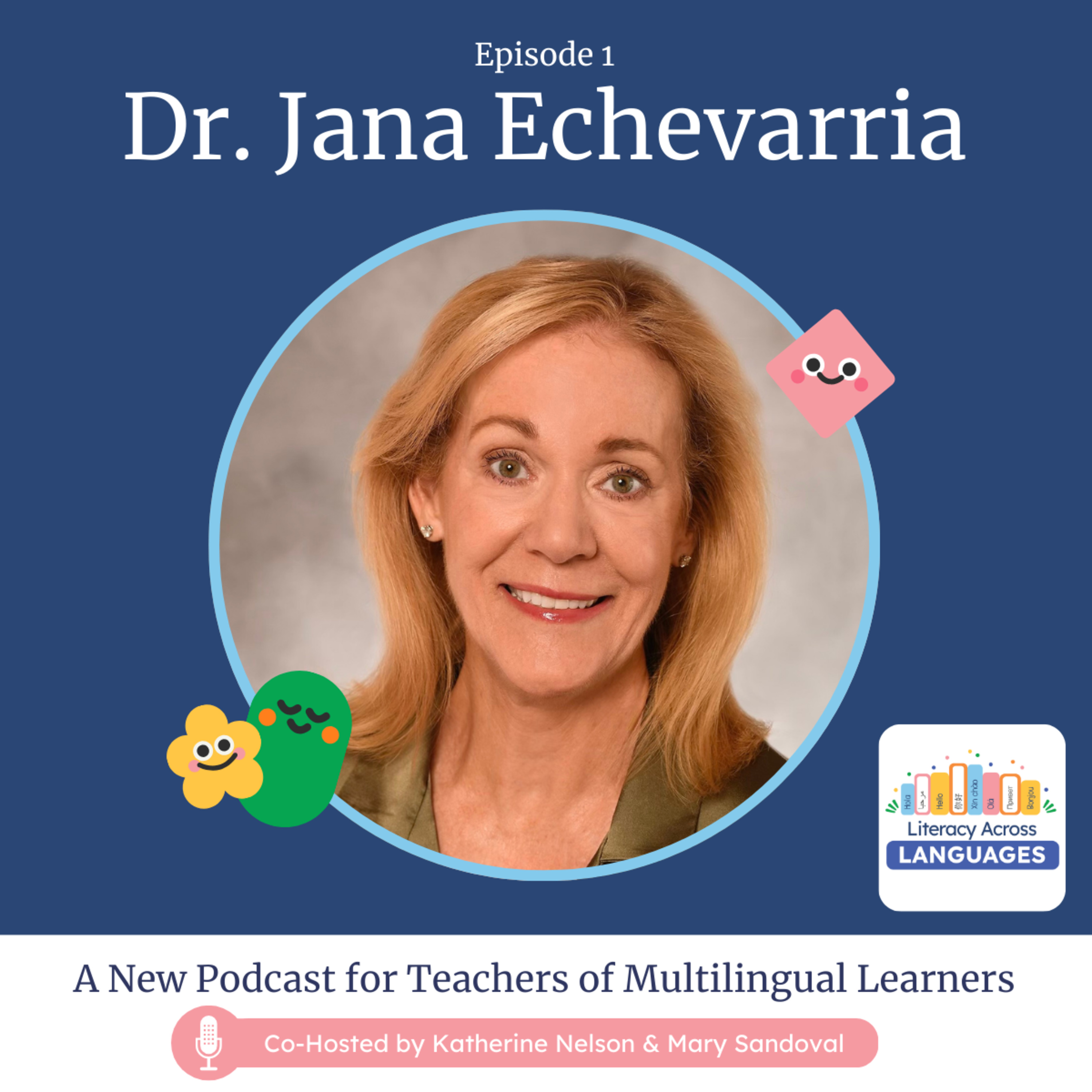
E1 - Literacy Across Languages: Integrating the Science of Reading with Multilingual Education
46m 54s
The transcription introduces the podcast "Literacy Across Languages," hosted by educators Mary and Catherine, who emphasize integrating reading science with language acquisition for multilingual learners. The episode features Dr. Janna Ishevarya, an expert in multilingual education and co-creator of the SIOP model. She explains that effective literacy instruction must combine decoding with language and knowledge development, tailored through scaffolds like the SIOP framework. Dr. Ishevarya highlights the interdependence of language and literacy, noting that oral language fuels reading while reading expands language skills. For multilingual learners, instruction should be linguistically informed, addressing phonics transfer, vocabulary, morphology, cognates, and structured interactions. She advocates for collaborative teaching approaches that merge content, literacy, and language, using strategies such as language objectives and building background to make grade-level material accessible. The discussion underscores moving beyond ideological divides to practical methods that support every learner’s right to literacy.
We've got decades of studies that show that effective literacy instruction involves systematic explicit instruction in decoding word recognition, coupled with intentional develop of language, of vocabulary, syntax, background knowledge. There's no credible model of reading where one alone is sufficient. We move past the polarization, I think, by embracing an approach that includes decoding plus language, plus knowledge, and it's got to be delivered for our multi-lingual learners with intentional scaffolds that make grade level reading accessible for all. That kind of an approach isn't ideological, it's just what works for kids. Welcome to Literacy Across Languages. I'm Mary, an educator, instructional coach, and committed advocate for multi-lingual learners. And I'm Catherine, a multi-lingual literacy specialist and author of early reader materials, passionate about developing reading and language together. Since we first met as teachers back in 2014, our multi-lingual students have shown us that literacy and language belong together. That understanding and our belief that literacy is every child's right has shaped our work ever since. With this podcast, we'll explore how the science of reading and the science of language acquisition come together to help every student become a confident, capable reader. We speak with experts and educators to dig into the research and share practical ideas you can use right away. Together, we can make literacy for every language learner a reality. Hi, educators, it's Mary. Catherine and I are excited to welcome you to Literacy Across Languages. Today's episode launches the podcast, and we couldn't be more grateful to have you here joining us on this journey. Today's episode features Dr. Janna Ishevarya, a longtime advocate, researcher, and pioneer in the field of multi-lingual education. Janna Ishevarya, PhD, is Professor Marida at California State University Long Beach, where she was selected as outstanding professor. Prior to receiving her PhD from UCLA, she taught in special education, ESL, and bilingual programs. A creator of the SIAT model, her research and publications focus on effective instruction for multi-lingual learners, including those with learning disabilities. She has presented her research across the US and internationally, including Oxford University with University, Harvard University, Stanford University, University of Barcelona, and Southeast Europe University, where she was a full-bright specialist. Dr. Ishevarya was inducted into the California reading Hall of Fame in 2016, and has served as an expert on English learners for the US Department of Justice Civil Rights Division. She is also an author on an exciting new reading program, Emerge, published by McGraw Hill, that reflects the science of reading. In this episode, Dr. Ishevarya breaks down the essential connection between language and literacy development for English learners. She clarifies how effective instruction must bridge both code-based and meaning-based skills. Dr. Ishevarya also addresses common misconceptions in the field and encourages us to rethink our practice, inviting educators to intentionally integrate language and literacy instruction for the benefit of every language learner. Let's jump into our conversation with Dr. Ishevarya. Dr. Ishevarya, welcome to literacy across languages. We are so excited and honored that you've offered some time to share your expertise with us today. My pleasure. Thank you for inviting me. We love to start each episode hearing the stories of our guests and what brought them to the work of multilingual education. Would you share your story with us? Gosh, I'd be happy to. It's a little bit of a journey. I started a long time ago. First, let me just say my grandparents immigrated from Spain. But unfortunately, we lost the language with the very first generation here. So I was always interested in Spain with my last name. My entire life, people have always asked me what's the origin of my last name. So I had that Spanish pride. Studied Spanish, a couple of all through school, went to Mexico and lived with families, and went to school there a couple of summers. And then as I was going along, I knew from middle school on I wanted to be a special ed teacher. And I just was always sort of single-minded about that. So I got my degree in special ed. But because I had the Spanish, and I knew obviously that there were going to be Spanish speakers, this was still like in the late '70s. But I could see that obviously there were going to be Spanish speakers. And at that time, we had a big influx of Vietnamese as well. So I got my bilingual certification and along with my teaching credential. And then I ended up getting my T-cell certification. So I went off to teach in special ed. But what happened was at that time, schools really needed bilingual teachers. There were not many bilingual teachers. When I started at a position at a school, then the principal would come to me after a semester or two and say, will you take over the teaching bilingual? So I did that for a few years. And I got my masters in bilingual special ed. And then there was an opportunity to work at Loyola Mary-Mountain University in training teachers in bilingual special ed. And so you can imagine in the early days there weren't many people that had that kind of qualifications. I started working there. And when I was doing teacher preparation, a lot of districts were really struggling with immigrant students, how to make content accessible for them. How do we teach these students during the content time? There was always ESL or ELD. But anyway, I started doing professional development in school districts and sort of developing what we now call sheltered instruction techniques. And just began delving into more ways to make content comprehensible for these students. So eventually through a national research center, my colleagues and I in collaboration with practicing teachers developed the SIOT model, which is the sheltered instruction observation protocol model. So up until that point, there really wasn't any kind of agreed upon model that what constitutes an effective sheltered or what effective content less than. So we tested the model and found it to be effective for helping multi-lingual learners access grade level content as well as improve their English proficiency. So that's sort of how I got to be more in the bilingual ESL field and known more as an expert with SIOP and helping English learners when really my initial preparation was special, but it's all come together to work really well together. I think it's hard to overstate how influential SIOP has been within the E&L community. I remember when I was in grad school, really all of our coursework focus on implementing SIOP in the classroom. And I think it's just such an approachable framework and intuitive and easy to understand that I think in a lot of ways, even though I had never taught before when I stepped into the classroom for the first time, I felt equipped in a way that I sometimes in talking with teachers who don't have experience working with English learners, there's a level of intimidation around how am I gonna interact with a student who doesn't share the language that I speak. And the SIOP framework really just makes it so easy to go through and see how you're scaffolding for those students and how you're making that information comprehensible from both a content aspect and from a language perspective. So I just thank you so much for your work and your colleagues work in developing that because I think it's really shaped the field. - Thank you so much. It has been very gratifying to hear because, as I said, there wasn't really a model. We teachers would have their favorite techniques or they would go to a professional development session on scaffolding or something, but there were just all these different pieces. They weren't really sure how to pull it together. And then through our research, we found that teachers who implement the full model to a high degree, their students outperform teachers who do kind of pick and choose and don't have a more comprehensive approach to teaching English learners. - Yeah. - So thank you for your comments. - Yeah. Well, it leads into, I think the moment where we are now where teachers are trying to figure out how do we integrate the science of reading, the reading research with what we know about teaching multilingual learners English as well. I'm wondering if you can talk a little bit about what makes reading instruction look different for multilingual learners and what sorts of things we should have in mind as we're trying to pull these two fields of research together. Yeah, that's great. This is really right in my wheelhouse and my pad.
because the core of the science of the reading doesn't change for multilingual learners. But what does change is how we teach it. I mean, we have to recognize that these students are coming to school bringing their developing English proficiency. They've got cross-linguistic resources and they have some unique instructional needs. And I say unique instructional needs, not because these learners are so very different than English-speaking students. But simply because they're learning all the same literacy skills as everybody else, while at the same time they're learning the language of instruction, English. So in teaching foundational skills, instruction has to be linguistically informed. Would you like me to give us some examples of what I mean by that? Yes, please. Okay. So, well, just for example, when we talk about the foundational skills, phonics, phonemic, or we're in that's all that. One thing is, you know, teachers should be aware of and explicitly teach, like contrast to phonology. So for example, the B or the B sound in Spanish is the same sound as the B or the B in English. So for example, a second grade student might be able to decode the word "very" but may pronounce it "bury". And this isn't a phonics deficit, right? This is a predictable transfer from their home language. So instruction should address it explicitly and not treat it as it's some kind of an error. So that's just around phonics. But when we get to vocabulary, it's really got to be much more substantially robust. Students need to have multiple exposures with visuals, gestures, examples to make the vocabulary understandable. I really like the bang for the buck you get with explicit morphology instruction, you know, teaching roots, prefixes, suffixes. That is just going to exponentially improve their understanding of language and their vocabulary when students really can start seeing those word parts and playing around with those. And of course, there's "cognate instruction", like important, important, there's a lot of cognates that are shared between the Latin languages and English. And also building breadth and depth of vocabulary through interaction, you know, one of the components of "saiop" is the interaction. And we want structured academic talk so that students have an opportunity not only to build vocabulary, but very closely related is oral language proficiency. So we say that oral language practice isn't an optional activity. It really needs to be central to literacy instruction. So that makes me think of our next question that we have for you. You're describing so much of the relationship between language and literacy. Would you unpack that a little bit more for us and how language and literacy influence each other? And perhaps thinking about the ENL or ESL or ELD teacher who's carrying the lens of language development as their focus. First is a classroom teacher or a reading specialist who perhaps is leading with a literacy focus. Catherine and I believe that teachers are not only language teachers but literacy teachers. And so how can we make that connection for teachers working together really clear? How do language and literacy influence each other? Great question. Well, they're really interdependent. I like to say that language is the engine of literacy because you can't have literacy without that engine driving it. And literacy is the accelerator of language. And that's how we expand our language is through reading and writing. The vocabulary syntax discourse all of that shape. How easily students learn how to decode, how to comprehend, how to write and so forth. We know that children with strong oral language, whether English or any other language, they are the ones who tend to progress more quickly in reading comprehension. So as students read, they are encountering more words, grammatical structures, text patterns, things that they don't see in everyday conversation. And when you're talking specifically about multilingual learners, reading in English is going to expose these students to forms of language that they likely aren't really going to hear outside of the classroom setting. And then writing, of course, gives them that opportunity to rehearse and to internalize new structures. This is where I really talk a lot about when I'm working with teachers about having the interactive aspect because interactive instruction accelerates both language and literacy. So discussion routines, partner talk, structured interactions, all that sort of thing are going to help students to improve their comprehension, be more familiar with the words and improve their writing. Talking about texts, that increases comprehension, it clarifies vocabulary. And we found in our research with multilingual learners that structured, structured instruction, structured interaction reduces the cognitive load for students and supports more risk taking and academically, which is, of course, what we want. Students are going to be more likely to use an experiment with new words and sentence structure with their peers in a small group. So it's very beneficial for literacy and language, but we can't forget that oral language in the home language also contributes to literacy in English because students are developing shared concepts, cognates, transferable morphology and so forth. For multilingual learners, both language and literacy develop across languages and instruction that integrates oral language plus reading plus writing results in the strongest grow. So as you mentioned, the ENL teacher and the content teacher both should be focusing on oral language, then reading, writing about what we've talked about, what we've read about. And then same with the ENL teacher, it's not strictly language during the end of course oral language should be a huge part of the end of instruction because of the relationship between oral language and reading. But as you said, they both are literacy and language teachers. And so grateful that you're pointing that out and taking that stance on it because I think sometimes in practice, it gets very siloed where the ELD teacher believes that their job really is to build up the oral language component and the speaking and listening and the vocabulary and then the classroom teacher, the reading specialist is in charge of the more text based language. I just couldn't agree with you more that they really are interrelated and if we're thinking about that language acquisition piece, there is no greater accelerant to developing your language than to be an avid reader and to just have that constant source of input pushing your language development forward. And I love that you're also tying that all together with the interaction using language for a social purpose. How can teachers who are trying to integrate language and literacy and content as well into a single lesson, how would you recommend they go about planning for that? Is it using your SIAP framework? Do you have another suggestion that you could offer in terms of how to make sure you're hitting all of those pieces? What's your advice there? Well, of course, no, our work with the SIAP model has spanned over 25 years, and we first published a SIAP model in the year 2000 and it was really the first book of its kind that was a resource for teachers and it still is used very, very widely today because mainly I think because we developed it over four years with classroom teachers. We met with them monthly, we would have many iterations of the model, but it's designed to integrate content, literacy and language so that all the pieces are considered a whole so language development is purposeful and explicit and embedded in daily instructions, not an add on. I find it interesting sometimes in English language arts is like, well, we teach language it's part of the name of our English language arts, but we need more explicit and purposeful language development for these kids. So one thing is I would say, well, the authors of the SIAP are credited with or sometimes they say scorned for popularizing content and language objectives. Scorned because language objectives can be sort of tricky for teachers that in fact about a year ago I was reading a little Twitter discussion online and they were talking about, you know, my principal makes me do these language objectives. I knew we have to do them and I was just about to chime in and somebody said, who came up with that idea for language objectives anyway. And I have to say I was not brave enough to chime in and take responsibility for the vitriol that was going on in the chat. But the good thing about language objectives is it makes language is visible for teachers and for students. So as teachers are thinking through what languages.
needed for this lesson. Of course, they've got their content, but the objectives really explicitly connect the lesson to literacy tasks, whether it's reading, writing, speaking, or listening. So, the teachers and the students are going to know the precise linguistic tools that they need to engage, whether it's a sentence frame, whether they're targeting vocabulary, or so forth. So, I mean, that's one thing, but the language objectives. And then another part of SIOP, that's very important, is the building background. And we want to connect with what students already know and build on that. And then we also want to activate that. And we want to build new background for them, fill in those gaps. So, we do that by using visuals. Gosh, we have so much access to short video clips, demonstrations, even with my grandkids, we're talking about something they may ask, what's this or that? And I'll just say, well, let's look that up real quick. And I just show a quick YouTube video so that they understand the concept of what we're talking about. And teachers have that kind of access now, which is really terrific. So, in building background, you might want to pre-teach the vocabulary words, for example, before reading about photosynthesis, maybe pre-few photo, what that means, light, and then synthesis to put together, and then highlight the Spanish cognate, photo-synthesis, it sounds very similar in English and Spanish. So, students kind of have this jump start to the lesson. And then I was just going to mention a couple other things. Of course, comprehensible input is really important, using gestures, using model diagrams. I like to say a finished product of an assignment. Again, if they're supposed to complete a then diagram, it's really useful for multi-lingual learners. And for actually all learners to see what would the finished product look like? So, I know what the goal is. So, when a text becomes comprehensible, then literacy becomes a language-rich opportunity, right? It's not a barrier. And so, that's why implementing some of these strategies to make the lesson more understandable for these students is so important. And then, you know, kind of marrying writing and oral language. I like this talk right sequence or talk, read, and then write about it. Partners talk, read something together, talk about it together, clarify, then maybe they write a couple sentences to summarize it, and then come back and share it, and then read. That makes so much of a difference with students in terms of feeling like they can participate. They're going to comprehend more. And again, that affective side of learning, students are just much more comfortable, and their minds are more open to this new language when they're not feeling like they're put on the spot. Absolutely. Would you mind unpacking the idea of comprehensible input for our listeners who may not be familiar with that? Sure. Comprehensible input is a term that was coined many, many years ago, decades ago. And it is simply every technique, strategy a teacher can use to make the input or the message understandable for the students. So, whether it's speaking more slowly for students who need it for beginning speakers, using gestures, you talk about three things, you hold up three fingers, visuals, chunking text, all of those things make the message more comprehensible. If you sort of contrast it with no comprehensible input, would be just like a teacher just giving a lecture and not connecting with the audience at all, right? The students are just there and you don't know if they're engaging at all or connecting at all. That's just the opposite of comprehensible input. Thank you. And the idea is that the comprehensible input is really what drives the language acquisition process forward. If students can't understand what the teachers talking about, vocabulary words are even the concept because the message is incomprehensible, they can't learn, they can't learn the concepts, the information, and they can't learn language. You can all think of a situation you've been in where you're in another country or even here, and you're in a situation where somebody's speaking to you in another language like so quickly, they could be saying anything and you just can't wrap your head around it. And yeah, that's how our students feel. It's like English noise to them. And I think that's one of the concerns that I've heard from educators who sometimes feel like the science of reading movement does not serve the best interests of their multilingual students. And I think that it goes back to this idea that you know, we're drilling phonics all the time and it's essentially meaningless to kids who don't know that "a" is a sound for Apple. So I think that really gets at one of the tensions between the research from the ELD field, which is everything has to carry meaning in order to drive language forward. And then the popular understanding of the science of reading as being very phonics focused and not inherently meaningful itself, that makes sense. Absolutely. And we get, you know, we feel pushback from people about the idea that it's one size fits all. If you could go back to unpacking a little bit more, the idea about tapping into our students cross-linguistic resources and how that can support teachers in helping students develop language and literacy in their classrooms. You mentioned quite a bit of intentional moves such as, you know, holding in on cognates and really focusing on morphology instruction. But I'm just wondering if you can bring them all together so that we have some more tools to think about that honor our students' home languages, the resources they have from their home experiences or prior schooling. But that also gives teachers a sense of what are ways that they can really leverage that home language beyond using translation. Sure. Well, first of all, I think it's important, there's a lot of good resources out there, written resources that and on the internet that talk about, you know, cross-linguistic transfer, what transfers, what doesn't transfer. So that's something for teachers to check out. But yeah, there's the whole issue of, as I mentioned, morphology with really dissecting. I like to think of words as being fun and try to convey that to students, looking at the prefixes and how we can take a word like preview and take it apart, pre and then view and then, you know, okay, what are other words that have that same pre so that kids really become aware of how language works. And there's a lot of those a fixes are similar in English and Spanish, for example, the TION ending revolution, Reboleuseon. I mean, there's a lot of similarity there with some of the cognates. And then, yes, as you mentioned, some of the sounds that aren't present, we need explicit instruction in what some of the sounds that aren't present in the students' home language because that's going to be a new sound. So they're going to obviously need more practice. That's what I mean about the foundational skills with a language lens or, you know, having a really linguistic approach to it. And then when you talk about building background, we need to start honoring more what students know. Sometimes teachers get the idea that students, multilingual learners are almost like different creatures than English speaking students and don't have much similarity to English speaking students. And that's just not the case. These students learn in many of the same ways. They have many of the same interests. You start talking about soccer and you start talking about, you know, a popular move, you know, Disney movie or something. And so when we introduce a lesson, it's important when we start talking about students' backgrounds, say, have you ever had an experience with this? What does your family do for this? And then tie that into the lesson. And it's a really quick way of focusing on what the students know and bring part of their life. They're lived experience and how that can be connected to the lesson. Thank you so much for elaborating on that. I want to return back to Caterin's comment as we're thinking about both, I guess, both sides of Scarborough's were open thinking about word recognition and language comprehension. And we have begun digging into the idea of code based and meaning based elements of literacy instruction. Could you unpack the idea of code based and meaning based elements of literacy instruction? Sure. I mean, these are two broad dimensions of effective reading instruction. So strong readers need both. They develop in tandem, not in isolation. So the code based skills, we were all familiar with the decoding and word recognition, the structure of English and so forth. But this is important because students have to learn the code to read.
and fluently. There is a bit of a misperception and I have to say in my own professional training when I was getting my credentials, we were not taught how to actually teach the code. And we were taught that, you know, if students are exposed to a lot of reading that they'll kind of figure it out. And I think that we've learned the hard way that that isn't the case. And so the part of Scarborough's wrote that emphasizes the word recognition strand. That's where learning the code so that they can read with accuracy. For multi-lingual learners, some of those phonemes are new. So as I mentioned that, that we need to explicitly teach those again more. And the biology, it's a powerful accelerator because of the roots and the cognates that I talked about in many, many transfer across languages. And the meaning-based skills, they help students make sense of the text. So once they are able to pronounce the word or decode the word, then to have it make sense, we need to focus there on the core components of vocabulary knowledge, building breadth, which, as we said, the more words that the students can recognize, then they're going to be able to be able to pronounce the word or decode the word, then to have it make sense. And if they recognize, then they're going to get a broader sense of vocabulary, but also depth, their background knowledge, language structures, text structures. These are the kinds of things that we've worked with are focused on in our work. What are some ways that we can encourage academic language and discourse. And then also use writing to deepen comprehension. So that really helps because decoding is just not enough. Students make sense of the words and sentences and ideas, of course, but then meaning, meaning-based instructions, strength, and language comprehension strand. And you know, some of our multilingual learners may have a rich background in something, but maybe don't have access to the language to express it. They may not be familiar with the syntax or how to say it. And they just may not be familiar with a lot of discipline specific language. So code bakes and meaning-based elements aren't complement, are complementary. They're not competing. Sometimes I feel like it's either this or that. And they're really very complimentary. For example, a child could decode photosynthesis, but not understand it. But then another child may understand the concept of the teacher's teaching with lots of good comprehensible input techniques and visuals and they get the idea, but they can't decode that multisolabic word. So the goal is really integrated access, balanced approach, not balanced literacy, but a balanced approach where we're doing both the code based and the meaning-based. And for multilingual learners, meaning-making is especially dependent on explicit language scaffolds. We want to make sure that we're providing support around the language strategic use of their home language and then that structured interaction. We couldn't agree with you more. I appreciate so much you saying that these two elements really are working in tandem. They're not working in isolation. One does not come necessarily before the other, but they're both simultaneously being developed. And it's important to be responsive to where we see students perhaps needing a little bit more attention on the code based instruction. And of course, continuing a center that meaning-making is part of their learning and their language development. So thank you for elaborating on that. Well, and can I just add one other thing that comes into like the MTSS idea and assessment and how we're assessing our students. You just said something that made me think about it. You know, if a student is in tier one, a multilingual learner needs to have an opportunity to learn before we start saying they need tier two or tier three. And an opportunity to learn means using some of the kinds of techniques that I've been talking about. Tapping into their background scaffolding what we're talking about provide opportunities to talk to one another. And if the student is is understanding generally comprehending because of the visuals and the working and partners, but still cannot decode the words. That's what we should work on, right? But if students can decode the words, but they don't have the sufficient English vocabulary to comprehend well, then we really need to work on explicit language instruction lots of opportunities to use the language and build their language. These students should not be in tier two going through decoding. They already know how to decode. They need language and that's why it's so very important to understand that these two work in tandem and know what each student needs. Some need much more language support. Others need to crack the code. They still have not mapped the word on the page. So it's super important when you start getting into labeling students and providing additional services for students. Thank you so much for saying that it makes me think about how we mentioned before that all teachers are language and literacy teachers. And when teachers have that lens on both seeing where the student is needing more attention or more opportunities for practice, it allows multiple educators to create more of a collaborative and cohesive response to the student before like you're saying labeling or putting students into an intervention that may not be necessarily meeting their needs. Absolutely. And so much of what you're saying starts with really knowing your student knowing their background experiences, knowing what their first language is like so that you can anticipate where they may need extra support. But teachers don't always have a ton of flexibility. A lot of times there are programs that they need to implement with fidelity. And wondering if you can offer any suggestions about how educators can be on the lookout for places to adapt their instruction a bit for the needs of the students in front of them, even when they have a curriculum in place that they're required to use. Well, sure, I think that one of the several things one is as I mentioned the sort of pre reading even I mean almost every kind of program that I've seen any kind of materials that are out there they do try to find what does the student know before introducing a topic or a unit. And that's as I say instead of just saying listing what you know about gardens say have you ever had an experience where you went to a garden. And some kids may not even know what a garden is. Okay, that tells you this is how you get to know your student. You don't have to have a separate period of time where everybody gets acquainted. It's through instruction that we get to know our students. So ask about their experiences their lived experiences their families during that part. Then the beauty of interaction when it's structured and students are talking about specific things you can go around and circulate and hear what the students are talking about in their small groups or pairs. And you can find out a lot of both academic information where their language level is how you know elaborate or limited their language is if they have a complete misconception about the concept that you've been talking about you can take time out and let's go back and reteach that I think that the interaction component really provides a lot of data for teachers. If they are paying attention and listening and taking notes walking around and listening to what's going on with the students. So those are just a couple of ways. The practice and application part that like you say if they're they're focused on a program that they have to implement with fidelity. There's always some kind of practice and so at that time again that's when teachers can really sort of delve into where they are in their language and then where they are also in their understanding of the lesson. Yeah. And starting with that observation piece like you said really seeing what the students are already demonstrating they're capable of and building on those strengths. Absolutely. You've been a bridge builder in literacy conversations, especially as you mentioned before clarifying that balance literacy but really a balanced approach. And as we've been discussing beginning with really knowing our students their assets looking for those opportunities to see what they can do engaging them in structured interaction as we think about the content both on social media but also put out through research and professional learning. And professional learning sources that teachers engage with how do you think educators can move past some of the polarization that's happening between science of reading the English learner community. The literacy community. How do you see all of these different facets of the education community coming together to really focus on what works for our multilingual students as well as all students. Yeah. It's a really good question. It's a little disheartening isn't it? Sometimes when you continue to see this polarization going on. I think there are a couple of ways one resource I'm going to give you once a month. We have a free Zoom call sponsored by the reading league and the focus is building consensus between the literacy community and the community.
the bilingual ESL community. So it's a collaborative community and we have a lot of good speakers and we get really good discussion. So I would hope that people would tune into that. But also we just need to move past this polarization by shifting our conversation from this either or to both and a little bit like we're talking about the code based in the meeting base. We need both and from both camps we need to really anchor our discussions in shared goals, not constantly talking about opposing camps. Everyone wants students to read with accuracy, with understanding, with joy. So we need to start with common ground, not ideological labels. And a second way would be to focus on the convergent research, not select some research over here. We've got decades of studies that show that effective literacy instruction involves systematic explicit instruction in decoding word recognition coupled with intentional develop of language, vocabulary, syntax, background knowledge. So let's focus on what we have, what the body of research says and find a way to talk about the things in common. The other thing is to use classroom practice kind of as your litmus test, not ideology. Ask yourself, does it help my students read more accurately? Does this practice help them to be more accurate readers to help them understand what they read? Does it build their language? Does it support my multi-lingual learners? So if it does, then it belongs. So I don't know. We move past the polarization, I think, by embracing an approach that includes decoding plus language, plus knowledge. And it's got to be delivered with our multi-lingual learners with intentional scaffolds that make grade level reading accessible for all. So that kind of an approach isn't ideological, it's just what works for kids. I feel so encouraged and inspired by your response. And I think that you've really hit on some key points about coming together and linking arms to move the work forward that really does best serve our students with intentionality, with knowing what decades of research have told us. But I really appreciate you saying that what's working in the classroom by being reflective is a really good litmus test for these practices that we are reading about and seeing in research and how do they relate to the context of kids that are in front of us. So thank you so much for that. Sure. As we close out our conversation this evening, we are so grateful that you've shared your expertise and your passion with us. We like to ask this question as well of all of our guests. What is your favorite part or favorite thing about multi-lingual education? Goodness, I thought about this and I thought, you know, the truth is I just love the people, the teachers, the parents, the students. There's a particular joy in helping students reach their potential, all students. But especially those who have to work a little bit harder to get there, there's a lot of gratitude from students and their families. And as far as the teachers go, there's also an admirable level of dedication on the part of educators who are passionate about serving these students and their families. Whenever I'm at any conference that's geared toward ESL, you know, you know, a bilingual conference, I always just feel like these are my people. There's so much enthusiasm and passion for teaching multi-lingual learners that it's really wonderful. We couldn't agree with you more as we shared before. We really feel so honored to have had time with you. We want to thank you so much for your time for sharing these tips, these resources, and these nuggets of wisdom to really help us push the work forward for our students. Thank you so much for being with us this evening. Thank you. It's been my pleasure. Highlisters, it's Mary again. Before you go, I wanted to take a moment to wrap up the learning and highlight the big ideas and strategies you can use with your students right away. As we reflect on Dr. Isha Varia's insights, we reminded that language is the engine to literacy development. Without its intentional development, students are not able to become empowered, active learners, and community members. So we'll leave you with this invitation. Think about one purposeful step that you could take to build literacy for every language learner in your classroom. You might begin learning about the SIAP model by exploring Dr. Isha Varia's website. Check out our show notes for two great resources from her blog to get you started. If you're already familiar with the SIAP model, click on our show notes to download the SIAP lesson plan checklist and start reflecting and planning your next steps. Or perhaps you might try one of the many suggestions that Dr. Isha Varia mentioned that supports students in making cross-linguistic connections. These explicit connections can make a big difference for our students. Their home languages are powerful resources for their literacy and language development. Finally, use morphology instruction to bring those meaning-based and code-based skills together. Showing students how words work and carry meaningful parts can ignite their curiosity for words and fuel their vocabulary development. We are excited to hear your thoughts. Leave a comment and let us know how it goes. And if you share our passion for multilingual literacy, join us in spreading the word. Like, subscribe, and share this episode with fellow educators to keep the learning going. Together, we can make literacy for every language learner a reality.
Podcast Summary
Key Points:
Effective literacy instruction requires systematic decoding skills combined with language, vocabulary, and knowledge development, especially for multilingual learners.
The SIOP model integrates content, literacy, and language through strategies like language objectives, building background, and comprehensible input.
Language and literacy are interdependent; strong oral language supports reading, while reading accelerates language acquisition.
Instruction for multilingual learners must be linguistically informed, addressing phonics contrasts, robust vocabulary, morphology, cognates, and structured academic talk.
Collaborative planning between language and content teachers, focusing on integrated oral language, reading, and writing, promotes the strongest growth.
Summary:
The transcription introduces the podcast "Literacy Across Languages," hosted by educators Mary and Catherine, who emphasize integrating reading science with language acquisition for multilingual learners. The episode features Dr. Janna Ishevarya, an expert in multilingual education and co-creator of the SIOP model.
She explains that effective literacy instruction must combine decoding with language and knowledge development, tailored through scaffolds like the SIOP framework. Dr. Ishevarya highlights the interdependence of language and literacy, noting that oral language fuels reading while reading expands language skills.
For multilingual learners, instruction should be linguistically informed, addressing phonics transfer, vocabulary, morphology, cognates, and structured interactions. She advocates for collaborative teaching approaches that merge content, literacy, and language, using strategies such as language objectives and building background to make grade-level material accessible. The discussion underscores moving beyond ideological divides to practical methods that support every learner’s right to literacy.
FAQs
Effective literacy instruction involves systematic, explicit instruction in decoding and word recognition, combined with intentional development of language, vocabulary, syntax, and background knowledge. Both decoding and language skills are essential, as neither alone is sufficient for reading proficiency.
Reading instruction for multilingual learners must be linguistically informed, addressing cross-linguistic transfers like pronunciation differences and emphasizing robust vocabulary development with visuals and cognates. It should integrate oral language practice as central to literacy, using scaffolds to make grade-level content accessible.
Language and literacy are interdependent; language acts as the engine for literacy, while literacy accelerates language growth through exposure to new vocabulary and structures. Strong oral language supports reading comprehension, and reading expands language skills, especially for multilingual learners.
The SIOP (Sheltered Instruction Observation Protocol) model is a framework designed to integrate content, literacy, and language instruction for multilingual learners. It provides structured strategies like language objectives and comprehensible input to make grade-level content accessible while improving English proficiency.
Oral language practice is central to literacy instruction because it builds vocabulary, syntax, and comprehension through structured interactions like partner talk. It reduces cognitive load, encourages risk-taking, and helps students internalize new language structures, accelerating both language and literacy development.
Teachers can integrate language and literacy by using frameworks like SIOP, setting clear language objectives, and building background knowledge with visuals or pre-taught vocabulary. Strategies such as talk-read-write sequences and comprehensible input ensure lessons are language-rich and accessible.
Chat with AI
Loading...
Pro features
Go deeper with this episode
Unlock creator-grade tools that turn any transcript into show notes and subtitle files.
 PodcastTranscript AI