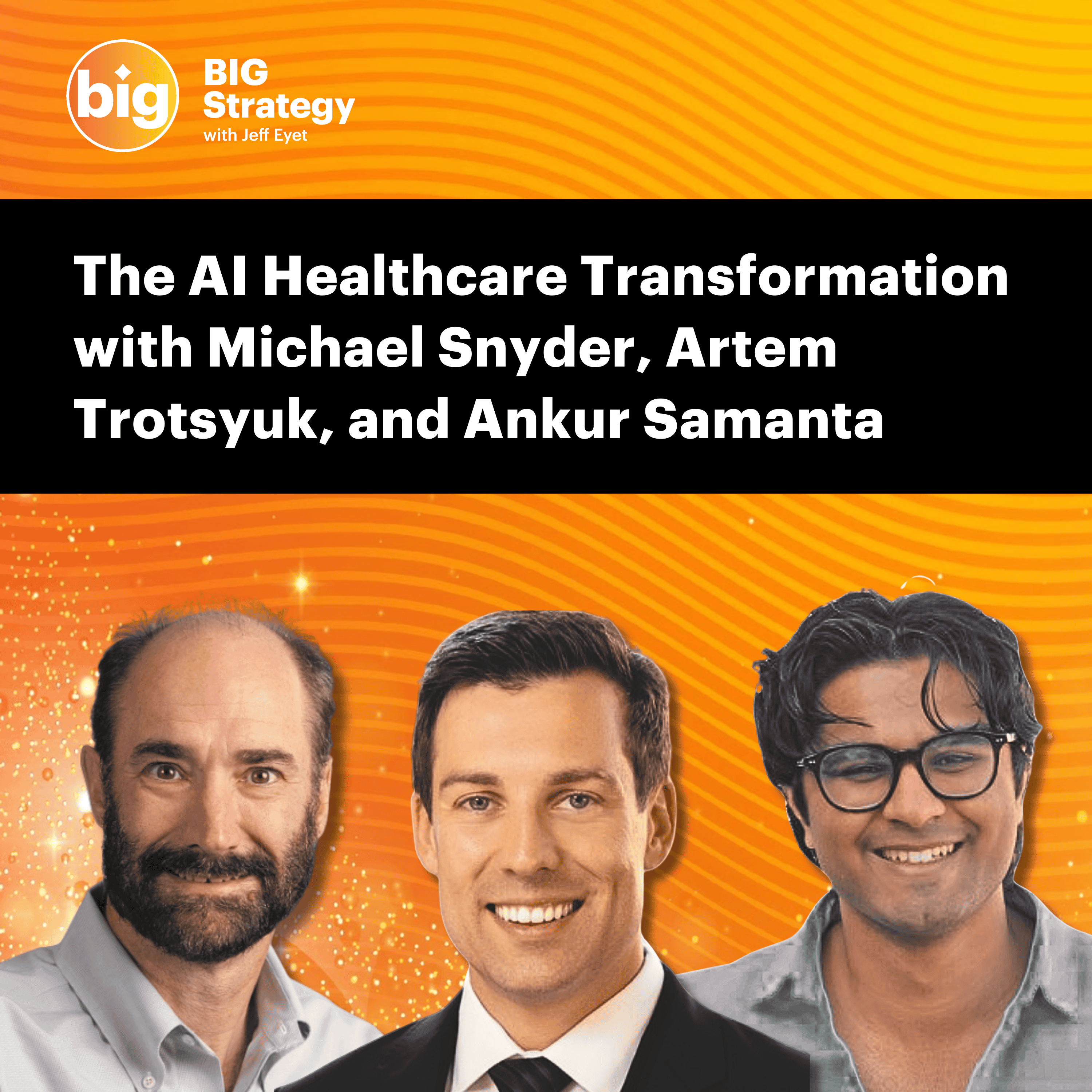
E066: The AI Healthcare Transformation with Artem Trotsyuk, Mike Snyder, and Ankur Samanta
50m 24s
The podcast episode features a panel discussion on the applications of AI in healthcare, particularly focusing on personalized medicine and the need for humans to utilize AI tools to enhance healthcare decision-making processes. Panelists delve into the idea of encoding preferences into AI models to provide personalized healthcare recommendations and insights. They discuss examples of utilizing AI in healthcare settings to analyze biological data, such as continuous glucose monitoring, to offer personalized recommendations for individuals. The conversation also touches upon challenges in training AI models with preference data and the scalability of personalized medicine initiatives. Overall, the discussion highlights the potential of AI in revolutionizing healthcare by providing personalized solutions at scale and improving decision-making processes in the medical field.
Transcription
9380 Words, 52507 Characters
(upbeat music)
- Hello, welcome to the Big Strategy Podcast.
I'm your host and fellow strategist, Jeff Hyatt.
This is your go-to spot for real talk
with the masterminds of business strategy.
It's about sharing stories, insights,
and those little nuggets of wisdom
to help you unlock big growth.
Let's turn the key and spring to action.
One of the promises of AI is that it will make healthcare
and fix this broken system,
but beyond fixing the system of healthcare,
AI can have massive impacts at the individual level.
And that is something that we are here to talk about
with a distinguished panel.
Rarely do we get such a panel,
particularly of researchers who are intimately known to this.
So let us jump in here and introduce our esteemed panel.
So we'll go around the room
and Michael will start with you, Artem, and then Ankur.
Just tell us a little bit about where you're at
and maybe one quick idea about AI and healthcare
that we haven't thought about
that you're gonna touch on during our conversation.
Michael, please.
- Okay, well, I'm Mike Snyder.
I used to chair the genetics department.
I run the Center for Genomics, Personalized Medicine
at Stanford.
We do a lot of big data research.
So as you might imagine, AI's embedded in everything we do.
What can I think of that you haven't thought of already?
- Probably nothing.
AI, as I say, is all over the place.
And I think we're all thinking about it,
thinking about how to use it.
And we certainly do all the time.
And so we can touch on any aspect you like
during this conversation.
- I'll give you a quick lightning round question.
Does AI need humans or do humans need AI?
Who needs it more?
- Humans need AI more, that's for sure.
- There we go.
All right, perfect.
Artem, please.
- I totally agree with Mike as well.
Humans need AI.
I view him as tools that can help us just super charge us
as humans.
Artem Trotshuk, I've done a lot of things
both in the longevity ecosystem
as well as in startup ecosystem.
Co-teach with Mike at Stanford.
We do intro to AI classes, longevity sciences.
And so today I'm gonna be bringing in the perspective
of the application perspective,
particularly on the applied AI,
mostly in the longevity sciences
as well as the early stage startup.
Perspective as well.
- Yeah, wonderful, thank you.
And a lot of these initiatives are in the early stages.
And so what is that timeline and track record for those?
We're excited to find out more.
Ankur, please.
- All right, yeah, I'm Ankur.
Thanks for having us.
I'm an AI researcher at Columbia
and the head of AI at SWASA.
Most of my work is in fundamental AI.
We look at AI reasoning, look at post-training.
So how to align AI systems with human preferences.
And then on the medical side,
we look at AI and drug development applications
and just thinking about when you deploy these models
in clinical settings and real-world settings,
how do we look at collecting preference data
and aligning AI systems to behave the way that we want?
- Fascinating.
Well, we've got a ton to cover.
And so I don't wanna spend too much time on me.
More of you makes for a better show.
So let's start with this concept, Michael, of big data.
And we've been sequencing the genome now for over 20 years.
That cost of that continues to come down.
But throughout your career,
give us a quick peek into
how we've actually been able to harness this biological data
and then convert that into a digital format
that we can begin to manipulate and apply AI to.
- Okay, well, showing up in a lot of case,
pretty much everywhere, as I mentioned earlier,
and part of it's because we're all different.
We're humans.
We all have different preferences.
We all have different biological reactions to food,
to everything we do.
And a good example is people's reaction
to a meal they eat for their glucose spiking.
So they're these devices called continuous glucose monitors.
And they're a big deal because a lot of our population
is diabetic, 11.6% to be precise,
and 33% are pre-diabetic.
And these devices let you look at your glucose spiking
after meals.
And it turns out we're all different.
So some people spiked to potatoes, some to bananas,
some to pasta, some to white bread, some to brown bread.
It's all over the map.
And we're only at a point where we can just start
deciphering some of that.
This is a big data problem.
We're trying to be able to collect data around people,
in our case, subtyping them by what's wrong with them.
Say, muscle and resistance, beta cell defects.
These are things that are evolved in,
if you will, glucose regulation.
And by subtyping them, even your microbiome,
we can try and better understand
how they might react to certain systems.
And again, I'm a believer if you collect enough data,
you should be able to build personalized models
and then personalized management systems.
And so that's what our lab does.
But I guess to add on to what Artem and others are saying
is that we also spin off companies that now use AI
and build AI-based models for personal health management.
For, I mentioned the glucose case,
but now we do it for virtual everything in the area,
metabolic control and other ways as well.
I could go all day on this topic.
I'm a firm believer in that AI has completely unlocked
this ability to bring personalized medicine at scale.
I created a GPT where I uploaded all of my blood work,
my microbiome, all right,
all that functional medicine kind of working.
And now all I do, I go to a restaurant
and I take a picture of a menu
and ask it, what do I eat based on?
- That's a good example.
And I might just, if I could have one more thing on this.
Traditionally, everybody's trying to talk about health coaches.
You have to have people involved in this
and it just doesn't scale.
And so all the companies that have done this
were the ADA Diabetes Prevention System
that involves coaches.
They touch maybe half a million people
when we've got a 100 million person problem.
So they're not even scratching the surface.
So we need scalable solutions.
AI is the way out of this.
- And Artem, to Michael's point,
is this where we're at?
Is it, do you feel as though the technology's evolved
to the point where we can use these AI tools
to supercharge humans?
What's your opinion?
- I think it's a, we live in a time where it's cheap
to do AI research.
And when I say cheap, it's much more scalable
for folks who, for example, you're using a chat GPT,
you scan, you take a picture
and you're getting that on your phone
while you're at a restaurant.
Five years ago, that was not a thing.
And even with, so what Mike was saying
with the continuous glucose monitors,
I recently put one on and I got a bunch of my friends
and family to try it too.
And it's super interesting how mindset shifts
based on the visual seeing of what's happening to you
on the individual level.
And so when you consume certain amounts of food,
you realize, oh, I didn't realize that strawberries
spiked me more than bananas.
Maybe I should avoid eating strawberries
to have a better insulin sensitivity result.
And then being able to have an extended longevity
in that capacity as well.
And so Mike's research is super interesting
in the fact that the glucotyping
and just having this personalized,
everyone's different, it's scaled component.
But it's interesting you brought up about using your GPT.
Onker's done some work where your readouts
get you to a certain point,
but it's not fully personalized yet.
And his work really ties into how do you get
from that 80% to 20% and better
to get even more personalized recommendations
in a scale way.
Maybe Onker, what are your thoughts
on scaling the GPTs and personalized coaches with AI?
- Yeah, so if you think about where you might deploy the,
as they say you're a business
and you're looking at building a personal health coach
and you want to actually use these language models.
The thing is, I like to say that if you paste
your wearables data into chat GPT, you send it in,
you could probably get an analysis
that looks good to everybody, right?
And it gets you about 80% of the way I like to say.
Actually, we've done research,
we've seen papers where they look at how does LLMs
compare to classical machine learning approaches
and interpreting wearables data or other kind of biomarkers.
And in a zero shot setting, meaning without too much training,
it actually does a pretty good job.
It's obviously not perfect.
It's not something that I would replace a human
with quite yet.
But compared to the existing machine learning approaches
that we have, language models are promising.
Now the key is, how do you provide sufficient context
of the wearables data that you're providing?
Think about time window, right?
What does this wearables data span?
What does it represent?
What is the context that the model needs to have
to understand what this means?
And that's at a general level,
but putting together that data package
when you prompt the model is incredibly important.
And then I think when you look at what piece of development
is gonna be the most useful
as far as going from a GPT out of the box
to an actual personalized healthcare assistant
is really in encoding preferences.
Because when you look at therapeutic applications,
because a lot of people use these language models
for self-guided therapy, right?
Because again, therapy is expensive.
And I would not recommend substituting
going to a human therapist
with just talking with your language model,
but you cannot deny the insane accessibility
that people have to some kind of guidance.
And the thing is, if you are a therapist, right?
There's, or you're a company designing a healthcare system,
there's probably a certain way you want the model
to behave in certain settings that's qualitative
and difficult to encode, right?
Or difficult to give rules on, right?
And so this is where we get
into the concept of preference learning, right?
Where you think about a proxy
of a population of human preference,
as far as what do I think there's,
what do I think my patients or users would respond best to?
And how do I, as a company or as an individual,
want the model to behave?
So we can take it out of the box language model
and align it, right, to my preference.
It's just like, you know, we teach the models
how to, you know, how to follow instructions, for example,
right, that's called instruction tuning.
And then the next step,
well, in a therapeutic system,
you're not necessarily following instructions.
It's a lot more nuanced than that, right?
The back and forth of it, they're a conversation.
And then another thing is psycho-fancy, right?
If you've used, like, Chatchapiti
or a lot of the other AI models lately,
you've noticed that the models tend to be very agreeable, right?
You can very easily gaslight these models.
And this concept of when you have enough evidence
to make a certain characterization or decision, right?
This concept of metacognition
that these models don't really have
as far as how they reason
and how they take into account evidence,
not just I'm using retrieval augmented generation
to provide them context about my, you know,
my health conditions or my data, right?
You, we want to be able to teach the model
when to use what information
and how to reconcile the information I'm providing it
in my prompt, which is what most of the companies
using these models can optimize
and the model that the information
that it's been pre-trained on, right?
Those may be conflicting.
When do you use what
and when do you recognize
that I don't have enough information
to make a certain claim, right?
And so there's a lot of development
that we're looking into
in how do you actually condition the models,
you know, guardrail them
and get them to behave in the way that we want
to maximize its usefulness
and sort of encode our secret sauce, right?
Did like, we think that preference data is the boat, right?
People ask, what is your data mode?
It is going to be the preference data,
these datasets that you collect for your platforms
that encode how you want these conversations to go.
- So what I'm hearing you say
is that the challenge is how the model was trained
versus that reinforcement learning from the user
to indoctrinate that model
with my own preferences as an example.
And like, I mean, I didn't want to get
to science fiction here, but you know,
that the model could say, well, my survivability is at stake.
If I give up on how I was trained, right?
We won't go there.
But Artem, like, what's your opinion
from the business side of things?
Is this preference data training these models?
Is that scalable?
Is that different than what we've seen before
where personalized medicine wasn't scaling?
- So if we're talking about scaling about the applications
and being able to do hundreds of millions of people,
I think it's a good first step.
As much of a lot of the work in AI, as you can imagine,
it's moving so fast and is iterating so quickly
that we're learning how best to teach the models
to adapt to what we want them to give us as an output
without necessarily knowing what we truly want.
And so that goes more on this higher level of,
what is it that we want to get out of this?
And how do we use other understanding of psychology,
the understanding of how your brain works,
understanding of like human want
and encoding that into these different model applications.
And that's where I work with the anchors doing
all that really like Tizen.
How do we address that big question
in social science research and translate that
into computer science to kind of bridge this gap
between what is it that we want
and how do we train the models to do that?
But on the business application side,
it allows for us to kind of explore
how do you build businesses
or how do you generate ideas?
So I'll give you a concrete example.
In our recent Intro to AI class at Stanford,
we had the students work on using large language,
using lovable.dev, which was, they vibe coded.
They vibe coded an idea.
And their entire semester, their project was create something
that you'd like for yourself as a utility tool.
And their final day of class,
they presented what they did, why they did it
and what data sets they used and so forth.
The limiting factor for a lot of those students
was data sets accessibility.
There wasn't enough data for them to use
to really tune in this preference component
into their projects.
But the interesting part was one platform,
lovable.dev, was utilized many different ways
by individual people tuned specifically
to what they wanted as an output for a task
or a specific objective.
So we had folks who designed a food coaching app,
a sleep app, a time management system,
a note to calendar system.
We had someone create, like take a picture of a barcode
and tell you what types of products are inside your
shampoos or your makeup, is it sustainable or not?
One platform, multiple applications.
So I think what's super interesting about where we are
in the development of companies and technology is
one platform, people personalize the use case
for what they want out of it.
And then on the business side,
it's understanding that the users will have the autonomy
to develop what they want.
And how do we develop tools to allow them to do that?
That's kind of where the next iteration of what I see
in terms of AI scaling is going into.
Before going into the whole area of physical AI
and where AI's robotics is interacting
with the physical world and where it's less constrained
in a system of a box and a computer and a cluster,
but rather interacting with the physical environment.
And what would that enable?
That'd be an interesting kind of--
- That would be fascinating.
And when you talk, I teach an introduction to AI class
at Berkeley as well.
And one of the things, frameworks I said very early
is that symbolist versus connectionist debate
at the beginning of the discipline.
And with that being said, I hear some of that
is that we can train the model on scientific data
to come up with an optimal path.
But what you're saying, and I may be overlaying,
so please correct me, is that the psychology piece,
it represents that connectionist
because it's not necessarily a set of rules, right?
What we want versus what's best, it kind of captures that.
And so is this one of the foundational decisions
in the discipline is still kind of unsolved today?
- I think it's a super interesting space, right?
Like the AI 1.0 was encoding rules.
AI 2.0 is encoding preferences.
What is a preference?
That's an aspect of like you're wanting to decide something.
How do you articulate a non-quantitative value
into a quantitative state?
That's hard, in my opinion.
But that's kind of where like work like Ankur is doing
is super interesting because it's trying to capture
that social science element into a quantitative setting
for you to be able to start articulate
these preference earnings.
And then work like what Mike is doing
where you can take the generation of the data sets
and the insights of individuals
to move towards this personalized medical applications
and scaling of that such that you can touch more people
with less humans in the loop directly
so you could triage better and so forth.
So it's like, it all kind of connects
but it ties into the fundamental underlying technology
being enabled to match more of what you're seeing
in the brain of how a human thinks
and how preferences are made.
What is the psychology and the social science behavior
of an individual that can be tied into models?
- And what have you learned from that Mike in your research?
- Well, I guess I'll back up a little bit.
Even without bringing the psychology part of it
just being able to pull in data to be able to make
see what's going on and make recommendations.
And a good example I'll use and I'm conflicted on this
but January I takes all your data, genomics data,
medical data and I have a ton of it.
I've fed it several years of all these medical records
and I get measured a lot.
You can see I have all my wearables here.
We can talk about that later.
My CGM data, all this data, we just fed it this thing
and I have all these concierge doctors
that give me advice all the time.
They're telling me what to do
and a lot of it's really, really good.
But this thing actually came up, they call January mirror.
It came up with things that had been missed
simply because the data was too large.
Meaning you can't, nobody can know all this stuff
off the top of their head.
That is say that the concierge doctors can't.
So for example, I made some recommendations about,
my zinc was a little low
and maybe I should do that to keep some of my immune cells up
and put together these bits of information
that were not necessarily obvious to the obvious person.
It even went against something
I thought some physicians were telling me I shouldn't do
which is it was telling me
you might back off of this one medication.
So I brought this out to someone who was a little more neutral
and said, well, actually they might be right.
Your AI was probably right.
That the physicians had a certain bias
about what I should be doing
and that's why I was on those medications.
I'm a diabetic by the way.
So that's only these diabetic medications.
So it actually came up and grabbed all this data
that again, no one physician can probably capture
and come up with quickly.
And that's a big problem about today's healthcare system.
You know, physician has 15 minutes to spend with you
and that's just not enough.
And so this thing can grab all this info,
come up with these very specific recommendations.
And by the way, a lot of what it told me
I was doing and knew about and all those stuff.
So that was all good.
But there were a few items as they say
that were probably pretty important
that turned out to be insights that I will wind up using.
So just pulling data and giving back again
sort of unfiltered, if you will.
And maybe it's a bit filtered,
but you know what I'm saying?
It's not trying to bring in any of my social aspects.
It's just trying to do that part.
And then on the other side,
I think when we start talking about the wearables,
there really is a lot of preference around lifestyle.
And that's where you really have
to bring in the psychology as well.
So again, all these companies, in fact,
every doctor is gonna have an AI agent
as part of their system.
If they, you know, who would use a doctor
that doesn't have that in the future?
I would.
- Would you add that AI assistant to their stack?
Or is it going to substitute elements of their care stack?
- Right now it's added because a physician
is ultimately responsible.
The ones who get sued if things go off.
But how--
- Welcome to America.
- So they're the final, you know, decision maker,
whatever, and this thing can bring,
the agent brings together all the info
and the physician reviews it and agrees or disagrees.
And what I like about the good systems,
the good agents actually tell you
where the information comes from.
So you can look it up yourself.
If they say, "Well, here, you should take more zinc."
And they give you the references that you can go spot.
Which, you know, as a scientist, I like that, obviously.
And so I think that's powerful.
And I'll give you one more example.
Again, conflicted on this,
I have another company called IOLO.
You give a little blood droplets.
I know what this sounds like, but ours works.
You give a little blood droplets.
Your mailman, no profile, 650 metabolites.
And then they give you very specific recommendations
'cause they can see, you know, your heart health,
your kidney health, all these things.
And it's not just exercise, more eat better.
It's very, very specific.
You should eat X, Y, and Z
and, you know, do these various things.
And, you know, some of these vegetables I never heard of.
I go look them up and sure enough,
yeah, they actually make a lot of sense.
So again, you can pull in information.
Now that's where you're gonna need the AI,
the psychology one,
because some of these vegetables may not taste good to you.
And so you have to have one that knows you a little better.
I think that goes to the heart of it, right?
The, it's the medicine we need
is the medicine that tastes the worst.
If you'll indulge me for a moment,
you're talking about bringing this data together.
And I was triggered by the eat better exercise more,
being insufficient advice.
And, you know, at my healthcare provider,
they tested three things and that was three blood markers
and that was their advice.
And then I went to a functional medical doctor,
tested a hundred, you know,
and got a much more nuanced advice.
And so I appreciate your, you know,
monitoring your zinc level.
It takes a special level of nerd to pull that off.
So I'm glad I found a tribe here.
But the point being is,
because I can't expect my primary to trust the functional
and the functional is not gonna trust the primary
or even just have the time to review.
So from a pure data perspective and then, you know,
Ankur, I wanna get your perspective
from a model perspective,
but Michael, from a data perspective,
do we actually need AI to create
this holistic view of our health?
- I think yes, because again,
no human can pull it together by themselves.
And as I say, I actually have all these concierge doctors.
People like to give me lots of advice
'cause they know I measure myself a lot.
And so I get all kinds of, in fact,
all our data have two petabytes of data online.
You can download and play with it yourself.
And so I get random advice too.
And so, yeah, and it comes, it's all over the map,
but consistent themes do pop up.
And, but the AI just gives a better,
it just does a more comprehensive systematic analysis.
And, you know, it can just reach much more broadly.
All the people, one of the drugs I was mentioning
was this drug called Farsiga.
It's an SGLT2 inhibitor, blotcher glucose uptake.
And, you know, it can grab all the literature around that.
And then figure out how it fits into your profile,
which, again, no one physician,
one physician might know all about Farsiga,
but most will not.
And so, but, and the one who knows about Farsiga
may not know as much about, you know,
some of the, I'm on PCSK9 inhibitors.
These are for keeping your lipids down.
They may not know as much about that.
And that's actually a problem with medicine today.
I'm sure you've heard this many times, it's fragmented.
We have cardio specialists, we have diabetes.
In fact, I tell my heart guy, you know,
he kept wanting to up my statins,
which I know raises my glucose.
And I said, look, your job has stopped me
from getting a heart attack.
And if that's true, you're successful.
But I could die as something else and you don't care
because you've done your job.
- Right.
- I know I'm pretty well, so I can tease him that way.
But that's the nature medicine, right?
They're trying to protect you on their thing,
but they're not looking at the whole picture.
And I think this is where your AI agent can kick in
and see the whole picture much better
than any specialist can.
- Yeah, and Ankur, what are the implications for this
from a model perspective?
- So first of all, when people think of like AI models
and AI, I mean, it's not just language models, right?
When we, like you think about in a clinical context, right?
Or I mean, a lot of any quantitative data
that isn't in a natural language,
you're probably not going to be using language models
to interpret some of that, right?
Because right now as baselines,
they have a lot of statistical modeling,
you know, how many standard deviations off the baseline,
are we that kind of stuff?
I think condition monitoring is really important.
And what I've done work, you know,
in the past with hospitals is say you have an ICU, right?
I have all these different kinds of data sources.
And as a human, I mean, it's obviously impossible
to try and interpret everything altogether.
Just orchestrating all of that as a nightmare.
And the thing is there are trends that AI can draw
from when I look at multimodal AI,
meaning from multiple data sources, right?
How do I put all of that together?
How do I represent that in a way that AI can then look
at that and draw correlations across different modalities
that previously only like highly trained clinicians
are able to do that?
I think AI can be a great assistant in that sense.
From a modeling perspective,
I think there's a lot of research needed
in interpretable AI.
Like you asked, you know, how do we get them
to trust what the AI is saying?
And in this case, because right now a lot
of people treat AI like a black box.
And to a certain extent, it still is.
And so to be able to see how the AI is coming
to that decision, what trends it's looking
on the full trace, you know, that it went through.
So you have the models that interpret the quantitative data.
And then you have the language models,
which can take the analysis from those, you know,
early stage models and then say it in a way
that say it in a natural language, right?
So that anybody can come and understand it
at different levels of expertise.
I think that's a great thing that AI can do is take data
that previously was not interpretable
to certain people in the organization.
And now you can then have different people interpret.
Like it translates, you know, say from Shark to Dolphin,
for example.
But yeah, and then from a modeling perspective,
I think one of the big ones, and Archim,
you brought up the psychology point.
And I think there's a lot of work that's needed
in terms of how to utilize the evidence, right?
And this is where not like grounding AI reasoning research,
not just in reinforcement learning theory,
or, you know, what is giving me a 5%
that like performance improvement
on a particular benchmark dataset,
but also looking at the way humans make decisions.
And it's not that the AI is gonna make decisions
the same way as the human, right?
Planes don't fly the same way birds flap their wings.
But it's taking inspiration
from that decision-making process,
the way that we accumulate evidence,
the way that we, you know, social perception,
confidence, these sorts of things.
And these are critical because being able to understand
the reasoning process of these models will go a long way.
Or, I mean, developing those reasoning capabilities
will go a long way towards enhancing trust
in clinical decision-making and regular day-to-day usage.
And that kind of research is fundamentally very important.
At the Berkeley Innovation Group,
we are a strategy consultancy and AI advisory firm
focused on mid-market companies
looking to unlock big growth.
In contrast to management consultants,
typical top-down hypothesis-driven approach,
Big uses a curiosity-inspired bottom-up approach,
leveraging customer insights to drive strategy co-creation.
Learn more about our approach by downloading our e-book
at biginnovates.com/e-book.
Now, back to the show.
- Artem, what's your perspective in terms of taking
what we know is some very rich datasets
that can provide deep insights,
but how do we externalize that
into making humans' lives better
through wearable devices or physical AI?
- The super exciting part of where AI research is right now
is that there's all these novel and kind of new insights
that we're trying to pull from how humans interact
or getting pulled into these models.
These models are getting better
at representing human preferences.
And on top of that, you have new advances in AI agents
and AI support assistants
and all these other tools being developed,
which allows for the application layer to be unlocked
to get new insights that were previously not discoverable.
So what excites me the most,
I think right now with all this work,
is solving a lot of biology and questions in biology
that have yet to be solved.
So even with the insights that Mike was talking about earlier
for the personalized data components
and all the data that Mike has on himself,
how do we extrapolate the learnings
of all the sensor data that Mike has on himself
and then see if that's generalizable and scalable
to other people who might not have all his sensors,
but we can glean certain insights from that.
And that can be useful for other diabetics, for example,
and people who have maybe other data that is kind of sparse,
but can kind of layer on top of that.
Some of the work that Swaz is doing with NASA
and the special forces groups are tying in this concept
of personalized delivery of AI
in remote settings where internet is not available.
Can you have a virtual doctor on a space capsule
on a mission to Mars where you can interact with them
and it gives you actionable insight
in the case that there's an injury on board
because of the latency of the delay in time,
it's gonna take to get that to Earth
and get a response from the Earth doctor
back to the Mars doctor.
Like how can you encode an AI
that can be deployed to space?
That's super fair.
- Can I ask a question specific to that, Artem Onker?
Is the answer that we create a specialized model
that's tuned specifically to those needs
that can run on a lower power processor
or do we need to pack these capsules with GPUs
or higher order processors because the models are so big?
- Yeah, I think that I wouldn't say
that they're mutually exclusive.
Like, I mean, look, when we look at in remote settings,
say in space or for DOD applications,
yeah, I mean, let's be real,
the compute demands or the compute infrastructure
that we have simply is not robust enough
for large scale model deployment.
But we do need to put a ton of resources into
how can we take the capabilities
that everyone is used to with language models
even at their current state and catch up these small language?
Like I really do believe that
as far as widespread adoption of AI, right?
Especially in edge cases,
you do need small language models
that can fit in memory constrained environments
that can perform reliably.
And to directly answer your question,
yes, at the current state of research,
what we find is that fine tuning small language models
for domain specific tasks, right?
Is feasible?
Most people do have the compute
to be able to do something like that, right?
There are memory efficient methods
to fine tune these language models.
Their declaration of the data set
is the single most important thing.
As we like to say with AI, it's garbage and garbage out,
right?
So like, I can tell you,
if you take your average small language model,
which again, this is several magnitudes smaller
than chat GPT or clot or whatever that you use, right?
And we're talking about models that can fit
on like a single GPU and eventually on a laptop, right?
Well, Google released their model recently,
like a Gemini for mobile,
you can download the model on your phone or something.
And that was, yeah, Artem, that's exactly where I was going
is like, I feel like we're this close
to be able to have a private model on my phone.
Yeah.
We're definitely getting there.
We're definitely getting there.
And I'm very much looking forward to having that.
I mean, data privacy is so important.
And when we think about what user data is like,
where before it used to be like your clicks,
your browser history or, you know,
how long you're lingering on a particular real, for example,
you're now entering a new phase of user data, right?
Which is how you're interacting with these AI models,
what style of conversation,
what kind of interaction between the human and AI
is able to keep you using it.
Because remember, there's not much stopping me
from switching between one AI model provider to another, right?
It's just swapping one subscription for the other.
And so when you start to think about, again,
it all comes down to mode, right?
How do I keep my users invested in my product?
It's the user experience, right?
And how do you encode how you want that user experience to be?
How do you maintain that?
'Cause AI models, you're not going to be using
the same model over multiple years, for example,
the speed at which this industry evolves.
If you're talking about open source models,
I think one of the biggest issues
that people talk to me about is, well,
what do I do when I get a new open source model out, right?
How do I know when to swap them out,
which one to use all these from a business standpoint?
And yeah, so the data set that you're curating,
the task, the domain specific data set is the key
on how to take a small language model
and specialize it in your use case.
And the research shows at this stage,
that is what you can do.
But high quality benchmarking and evaluation is critical,
because there are cases where a language model,
if you have access to remote API calls or you have that,
then that does more than well enough
and it isn't worth the investment to do the fine tuning.
So there's a lot of work that's needed there.
So I guess it's when your answers start shifting,
then you wanna see what's going on and evaluate that.
Just to your point though, Ankur,
there's a book that came out very popular
just a few years ago, "Deep Medicine"
from Eric Topol about AI in medicine.
And he said, AI will replace all these things
or complement all these things,
but one area it will never substitute is empathy.
And that concept's gone.
Now you can definitely have empathy brought into AI.
So, and that book just came out,
I think it was two years ago or something like that.
So it's pretty clear,
we can bring a lot of these things that were thought
to be totally human into the space
and they're pretty effective actually.
Some people would prefer to talk to their AI doctor
than a real doctor.
Probably most people would.
- Did you all hear or see the demo
of XAI's recent voice assistant
of how empathetic the tone was of the female voice?
It was quite interesting.
Like she whispers to help you coach you through a problem.
If you're struggling with something,
it is when I listen to this,
I was like, this will either impact birth
just like the population levels completely
and or just the way in which it's evolving is crazy.
- I can certainly see the convergence I'm seeing
and I see it amongst the student population
is as we shift from millennials
who really grew up with the internet
but still had the get outside and play sort of mindset
and they were very much chafed at the idea
of being constrained by a class assignment, for example.
And they wanted to have, oh, I've got to,
I want to do my project, okay, do your project.
And now as we move into this generation Z
who's coming through the ranks,
it's very much what's the rubric, show me an example,
what's an A paper and they're very tentative
to get outside of that protective umbrella,
if you will, that's created by that classroom.
And my theory is just as those folks emerge
into the professional world in conjunction with AI models,
as you said, Artem, that are that empathic,
it's very interesting, right?
What does that say for creativity?
You can program in, you can raise the temperature
to increase creativity, you can add tone for empathy
and are humans going to assume
that that's the new normal and align with that?
Or will humans continue to challenge the model
and to bring the model up to where we are?
And I guess that may be a bit hypothetical,
but who's ultimately leading this conversation?
- Well, it may be for the masses,
yeah, the AI will be leading the conversation.
But it may be, I guess some of us hope
that there'll always be some individuals
who will be very special,
who can at least match that, if not exceed it.
So that's what we hope because at least,
I think we're at that point right now,
they're clearly very, very smart people
who come up with things that AI doesn't come up with
and da, da, da, da.
Will that be true, you know, five years from now,
10 years from now?
I don't know.
- I think we need to make sure that in the education system
as it evolves, that people are taught
how to think from first principles
and question outputs because what you just described,
we'll push that into five, 10 years from now.
If you just believe everything your output is giving you,
the model is telling you, you stop thinking critically.
And if you stop thinking critically,
what does that mean for humanity?
For education, I really want like,
I think that the most important part is
that thinking critically about a problem
and questioning when something doesn't seem right
is important.
And this aspect of including sources
of making sure you know where your data is coming from
and linking all of that,
that kind of part of the scientific method
to make sure that check, but verify and validate
to make sure that what you're seeing is accurate.
Otherwise, if what you're seeing on the student side
is here's the constraints, here's the rubric,
I'm not thinking outside the box,
that's not healthy in my perspective.
- And it's interesting that you said that the students
are asking for the rubric, they're asking for an example,
they're asking for it.
That sounds a lot like the things that you would put
into the prompt of a chat.
- Yeah, as far as how do I actually,
how do I do this assignment, which it's interesting
that like our brains, again, like as we grow up
with these, you know, grow older with these models,
like your brain, like I think it's reconditioned
as far as how you think about solving the problem,
which part of that's a good thing as far as,
well, the way that you load up the context
for a model, I mean, that is how we should be thinking
as well as far as how to frame the problem,
how to organize everything.
But yeah, I mean, arts and bring up a really good point
about first principles and then learning how to learn, right?
Learning how to learn and learning how to problem solve.
And a lot of people, a lot of people talk about like,
taking software engineering, right?
Well, isn't AI just going to replace all the jobs?
Just look at the code.
I like, I don't look at a software engineering degree
as learning how to code.
It's learning how to problem solve, right?
Like AI is just another tool, right?
When you, when all these companies, I think it's too much AI
or AI this company, AI company, like just own AI
and everything, it's a vertically integrated company
that in a very specific domain that just happens to use AI
as another tool in its toolbox, right?
And I think bringing it back to, again, take an IP lie
in venture capital or private equity,
like these are fundamentally different verticals, right?
And learning how to, the kind of problems
that need to be solved in those different verticals,
framing it in a way properly in the way that humans do,
the way that we do right now, and then going and saying,
okay, where can I effectively deploy AI
in a way that actually drives value?
Not just, well, here's a chat assistant.
I'm just going to try and use it to automate most of my job.
So thinking on framing that problem is critical.
- When we invest in companies,
what Anchor just brought up is super important.
There's a lot of me too AI companies that are like,
oh, here's this new tool for this
or this new use case for this.
A lot of those me too companies,
their utility is being kind of absorbed
by the larger AI labs, particularly the chat,
to be the open AI and other groups,
because it's simply they're adding applications
into the already integrated vertical stack.
And so the ones that companies that are standing out
on the AI use case, not only have a data mode,
a data mode of users, but also a real use case,
or real world application that is useful for people
that they can't get anywhere else.
And just by Googling or asking for complexity
or asking chats, browser, or anything in that capacity.
And if we're talking companies that are developing insights
and projects in the biology space,
it's not just I have another AI engine
that can dissect your data, but I also have a product,
like give like something that can help a person,
not just another way to look and interpret the data.
And so like if we're talking about developing drugs,
for example, it's preferences of chemists,
preferences of biologists, preferences of different
individuals, data modes that are unique.
And then can you get assets and tangible products
out of that pipeline, or do you just get a bunch
of readouts that don't necessarily have utility?
And it'll be interesting to see when the first AI generated
asset actually passes phase three clinicals,
'cause there's yet to be one that has been fully FDA approved,
that's been generated fully by AI.
So at least for now, for the last 10 years,
there's nothing out there that's been approved.
It will be interesting to see when that first asset
will likely be approved.
Until then, you still need the humans in the loop
for all that.
- So you use the word when.
So I'm assuming that's in place of the word if.
- If it, I mean, there's companies that tout
that they are almost there.
And so I want to give them the benefit of the doubt.
But right now, it's all human guided development.
It's not AI generated development.
So there's a lot of still human involvement
that is required.
And so not to over, like the last key point here is
not to over rely on the outputs of the models,
but also understanding its limitations
is they are not the end, I'll be all,
can solve all the problems.
They will agree with you.
They, if you yell at them, they will be more responsive.
There's a lot of things and where it's like,
you learn how to question the model,
the model hallucinates still, makes things up.
Until all those are solved,
it's simply a starting point for which people
are kind of playing with and adding applications
on top of that.
- And Artem, like that the concept of using AI
and research to come up with new hypotheses,
like when you, when you think about like,
what does completely AI guided research look like?
Or what do we want it to look like?
And that comes down to the fundamental question of,
is AI capable of original?
I don't know if original discovery is the right way
to phrase the problem,
but original ideation and is it a problem if it isn't?
Does it need to be like,
when we think about the research community as a whole,
right, how much of the work is truly original
versus an iterative improvement
and getting a better understanding
of which parts of that pipeline can AI effectively sub in?
I or assist, you know, we've seen papers
that look at AI to self-improve, right?
Or like when we talk about tuning AI models,
can it design its own reward models?
Can it learn to tweak itself or on the other hand,
like using AI to generate different hypotheses?
You test them in the robotic labs, like full automation.
So it's very interesting research that's going on
to see the limits of what AI
in its current format is capable of.
But yeah, it's a very interesting conversation.
- So final lightning round here
and we'll start with you, Ankur.
What is the potential and what should I expect from AI
in terms of improving my health?
And between now and then,
what should I remain skeptical of?
- As far as improving health outcomes,
I think a personal guide,
being able to interpret my health data
and being able to, I think what we need to work towards
in the research community is how to get the AI to a point
where it can understand my data
and provide responsible guidance in a way
that is sanctioned by experts in this field, right?
People who do this for a living
and guiding that to the way that it should be.
'Cause I am going to be using these models.
We are going to be using these models for guidance
like it or not.
This reality is there.
It's not a question of whether we should be doing it.
It's a question on the research in the industry
on how can we get AI models in a way
that there's more interpretability
and more responsible generation to the user.
I think it's critical that we put a lot of resources
into that and what we should be skeptical of.
Don't trust everything that is generated.
Don't take it of base value.
Use it as an assistant.
In fact, learn how to use it.
If you know the way that you prompt it,
the way you interact with it
is we'll shape the conversation heavily.
So use it.
Don't stay away from it.
Heavily use it.
But just there's an asterisk in front of whatever they say.
- Nice, nice.
Artem, I saw you nodding in violent agreement.
- Yeah, don't trust everything that it says I agree.
But also it's going to add a follow up to your question
when you said the utility of this.
In what timeframe are we talking?
In the next month, next six months,
I see you're next 10 years.
'Cause I feel like each of those
will have a different outcome.
What are you thinking in terms of?
- Yeah, I don't expect anyone to know in 10 years
what will happen, right?
But I like to say today's the worst AI that you'll ever use.
And if I look one year back
and just think of the progress
that's happened over the last year, I'm in awe.
So I would even think closer in,
what is something that may happen sooner than we anticipate?
I think the soonest thing that will be the two things,
a model on your phone that is easily accessible,
that's integrated into the hardware,
and then physical AI.
Those two things are gonna be super interesting
in the next two years.
Because the move towards robots,
the move towards integration and interaction
with the physical world,
and then this aspect of compute on your phone,
your phones are really smart as is now.
Imagine layering that on top of that,
where it can access data silos
that researchers don't necessarily have access to
because of privacy on your phone,
but what if has my Apple health data, my Fitbit data,
my WOOP data, certain health record data
that I'm not necessarily feeding into a model?
But I'd like to keep on my phone,
but I also want some personalized insights on that
so I can get some personalized kind of approach
of how I tune my body.
Optimal performance, enhancing performance, longevity,
all these things.
I think those two will be super interesting,
kind of see how that ties in.
And I pushed that further
because we've been literally vomiting data
for the last 15 years.
And what have we gotten in return?
Like autocomplete and Gmail?
I would hope that for all of this data,
there would be some greater end.
I don't know, we'll let you get the last word
in this discussion, Mike.
Yeah, I'll build on Artem's thing.
I mean, I envision a world where you get up in the morning,
you look in the mirror,
it's already inputted all your wearable data,
and it's going to have visual data and voice data,
and we'll give you very specific recommendations about,
look, you didn't do that walk after dinner last night,
and that's cost you 30 points on your glucose.
So don't skip that tonight.
And I think we will have
these personalized health management systems.
They're already here to some level,
but they're not at the level they could be in.
And I think if people also get some realization
about how bad health really is right now,
I think there is some awareness going forward.
For example, like the glucose is the one I keep going back to,
but this is a real problem when you think about half
the country being pre-diabetic or diabetic,
and those numbers are getting worse.
And the consumption of ultra-processed foods
is just going up and up and up.
And so we need methods to mitigate all that,
or we as a society will all pay for that,
both as a society and at the individual level.
So we really need these personalized management systems,
and they're quite doable.
We'll see if RFK gets his wish about everyone in the country
getting a wearable, that would be very, very interesting.
It happens to be something I'm supportive of.
I've sort of argued for that for a long time.
I think people who wear a watch,
they do take that little bit of extra to, you know,
everybody walks 9,600 steps,
will always walk that extra 400 by the end of the day.
So they do promote,
and I think we can use all this information.
We just see better systems.
I think it is holding us back that we don't collect the data.
We don't get it back in a very, very rapid and usable form,
but imagine before you go to bed,
you have a set of recommendations
or when you get up in the morning, same thing,
to better manage your health.
And I don't think we're far away from that at all.
- What I'm gathering from all of your feedback
is that the biggest barrier is not technological.
It's ourselves and our psychology.
And I think that that goes back to a very early comment
that you made, Ankur, in terms of that model
and balancing what the model is trained on,
the quantitative data that it's trained on
versus the qualitative reinforcement data
or learnings that it gets from the user.
And how do we optimize that?
Understanding that we're actually have a model now
that can optimize better than its subject,
can execute and what's the takeaway from that?
But that will be for part two of our conversation.
So I wanna thank you all.
Michael, Artem, and Ankur, thank you so much.
We will add links to your labs
and other things we've discussed in the show notes
here as we go.
But again, thank you very much for joining us on the podcast.
- Thanks for having us.
- Thank you for having us.
(upbeat music)
Podcast Summary
Key Points:
Discussion on the applications of AI in healthcare, focusing on personalized medicine.
Panelists discuss the need for humans to use AI tools to enhance decision-making.
Exploration of utilizing AI models to encode preferences for personalized healthcare recommendations.
Examples of how AI is being applied in healthcare settings to provide personalized insights and recommendations.
Mention of challenges in training models with preference data and scaling personalized medicine initiatives.
Summary:
The podcast episode features a panel discussion on the applications of AI in healthcare, particularly focusing on personalized medicine and the need for humans to utilize AI tools to enhance healthcare decision-making processes. Panelists delve into the idea of encoding preferences into AI models to provide personalized healthcare recommendations and insights. They discuss examples of utilizing AI in healthcare settings to analyze biological data, such as continuous glucose monitoring, to offer personalized recommendations for individuals.
The conversation also touches upon challenges in training AI models with preference data and the scalability of personalized medicine initiatives. Overall, the discussion highlights the potential of AI in revolutionizing healthcare by providing personalized solutions at scale and improving decision-making processes in the medical field.
FAQs
AI has the potential to impact healthcare at both the system level and individual level, providing personalized solutions and improving outcomes.
Humans benefit more from AI, as it can enhance and support human capabilities.
AI can analyze big data to identify individual variations in health and suggest personalized treatments or management strategies.
Preference data helps train AI models to align with user preferences, enabling more personalized and effective interactions.
AI tools can help scale personalized healthcare solutions by processing large amounts of data to provide tailored recommendations and support.
Chat with AI
Loading...
Pro features
Go deeper with this episode
Unlock creator-grade tools that turn any transcript into show notes and subtitle files.
 PodcastTranscript AI