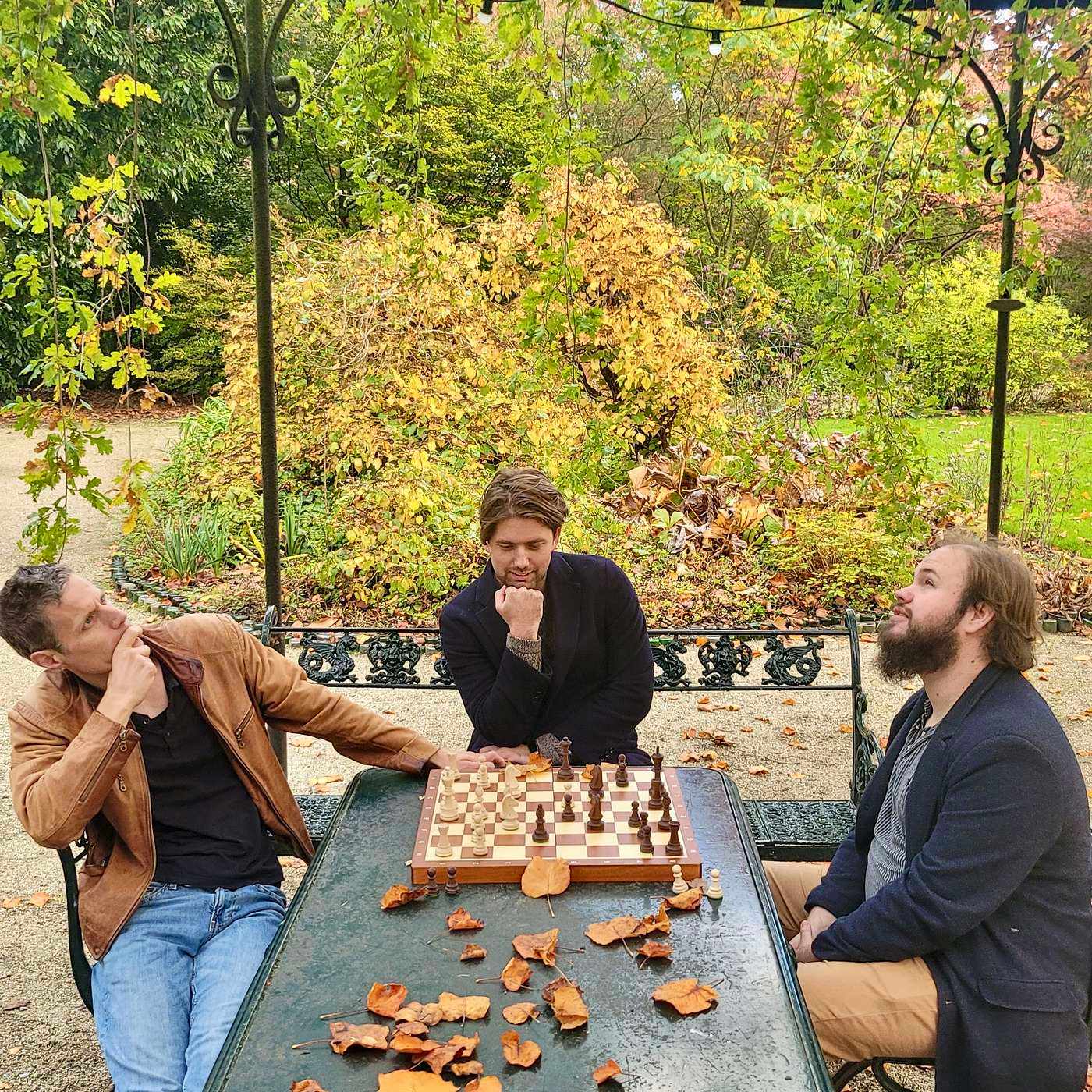
The transcription discusses Kant's fundamental questions regarding knowledge, action, hope, and the essence of humanity. Kant's inquiries revolve around the limits of knowledge, ethical actions, and the concept of human nature. The "Human Conditions" podcast explores philosophical anthropology, emphasizing the importance of understanding what it means to be human and how it shapes philosophical inquiries. Kant's works, particularly the "Critique of Pure Reason," delve into the conditions necessary for scientific knowledge and human understanding, emphasizing the analysis of human faculties. The dialogue between the speakers provides insights into Kant's critical philosophy and the significance of self-reflection in understanding human existence and the foundations of philosophical thought.
Transcription
10691 Words, 59886 Characters
"Yeah, yeah, oh yeah, why is contingent my condition?"
The manual can't, the most influential enlightenment philosopher, summarizes his project as follow.
All interests of my reason, the speculative, as well as the practical,
is united in the following three questions.
The first is, "What can I know?"
That means what are the limits of knowledge?
And knowing these limits brings us to the second question, that is,
"What should I do?"
And about that second question, if I do what I should do,
Kant says, "Then there follows a third question. What may I hope?"
In his lectures on logic, Kant adds a fourth question.
For him, the fourth question is the most fundamental one, as the previous three
are rooted in this single and composing question.
And that question is, "What is the human?"
In these podcasts, we zigzag through space and time,
traveling through philosophical history, attempting to address the condition that affects
us all the human condition. We will see that there might not be a single condition,
but many ways of being a human, multiple conditions.
So we are dropping in, trying to see the condition, our condition is in much like
the eponymous song by Kenny Rogers.
Welcome to this podcast about the human conditions. In this postcast,
we, that's David Julian and myself, Rolf, we will discuss human conditions.
Some important questions that we'll discuss. What is philosophical anthropology?
Why is it important? And the most important questions of all, what is the human?
In each episode, one or two philosophers will take center stage.
I also happen to be a human being, so I have got a special interest in this course,
so to say. And I've brought to other human beings here to discuss this.
One is David. Could you introduce yourself?
Hi, I'm David van Bitten. I'm also a teacher at S. Phil. My interest in the area of these
philosophers, but also I've done research about the philosophy of financial debt. And I'm also,
I think, a human being. However, I only go by my passports in order to determine
this. So whether I'm actually a human being, this is something we're going to have to find out
in this podcast. You certainly look human to me. Julian, could you introduce yourself?
Yes, so I'm Julian, an assistant professor of social philosophy at the Erasmus School of Philosophy.
Very much intrigued by the question of human conditions, which is why I'm here.
I also have interest in themes in political theory and education.
Okay, well, let's start with the big questions, because that's what it's all about.
And the biggest question of always here now, why do we call it human conditions?
So the name, human conditions, I think, on the one hand, we can say it refers to a shared melody,
something that we have in common in the sense that we all suffer as human beings.
And this is something that is just shared fate. I am suffering from a human condition, you could say.
And on the other hand, we can say human existence, if we try to think about what this might mean,
what it requires of us, apparently, we are conditioned by something in some way, maybe even plural
some things, hence our choice for human conditions in the plural. And what is more, we think that
this question of human existence, what is it to be human, and what does this require of us,
is in a way the first question that you can ask in philosophy. So in order to start thinking,
in order to even begin to ask such questions as what should I do, what is right, what is wrong,
you first need to know what kind of human conditions condition this thoughts in the first place,
that sounds complicated, and maybe it is, but that's what we're here for. And as we will see,
it's really from the 17th and the 18th century on that humanity starts acting as a condition for
all sorts of practices within and outside of philosophy.
What do you mean by the humanist condition for philosophy? That means that in order to do philosophy,
we need to reflect on who it is, which is proposing to do this philosophy. What are the starting points
of thoughts? And then, of course, classically, you can relate this to all kinds of features of
external reality, like a God-given law, for instance. The frame of human conditions proposes that
in order to get it right, we should focus on what is it that characterizes human existence,
in general, and human thoughts, in particular. So, and why the human and not something else here?
So the guiding intuition is that we need some kind of starting point, and since it's harder for us
to think from the perspective of an ant than from the perspective of the human being, it's maybe
unavoidable, even if we say that we're thinking from the perspective of a tree or the North Sea,
that it's human beings doing so. It's really an attempt to reflect on this initial situation.
So, if I would summarize it, since we have no external basis to base ourselves upon,
all we are left with is introspection in ourselves as the condition for all kind of philosophy.
Yes, and then I think that's something that maybe requires a kind of final answer, but which is
also very hard to give. So it's digging up the foundations of, I would say, all of philosophy.
Okay, so will we get the final answer after the course is that we're done?
I think final answer is maybe a bit ambitious, that would mean that we can all go home as philosophers,
but I think we can definitely shed some light on what kind of thought we need to have in relation
to human conditions in order to start doing philosophy. So it's not just an abstract philosophical
problem, it's not just about something that only philosophers are interested in. It's really about
kind of evolution in thought, where humanity, as such, becomes foundational to all sorts of practices.
So you can think of something like human rights. So on the one hand, we all like to say that we
no longer believe in human exceptionalism. So it's very common now in science that people no longer
believe that there's any particular distinguishing characteristic, which separates the animal,
the human being from all other animals. On the other hand, we still in a legal situation, for example,
we speak of human rights, which means these are rights that you have not because you've done something,
not because you've learned something, but rights that you have by the very fact of being a human being.
And this discourse, the discourse that gave rise to human rights, that starts in the 17th and 18th
century. I think in antiquity, for example, you don't have something like that. In Roman law, for
example, you have creditors, debtors, you have slaves, but you don't have human beings as such as a legal
category. In this podcast, we will be talking about Emanuel Kant. I have been teaching philosophy for
several years now, and I do not know a philosopher of whom the opinions are more divided. There are some
people who love Kant, and I mean really love him, and there are more people who really hate him.
I've taught a course about Kant, where we started reading Kant, and my experience was that
everybody was astonished after reading Kant, really surprised by the genius of what he was doing,
because I really believe it is genius, what he is doing. But the people who loved him loved him even more
for it. But the people already hate him, hated him even more for it. Emanuel Kant is hard to overestimate
his influence on philosophy, and today we will be talking about him. He was born in 1724 in Königsberg.
In his early life, he worked on physics and astronomy, but he is primarily known for three works.
That's called the three critiques, critique of pure reason, the critique of practical reason,
and the critique of judgment. And the first question that I would like to ask Julien is,
what is it with all this critic? What is so critical about Kant? Why are his books all
called a critic of this and that? So the first response to this intuitively is that you might think
that Kant is a skeptical philosopher forever trying to debunk things and to critique them in that sense.
That's part of the answer, because Kant is trying to respond to David Jung, who's the most well-known
skeptical philosopher, and Kant thinks that we should take this challenge very seriously,
but also to get beyond it. And these three critiques are sort of his answer to this
skeptical challenge. So what he's trying to do is to look at human faculties, so the capacities
that we have to do things. And critique here means not just criticizing, but also analysis.
So what is it that we do when we engage in practical reason, whatever that means? It's justification,
so what grounds practical reason, or pure reason, or what have you? What is it that makes this
a viable enterprise, something that we can in fact do in the first place? And then also to try
to showcase the limits of these capacities. So how far can pure reason take us in the realm of
knowledge and where can it not take us? What are the limits of this capacity that we have?
So these three books are critiques of David Jung? Well, there are responses in a way to David Jung
by trying to point out how we can in fact have knowledge, which is something that Jung has a
skeptical philosopher in some parts denies. It's a constructive enterprise in the sense that he
tries to show what grounds and what justifies the kind of knowledge that we can in fact have,
the kind of morality that we can in fact derive. But what is he criticizing then?
I think it's not primarily about criticizing. It's about using this word critique in the sense of
analysis, justification, and limits. There was a funny newspaper article a couple years ago
where someone said that Kant was the first woke philosopher. That was a very funny take, especially
if you know that in philosophy, Kant is usually criticized for his quite outdated political views.
But the reason they thought he was the first... Because his shoes were politically outdated,
I heard he was a full-blown racist, right? Yes, exactly. That's definitely not why we're
reading... Especially to be sure. Yes, 100%. But the reason he was interpreted as being the
first woke philosopher is because this offer read the word critique pure reason and they assumed,
oh, this is the first philosopher who no longer believes in the faculty of reason. And it's
actually quite the opposite. Kant is not criticizing reason in the sense of saying, well, the
faculty reason is bad. He's using critique in the sense of canine, which means to distinguish
in Greek. So he's using critique as a tool for discovering, to what extent we can use our
faculties. And if as long as we use our faculties within certain boundaries, then we have, in fact,
for Kant have a very powerful faculty of reason and a very powerful faculty of understanding.
We're extremely rational beings. So he is criticizing his own reasoning. Exactly. And our reasoning.
And how does that make reasoning better? Well, I think we're going to get to this in more detail,
but Kant is going to show that if you use your faculty of reason in an unrestricted way, you can
lead yourself into paradoxes. And one of the examples he's going to give of this is, is once you start
thinking about metaphysics in the sense of once you start thinking of those questions, which you
cannot answer by means of your empirical faculties alone. So you can, you might think, for example,
about the limits of space. As soon as you start thinking about, oh, is a universe.
I'll wait a minute. Let's take three seconds to think about the limits of space.
Okay, but with the limits of space, I'm not referring to, let's say, the restricted housing market.
No, I'm thinking about the limits of space in a physical sense. So if you use your imagination,
you can kind of bring yourself to the boundary of the universe. And then you can think about
the question, is the boundary of the universe a heart boundary? In a sense that there's, at some point,
if you take a spacecraft and you venture out into space, you suddenly run into a wall,
you can think about the question, is that boundary, is there something behind that boundary or not?
And then you start thinking, well, if there's something behind that boundary, then it means
the boundary of space is not really the boundary boundary, just the wall, and actually space continues
outside of that wall. But when outside of that space is there then another boundary, et cetera,
et cetera, et cetera, you notice I'm talking much quicker and quicker and quicker. And the reason
I'm talking quicker and quicker and quicker is because my faculty reason is kind of encountering
an error. And what Kant is trying to do is trying to explain why, whenever we start talking about
these great questions, we run into contradictions. So we run into a boundary, which is not really a
boundary, but which might imply something behind it. And his answer is going to be that in those
cases, we're using a very important and value aspect of our rational faculties, but we're
using it in such a way that we can all longer answer questions. So the critique of pure reason is
to prevent us from asking those kinds of questions and only asking those questions that we can actually
answer. So basically, Kant had a kind of stoner experience, but just did not forget it the day
after and looked for the serious consequences of those, I would say stoner thought experiments.
I would say he had perhaps he had a stoner experience. I mean, Kant in his personal life was not
exactly a stoner, but he had the question, why was that experience empty? Say, why did I not learn
anything from that experience? What went wrong here? When I would walk by and hear you having this story
about space, I would think, wow, that might be very interesting, but philosophers are doing quite
useless stuff thinking about stuff like this. How can this be irrelevant for anything? Well, the answer
to that is that if you start thinking about the limits of your rational capacities, then you start
thinking about what those rational capacities actually are, and Kant is going to try to answer that
question, but the point is actually that it's precisely as you're trying to say is that we shouldn't
think about those out there questions. No, but by thinking about why we cannot think about those
out there questions, we can start thinking about what the here and out questions are and what
raw rational capacities have to play in those questions. You know what you what you don't know and cannot
know. Yeah. And you know exactly where you know that what you cannot know starts. Only then you can
know what you can know. Exactly. So in the end, it's going to be about science. And Julian, how does the
human come into this picture? I think there's an answer to that question, which you can take from
Kant himself that's always helpful if we're trying to figure out why this philosopher thought serves
and things. In the book that we already mentioned, the critique of pure reason, Kant says that his
project in these so-called three critiques revolves around three questions. Firstly, what can I know,
which is the critique of pure reason? Second, what all I to do, so what should I do? In an ethical
sense, which is the critique of practical reason, and then what may I hope for, which is the critique
of judgment? Now, I think for our purposes, it's important to involve a fourth question that
he adds in his lectures on logic where he says, okay, there's a fourth question, which I'm attempting
to answer, which is, what is the human being? What is the dimension? And then he adds, the fourth
question is the most fundamental one. As the previous three are rooted in the question concerning the
human being. End quote. What that implies is that in order to answer the question, what can I know?
What I'm really asking is not, okay, let's fly out into space and then either encounter something
of a boundary or not. It's how can I try to ask meaningful questions in the first place? What makes
these questions legitimate? And what are the limits of asking these questions? This is what you
can call, what can't himself calls an imminent critique. So it's human reason, inspecting human reason.
It's us, if you will, looking into our own head, at least us looking at our own capacities,
and trying to figure out what makes them work, on what condition can they work? And this condition
is summarized in this idea of that we are human beings. All of these capacities are in the end
human capacities. And this comes first. So in order to know the answer to questions about space
and about freedom and about the existence of God, we first need to know, okay, what is the
perspective from which we are asking this question in the first place? What are the capacities that come
into play in even formulating these questions? Let alone answering them. So that would be the answer
to the previous question, what is it a critique of? It is a critique of reason by reason. You know,
human reason is criticizing itself exactly in order to determine what it can and cannot know what
it should and should not do and what it may and may not. So we are returning from space. We just
learned that all this theoretical babble about the borders of space is very important if we want to
know what we can know and what we can say sensible things about. And in order to do so,
we are going to discuss Kant's most famous work now, which is the critique of pure reason,
which is a very thick book. David, can you tell us what this book is about?
Well, in a very simple sense, it's about knowledge and it's about science. It doesn't mean that he's
going to give us an overview of science, but he's inspired by not what we know, but how we know
that we know. Kant's big inspiration was Isaac Newton. In some sense, he modeled his approach to
philosophy on Newton's scientific approach, but he was also interested in the question
where these Newtonian insights about gravity, about physics, etc. But where do these statements
come from? So what is it about our faculties that allows us to make these kinds of judgments?
But it is not science itself. It's about the condition for science, about the faculties through which we
do science. So it's a science of science. But no, I think it is quite generally agreed nowadays that
science is, you know, it's the best road we've got to knowledge because then we've got proof,
right? We can prove that things are true. So if this is not science,
what can be the value of it? Well, I mean, the statement you're saying that science is the best
road to realizing something or other, or the furtherance of the of humanity, or whatever,
it still presupposes that the science is valid. And we need to be able to account for how it is
that science works. Philosophical pragmatists will always say, well, we don't have to account for this,
which is as long as it works, then it's fine. But Kant wants to ask the question, how is science possible?
What is it about us as human beings that makes us capable of doing science? And that is a set of
faculties. And with faculty, you might think of faculty at university. But by faculty, he's really
referring to aspects of our, I'm not going to say reason because reason is technically speaking
only one of the faculties, but aspects of our human capacity for knowledge. You might think, oh,
these are parts of the brain or something, but it's not that exactly. It's more that Kant is going to
say, well, every knowledge judgment that we make is a combination of, let's say, ingredients.
One of the ingredients, for example, is our intuition. So when I say, there's a pen lying on the table,
and part of the judgment that I make is intuitive. It's that I see that there's something lying on the
table. But that's not relevant for science, right? Oh, in a way, it is because science is based on
experience. And experience is based on these two diff modes. So if I want to answer the question,
what we've got science and we know it works, what does this extremely complicated book add to that?
Well, that brings us back to our earlier discussion. So even science is capable of
evolving itself in paradoxes. For example, you earlier called them stoner questions about the
limits of space. And so Kant wants to kind of circumscribe an area in which we can do science
and also to delimit certain areas of as being out of out of limits, not only in a sense of being
outside of space, but also outside of the limits of our faculties. So these are things that science
cannot do. So he's he's he's trying to show how science can work. In a way, you could also see him
as a philosopher of science. So it is about putting the limitations on science. So because it does
often go too far or try to do more than it can do. And by taking these limitations serious,
we make sure that those parts that can be trusted that we that we can have knowledge about
are worth what they are actually worth. Exactly. So it's about distinguishing physics from metaphysics.
But the book itself is metaphysics. Okay, that's that's a difficult question. Because on the one
hand, you can understand Kant as being a critic of traditional metaphysics, which deals with questions
that are outside of our experience. He doesn't want to he thinks philosophy should refrain from answering
those questions. On the other hand, he also says that he's going to for example, he has a book called
Prologomana to any future metaphysics. So he also wants to introduce a new kind of metaphysics,
which is good, but he's working it thin line there. Exactly. I would say that's what makes it
interesting. Exactly. Yeah. It's a tightrope walker. He chooses. Yes. Exactly. So what Kant is going to call
metaphysics is the domain of the transcendental. The transcendental. The transcendental. What is
the transcendental? Let's let's take some words you need to say out loud and try to pronounce them
because that makes reading easier. And in Kantian philosophy, there are just some words that are
impossible. For example, transcendental, transcendental, sounds like a very expensive dental clinic,
but I don't think it is really, can you explain? I can try. So the first route, I think to understanding
what this word means is to contrast it with a word which is very similar, but which means something
else, namely the word transcendent. So that word refers to a level of reality that transcends,
that goes outside of, that goes beyond our normal reality. So something like a God would be a
transcendent being in so far as this God is not part of the natural world. So what is transcendental?
It is that which transcends experience. So it's not about finding facts or going into the world and
reporting the things that we now know, but it's trying to ask the question, what makes such knowledge
possible in the first place? So transcendental, Kant always refers to the condition of experience.
Why experience? So as David was saying previously, Kant is interested in delimiting questions which
leads to knowledge from questions which do not, is trying to put knowledge in its proper bounds.
So on the one hand, you've got the stoner questions, are meaningless questions that cannot be answered,
and those are to be distinguished from scientific knowledge. And in order to get at what the distinction
is, we need to know what makes knowledge possible in the first place. And that's the transcendental
question. That's the transcendental question. Yes, experience, that seems like a proper place to
start. If you would talk for what is more fundamental, I would say, the world. We live in the world.
There's a world and there's us in the world, right? And you might also refer to science, the kind
of common sensical truisms which Newton gives us a very nice theoretical account of. For instance,
about natural laws, one thing causes another, right? This is a very common sense every day way of
thinking. But this is exactly what Kant was trying to justify on a philosophical level. We mentioned
David Yume earlier, the skeptical philosopher, who denies exactly the possibility of this kind of
knowledge. And Kant is here trying to justify. Before we go too quick now, can you explain the
main point of Yume here? So it might work best if I go into the bookcase for a little bit and then
find that the relevant passage. Okay, yeah. Okay, Julian stands up from his chair and walks
to his extremely huge bookcase, throwing some books on the ground, but those are apparently
not the correct books. He's diving in the pile of books on the ground. Okay, well, I don't know if
tearing places out. Yes, yes, he's he is coming back with a page that, Julian, you have found the
fragment you were looking for? Exactly. So let me read from the page. Here is a billiard ball lying on
the table. Another ball moving towards this with rapidity. They strike. And the ball which was
formally addressed now acquires a motion. This is as perfect an instance of the relation of cause
and effect as any which we know. End quote. Yume's points, despite this in his words being a perfect
instance of cause and effect, is that we do not really experience causality directly. We see one
ball. We see it striking. The second one. We see the second one moving. We see them in the vicinity
of one another. But we do not see is a cause. What we do not see is an effect. These experiences do
not provide us with the relation of connection between one event and the other. This would mean that
if we take Yume seriously on this point, we never see any cause and effect. And count counterpoint
is to say, of course, we do experience cause and effect. Otherwise, how would Newton be possible
in the first place? So again, this is the level at which he begins to ask questions. What makes
the knowledge that we do in fact have about cause and effect possible? Just to try to summarize it
before we move on. Basically, I was just saying it would be logical for my position to start with
the world. But you are bringing Yume here in the discussion to show that Yume had shown that if we're
talking about valid knowledge, we cannot know there is a world, that we cannot know there is causality,
we cannot know there's anything for sure. Then, count says, okay, we might not know it for sure
directly. But it is there in our experience. That's why it starts with experience.
Yes. And then the question is, where does this come from then? If we don't actually perceive
causality out there in the world? And the answer to that question is the transcendental.
What can I know? That is a question that I'm asking myself more and more now we're having these
conversations. Based on the discussions we just had, I thought of an example, if I have a chainsaw
and I ask myself, what can this chainsaw sow? The first thing that I look at is not at trees.
Not going to study trees. Well, there's a big tree that might be hard to saw. That's a small one
that might know. The first thing I look at is at the chainsaw. How does it work? What material is it
made? How hard is it? How much power can it generate? And based on knowledge of the chainsaw,
I can start to know where it might and might not saw. Not just one particular tree that I can try or
not. Now, I might have a real good understanding of what in principle it might be able to do or not.
And I think something similar is going on here in relation to the human. If I ask myself the
question, what can I know? I shouldn't look at the world first. So, oh, there are some things that
might be very difficult to know. Some things very obvious to know. Now, the first thing that I want
to study is myself, so to say in this example, the machine that has to know something. How can it know?
Is it capable of? What are the faculties it has? Because if I manage to understand that,
then I might start formulating an answer to the question, what can I know? So, in order to answer
the question, I should know what the human is. So, we need to study humans. And I'm a human and
they're sitting two humans here with me on this table. So, I'm still on the fence. So, David still is not
sure whether he's a human, but then all I need to do is study you. And then I can answer these
difficult questions. So, I'm looking at you. I see you both have a nose. You both have mouth,
eyes. Well, should be listing something like that. But then that doesn't seem to tell me much
for these difficult questions. What would be going wrong here? Well, for Kant, you would be looking
at physical characteristics. And he wants to study something else, which is namely mental faculties.
And you might try to kind of substantialize this question. So, you might think, oh, these faculties,
where are they? Should we cut open someone's head and see where is the faculty of reason?
And for Kant, that's kind of not how he works. He doesn't necessarily deny that these faculties
are located in the brain or whatever, but he says that this is kind of an indecidable question.
If I would just take a knife and really, you know, crush it through your skull, take your eyes out
and your brain and dissect it all. This is becoming very gruesome. Yes, but I'm just trying
to visualize. I would not find much humanity. Actually, I might do something that's rather
inhumane. And you will also never be able to find the faculties. And it's also because the faculties,
they are conditions of experience. They're not inexperienced themselves, but they make experience
possible. Conditions of experience. And if you want to answer the question, where are these
conditions of experience? Where are these? They're literally human conditions. They're not there,
but we have to presuppose them. We have to presuppose them. Why? Because they're the only by
presupposing them. Can we make sense of the things that we do cognitively, ethically,
aesthetically? And the first critique where Kant's talking about the transcendental aesthetic.
And that's a very complicated word, but it's not about aesthetic, as in you might say,
someone has a great aesthetic. So you mean that they have a certain style? No, it means aesthetic in
the original sense of the word, which has to do with experience. And specifically, the part of
experience that we get from our senses, is that this means the study of the senses. And Kant says,
well, the interesting thing about the aesthetic is that it has forms. He might say, what do you mean?
It has forms. And Kant's going to say, well, there's everything that we intuit, everything that we
receive through our senses is going to be located in space and time. And you might say, well, okay,
but I already knew that everything that I experience is as spatial or temporal coordinates. But Kant's
also going to say, well, these forms of time and space, they're not only out there, they're in us,
they're necessarily within us. And the example he gives is typical judgment you might make in
mathematics. So you can say, wait a minute, we're going very fast here. Again, we're starting with
experience. And that is then because we cannot not experience. So, you know, I might cut off your
nose, you could still be a human, you know, I could take out your brain, you would not be human anymore,
but it would just stop right. But, but, but, you know, experiencing the world. So to say, that is
something that is necessarily there. Yes. And that's why we, so when you talk about transcendental
aesthetics, not these difficult words, basically you're just saying that you're looking around,
and you know, you cannot not see the things you see. Exactly. Yeah, we're talking about the things
that are necessarily part of being a human being. And that is having a human experience. Yeah.
So you are seeing things too. Yes. Julian is also seeing things.
So when we're talking about experience, this is something that is just necessarily there for
us humans. You know, we cannot not experience the world. We have to see things. We cannot not see
the things that we see. That's the basis, so to say, I think. And that's that's that is transcendental
aesthetic, you talk about. Yeah. So transcendental aesthetics is the starting point of the critique of
pureism. And this is aesthetics, not in the sense of art or in the sense of someone has a good
aesthetic, certain style. It's a static in the original sense of sense experience, or as Kant would
call it sensibility, but the kind of knowledge that we can gain from using our sense organs,
sight, hearing, etc. And the outcome of this transcendental aesthetics is for Kant that space and
time are given with each experience without being contained within the experience. So how does that
work? When I look at the world, I see things in space and I experience the things in time. Exactly,
but time itself is never something I can grasp. It's not something I encounter in the same way that
I see a thing in the world. So apparently it's something that's given with our experience.
What do you mean by that with our experience? Let me give an example. So Kant's own example is
confined in terms of or defined in terms of mathematics. So take for instance, a straight line is
the shortest possible distance between two points. Straight line is the shortest possible distance
between two points. That's that's like a mathematical axiom, right? The one of the the classic
mathematics, the basics, and necessarily true, because if you deviate from the line, you will always
have a longer line. Okay, yeah, I got it. But how do we know that this is the case? So what do we
actually get when we get this statement when we grasp the truth of this axiom? So how can we be
sure even when we have not found it yet? There is no shorter line possible in principle. Exactly,
it's not a matter of checking all the lines and seeing if it adds up. Then we're back with you,
right? You can check millions of lines, then the fact that you haven't found one doesn't mean
that they might not be a short. On the other hand, it's also not something that's true by definition
that's sort of logically given because the straightness of the line is equality and the shortest
is a quantity. So these things don't really go together. So apparently we're just able to draw
this line in our imagination in a way that's prior to any actual experience, but which then is true
of the experience nonetheless. So it's something as you put it earlier, space and time are both
forms of the experience. There are ways in which we experience something. Every experience that we
do have of the world is categorized in terms of space and time. But wait a minute, wait a minute. So
I've once heard of something called non-usually in geometry, right? And that says that sometimes a
space can be curved so that the straight line is no longer necessarily the shortest possible
distance between two points. What would be the kind of kind of answer to that?
I suspect that he might say, of course, he was never aware of this, of the curvature of space.
I suspect that he would say, okay, but this is not something that we can, that we do actually
experience. So if we look at sensibility, which is the faculty that we're now discussing. So how can we
know things through sense experience? These kind of curved spaces are not directly part of our
experience. So in that sense, we can still hold on to Kant's answer here. That's exactly because
these kind of mathematicians always start their talk with it is very counterintuitive. You cannot
imagine what we're doing here. So Kant would still say that a line is the shortest distance between two
points is necessarily true for all our observation. Exactly. Okay, okay. So even if the world of physics
is non-uclidean, we still live in the Euclidean world and that's what we need to explain. I'm satisfied.
So we're talking about experience and about space and time. So can you rephrase how space and time
relate to our experience without all the difficult words you just used? I can at least try. So space
and time are things that are always part of our, the way we experience the world, but they're not
objects within the world. So in other words, they're part of how we experience the world. How do we know
we're not objects in the world? So have you ever seen space? Have you ever held time? No, no,
but them still might be objects in the world, right? Perhaps, but that doesn't explain how we're able
to see everything. Every possible experience that we can have will be situated within space and
situated within time. And that's what Cons is trying to explain. So it necessarily says something
about how we need to experience the world. Yes. And if you don't succeed in explaining it in
simple words, neither did it come, right? He tried to do in a book that is still impossible to read.
So Rolf, I heard you have a very good example of this. So yeah, yes, indeed. So if I understand it
correctly, all our experiences are necessarily take place in space and time. We cannot experience anything
without those two forms. I remember a very good example that my former professor used to get.
It is about a police station where a police officer is sitting behind her desk and a man comes
running in and he says, oh, there's been a huge accident, a huge car accident. And the police officer
asks, well, where exactly did this accident happen? And the man answers, well, it did not have a
particular location, right? But it did happen. Okay. She answers a bit wondered when did it happen?
And he answers, well, not at one specific moment in time. If this were the case, the police officer
would not need to go outside to check because she knows that if it didn't happen at a specific time
or a specific place, it is just a meaningless story because accidents can happen in many ways.
You know that it has to happen at a place and at a specific time because that is the press
supposition before anything. So it doesn't have to go outside to check. It is a necessarily
re-condition of our experience. Exactly. Or you need to help the person kind of regain their
faculties in order to remember when and where it is taking place. Well, possibly he had been
philosophizing about the limits of space the previous day a bit too much. Yeah, that's right. That is very
dangerous. Okay, so what's kind of difficult about about this is that we're now talking about a
mathematical example. But mathematical knowledge is, of course, not knowledge. It contains a reference
to the external world. But previously we're talking about these billiard balls which are kind of a
physical event that you see happening in front of you. That was where the balls that one ball is
touching the other ball, the other starts rolling and that was Jung who was saying you see the balls,
you see them rolling, but you don't see the causality that causes it, right? Yeah. And so that was
our starting question. So now we need to answer how is that possible? How is it possible that we see
these balls as being causally related? Because we experience causality. Exactly. How is it that we
experience causality? And cons answer is very, this is probably the most famous part of the first
critique. His answer is that we do that by means of concepts, but not just any kind of concepts.
These are foundational concepts for experience that Kant calls categories. So in order to explain
the difference, we have all sorts of concepts, right? So I have a concept for what a table is,
I have a concept for what a dog is, I have a concept for what a plane is or what a chain saw is.
What a concept is? I have a concept for what a concept is. A concept is a rule. But these are all
particular concepts that I encounter on one day, maybe and maybe not another day. But Kant also
says that on a more fundamental level, I need concepts that apply to everything in general. So
if I say this is a table, I'm not just saying, well, this is the empirical concept of a table applies
here. I'm also using a more foundational concept, namely that I'm speaking of a dish. And when I
speak of a dish, I'm implying that the table is unity. So I can also say these, for example,
then I'm talking about the plurality. But these foundational concepts, substance or, or let's say,
plurality, these are what Kant calls categories. But so you say, we cannot talk about tables or anything
without the notion that it is something. We need a notion that it is something. And just like
observation, we necessarily see things in time and space. When we talk about objects in the world,
we necessarily do so from the understanding of a concept that things are there. And concepts that
are 12 categories. Yeah. So why 12? That's a difficult question. There's a lot of disputes about this.
But these 12 foundational concepts are for Kant implied in every experience in general.
That doesn't mean so, for example, on the left. What are the 12 concepts?
I think this is a good point to have an audio fragment.
Kant proposed 12 categories of the understanding, which are divided into four classes of three.
The class of quantity refers to the categories of unity, plurality and totality.
The class of quality refers to reality, negation and limitation. The class of relation refers to
inheritance and subsistence, cause and effect and community. The class of modality refers to
possibility, impossibility, existence, nonexistence and necessity and contingency.
So one way in which concepts, constructions are experienced is in explaining how different
experiences hang together, how they are related to each other. And this is Kant's answer to
Jung's skepticism with regard to causality. So what is cause and effect? It's a way in which
one experience hangs together with another experience. And this causality is not
something we observe on the level of an object, but it's very much part of our experience.
As David just explained, it's one way in which categories structure every experience.
Because just like we need to see things in space and time, when we see two things happening right
after each other, we necessarily see relations there. Exactly. And causality is one such relation.
I cannot think that one billion balls stopped moving out of itself and right next to
that the other one started moving out of itself. Exactly. And this is what enables us to explain
how physics is possible, why Newton is able to formulate natural laws of cause and effect.
It's also, you can also see why this is what distinguishes mathematical knowledge from physical
knowledge. Because these categories, they do apply to the external world. So for example,
you can have one billion ball hitting another. They don't apply to the mathematical world,
which just uses these mathematical tools. They don't have billion balls in mathematics.
Well, in geometry, you never have a triangle that hits a circle, if physics you do.
Or a geometrical form doesn't necessarily have the kind of substantial. Of course,
you can also have an empirical triangle out there in the world, but a mathematical triangle
is in the substance. What's the difference? Well, it doesn't have the kind of
disness of a substance. It doesn't have unity to which you apply a bunch of things.
Oh, and then we're back at these concepts, you just mentioned. So is that also where these 12
concepts are different from the two earlier ones we just discussed?
Yeah. So the forms of space and time, they apply to all knowledge in general,
whereas the category is only applied to experience of the external world.
It's becoming layered here. We've taken two steps on the chat. The first one
were these forms that we necessarily perceive. And now it's these relations that we necessarily
perceive. So there is a differentiation here between observation levels here. But how does it work,
exactly? So in the same way that all experience is going to be within space and time,
you might say that these forms of sensibility, structure or constitute every possible experience,
experiences of the external world are all structured or constituted in terms of these
categories, such as substance, such as causality. They play a similar structuring role in
that regard. If I would connect it back to the earlier example, if the police officer would ask,
what was the cause of the accident? And the man would say, no, there was no cause. It absolutely
happens spontaneously. And we also know that it's a nonsensical story, right?
The transcendental logic is the faculty by which we are able to give an account of what are the
kind of relationships between concepts which structure our experience. So logic in this sense is
actually like a feat we've got something we can do, just like a chainsaw can have a 10-horse power
motor to do what it needs to do. These faculties are just the things that our reason cannot do.
Exactly. And we're able to make, for instance, causal knowledge statements because of this,
because this is a concept, a category which we in fact possess. And because we know we cannot see it
in any other way, that is why we know it must be true. What is logic here? Because I don't find it
a very logical word to use here. To put it simply, it's a necessary way in which one thing relates to
another thing within our experience. Is that a common way of using that word? Because I've never
heard it being used like that. You can't basis this on Aristotle. So at least within philosophy,
it's more or less a commonplace. Yes, okay. For Aristotle, it is logical. So we're very much in the
context of the critique of pure reason where Kant is trying to seek out how we are able to know
things and also to demonstrate the limits of this. In the terms that we've already come to know,
there's first intuition, or which is about how we receive information from the world.
Kant says this is apprehended in terms of the forms of sensibility, space, and time.
On a second level, we have what is called the understanding which applies
concepts, so more in particular categories, to the information of our experiences. And even beyond that,
we then have a faculty of what he calls reason, which looks for the broader system, which organizes
all of these concepts that we apply. But for Kant, this is a dangerous territory. Reason was
just, you know, everything of these three. And now it's a born of the three. So this is, in fact,
a bit confusing. Kant uses reason, so in German for nooft, both for the cognitive system, if you will,
as a whole. And for this particular, what he calls a dangerous faculty that we have.
So we're getting into the danger zone here, the danger of reason. And I was just starting to get it.
But it still remains, you know, quite dry stuff. When you are telling me this is becoming dangerous,
I'm a bit skeptical. I would say, come on, are you an aren't you overselling it? How can,
how can this drive the loss of fighting ever be dangerous? It's dangerous because Kant basically
believes that our thinking only works when we all apply all these faculties in a harmonious way.
There's a famous quote that he gives. Thoughts with that content are empty intuitions without
concepts are blind. Okay. Can you rephrase that slower once again, please? Thoughts without
content are empty. So thoughts without content are empty. Thoughts without content are empty. Yes.
Okay, intuitions without concepts are blind. And intuitions without concept are blind.
So the full story is that we come into a room, which we haven't seen before.
The first faculty that kicks in is our intuition. Through our senses, which is part of the intuition,
we receive information from that room. Now I'm going to enter a room that I've never been in before.
I might encounter anything. Okay, so I open the door. I walk in. What happens? So first we see
colors, shapes. The room has a red telephone on a table. What happens here is that our sensibility
gives us data, color red, the intensities that make up a phone. And then you see that immediately,
this experience is already in space and time. So we see the patch of red in a particular place.
So that's where the forms of space and time come in. But then there's also another moment in which
this telephone is already a unit. It's a singular thing, which all these qualities are attached,
redness, the shape. They're all part of this one telephone, which is on the table, which is
your relation. And this complex of logic or relations is what's provided by the understanding.
Yes, because the categories. You know, I don't see random pixels. I see a telephone with qualities
on a table. You know, I don't see those things individually and I chance floating in close proximity.
No, I see that it's on the table. And now what our reason does in this whole story is that it
allows us to systematize these concepts. So I see a these concepts again, those were the concepts
that make us understand all the relation. Yeah, actually, I should, I should add that aside from
the categories, there are also other concepts that play a role, namely the empirical concept of a phone,
which is just something we learn from school, the dictionary, other people. And that concept is not
what Kantian philosophy is about, right? It's about what phone you and I imagine.
Well, those concepts have a necessary role in order to, for example, recognize that it's a phone,
but I've never learned what a phone is that I'm not going to be able to recognize it.
What phone do you do you, you know, I've got a clear picture of a phone. I'm picturing an old-style
phone with a dial on it. Yes, me too. Me too. Julian, what kind of phone are you? Me too, but I think
this dates us. Yeah, I guess they're not particularly many red smartphones. But also in these movies,
whether red phones, the serious phones, they're also that kind of phone. They look like your phone.
Yes, exactly, exactly. But this takes us away from Kant. I'm sorry. It's okay. We're in a collective
imaginary respect. It seems we're very distant, but we're actually at the main point. So when
reason comes in is that so we recognize this phone because we happen to have learned what a phone is.
Even if you don't know what a phone is, you still experience it as a unity in space and time,
sort of categories. But now we know that it is a phone. And our reason basically what it does is
it situates this concept of phone in a larger system. They're like, oh, it's a phone. And yeah,
phones, those are pieces of technology, right? And it's a phone. So it must be connected to something,
because it needs to be hooked up to the network with a cable. Yeah. And what reason does is it knows
the system intensity of concepts. So you could kind of picture it in terms of Venn diagrams. So there's
the intuition gives you a point in the Venn diagram. The understanding gives you the circle,
which the point is located. And reason gives you the system of circles, interlocking entire system
of concept, to which we take. But now the problem with reason is that it, it works. It allows
to situate that phone in something. But if we go too far, we get stuck. So we might say, well,
there's a phone here, which means that someone must have put it there, but that someone has to have
come from somewhere. So they must have been, they must have had parents. Those parents must have had
parents themselves. So there must be a kind of beginning of humanity. The beginning of humanity,
well, that presupposes that there's been a universe. And that universe must have begun somewhere,
the big bang. But where did the big bang begin? We've, it's the stoner that entered the room again,
right? Exactly. So as soon as we start to zoom out from that situation, a very simple situation,
which is a phone on the table, then we get into trouble. And that's why the faculty reason is
dangerous. If we use it too far, we use our concepts in order to extend backwards. In this case,
we're using the concept, the category of cause and effect to think backwards to the beginning
of time. Then we're in trouble. So these basically, this whole stuff that's necessarily going on that
helps us understanding that the phone is a thing. And that's that's quite useful and valid there.
You know, if you take just a lot more steps, brings us to the big bang. And that's just way
beyond anything that we can surely know. Exactly. So we have faculties that allow us to very easily
work with a phone that's on the table. It also allows us to to to picture the immediate logical
relations that that has. But once we go to the limits of those logical relations, then we no longer
know. Okay. But surely Kant has done something to counter this danger. So the trouble with these
ideas, as he also calls them, these ideas of reason, something like a world, for instance,
this is kind of a limit concept. So I never quite arrive at justifying this in the same way,
that sort of the beginning of the universe. I can always ask the question, okay, what came before,
what came before? But I still need them in order to think. I cannot help but orient myself
in terms of reality. So what Kant would call a world. All of the experiences that I
have or that I could have are situated within this larger context. Even though it is valid that you
assume that everything has a reason does not make it valid to do that a thousand million times. And
then assume some kind of beginning of time. I have no knowledge about this. That's what we're talking
about, right? The limits of knowledge. It kind of works like an optical illusion. So in the same
way that if I see a straw in a glass of water and I notice it's bent, I can't really conclude from
that that it is in fact bent, but I also cannot help but see it that way. It works the same way with
these ideas of reason. So something like a world or universe. I never quite get there, but I need it
in order to systematize the experiences that I do have. Why do you need it? Otherwise, what I have
is a set of experiences which are related to each other somehow. But that is not what I experience,
what I actually experience. I experience this as events that occur within one underlying reality,
which I can never quite grasp, but which I do have to presuppose in order to think in the first place.
We necessarily perceive things in relations and that that somehow presupposes one reality or one
world because you know, they're not two domains of separately the things that are not related,
but that doesn't mean that we know anything about this one reality as such. Exactly. So these
are fictions that we think with necessarily without being able to have knowledge of them as objects
existing at some place or at some. So now we've arrived right at this boundary between things we
can and cannot know. Well, okay, I would agree that it is a dangerous boundary to work. The ideas of
reason are sort of like the background noise of faculties. Just as you might hear in the background,
at this moment, some music playing in the basement. We're sitting in an audio studio.
Okay, so to wrap it up, we were discussing the question, what is the human, which is not just,
any question you might ask, what is the table, what is the tree. Now the question, what is the human
is a more important question because that question allows us legitimate foundation for things to know.
And we've been discussing the question, what can we know now? It's by this considered very
influential in a break in philosophy. But now actually almost all later philosophy or as I've read
after Kant, they disagree with Kant. They say that he got it wrong. How come that Kant is still
considered this important central figure in philosophy? I think one very important lasting
influence, which we have to attribute to a Kant and sort of give him his flowers for is this idea
that we don't have direct access to the external worlds in knowledge, but also for instance in morality.
We cannot sort of directly grasp the things as they are in themselves, which is a way that he sometimes
puts it. What we have to do in order to even begin to arrive at this point is to ask how it is that
we can know whether in a cognitive sense, but also for instance in the context of morality,
how is morality possible? And this is the transcendental question as we have phrased it. What is it that
makes knowledge, morality and aesthetic judgment possible in the first place? And that's a foundational
move. Kant is a very humble person. So the way that he describes this himself is in terms of a
second Copernican turn. So you may have heard of the Polish, I think, astronomer Nikolaus Copernicus.
What Copernicus of course accomplishes in astronomy is to shift our world view from one where the earth
is at the center of the universe and not just cosmologically but also ethically. It's the most
important place. It's the site of God's creation after all. Two, one where the earth revolves around
the sun, so our current heliocentric picture of the universe. So how is Kant similar to Copernicus?
In the same way that Copernicus you could say, inverts the perspective from the priority of the earth
at the center of everything to explaining how this perspective itself becomes possible. Kant in a
similar way is not really interested primarily in the objects of knowledge but how we are able to
arrive at these objects of knowledge. So the perspective from which this knowledge becomes
possible, if you will. And this is something that all philosophers after Kant have had to accept
or at least take into account somehow. All these philosophers after they didn't agree with some
specific part how Kant did things. This basic move is either present or criticized in much philosophy
afterwards. We've lost our direct access to the world and the quarrel, the disagreements between
Kant and many of the philosophers who came after became, okay, what gives us the right to talk
in terms of knowledge? What gives us the right to talk in terms of morality? Kant still thought he
had a single universal answer to this. And this is the part that many philosophers after him take
issue with. But the shift in perspective is something that has stayed with us. Kant shifted the focus
to first looking at the human. If you wanted to know what is good, you don't look at an external
God, but you first have to look at the human. And all philosophers afterwards who don't disagree
with this single solution of Kant, they still think that you cannot turn to one objective reality
or a God. They still make that a reflexive move, so to say, as a basis of their philosophy. And in
that sense, their philosophy could be considered Kantian. And what is the human has become the foundational?
David, would you say Nietzsche is also a Kantian? I would not. I think Nietzsche is going to try
something completely different and saying, well, maybe the human is also not so important. I consider
Nietzsche a Kantian. We're going to have to talk about it.
Our thanks to the following human beings and related entities, Daniel Nolette,
Zamfiti Keiner, Max Wassing, our editor extraordinaire, CLI at our university and the Erasmus
called the philosophy. The space and time we presuppose before we sense reality is having eight subjective transcendental ideality. The space and time are forms of our perception where by sensation synthesized in orderly array. The same must hold for rational conception in everything we think the laws of logic.
The most holds the way.
Podcast Summary
Key Points:
Kant poses three main questions
Kant adds a fourth question in his lectures on logic
"Human Conditions" podcast delves into philosophical anthropology, discussing the essence of being human.
Summary:
The transcription discusses Kant's fundamental questions regarding knowledge, action, hope, and the essence of humanity. Kant's inquiries revolve around the limits of knowledge, ethical actions, and the concept of human nature. The "Human Conditions" podcast explores philosophical anthropology, emphasizing the importance of understanding what it means to be human and how it shapes philosophical inquiries.
Kant's works, particularly the "Critique of Pure Reason," delve into the conditions necessary for scientific knowledge and human understanding, emphasizing the analysis of human faculties. The dialogue between the speakers provides insights into Kant's critical philosophy and the significance of self-reflection in understanding human existence and the foundations of philosophical thought.
FAQs
Kant addresses three main questions: What can I know? What should I do? What may I hope?
In Kant's works, 'critique' means analysis, justification, and setting limits, not just criticism.
Understanding human conditions helps us know the basis of our thoughts and actions, guiding philosophical inquiry.
Kant's 'Critique of Pure Reason' explores the conditions for science and knowledge, focusing on human faculties.
Kant's work examines how science is possible, delving into the human capacities that enable scientific inquiry.
Chat with AI
Loading...
Pro features
Go deeper with this episode
Unlock creator-grade tools that turn any transcript into show notes and subtitle files.
 PodcastTranscript AI