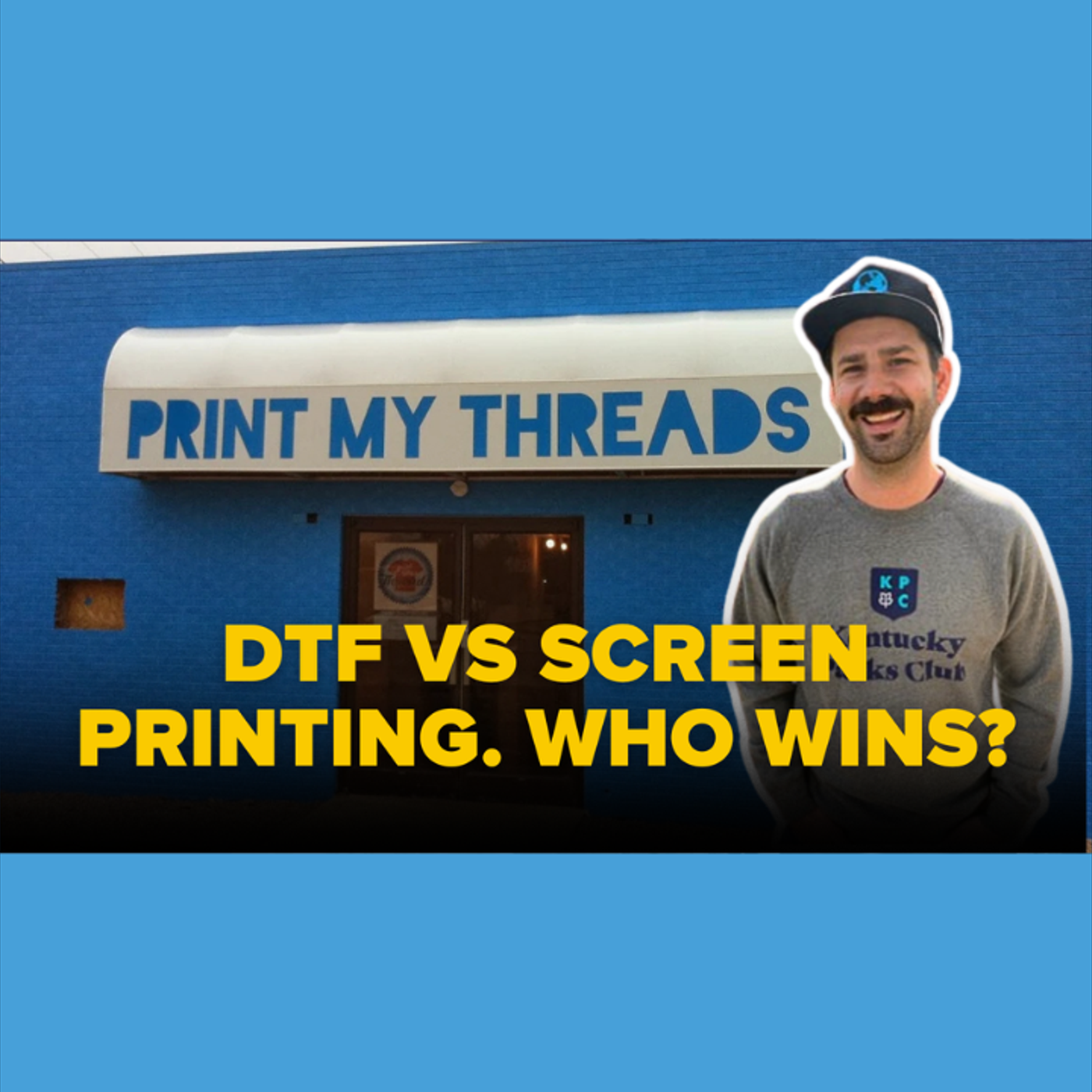
DTF Growth: Kyle Robinson on Profit Shares, Lean Teams, and Building a Sustainable Shop
57m 28s
The transcription begins with promotional acknowledgments for sponsors offering discounts on printing supplies and services. The main discussion features Kyle, a screen printing business owner, who shares insights from the Printing United trade show, where he evaluated DTF printers and noted the industry's technological advancements. He details his shop's evolution from water-based to plastisol and now DTF printing, highlighting a recent milestone where DTF impressions exceeded screen printing. Kyle emphasizes running a lean, profitable operation with a transparent profit-sharing program and family involvement. He discusses challenges like color matching and vendor support, while expressing optimism about DTF's growing quality and potential for creative applications alongside traditional screen printing. The conversation also touches on business management, equipment setups, and adapting to industry changes.
[MUSIC] We've got a couple incredible sponsors that always help us put this show on. First up, multi-craft daddy, multi-craft underscore daddy. Open up your Instagram map, send him a DM. He sends out gifts every single week. And if you give him your email address, you also can get 10% off your first order. Multi-craft screen printing and digital supplies have been around for over 50 years. Providing the industry with top brands at competitive prices. So as usual, send your info over to his Instagram account and you'll be entered to win. Usually he sends out a bunch of PMI tape every single week. So that is awesome. Next up, stalls.com. If you're ready to take your custom apparel to the next level, stalls is the leader in heat printing solutions. We were just at their new facility launch in Michigan. Unbelievable to see that in person. It's such a cool company. Whether you're a small business, just starting out or an established brand scaling stalls makes the hustle easy. They're here to simply heat press to help you heat press and profit. So they got equipment, transfers and support to help you out. Use the code hustler 2o. That's 20% off your next DTF transfer order. It's hustler 2o. Graph X source. Graph X offers industry leading outsourcing options for your shop by truly becoming a part of your team. They plug and play with print
avo. And they just manage the steps. Mockups, creative art, digitizing, some back office admin and customer service. They've been doing it for 40 years. So they've been in the game for quite some time and there were tons and tons of shops. If you mentioned the code printavo.pod24. That's 50% off your first order to give them a try. So it's printavo.pod24. Easy way.com. This is the URL to use easyway.com/giveaway. If you enter, this is actually a big giveaway. $250 every single month of product giveaway. So they've got this monthly giveaway program to get back to the raising customers. $250 a product credit. Easyway.com/giveaway. Easyway makes reclaimer screens a whole lot easier with their easy way systems, chemicals and equipment. I think we're good to go. Kyle. Beautiful sweater you're wearing. Like that. I like the he's for the audio listeners. He's wearing a fabric sweater. AS color. He understood. He understood the assignment. Yeah, thanks for how's your group been going? Good. Yeah. Yeah, no, it's been good. It's been good. I think we actually meet. We meet the we're coming up I think this week. So it's been a little bit, you know. Or actually no next week. We'll be next week. I was going to make something that was totally irrelevant, but I'm going to say it anyways. Do you know when you print for your friends as gifts that are other printers? Like Kyle, if you printed a batch of stuff and sent it to us, you're like, I hope this prints well. Yeah, like who printed it? I was going to ask that. And so when I was printing these for fabric, we sent out care packages and I was like, all right, guys print these. Make sure they're fucking straight, right? And I'm like, please make sure it just comes in right. Like, please make sure it prints, right? Because I just don't want to be the laughing stock of everyone. Yeah, that's rough. Is that ever go through your head? Or are these just inside my brain thoughts? No, I mean, I think about that all the time. Yeah, like anything that gets printed for like the print hustlers conference, I mean, you know, it's getting screwed and it's hard. So it's not a solar like it printing the United like you go to all these booze, man, and it's just like that can't think of anything I'd rather like like to do less than like be on center stage or like a trade show, a bunch of like my peers, like trying to print in front of them. Takes me back to there was a maybe a long beacher for worth or something. And we happened to walk by the workhorse booth in Justin Lawrence was printing on a manual. He had this like camo hoodie they were printing and the longest line I've ever seen to get because it was a really nice hoodie, but we thought it was for Justin and his master for skills. I mean, in the free hoodie, but he was just working that press for Kyle. How was printing United? Were you there? Yeah, I was there for it. So I was there for a day. And so I think, you know, you could go all three days and not see everything. So it seemed pretty quick. And but yeah, I mean, it was good. It's just I don't know. I guess I'm a little ADHD. It's like I always have a plan like walking into it and then like you walk in. And it's just like sensory overload and it's just like the sounds and the smells and it like everything's like grabbing for your attention. So I get sidetracked very easily. But yeah, I got to see some good things. I mean, one of the one of the vendors that I was there to go see like they were launching a new printer for the show. And then I went to their booth and apparently they said that like a forklift went through the printer so they didn't even have it set up. So that was a little disappointing. So what was your mission going to printing United? What were you walking in there to do? I think for me, like I, you know, so we've been researching like getting into like a expanded color gamut DTF printer. So I just wanted to kind of kick the tires on on a few of the different ones that I've been researching online. And you know, I think the main thing for us is that like what we, what we, the, what issues that we ran into with the Mimaki and then just sort of like the after service, are there after sales, service and support? Like anything that we get into now, I just really want to make sure that, you know, we feel really comfortable with who we're working with. So you know, I think, I think the good way to go and find that out is, you know, if you go to the trade show and you kind of have conversation, you know, talk to the people fit, you know, face to face and kind of get a feel for, you know, what, what that might be like. So any, any great findings for Cliff through a DTF machine? Yeah, I mean, I don't know. It's, it's tricky. I think it's like, it's just, it's crazy because it's still early, right? And so like, I mean, I feel like, I think I'm most impressed right now by the guys that American print supply. I know that people kind of either love or hate them, but and it was funny because like, so I broke my whole family. So my wife and my kids were there and you know, they're wearing like, they're like full on like sublimated like shirts and stuff and they kind of look like, but I, but in a way, that's kind of what you want, right? Like you want these, you want guys who are kind of like, like kind of better their geeks. They know the machines like inside and out, you know. But anyway, so yeah, I don't know. We talked with them and then, you know, MMR has got a machine out. Like, yeah, the same thing. The face is coming out. Right. Now it's the, yeah, the Quattro. But anyway, it was like, I sales rep, like, my sales rep didn't even know like what, like, like he, he was, he didn't even know what rip it. What was on, you know? So it's like, I don't know. I shouldn't know more about the machine than you, right? If you're, if you're going to be selling it to me, so that's sometimes a kind of a red flag, but a lot of red flags. But it was good. I got to see, I got to see Andy McDougall. Do you guys know Andy? Andy. He was, he's the one that's always poster printing, right? Yeah. So he was there. He came down from Canada. He always is with like our solutions. They're like a big graphic screen printing equipment company. So he's the guy that, when I first started, like, came out and like, helped me get my, my garage shop set up and stuff. So we kind of have like a little bit of a connection, I guess, there. And I bought that, you know, building out like a print studio. So I built some, I bought some used equipment off of them. Anyway, so we got to see him. And the last time he saw my wife and kids, they were like, well, Harper, my younger son, he would have just been born. I mean, he was probably like, he was just, you know, infant and then Finn was like two. And so now we were there and Finn's 18 and Harper's 15. So how can you have an 18 year old if you're like 30 years old? Wow. You look great. Everyone should go on YouTube right now and see how great Kyle's, you're looking great for 30. Bruce, what do you got? What's this poster shop you're making? You've talked about this before a little bit, but more of a retail thing. Well, no, it's just, it's really like, it's my, so I'm not 30, right? I mean, it's my midlife crisis is what it is. It's like, I think it's kind of like, you know, some guys are into like cars and so they'll go buy a car that they want to fix up. So like, I went and bought a bunch of old screen printing equipment and kind of like doing a makeshift fine art studio in order to do like fine art prints. Yeah, but it's low going because basically what it is, it's like, I get it, I'll get like a, we'll have a slow month at the shop and I have time to work on it and then we get slam busy and then I'm kind of pulled back into things and so then it kind of gets put on hold. So it's sort of like my, my hobby right now, I guess. Kyle, what are your day to day responsibilities? Well, so we hired a production manager who took, he's been taking over a lot of my day today, but because of the seasonality of the business, like August and September, I definitely get pulled back in and I kind of like, I almost, so like this year, this was the, this was our production managers like first busy season. And so for the last two months, I definitely got pulled back in and kind of ran the show again. But now that we're now that we've slowed down, he's back in that role. Okay, what is run the show? Get more specific. Like what if I put a body cam on you for the day, what would you be doing? Well, right now, honestly, like I do still have a pretty heavy hand, like in the DTF side of things. But really, kind of like what I'm doing is like we, so what used to be our showroom is now like our DTF area and that's where my computer is. And I typically just kind of have like a standing desk and so like when I come in I'm typically
doing like a sort of for still helping with like the morning check-in just sort of make sure that everybody's you know set up and kind of like going in the right direction. But a little bit of that's kind of like old habit right because so like this last week that I was out of town I mean he did that right and I wasn't needed in the shop just you know ran I know I wasn't there for four days so but yeah so I mean I think you know I still and well and then my wife she's she actually just started working for the business too and so it's been kind of interesting because she again like dirt it's like all hands-on deck during August and September for us so she's like been in the back like counting stuff in and staging shirts and dang Bruce's heat pressing regularly I think he has the first thing on fabric sweaters. Yeah but I mean both my kids are there right now running replay and so that's actually I wanted to take like my older son Finn he's getting ready to graduate and I wanted to you know kind of show him the like the industry like the other sides of it like he's just really personable who'd be like really good at like sales or marketing. I don't know that he necessarily wants to like likes the idea of like taking over the shop you know which is completely fine with me but I just wanted to kind of give him the opportunity to see that you know it's a huge industry and there's you know there's other things that you can do. It's character spread out screens. Reclaving builds character. They're using a lotus so it's not like they're all. No. It's not building that much. Wait what did you have to take over from the product manager when you guys are super busy again? I mean honestly I kind of took over the role of production manager because we needed him like like literally like in production so he he's a very versatile like he he was a musician and like he's he's from the area he moved away and then he like he got a job at a screenshot down I think in like Atlanta Georgia and kind of worked as like a almost like kind of almost like mentored under a guy that you know just been in screen printing forever and learned a lot of stuff and so anyway he's you know he knows like he's it's really good because he if we need him to fill in like we run a pretty small skeleton crew right and so like if we need him to fill in and make screens you know set to make screens if we need him to you know run the press he can run the press if we need him to pull he can pull or catch or but then we do a lot of fulfillment so he's also like you know very tech savvy so like when we're doing our big fulfillment like he can take over you know generating all the labels and things which I mean we're you know when we're spending $10,000 and postage or whatever you know you want somebody that can use ship station right yeah Kyle you were texting with us and you said we had our first week where the number of DTF impressions beat out screen printing this is some new territory so just so everyone knows this is Kyle from print my threads all star fabric member thank you for the plug can you tell us about your shop and layout so then let's let's preface this like how many autos how many DTF machines just so people can think through this within their head so yeah so our I mean our facilities like 9,000 square feet it used to be a roller rink so it's like it was wide open space we have I think I mentioned so like when you first come in the building used to be a showroom but now that's our DTF space so we have two mnemaki DTFs that we're running we have the auto reclaim right behind that and then the dark room right behind that so you kind of have like you know it's partitioned off we have an office for our two onsite designers in the break room and then everything else is wide open production space we have three side by side mems we have a half press and a tag press for in in terms of the feet press department we have two ten color autos so if you include myself and my wife and my two kids were like at 11 but but I mean so my my two kids are you know I mean they they just work a little bit after school like when they're not in sports so yeah I mean we're pretty lean like crew like so more really more like I guess nine if you count me and my wife and seven if you don't so was that purposeful like were you bigger before and skilled back or yeah at one point I mean at one point I think we got up to around 13 or 14 employees and you know pre pre-COVID and I think I've shared this story before just you know we got to the point where it was just sort of unsustainable growth we just kept you know we just kept growing and adding people and adding equipment and kind of throwing people and equipment at the problem and you know so like our revenue was like this and our overhead was like this and so you know we had to kind of take a step back and really like get to handle on our financials and really learn you know how to run a business which we've done I mean like so we're you know we're super lean and and super profitable like so we just had our third quarter profit share and it was you know we netted 152,000 and Q3 so like we paid out it was a substantial I think we paid out 35,000 or something through the profit share anyway if you guys hear Kyle's earlier episode that he did with us we'll have to link to it but Kyle could be one of the only shops that we've talked to that's successfully runs a profit share program at the end of every quarter that's like super transparent super impressive so like you guys had some sort of awakening where you got the business got it lean got it profitable and now you're just kind of like filling in making it hum a little bit how are you thinking about the fact that your DTF machine is outperforming the screen printing now is that keep you up at night what's this like next stage no I mean it doesn't keep me up at night and I don't you know I don't know that it's fair to say that it's outperforming it but I guess it's just like I don't know it's you know I think like for us it's been kind of interesting because like so when I started the business you know we were a hundred percent water base and like that was really important to me and like you know I'm like I learned how to screenprint is like in art school and you know like I come I'm coming out from that standpoint and so you know that was like a really hard decision for us to like kind of say hey we're getting away from water base and we're gonna do plastic all but we're pretty like a hundred percent plastic all now and so I kind of like look at DTF the same way right it's like initially like I didn't want to get into it and I was very opposed to it and I you know thought it was pretty trashy honestly and it's sort of the dumbing down in the industry but it's in the three years that we've been doing it you know it's come a long way right like some of the samples and some of the stuff that we saw I mean it was pretty trashy and I feel like now I mean some of the stuff that I saw at the show I actually took some pictures to show my staff it's like with some of the halftone and artwork that they're doing now like you I feel like a lot of people would be hard pressed there were some shirts that if you had like a shirt here like side by side with some of the halftone and the stuff it's hard to tell if it's screenprint or DTF so it's getting there and so it's I mean it's interesting to me and like I thought that also like especially going to the Stahls facility the effects too it wasn't like we're trying to replicate it was like we're actually going in our right direction and this is some really cool I mean just Teeva Ply just in general was in some of the things you showed me your guys' office Steven I was like oh my gosh this is sick well yeah I'm like green like a yeah Adrian did an article on us and we did like a send a picture and like we for one of our clients we did like a print where we it was like a halftone kind of gradient fade for this water and then like the top was this like polar bear with like a car anyway and it like it was DTF on top and it went and then screenprint on the bottom and it gave like this really kind of cool elevated effect because it had like a no-fuel you know print here and then it had that kind of textured feel here and I don't know it was so I think there's a lot you can do with it and I don't know I mean it's just it's happening so I mean we certainly are embracing it and like I feel like you know it's a total shit show when we first got into it and we've worked through it the last three years so to some extent I'm trying to kind of stay out in front of it as much as possible what's like the magic set up now yeah like what works you talked about the equipment you have but like what you know some folks feel like they get stuck being a maintenance operator of the machine or having to train people to run the machine or balancing ordering transfers or spring in the house like is there a set up that you feel like works super well for you now in terms of people and process maybe would have been the best one to get to sooner I mean honestly one of the things that one of the reasons we're looking to get into like a different machine and a nine color machine that's just properly color profiled is that I feel like we're chasing our tails with color all the time to the point where you know a lot of times like what we're seeing on screen isn't what we're getting like right up you know like when you go to hit print and so I think that if we can really get a machine that's just profiled properly and that has that expanded color gamut I think it's going to save us a ton of time because right now there's just a ton of back and forth because we're so picky about color and a lot of our clients are that we spend a lot of time like where we have the two machines a lot of days it's like the whole morning we'll be spent just doing test prints on the one machine so that we can make sure that the file is good before them we like run production on the other machine and so if we can you know I don't think you're going to always 100% eliminate that but if we could eliminate a lot of that and which I you know that's the thing is when all of this came out people didn't know how to color profile and I think you can argue that a lot of the companies still don't know how to color profile because you're seeing a lot of the expanded color they're using RGOB where like they should really probably be using violet instead of blue but anyways you can get into the weeds and all that but I mean like I think that like as you know that side of the industry is learning more about color and the inks are getting better and the powders are getting better and the films are getting better.
It's just all getting better and faster. And then you've got a lot of the heat press automation, which, I mean, that's a whole nother conversation. I'm still not really sold on like a lot of the, like fully automated solutions that are out there. - What do you like there and what don't you like on the heat press automation? You mean the circular presses or the. - Like, I mean, I like the idea that you can, you know, get more impressions out per hour, but like, I see these machines, like, I just, to me, they're just a little bit too robotic. Like, I just feel like, you know, like, little suction cup hands or sometimes picking up like more than one transfer and they're not always being placed accurately. And so like, you know, it's just kind of like the same thing. It's like, you can run your automatic press at 600 pieces an hour, but if you're not loading the shirts straight, like, who cares, right? So like, you know, to me, I think it's like, I still think, I think, Steven, you mentioned like the mems that are just like have the two heat presses but are still like, managed by people. Yeah, I think that's probably the fastest route. And I think it, if it's done correctly, and then honestly, I think that, like, I think when we, when we, at the last print house, there's when we toured, where do we toured the, in the clew, like, near, yeah, stakes. I don't know if you noticed, but it was like, they had like an army of side by side mems. And then they had a, they had a rotary heat press, like, off to the side that nobody was using. And like, to me, that was very telling, 'cause they're like a huge facility and they're doing like, like, massive production. And I think there's something to be said about, like, the mems are just so simple and easy to use. And some of these rotary machines are like, they're just, they're intimidating, right? It's similar to like, you've got to find someone who's like, you know, the right kind of, you have to find like an operator, similar to like what you, you know, finding someone who can run an automatic press. - Yeah, so I think, I think the most, so Kyle, do you heat press, do you do two hits on every, every transfer? So I think what we're referring to is you, you know, heat press it with the film on, peel, and then do a second hit to like, close it off. The, what I think shops could actually do to speed up the process is to run heat presses that do one hit versus heat presses that do the second hit. The second hit is unskilled. You can go a lot faster and a lot hotter. And so we actually like, on our production lines, every shirt only gets touched once per heat press, right? And so they're not actually going back and forth. So they like, heat press it, take it off, peel it, it goes in another pile, and then another person is doing all of the second hits at once. - When they do the second hits, are they threading it or are they just laying it on top? - Just laying it on top and it's half the time and like 15 degrees hotter. It's like quick, hot and fast, just, you know. And so like you can make incremental improvements in your production line to get out, you know, instead of 60 shirts an hour, a hundred shirts an hour, just by re-reguring the process a little bit. We've got rotating heat presses that are used for specific purposes, that we like a little bit more, but for our D to C business, they're all of the shuttle presses. So we have a little Spanish armada. - It's like the idea too. It's like the, you have to think about it differently, but I mean, like, you know, when you're running, when you're running an automatic, I mean, the way we run at least, you know, you've got your loader, your unloader, and then the person catching it at the end of the dryer. So whenever you're running a job, you're, you know, that's three people. So, you know, if you're averaging 300 pieces an hour, which for us is, you know, I'd say pretty average, right? So if you can take those three people and they can average 100 an hour on a heat press, you're, it's similar output. - Yeah. Okay, so if a shop was getting it, so you started with the mommokies, and now you're thinking about switching to expand color gamut, things like that. Would you, if you were to go back in time, are you happy with the decision you made? How many years in are you? - Three, I mean, I think we were like the third or fourth shop to get like for the DTF Superstore did an install with. Like we were early. And like the guy who did our install, it was definitely his first install. - I remember my first install. - It was like, it was so, I mean, it was like, I was like, I was like very like clear with my sales rep. I was like, I do not want, because we, you know, I still had like PTSD from our DTG days, and I was like, I do not want this to be like that. He was like, oh no, it won't be, you know, and then the guy showed, like, you know, the installer shows up and, I mean, they couldn't profile the machine. It was like printing white first and then color and like ink was dripping down every, we went through so much ink and so much film and I was sitting there like, and of course, you know, I had a job, I think like right out of the gate, like one of the reasons we decided to pull the trigger out is we had a customer who had been wanting us to do some of these designs for years that were like 18 color, you know, and it just wasn't realistic. So like, we had like a 600 piece job, you know what I mean? Like that we had to get running like as soon as the printer was like, you know, ready to go. So like we certainly didn't ease our way into it. Like we, you know, as soon as that printer was set up, like we started running like a 600 piece job on it. So you would go back in time and buy the same machines? I think so just because like, it was the first Japanese machine that was like more plug-and-play. So, you know, we didn't have this experience that a lot of people did like the early on Chinese machines. So I think, you know, it's been a good experience overall. I mean, obviously there were some things that happened that were out of our control and there's been some issues with, you know, firmware and dampers and things, but I think, you know, overall like, it's been a great addition and it's like allowed us to kind of like, it's been, it's really interesting because it's, it gives us a lot of flexibility over production because there's a lot of jobs that we get to go DTF or screen print. And so again, like since we're such like a, like a small crew and we try to run so lean, then a lot of times it's like, depending on who the customer is, we might, you know, decide at the very end or make like a switch or at the very end, like, you know, like, oh, it was gonna be screen print, but we'll just go ahead and run a DTF because we've got a backlog in this, you know, in here or vice versa, right? If we get a backlog in heat press, then we might just go ahead and put it on the auto. - So Kyle, and then I'll let Bruce say something. If a shop was getting into DTF, what is the expected lifespan of a machine? What can you expect? What would be good? Like if you got this many years out of it and then it's trash. I mean, you know, so ours are, so we've been running ours for, so we got the TX 150, which was like the single head. And we upgraded about six to eight months into the, to the two head machine and got a second to met head machine at the same time. So we've been running those two printers now for like about close to two years. And they're, and like, and like, we're on the same print head. Like we haven't had to replace a print head. So like, and we run them. I mean, like we like, we run 3000 piece jobs on them. So like we again, like with that, we haven't had the same kind of nightmares that you hear from like a lot of shops that are running the Chinese machines. Which makes it like. - We haven't known them or it's still TBD. Have you seen something different Steven? But as far as, - Well, I just bought six print heads last week and two main boards and tubes. I mean, so with the Chinese machines, the color gamut is you can get a lot more vibrancy. And essentially the machines are whatever casing on the outside, you're gonna replace all the insides a few times. So we've probably rebuilt all our machines several times over. We know we know how to replace every, every living breathing part of it. It's definitely not as plug and play. But we're able to nail a different, like probably a little bit more vibrant of a color gamut than a mnemaki. But the mnemaki is definitely, definitely easier to use. I think it's, I still think it goes back to the conversation we had of, if you're not spending $70,000 to $100,000 a year on transfers, just keep buying transfers. - No, I mean, and I think that, you know, I think for a lot of shops that makes sense. So one of the things I did see it, so I wasn't impressed by the Roland that I saw at the show. That was some of the ones that had like the really, like the artwork was done really well. And you almost couldn't tell if it was like a sudden process screen printing or not. And then brother came out with the machine. So brother, like it has a true roller roller machine now and it was pretty impressive too. Again, both of them either when we're expanded color gamut. But again, it's like, if you profile, I think that part of our issue is like, I mean, there's times where I'm like, I don't even know if we really need expanded color. I think that it's just the mamaaki just have, just such horrible color profiling that that's kind of part of the issue. 'Cause I've seen some pretty impressive prints from, you know, to CMYK printers, right? 'Cause it's not, it has to do with the machine, it has to do with the machine, it has to do with the ink, it has to do with the film, it has to do with the rip, it has to do with the color profile, right? So there's, it's not just, I mean, they're going to go into it. - Yeah. - You're a pretty, numbers heavy driven guy. have you seen a change in profitability?
a grant that there's so many factors that go into this with the business and you know just general orders coming in but. So I need to do a better job like so I need to do a better job at coding stuff differently like for accounting purposes I've been kind of lazy about that like on the DTF side. Like we do a little bit of contract printing through that stream platform and then but I mean one of the things that DTF SuperSort did is like they did a video like specifically for the Wemaki to kind of like figure out like what your cost per square inches and so that you know what they kind of deemed was that you know your cost per square inch on on the Memaki you know for your consumables so your ink your film your powder your electricity in your labor you're right around a penny a square inch right and so we've just kind of used that as like a ballpark or baseline for when we're pricing when we're pricing our jobs and like we have I wouldn't say that we've seen like a huge increase in profitability but we're also like not losing margin where we're you know doing much more of the much more DTF so the way we handle our pricing we kind of we kind of make sure that we maintain the margin we want and so we've just made sure that like you know the margin we get on a screen print job is comparable to the margin we're going to get on DTF job. What about this year just high level how have you guys been doing how is the man that you're seeing how's your customers doing? I mean we we until this month until October we were up I want to say like three to five percent maybe so not like we we weren't up a lot we're you know pretty like flat and then this month like last year this month we had like a really big program for one of our hospitals that we knew we weren't going to get so you know we had just like an amazing October last year that isn't going to happen this year so that's hurting us a little bit but we're planning for it so you know we budgeted for and then we're just going to kind of we're using this time to sort of start working on end-of-year stuff and get out in front of next year. We also you know we are November and December is always very slow so we actually shut the shop down for like the typically about two weeks between Christmas and like right around Christmas and New Year's and we give our people like pay time off and stuff so so we budget for that going back to the profit share I mean that's one of the things that was kind of interesting is that like so we pay out quarterly on the profit share and I don't know it's one of my wife and I were talking about the other day is like it would it would be more beneficial or better to like just pay out like a year-end profit share because the issue the because like what you're seeing because what you're seeing is it's like so like right now October for us we're going to show a loss but part of big chunk of that is because we just paid out a huge problem yeah we just paid out the Q3 profit share so like the Q3 profit share was similar to running like an additional payroll in the month so you know from that standpoint it's you know it kind of skews your numbers and the little and messes with your cash flow a little bit and then the other thing that we do is that you know so we know that we're typically not going to be profitable in Q4 but we'll go ahead and pay out like a like a year-end bonus anyway and so it's like so we've we're kind of in talks about like would it make more sense to just you know pay out the profit share it appears people get a like a larger sum of money then kind of in lieu of the business you know paying out a bonus even more not like it's generous of you to pay out an additional profit share or slash bonus in Q4 when you're not profitable you for I mean especially when you talk about like you know because the cash flow and you could argue like okay well Q3 we did well so it'll carry over so yeah it's going to be a negative month but like on a year annual basis you know I'll smooth out but Kyle are you more motivated by profit or top line or like it seems like you run a calm business I don't really know what my motivation is sometimes like I don't know that it's money you know like I don't know I don't want to not be making money that would not right I mean I definitely want to be making money and I we definitely like it does bother me like if we have a month where you know we show any kind of a loss but yeah it's I don't know it's interesting and it's like it you know as you guys know like running a business can be like I mean I want to be kind of careful what I think is my employees watch this but it can be like so thankless right so like we just had this awesome quarter and we do this profit share but it's become this thing it's kind of like I think I mentioned before it's like you know yeah it becomes an expectation and it's just like not not a not a single person said thank you there wasn't like a quick text it was like awesome man thank you you know and so like well like you try not to take it personally and I guess you know the idea of the profit share is that you want them to sort of like have ownership and you know like feel like they earn that right and so I guess in like they shouldn't technically have to thank you but at the same time like you know like what most business owners do is they have like a really good profitable month and they take all that money most business owners don't have profitable months some business owners have profitable months but like what I'm hearing though is like you're not stressed about it the problems that you're dealing with now are more like design flaws like we need to fix that a little bit we you're like making smaller tweaks on your business but it seems like you've gotten this plane that you're flying up to 30,000 feet and it's now just like handling the turbulence and all that stuff how have you designed the business to compliment you your wife your family because it feels like you've kind of achieved a threshold of like contentness happiness you said it earlier like it's not about money how do you actually think you know it's about the way yeah yeah it's super freaking annoying when they're well I think I think what a lot of it I mean I think we're fortunate in a lot of ways in the sense that like kind of where we live right like I'd never really want it I'm from Albuquerque my wife's from here like it's very kind of small town rural we're very much sort of like big fish small pond pond kind of scenario and it's not really anywhere that I ever wanted to live or thought that we'd end up but it's worked out very well in the sense that you know like we were able to like acquire our building and like we've just you know we've been fortunate in the sense that like I think you know I was actually listening to as we were I was traveling last week I was getting caught up on all your podcasts you know and it's like and then I hear some of the conversations and fabric and like initially like I wanted to be one of those shops right like I wanted to be one of those bigger you know six ten plus million dollar shops and I had these like kind of visions of Grandeur and like I think at some point I just realized that that wasn't realistic based on like the geographic area that we were in and so I kind of just had to like you know be okay with adopting sort of like this mentality of like it's okay to be small and then you know kind of figure out like you know what the right size of the business is and it was hard I mean it was it was it's it's a struggle right um but I think in I I owe a lot of that to my wife too because like I'm always the one that wants to go out and buy the next thing or do you know like very ambitious and she's always the one that kind of keeps me grounded and kind of plays the devil advocate and kind of pulls back a little bit and so I think you know one of the things that happens and you guys have talked about this in our industry right is it's like it's so easy to go to like a print united and you know see all of the shiny toys and buy shit and it's just like that's a lot of t-shirts right so like every time you go buy something it's like you got to print a lot of t-shirts feel like 10 years ago seven years ago six years ago whatever the trade shows it was like the gun show like what do you got what do you get what are you getting what do you have how many autos do you have and then now the the older shop owners are just like I don't care like it's kind of like it's like it's like it's similar to like we just I was just having this conversation with with Finn and Harper last night right because Finn's getting ready graduate and there's like a like a really like kind of cool small school like just north of us called Shawnee State and it's like very affordable and like we're really kind of like encouraging them to kind of go there and super small like students faculty ratio and whatever and but he's like die hard UK fan right like he's way into sports and he's always been a you so like he really wants to go to the University of Kentucky which it costs about double and you know so we've been having these conversations with him or it's like you know we don't want to tell you you can't go and like you can go but like you just have to understand sort of like what you're signing on for and like what the commitment is because it's kind of the same thing right it's like you you go to college and you're immediately taking on this enormous amount of debt and then so it's like you're starting out like you're starting out your adult life with a tremendous amount of debt and I think that like as business owners we kind of do the same thing it's so easy to like you know when you first are starting you know you take on this tremendous amount of debt and then you have to spend all your time working to like pay that off right whereas if like play it smart and like not start out with that debt then you don't necessarily have to work as much like your partner Steven Jed yeah I mean super blue collar right like no debt And always.
paid for things in cash, went to trade school, became a welder, rose to the ranks, and I'd call him like, "Boo collar rich." He's got everything he wants and all the toys and the shed and the country and the lake houses. He lives a simple life doing that. I think a lot of people envy it, but. It's interesting because with the. I'm a little bit stuck on the expectation of. I also felt that way too. We did profit sharing for a long time as well. It just gets sent out. Then after a year or two, like you said, it becomes expectation and is what it is. Then the company switched to more bonus base program. It was X percent of salary and then that was also based on performance. I don't know, one to five. If you're four out of five, that percentage of your bonus percentage is what's paid out to you. Also becomes expected, but at least that reduced my expectations to. I wasn't expecting. Oh, thanks. Sick. I'm glad we crushed it, type of thing. Maybe it's because over a quarter, let alone a year, it's such a long time to. I think about it in that perspective of, yeah, we're going to keep working towards this keep working towards this, but then maybe when you're in the day to day of it, you may. A team member may lose sight of the work that goes into the team group to hit the profitability to then get the bonus. It just doesn't. I mean, it's the marshmallow experiment, right? This is delayed gratification. How much do people care about it? We don't do that at campus ink. We do have bonuses and are pretty. give pretty meaty holiday bonuses if we hit goals. The one thing I like to do is to surprise and delight employees with things that they wouldn't buy for themselves. For instance, our CFO loves to cook and he's the stingiest, most frugal human being. He got his Christmas bonus, which he wrote his own check and told me whatever it was going to be, but I was like, I just bought him a blackstone grill. I was like, "Hey, dude, I think you need this. $350 or whatever." Next year, I got him a trigger. He wouldn't have bought this for himself and that to him that means something. You could give someone $300 or $400 of cash or you could give them an experience or something. What I've felt is there's a comfortable balance in doing the same and doing both. I don't know. That's just what I do. Maybe carry some meaning to it in addition to the cash. Well, yeah. Honestly, I think they were like a couple of years ago, whenever a pretty night I was in Atlanta, I took the entire team down and we did that. And ever since they wanted to, so they're always hinting, not hinting. They're straight out saying, "Oh, we want to come." I think the year that we did it, I just said, "Well, yeah, we can do that, but just keep in mind that's going to, so that'll affect the profit share." But I mean, that's the thing. Instead of handing everybody a check, we could have paid for everybody's trip. Everybody should have gone to Disney. I don't know that their spouses would have been thrilled with them using the money that way, but they would have had a great time. I think the team's like that. It's cool that you're open and share that. It creates a faster mindset or a mature culture of, "Okay, just because this is a business means we all have to work together." And I don't think I've met a shop that does it as well as you do and consistently as you do. And you taught us in fabric. You've talked about on the podcast. So thank you for sharing that with us. Super, super insightful. How are you thinking about next year planning? You talked a little bit about wrapping up this year soon and stuff. What are you thinking about in terms of what you want print my threads to look like? I think going back to what we were talking about before, I think that's something that I struggle with a lot because we've hit this sweet spot. It's always this balance of are we trying to grow? And then if so, make sure it's very intentional. What does that mean in terms of taking on additional debt or new hires and so it's this balance between. Yesterday we had a. So we didn't run production yesterday and so I'd been out of town and so I went into the shop and I was kind of like, you know, we did not run production yesterday. We didn't have enough to run so we just called everybody up. So you know I was there and then it was like, you know, the shop that the studio that I'm building out like my been like crisis hobby. It's like I hadn't set just foot in that place for a month, you know. So I just went over there and I was just like, you know, I just sat there for a little bit and kind of. You know, just kind of just to kind of think because you know, we don't ever do that anymore, right? And so I don't know, it's tricky because it's like I constantly waver between like, you know, being gung-ho about buying the next piece of equipment and or learning embroidery or do we need to get a, you know, what do we need to do to, you know, increase revenue in our, you know, in our more seasonal like, what can we do to bring in more revenue in those down months, you know. But it was interesting. I was kind of having that conversation with Andy and he was like, he said, yeah, he said, I don't know. He said, this is the only industry I know. But he said, I think most industries are seasonal, right? And he said, so you just kind of have to learn like when, when, what is that seasonality? And if you know what it is, then you just have to like be comfortable with it and be okay. And then like learn to kind of, like, so when you're slow, like, teach, kind of teach yourself to not stress out and like freak out and like, then be like chasing, you know, chasing your tail the entire time you're slow, right? Because then it's like, you're going to get busy again, right? And we know that. I mean, like our seasonality, it's like, it's very like methodical at this point in the business. And so it's like, it's really hard because you can spend that whole time that you're slow, like freaking out and trying to find products for people to do or, you know, or you could just kind of sit back and enjoy it. I wonder how spirit of Halloween thinks or like the Christmas tree companies, right? Like they have to crush it for 30 days and then they have 11 months to do it all over again and plan it out. Flower business as well. It's the same thing. Yeah. I don't know. My business partner told me you always have to crush it in months that don't start with Jay if we work in the academic calendar. So January, June, July, if you can get through those, crush it nine months of the year, it would be fun. Well, yeah, I mean, I've had that conversation like with, I mean, that's part of the reason why I mean, think about it. You have to have like a certain amount of equipment and a certain amount of space and whatever. So you have the capacity to like for us to do like those really big jobs and those really big programs, right? And so there's times of the year where it seems like we have way too much equipment and like way too much space. And then there's times of the year where we're like, oh my god, we need more equipment. We need more space. So I don't know. I mean, again, this is all I've really known. Well, that's not true. I've worked in the restaurant industry and other things before, but this is only like business I've owned, but I don't know. So I guess that's the thing that I'm still kind of trying to learn is just like in my wife tries to remind me is like, you know, you just so we know we're going to be slow. So like, let's not freak out. Let's just enjoy it and find some things that we can do knowing that like let's take it, you know, let's take that time now. And then and I think that we do try to kind of build that into our culture. That's the reason why we shut down, you know, between Christmas and New Year's because we used to and now we've just told people like you're going to get the X amount of days paid and it is what it is because it used to be this thing where we didn't do that. And then we were going to shut the shop down and everybody was stressed out because they were trying to save up all of their pay time off for the end of the year. So that's part of the reason why we do it, you know. What about your role next year, like do you if you thought about what you do want to do more of and do less of, especially now that you've got a good production manager? Yeah, I mean, I think, you know, the goal really with this new space was for me to just, you know, be able to, you know, operate 100% out of there and not really have to step put in the shop a whole lot. And I think we're getting there for sure. So, you know, it's just one of those things like my production manager was out sick today. So I was there. But, you know, so it's just, it's happening. But you know, again, it's like if we go and buy a new DTF machine and that's going to suck me back in because I'll be the one having to learn the ins and outs of it, right? So I think that's the tricky thing. And then wait, do you hold on timeout? Why can't your production manager do it? Oh, and you could. I mean, that's the thing. I think I think I like to, I see my role as being the person that like figures out the new machinery, the new equipment, the new, and then builds a system out so that I can hand it over to somebody else. But do you, why can't he do that? Why do you have to? Probably not, probably just not within like his wheelhouse. I don't know. Actually, he used to run, he used to run roles. So he might be able to. I think we have, I was talking to another leader in our shop and in our business. He's like, he's like, I need to dive into this master it so I can teach someone else. I'm like, why do you have to? Why can't you just set the expectations and let them do it? He's like, well, I feel the need to, and it was like, you know, yeah, no, you're right. I mean,
It's really interesting. So I was gone all last week and we got this one, this guy Zach, who, I mean, Zach's just the best, right? And like, just like kind of quite quirky, like, you know, very thoughtful, dude. Just had his second baby, they just bought a house, you know, he just, anyway, he's like the good dude. Anyway, and so we had this like really hard fulfillment. So normally like with the fulfillment, it's pretty like streamlined and it just goes to ship station, but every once in a while we'll do fulfillment for the hospital where it's like, we have to bag and box everything by cost center and it's like, it's all very like manual and confusing and convoluted. But man, we came back and it was like, he had everything like so nicely packaged and like these lists and it was just like, I mean, so much better than anything I ever could have. Like if I, I guess what I'm trying to say is, if I had come in and tried to like build it out in SOP and say follow this, like it wouldn't have ended up as nice as like what he came up with. - Dude, it's so fascinating because I fall into the same traps, but I think that especially the good players and you tend to know who the good players are, do you think that they rise to the occasion, especially when giving more space to do it? Like as in, this is just an example, but like as a production manager, hey, you know, whenever I've nailed our options between three different printers, I want you to like meet the different sales reps, learn, bring all your questions and prepare for that so that you can help pick which one and then be able to take it from there. I had the same things with product whereas yeah, I definitely need to still be in it but definitely not as much as I was. - Right, and like we actually, so like I had the quarterly like one-on-ones right before I left town and I was actually, 'cause I was actually thinking about having, so Nathan who's one of our, we hired him as a graphic designer but he's other than me and the person that's really run and learned the DTF and so I actually had like a one-on-one with him and was kind of like talking about DTF to just kind of like, 'cause in the back of my mind and I had actually talked with Ania, so what if I'd bring Nathan down and like have him be like, my second set of eyes and like help me kind of determine like what machine we want to run? And so rather than just like invite him to do that, like in the one-on-one I kind of like just put some feelers out there to see like how interested he was like, or engaged he was in and like, and it was like he didn't care. So I was just like, all right, if I get, we're not just gonna like do it as a family trip but like, you know, had he, you know, really like shown some interest in that? Like that could have definitely gone differently because I, so that's the thing, I mean, I don't know and maybe that wasn't a fair test but. - But if you got, okay, if you won the right lottery or got hit by a bus, someone would figure it out. - Yeah, hopefully like my life insurance would just take care of my family. - Well, yeah, no, I'm not trying to freaking, okay. But I'm saying like if you, if you were unable to do something and you literally could not do it, someone would step up and do it. - I think that's the hardest part for us to do is to like actually let someone off the deep end and trust that it could get fucked up but they're just gonna figure it out. I don't know, I feel like it's more in our heads. - What was those one on one? You said you do quarterly one on one. What are some questions that you tend to ask that are good? 'Cause I always find one on one's a little bit tricky to know exactly. - Oh, I suck it. (beeping) I, all of the questions I asked I got from you guys. I think I did a bus pass in fabric. (laughing) - You guys are really, I think you and I think you. - I'm always tweaking it though because it's like, I'm like, did I get enough out of that? Was that they feel comfortable? Did they actually share anything? Is there anything actionable? Am I doing it too often? Am I doing that? Quarterly is interesting. I know I think Stephen, you said weekly or what do you do? - For one on ones. Like direct reports usually like have their one on ones once a week and then everyone should be in a meeting cadence whether it's once a week or once every two weeks. There shouldn't be anyone in the company that isn't met with. - Yes, I've got a quick little list but it's yeah, I was like, what's going well so far this year? Anything you wanna talk about? What questions or feedback do you have? What can we improve upon? How do you feel about your current workload and anything we can do to support you and your role? So I think that was sort of a combination of the stuff I got from you, Kevin and. - Yeah, I have these really cool cards that are like, it's called, where should we begin at work? If there are icebreaker questions for one on ones or group settings and so one of them says, it's difficult for me to ask for help when and you actually try to develop some of their interpersonal work or one thing that can instantly ruin your day, what is it? - Yeah, I'm just really bad at like, I think I'm a talker and I'm like, so it's like when I just have to, I'm trying to learn to just shut up. And so like I had any, my wife in the one on ones with, with me just kinda, she's really, she's much better at all that than I am. So her and Bridget, her sister who works in the business, ideally they would be running the one on ones. So. - Yeah, I feel like one on ones, when the owner does it, it's our meeting and they're there. - Right. - But then when someone else does it, - Yeah, when someone else does it, it's like it's their meeting and we're just there to facilitate and help them. - Yeah, and no matter what I say, like there's certain people that no matter like how I try to preface it, they always like are nervous and they feel like they're in trouble. - Yeah, especially if you're like, hey, you free Thursday, they're like, oh my God, I thought something bad is gonna happen to me and it's like, oh no, sorry, it's just a check-in. Steven, honestly, your idea was, I felt one of the best, which was taking people out to lunch more and it's harder as it's getting it's bigger, but, you know, sub 15 or so, it was just like every other day, I like to go on out, I don't like bringing them in lunch as much, but that was a nice time to, and I think they value it too, I think. - Oh yeah, I think when you can get away from the shop and just say like, what's up, my business partner, Jed will take people to Chili's, but come on, we're going to Chili's, come on, we're going here. And you're like, okay, sweet, makes people's day for sure. - Thanks Kyle, it's Kyle Robinson. - Print my threads, appreciate you being a number of fabric and an awesome progressive shop owner. It's always great to have, you know, like mine did people trying to push the envelope forward. - Yeah man, we'll see you on again. - And hopefully, hope to see you. - Same time next year, we'll see you. - All right. - Have a good one, Princessus, see you in the next episode. - Thanks so much for listening. Hopefully that was informative. Don't forget to subscribe, don't forget to like, don't forget to hit the bell for notifications if you enjoyed this video. If you enjoy all this stuff we're putting out, it's really helpful, we love to just be able to see it. That means we're doing a good job. To subscribe, hit the bell for notifications, hit the like button, and I'll see you in the next episode. Bye.
Podcast Summary
Key Points:
The hosts thank sponsors including Multi-Craft Daddy, Stahls.com, GraphX Source, and Easyway.com, offering discounts and giveaways.
Kyle discusses his screen printing business, including a shift towards DTF printing, equipment considerations, and a lean, profitable operation with a profit-sharing model.
He shares experiences from trade shows like Printing United, emphasizing the importance of vendor support and the evolving quality of DTF technology.
Kyle reflects on business growth, family involvement, and balancing screen printing with DTF, noting DTF impressions recently surpassed screen printing for the first time.
Summary:
The transcription begins with promotional acknowledgments for sponsors offering discounts on printing supplies and services. The main discussion features Kyle, a screen printing business owner, who shares insights from the Printing United trade show, where he evaluated DTF printers and noted the industry's technological advancements. He details his shop's evolution from water-based to plastisol and now DTF printing, highlighting a recent milestone where DTF impressions exceeded screen printing.
Kyle emphasizes running a lean, profitable operation with a transparent profit-sharing program and family involvement. He discusses challenges like color matching and vendor support, while expressing optimism about DTF's growing quality and potential for creative applications alongside traditional screen printing. The conversation also touches on business management, equipment setups, and adapting to industry changes.
FAQs
Send a DM to multi-craft underscore daddy on Instagram and provide your email address to receive 10% off your first order.
Stahls.com provides heat printing solutions, including equipment, transfers, and support for businesses of all sizes. Use code 'hustler2o' for 20% off DTF transfers.
Graph X Source offers outsourcing services like mockups, creative art, digitizing, and customer support. Use code 'printavo.pod24' for 50% off your first order.
Visit easyway.com/giveaway to enter for a chance to win $250 in product credit each month.
Evaluate after-sales service, support, and color profiling. It's important to feel comfortable with the supplier, as seen with experiences at trade shows like Printing United.
Kyle steps in as production manager during peak times, overseeing DTF operations and ensuring workflow efficiency, while delegating tasks to a versatile team.
Chat with AI
Loading...
Pro features
Go deeper with this episode
Unlock creator-grade tools that turn any transcript into show notes and subtitle files.
 PodcastTranscript AI