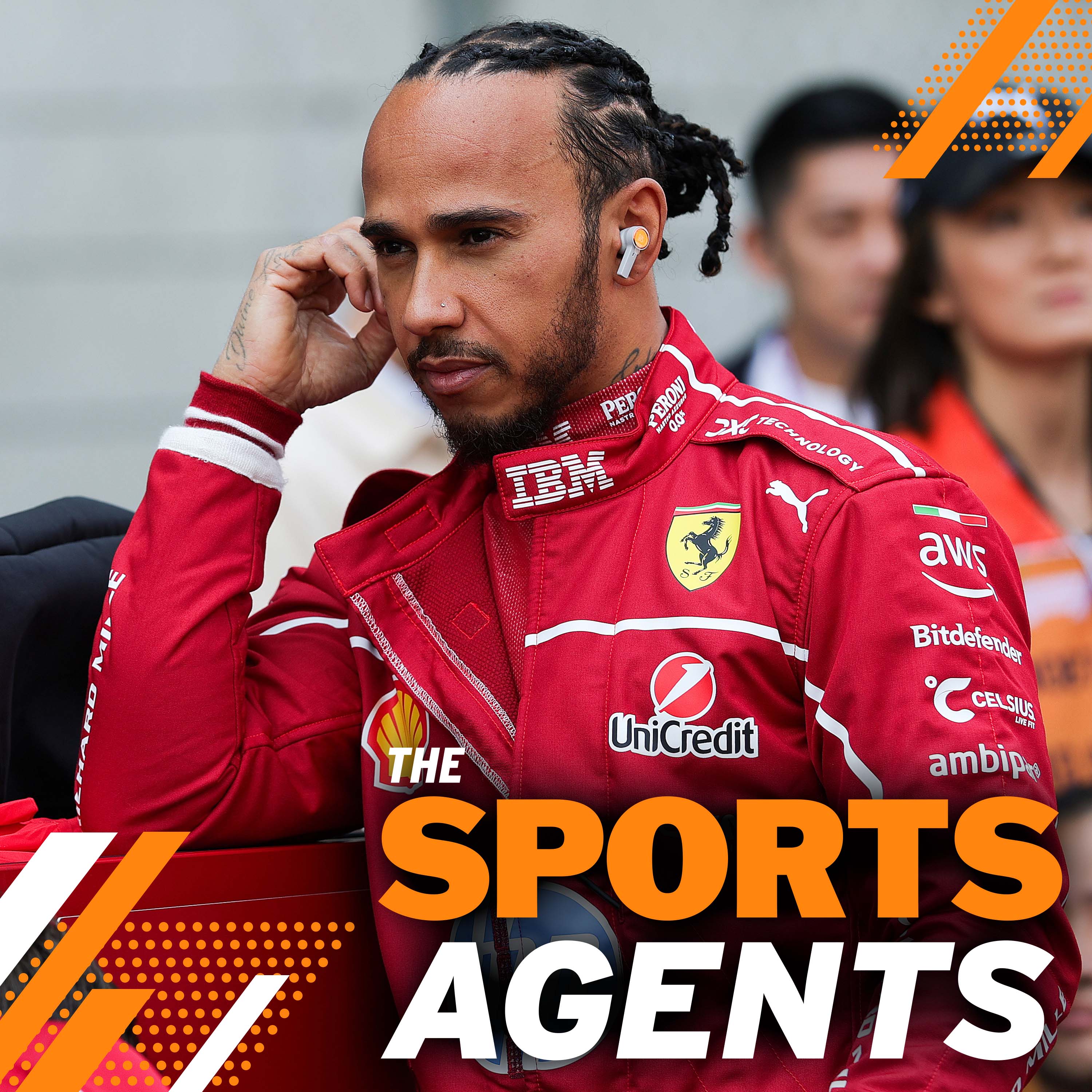
[MUSIC PLAYING] This is a global player, original podcast. Drive to Survive is the golden example of how to grow a sport by making it cool again. If we had a penny for every time Gabby that we've spoken about this show, the F1 Netflix series, we'd have a lot of money. We'd have a pound, I think, at least. We'd have a least of pounds. Well, Formula One's global fan base has reportedly grown by hundreds of millions since Drive to Survive launched back in 2019. And this is really important. Three and four new fans are female. So a season eight of Drive to Survive airs has any other sports audience ever grown as fast or changed as much as F1, thanks to Drive to Survive. Welcome to the Sports Agents. [MUSIC PLAYING] The Sports Agents. With Gabby Logan and Mark Chapman. Hello, Mark. Hi, Gabby. Busy Champions League week. Yeah, an interesting one. I mean, I was desperate to get to St James's Park to do a Champions League game this season. And it ended up being, as you know, a bit of a dead rubber because obviously Newcastle brought back a 6-1 school line from Carabag and then scored two goals in the first six minutes. So it was all over, really. But I loved being back in Newcastle. I've got quite sentimental about it. Went for a walk in the morning over the bridges and came back and had breakfast with John Champion, the commentator. And I started crying. Did you do it all to me? You didn't quite know what to do with me. I said, I love this place so much. So yeah. But yeah, I'm glad-- I'm very, very glad that we-- you know, I've got us far as we've ever got in the Champions League. And we're through to the last 16. But a bit more jeopardy next time would be lovely. Well, you would have thought there will be jeopardy next time, right? Yeah. I mean, Barcelona or Chelsea in the last 16 by the time you're listening to this. If you're listening after Friday morning, you will know who they are facing. But after a very long league stage and this sort of playoff stage, we are set for some brilliant, brilliant ties. We could get Manchester City Real Madrid again, as well. We could, which I don't want. You don't want? No, because it feels like we've had it-- well, we had it five times in the last. Yeah, but I also know why you don't want it, because the other option for Manchester City-- because they're all in these brackets. So it's either all for every team. Their other option is Bodo Glimps. Yes, and you know how much I want to go there. And that's genuine. It sounds like I'm being sarcastic. I know. The only thing is, it'll just be that bit warmer, which you want it as cold and Arctic Circle as possible. But I'd loved to-- I loved the first leg of their game against Inter. Obviously, last week was fantastic. But I would love to go up there. I've got a feeling we won't be going there, though, because there are so many English teams involved that I've got a feeling we'll be here. Yeah, but if that's the cheese denied and sit here away to Bodo Glimps, I'll keep banging the drum as well on your behalf. That has to be-- As you say, there are others there that-- if it's Newcastle Chelsea, well, that's just all primarily-- There's a chance if it is that. Well, not a chance. If it is that, Newcastle will play Chelsea three times in seven days. So it's-- Do not worry. I'll go do that. So Tottenham and Liverpool could get a letter to go Madrid.galatast, right? Liverpool have already played Galatast. Yeah, exactly. So they asked not let's add a Lanter or Biolabic, because they've played Atalanta in the past. I'm sure I'm probably Biolab. There you go. It's all set up. There you go. It's all set up. Yeah, I'm off to the Arctic Circle. Busy week for you as well, I know. Have you had your eye on England's performance in the T20? Do you know? I sort of have and haven't really. And because-- it's interesting, isn't it? Because we're going to talk drive to surviving a moment, and a sports format, and how it operates, and how big it is, how small it is, the bubble it operates in. And parts of this men's T20 World Cup have been quite interesting. Some of the associate nations have done well, and you can see improvement there. But you know, you had four groups of five to start with. And then the top two go through, and now you have two groups of four again. And then you'll get down to semi-fans on the final. So it's elongated. And the other thing is, it's also slightly skewed by who refuses to play, who, where? And I'm basically talking in the Apacistan, but there's no Bangladesh there as well. So there are all these sort of caveats and restrictions. So actually in the Super 8 group, two Super 8 groups, you've got three of the teams that finish first in the group in one, and three of the teams that finish runners up in another, which is actually England's group. So sometimes I just wonder about-- because of all the politics that comes into it, how sort of actually fair it is at the moment. But having said all of that, Harry Brook hit a century the other day for England, he has Pakistan, which was, I mean, out of this world. It was just a sensational century who was moved up the order. He batted three. His England captain, he said, "All full of stick recently, partly through how he gets out, partly through various other things that have gone on off the field and being in a bar and so on and so before the ashes in a one-day series and whatever." So I was really pleased for him. I was really, really pleased for him. And it was a century to behold. So I've at the end of all of that. I've quite mixed feelings about this tournament. But England's men are in another 220 semi-final, and they have a chance to win it. Remember, you can catch up on previous episodes on YouTube, Global Player, or wherever you get your podcasts. Hit subscribe or follow and leave a review for us if you can. And you can get in touch on socials at the Sports Agents or email
[email protected]. So next up from Drive to Survive and the F1 movie with Brad Pitt, it's executive producer Ian Holmes. A motorsport journalist, Will Bucksdon, who hosts Global's new F1 podcast, Butto Speed. The Sports Agents. OK, let's talk all things Drive to Survive. Ian Holmes is with me in the studio, who's the exact producer. Will Bucksdon, friend of the podcast, is in LA. Good morning to you, Will. Good morning. Let's get going then on the idea and kind of where it came from. And when you first-- unless it was your idea-- when you first heard the idea propose, whether you could have foreseen what this would do to the fan base and popularity of F1. Yeah, there's a lot of stories about where this came from. But I think I'm in a position to tell you the real one. But essentially, soon after our current owner's Liberty Media bought Formula One, we were approached initially by another well-known streaming platform, who had another brand of programming, wanting to make some sort of behind-the-scenes type series focused on a team, which tended to be that that was their sort of USP. They've done it in football. They've done it in other sports. But essentially, it was focused on one. Right, video. Possibly on one. But yeah, focusing on a particular team. So we were talking to them. Partly as a result of Liberty's recent purchase, they were keen to make sure that perhaps if we pursued this type of programming option, the whole grid, all the teams, were given sort of exposure. We suggested this to the company, the streaming company. And they understandably, they had a brand that a particular style, and they weren't so keen. So we thought, well, let's talk to another well-known streaming platform, Netflix. And we suggested the idea of something, but effectively covering the whole grid, all of the teams. And they were interested. And that's effectively where it originally came from. It's interesting you mentioned the other streaming platform, and they're sort of behind-the-scenes documentaries. I'm assuming we're talking all or nothing. So there are some of those that are absolutely-- I have fan fascinated when I've watched. And some, I think, have been terrible and tedious, and I don't believe them for one second. So what makes Drive to Survive the success it is? I think there's a couple of very key components. I think, firstly, we're dealing with a small cast, 20 drivers, now 22 going forward, 10 team principals. And to be fair, when we were first talking about this, I don't think anyone quite realize that the team principals would provide such interesting, compelling content, but effectively, you're dealing with 30 people. Unlike a, let's say, a football team or a bigger series, something like the tennis, for example, or the PGA golf tour, or even the participants in something like the Tour de France. That's a much bigger-- let's call it a cast. So it's quite a narrow cast, which allowed the production to really focus on everyone in quite an in-depth way. The other thing is that we spent a long time negotiating the contract, both with Netflix and obviously with the teams. Without the teams buying, it's impossible to make. A lot of the filming takes place in areas and at times that effectively belong to the teams. We spent a lot of time discussing and negotiating what could be captured, how it would be produced, and what sort of rights the teams had in regard to reviewing and/or requesting changes. But what that effectively meant was that the series-- I'd like to think anyway-- the series is very honest. I'm filtered at times. Yes, I'm filtered. Of course, we have to respect these are big businesses, and you absolutely don't want to bring anyone into disrepute. But at the same time, we wanted to have something that felt honest. And times are revealing to some things that perhaps some-- Well, I think that isn't one. The key will, isn't it? That there are many reasons why it has been such a success. Season 8, congratulations in your involvement in it will as well. And I'm sure you have felt that the growth in terms of what you do around F1 and have reaped the rewards of that. Because it has taken Formula One to a different audience as well. So many other sports will be completely jealous of. And yet, when you describe the cast there-- because one of those audiences is women, the number of women watching F1-- it's a very male-dominated cast in terms of the drivers, in terms of the owners. But there is something of the drama, I think, that draws people in who haven't had any previous knowledge of the sport. They're able to kind of access it in a way that they can't access other sports. Yeah, you're absolutely right. And the growth of the sport has been-- I mean, vast, under liberty, media, zone of ship. Drive-Sovive has obviously been an absolutely massive part of that. And what's lovely is I remember being at some races and you'd get people sort of coming up and say, oh, we love Drive-Sovive. And I said, great, you're really glad you're enjoying it. And I say, you enjoy the current season of racing. And some of them would say, oh, we're not watching racing. Don't spoil it for us. We're waiting for the next season of Drive-Sovive. Some people watch it purely as an entertainment series. But the vast majority have had it as this access point to a sport which we've loved for decades. And it was about opening this sport up and making people feel included. And Ian's very modest about, obviously, his involvement and liberty, media's real, I think, vision in bringing this documentary to the fold. The word luck is used a lot about the success of Drive-Sovive because of how it unfolded. But we all know, in sport and in life, luck is where preparation meets opportunity. And if liberty hadn't have prepared in the way that they did, if they hadn't put the groundwork in, in the way that they did, then that opportunity when it arose, which extensively was within COVID. And when people were locked down at home and had nothing to do, and were really devoid of meeting new people, along came this series and this incredible cast of characters and this beautiful mode of storytelling. And people felt connected and liberty at the same time, along with the FIA, had managed to work along a scenario where Formula One continued through the pandemic. So they were able to watch this series and then watch the racing. And that created this ground swell for this series, in which suddenly all sports said we need a Drive-To-Sovive. It wasn't we need a sports documentary. We need a Drive-To-Sovive. And it became this guy word. It must get mentioned at least twice a month on this show when we talk to other sports and what they're trying to do and what they're trying to grow. But interestingly, well, just going back to the point of, of those people who've said, "Well, we're watching the documentary, "but we're not watching the racing." How is the sport measuring its growth in terms of eyeballs on the racing? I get how the success of Drive-To-Sovive is measured through Netflix. But how is F1 itself measuring the rise in its audiences? I think that's probably a question for Ian, who will know far better than I-- Not knowingly. Yeah, the real world consequences. But I think you only need to look at the investment that's taken place in Formula One over the last decade and in particular over the last eight years. You look at the influx of sponsors, particularly those who've come from the United States, which we know is one of the areas where Drive-To-Sovive has had its greatest burst of popularity. That wouldn't have happened, I don't think, without this series and without the global magnifying lens that it's given the sport. Yeah, I mean, we obviously track our data, track our fans. You can't always tell exactly why someone sits down and watches, if they do watch. But we gather a certain amount of information. It might be something as simple as understanding, asking them to explain why they watch a race. But what we have seen in particular-- and it's already been mentioned-- is the particular increase in fans in the US, big market, where we were very, very small. And we're still rather modest, but certainly a lot bigger than we were. But Drive-To-Sovive, we know it's been particularly impactful in that market. And also, younger viewers, we want to probably the only mainstream sport whose audience is getting younger and more female-skilled. We know for a fact that Drive-To-Sovive has been not the only thing but important. Do you use the traditional fan base? Do they mind the newbies? That's a very good question. You know, look, there's been a certain amount of speculation about the series. And is it made up? Are there stories that are coaxed out? I mean, some of them-- it does at times appear, wow, this is fortunate. This is very lucky. Is the dog wagging the tail? I have a position on this. And it's been fairly well documented. There's nothing that's made up. Nonetheless, there is a certain amount of screen time where a narrative has to get told, which maybe a narrative that takes place from-- we were about to go racing next week. And we'll finish in December. So it could be a 10-month narrative. But it needs to be told in half an hour. So in order to tell that story, it needs to be edited accordingly. Nonetheless, the story is the story. But back to your question about the existing fans. Yes, they watch it, for sure. They may have different opinions on it. I mean, one thing that we say internally or amongst the teams is that the series is not for the people that occupy the paddock or work in the sports. It's really designed to be as inclusive as possible. And therefore, by definition, it requires some explanation as to what the sport is. It's a complex sport. Now, maybe there's some elements of that where if you're an established knowledgeable fan, you might find that-- Don't want to feel like you're being kind of told how to suck it. Exactly. So there's a delicate balance on that front. When it comes to the stories, then, Ian, do you-- like, you can't arrive at-- you said you were flying to Melbourne tomorrow, I think. You can't just arrive in Melbourne and start shooting and hope that stories develop or do you? Or do you have a sense going into a new season of-- right, well, actually, we want to focus on Adrian, knew it, Aston Martin. So whatever happens, that will be a story. OK, so I don't want to overplay my role in deciding the narrative. But essentially, box to box, who make the series. With our input and netflix's input, they will spend time, preseason, and at various points during the season, trying to ask themselves and the teams exactly that question, trying to come up with some ideas of what the narrative might be for them across the year. You can see it in the sense of at a particular race, they will have a crew that's perhaps embedded with a particular team, because they're planning on following a narrative. They'll also have one or two crews that are floaters that will be able to pick up on anything else that is going on that perhaps wasn't foreseen before the event took place. So you mentioned a good point. Adrian knew the new Aston Martin. That's his first car for Aston. So that in itself would be an element of a story. I mean, it's important to note that the series is not about engines and tire compounds and things like that. But for sure, just from a logistics point of view, that there has to be some ideas beforehand. And those things that-- maybe the elephant in the room here-- those big stories that break, that could be quite controversial and scandalous even-- are they now an opportunity for you, where previously you might have thought differently about those things in the reputation of the sport? Do they now look like opportunity? In short, yes. Using the word opportunity, not necessarily sometimes it says a negative connotation. But look, it's about what we quickly realized for the series is that people are interested in people. And I think you've seen that all the way through the series and that some of the most followed liked, enjoyed personalities aren't necessarily the people that are winning championships and races. There's plenty of examples. And probably someone like Gunn to Steiner would be one of those who, let's face it, before Drive to Survival, those being involved in the sport. In lots of different-- Well, particularly well-known. Yeah, no. And some of the drivers that are perhaps lent in more than others. But people are interested in people. It's a man at the moment. It would be great if we have some female drivers. But it was a young man. And his late teens being given an opportunity. There's a huge amount of pressure on him. That in itself is a story. With sensitivity, of course, we're going to pick up on elements away from the track. And Formula One has always had that. And that's actually what I was going to say to you, Will, is that it's very easy to go. Well, since we've had Drive to Survival, there's plenty more soap opera for one to the better term within the sport. And then actually, if you know the history of the sport, all you have to do is go, well, pro-senna. That didn't have Drive to Survival, did it? But that was a-- I mean-- Did you imagine-- Oh, my God. Could you imagine, yeah? Is it possible to do a prequel? [LAUGHTER] It is where they are. You know what's in the vault scene. You know what's in the vault. Probably it's possible to do a prequel. The Sports Agents. The Sports Agents. So much of what makes this show a success, I think. And as Ena said, you know, is people. And ultimately, it's their stories and telling their stories. That's what's made this thing a success. Because people are hungry to know more about the drivers. Yeah, I got involved with the sport 25 years ago. And politics was a huge part of the sport. What was going on behind closed doors with Bernie Eccleston and Max Mosley and how they ran the sport and how the teams kind of faced that. And at periods where maybe the racing wasn't as exciting as it is today, politics was the headlines for Formula One. We don't have so much of that these days. It's very much the on track action and the on track personalities that have created what drive to survive is. And he's very modest, you know. But when you look at this current season, there's a number of the storylines in there, which had to be thought about before the season started. They followed the rookie drivers. We knew before the season started that Jack do and was on Thin Ice and potentially only had about five races to prove his worth in Formula One. And so they made sure that they were with Jack on the weekend where potentially it was going to be and ultimately ended up being his last race. You know, that kind of thing doesn't happen by chance. There has to be some planning that goes into that. And I think they do a great job of it. And following on from that then, in that situation, if I was Jack do it, I'm not I'm not sure and I'd really want you around with all with all due respect. And I mean, I have to say, I couldn't think of anything worse than having a camera pointed at me whilst trying to do my job. I know that sounds ridiculous, but to give you some context, they did it behind the scenes. I know, but they did it behind the scenes and matched the day about two weeks into the new season. And whenever the camera was anywhere near in the office, I'd just stop talking in the hope that I wouldn't be in this documentary. Anyhow. Has anybody has the host hope that he's not part of the show? No, did you have to go? Did you have to convince people? Did people say no? That buy the buy-in of everybody is, I mean, is it financial? Is that what it boils down to? There's always a financial angle. They don't get paid for drive to survive per se. In the broader. It doesn't harm with brands, does it, though? Yes. With the broader interest. I mean, Ferrari and Mercedes famously didn't participate in Series 1, which is fair enough. They didn't really know what to expect. They were both that year involved in the battle for the championship and wanted to focus on that. They very quickly agreed to participate in Series 2. And whilst I can't speculate what might have gone on behind closed doors, but I would imagine that their partners were quite keen to enjoy that sort of extra experience. And now it's normal, isn't it? You're on season 8. So anybody coming into the sport understands. This is almost part of-- he can't see life without it almost. And as Chap has said, we talk about this. It's fairly regularly when we talk to other sports who are trying to look at ways that they can grow their audiences, the ways they can develop their competitions. And in a rugby had its opportunity and with a Netflix series. And knowing some of the stories behind that just didn't give enough access, I think, in terms of making it a success. And I'm sure is absolutely kind of kicking itself in how that ended up being dropped for the second season. Other sports are desperate, aren't they, will, to replicate this kind of growth, and especially with young audiences and female audiences? So you're advised then. You're advising another sport on how they can take a drive to survive and make their sports grow. Don't do it. Don't do it. Right, seriously though, because you can't copy it. And people have tried. And people have failed. And Ian made the point earlier, what led to the incredible global rise of Formula One? Yes, drive to survive was a part of it. But there was so much else going on at the time, liberties push into the digital domain and making sure that eyeballs were on the sport across digital platforms was a huge part of the sports growth, which ran hand in hand, were drive to survive. Drive to survive itself, as Ian said. Only really found success between seasons two and three at a time when COVID happened and the sport was continuing all of those circumstances combined together to create this incredible effect that you cannot replicate. So if you just try to copy and paste it, it's not going to work. Racing drivers seem to me, I've never worked in Formula One, but on watching the coverage, racing drivers seem unbelievably compliant and willing to talk at any point in their competitive day. Well, in terms of accessing them before-- Unless it's going very badly for every Lewis Hamilton interview I saw last season. They did not massively comply with it. But they still have to do the interviews, right? Even though they don't want to. They're not, you know, they're not shirking their media responsibilities. So they've been used to that. It's been part of their growing up within the sport. They understand. It's not like in a football team where you can hide if it's not your thing. You know, you're not-- Not be the one that's spoken to. Drivers generally, they are intelligent, articulate. They've worked with the media probably for many, many years, despite being young. We're lucky enough to race in some attractive places. The backdrops are good. And there is this sort of traveling circus to coin and cliche. They all rock up it. Let's call it Wednesday, Thursday, Thursday. And everyone is together in this paddock, in this working environment for three or four days. So if it's a game of football, I don't know how many hours before the game that the team typically turns up, but they turn up, they get changed, they go and play, and leave. I think there are some raw ingredients for our sport that lends itself to making this series particularly attractive. It doesn't need it per say, but has had some good examples. And obviously, Rexam is a great example of you, isn't it? In terms of-- Apparently, if you have a Rexam story on the BBC sport homepage, even when they were a couple of divisions lower, they get a ridiculous amount of hits compared to other teams in the division because of the popularity now globally of Rexam. Yeah, I think that says it all. Obviously, they've got some very well-known, or one in particular, well-known owner. But at the same time, it goes back to that storyline of these underdogs, if you like, this team that has been promoted on a regular basis. And again, the cast of characters are not necessarily the people you think at the very beginning of a story like that might become the stars. Are you thinking what next, Ian, in terms of what the next step is for growth? Or are you thinking drive to survive can keep growing the sport because the story lines will always keep changing? I think it would be foolish not to be thinking of what next. I don't think when we set out on this path, we had any expectation that we would be eight series in. We will continue to sort of put our efforts into drive to survive. There are some things that we have been discussing about how we can perhaps freshen things up, change some approaches. In the last couple of episodes, a couple of series, we tried in series seven for the Singapore Grand Prix. We had five drivers pretty much mic'd up for the duration and they filmed most of them content themselves. So it was a slightly different approach. We've done tried to do something similar for the series. It's about to drop in Las Vegas with four team principals. Something kind of similar. But what is another interesting genre? I mean, completely different opportunity, but we were fortunate enough to enjoy the working with Apple and Jerry Brookheimer for the F1 movie. Brad Pitt, of course. Would you make it to think a younger Brad Pitt? Who knows? Who knows? He likes his bikes. OK. You said nothing, which means that he wasn't that good. No. He loved it. By the way, Councillor, I mean, he loved the driving. OK, was he any good? He was. Could he have made it, you think? I was really good. I've no idea. Well said, he's really good. Obviously, when they started shooting, they started shooting the day before the sag strike hit, and so then they had to kind of pause for a year. And Brad went off and just started driving F2 cars during the strike with a team in Formula 2 called Carlin. And the engineers and the mechanics and everybody on Carlin said, like, Brad could legitimately jump into Formula 2 right now and be pretty much midfield. Like, he's not going to be winning races, but he'd be mid-grid. And he's like, that's the-- Doesn't look it. No, I know he doesn't. Well, that's depressing, isn't it? It is. It is, isn't it? Well, obviously, up to speed, your latest project podcast is another way of people accessing the sport. Where would you say that sits in the kind of the absolute key nose, or those who've only come in through drive to survive in the last few years? Excellent plug, Gabby. Thank you so much. Yeah, we're all really excited about it and bringing together David Coolthard and Naomi Schiff, myself, and Jolie Sharp. We represent four very different generations of people who have loved, followed for DCs case, having raced in Formula 1. And our hope is to bring our combined knowledge, understanding, experience within the sport to bear, to bring in fans of all generations. If you're brand new to the sport, if you've been watching it for 30 years, if you like more of the gen Z stuff that I don't really understand, there's a little bit of something in it, hopefully, for everyone, because I think what drive to survive has really done is thrown the doors open on Formula 1 and embraced fans, whether they're new or old, to say, come and take a look at this wonderful sport, come and enjoy it with us. And that's what we hope the podcast will do, as well, is be something and a safe space for everybody to enjoy the wonderful sport that is Formula 1. And how has Max for stepping on the first one? He was good, and you know what, so much of the feedback from it was I really disliked this interview, because I hated Max, and now I really like him. It was a lovely insight, actually, into the guy, and just what a-- he's very mindful, and he's far more mature than people give him credit for. And just this guy who is now a father, a four-time world champion, just his overall outlook on life was something that I think took a lot of people by surprise. And one of the headlines that came out from that was that he might be coming towards the end of actually being in love with what he does, and actually the kind of prospect of being a family man and having a life away from the sport is not something that's far from his mind. No, and he's been talking about it for a while, and I think you have to take him seriously on what he says. Is that hung? Good, you think, well, just-- No, the hungers always there with Max. He just-- he exists to win. But what's lovely for him is he's achieved everything in his life that he ever wanted to. He's won the Formula One World Championship. He just wanted one of them. He's got four of them. So he could walk away now and be happy. And I think what's lovely is that kind of-- there's a certain realization that hits us at different parts of our lives as to what's really important, and it's hit Max in his late 20s. And luckily, I think he's done enough with his life, and he's made enough money in his life that he could walk off into the sunset tomorrow and live a very, very happy existence for the rest of his life with his family, what a lovely position to be in. I have a disappointed chap as I assumed. There would be cameras, and we would actually get into Series 9. I thought that's what this was all about. Well, you've already heard my thoughts on that. Actually, I can add to Chapters' story. I think for Series 1, they brought a camera crew up to our offices, the Formula One offices, and they wanted to film a meeting. So we had a meeting. Fake meeting? Oh, yeah. Probably we would have had the meeting, but a little bit like Chapters. Actually, I was the opposite. I spent the whole time thinking of trying to think of something intelligent to say, but didn't say anything. And anyway, they quickly realised that we wouldn't be source material. We didn't do too many meetings. Yeah. Thank you so much, guys. Unsurprisingly, very open and honest about what's made it a success, and which is being open and honest. Thank you. Great being on here. Enjoy the season. Thank you. Thanks, guys. The Sports Agents. The Sports Agents. That's it for today. Thank you very much for listening. If you've got any thoughts on today's show, on Drive to Survive, or on anything, in fact, OK, we're not on anything. I don't want to hear your views on absolutely anything. The Sports Agents at global.com or messages on social media or via the link in the show notes. Do you know what I'm doing on Friday? To be honest, it's quite difficult to guess sometimes with you. So you will never-- I could see you there for an hour. And you'd never get to this point. Go on, man. I'm filming on Friday ahead of the London Marathon coverage on the BBC with Daddy Pig at a track in West London. I'm not going to name where it is in case there are Daddy Pig fans who want to come along and watch this. Because Daddy Pig is running the London Marathon, and it's part of the storyline. And-- Is it? Yes. And I'm reporting on Daddy Pig's training as a piece to go into this. I mean, obviously, when this email landed, you can imagine how quickly I said yes. [LAUGHS] So this interview that you do in Daddy Pig will be in Peppa Pig? Yes. Yes. Oh my god. Yeah. I mean, I haven't got anybody in my world. Because my kids are 20, and I haven't got grandchildren, obviously. I haven't got anybody in my world, really, who talks to me about Peppa Pig. But it is iconic for me. So-- Oh, that one. Yeah. Amazing gig. Yeah. So I'm going down there to experience the delights of Daddy Pig. Well, hang on. No, hang on, hang on, hang on. And we've just done a whole episode on Behind the Scenes Access and stuff. So-- and now I'm fascinated in this. So is this-- If you've got toddlers listening, turn this off, because I don't want to destroy the magic of Peppa Pig. Is this a man dressed as Daddy Pig? I'm assuming there is a human-- and it's not a pig in the costume. I mean, he's a human. It's a human in the costume. That's not a costume. Yeah. And there is an actor who has the voice. Yes. So I'm assuming the person I speak to tomorrow is the person whose voice is the one that we recognize. But maybe the person running the marathon is different to the person who is the actor. I don't know. And then you're being drawn into the series. Are you being animated into-- I'll find out more tomorrow. I mean, I've said yes just on the basis that it's Daddy Pig. So I'll find out a bit more tomorrow, whether or not this goes on some kind of platform in our buildup as well. I don't know. I hope I'm going to be drawn in. I mean, but I would need to be there. I don't know how they do it. I'm just excited about going and meeting Daddy Pig. You are right, though. It would have taken me quite a few guesses. [LAUGHTER] And remember, you can catch up with all our past episodes on YouTube, global player, wherever you get your podcasts. And please make sure you subscribe or follow and leave a review. Thank you for listening. The Sports Agents. This has been a global player, original production.
 PodcastTranscript AI