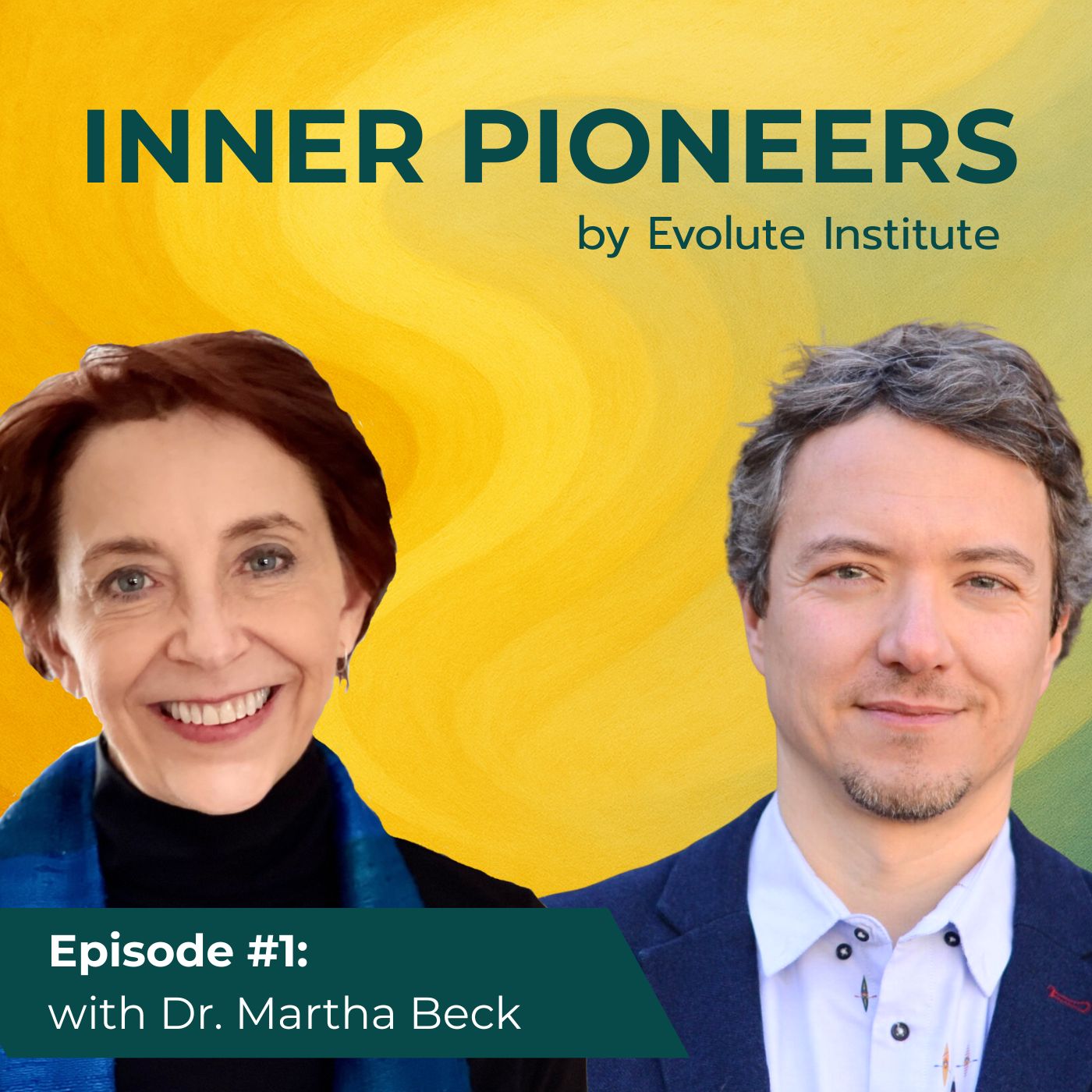
Dr. Martha Beck: Have the Courage to Trust Your Life (Even When It Makes No Sense)
from Inner Pioneers
61m 39s
Dr. Martha Beck, a Harvard-trained sociologist and life coach, discusses navigating rapid change and anxiety in a conversation with Christopher Gabakis on the Inner Pioneers podcast. She argues that modern culture wrongly treats humans as machines, leading to anxiety spirals driven by left-brain language and defense cascades (fight, flight, freeze, flop, fawn). Instead, we should embrace our animal nature: slow down, breathe, use kind internal self-talk (KIST), and allow natural shaking to release stress. Healthy fear is brief and broadening, while anxiety narrows and persists. The antidote is the creativity spiral, activated by curiosity, which opens access to eight Cs—calm, confident, clear, creative, courageous, connected, compassionate—and leads to flow and unity. Beck emphasizes integrity: aligning mind, heart, soul, and body, and recognizing that suffering signals we are lying to ourselves to please socializers. She shares her personal story of leaving academia, religion, and family to follow truth, and advises treating work as an ecosystem, not a machine, where passion and creativity naturally grow into value. Ultimately, she advocates trusting a benevolent universe, moving from scarcity to "enoughness," and committing to joy. She sees current global chaos as an "extinction burst" of a dying system, with a phase shift toward a more soulful, creative humanity already underway.
by the time we are five months old we are already shaping our responses to please other people
by the time we're five years old we're hearing all these messages all the time about what we're
supposed to be if those go along with our true nature fine absolutely great but if we're being
socialized away from our true nature we start to sell out our nature and go with our culture
and we internalize things like there is no other way for you to survive than by getting your
military pension and we believe it as if it's real it's not and if you are in psychological suffering
of any kind including coming from your soul murdering job it's because you are innocently
lying to yourself to please the people who socialized you
and recognizing that i am suffering therefore what i'm doing is not true for me
that's regaining your integrity and when you do that you'll not only leave situations that
are bad for you but you'll start to know what to do next but if you don't do it nobody can help you
you're listening to inner pioneers a podcast for curious minds
who want to understand how to navigate change crises or simply the call for something new join
us as we dive into real stories of transformation and learn from leading voices in psychology
science and human development how to move through inner shifts and seasons of change
i'm christopher gabakis and now let's begin pioneering
today it's my great pleasure to have with us dr martha beck martha you are a renowned
author um harvard trained sociologist with multiple degrees from harvard um your life coach
and um podcaster you told me before as well as podcast guest of course obviously um and uh an
expert in a way in transition moments in um navigate helping people navigate through shifts
inner shifts so the perfect guest for our podcast so welcome today thank you so much for having me
um and so my first question would be we always like to start with something personal so
what is shifting for you currently in your life
oh it's really interesting i moved to a new location about nine months ago which is always
an interesting event but also i've been dealing with the fact that the pace of change is
accelerating so dramatically in my life but also the lives of my clients
it used to be that everybody could take a deep breath between
major life transitions and now it just seems to be as as my partner roe puts it she said it used to
be that change occurred time seemed to go on pretty slowly and now it's just christmas christmas
christmas like time is speeding up so much that it feels like a year is a week long instead so that's
been really interesting to help people how do you go forward with intention purpose groundedness in
a time when change is so so so fast yeah and do we need to slow down uh to also change time ourselves
in order to be able to deal with this or do we need to speed up to match the pace of change what would
you say absolutely do not try to speed up that is the worst thing you can do i used to talk to a
crisis management specialist and he told me in a crisis the first thing you must do is slow down
it's so counter-intuitive but that's the way our brains work best
i once read about a violinist who was practicing these runs on the violin that were too fast
for her nervous system and her teacher said you cannot speed up to match that pace in the music
so you have to stretch time and she said oh all right and she stretched time and she could play
within the time she'd stretched and it came out as if she were a recording that could be sped up and
i was fascinated by that because i mean she was a real person and i started to think how do we
stretch time and i actually think it's by stepping backward figuratively stepping backward and then
i know this sounds ridiculously simple but you do it with your breath when something's really
really pushing you and you want to speed up whether it's business or whether it's something
you're doing that is very immediate and small stop for a second take a deep breath
and slow down your perception of what's happening and you breathe more slowly when you do this
and it's the breath i swear it's the breath that changes the brain that changes our perception of
time so that's i mean it's a very odd skill to be teaching to entrepreneurs but i love teaching it
yeah yes uh extending the exhalation i think um so i of course i i read your books um some of them
at least i mean some of them are very interesting but i don't know if you've read any of the books
not all of them they're too many uh the north star back in the old days there are too many
there really are i didn't read integrity uh this i i it's still on my reading list but i did read
the largest part of this latest book beyond anxiety it's one of the skills you introduce
um to calm down our nervous systems right to get away from anxiety or the anxiety spiral
as you call it with the breath and uh are there other which other ways are there for us to calm
ourselves when we're anxious about the pace of change or about what's happening in the world
i mean a lot is happening so we can maybe then i mean we get later to it hopefully get to the
creative creativity spiral right right um so modern culture really sees um time as being linear
and very uh
unidirectional right it it only goes one way if you stop and step back and breathe
then you can see time as more of a spiral and i talk about this a lot we could talk about it in
a minute how transformation always goes in cycle in um a spiral not in a straight line so if you
go to your breathing you slow it down get your nervous system a little bit calmed down then the
you have to charge forward and then you notice your own anxiety as if it were a frightened animal
and this is where people make a lot of mistakes because we are taught to think of the brain
as a machine and if we're anxious the machine is broken so what do you do you put medicine into it
you you know you do interventions to fix it you try to end your anxiety you stop it completely but
if you walked up to an animal and said i'm going to end you i'm going to stop you completely i'm
here to stop you that animal would not get less anxious it would get more anxious yeah so when
you've stepped back you've got your breathing calm it affects your entire nervous system
this again sounds silly talk to yourself in a low slow calm voice because your nervous system
evolved to respond with calm to this kind of voice and we
all know how to do that we all instinctively know how to calm a frightened small animal we don't have
to learn about brain chemistry or anything if you found a puppy on your near your front door
all shivering and dirty how would you talk to it with the calm soothing voice yes exactly and you
don't say i want to stop you i want to end you you say you're okay i've got you it's all right
i've got you so even if you don't believe it saying things like you're okay it's all right
i've got you it actually moves you into the part of the brain that knows how to calm the animal
and then the animal part of the brain calms down and i used to think that was so i call it kind
internal self-talk so the um the acronym is k-i-s-t or kissed i think i'm going to use some
kissed now and i would start talking kindly to myself and i thought i will never tell anyone
about this because it's so corny they would they would kill me at harvard for kissing my own brain
but i swear to god christopher it works like magic yeah i and what i mean i think about some um
entrepreneurs or ceos who might be listening and they might think like i'm not anxious
why should i uh talk to myself like a frightened animal i'm not frightened
but like sometimes i i then would prefer to talk about stress because people like to
talk more about stress than about anxiety but is there another way to realize when we are actually
anxious because some people might not recognize it and they might not know that
they are in this right exactly because what it does is it triggers something called the
the defense cascade in the body anything that you feel slightly threatened by and that means
anything unfamiliar by the way the part of your brain that is primitive and ancient and doesn't
really know the things that you're you know cognitively it's going to respond to anything
alien or strange with the defense cascade and that involves all the fight or flight mechanisms so some
people have coined the term the fight or flight mechanism but there are there's more than just
fight or flight there's also well let me just say a lot of your entrepreneurial listeners might be
going to fight instead of flight so they see something unfamiliar they're experiencing a
radical change and they get irritable angry furious at it and they think that they're going to fight instead of flight
that's going to make it, everybody who goes into an anxiety response thinks it's going to make
things better. If I stay tense and focused on worry, that'll make me, that'll make sure I don't
do anything wrong. If I'm aggressive and go in there and win, it will make sure I don't do
anything wrong. Actually, it makes you much more likely to make mistakes. Anyway, the other responses
are faint, where you just don't want to, you just go rigid and frozen. Another one is flop, where you
just feel completely out of energy and don't want to do anything. And then finally, there's fawn,
F-A-W-N, which means that you get very ingratiating and you try to please people
and you flatter people, you lie. And you might find yourself doing this with
another person who frightens you, becoming very hyper-pleasing. And you might even say to yourself,
what is wrong with me? I don't even believe what I'm saying here. I'm just flattering this person.
That's a flight response.
That's to keep you safe with other social predators. Dogs do it, right? They're ingratiating
to bigger dogs. So all of those things, fight, flight, freeze, flop, fawn. If you're doing
any of those, it can really help to take a step back, breathe quietly. And I know it sounds stupid.
Talk to yourself in a slow, calm voice. Try it. You know, hear me now, believe me later.
Yeah, I know this from somatic experiencing, Peter Levine with trauma patients. He talks about
voo-vooing, you know, this voo sound, the vibration that calms people's nervous system down
in like therapy settings, of course, which sounds a bit similar.
Yes. And Peter Levine also talked a lot about the shaking response. And that is something that can
actually calm your nervous system and regulate it too. You wouldn't think this was true,
but if you allow yourself to shake when you're anxious,
it actually moves the adrenaline and the cortisol through your body. So one of Peter Levine's
students was living in Lebanon when it was being bombed. And he was at the site of several really
dangerous situations. And what he found was that sometimes he shook violently after, say, a bomb
dropped close by. And sometimes he didn't. Sometimes he got control of himself and was like
in there helping people. But after the times he didn't shake, he would have nightmares. He had
PTSD.
So he makes his, his name is David Rosselli, and I did a few sessions with him. One of the things
he does to help people cope with change, cope with alienation, to cope with bad things happening,
or good things happening too fast, is allow the natural shaking response that all animals feel.
The whole thing about anxiety, Christopher, is that we try to pretend we're machines because our
culture treats us like machines. Once you accept that you're an animal, it's not so weird to let
yourself shake, but it's not so weird to pretend to be an animal. It's not so weird to let yourself
shake, but it's not so weird to pretend to be an animal. It's not so weird to pretend to be an animal.
It's not so weird to let yourself shake,
or to let yourself like lie down and be limp for a while, or to be kind to yourself in the way you'd
be kind to a beast. You know, it's a simple shift, and it makes all the difference in the world.
And how would you say, so how can we tell if the activation that comes with
fear is good or productive? And when it's unproductive, holding us back,
how do we know? I mean, you could even say sometimes in some conditions, the fight mechanism
I mean, might be productive, no? Absolutely.
How can we tell one from the other? Yeah, so yeah, good point. All of these
are useful in certain situations. And you should have full access to them. There's a fear response
that is absolutely crucial to your survival. But the whole difference between fear, which is healthy
and anxiety, which is not, is that in most creatures, the fight flight mechanism shuts down
when the danger is passed. And so, you know, it's not so weird to let yourself shake, but it's not so
weird to let yourself shake, but it's not so weird to let yourself shake, but it's not so weird to let yourself
shake, but it's not so weird to let yourself shake, but it's not so weird to let yourself shake.
So I wrote about watching a wildebeest walk up to a pride of lions in Kenya,
because wildebeests are not smart. They would lose a battle of wits with a walnut, right?
So this wildebeest walks up and he starts going, gong, gong. And the lions looked at him like,
are you going to make us kill you? Like, what is happening? They had just eaten. They were very
full. One lion gets up and he says, I'll do it. And he goes over, he starts moving toward the
lion, gong, gong, woo. And then the lion goes down and, you know, and they get really low and
then they start to charge. And the wildebeest went, gong, gong, gong, and just sped up to like 60
miles an hour for about 300 meters. And then the lion gave up. He was just like, oh, this is too
much trouble. Immediately in that moment, boom, the wildebeest stopped running, went and started
eating grass. The lion was right there. He just realized the lion wasn't coming for
him. So the fear response went away. That's what's healthy. What we do is we take a fear response
about a situation that may not even be dangerous. And then we replay it and we say, oh my God,
there are lions everywhere. I can never let down my guard. Oh, what am I going to do to protect
myself against the lions the next time they come? And we get into a thought spin, which is very,
very unhealthy. It keeps triggering the fear response, right? So how do you know when it's
healthy versus not? Here's the thing. If you're a
and you're having like, you feel all jazzed up and trembly and, or, or you feel like running or
you feel like fighting, just ask yourself, is this causing me to be more creative? Is it opening me
up or is it shutting me down? Does it have the effect of narrowing my attention or of broadening
my attention? Because being present with what's true and real broadens you. So that's really the
is the difference between shutting down and opening up.
Yeah, I like that. Makes sense. And also I like this realization that
because of cultural conditioning, I guess most often we have lost access to the natural responses
of our organism to deal with stress or with dangerous situations. So we push it up into
the mind and then try to resolve it there. And then we caught up there and we can't get out of
it. Right. And, and you already mentioned it, the creature part in us,
the animal part of us, but that we have abandoned or unlearned, forgot how to let it be,
shake, shake out, for example, the stress and then move on. And so we get into those loops.
And can you tell a bit, talk about more about this? How do we get from that anxiety spiral,
the creature part, maybe to the creative part, which is the next step, right? Also in your book.
Okay. So, um, a lot of times people say to me, like, I really, you know, I couldn't be effective if I
weren't anxious. I wouldn't, I wouldn't try to help anyone. If I'm not anxious, what would move
me? What would I be doing? And what I say to those people is if you've, God forbid, fell out of a
fourth story window and you survived, but you broke like 12 bones and you smashed some organs
and they took you to the hospital, would you want to be treated by doctors who were in a panic?
Or would you want to be treated by doctors who are kind of interested in what was going on
inside your body? And we're like, they're there because they're fascinated.
By helping people heal, which group of doctors would you rather have dealing with you? So,
and what you see is that anxiety is not nearly as productive as functions that cause us to lean
forward into things because of fascination. So anxiety makes us run away from the danger or
try to keep the danger away. Keep it away. Keep it away. It's about separation and avoidance.
The opposite side of the spectrum is about being moved towards something by anything from,
you know, fascination to all out falling in love. And that is handled on the other side of the brain.
So everything we've been talking about with anxiety happens in the left hemisphere of the
brain. The only way we keep the anxiety running is by thinking in language, which is something
almost completely dominated by the left hemisphere. And yes, I know they're always
both working together, but if you have a left hemisphere stroke and you lose all language,
you don't have any more anxiety. I heard this from
multiple people who'd had left hemisphere strokes. Anyway, if you go over to the right
hemisphere, the mirror mechanism of anxiety is something I call the creativity spiral.
And what that does, so anxiety starts with shock and avoidance. Oh my gosh,
there's something new I have to change. And then goes into the defense cascade.
On the right hemisphere, what happens when you see something new is, oh, that's new.
Whoa, I got to see what that is.
Man, I got to look at this. And you can feel it. Most of us have had the experience
of driving past an accident and slowing down to try to see what happened.
Have you had that? And I always were like, I shouldn't be staring. Like,
why am I staring at these poor people? That is such a deep evolutionary compulsion because
when you see something where someone was hurt, the potential for learning about how to avoid that
pulls you into a kind of fascination with the accident, even if you're just horrified by it.
So that feeling of, we call it rubbernecking, yeah, of leaning into something and trying to see,
that's the first impulse that takes you out of anxiety. So it's curiosity, essentially. Then
you get into a part of the brain that is curious, calm, confident, clear, creative, courageous,
connected, and compassionate.
Those are the eight C words that describe
describe a part of the brain that one therapist calls the self with a capital S. And once you get
really curious, they've shown that people who are very bigoted against folks from other cultures,
say somebody's wearing a turban and you've never seen that and it freaks you out. The initial
response is fear. And then, oh, that's another person's not like me. And it's separation. But
if you ask them one question, and the question that they used in some research is figure out
what this person has for dinner at night. The moment they started trying to learn about the
other person, the fear and the rejection and the othering dropped almost to zero. The person's
anxiety at dealing with newness, difference, change, dropped to zero. And they were suddenly
able to begin understanding.
This other person. It's the same thing. If you're an entrepreneur dealing with a rapidly changing
market, which we do all day. I mean, that's where we are, folks. Things are changing so fast. And if
you go, oh my God, I've got to get, I've got to handle this. I've got to attack it. I've got to
run from it. I've got to guard myself. You're not going to survive. But if you say, oh my God,
holy smokes, what is causing this? Where's it going? What's happening to people? And you go
into it. You start finding ways to
understand things like what's happening to your demographic that you're trying to sell to?
What's happening to the industry that you're in because of AI? And instead of freaking out,
you're like, ooh, what can I do with that? The AI thing is huge right now. People are terrified of
it. I'm freaking fascinated by it. Aren't you? I mean, it's like, it does things. So if we can
approach it that way, we're going to deal with every, every change.
So much more competently.
Okay. So, so the key is activating our natural curiosity, what's going on and then follow that.
And it might be even at the beginning, focusing on something dangerous, like you said, the
fascination with an accident, but then it might extend and move to other things as well. And
into something that is not focused just on danger, but on potential and something we can create.
Right. And what else, like how, like, is that,
all that is to change, moving out of what can become an anxiety spiral to a creativity spiral
through curiosity? Or are there other elements that are important?
Yeah. I mean, that's an initial thing if you're dealing with a shock, but what happens when you
activate that part of the brain, you go into this creativity spiral. And in that creativity spiral,
you start to notice more and more things that make you happy, that please you, that fascinate you.
So people who are not anxious are in creativity.
So people who are not anxious are in creativity because they're incredibly curious.
We humans have an interesting genetic mutation. It's called neo.
In most social primates, which we are like chimpanzees, orangutans, whatever, the babies
are really, really quick learners and very playful and very exploratory. In most primates
at puberty, these changes kick in, the brow gets dark, the teeth get much bigger, they grow in, the jaw
gets really huge and powerful. And also the creature stops being as playful and curious.
But human beings have this mutation, which makes us look like baby apes our whole lives.
So our faces are relatively flat. Our teeth are small. We're like baby apes. And we didn't lose
the curiosity. That means that adult humans, even old humans like me, can be extremely playful
and exploratory if we give in to that impulse.
But again, we're locked into a culture that number one, tells us to be anxious. Number two, says treat
it like a machine. And number three says, don't be curious. Learn what I have to tell you and then
don't go away from it. Like don't do anything outlandish or weird, right? But if we can be as
playful as we are designed to be, what happens after we get curious is that we start to learn
and learn and learn and learn the way a toddler does. We start to learn and learn and learn the
right way. We start to be more like toddlers. Did you know that children under the age of four laugh
about 400 times a day? And how often do you think adults laugh a day? The average adult?
What would you guess?
Depends on who they are. No different characters. Much less. I mean, like a dozen times,
hopefully. I don't know.
Yeah. Around 15. Good guess. And it's not because we've lost our sense of humor. It's
because we've lost our sense of curiosity in play. So we can start becoming curious about
everything that's happening in our business, in our market, in our personal lives. One of the
things that I've done my whole life is I see what fascinates me and then I turn it into a product.
So I like horses. Never had a horse. Didn't know how to ride a horse. Really like horses.
So for a while, I worked with a horse whisperer and we would, because working with horses is in
incredibly powerful at teaching you how you're putting out energy so that other people react to
it. Other people will keep themselves stiff and straight, right? Like they won't shake if you're
scary, but a horse will shake if you're scary and they're big and they give you a lot of feedback.
So for two years, I bought a ranch with the money I made doing the horsework shops with,
with business leaders. You know, I like going to Africa to see the big animals, turn that into a
week long course. I like going to Africa to see the big animals, turn that into a week long course.
People fly from all over the world. Like get curious, get creative. And suddenly everything
you love can be part of your business. So teach what you want to learn. That's
what they said. And now you say, yeah, make a business out of the things that make you curious,
which is a variation from that. Yeah, same thing really. Yeah.
Because what you want to learn is the curiosity and teaching is a product. Yeah.
So I think, yeah, I feel that it's really important to connect to that child energy
each of us in our culture, right? To rediscover that place of joy, natural curiosity and so on.
And I think we have like also to the programs that people come, that we organize, it's often
people are lost and feel stuck. What they often report is, ah, when I connected to what I used to
love, what I used to do, like one medical doctor, he said, I loved music so much as a teenager and
I played music. And, but then I stopped, I don't even know why, the studies and then the work and
so on. And, and he got, um, lost joy for everything because he lost the joy to those things that he
really cared about. And, um, I, I, I think it's, uh, it's crucial to connect to this young part
of the monkey, the baby monkey, you said that knows how to just follow its curiosity and laugh
and, and so on. Well, you're so right. And it's such a razor's edge, Christopher, because
here's the thing they've shown in studies that even a slight amount of sort of
pressure to produce something will kill the creativity and put you back in anxiety. So they,
they would do things where they'd give somebody a creative task, like here are three objects,
make a candle holder out of them or whatever. And they would, they would start working like
little kids and they would be curious and figure things out. Then they'd say to people, okay,
here's another creativity thing. And if you do this one, right, I'll give you $5, which is not
$5 in America. Um, not a good one, but they would say, okay, $5, their creativity just went to zero.
And suddenly they were anxious, not because someone had a gun to their heads, not because
someone was yelling at them because someone was paying them. That is interpreted by our nervous
systems as terror to charge for something. So what we have to do is find that place where we're doing
it for play and we can market.
And exchange it for something of value without freaking out. And that is quite, that's like quite
a trick, but we can do it.
I mean, many people would probably say, yes, but I need to make a living, right? I have like,
I have a mortgage. I have to support my family. I can't just quit my job and do whatever I love.
How would you respond to those people?
Well, I always say, stay in your horrible soul murdering job as long as you can. Just stay there.
Yeah. If you're not, if you don't have any other way of thinking, you have no other ideas about
how to make a living. That's going to be catastrophic. I remember teaching a group
once there were about a hundred people and this woman got up and she said, I'm in the military
and I hate it. It's horrible. I've hated it for 20 years, but I've only got five more years to go.
And then I get my pension. So I can't leave, but I swear every time I go to work, I get violently
ill, but there's no other way for me to make a living.
And I said, really? No other way. And she was like, nope, I got to stay in there for my pension.
And I said, can anyone in here think of a way that this lovely person could make a living
aside from being in the military? Not a single hand. I'm like, she has to be in the military.
Yes, she has to. They all accepted it without. And then I said, how many of you are making money?
Everybody raised a hand. And I said, how many of you are in the military? Nobody. I was like,
think of a way she might live without being in the army. Nope. Can't think of anything. Oh my God.
It's insane.
So if you have been so conditioned that you literally cannot think of anything like, I
don't know, getting a horse and doing a seminar with her, like there's got to be something
you can enjoy, something that makes you laugh more like a toddler, something that makes
you curious.
If you go into that and you find something of deep, deep value to your experience, that
something will also add value to other people's experience.
There is a way you can turn it into an exchange for money or other things of value.
You can do this.
I came back from Africa once.
I'd been doing this seminar.
There was a woman.
I went to the grocery store, resupply.
I did this big shop and she said, wow, that's a lot of groceries.
And I said, yeah, I just got back from a month in Africa running seminars to help people
change their lives, you know, with out on safari.
And she said, oh, my God.
How did you get that job?
And I was like, it's not a job.
I just made it up.
I just made it up.
Your creative capacity is infinite and you've let them shut it down to, I have to do this
for five more years.
What?
You have a human brain.
It's the most powerful thing in the world.
Use it.
So would you say, is this anxiety or is it something else?
So there is like a social layer to it.
Maybe most people around us might not do it.
And so we also think we cannot do it.
So I don't know.
What would you say to people who feel like they feel stuck in what they're doing?
Maybe they look for what's next, but they wouldn't say, I'm afraid of trying out something
new.
It's just like that.
They don't know what.
Yeah.
So this is why they should read The Way of Integrity.
The Way of Integrity was the book I wrote right before Beyond Anxiety.
And I thought it was the last book I would ever write because it was everything I know.
And it's a book.
It boils down to if you are in alignment between your mind, your heart, your soul,
and your body, if you're doing things that make all those parts of you relax and feel
grounded, you will have total integrity.
So integrity just means being one thing undivided, not two things.
That's duplicity.
This is integrity.
So if you can find integrity, you will have no more sufferings, a psychological suffering
of any kind.
And I put it out there and people came back and said,
okay, I'm in integrity, but I'm still afraid.
And I realized that they had internalized the social messages around them so deeply
that they could not see that they were lying to themselves.
So here's the deal.
We're all born completely true to ourselves in total integrity.
By the time we are five months old, we are already shaping our responses to please other
people.
By the time we're five years old, we're hearing all these.
All the time about what we're supposed to be.
If those go along with our true nature, fine, absolutely great.
But if we're being socialized away from our true nature, we start to sell out our nature
and go with our culture.
And we internalize things like there is no other way for you to survive than by getting
your military pension.
And we believe it as if it's real.
It's not.
And if you are in psychological suffering of any kind, you're not going to survive.
Any kind, including coming from your soul-murdering job, is because you are innocently lying to
yourself to please the people who socialized you.
And recognizing that, I am suffering, therefore what I'm doing is not true for me, that's
regaining your integrity.
And when you do that, you'll not only leave situations that are bad for you, but you'll
start to know what to do next.
But if you don't do it, nobody can help you.
So that's the key question.
So what's true for me?
And be honest about the answer.
And then the anxiety will come up probably anyhow.
Yes, it does.
And then we need all the advice we can get how to move to a feeling of calm and safety again.
We had the breathing and grounding exercises, the calm voice, kissed, the kind internal
self-talk and self-regulate.
So that we can grow.
So that we can grow the space for this play, you know, the exploration.
Well, so that we can do things that we were not socialized to do.
And that creates huge anxiety.
Okay, quit your job.
I wasn't socialized to quit my job.
I'm terrified.
I started my quest for integrity when I was 29.
I made a New Year's resolution that I would not lie for a year, not in any way, not for
any reason.
And I kept my resolution.
And during that year.
I lost or walked away from my job, my industry, I left academia, my religion of childhood,
which was massive for me, I was raised Mormon, very, very Mormon.
So I left my religion that meant losing my family of origin, which was huge mental losing
every friend I'd had before the age of 17.
It meant like I moved away from my home, my everything, everything I was doing was so
connected to my socialization that it was wrong for me.
And when I simply stopped lying, which I do not recommend, it was awful.
When I stopped lying and did what was true for me, I pretty much threw away the life
that I'd had, and I got the one I wanted.
And that is going to be true for everybody.
But don't do it the way I did it.
Do it very gradually and softly.
And get support along the way.
I think what one of the elements that you also mentioned is the importance of finding
a community or like minded.
Yes.
Others, right?
So probably you had to move away from your community of origin in a way to find new,
like minded people to develop that and cultivate that new life that you're building, right?
And at the end of the book, you mentioned constellating an ecosystem.
And can you talk a bit more about this community aspect of managing or navigating change and
yeah.
Yeah.
So I love the idea that, and you talk about this, you said a lot in the podcast that your
job, your environment should be treated like an ecosystem.
Again, the machine thing comes up.
We're taught to work like machines and we're taught to work in machines.
Even a corporation is sort of pictured as that assembly.
It comes from that assembly line image of people sitting and doing a specific task over
and over.
And then you put them all together and they make a big machine of productivity.
You know, Henry Ford created that when he did the first assembly lines for Model T Fords.
And he's famous for that.
Also, everybody hated him.
His factories were so awful that he had the turnover rate was 90% per month.
He had to hire 55,000 workers a year to fill 14,000 spots because being treated like a
machine is horrible.
So treat yourself like an animal and treat your business like a garden, like a forest,
like something that grows naturally.
So an ecosystem in nature, every place there is space and energy and water.
There is life.
There's an ecosystem that grows even at the bottom of the ocean on the heat vents because
the heat vents provide energy and it's underwater.
You get creatures living at unbelievable depths in pitch darkness and they're happy there.
So an ecosystem, I think I said in the book, correct me if I'm wrong, I think I said the
equivalent of a space for an ecosystem to grow is your time, the time that you have
left in this life.
That's the equivalent of the space where an ecosystem will come into being.
Water is your creativity.
The energy is your passion.
So if you have passion and creativity and time and you put them all together, just sitting
in a room, if you activate your creativity and your energy, you are going to start making
something.
Everybody in a state of relaxation makes something.
When you start to make something.
Really allow yourself to be in a child state of exploration, but with an adult brain, with
everything you've ever learned in your life, what you make will be fabulous.
Doing it either.
And that's all I've ever done.
I either sell the things I make or I sell training in how to make it.
People are interested in both.
And I, once I had to speak to a group of life coaches and they asked me, what's your marketing
strategy?
And I truthfully told them.
Concealment and evasion.
I run away from people.
I'm very shy.
I just want to throw a book at them and run.
But they keep following me and throwing money at me so I can teach them something.
It's weird.
But then when I do teach them to follow that, people start offering them money too.
It's like magic.
I also, I like the ecosystem also because it's, you create a space for something to
grow and no, you can't make the plant grow.
You have to collaborate with reality as it is.
And this process that it's not just, you have to do everything, right?
It's you alone in the world have to do the things.
But it's more like, okay, how can I participate in this creation and maybe carve a little
space, my little garden, and then put a little water and trim here and there and so on.
And it can grow and blossom.
This is, it feels very right.
again when you say it like so. It is.
Like, it's such a joyful
exercise right and so different from how most organizations operate or how most jobs are
structured in yeah like i i tried in academia i tried to like keep that artificial system running
keep um turning out journal articles that nobody would ever read that were boring to me as well
it just nothing happened by itself it was a dead desiccated thing it's so funny that you say this
i i just moved to upstate new york which is we had a terribly cold winter but in the middle
my family and i decided we wanted to grow some tomato plants so we took these tomatoes we ate
the tomatoes we put the little seeds in the little starter things and sure enough in a couple of
weeks these little plants came up this was around christmas time at this point there was an entire
room in my house absolutely full of these gigantic tomato plants they're just like
how are they doing this they just keep getting bigger we hold we hang lights over them to give
them light and like in a day or two they've grown above their lights it's frankly a little alarming
but you're never supposed to grow tomatoes at that time but we're like who knew this would happen
anyone who's ever grown a plant knew this would happen that's how i feel about business
you put a seed in no matter how tiny it is and you water it with your creativity and your energy it
just goes bonkers and you don't you're exactly right you don't have to feel like you're dying
of overwork and that your soul is rotting away it's just like this is how nature designed me to be
yeah so this is like i mean i love this idea of the ecosystem thinking let's say or
cultivating ecosystems and and working with nature also in a way you mentioned also in
your book and i it reminded me of somewhere else where i'd heard it this idea of
through me and i wanted to ask you about that because yeah again like this this idea i mean
i can be in the victim mode life happens to me i can be i'm the creator of everything
like by me mode which is functional and productive i mean nothing against it to an extent i can or can
move into this through me mode or even as me and maybe that's the final part of your book where you
talk about the creation and also awakening or yeah and can you talk a bit a bit more about that it
is like it's the uh the final stage the most fulfilled stage of living uh in the the creative
life let's say yeah yeah so on the left hemisphere of the brain that anxiety spiral it goes
tinier and tinier your life gets tinier and tinier people who really give into their anxiety
sometimes end up you know unable to leave their homes and this is not their fault i'm not saying
they're bad but that's what anxiety does if you let it just have its way on the other side of the
brain
there's also a spiral but it opens up as it goes forward so at first it goes into the arts it goes
into connection with people in a community it goes into love and compassion and if you keep creating
and you keep connecting and connecting things connecting people connecting things in your
business if you keep doing that from a space of curiosity and love self-love other love
it gets so huge that there's a
point where psychologists identified maximum human fulfillment and it's a state that a researcher
named chicks and me hi he called it flow and it's where you're producing the maximum amount of
dopamine and serotonin and feel-good hormones and it's right at the edge of impossible for you but
when you get there it's as one philosopher said when you get to the top it is easy even though it
is hard if you keep going
you're going to get there and you're going to get there and you're going to get better and you're
like that violinist who was fully into that music magic starts to happen you can stretch time
you can expand the way you see and tell your creativity absolutely dazzles people and as you
move forward it starts to feel like it's not really you doing anything there is a sense that
there's a broader intelligence that is vast much bigger than who you are as a human being
as an individual and you start to lose the sense of separation from that vastness and it starts
moving you so in china the daoists were five thousand years ago they started talking about
this that the dao this benevolent flow of force of energy not force but of this powerful benevolent
energy it it sort of picks you up and starts to move you as if you're floating in a river
and sometimes the river gets very very fast there's a daoist story about
these scholars who are walking by a waterfall huge waterfall and they it's white water everywhere and
they see a dead body in the water and they're like oh we have to get it out and give it a proper
burial so they're saying how are we gonna get in there what do we do and as they're talking this
little old man pops out of the water towels himself off and walks off down the road and they
they run after him and they say how did you do that we thought you were dead and he said it's
it's really easy you go up when the water goes up and down when the water goes down
and they're like what that was where the chinese wisdom traditions kind of poke gentle fun at the
way we do things as machines and by rote and we're going to memorize and force that was the scholars
and those who live in harmony with the way things are get moved into the next thing and it can look
as if you're going incredibly fast and working incredibly hard and undergoing terrible changes
and to you it's
a joyride it's just fun you're not doing it the water is doing it the dow is doing it and how can
we um help people get into this alignment with the the system bigger the high intelligence or the
the ground of being the the dow you said you just keep doing the stuff that interests you
so follow follow your curiosity and your creativity i also know that like the ultimate end is all
opening can be like this experience of unity or oneness feeling really at one right and it can
also be an extraordinary state of consciousness not just the flow state but also yes that's that's
at the edge of what science accepts and beyond that is the mystery and i'm here to tell that's
why the first third of my book is about anxiety the second third is about what science acknowledges
and the final third is about what happens in the mystery and the magic of a life that is beyond
what our culture tells us is possible and uh i mean i have some ideas but uh i wanted to ask you
how can you help people move into the magic because there's a great i mean yearning i think
for people to to it's like sometimes i think it's like a spiritual void or so left by the
demise of religion in in western culture and someone said like we have a god-shaped hole in
Substances with distractions, with money, with status and so on.
The hungry ghost, right?
It's never enough.
But actually what you're looking for is this deep sense of connectedness, right?
Or union.
Like, is it possible to read your book or have a simple life coaching experience and move towards it?
Or is there something else?
Yeah.
I think it's an act of courage that everybody has to do for themselves.
The one thing we can do to help other people is to really commit to it.
Commit to our own integrity.
Commit to our own joy, our own creativity.
And take the steps that lead toward that joy.
Another thing I would say is cultivate stillness.
What you just said about the God-shaped hole in our hearts.
I think that, you know, Freudian theory was obsessed with sexuality because his culture, Freud's culture, was very repressive about sexuality, which is natural.
It's part of us.
These days.
I mean, I did three.
I did three degrees at Harvard and had three children along the way.
And that experience, especially because my second child had Down syndrome, was it shook me right out of the whole social setting I was in.
I had to look at what made it worthwhile to keep raising children in a place where I was very, very conditioned to think that that was silly and that was my personal life.
And I, Harvard didn't want any part of that.
But even more, it didn't want me to have any part of a non-materialist worldview.
So what we have now is a deep repression of spirit, not sexuality, a repression of spirit, which is a natural part of ourselves.
So if you were, if Freud were here today and he, you know, came up with a system of analysis, he might be looking at dysfunctions around repression of spirituality.
And it's not.
Even religion represses spirituality.
Mormonism repressed my spirituality hard because that wouldn't, it, as soon as I got spiritual, I left.
So, yeah, there's this incredible need, this ache, this yearning to be fulfilled.
And even people who are madly successful as business people, the money doesn't do it.
The success, even the fame does not fill that gaping absence.
But the pursuit of our own curiosity, creativity, compassion.
Those take us.
Those take us.
Into the state of union.
And there you find that you have enough.
There's a story about.
Joseph Heller, the writer Joseph Heller, he was at a party where there were all these billionaires
and socialites and famous people. And another writer said to him, wow, gosh, it must be weird.
You're not that rich and everybody around you is rich. Don't you feel a little out of place?
And he said, a little, but I have something they'll never, ever have. And the other person
said, what? And he said, enough. I have enough. And you can see the rapacious appetite that people
have where they're just consuming vast amounts of money and it's never enough, never enough.
When you find that unity outside of all anxiety and beyond even the creativity,
there's a sense of satisfaction, of enoughness that is like drinking from a spring of clear
water all day.
There is genuinely a state of bliss that will make you know you have enough. And it will also
through you, make sure you keep having enough materially so that you can go on realizing you
are not material in your essence. And you can experience the world beyond form while still in
form. And that is just an ongoing state of magic. Yeah, this, yeah, very nice. It's
a great question. It speaks to me. When you said courage, of course, it comes from core,
from the heart, to live from the heart. And I think too many people in our culture and also
me when I was younger, living very much in the head, reducing uncertainty, right? Helping you
to navigate the systems that humans have created. And the living more heart-oriented, in a more
heart-based way, I think is part of it. I love the stillness, moving into stillness. So space to
slow down, to quiet down, meditation and all the practices that people know, right? And then the
final thought that came was, so this, okay, I will be taken care of. Life will take care of me.
This is an enormous leap of faith for most people, right? Huge, huge. It's like it ties into the
anxiety, like the scarcity paradigm, right? I might not have enough now to provide for my family,
but also later in old age, my pension. And
so people live in those systems of fear, basically, right? And so I wanted to ask you about
the social dimensions of your work, the cultural dimensions of your work, and how can we move from
an anxiety-oriented culture, basically, a scarcity-based economic system, at least,
to more creative and connected way of being? Yeah. We have to be a traitor to suffering.
We have to not just decide that our culture is right when it's not right, but we have to
says you have to do things that make you miserable because you've got to feed your family. You've got
to make your pension. I am number one, the primary breadwinner for my family, have been for decades.
Number two, I'm old. So I can tell you something. I left my job at 29 with no prospects,
nothing I could do. I had three children under the age of five. I was chronically ill. I couldn't
walk, stand or move my hands. Spent most of my time in bed in so much pain, I could hardly move.
And that went on for 12 years. And I kept saying to myself, I've got to get out. I did things,
I crept onto campus and I taught my classes and I wrote my papers. For a while, I had to
type by putting a pencil. I had casts on both hands. So I would put pencils between my fingers
and hit the keys with the eraser ends. I was not well. Yeah, well.
So that's why I decided not to lie for a year. It really, and it healed me. But that's another
story. But I kept telling myself, I've got to do what people say to do because I've got to provide
for my family. I've got to provide for myself in old age. But I could not. I was given the
incredible gift of absolute disability. And what I have learned is that I could have trusted
the whole time. If I had known then what I know now,
if I'd gone back to myself at the age of 30, and I would say, look, what you are is enough.
What you do for the joy of it will provide for your family. What you do for the love of other
people will pay for your old age. I'm in charge of this. And I don't know what I am, the universe,
whatever you want to call it, my higher self, but I've got you. We're fine.
You know, the reason you're miserable is that you need to find the things that bring you joy.
Put that first and you'll always be provided for. I know it sounds stupid. I know it sounds
impossible. That has been my experience for the last 33 years of my life, even when I was
completely disabled. So again, I went from faith, which is a kind of gripping sensation in my mind,
believing in what you don't see, to trust, which just has a
different connotation for me. So instead of keeping the faith, I would say cultivate trust
in the benevolence of the universe. It wants to treat you as well as you would treat yourself if
you were given your entire, if you were absolutely mentally healthy. So experiment, trust, see if it
works. I promise you it will. And would you say then, if we, if we follow our joy,
and we trust that we create different lives for ourselves and that this way we change the world,
the world, I mean, through, through the ripples we have directly in all the interactions we have,
but maybe also on an energetic level, what do I know? Is this the way to, to change to, and then
to reach maybe a tipping point of people who are not anxious and, and then it has really a phase
shift in, in society or how, how would you think about it? I like that you call it the phase shift.
I swear I was born knowing that I was here to help with some kind of a transformation in humankind and
I would live to see it. And I grew up knowing this. I couldn't say it to anybody. They were all Mormon,
you know, like I, and I was a girl, girls don't do anything in Mormonism. They have babies, you know,
but, um, breed well in captivity. I used to say, I knew that I was here to help with something. And
I would see people sometimes, and I think, you know, you're one of us, you're one of them. And
I didn't know what I was talking about. And it wasn't until I was in graduate school that I
started to notice that some people very rarely, they said things that sounded familiar. And I
think, wait a second, you know, by the time I was, I'd been coaching for about 10 or 15 years,
I realized all the clients coming to me were people who already knew it. When you talk,
we've never met before. When you talk, I'm like, oh,
he's part of it. And again, I have no, there's no testable, you know, I can't do any research on
this. It's just that a strangely prevalent group of people that I've met in my life all have the
same idea that we're here to be part of a phase shift for humanity in general. And that it's
happening now. It's happening now. I spent so many years going, when do we start? When do we start?
We've started.
And this podcast is part of it. So if that resonates in you, let that be the thing you trust.
And trust also this, that if you follow your joy, if you follow it all the way, no taking two steps
and then running back to the culture. Okay. I've imagined something better. Now I'm going to run
back to my job. It doesn't work that way. Go all in. Trust what you trust in yourself.
It was Goethe who said, when you trust yourself, you will know how to live.
And for all of us today, when we trust ourselves, we will know how the planet gets to keep us alive
for the indefinite future. We'll turn it around from its destructive course
and we'll save our own lives in the process. Win-win.
That sounds wonderful. Sometimes it feels a bit like we're regressing also. I don't know if it's
a normal, like a pendulation movement of the world.
I think it's more. Do you know what an extinction burst is? Okay. An extinction,
if you have a pigeon that's been trained, that if it pecks a lever, it pecks a button. Yeah. And
at unpredictable intervals, a bit of food plops out. So this is one of the most reinforcing
strategies you can have. Intermittent, unpredictable reinforcement. The pigeon
will just peck away like crazy. If you stop giving it pellets, it goes absolutely insane.
It just pecks and pecks and pecks and pecks and pecks. They call this an extinction burst.
And then it will go,
whatever, and give up. If you feed your dog from the table, it will come and beg and beg. And if
you stop, it will beg harder. I know I've done this with several dogs. So it gets, and then you
say, no, no more table scraps. And you don't do it. The dog goes bananas, pushing and pushing.
And then it goes, oh, whatever. And gives up. Right now, what I believe, what I hope we're
seeing, certainly in the government of the United States and other places around the world,
and in the economic sphere, is an extinction burst of the old mechanical, soul-destroying
socioeconomic system. It is dying. And so it's frantic. And it's screaming.
and it's terrifying and it's dying and the shift is what comes next.
On that note, what else to add? I mean, towards, yeah, let's hope that this shift towards more
soulful, creative, joyful, meaningful living happens for more and more people and more
quickly. I can't wait and be glad that you're part of that journey. I love your work, your books,
and I hope our listeners will too. If they want to learn more about you and your work,
where would you point them? MarthaBeck.com.
MarthaBeck.com. And we mentioned already the books. I mean, Beyond Anxiety, we talked a lot
about your latest work, but there are many other books as well. And I can, from my whole heart,
recommend them. I will also. Too many of my friends, I thought about them when reading that.
And yeah, I would love to have a follow-up conversation one day if we go deeper on those
topics. There's so much we didn't explore. Let's do it.
But yeah, I want to contain it, this interview also. So thank you very much, Martha.
Thank you. It's been lovely.
Thank you. And have a good afternoon and evening. Bye-bye.
Thanks so much for listening to Inner Pioneers. If you found this conversation meaningful,
don't forget to subscribe and share it with someone you care about.
Want to go deeper?
Visit evolute-institute.com. Until then, keep pioneering one step at a time.
Podcast Summary
Key Points:
Modern culture treats humans as machines, but we are animals; calming anxiety requires embracing our animal nature through slow breathing, soothing self-talk (KIST), and allowing natural responses like shaking.
Anxiety is unhealthy when it persists beyond danger and narrows attention; healthy fear is brief and broadens creativity. The creativity spiral—driven by curiosity—opens the brain to calm, confidence, and compassion.
The defense cascade includes fight, flight, freeze, flop, and fawn responses; recognizing these patterns helps identify anxiety, even when it manifests as anger or hyper-pleasing.
Integrity means aligning mind, heart, soul, and body; psychological suffering often stems from internalized social lies (e.g., "there's no other way") that lead us to betray our true nature.
Treat work and business as ecosystems, not machines—nurture creativity and passion in time, and follow curiosity into play, which can be turned into products or services.
Moving from anxiety to creativity to flow and unity ("through me" mode) leads to a sense of "enoughness" and trust in a benevolent universe, not scarcity.
Social transformation is possible through individual commitment to joy and integrity; current global turmoil may be an "extinction burst" of a dying mechanical system, heralding a phase shift.
Summary:
Dr. Martha Beck, a Harvard-trained sociologist and life coach, discusses navigating rapid change and anxiety in a conversation with Christopher Gabakis on the Inner Pioneers podcast. She argues that modern culture wrongly treats humans as machines, leading to anxiety spirals driven by left-brain language and defense cascades (fight, flight, freeze, flop, fawn).
Instead, we should embrace our animal nature: slow down, breathe, use kind internal self-talk (KIST), and allow natural shaking to release stress. Healthy fear is brief and broadening, while anxiety narrows and persists. The antidote is the creativity spiral, activated by curiosity, which opens access to eight Cs—calm, confident, clear, creative, courageous, connected, compassionate—and leads to flow and unity.
Beck emphasizes integrity: aligning mind, heart, soul, and body, and recognizing that suffering signals we are lying to ourselves to please socializers. She shares her personal story of leaving academia, religion, and family to follow truth, and advises treating work as an ecosystem, not a machine, where passion and creativity naturally grow into value. Ultimately, she advocates trusting a benevolent universe, moving from scarcity to "enoughness," and committing to joy.
She sees current global chaos as an "extinction burst" of a dying system, with a phase shift toward a more soulful, creative humanity already underway.
FAQs
The first thing to do in a crisis is to slow down, which is counter-intuitive but best for how our brains work. You can do this by stepping back and taking a deep breath to stretch time and calm your perception.
You can calm your nervous system by breathing slowly, talking to yourself in a low, calm voice as you would to a frightened animal, and using kind internal self-talk (KIST). These actions help move you into a calmer part of the brain.
The defense cascade includes fight, flight, freeze, flop, and fawn responses. These are natural reactions to perceived threats, but if they persist after danger passes, they can become unhealthy anxiety.
Fear is productive if it opens you up and makes you more creative, while unproductive anxiety narrows your attention and shuts you down. Healthy fear shuts off when the danger is gone, unlike anxiety which keeps replaying threats.
The creativity spiral is the right-brain counterpart to anxiety, activated by curiosity. When you get curious about something new, it moves you out of fear and into a state of calm, confidence, and creativity, helping you cope with change.
Studies show that even a slight pressure to produce, like offering a reward, can kill creativity and trigger anxiety. This is because our nervous systems interpret such pressure as a threat, so it's important to focus on play and curiosity instead.
Chat with AI
Loading...
Pro features
Go deeper with this episode
Unlock creator-grade tools that turn any transcript into show notes and subtitle files.
 PodcastTranscript AI