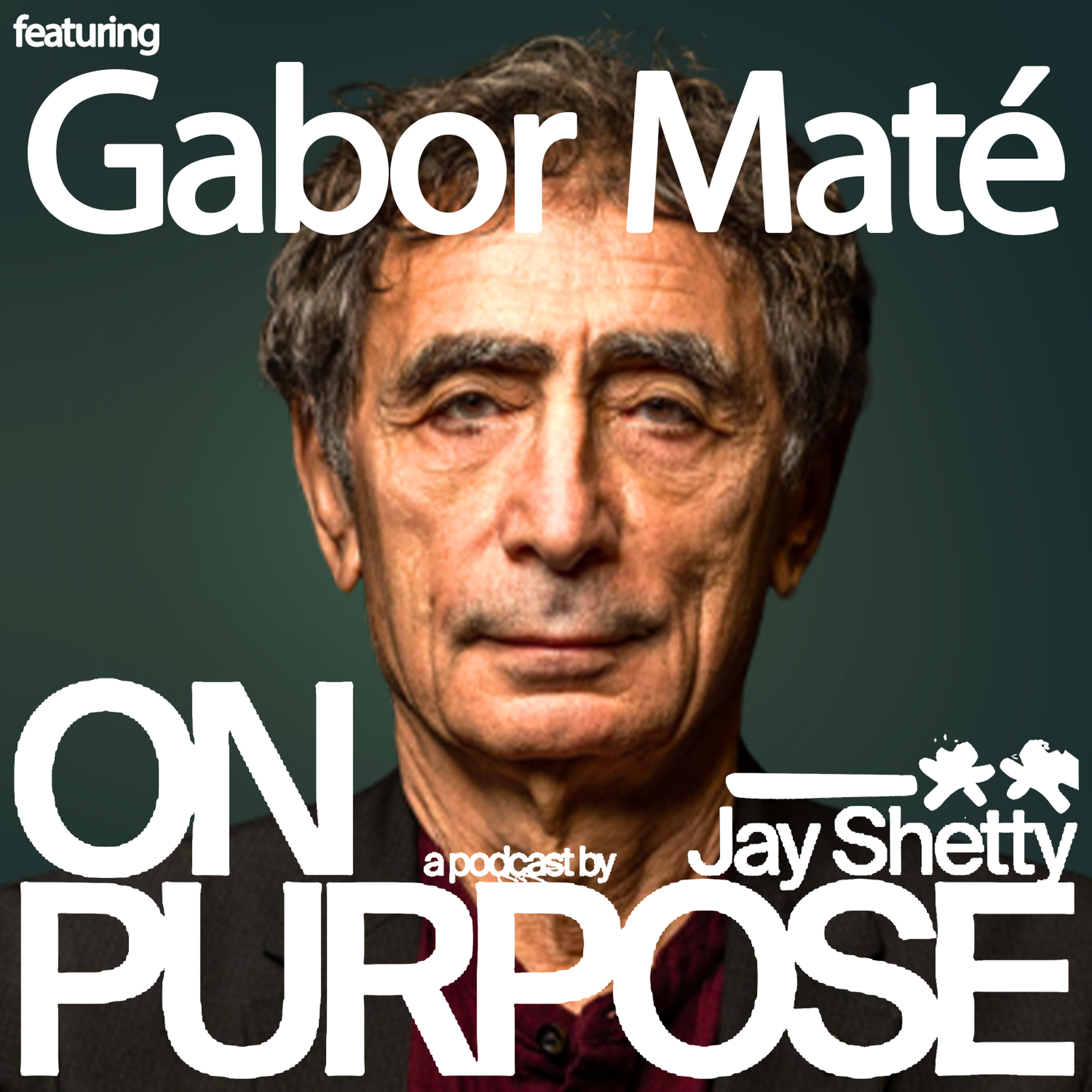
Dr. Gabor Maté: Constantly Worrying What People Think of You? (THIS Simple Shift Will Help You Trust Yourself and Stop Seeking Approval)
49m 21s
The conversation explores the roots of people's obsession with others' perceptions, tracing it to early childhood. A fundamental human need is to be seen authentically by caregivers. When parents, due to their own limitations or cultural pressures, cannot see the child's true essence, the child learns to mold themselves to fit expectations, creating a false self. This leads adults to derive their worth from external validation, titles, and busyness, not from simply being. This disconnect causes chronic stress, which has damaging long-term effects on physical health, including immune function and heart disease. Healing requires a personal awakening to question "Who am I really?" and whether one's life aligns with that truth. The solution is to break the cycle by working on one's own trauma, cultivating self-compassion, and learning to assert personal boundaries—specifically, by identifying where one needs to say "no" to others' demands and "yes" to one's own authentic desires and needs.
This is an I Heart Podcast Guaranteed Human At some point something has to happen for you That causes you to wonder Who am I really? And everything that I manifest and speak and do Is it designed to fit other people's expectations Or does it line up with who I really am? I truly am so excited to be here tonight at the Orphan Theatre in Vancouver With a dear friend Someone that I consider to be the utmost expert goat The greatest of all time in its face Like there is no one like Dr. Gabel Mate Could you say more about that? We've been talking tonight about Worrying about how we're perceived by others And how that blocks us from things in our life Where does that come from? Why is it that we're so obsessed and addicted to what people think about us? Well it's a great topic and I think in this culture it's a fundamental one There's a wonderful Catholic monk in Mystic called Thomas Merton Who talked about how we live in other people's minds So when we're concerned about what other people think of us, how they see us, perceive us, judge us, love us, hate us We're not living in ourselves, we're living in other people's minds So where does that come from? One of the needs of the human child, it's an essential need Just as we have the need to be held physically, to be fed, to be nurtured We also have the need to be seen Because we get to see ourselves the way others see us When a parents can't see the child in the child's essence In the child's, well the great psychiatrist and co-writer with Oprah of Bruce Perry has written a book called Born for Love And we're essentially born for love It's a developmental need And love isn't just other people's feel about us, is do they see us? And if they can't see us for who we are, for who we are because of their own limitations And a lot of parents have trouble doing that, I certainly did Then the child wants to be seen in a positive way by the parent And then they'll change themselves, height parts of themselves, as you exaggerate other parts of themselves Basically create an image that they want the other person to see because they can't see the real person So really it comes to our earliest relationships where we were not seen for who we are Had we been seen for who we are, we would just accept ourselves and not be so concerned with other people's feel So it goes back to our earliest days in homes where the parents actually loved the child We're not blaming the parent here, we're saying that the parents own limitations prevent them from seeing the child Exactly who they are, then the child will mold themselves into whoever the parents wants them to be Well, how do you see someone for who they are and not who you want them to be, who you think they could be, or just the best parts of them? Because what I'm hearing is that's what we end up doing, right? Yeah, well that's the key question and somewhere I heard you say that people love you But they may not love you the way you want them to love you And we actually have trouble loving people the way they need to be loved We think that love is the feeling that we have for them and that's certainly true But it's much more than that, you can have all kinds of loving feeling towards somebody But be limited by your own traumas from seeing them for who they are And then also a lot of parents in this culture wants the kid to fit in with the culture Now that means you have a preconceived idea of who the child should be And then when you don't see the child as the way you want them to be, you're dissatisfied with them Another child will behave even more impetus to fit themselves into the parents' expectations So it comes from this culture's incapacity to see people who they actually are Yeah, I mean as I'm listening to you, I'm thinking about just the amount of moments there are in our lives Where the person's trauma creates new challenges for us That doesn't get healed, that then gets passed on How do people in this room, how do we all make sure that we are people where that cycle stops That we can break that cycle, that we can interrupt that pattern That we can be the people in our families, in the lives of people who have children Even if you don't choose to, how do you become the person that changes that trajectory for your family? At some point something has to happen for you that causes you to wander, "Who am I really?" And everything that I manifest and speak and do is it designed to fit other people's expectations Or does it line up with who I really am? People get to that point and that's what they call the mid-life crisis actually And all of a sudden you start wondering, "Who's life am I leading anyway?" I suddenly went to that, still going through it 81 years old and still going through a mid-life crisis See you're not too old at the end, 26 is alright, you're doing just fine But what I'm saying, Jay, there has to be a questioning there At some point you have to recognize that it's not working the way that feels good in the heart or in the gut So there has to be that recognition, then there has to be a curiosity Now, you're asking about future generations, but the way we gift future generations Is actually working on ourselves, not by trying to be better parents But by actually dealing with our own stuff, that's the way we avoid this best we can And passing it on to the next generation I think one of the ways the inner critic and inner voice keeps us imprisoned Is that it makes us believe we're only valuable when we're busy We're only valuable if this is really the thing Wait a minute, the guy who just starts a 13-city tour in two weeks just asked me to go ahead You can't expose me on my own show Look, I just believe me, my wife's in the audience and she once said to me, "Body, you've written a book called "When the Body says No" "You better wait one called, when the wife says No" Precisely for the same reason That's so good, that's so good We didn't answer my question Sorry? Sorry, Mr. What you said? No, I was saying, "Yeah, I mean, me included, we definitely have that belief that I am valuable if" And fill in the blank, it could be, "I'm only valuable if I'm busy, I'm only valuable if this person says I am" "I'm only valuable if I get promoted, I'm only valuable" I know, and we do have this idea that we're only valuable as how we appear or what we do But not for who we are, and again, it was back to very early days I've often talked about something my friend, the great trauma psychologist, pioneer Peter Levine said To me a couple of years ago And Peter is, I think, a year or two older than I am, he's done an amazing work in the world One of my mentors and Peter said, "If I ask myself, have I done enough?" The answer is very much "Yes" But if I ask myself the question, "Am I enough?" I still don't know the answer, you know? And in this society, if we're very much programmed to identify our value, we're what we do And it's very interesting when I talk to people about it, because people will tell me, "I'm only as valuable as I do" And then I ask them this question, "Do you value me?" I talk to myself as a human being, and they say, "Yeah, of course" I say, "Okay, what have I gone for a bit tomorrow? I'd ever stroke, and I couldn't speak, and I couldn't move, and I couldn't give anything to anybody" "Would you say to me, then, "Gabbo, you're worthless?" And they say, "Of course not!" And they say, "Why are you saying it to yourself? Why are you saying to yourself that you're only as valuable as what you do?" So that is this inner concept that I'm only as valuable as what I do, or how I show up There's a tremendous lack of self-compassion Wow, that's yeah, yeah, please give it up (Applause) I've never thought about it like that, and the distinction you just made between those two questions Have I done enough? Am I enough? How do we. learn to give a positive, genuinely true answer to the second one. How do we rewire when the whole world is telling us like what you do is who you are, your title, your followers, your Instagram bio, the whole world is telling us that how do you kind of even begin to remanuver how the mind is being programmed? Yeah, well, I can't say that I fully worked it out, but two things come to mind when I hear your question. One is, would you say to a one day old baby who can't do a thing? Would you ever say to them, "Well believe about them, you are not enough?" And of course you wouldn't. Then why is saying it to yourself? Okay? So that's the first answer. And then the second answer is, who's even asking? Who, you know? [Applause] Gabba, on the flip side of feeling like we only have value because we work hard, a lot of us are guilty or feel guilty for resting. If you look at the studies in the United States, high percentages of people don't use their annual leave and the annual vacation in the US is far less. I'm hoping in Canada people use their annual leave. Yeah, there you go. And in the UK we definitely use our annual leave. But there's that sense that we all still feel like guilt for resting. We feel like guilt for taking a break. I can totally relate when I was busy and work all like family doctor. Literally, and you know, I used to live with babies and look after pregnant women. I'd feel terrible going on holiday with my family because somebody might give birth without me. You know, it's like, imagine, somebody in the world is born without me. How's that? [Laughter] How did humanity survive all those many years? But the voice, I mean, I'm committed to that patient, I have to be there in the sense of guilt that I'm actually looking after myself. That comes from that same belief that we're not enough unless we're doing something. That lack of valuation of ourselves just for being. That resonates so strongly and so many of us are constantly challenged by it. Walk us through what's actually happening to the brain when we stress ourselves physically or get close to burnout. What's actually happening to us that we don't see the invisible effects? We know that we get tired, we get exhausted. But what's actually happening inside that we often miss? Well, so stress, by the way, we Canadians can be proud of the word stress because it was coined right here in Canada in the way that we use it today. I didn't know that. Yeah, I know a lot of people don't. They was coined by another fellow Hungarian of mine called the Iano-Schohann cellier, SCL-Y-E, who was a physician and researcher who came to Canada in the early 20th century. He stepped through the First World War and he did his research on stress at University de Marial in Montreal. He's the one that showed in the laboratory the impact of stress on diminishing the immune system, overgrowing the adrenal gland, which is the stress gland, and also rating the intestins. He's the one that the word stress wasn't new, but the way he used it was new. He's the one who established it internationally. The thing with stress is it's an essential response to life challenges. If you're confronting a threat, you better have a stress response, which means you'll have activation of your nervous system in a good way and it makes you more alert. You'll have more adrenaline to give you more energy and strength to fight back, more cortisol that gives you more blood sugar to have energy for the challenge you had in the long term that's a positive and necessary physiological response of all animals. In the long term, those same stress hormones, and this is something that my profession, a medical profession, I only which would understand and practice more, is that in the long term, those same stress hormones give you high blood pressure, constrict your blood vessels, high risk of strokes and heart disease, thin your bones, so you got a lot of osteoporosis, suppressed immune system, or can even turn it against you, so you get autoimmune disease, make your depressed, put fat on your belly so that you're more risk of heart disease, turn on genes that can cause cancer, turns off genes that can protect you against cancer and cause inflammation in the body. So this is what we all bring on ourselves and people don't realize how because they've taken on this driven values of this culture, they're actually literally makes them less sick and sometimes it takes an illness to wake people up and I don't recommend that way of waking up, but my God, it books that way very often, one of the Greek playwrights, Eskolas wrote in a play called Agamemnon, written 2400 years ago, and he said that the way that the God's created us, human beings, that we have to suffer into truth, we have to have pain, wake us up to reality, and unfortunately too often it's these stresses that we impose on ourselves that then create pain, illness, dysfunction, that then wake us up, that maybe the way I'm living isn't the way I'm meant to live, but I hate it, I don't hate it, I regret that that's what people have to wake up, but it often is, certainly I have to be dragged kicking and screaming to the truth, I don't gravitate there automatically. I'll give someone sitting there right now and wondering, Gabbo, I noticed stress early, I can see it's getting worse, what do I do, where do I start, what should I be thinking about doing, changing, shifting, if I want to walk out of here tonight and I want to really prioritize this because I don't want to end up with that long laundry list of pains in my life, what should I do, what would you say? Well, read my books, but actually I did mention a book I wrote called "When the Body Says No", which is the whole point is that when you don't say no, the body was said for you in a form of illness, in my most recent book that we've discussed before, the methanol normal, there's actually a whole chapter on this and when I say this, this simple question to the inquiry that you just made for that person I would say, "Where in your life are you not saying no?" and by that I mean, it doesn't know that wants to be sad, but you're not saying it because you're afraid of what the world will perceive you, you're afraid that people will not like you, you're afraid that people might be disappointed in you, where's there no, that your organism wants to say, but you're not saying it, start with that, where this week that I not say no, where today that I'm not saying no, and that usually happens in two arenas of life in personal relationships, happens all the time in personal relationships and in work, where there's a no that wants to be said, but you're not saying it again to you, that the no that you're not saying is going to be a source of stress for you, so that's the first question, other questions follow, but that's the first one, where am I not saying no? That's a great first question. Everyone resonate with that, that idea of where am I not saying no, that resonates so strongly with me because I think you're spot on, we were talking about that in the first half, we were talking about that inner voice, that if you just sit and listen to it, but we're moving so fast, we're so busy that that no can be really quiet, and it's like this little whisper that's barely getting. Well that small still voice that the Bible talks about, right, and there's a related question as well which comes later in the same exercise you might say, which is where am I not saying yes? There were times in my life where I'd certain creative urges or desires, but I lost too busy not saying no, that there was no space for me to say yes to what I wanted to say yes to. So those two questions, where am I not saying no? Excuse me. I just came back from a 12-day speaking trip, so my voice is saying no. Here you are. I like to see you at the end of this trip, but those two questions, those two little words, yes and no, they're crucial in people's lives. There's small little words in every language, there are very short little words, you know, German, nine, Hungarian, now Russian, yet, you know, French.
No, really short little words, but they're just decisive in people's lives. And it's very interesting. Those of you that have impairments, what is the word that your kids start saying it one and a half? No. Put your shoes on. No. And you think, as my fact, I have a friend, I told this story before, I had a friend called Harold, who had a cell called Ben, and we were medical residents at the same time. This is decades ago. It's only 47 years ago. And Harold, the father, sister, son Ben, who was two years old, Ben, do you want an apple and Ben said, no, I want an apple. And what's that's about is nature putting a barrier for the child behind which you can develop his own self. And before your yeses mean anything, you have to go to say no. And in this society, we call that inner stupidity. We call that the terrible twos when it's perfectly natural. So we start with that word and then we be stifled in people and at age 45, they don't know how to say no. It's so interesting because I feel like our mind convinces us. I don't know if you all like this as well. Our mind convinces us that I can't say no. Like oh my god, I just couldn't. If I started doing that, my life would just fall apart. I can't do it. It's not possible. And our mind says oh no, and I can't say yes to this because so we almost kind of fool ourselves. What we do, and the Buddha said 25 and a years ago, almost in so many words, that with our minds we create the world. Now if your mind lives in a world where you say no threatens you, then you're not going to say no. No. What the Buddha didn't say is that, which is more modern psychology, is that before the minds create the world, the world creates our minds. So if you go up in a family where you know it wasn't respected, where we're seen as a sign of disrespect, disobedience, something to be suppressed or punished, and your acceptance dependent on your acquiescence, then you'll forget how to say no in order to protect yourself. So it starts up as an adaptation. Sometimes when I give my lectures, I play a song by Elvis Presley. Did you see that wonderful documentary about Presley called The Return of the King? I haven't seen that one, but. Okay, it's wonderful. He goes through this phase where he sings terrible songs where he gives up on his incredible charismatic energy and talent and he just becomes a puppet in the hands of his manager. And then he does his comeback concert and he shows up on stage dressed like a god in leather clothing. He's the most beautiful man on earth and he sings his ra, ra, ra, ca, rebald, wonderful ra, and roll and he's fully himself. But then he gave that up and he sings this song called Any Way You Want Me. That's the way I'll be. I'll be strong as a mountain or weak as a willow tree. I'll be anything that you want me to be. And that's how he ended up living his life and ended up dying very young and very tragic circumstances. He's somebody whose ra genius was of world significance and his energy was unbelievable and he gave it all up. Yeah, it's a. And you pay the heavy price. Yeah, those stories and when we have hindsight can be so powerful for us. Yeah. Even if we're not living that life or whatever it may be, they're so powerful for us to look back on. And tonight I wanted to make this an extremely special experience because I want you to know just how deeply grateful I am that you're here today. And I've asked Dr. Gabbo as my first guest if he was comfortable leading and guiding an individual who wanted to go through his compassionate inquiry personally in this seat up here tonight. And so if there's anyone who's going through something feels like they've been held back, feel like they've been challenged who wants to, before we take questions, would like to go through a process in front of the audience. He'd happily walk you through. So if you want to just raise your hands and I'll have a look around. Well, thanks for coming up. I hope you're not nervous. There's only a thousand strangers watching here. What would you like to talk about? I'm on your chapter on Intunement. A Tunement. And I guess I would love to hear it from your point of view because I think I'm really trying as of this week to stop trying to explain myself and refine my instinct and listen to my gut. And I would just stop trying to be seen. Stop trying to explain myself is something I'm really working on right now and something I want to pass on to my children and would really love to see how that starts. And I think you guys kind of gave a really good intro to that today. All right. Thank you. So are you concerned about if you don't figure this out, that might affect your children somehow? Yeah. Okay. Well, let's start with the beginning. How old are your kids? You said one and three? Yes. And how old were you when your mother began to work on herself? That's a tough question. Well, what's the answer? Probably now. Okay. What would it have meant for you if your mother had begun to work on herself when you were one year's old? I made a big difference. How so? You would know who you were. Yes. You've already given that gift to your children. Notice that, okay? Because you've already begun that work. You already began to answer those questions. So you got nothing to worry about. That's the first point. Okay? The second point is, who's the one who's even asking the question? Who's the one that notices that sometimes you don't follow your gut that sometimes you don't listen to your heart? Who's the one in you that notices that? Me. Yeah. So you're already here. You say, "I'm trying to be myself." You don't have to try anything. It's already here. You just have to pay more attention to it. You know, that part of you that sees and asks, "Can you check him with that in your body? What does that feel like in your body?" Peace. Yeah. Peace. Now, peace, but you said it with a kind of a scrunched up face. Peace. Just checking again. I'm not criticizing you. I'm just noticing. Like you're not quite ready to believe yourself. So checking again, that part of you that notices and is committing committed to being you and is committed to helping your children be themselves. How does that part feel like inside you? Confidence. Thank you. Notice how you said that with absolute confidence. What else do you need to know? Is anything else you need to know? I'm asking you. So how do you just be confident? You just did it. You know what you do? You check him with your body. This thing that I'm doing is called compassion or inquiry. It's a therapeutic method that I've helped to develop. And we teach it internationally online. You can look it up online if you want to. But it's based on the fundamental belief that there's nothing wrong with anybody to start with. That everything, for example, you're disconnecting from your gut feelings was an adaptation, that the truth is inside you. And by asking the right questions, the truth will emerge. It's as simple as that. And I think the audience has been witnessing that truth emerging from you very easily. That's my sense, unless you're pretending, which I don't believe you are. Okay? So just keep asking yourself, where am I not saying no? Today, if I didn't pay attention to my gut feelings, not judge yourself for it. I didn't, you know, screw up again, but, "Huh, I noticed I didn't pay attention to my gut feeling today in that situation. I wonder why not? What did I believe at the time?" So just keep asking yourself. Just keep showing up for yourself, which is what you're already doing. Some telling you, you were on the right track already. Come over, then I was at your age, by the way. Okay? Thank you. You're very welcome. (Applause) Thanks.
(audience applauding) - I really love that method. And I hope as you were listening, you were practicing on yourself. - Right, right. - Because as I was listening in, there was a real sense of just how we constantly think we're not on the path. - Yeah. - We constantly think we're not doing the work. We constantly think that there's something wrong with us and something broken. - Right. - And you were just saying, actually, that is the challenge. That, you know, that kind of-- - Yeah, and I'm saying that, whether for you or for me or anybody in this audience, whatever you think is wrong with you, at some point serve the purpose. Sofikrstina, at some point, disconnected from her gut feelings serve the purpose of being accepted by the people that she had to be accepted by. It wasn't a mistake, it wasn't a moral failure, it was an adaptation. The problem is that these early adaptations then becoming grained, and that which was helpful in one situation becomes a limitation in another situation. But asking herself the right questions, we'll get us back to the source. I, if I may mention, I'm wearing this bracelet here, and I was given this in Heidegger, which is, as people in British Columbia know, that it's a beautiful set of islands in the north of our province. Where indigenous people have lived for some like 10 or 12,000 years, and then it was colonized, and they were treated terribly. And I gave a trauma workshop up there year and a half ago. And an elderly woman came up to me, and I've told this story before, of she was so ashamed of herself, because she forgot her native tribal national language. And I said, "Well, what happened to you?" And I was given this bracelet at that workshop. And what happened was she went into residential school, where indigenous people had to surrender their children to the state and to the church, and she made the mistake of speaking her native tongue, at which point they took a stake and they beat her. Her forgetting her language at that point saved her life. And then she was ashamed. I didn't fight back. I said, "Okay, you were five years old. Could you escape? No. Could you ask for help? No." What would happen if you fought back? They might have killed me. So I'm not fighting back what she's judging herself as cowardice, was actually her organisms, which are wisdom to save her life. And what I'm saying is that all these things in ourselves, that's an extreme example, but all these things in ourselves that we be radar ourselves for, judge ourselves for, criticize ourselves for, they began as adaptations. We need to be very kind to ourselves. And that's why I'm saying compassion and inquiry. There's a spiritual teacher who says that only when compassion is present, will people love themselves to see the truth. Well, that compassion needs to be extended to ourselves. And then we can extend it to others as well. - Ooh. It's so, yeah. (audience applauding) (upbeat music) - It's so powerful for me to hear that from you because I think we're so good at saying, oh God, the last three years, we're just a waste of time, but now I figured it out. You know, that job that I was in 10 years ago, I should have left it earlier. You know that relationship, we're so good at be rating, as you said, and just saying, oh, that was a waste of time. And it's almost like, well, no, no, no. It wasn't ideal, it wasn't it helped. It wasn't easy, it wasn't comfortable, it wasn't nice. But it's aided you, it's helped you, it served you, and you're so right that. - Well, you know what, the great German philosopher, Neutr, he said once that we, I'm fair phrasing him, but he said, we talk about these dead ends that we went down, he said, there are no dead ends, we just found out that that wasn't the way to go. (laughs) So we didn't waste any time. Thomas Edison said, he was once asked, what did it feel like to have failed 1,099 times to build a light bulb until you finally got it? And he said, I didn't fail 1,099 times to build a light bulb. I found out that there was 1,099, and he was not to build a light bulb. (laughs) And so much for our dead ends and our mistakes and all these things, we had to do it, to find out, to find out our reality, that's all. - Yeah. I wanted to give you all an opportunity this evening to ask questions to Dr. Gabel Mathe, because we have him here for the last few moments. If you would like that was a good question. I'm gonna come out into the audience and hand you a mic. So raise your hands, and I'm gonna come and find you. So yeah, keep them raised, I can see you. - Even as an adult, in my experience of working with many different people in marketing and business, and when you say no to someone right away, whether you have an reason to, people abruptly shut down. They don't hear what comes after the no. So what I've been doing with my children, I'm also a school counselor, so I talk about diplomatically saying no, saying, just that pause moment for you to share your no without saying no right away. What are your thoughts on that? - Well, Eckhart Toley, who's another Vancouver-based teacher, internationally very well known, I'm sure very well known to this audience. He talks about high quality no. So there is, that's kind of an automatic, resentful reactivinal, which doesn't get across, it just creates more resistance. Or does it high quality no? Where you're really honoring yourself, and you're not making the other person wrong, you're just saying no, that does not work for me, and I will not do that, and if you can't accept that, it's not my problem. I don't know if that answers your question, but that's what comes up for me. - Thank you so much. Thank you for the work. (audience applauding) And by the way, I thought I heard you say that you had cancer at some point. Well, in my view, that's one of your bodies way of saying no, is through illness, you know, when I've seen that all the time. - So my question is, as an indigenous person, who's had family that I've went to residential school, as I get more serious, my partner, we're talking about children. How do I know if I'm healed enough to not pass on that trauma? - Well, some friends of mine, who made a film about my work called The Wisdom of Trauma, are just releasing a film this month. It's called The Eternal Song, and it's about indigenous wisdom around the world. And what they, and they came to Hightaguay, they came to Northern Bishkondia, Africa, South America, Australia, New Zealand, they spoke everywhere to indigenous people. And The Eternal Song, the universal message everywhere is about the importance of learning from the heart and unity with nature, unity with the whole world. And when I speak in indigenous communities here in Canada, what I stress is that your own traditions, that they try to, they try to, kill in you. And one Canadian politician said about the residential schools that the intention is to drive the Indian out of the Indian. So when you ask me, how do not to pass it on to your kids, I say, first of all, as I've said before, working on your own trauma, but also as much as possible, connect with that deep wisdom in your own traditions that would be so beneficial, not just for your people, but for the whole society. And I think it's one of the tragedies of modern civilization. I've just did a speaking to an Australia. In Australia, they've been indigenous people for 60,000 years. A continuous culture for 60,000 years. Canada is not 200 years old yet. Do you think in 60,000 years that might have learned a few things? Do you think in 60,000 years, they're over there, or your people here, might have learned a few things, that would be worthwhile for the rest of us to learn? So what I'm saying respectfully in response to your question is deal with your traumas, work them through, but also go back to your own wisdom because there's so much there that is healing, the unity, the chanting, the drumming, the dancing, the, the,
the Sundancing, the Cedar brushing, the what you call the the smoke that you certain plant, you know, the sweat lodges, there's so much there, so combine modern trauma, work with your own traditions and at the heel of the perfect brew. That's my best advice to you. Thank you. Thank you. So I'm just wondering how relating actually to your previous conversation, all does one balances the desire to self-improve and self-acceptance. You see some kind of a contradiction between what you call self-improvement and self-acceptance. Can you say, "Tell me a bit more about that." What is the contradiction that you're perceiving there? The way I see it is for you to want to improve in the first place you might see maybe yourself as not enough in some situation or facets. And that's true. If you're working on self-improvement, you're making some kind of an accusation against yourself. But, but if you just put the two together as, "How can I reach my full potential?" And I should solve that question. Then there's no contradiction. How can I reach my full potential? And what is keeping me from my full potential? There's no accusation in that. There's no self-judgment in that. There's no self-jection in that. It's just as, "How can I reach my full potential?" And that is a lifelong process. It's a beautiful one. And there's no contradiction in it. I hope that answers your question. It did. Thank you. Thank you so much. [Applause] Hi. I've been on a similar journey, Colonel S. J. Shetty. I grew into wanting to help people. Since a really young age, I've always wanted to just be there for my friends, for my family. And I think one of the things that I've been, that have limited me a bit, is just feeling too young to help people to give guidance or to, you know, just, and yeah. I recently started a YouTube channel. And like I was saying, I feel like there's just a lot of things for me to still learn. And I feel sometimes too young to be spreading out, whatever it is that I know. And like what we were talking about earlier, like feeling like I'm going to be judged or be looked at as like, "What do you know, you know, but I'm 22 years old, so I do feel really, really young still." And so I guess just my question would be, how do I, how do I, I guess, tap into that wisdom that I have without feeling like it's not enough? What I heard you say is that you feel that you're too young and you have a fear that other people will judge you as doing mature as just not ready to make a contribution. That's what I heard you say, okay? No. I can think of lots of people at age 22 who were recognized geniuses by the time they were going to a Mozart was one of them, you know? He was composing stuff when he was 11 years old, you know, so that age has got nothing to do with it. The second point is when you say, "I feel I'm too young, that's not a feeling." Feeings are, I'm tired, I'm hungry, I'm sad, I'm angry. Those are feelings. I'm too young, is not a feeling. It's a belief, okay? Can you see the distinction? Okay. If a friend of yours, like age 22, I was at university and I was writing columns for the student newspaper. Would you have come to see, would you have come to me and say, "Gabor, you're just 22, you're too young to write anything?" Would you have said that to me? How come you would not say that? I think, well, one of the things that I see is that, like we were talking about earlier too, I. Wait, wait, wait, wait, wait. I'm just asking you a simple question. You're 22 and you're saying yourself, "I'm too young." But you would not say that to me at age 22. I didn't have you, to those in YouTube, then what there was a newspaper that I wrote for. Why would you have not said to me, "Gabor, you're too young to do this." How come? Because you're not me. Oh, so there's different rules for you and me, is that right? No, but I think I would just. I would not medically think that you're good. Well, here's what I'm thinking. Are you willing to apply the same rules to both of us? Yeah. Then just apply the same rule to yourself as a. And as in my fact, even if a friend of yours was your age, said, "Hey, I got this idea of a YouTube channel, I don't know, make a contribution and express myself." And we just said to them, "Hey, you're too young." No. So again, notice what I referred to before as the lack of self-compassion. And just notice it. Now don't judge yourself for lacking self-compassion, just notice it. And then make an effort to teach yourself the way that you treat me or anybody else. And you'll be just fine. Now you know what? People may judge you. That's totally true. That may be true. So what? What's the headline? Human being is judges are the human being. People judge me all the time. I mean, just go to the YouTube channels where I got all this stuff from mine and lots of wonderful comments, but some people say, "This guy borrows me to death." And one of them, actually, I love this one today. It was an opposed issue that obviously this person didn't agree with me, but they said, "Gabor obviously has dementia." Okay. So what? Okay. Thank you so much. Gabor, you have been such a joy and such a treat to have my first ever live interview for the podcast. But we've ever done, to do it in Vancouver, to do it with you. Someone that I genuinely learned so much from every time you speak, every time you share. Someone that I so grateful to call a friend. We've meditated together. We've had plenty of conversations together. And I want to ask you one last question before I. But before you do, let me just also say that it's a real honor and a pleasure for me to be invited by you to speak with your audience and to be the first one on this tour to be a guinea pig for you. [Laughter] [Applause] We've all been guinea pigs tonight. That's right. We're in it together. But I want to end with one last question I wanted to ask you, which is if there's. One thought you'd love for people to discuss as they left today. Something that they could talk to on the way home with their friend that they came with, the partner, the family member, and if they came alone, something they can start a conversation tomorrow at work at home. What would you encourage them to take? Well, I'll tell you what comes up right away for me. It's as if you said this question, "What is true for me?" What is true for me? Ask yourself that question and keep asking us that question. Keep asking all your life. That's what comes up. What is true for me? Yeah. I love it. Dr. Gabel Matte, everyone. If you love this episode, you'll love my interview with Dr. Gabel Matte on understanding your trauma and how to heal emotional wounds to start moving on from the past. A therapist once said to me, "But if your parents didn't know or hold you, you developed to mind you or yourself with. It's a fate of pain and it's designed to keep you from experiencing pain." This is an I Heart Podcast. Guaranteed Human.
Podcast Summary
Key Points:
The discussion centers on how early childhood experiences, particularly not being fully seen or accepted by parents, lead to a lifelong preoccupation with others' perceptions and a disconnect from one's authentic self.
This conditioning creates a belief that self-worth is tied to productivity and external validation, leading to chronic stress, guilt about rest, and an inability to set boundaries by saying "no."
Chronic stress has severe physiological consequences, including immune suppression, cardiovascular risk, and inflammation, often requiring a personal crisis or illness to prompt self-inquiry.
The path to healing involves questioning one's true identity, practicing self-compassion, and learning to say "no" to others' expectations and "yes" to one's own needs to break intergenerational cycles of trauma.
Summary:
The conversation explores the roots of people's obsession with others' perceptions, tracing it to early childhood. A fundamental human need is to be seen authentically by caregivers. When parents, due to their own limitations or cultural pressures, cannot see the child's true essence, the child learns to mold themselves to fit expectations, creating a false self.
This leads adults to derive their worth from external validation, titles, and busyness, not from simply being. This disconnect causes chronic stress, which has damaging long-term effects on physical health, including immune function and heart disease. " and whether one's life aligns with that truth.
The solution is to break the cycle by working on one's own trauma, cultivating self-compassion, and learning to assert personal boundaries—specifically, by identifying where one needs to say "no" to others' demands and "yes" to one's own authentic desires and needs.
FAQs
It stems from early childhood needs to be seen and loved for who we are. When parents, due to their own limitations, cannot see the child's true essence, the child adapts to fit expectations, leading to a lifelong pattern of living in others' minds.
By working on ourselves and addressing our own traumas and limitations. This self-work is the key to avoiding passing these patterns to future generations, rather than just trying to be better parents.
Recognize that self-worth is inherent, not earned. Ask yourself if you would deem a newborn baby 'not enough' for not doing anything—this challenges the belief that value comes only from action.
Chronic stress can lead to high blood pressure, heart disease, weakened immune system, depression, and increased risk of conditions like osteoporosis and cancer due to prolonged exposure to stress hormones.
Begin by asking, 'Where in my life am I not saying no?' Identify situations where you suppress your true needs due to fear of others' perceptions, as unexpressed 'no's' are a major source of stress.
Saying 'no' establishes personal boundaries and protects your authentic self. It is a natural developmental step often stifled in childhood, leading to difficulties in adulthood where inability to say 'no' causes stress and self-betrayal.
Chat with AI
Loading...
Pro features
Go deeper with this episode
Unlock creator-grade tools that turn any transcript into show notes and subtitle files.
 PodcastTranscript AI