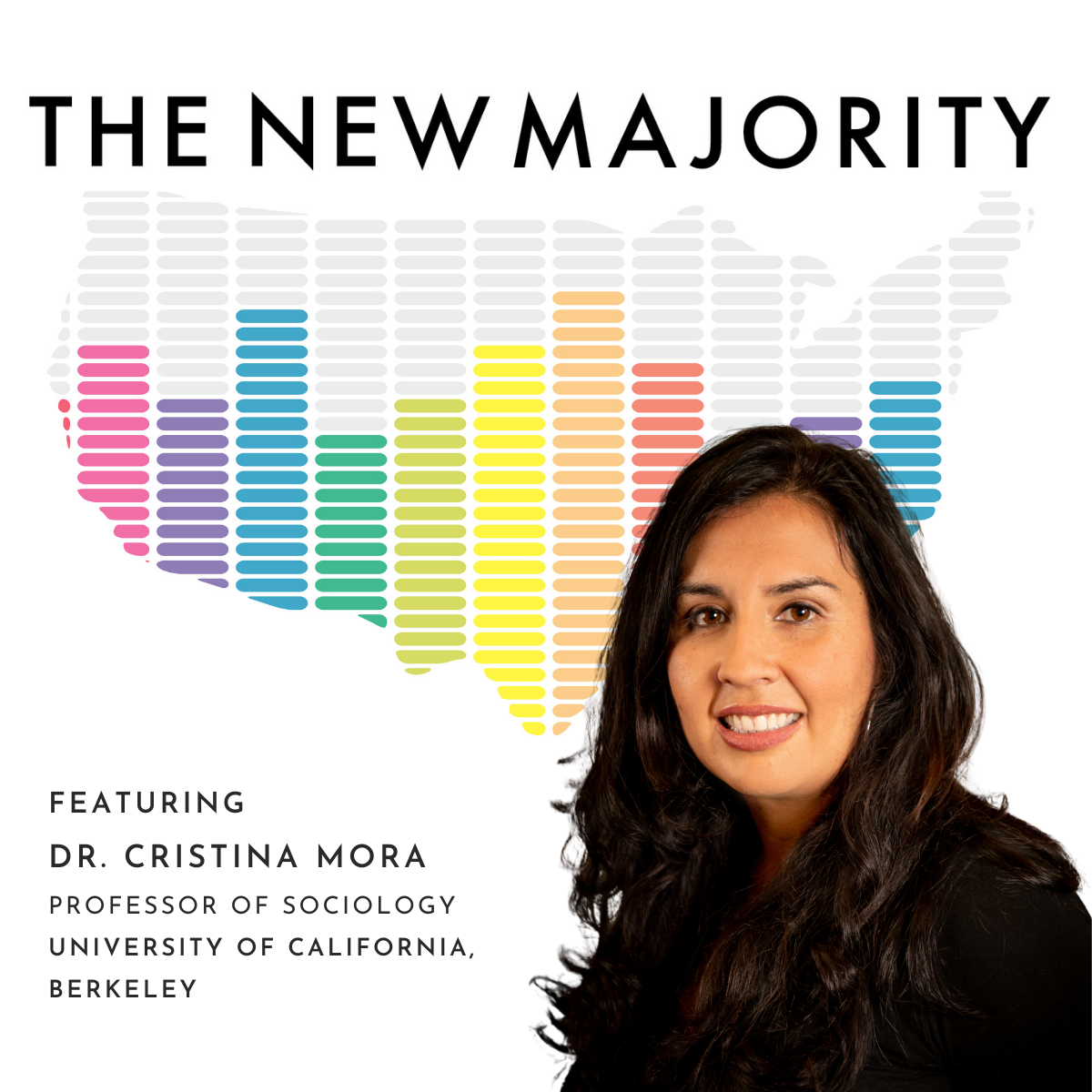
Dr. Cristina Mora, Insisting on Nuance and Being Seen as American
45m 56s
The text discusses the significance of taking control of one's career path to unlock new opportunities in the workplace. Dr. G. Cristina Mora, author of "Making Hispanics," emphasizes the nuances of Latinidad and the need for unity within the Latino community to strive towards justice and recognition. The evolution of Latinidad identity is explored, shedding light on historical disparities and challenges faced by Latinos in terms of representation, diversity, and societal perceptions. The text also touches upon the complexity of Hispanic identity, the importance of acknowledging differences, and the impact of mainstream media on shaping narratives about the Latino community. Overall, the discussion highlights the need to embrace and celebrate the diverse aspects of Latinidad while addressing systemic inequalities and advocating for a more inclusive and just society.
Transcription
6729 Words, 38410 Characters
Your impact in the workplace matters, whether it's through people management,
leadership initiatives, or high-priority projects, taking ownership of your career
path can lead to a new world of opportunities. Metta is a great place
to advance your career. When you work for Metta, which includes the Facebook app,
Messenger, Instagram, and WhatsApp, and more, the decisions you make and the
solutions you build have the power to positively impact the lives of billions
of people around the world. To learn more, visit metta.com/careers.
As the author of Making Hispanics, how activists, bureaucrats, and media
constructed a new America, Dr. G. Cristina Mora is familiar with the nuance of
Latinidad. In fact, she insists on it. She's also aware that our Latino community,
a structure undergirding the nation as she perfectly puts it, needs to work
together towards a common project of justice. That project is one that affords
our community the visibility and respect for who we truly are, revitalizers of
cities, and growers of economies. For Dr. Mora, that's the greatest challenge faced
by Latinos today, being seen as American and contributors to our nation's health.
Our collective consciousness may have developed as a result of never being
accepted, but it's that consciousness that can unite the Latino community and
anchor the work to make society better for all.
The New Majority is a podcast for Latino professionals to share their narratives
and find inspiration.
Dr. Mora, welcome to the New Majority podcast. How are you? I'm great. Thank you
for having me here today. Well, thank you for joining us. You are the first in your
family to have graduated from college. You received your PhD in sociology from
Princeton University, which I assume you're one of the few Latinas to have
done so, putting you in a rare category. You identified as a Chicana for the
majority of your youth, and you're now the author of the first historical account
on the rise of the Hispanic Latino Pan-ethnic category in the United States.
And I got to tell you that reading your book, Making Hispanics, was a bit like I
would imagine being a guest on Dr. Henry Lewis Gates' show Finding Your Roots,
whereby you're both excited and maybe a little heartbroken to learn about the
story of your family lineage. How did your upbringing influence your interests
in studying the origins of Latinidad? Where does the story of Dr. Mora begin?
My story isn't unlike, at least my upbringing isn't unlike many Mexican
Americans, but also Central Americans and others in the US. I mean, I'm from
Los Angeles, which, like Chicago, like New York, even like Miami, is a very
segregated place, right? Neighborhood segregation, racial segregation, maps on
to the inequalities that we see. And so I grew up in an all-Latino barrio,
and like really specifically, basically Mexican and some Central American barrio.
We used to say in high school diversity is whether your family was from the north
or the south of Mexico. That was diversity. And so it wasn't until I left LA,
where in LA, you were Mexican or you were from Michoacán or Jalisco, that I got to
the Bay, and there was sort of a bigger world that opened there, right? Suddenly
you had the Mission District that historically had a more Caribbean Central
American and Mexican feel to it. And so the ideas of Latinidad were a little bit
more open than just sort of a Mexican-centric, segregated flavor for me.
But it really wasn't until I got to the East Coast,
in which sort of my mind just blew, right? The different sounds, colors,
sights, taste, feels of Latinidad looked completely different in Philadelphia,
New York City than they did in Pocoima, in Los Angeles, where I'm actually from.
And so I think it was the sense of somehow I belong to the same category.
Somehow I would walk down Washington Heights and folks might think I'm Puerto
Rican or Dominican, and yet I was this Mexican American kid from LA, right?
And so I got a lot to thinking about how is it that this category is so big and
broad and diverse, and yet we still know it. It hasn't collapsed on itself.
It hasn't gone away. It still exists, and it's quite powerful. And so
it was a quest of thinking what binds us, what links us, how did this start,
and how come we haven't had the story documented? How come no one has borne
witness to this really important part of Latino history in the US?
Wow, that's great. And I want to jump into it. It hasn't collapsed. And if anything,
it's getting bigger. Would you say it's getting even more complicated?
Oh, yeah. So back in the 1960s and 1970s, when we used to think of Latino, we really would just
think of three groups. We would think of Puerto Ricans, we would think of Mexicans,
and we started to maybe think about Cubans. Although there was a big debate whether Cubans
should even be thought of in this category because the idea was, well, maybe they're
all going to go back to Cuba. Maybe they're only here temporarily, right? The Cuban Revolution
hadn't been around that long. And there was lots of talk about sort of going back, right?
And so diversity was just how different Puerto Ricans were from Mexicans. And we do know that
Puerto Ricans have a really, not only sort of they don't eat salsa or chile, they dance salsa,
right? They don't really listen to mariachi. It's not only these cultural aspects,
but very importantly, the legal aspect, right? If immigration and immigration reform is really
important to Mexicans and other groups, it's not a central part of what the Puerto Rican
political imaginary has always been like in this country, right? A lot of that has been about
international relations between the US and the island about really important questions about
statehood or independence and about then what is the Puerto Rican experience here? And that's
where you could find these bridges, right? The 1960s, 1970s, regardless of these other differences,
some of the similarities were just stark, right? If you were in school in the 1960s,
whether you were in Los Angeles or in South Texas or in Spanish Harlem, you were likely
disciplined, chastised, and even expelled sometimes from your school for speaking Spanish.
The idea that you could take pride in your mother tongue, the idea that you came from
people who have built this country, created this country and were part and parcel of the
country's founding and development wasn't inscribed in your textbooks. In fact, there was a lot of
shame, right? Induced from authorities, from cultural institutions, right? About whether
you even belonged, right? And that existed whether you were Guatemala, whether you were Mexican or
whether you were Puerto Rican. A lot of that commonalities were these initial sort of
understandings of living a similar experience of not full incorporation. Sometimes we call it
othering, of being othered, right? But when we used to talk about diversity back in the 1960s
and 1970s, it really was about you're Puerto Rican and I'm Mexican, you're Salvadoran,
and I'm Nicaragua. And now we have moved steps beyond that, right? There's a lot of talk about,
for example, the really important role that legal status plays in shaping your experience
of Latinidad. So we're talking openly about sort of the difference between documentation status,
not having papers or having TPS or having temporary protection and how that shapes your life chances.
We have some amazing research on how one of the most consequential things in your life is whether
your parents have papers, whether you have papers that shapes everything from how you're
going to be civically engaged to sort of educational outcomes to the wealth that you'll
accumulate. So we're talking about legal status. We're definitely talking about skin color a lot,
especially in this moment. We're talking about colorism. So we're talking about the difference,
experience of Latinidad. If you're a much lighter skin color versus if you're much darker skin color,
we're talking about the identities that go along with skin color. So Afro Latinidad and
Indigenous Latinidad are much more at the fore of the way we talk about the diversity of Latinidad.
And we're also talking much more than we've ever talked about of sexuality, how sexuality
really informs your experience, whether you feel like you belong in Latino culture, whether you're
represented in the media, whether you're represented in books or cultural or movies or cultural
representations of who Latinos are. And so there's this, we might have started with just national
and we've moved to all these intersectional ways in which our identities have much more depth to
them. And Latinidad has much more diversity to it than we have or that mainstream media has depicted
or New York Times, Boston Journal has depicted us as. Yeah, no, this is, it's fabulous work. And I
commend you for leading here, but I'm just so many things come to mind as you're sharing and even
I'm thinking of how ingrained it is in some of our families, how we describe our siblings,
even thinking of, you know, the reason why my grandfather said he married my grandmother is
and so I mean, just how ingrained the sort of the differences are and how really you can
sort of extrapolate so much from that. In your book, there's a quote that stood out from me
early on in your book where you essentially warn Latino leaders to proceed with caution
on the wide application of this, of a pan ethnic Hispanic identity that could potentially mask
these serious differences that you're basically started to get into just a second ago. I feel
like that is really at the crux of why so many within our community and outside of our community
are kind of getting it wrong right now. Can you elaborate on that? And how is that warning being,
is it being heated? Is it being ignored? I don't think it's new. I think since the beginning,
folks have had a sense that there are differences and that we're going to, we're not going to get
anywhere if we ignore the differences. So if you look at just, for example, the initial
lobbying in the 1960s and 1970s to the Census Bureau, at one point the census just wanted the
category to say, are you Spanish origin slash Hispanic? Those were the terms the Census Bureau
liked, but it was, you know, Mexican American and Puerto Rican activists that fought and said,
you have to desegregate the data. Fine. You could group us all together,
but make sure that there is an aggregation mechanism. Okay. And if you look at the first
political advocacy groups, even the cultural market, you know, even if you look at the rise of
Univision, Univision was smart. They knew that, for example, they could, while they had a national
media lineup, they also knew that regional differences were really important. Right. So
they knew that the Mexican films would go to the Southwest and the Puerto Rican San Juan films would
go to the Northeast. Like they just, that made sense, dollars and figures, right? And these big
political advocacy groups, you know, they knew that it was never a question of, are you Latino or
are you Mexican, for example? In fact, in the 1990s, early 90s in Miami, one of the most popular
bumper stickers said, don't call me Hispanic, I'm Cuban. People knew this, right? People knew this.
Like, especially if you are trying really hard to get representation, if you are trying really hard
to go against invisibility here, how do you bring people along? Well, there's no Hispanic country,
there's no Latino flag there. You know, in the 1960s and 70s, there weren't even Latino studies or
history books or anything. Right. So, but there is Mexico, there is El Salvador, there's Nicaragua,
all with flags and presidents in history. Everyone has always known that national identity can't be
ignored, right? And these forms of diversity can't be ignored. And so I think what it is, though,
is that we live in a society that functions in large categories. And by that, I think
if the way we think about how the state or the US government sees folks, while there's so much
diversity, it only thinks of them often as black, as white, as Asian, you know, and if you think of
outgroups, the way stereotypes work and the way that biases are just ingrained in sort of the
institutions and the way the country was founded, if you ask folks, what are the major racial groups
or what major groups are out there, they're going to say black, they're going to say Latino, right?
Sometimes they might say Mexican as a shorthand for everyone, but they'll largely say Latino or
Hispanic and they'll see you as one. And that's the way it sort of operates, right? If you think
about yourself, you walk around, we walk around every day and we're overloaded with information.
And we're making tons of decisions. And so we see people and we sort them,
we sort them in these categories, right? And so part of that is just the way that groups are formed,
the way that sort of racialized states are created, that give us this imperative. And so when you
think of the fact that Latinos are severely underrepresented in media, you know, that they're
not in for a long time have not been in the editorial rooms of New York Times,
Wall Street Journal, Washington Post, you know, the media has a huge role. The general mainstream
media has a huge role in defining us, right? And if you're not there, if someone's not there to insist
on the nuance, then that becomes what we have to respond to, right? And so I think part of it is
sure us and our institutions and making sure that we continuously talk about our diversity.
But the other part is, what are we responding to? And I think that goes two ways. On the one hand,
you have these institutions, let's just say the mainstream press, the 1990s and 2000s, you know,
the way they've always covered us, right? They might have just one Latino data point and that's
just it or they might, you know, if you search up Latino, almost all the stories will probably be
about immigration, right? Even though, you know, only a third are not born here, even though
there are many other issues that folks say are important, right? And so they are defining us
and we have to respond to that, right? At the same time, we know that their definitions of us
really matter. They matter for our life outcomes. They matter for, for example,
let's just take a really, really stark example. Someone argue, or I would argue many would argue
that Latinos have never really been seen as fully American, as incorporated, and that for a long time,
especially in some media outlets, there has been a sense that Latinos are somehow taking over,
that the country has an existential cultural threat, because we're now 20% of the population.
We can just pretend that that's a narrative out there and, you know, it's just there,
but think back, you know, to El Paso a couple of years ago, that had real consequences. People
died, you know, it motivated a sense of fear and hate. Think about political discourse. Think about,
you know, even I've been studying COVID lately. Remember Governor Abbott's in Texas discourse
about Latinos and who's spreading immigrant spreading disease. That's not new. That's been
around for a long, long time. There's been this discourse about Latinos spreading disease for a
long, long time. And so that doesn't differentiate whether you're Mexican or whether you're Puerto
Rican, or whether you're Salvadoran, the guy that drove down didn't care what sexuality you were,
didn't care if you were the lighter, darker, you know, that discourse is really important and
it happens. So one part is responding and pushing back to that discourse, I think.
And the other part is actually just saying, there are just some real differences. I mean,
there are some differences and some real commonalities, and you can ignore the commonalities,
because if we're ignoring the commonalities, what we're doing is we're not working towards this
project, you know, if that is our assumption, we're not working towards this project of justice.
And so when I think about that, I think about the fact that it kind of doesn't matter if your
parents are from El Salvador or Nicaragua or Mexico, you know, Latinos are less likely than
whites, blacks or Asians to earn a BA, right? And there are some differences. There are some
nuanced differences. I'm not going to say this is the same everywhere, but on the aggregate as a
whole, they're less likely. On the aggregate as a whole, Latinos are less likely to have wealth
and assets, you know, compared to other groups. And on the aggregate as a whole, they were more
likely to die from COVID. Here in California, there were 75%, 75% of COVID deaths in the working
age adult bracket that didn't differentiate if your dad was from Nicaragua, your mom was from
Mexico. So in all these ways, we have this balance. You know, on the one hand, it's an identity that
needs to be mobilized because there is also a justice project, right? If all these numbers
were random, perhaps it wouldn't matter, right? If it was just random, who died of COVID, who gets
a degree, who gets wealth, perhaps we wouldn't be talking about this. I don't know. But we live
in a racially unequal society that operates through large categories in which reinforce
inequality where Latino communities suffer. And they've been suffering for a while,
and there's been a discourse to push against this invisibility.
Yeah, I think that's what makes this whole exercise a uniquely American project in many ways.
And it's almost self-fulfilling, as you say. But the data is showing that there are some
commonalities. So maybe this construct actually does help us in some ways.
You know, sometimes it feels when I hear discourse about this, sometimes it feels as if
folks want to throw the baby out with the bathwater, right? On this sense, we're just so
different. Just call me Mexican. Okay, that's fine. That's fine. And we're never going to get at
these aggregate patterns. And at the end of the day, the state still treats you in this aggregate
lumped form. And at the end of the day, the guide drove down to El Paso because Hispanics were taking
over. And so we're not addressing-- He wasn't looking for Puerto Ricans or Mexicans. Exactly.
We're not addressing the lumped cause, the root causes of this. And one way to think about the
root causes of this is if you think that we are citizens in a society that strives towards a
more perfect project. That we all come together to build this nation for justice. If you think
that, that might not be your assumption, right? It's my assumption as a professor, as an educator.
But if you think that that's what you're doing, whether you are doing it in corporate America,
or whether you're doing it in media or in healthcare, there is at some level some working
contract that we must have about what is the nation that we're trying to build.
Hispanic executive was founded in 2007 to raise the bar on how the stories of Latino success are
told and to challenge the paradigm of what leadership in business looks like. By shining a
spotlight on Latino leaders, we hope to inspire a generation of trailblazers helping to uplift
themselves, their family, and our community. We want to continue shaping the narrative of
Latinos in America today in new and ever more innovative ways, and we need your help to do so.
Support Latino-owned independent media by subscribing to Hispanic executive today.
Use the discount code "Publisher" for 10% off your one or two-year subscription.
Insisting on the nuance to me, I think, is such an interesting
statement and mandate or call to action for Latinos. One key actor, I think, in your book was
the role of ambiguity and how that's been very beneficial for us in many ways,
but nuance is specificity almost. How do you reconcile that? And then also, what is Latino
of 2.0, so to speak? What is the next level? We can have that ambiguity when it benefits us,
but we can also demand the specificity or insist on the nuance.
I think that most things are not as clean or as coherent as we think they are. I think that
a lot of identity is about contradictions. A lot of culture is about these ambivalent,
contradictory forces, and I think that that's okay. I think that humans are complicated. Human
societies have centuries of cultural patterns, and it's not so clear. It's not so clear what is
white. It's not so clear what is black. It is definitely not so clear what is Asian. We can
hold Latinidad as a group that is diverse and as a group that has these important aggregate
patterns, just like we can hold that there's nuance in this diversity. To some extent,
when you talk about the aggregate patterns, there's going to be some ambiguity. I think
that we can do it. As the way I describe, part of this entire project is how we describe ourselves
against the society that enforces a definition. I think what we can do is instead of saying,
you're completely wrong, or instead of saying there's nothing that binds us, we can demand
this broader level of nuance to it. A broader level of we're diverse and we share many experiences,
and that's fricken fine. That's totally fine. That's actually the way most things work.
What is American? I can give you seven definitions of what is American.
Things are not as clean as we always think that they should be. If we're not doing both,
we're going to miss out on important aspects of Latinidad. If we're not demanding the nuance,
we're going to miss out on the experience of Afro-Latinos and how that differs starkly often
from the health experience of Lydreskin Latinos or Indigenous Latinos. If we're not doing that,
we're doing ourselves a disservice and it's not authentic. If we only walk around with a microscope,
we're not seeing the broader justice project that needs to be carried out. When I think about
what 2.0 is, I think it's that. I think that you can define Latinidad in many ways,
just like you can define what is American. Some people say an American is someone that was born
here. Some people say an American is someone that is faithful to the Constitution. Other people say
American is someone that believes in freedom of speech. All of these things are in various ways.
Some folks actually say, we have data that say some folks actually say Americans are white people.
Folks are walking around with different conceptualization of what a true American is.
I think that we have a chance to think about what is the core of Latinidad.
We can think about it as a group that is tied together because of cultural taste,
which is often the way some commercialized forms of Latinidad are thought of,
that is held together by love of their family, speaking Spanish. I think often the description
ends there. I can't tell you how many times I've heard or read folks saying Latinos are hot-blooded
or temper or passionate or this or that. Exactly, whatever it is, Latinos like to party, whatever
it is, that's what they say. What I hear much less, and I think what we have the opportunity
is to really think, Latinos are makers. Latinos are makers on this story towards a better nation,
whether that means the contributions that we have had for a long time towards justice
in organizing farm workers, in organizing better labor conditions, in organizing
nuanced understandings of what the border is. In all these ways, we've contributed to
a different understanding of the nation. I think those kinds of narratives are real
opportunities. What if we saw ourselves as together because we had a common project
to work towards justice or to work towards the contribution? It would hinge less on whether we
like a party or whether we all love our parents because at the end of the day, every group loves
their parents. It would be more on what are we doing? What should we do? I think that's one
opportunity we have. Yeah, almost like aligning ourselves. That's one of the questions that we
get all the time and that we ask all the time, which is, what is that common thread? Is there
something that can unite us, unify us, so to speak? I think that's interesting, a common project to
insist on that nuance, to tell the world about the complexities of what it is to be a Latino.
When I often think of what is common to most groups, I'll say at the end of the day,
it's that Latinos have never been fully seen as American. They've got this experience.
That can be even if you are a fifth generation, if you are a first generation. If I think that,
then I think that Latinidad is that consciousness of that. Thinking then, what do I do with this?
That's one way. It pushes us beyond our ways of thinking about race or ethnicity as just culture.
It makes us think about what we call racialization processes. It makes us think about
redefining citizenship. It makes us think about how do we take part in nation building.
It makes us active participants, forward-looking in that.
So as you know, we are the largest that we've ever been, strongest contributors to the economy ever.
I think the impact of our vote is clearly felt now, I think more on a national scale
than perhaps back in the '60s where it was felt more regionally.
What would you say is the greatest challenge that we face today?
Yeah, invisibility. You just said impact of the economy. You just said our vote. I bet you,
if anyone did a media analysis of the way folks talked about what was politically consequential
in the 2020 election, a small fraction of that would be Latinos. A very small fraction of that.
I always say this just because it's important, but in California, 51% of the student body is
Latino. 5-1, K-12, yet they're only 15, like reverse those numbers, 15% for the UC Berkeley
student body. And here it's a challenge every day on this campus to get folks to understand
that this is the future, that you can't ignore the future, that you can't be a modern institution in
the United States and ignore these economic, political, and demographic realities. And yet
they do. And one thing is if it didn't matter, okay, fine. But who goes to college and who doesn't
go to college has really important outcomes, has really important consequences for your life outcomes.
Latinos live in, right now, we're heavily debating redistricting. And this will have an impact on
Latino voting power. All of these things are important. And unless there is a much more forceful
narrative, much more forceful set of consistent voices about we are here, we're doing this,
I fear that we'll still stay here, stay in this sort of every 10 years and talking about how we're
bigger. I have to think, and this has come up before in a few other conversations on this podcast,
but obviously elsewhere, I have to think that the dam is going to break at some point. Maybe I'm
an optimist, maybe I'm naive. Maybe this is... Oh, I think it will. I think it will. But I think
it takes intentionality. Yeah, I think it will. But I would like it to break in a certain way and
much faster. And so if I think about what that means for me, is that I need us to define ourselves.
I don't need the mainstream media to define us. And for me, what does that mean? I'm a big proponent,
for example, and this is now happening in California of ethnic studies in high school,
right? Learning your history, learning to take pride, learning about these aggregate patterns,
learning about everything from the zootsuit riots to Operation Bootstrap to the construction of
Little Havana. Understanding that and then understanding that not simply as something
that Latinos need to understand, but understanding this as part and parcel of American history.
The Latino contributions to World War II, Latino contributions to Vietnam, all of these things
are not just Latino history, they're American history. So what if we all understood it that way?
Then maybe we'd see agriculture policy. Then maybe we'd see education policy. Then maybe we'd see
immigration policy in a different light, not as something that is of right now, but something
that's institutionally set in this way to reproduce certain inequalities. So if the dam breaks and
they suddenly start paying attention to us, let it be because we have this ability to say,
not only are we here, we've been here for a long time, and this is the nation that we want to build.
This is the vision that we're striving for. These are the institutions that need to be changed.
Maybe, I don't know, 10 years ago saying, you know, ethnic studies in high school was not a
controversial issue, and it seems to be now. And I think that that's not a coincidence, right?
I think that there is something very powerful about knowing where you're from, very powerful
about knowing patterns and forces of exclusion and what that has meant to you as a driving force
to build something better. And I think we have the ability to do that and not fall into, we're
just sort of, we're just going to get there because we're growing, or we're just going to get there
without sort of a mission, a drive, a sense of self. So, you know, within our lifetime,
Latinos will be the majority, or at least the multicultural America will be the majority.
Do you feel like we're ready to lead? Yes. Why wouldn't we?
Why not? Absolutely. I mean, when you say that I think of my mother, I think of my grandmother,
I think of, you know, my grandmother was a single mom who raised my mother's head of, you know,
eight children here on the meager salary she made working at a cleaners, the way the business
acumen she had to financially keep her family afloat, the sort of grit she had in coming and
raising a family by herself. I mean, that's what we need, right? That's what we need.
And when I think of just the courage and things like the justice for janitors campaign, or the
agricultural workers, or when I think of their courage, I think, absolutely, these are skills
that we now talk about to lead big institutions. Like, a lot of the times it's about, how do you
make decisions under uncertainty when you don't have perfect information? Right. What the hell is
my question? Yes, then perfect information. How do you make more with less in times of austerity?
Talk to us, right? How do you teach? Well, they were working three, four jobs, right? And so,
absolutely. And I think there's also a pride of sense behind it, right? If we can merge that with
purpose, if we can merge that with a pride of place and identity. Yeah, I don't, I absolutely,
I don't see why not. It's going to require, you know, much more equal access to skill building,
much more equal access to economic opportunities. We can't have these studies, you know, we can't
have these outcomes anymore, where we're doing audit studies on banks, and banks are systematically
giving black and Latinos less favorable loan terms. We can't have, you know, if we're going to do this,
we need to make these opportunities much more equitable. But given the chance, I mean,
sometimes I think, I think of my students, my God, you know, they've come from so many times,
they've come from really hard circumstances to get to one of the most elite institutions on the
globe. And I think what better example of grit and endurance and perseverance than that?
Absolutely. I think the leap of faith that the immigrant makes when leaving the comfort of
their home to come to the, step into the unknown is quintessential American. This invisibility
just really, it's something that I think affects a lot of us. And by us, I mean, Latinos, specifically
with what we went through in the past, or still going through, frankly, in the past, you know,
past year and a half and counting, talk about, you know, that invisibility or, I would say,
the omnipresence of Latinos to keep this country going in the past 18 months, paired with this
invisibility, what the impact of that is on us. To me, it honestly feels like gaslighting.
It's the best way to describe it. It's almost like, wait, what are we talking about? Like,
can't you see? Like, we're here. We're saving, you know, Midwestern towns. We are reviving the
rest belt. We are growing Southern economies. Like, what are you talking about? Rapist murders?
What are you talking like? So to me, part of it feels like gaslighting. It also feels like gaslighting
when we have change in leadership and we're waiting for things like immigration reform
and things like that. And so, I don't know what the answer is other than maybe, I don't know what
the answer is, but I do think two things. I think one is, when my students ask, like, how is this,
how can we make it different? I just think, when you change at all levels, when you change,
you know, in the medical field, in early education, in the arts, in media, in politics,
so wherever you're at. Yeah, do what you can, because it's not going to be just one spear.
It's not going to be just politicians that bring this. It's not just going to be Hollywood. It's
everyone. And then I think the next thing I think about is it's going to just depend a lot on
whether we really take hold of a justice, a social justice narrative or not. You know,
if I look back at one of the most significant Latino movements in American political history,
there are a few, but the ones I think about are the 2005 immigrant rights marches. That's amazing.
That's amazing coordination with media, religious organizations, political organizations, civic
groups, neighborhood groups. That is amazing. We have that capacity. I'm not saying that that is
what needs to be done. You know, that collective action is what needs to be done. But what I'm
saying is we have this collective capacity to coordinate and organize and work. And
that's kind of what's needed. If we're going to get everything from an actual Smithsonian Latino
museum to representation in higher education, to increase the number of Latino elected officials
beyond the less than 2% market that are at now. Yeah, it's going to be tough. Yeah, it's going
to be tough. It's not impossible. I mean, it's not impossible. For me, I might be an optimist.
It's not, well, one, you have to be an optimist. You can't lose hope because once you have,
do you want to live in the world where that won't be possible? I don't think I want to.
And, you know, what every new generation brings about change. We've seen it in the Latino community.
You know, we're talking more about our language, non-gender binary terms. We're talking more and
more about our diversity. And that's a new generation sort of thinking, right? And so it's
possible. We're not stagnant. And we're one of the most dynamic groups in America. Every year,
a third of us are born outside this country, bringing in new ideas, new understanding.
That dynamism, there's bound to happen, you know, some eclectic understandings, right? Over time,
we've become increasingly more class diverse. So even though we're at a represented way,
more of us are in higher education, in the professoriates, in academia than ever have been.
And so it's not impossible. And if we can harness our dynamic diversity and nuance, if we can harness
it towards a project, I think we can get there. You know, you can't just grow on your own.
You know, then you'll have many things, many definitions. If there can be a way of orienting
growth anchored, perhaps, in a witnessing of your group's history and understanding,
identity in context with the national history, you know, this sort of early education and us
thinking about ourselves as not as sort of new arrivals, right? Not as just got here,
but rather as part and parcel of what built this country and the idea of Latinidad and Latin America
and Latin American migration as fundamental to the growth of the country. And I think that gives
us a new sense of cultural power and direction. That's great. One that hopefully gets everyone to
pick up a spear. Or a pen. Or a pen. Well, that's kind of a perfect segue to my last question,
which is really about authoring that story for ourselves. And I think you used the word that
I thought was beautiful, which is that we're makers. But if you were going to author the story
of Latinos in America today, would you use that word or what would be, how would you write the
title of that book? Or what would you say the story is of Latinos in America today?
Oh, that's such a hard question. What is their story? Their story is certainly unfinished.
Their story is future oriented. They are 100% the future. They are bears of deep, deep culture
and deep roots. They are revitalizers, I think of the rust belt. They are, yeah, they are often
the structure that undergirds the nation. And that's undeniable. And so we are future sort of
upholders of the nation. We will receive the torch one day, whether we're ready or not. And so let's
build that country that we want our kids to see, right? Let's build that country that honors us,
just like it honors other groups, just like it honors African American, Asian, Indigenous history.
And we are part and parcel of this diverse story. And I think it's exciting.
Well, it's been great to have you, Dr. Mona. I love hearing you talk about
Latinidad and our community. It's intricate, nuanced, complex, but to use the last word you
just used, it's also very exciting. Well, thank you very much. It's been a lot of fun.
Thank you for listening to this episode of The New Majority and supporting Latino-owned
independent media. I'm Pedro Antonio Guerrero, CEO of Guerrero Media, publisher of Hispanic Executive
and proud member of our team working to amplify the voices of Latinos leading in plain sight.
This episode was brought to you by our sponsors at META. The New Majority is produced by Hispanic
Executive, hosted by me, Pedro Antonio Guerrero. This season was produced and edited by Revision Sound.
Our production team includes Kevin Warwick, and our executive producer is Vianni Lubis.
Music is Let's Start at the Beginning by Lee Rosevair, recorded in Chicago.
Music is Let's Start at the Beginning by Lee Rosevair, recorded in Chicago.
Podcast Summary
Key Points:
The importance of taking ownership of one's career path for new opportunities.
Dr. G. Cristina Mora's insights on Latinidad, unity, and challenges faced by Latinos.
The evolution of Latinidad identity, historical background, and challenges faced by the Latino community.
Summary:
The text discusses the significance of taking control of one's career path to unlock new opportunities in the workplace. Dr. G.
Cristina Mora, author of "Making Hispanics," emphasizes the nuances of Latinidad and the need for unity within the Latino community to strive towards justice and recognition. The evolution of Latinidad identity is explored, shedding light on historical disparities and challenges faced by Latinos in terms of representation, diversity, and societal perceptions. The text also touches upon the complexity of Hispanic identity, the importance of acknowledging differences, and the impact of mainstream media on shaping narratives about the Latino community.
Overall, the discussion highlights the need to embrace and celebrate the diverse aspects of Latinidad while addressing systemic inequalities and advocating for a more inclusive and just society.
FAQs
Metta offers career advancement opportunities through working on projects like the Facebook app, Messenger, Instagram, and WhatsApp.
Dr. G. Cristina Mora is an expert on Latinidad and the author of 'Making Hispanics', focusing on the nuances of the Latino community.
The New Majority podcast is a platform for Latino professionals to share their stories and find inspiration.
The concept of Latinidad has evolved to include discussions on legal status, skin color, and sexuality within the Latino community.
Acknowledging nuances within the Latino community helps address inequalities and push back against stereotypes and biases.
Discussing commonalities and differences helps in understanding shared experiences and working towards justice and equality.
Chat with AI
Loading...
Pro features
Go deeper with this episode
Unlock creator-grade tools that turn any transcript into show notes and subtitle files.
 PodcastTranscript AI