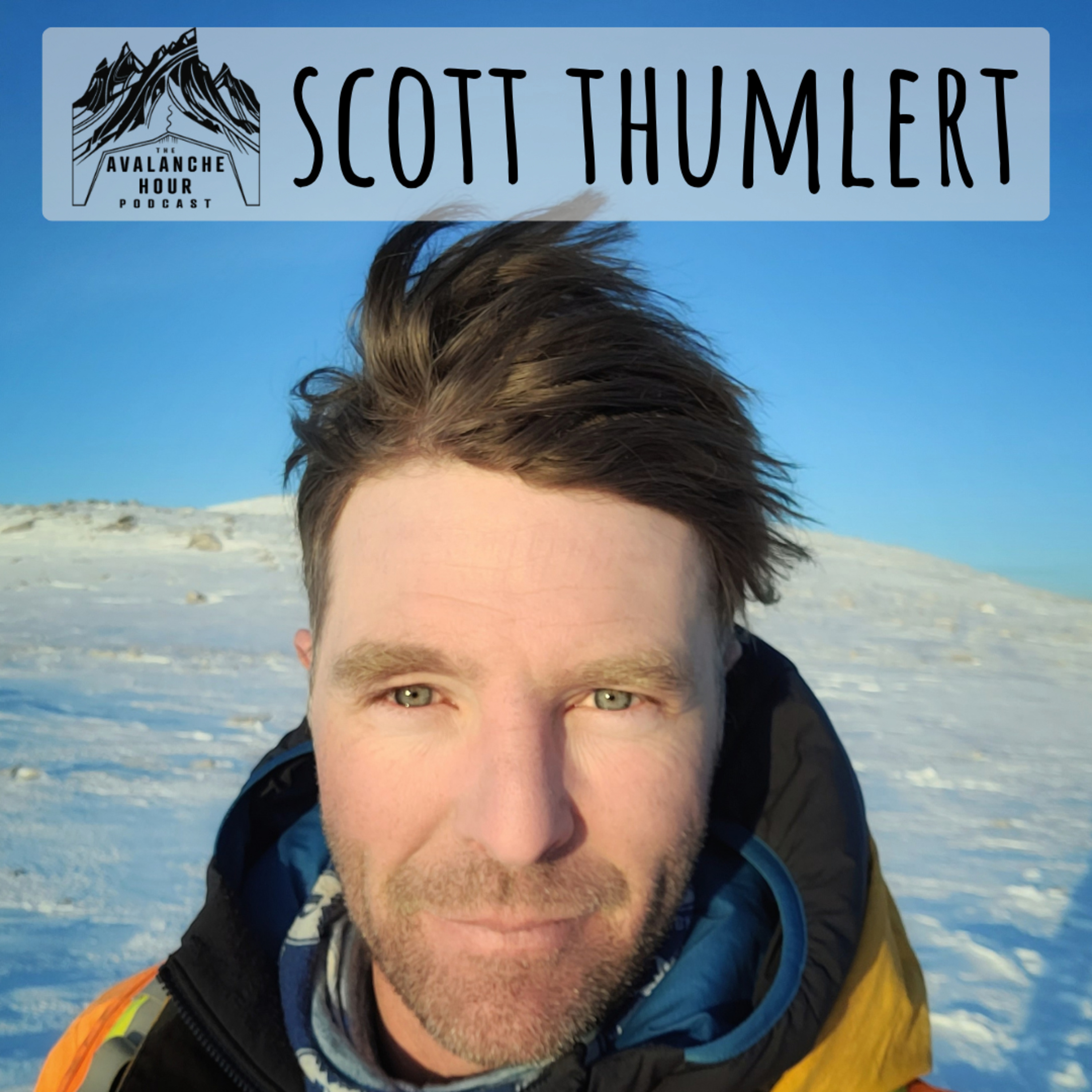
Dr. Bruce Jamieson x Dr. Scott Thumlert: Merging Theory and Practice
57m 50s
The transcription features a conversation between Bruce Jamison and Scott Thumwright on the Avalanche Hour podcast. Scott discusses his journey from graduate studies in avalanche mechanics at the University of Calgary to becoming a ski guide and consultant, emphasizing the value of combining academic research with practical field experience. His research involved measuring stress from skiers and snowmobiles in snowpacks, showing that softer snow transmits stress similarly to standard tests, while harder snow differs, leading to refined testing techniques like adjusting for penetration depth. The discussion highlights challenges in avalanche forecasting, particularly in communicating likelihood, where terms like "possible" are vague and probability scales need improvement for low-probability, high-consequence scenarios. Scott advocates for adopting clearer terminology and frequencies from other industries to enhance decision-making. The podcast also promotes the Canadian Avalanche Association's role in professional training and community building for avalanche risk management.
[MUSIC] I think it was about 15 years ago that Scott Thumwright showed up at my office at the University of Calgary. He said he was keen on doing graduate studies on snow and avalanches. Scott went on to get a PhD in civil engineering, specializing in avalanche mechanics at the University of Calgary. Over the years, Scott and I worked together on a variety of projects. He brought perspectives and insight that I often lacked. As you get into the avalanche world, you're learning a lot of the theory now. But you need to get into a real decision of whether you're going to open or close the road or something that you're really going to do. And he's like, that will crystallize all of the things that are actually important for decision making. After his PhD, Scott was a postdoctoral fellow with Pascal Hegeley at Simon Fraser University. For one project with Pascal, Scott analyzed terrain in terms of slope angle, vegetation, convexities, congavelties, gullies, and ridges. That's so much closer to the way avalanche practitioners assess terrain. So much better than the focusing only on slope angle, which is the way we had done it during his studies with me at the University of Calgary. I've got a few retirement hobbies, but one of them is making educational videos mostly about avalanche science. I've included Scott on a few of these videos and he's contributed to topics like avalanche likelihood, convexities, ski cutting, and slab tension. That's all classic snow geek stuff. What's next, I think the obvious and logical step is sort of the connection from avalanche problems when you describe them on the size and likelihood scales that we're used to seeing. How do you go from that to the actual hazard rating? On the various projects that Scott and I have worked on together, I really value the balance that he brings. He brings in some of his field experience, his practical experience, as well. He knows about the analytical methods from science and engineering and he brings them both into the projects that we've worked on together. In addition to his consulting work with Alpine Solutions, Scott is an ACMG certified ski guide and works as a heliskie guide with Canadian mountain holidays. As a professional engineer, he has experience with hierarchical field observations and on a variety of projects with managing snow avalanche risk. I'm really stoked to speak with him about our shared passion for snow avalanches. There is no paper, no guideline, no standard that a Canadian avalanche professional can go to and read and learn how they're supposed to go from the conceptual model to an actual hazard rating. I think we ultimately need a bit of funding to just put a little bit of fire under people's feet and get people together and figure it out. I'm Bruce Jamison. On this avalanche, our podcast, we sit down and spend time with Scott Thullberg. [Music] Scott Thullberg wears many hats. He is the current chair of the Techal Committee of the Canadian avalanche association, so it seems fitting that the CAA is sponsoring this episode of the Avalanche Hour. The Canadian Avalanche Association is a world-renowned professional member organization and home of the industry training program. Our courses deliver professional-level training in avalanche operations, avalanche search and rescue, weather, mapping, blasting, avalanche risk management, and delivering avalanche education. And there's still availability this fall and winter, your opportunity to advance your skills with globally recognized certification. For those who have completed CAA courses, you can apply for membership, which is internationally recognized for upholding the highest standards and avalanche risk management. See www.avalancheassociation.ca for information on course availability, as well as member benefits, professional development, career resources, mentorship, and networking opportunities. Join the Canadian Avalanche Association today and be part of the community shaping avalanche risk management. You're turned into another episode of the avalanche hour podcast, your source for in-depth conversations within the snow and avalanche community, and welcome back to season 10, a decade of digging deeper. The avalanche hour podcast is proudly presented by the Darren Johnson avalanche education memorial fund, AVSS, developing precision drone-based solutions for the avalanche control industry, as well as drone-amplifieds Montess, the field-proven drone-based avalanche control system, additional support for the podcast is provided by CIAAL avalanche, safe-back avalanche survival gear, and on ex-backcountry. Thank you all for supporting the podcast. Now let's drop in with Scott Thumbit. Hi, Scott. Thanks for making the time for this. First, can you talk a little bit about your early winter backcountry experiences? Yeah, right on Bruce Wohl. Yeah, it's a pleasure to be here. I'm a huge fan of the podcast, the avalanche hour, and it's great to chat with you, especially. I had one little story that popped up, and somehow over the last few years I've inherited the nickname, Dr. Snowflake. But I think it was actually Willie Rennes, who called you, Dr. Snowflake, and so it's nice to be here with the OG Dr. Snowflake, the original. The old guy. That's right. The one that popped out when you asked that there was a trip to Mount Waddington, and into the range there, we had six of us flew into Buton-Led, and then thrashed our way into Waddington, and had some nice weather and skied around, and then we thrashed our way out to Night in Leden. I was super green at the time, and made all the mistakes, and fell in a river, and then completely froze up, and dropped the rope. It almost a day behind us, and anyway, but that was pretty transformative, and we had to make a lot of real avalanche decisions. So she on the way out, and ultimately ended up having to make a detour, and the two or three-day death march out of there, so. Anyway, yeah, that one definitely changed my life, I think. And what got you into Snow in avalanches? Well, I suppose a love of skiing to start off with, but then really it was your program at the University of Calgary. I remember showing up in Victoria to go to engineering school. I was young and didn't really know what that meant, and someone that just said, "You're good at math and science, so why don't you try engineering?" And I still distinctly remember being in the back of a truck at the first party of school, and some of these other engineers were yelling at the other students, "E-R-T-W," you know, "Engineers rule the world," and I remember thinking that I'm not too sure if these are my people, so to speak. But then I found your program, the Snow Science program at ASARC, and I knew that that would be a really a great way to combine engineering with mountain stuff. So that kind of kept me rolling and engineering, and gave me the motivation to keep going. You've worked as a researcher and more recently as a lead ski guide, and we'll get more into that, but also as an avalanche engineer and working as a consultant, and a professional member of the Canadian Avalanche Association, and so can you talk to us a little bit about those changes and what motivated the transitions? I guess what I was in your program, the field work was in in Blu River at Mike Wigley's Heli skiing, so I think just hanging around in that environment, you know, doing a lot of skiing beforehand, it was a natural kind of fit, or it felt pretty natural to get into the guiding and do those courses in that training. And then, yeah, I did, I guess, a post-doc with Pascal as his group was forming at Simon Fraser University. And I remember coming out of that, I was, you know, I have been in academia for quite a while, and I just remember thinking that I wanted some shorter projects, actually, instead of like these really long one or two year long projects where you were kind of the same thing, so that was kind of motivating to get more into engineering where it's shorter problems and a little quicker, quicker pace. Okay, so the key part of your graduate research is you were studying the stress under skiers and snowmobiliers, et cetera, and can you tell us a little bit about that? And yeah, and if you've got any anecdotes from those numerous field days in the mountains around Blu River, let her fly. Sure, yeah. I mean, that was a cool time. You know, we had the two snowmobiles, and we also had, I guess, a sort of a permit that allowed us to go into the caribou closure. So we basically had a free reign of the mountains around Blu River to go snowmobiling and gathering data and all sorts of different projects. So that was pretty fun time overall. But yeah, I remember one of the early days I had never really been snowmobiling before, and you know, so it was super green. And I remember Mike Weider and I, he was also pretty green on this legend, and we had to get up to Mount St. Ann, and it had snowed an absolute tonne. And there was no bottom to the snowpack at all. And so we, you know, a couple of keeners just tried to make our way up there. We spent the entire day, I think we made it about halfway up, just getting stuck and like sweating, back sore. And I remember the time we had finally decided we had to turn around. I ultimately had to dig down and hit the ground of the logging road and had dug this giant hole around the sled and then like slid it around on the ground. And I remember Mike was like behind quite a bit, and we couldn't really talk to him. And we were really green. So we're on the repeater talking to one another. And so the entire Blue River and Mike Weekly's operation is listening to us, like, have this absolute disaster. And then we got back and I remember being pretty frustrated and sort of dismay. I thought I didn't know how we would actually get up to the site ever. And you said something like, you know, settlement is a powerful thing and just had to be a little bit patient and it would set up and everything would be fine. How did you measure the stress underneath skiers, snowmobilers and even a falling skier? Yeah, we ultimately mounted some little capacitive sensors on the end of some long aluminum sheets. And then we would slide those sheets or kind of like little angle angle. There's a thin aluminum into the snow pack. And then they would be kind of underneath some virgin snow. And then yeah, we would load them up on the top skiing and snowmobiling and falling and all sorts of different. So how far back were the senses from the pit wall? They were, I suppose, about a meter. I think they were a meter 20 long sheets. So and we left them out a little bit. So about a meter from the pit wall. And so a meter back from the pit wall. You had skiers and snowmobilers and snowboarders and whatever going over top of the centers. Yeah, exactly. Yeah, we tried to measure a bunch of different types of loading. But also we tried to really keep it consistent so that we would be able to pick up some changes in this snowpack structure and how the stress would move through different structures. So those senses were at what two or three different depths in the snowpack. So you could measure the lower stress at depth. Yeah, exactly. I think we had four depths a lot of the times. Okay, and I recall when you asked me to do a fall, a shoulder roll and a fall right on top of the centers and whatever. And that was sometimes a hit, especially when we're presenting your research results to snowmobilers. So, yeah, I think we had a nice video of you falling that we would put on repeat. And as I recall, the stress increased sharply with more penetration by the skier or the snowmobil, especially if you're climbing the hill with a track spinning and whatever, the snowmobil penetration was more and the stress was a lot higher. Yeah, exactly. Yeah, we definitely, that that became apparent quite quickly that the increased penetration of the snowmobil was really what the primary factor that would have more stress under a snowmobil. And it's really cool. Jeremy Hanky and Ian Stewart-Patterson are kind of taking that work and expanding on it and doing a lot more different, more high-end snowmobil moves and then measuring the stress underneath and you know, Jeremy is quite an accomplished snowmobiler. So I think that's pretty cool. And how does the stress underneath skiers and snowmobilers relate to triggering? That's a great question. So, yeah, I think one of the, or findings that we discovered was when the snowpack is soft, the stress underneath skiing and snowmobilers, whatever it is, is more similar to the stress in the, in the snowpack tests. And then when it's a hard snowpack, then it's quite a bit different. So because you cut the walls and the tests, you, you disturb or change the snowpack quite a bit and when it's hard and intact, the stress spreads out and then in the test, it's actually a harder column and it transmits the stress deeper. Yeah, so the test you're talking about are the, the ECT, the extent column test and the compression test? Yeah, exactly. Yeah. So, did you come out with any recommendations, maybe understanding of the limitations of those tests based on, on those studies? We did come up with some recommendations. I don't think they've hit the mainstream yet, but certainly something I do and the, you know, people who kind of work with me a lot too, as we now remove whatever the penetration is, so if your ski pen is about 40, you take that off the top of the compression test and then make the test deeper. And this way, you don't miss any deeper layers and you already get a lot of information about that top, you know, keep pen because your skis are damaging it and whatnot. So you get a lot of info about that already. So that's sort of something we do. We're not very good or maybe even consistent at rating avalanche likelihood in your, your various presentations and papers and whenever I recall, Grant Statham is called avalanche likelihood, the holy grail of avalanche forecasting. Can you talk about why avalanche likelihood is such a challenge and how we might get better at it? Yeah, absolutely. That's a good, great question. Bruce, I think it's a challenge because communicating probabilities in terms of like risk management and I guess the general feel of risk communication is challenging in itself. And it's a whole field that people have been studying for a long time and a lot of other industries, you know, bumped into these problems back in kind of like the 60s and 70s. And they have been studying it, you know, this stuff since then and come up with a lot of really good strategies, but, you know, things like intelligence and climate science and, you know, all sorts of different fields have, you know, have have found this a challenge. So it's not just avalanches, but it's across the board. And then if you do think about avalanches, it's, it's really complicated because our, our spatial scale where we're forecasting likelihood of avalanche where it changes a lot. So we could be working from a single start zone or single avalanche path to an entire, you know, mountain range to an entire, you know, 10 year or or large forecasting region. So that change in spatial scale is really a tricky thing to figure out. What's the change or maybe we're not ready for change, but even a direction, you know, there are some solutions emerging. Yeah, absolutely. You know, that's the beauty of all these other industries have been studying this, this stuff for quite a while. And really, they have really easy and obvious solutions and it's really just up to us to kind of adopt them and the literature. And then there's, you know, 50 to 100 papers on this kind of stuff and that it shows improvements when you do easy things. So kind of some of the obvious things for us in the avalanche patch would be, you know, the word possible has been shown to be a really poor word to communicate likelihood, because really anything is possible, one in a billion is possible, one in two is possible. So it doesn't really work. You're not really communicating much of a probability with that word. And the only reason why it works for us, I think, is because it's in an, an ordinal scale from, you know, possible is a little bit more than unlikely, and it's less than likely. And so it still works, but it's not a great word. The other thing is, we as a group, I think, should figure out what terms and what words would work the best for operational decision making for the most people out there that we can. And so for an example, right now, we have three more probable terms, we have likely very likely and almost certain, and I made the argument in a few others have as well, is that, you know, we, I don't think we need three on the more probable side when if we're doing our jobs well, lots of times we're, we're operating and working in the lower probability. And especially the low likelihood high consequences is one of those problems that plagues us and, you know, probably a lot of us have gray hairs from that. And so I think having some more terms and whatnot to be able to work with those types of problems that would be super valuable. Yeah, I know the, the landslide assessment terminology, they break down the low end of the probability range into several things and the strong interest in the low probability. Anything that has high consequences, you get very interested in the low probability range. Yeah, absolutely. Yeah. And, you know, probably the good example or the good way to picture this is, you know, we often get, you know, deeper weaknesses in the snowpack. And, you know, the Rockies, especially where I live, you know, we have that almost every year, but they go through times where it's those layers and those weaknesses are more reactive and less reactive. But as a, as a group or as an operation, if you're working in that place, you really don't want to forget about those deep weaknesses. You don't really want to take that problem off the list in some ways, but there's times where, you know, the temperatures are cold, steady, there's not a lot of, there's not a big weather input. And so the chance of triggering those things is actually, you know, quite low, highly unlikely or something, but so in that day, it's really unlikely to trigger, but it's still a problem and it's still going to dictate maybe where you're going to travel and where you're going to go. Yeah, and I recall you talking about the words for likelihood and there are probabilities of probability ranges and also whether frequency terminology was good and can you tell us a little bit about your what you learned about that. Yeah, no, that's a great question. I was going to mention it earlier. Yeah, so words are great for quick communication, like humans use words all the time that they have a lot of power and especially for field stuff and whatnot, especially when you translate those into probability. So, or percentages that that in the combo of those is really effective at clearing up differences in communication differences interpretation, but the challenge with just straight percentages or probabilities is that they don't always specify what's called the reference class. And that is what that percentage belongs to and the way to think about that is if you do, if you translate it into a frequency, like you just mentioned. You know, X out of Y, once you say out of Y, what you have to do with a frequency, that is the reference class and it's a little tricky to maybe describe with just words. So the good example is the, you know, chance of precipitation that meteorologist was using. If you say 60% chance of precipitation in Vancouver tomorrow, it's not entirely clear whether that means that it's 60% of the hours of the next 24 hours. Is it 60% of days with similar conditions? There'll be some rain for each point of Vancouver. There's a 60% chance of measurable precipitation. So it doesn't really, it's not clear until you actually say what that means. Yeah, yeah, that's great. And I recall that recent paper with some of your Norwegian colleagues where you proposed being really clear about the spatial scale and the number of start zones or slide paths being referred to. Yeah, and it's interesting, like, I mean, you know, and Grant have worked on this and we've been discussing it for quite a while and and he's he's got some really good points about how he's not sure that for a lot of forecasters, like using numbers of percentages and what not are is going to be valuable or or even possible. A lot of people don't like or don't think like that. And it's a really good point. And the sort of the counter point, I think, is that it's not that, you know, we would propose to use probabilities and frequencies in forecasting, you know, directly and say that, you know, every single day you have to use these numbers. It's more that the words that we use have a definition like like a dictionary, like the word likely, it actually is defined as what it actually means in terms of avalanches so that when you say likely and I say likely we're using the same definition and I don't have you think in 80% and I'm thinking 10% and we did some surveys with avalanche, you know, practitioners and professionals and we found that some that the range of likely was from 95% all the way down to about 5%. Wow, are we making, is there any progress on validating these words like can we get some validation of the number of avalanches that occurred when it we're using the terms like the probabilities or frequencies that go along with words like likely. Yes, absolutely, the new sort of remote sensing work, yeah, in every year it seems to be getting better and better and ultimately they're using satellites now to sort of track and look down and see how many avalanches happen they can count them. And so ultimately we can sort of say, okay, our forecast was this, how many avalanches actually happened. So that that date is coming and that will be a huge, you know, wealth of data to kind of refine our forecasting. The challenge there is a lot of times you might be forecasting for natural events and so that works really well. But lots of times we'll also be forecasting for artificial triggers and it's a lot of times if you're thinking of ski triggering, you know, then you forecast where you think those might be possible or likely to trigger and then you avoid those places and don't go there. So it's a little more tricky to validate those that type of forecast and people are intensely interested in the human triggering side of things and that's the maybe the hardest verified thanks to good root selection. Yeah, exactly. Yeah, that it's definitely a complicating factor for sure. Yeah, so avalanche likelihood is one of the cornerstones of the conceptual model of avalanche hazard. What what's next for the conceptual model of that avalanche hazard and just see some next steps for improving it. Yeah, absolutely. I mean, yeah, that's a great question. I think it's worth mentioning and just saying off the get go that I think the conceptual model was a huge step forward for our industry and our profession and really the power there other than just really, you know, thoroughly and robustly describing avalanche forecasting. But using risk based terms, I think has been really helpful in sort of with internal communication and then also external communication when we talk to the, you know, the geotech engineers or other type of people who are working in geohazards, they use the same type of language and it's really helpful to be able to communicate in those terms. So, yeah, I think it's a, it was a really fabulous step forward and really pivotal piece of work and then. So yeah, what's next, I think the obvious and logical step is sort of the connection from avalanche problems when you describe them on the size and likelihood scale. The bubbles that were used to seeing making that how do you go from that to the actual hazard rating. And I think it's very important to point out that the authors of the conceptual model explicitly left that step out. So they, they at that time made the conscious decision and it was, it was probably a really good decision at the time given how much we knew and data and whatnot and that they wanted to capture some data about how avalanche professionals do that already and then to use that to kind of inform that process. But right now, you know, there is no paper, no guideline, no standard that a, you know, Canadian avalanche professional can go to and read and learn how they're supposed to go from the conceptual model to an actual hazard rating. And is anyone working on that? Yes, we are, yes, a little bit. I think we ultimately need a bit of funding to just put the, you know, people a little bit of fire under people's feet and get people together and figure it out. But as far as I know, there's no sort of formal work going on there. But I think a lot of discussion and I think a lot of people are seeing it's the obvious next step. We'll be right back to the episode with Bruce Jamison and Scott Thumbler, but first we got to paste some bills. Today's episode is sponsored by Propagation Labs, long time supporters of the avalanche hour podcast. For anyone working in avalanche train, snow pits are an essential tool. And there's a kind of magic in seeing the history of storms, slides and pow days stacked up in front of you. I'll be honest though, it's not always peaches and cream. Scribbling notes with cold hands in the field, retyping at home, shuffling PDFs back and forth with your team, it's slow, clunky, and sometimes feels like more work than digging the pit itself. That's why I've been using the snow scope app from Propagation Labs. It's built to solve these headaches. With voice to pit, I can literally just talk to draw a profile. No frozen fingers or patient partner required. If you're more of a pen and paper person, hey, I get it. That's fine too. Record it in the app later, either on your phone or on the web. In the best part, all your snow pit data lives in one place so you and your team can analyze, compare and track the season's history together. Propagation Labs has been at this for years and it shows the app is simple, intuitive and built for folks who spend their days in the snow. This season, you can try their newest feature, voice to pit, free for a limited time, and in the long run, all manual recording tools and research access to data will continue to be free and accessible. So make all that hard work in the pit count. Download snow scope today on iOS, Android, or at PropagationLabs.com. In addition to being all the other things you work as a avalanche engineer, consultant, planner, researcher, and teaching avalanche courses, but you're also a lead guide, a lead skiing guide for Canadian mountain holidays. You've talked about CMH's recent deep slab avalanche strategy. Can you tell us a little bit about that? Yeah, for sure. I think it's super fascinating. We're theory and practice come together. So this came about two hundred years ago when we had the really weak basal facets, a really cold and shallow start to the snow pack. Ultimately, it was apparent that we had this really weak basal layer at the bottom, and the mountain safety manager and the company at CMH as a whole, we're figuring out how do we manage this? There's a lot of uncertainty with these types of layers, and so what do we do? So they came up with a few strategies, and one of them was this sort of called it the magenta run coding, and it was a really well thought out way that if a run was sort of closed, kind of red or black, we hadn't skied there, hadn't rated it in a while. And we wanted to turn it green and go there, somebody actually had to physically go to the run and have boots on the ground, you know, ski it, dig a profile, gather some data. Then that information had to come back to the guiding team. Then if the guiding team said, okay, yes, we're comfortable to open this piece of terrain. Then it would stay closed for another 24 hours, sort of like a cooling time or just to slow down the process of moving into new terrain, gather more information. So that was implemented for most of the season that year, and it subsequently has sort of morphed a little bit, we lost that 24 hour period, but the gathering more information, the boots on the ground to open up new terrain still exists, and that's just a regular procedure now. So I think that was a really interesting thing that came out of that, that, you know, shallow start of the winter. And then the other really fascinating time is that, and this is the guides at the adamance he did this. I'm not sure how many other operations did, but we kind of came up with this strategy where each of the lead guides would go through the run list and scratch off runs that were just that were done for the season that we weren't even going to have on the list to decide we're going to talk about them. And each, each lead guide did it individually, and then the guides on that on a shift would do it together, and they kind of came up the list, and then the ones on the other shift, and ultimately as a group, we came up with this list of runs that were now done or, and then what what we would consider skiing. And which was, which is interesting, but the best part was really discussing the terrain, you know, with different levels of experience, and what people thought about the terrain and how the, what those differences were. And you know, some of us myself was really hesitant to like, you know, eliminate runs, and some people were more, you know, they were keen to get rid of runs to simplify things and simplify the decision making. But that, that process really, I think as a group, we really grew together and brought us together in a, in a year that had a lot of uncertainty was, was challenging to operate. Yeah, these really deep weaknesses, these basal instabilities, they just haunt us, and I think that team process sounds really valuable. And it's interesting, the, that year in the northern Selkerks, actually, we didn't have a lot of deep avalanche releases, like it didn't become a huge problem up, up there, you know, for whatever reason. I think one of the reasons is that there wasn't a hard layer, there wasn't a crust in there at all, you know, to really sort of concentrate some of those stresses and get the wide propagations. It was all this week and kind of, you know, mushed in, incidentally that the next winner, we actually had like a really gnarly crust layer, a rain crust layer. And we found that that winner was much more challenging to deal with, actually, and we got caught a little bit. And anyway, but yeah, I think it speaks to the uncertainty of those layers. We don't have a ton of experience of how they're going to react and perform, and the only real prudent approach is to eliminate terrain and taking a cautious approach. So did that lead to a difficult winter with the crusts and where they're fast on the crust, and did that lead to changes in the strategy or was the strategy evolving at that point. The strategy was in place at that time, but ultimately, yeah, it was one of those, it was January, and the temperatures went really high and it rained. And, you know, I think the entire CMH as a company shut down for a week or two, it was that kind of that bad and that warm of temperatures. And then it snowed enough, it snowed about 40 centimeters, and then we kind of were able to reopen and it got kind of cold and clear and then that so that new snow faceted. And the skiing of the next week or two when they finally did open was all up in the Alpine and stuff and down in the trees, there was no disruption, no skiing, nothing going on. And you just had this sort of like layer of facets on a rock hard rain crust, and you know, finally, it snowed a bunch, it snowed a meter or more. And it was a layer that like that meter deep slab was really almost not attached to the underlying layers at all. And yeah, like I remember getting into this run in the trees and, you know, doing a turn and stopping in, you know, fairly low angle sort of 25 degree terrain fairly heavily forested. And seeing these cracks and then this slow moving slab start to move and I would rate on it and I, you know, slow enough that I could step off the slab. You know, onto this this rain layer and just watch the this car would go and then, you know, ultimately that that had propagated, you know, 500 meters through the trees. And yeah, the type of avalanches I would have said that were not possible physically until, you know, you actually see them in real life. Yeah, and we've gotten so much better at sharing those stories. Yeah, I think that's really helpful. Yeah, and sorry, one more good point on that is that I think when we looked back at that as a team and, you know, as a group, it became apparent in, you know, talking to that that type of crust facet layer. And, you know, we're all we're very aware of crust, crust facet layers in there that there are problem, but none of us had really seen that severe of a crust facet layer in our in our team. And that we know when we're talking to some of the older guides at other places, they thought maybe 10 somewhere between 10 and 30 year return period for that type of layering. And that was outside of our experience and and so what we really learned was that like we were skiing in our storm skiing our high hazard area that we had pulled back to what we always do. But this was a set of circumstances that was outside of, you know, the normal and we really needed to pull back even further, but so kind of moving forward is to, you know, somehow be able to pick up on the times when the conditions are are so different outside of our collective knowledge that we really need to, you know, pull back and maybe it is all the way to the lodge. Yeah, we have to be able to do that. Yeah, I've written about the facet crust layer in 1995, 96 that that winter and the again, big rain and around November 11th, it was called the remembers day crust and then facets on top of that. The avalanches, well, they would on and off, they were a lot of them initially and then go dormant and then it would wake up again and produce some big scary avalanches and mostly naturals, but they were just they were just head shaking, you know, and I recall a colleague. A mid-career guide who said he didn't want to be a guide anymore after what he was seeing in Mark from a layer that was buried in November. Right, yeah, yeah, what yeah, you yeah, you've written lots and studied those types of layers that like do you have any good strategies for dealing with those or is it just patience or. No, we tried to cobble together some, but I think what what you're working on now is far more advanced than what we were talking about with with Christatham and others in the late 1990s. Yeah, there's good practical stuff coming out what you're working on and looking forward to hearing and reading more about it. Yeah, okay, so let's jump ahead to the. 2024 International Snow Science Workshop in Norway, Grant Statham said artificial intelligence AI is going to change us from avalanche hazard forecasters to avalanche hazard verifiers. Do you agree with that statement and what you take on the effects of AI on future avalanche work. Yeah, I think that's an awesome question. I would love to give you a perfect bang on answer and let everybody know the the future here and forecast it perfectly, but but quite honestly, I don't know what the future is with the AI. I think it's absolutely fascinating and yeah, we have a full session plan for the for the ISIS W on on AI and in avalanche forecasting, we're not. We'll see, hopefully we'll get some insights there. I can speak, you know, I think when Grant saying that I think AI is going to be really powerful and it already is for like large spatial scale avalanche hazard forecasting. And so in grants work, you know, forecasting for the public in the parks, you know, yeah, he'll have these outputs of hazard across the bank park and then they'll go out and verify it. And so I think he's bang on with that, you know, for, you know, specifics, you know, individual slopes and like more, you know, maybe like single start zones for, you know, highways and whatnot, that type of operation. I'm not sure that AI will be able to do that forecasting for us, at least right away. And then I think, you know, just maybe in our group already where we see it impacting and improving things like right away with with coding and like maybe a lot of us don't have to do too much coding. But and so we're not it's not our natural thing, but it's a game changer like, you know, before when I had to like, you know, come ahead against the wall with Sasha with your group and learn how to code. It was such a slow and painful process, but now, you know, you just say, I have this data. I'd like to change it to this, you know, write me the code. It spits it out perfectly and you just put it in. And it's it's done and it and most of the time it's perfect. So I mean, that's huge. I think like writing hazard forecast and so some of our group working industrial setting and like to, you know, write a synopsis of the weather. You know, he just, you know, feed it a few little data source and say, give me a synopsis of the weather, you know, comes it out and so that speeds up things right away. And so yeah, productivity is increasing right away. For those of us who love our work with skis and shovels and whatever, do you think that's going to continue? I mean, you talked about the specific slopes and Grant has talked about being verifier, but do you think AI is going to diminish the number of field work that we need? I don't think so. So I read a bunch of books on AI recently and one of them was sort of for like a, you know, being a business leader, but one of the like key takeaways or thesis of that book was that the humans need to still be the sort of thought leader. AI is supporting the thinking and whatnot. And so if, you know, you still need to kind of gather the data and get out and verify and be in the field and see that stuff and then come up with the series and you're using AI to get other information and synthesize a lot of data to help your decision making. But as long as I mean, and the maybe this is a little more philosophical, but as a, as humanity and as a species, as long as we still maintain ourselves as the leaders of the thinking and AI is supporting that I think, yeah, will still be in the field skin around. Yeah, good to hear that there's still going to need all that field data and digging square holes in the snow because that's certainly what I grew up on and what I love about working with avalanches. Okay, yeah, yeah, swing around your consulting work with planning and engineering, maybe tell us a little bit about your work on assessing avalanche hazard after wildfires. Sure. Yeah, absolutely. Yeah, we, so this is a, you know, work with Alpine solutions and we working on a bunch of different projects over the last, you know, decade or so. We were seeing, you know, fairly obvious evidence that, you know, post wildfire and specifically with like higher or very high burn severity fires, you know, we would see increases in either run out distances. You know, you can see that picked that up in the arrow photos or even just like new avalanche pass that have just come out of, you know, what would have been a heavily forested area before. And so we were seeing, okay, yeah, this is quite obviously an increase in avalanche hazard and then, you know, working in, you know, with other geohazard assessors, we were seeing that that that that a lot of times post wildfire, you know, people would go in and assess for. You know, increased rock fall and flooding and debris flow, but they weren't accounting for any sort of increase in snow avalanche hazard. And so yeah, to kind of address that or fill that gap we're working on a paper. So Brian, Google and Ken Campbell and Jill Harvey and MP Rojo, we're working together to build a paper that really just describes all of the physical processes involved in, you know, the protective nature of the forest cover. What that does the snow pack for a stabilizing effect and then, you know, different burn severities on different forest ecologies of how wildfire would affect different forests. And then, you know, the logical next step would be what what's the effect once you remove the forest cover and damage the roots and degrade the root strength. And then putting that all together of, okay, so how do you identify an area where you have an increase in wildfire or avalanche hazard post wildfire. And again, an increase in hazard isn't really a problem until there's something in the way. And so, you know, that you have to also be able to identify that yeah, there's a town or a road or something in the way that there's actually an increase in risk. Wow. And thinking about the the white zone just below the blue zone and zoning for occupied structures, certainly when we draw the the blue white line and the developer gets the go ahead to build in the white zone. Does that change? I mean, government and the public have this great expectations that it's 300 year return period for low impact and just kind of breaking windows and stuff. So what happens to this when we start so heavily forced to start zone when you anticipate that it could burn does that going to change our zoning? Yeah, that's a that's a super good question and a yeah, we've we've thought about that a lot and especially the really good example is is water tin and the post keynote fire in 2017 it burned the entire start zones on on birth amount. And we actually went in and and assess that and did adjust the zone zoning because that. But when you think of zoning, you know, that those lines are determined with either the one in 100 or the one in 300 year avalanche. And so I think there's a good case to be made that in certain, you know, like high impact or high value areas like that that you should be or that we should, especially with the increase in welfare be accounting for if these start zones get completely. Burnt at least there should be statements in there that say that zoning should be adjusted or changed if you see a like a really high severity burn. But of course, if you've already built a bunch of things there it's it's not you can't really just move, you know, the houses so. Yeah, so going back to water tin were there changes when the hazard line moved the hazard zoning line moved. You know, I don't think it actually there were already a few structures in the red zone. And I don't think the red zone changed any further that new existing structures were in there, but there were areas that were now in the red zone that were before. And with a summer occupancy only. Yeah, exactly. Yeah, yeah, they had, yeah, they would be closed in the winter. Yeah, good point. Yeah, so we weren't talking about lots of life were mainly talking about property damage if the. An avalanche runs into the the blue or the white zone. Yeah, exactly. And the interesting thing too was like, you know, Cam Campbell did a lot of really interesting work with rams and that that's how we ultimately based the, you know, the analysis was running the avalanches with the forest cover. You know input in the rams and then seeing where those went and then simply removing the forest cover and then seeing how much further the rams output. Yeah, so that was sort of the use of dynamic models. I think it works really well for that that case. Yeah, so rams is the Swiss avalanche dynamics model in terms of practical avalanche planning now it's playing a really key role right now and avalanche dynamic models evolve rams is really really valuable right now. Yeah, and I think it's also worth mentioning that yeah, there are challenges with rams and you really need to use it in in the right ways and Brian Gould and I spent I think it was six days in the field they're mapping other avalanche paths in the area. And so like you know mapping a fine you know looking at the dendro technology to check out the trees and mapping how far you know previous avalanches had run and then running rams to match those those run outs and then using that sort of those parameters that were put into the model for the birth start zones. So I think it really like calibrating the the model to known things is really important because you can you can tweak things and get those those models to do whatever you'd like like they'll they'll change a lot so yeah calibrating is is super important. Yeah, and this ties nicely back to your comment about the some of avalanche work being year round in the summers the planning and mapping engineering is summer work. Yeah, and and and hopefully we anyone out there who has a business or an operation who wants some of this planning and engineering work done it's great to call us in the summer and and not in October when when everybody calls us as soon as this knows starts falling a little bit. Yeah, yeah, in my time working with planning and zoning I mean it seemed like a huge amount of the work came up in late summer we were wishing it would come up in early summer but it seemed like in August and September the phone would start to ring and. It was a wish to admit a few months earlier totally I think there's some voodoo in the world that you can you can never put a weather station in for avalanche forecasting outside of October November it's the only time that the world allows it yeah okay so you're the current scientific and papers chair for the next international science workshop and that's in whistle can you give us some of the highlights of how that's shaping up yeah totally yeah that's a great question yeah we're so we're very deep in the planning phases right now in fact of two meetings later today about it and yeah so they're the organizing committee Tim Hagerty Nicole kosher and Jerome David they're doing a fabulous job on the organizing they got the whistle conference centers is an incredible venue for it. And then yeah nada penny Curtis Simon and Chris and myself are sort of we're calling ourselves the technical committee someone made a comment that the scientific committee we want to be you know really merging the theory and practice so we shouldn't call it just scientific so we're the technical committee. And yeah we are planning right now maybe one of the highlights that that we were trying to communicate and trying to get out there is we are structuring it or a slightly different maybe from traditional ISIS W's so in the morning we are have these sessions call advances and understanding and these are maybe a little more classic you know fracture mechanics. You know propagation you know metamorphosis and all sorts of you know hardcore snow avalanche and the latest you know understandings and findings that we have as a as a global community. I kind of like grabbing your cup of coffee and going to school in the morning and then we have the middle of the day two sessions and we're going to focus someone called them risk management sessions. And the idea here is instead of maybe the traditional you know snow pack modeling session or dynamic session or education session we're going to have a ideally a really good practical presentation to start where someone outlines their program the main problems they're facing what kind of solutions they're trying right now and really hopefully it just really brings out okay what are the main things that the people with boots on the ground are trying to deal with. And then the talks that will follow that will sort of be all sorts of different maybe there's a modeling one maybe there's some rams of dynamics maybe there's education rescue. And they'll kind of fit together so and I think you actually Bruce had a you know some good experience from a different conference maybe a two hazards one where they did something similar and it did not go well. And I think the thing there was that the more theoretical presentations thought they had to solve the the problems of the of the first presentation so we need to be very clear that they don't need to solve that but ideally they'll be able to connect their work to some of those problems or say somehow make that like you know I'm working on. Infrasound signal detection and filtering out you know different things and that's going to be useful for using it for sound detection methods for a highway or something like that so yeah what are your thoughts because I know you we've talked a little bit about that but. Yeah I think the international science workshops the ISSW has done an amazing job of merging in theory and practice but there's always been some things some presentations and maybe sessions where you walk away and think well most of this workshop merge theory and practice but there were some pieces that didn't and that maybe that's inevitable but there's I like what you're proposing there I think that's really interesting and you got to keep these academic researchers to. Yeah to making a connection to application and to medication yeah and and really that I think the key for this vision to kind of come off and succeed is that we really need some strong practitioners and practical presentations to to actually go and submit something because that you know I am correct me if I'm wrong you've been involved in these for a long time it one of the people always say we need more practical presentations but. To get people to actually do it and put the work in is the hard bit so so maybe this is the challenge to people out there who have a few good ideas to to to make it happen and and put a presentation in and come in and participate in the conference. Do you have any strategies or anything you're doing to get really active participation and lots of practitioners on stage and at the poster session. Yeah so yeah I mean the organizing committee has really made that a priority that we try to encourage practice practitioners to get up there and and present and participate and I think you know yeah going back you know talking and being at these conferences for for a few years now it seems like it's those are some of the most valuable presentations when they're when they're up there and in almost all the time people are like we need more of them so. Yeah so things were doing right now we are we have a group so grant and and Christetham and Pascal and I think they're trying to get you in their Bruce a little bit to ultimately provide some support for practitioners so if a practitioner has an idea to for a presentation they can contact this group and you know pitch the idea to them get feedback on whether that whether it be appropriate is it a good idea and how they might sort of formulate that into. A paper and a presentation or a poster however it is and so you know ultimately I think maybe for some practical people like the idea of writing a technical paper for a conference is is intimidating and it's something that if I have to do that maybe I won't do it. But we've got some templates and then the support group so you know if you were a practitioner was thinking of the stuff it's really good to know that you've got some support there's resources out there and there's help and and it's not as intimidated as may feel yeah hopefully I think you know it's a good challenge I think everyone out there who's got an idea should go for it. Yeah yeah that's great and I'm happy to help if I can because presenting in an ISW even a poster seems intimidating to some and the more we can provide the support resources and whatever that will make it easier and we'll get some really strong practitioners presentations. Yeah absolutely I think it's that dynamic between the researchers and the practitioners and the dialogue is really what is the strength of that conference. I still remember the first one I went to in Anchorage and that was working with you and that so that was more in the research world and but I you know bumped into Christetham you know at the poster session over beer after and I still remember the two things he said to me was that as you get into the knowledge world what you know you're learning a lot of the theory now but you need to get into this you know a real decision of whether you're going to open or close the road or or something that you're really going to do and he's like that will that will crystallize all of the things that are actually important for decision making so I thought I was fabulous and then the other thing he said was to it's really good to move around and learn what the Coast snowpack is and the Rockies went up but it's also incredibly valuable to go to a bunch of terrain and stay there for you know five years or more and see how the same terrain reacts with the different snow pack is that that's a really valuable thing as a forecaster so you know those two things as a young young you know getting into the field where we're super valuable so hopefully you know a lot of people go to the conference will get you know things like that yeah that that's a that's a really good point and some good ideas from Chris there and thanks for bringing them up yeah thanks so much God for bringing all this diverse perspectives here from engineering planning and ski guiding and research it's you have meld with them all together and we yeah I'm really grateful. All right I'm Bruce yeah appreciate it's awesome to chat with you and to be on the podcast and yeah thanks so much. Hey this is Caleb Merrill just jumping in to say thanks for listening today we hope you're enjoying season 10 of the avalanche hour podcast a decade of digging deeper. If you're new to the show welcome if you're returning listener or glad you're back we put out three to four episodes a month from October through May. The first of each month will start with a slabs and sluffs episode with our season long anchors Dom and Sarah. We'll be bringing some continuity to the season and weave themes throughout our content. They'll update you on what to expect for the upcoming month's episodes talk about news and events in North America and even engage with some listeners through our new voice mail bag. The rest of the month's episodes will be made up of a rotating tap of guest hosts from around the globe music on the avalanche hour podcast is provided by Ketsa. Find more music to stimulate your creativity and curiosity at ketsa.uk. Our logo artwork was created by Mike T. Check out more of Mike's work at Mike T dot com. The soon to be released season 10 artwork was created by one of our talented hosts, Brooke Moushend. Make sure to subscribe to the podcast and shoot us a rating and review on Spotify or Apple podcasts. Give us a follow on the socials. We're at the avalanche hour podcast. And check out our newly redesigned website, the avalanchehour.com, where you can access and search for all of our archived episodes from previous seasons. While there, you can also drop us a line on our contact form and soon you'll be able to order some sweet new merch. Until next time, stay tuned, stay safe, and keep having fun out there. See ya.
Podcast Summary
Key Points:
Scott Thumwright transitioned from academic research in avalanche mechanics to practical roles as a ski guide and consultant, blending field experience with engineering.
His research on stress from skiers and snowmobiles revealed that snowpack hardness affects stress transmission, leading to improved snow stability testing methods.
Communicating avalanche likelihood is challenging due to spatial scales and terminology; clearer probability terms and reference classes (like frequencies) are needed for better risk management.
The Canadian Avalanche Association supports professional training and community development in avalanche risk management.
Summary:
The transcription features a conversation between Bruce Jamison and Scott Thumwright on the Avalanche Hour podcast. Scott discusses his journey from graduate studies in avalanche mechanics at the University of Calgary to becoming a ski guide and consultant, emphasizing the value of combining academic research with practical field experience. His research involved measuring stress from skiers and snowmobiles in snowpacks, showing that softer snow transmits stress similarly to standard tests, while harder snow differs, leading to refined testing techniques like adjusting for penetration depth.
The discussion highlights challenges in avalanche forecasting, particularly in communicating likelihood, where terms like "possible" are vague and probability scales need improvement for low-probability, high-consequence scenarios. Scott advocates for adopting clearer terminology and frequencies from other industries to enhance decision-making. The podcast also promotes the Canadian Avalanche Association's role in professional training and community building for avalanche risk management.
FAQs
Scott Thumwright holds a PhD in civil engineering, specializing in avalanche mechanics from the University of Calgary. He has worked as a researcher, avalanche engineer, consultant, and is an ACMG certified ski guide.
He analyzes terrain using multiple factors like slope angle, vegetation, convexities, concavities, gullies, and ridges. This comprehensive method is closer to how avalanche practitioners assess terrain compared to focusing only on slope angle.
His research found that stress increases with greater penetration by skiers or snowmobiles, especially during climbing. In soft snowpacks, stress is similar to snowpack tests, but in hard snowpacks, it spreads out differently.
Avalanche likelihood is challenging due to difficulties in communicating probabilities and varying spatial scales, from single start zones to entire mountain ranges. The term 'possible' is particularly poor for conveying specific probabilities.
He recommends avoiding vague terms like 'possible' and adding more terms for low-probability, high-consequence scenarios. Combining words with percentages or frequencies can clarify communication and reference classes.
The CAA offers professional-level training in avalanche operations, search and rescue, weather, mapping, and risk management. Membership provides internationally recognized certification, career resources, mentorship, and networking opportunities.
Chat with AI
Loading...
Pro features
Go deeper with this episode
Unlock creator-grade tools that turn any transcript into show notes and subtitle files.
 PodcastTranscript AI