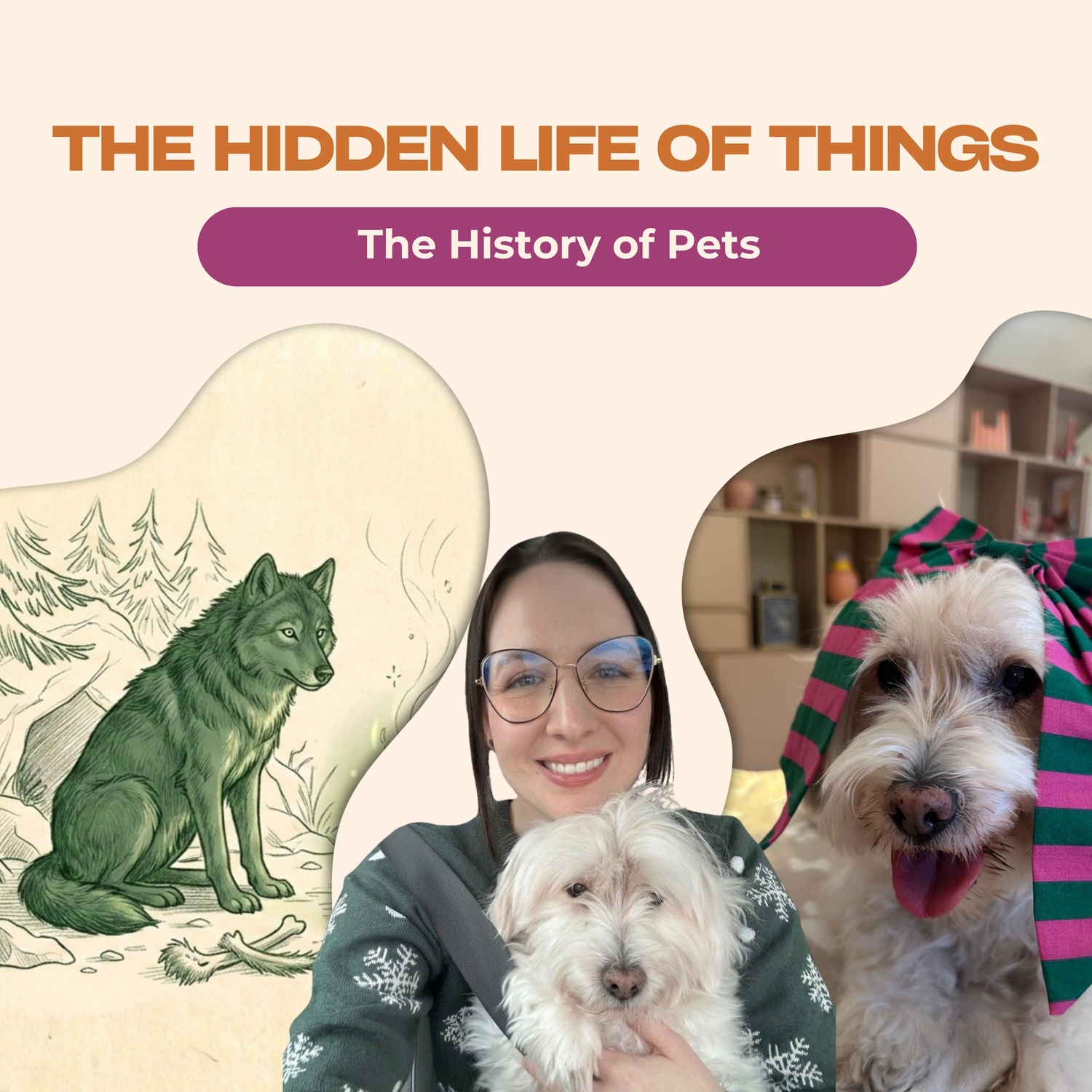
Dogs: The Science and History of the Best Decision We Ever Made - Episode 21
26m 53s
Dogs are not merely domesticated animals but the result of a profound, co-evolved relationship with humans that began with wolves seeking food near human settlements, not through deliberate capture. Over millennia, this proximity led to natural selection favoring less fearful, more tolerant wolves, eventually forming a mutually beneficial partnership. This bond deepened with emotional and biological evidence: 14,000-year-old grave findings show humans caring for sick puppies, and research confirms dogs evolved a unique facial muscle to trigger human empathy. Unlike other domesticated animals, dogs developed specific biological tools—like the LAOM muscle—to understand and respond to human emotions. Their diversity is staggering, with breeds shaped by millennia of selective breeding, from ancient Salukis to the Arctic sled dogs and the rare woolly dogs of the Pacific Northwest, who were historically sheared into blankets of cultural and spiritual significance. Across cultures, dogs were buried with humans, named, and regarded as companions, not objects. Scientifically, the human-dog bond is measurable—reducing stress, lowering blood pressure, and improving mental health—especially in isolated or ill individuals. Most remarkably, dogs are the only domesticated species to evolve a biological trait specifically for human communication, and to develop a shared neurochemical response (oxytocin) with humans during eye contact, a result of over 33,000 years of co-evolution. The origin of breeds like the Cotton, a fluffy dog from Madagascar with royal status and a shipwreck origin, illustrates how deeply embedded dogs are in human history and identity. This unique bond—rooted in empathy, mutual adaptation, and emotional intelligence—makes dogs not just pets, but a testament to the most intimate and scientifically documented interspecies relationship in history.
Hello, welcome back. You may have noticed from the crew last week that today's episode is a little different from usual.
Every episode of this podcast is about the hidden life of things, the ordinary objects we overlook, the tools and materials and inventions that shape the world without anyone properly noticing.
But today I want to talk about something that is very firmly not a thing.
Actually, I should be specific. Today is officially an episode of the hidden life of pets, not things.
And I'm only calling it that because I refuse to call what I'm about to talk about a thing.
Because he's sitting next to me right now and he is very much not a thing.
This is my lovely dog. He's a cotton detunia. He is very fluffy. He was deeply suspicious of the microphone before I clicked record.
And he has an origin story that involves a shipwreck, a pirate port and malagasy royalty, and we're absolutely going to get to that in this episode.
Today's episode is about dogs. How they got from wolves to our sofas would actually happen biologically and archaeologically and neurologically to produce the specific relationship that humans have with dogs.
This partnership that is genuinely unlike anything else in the natural world, about breeds, about history, about the extraordinary things dogs can do that no machine has replicated.
Amalek Sandro, welcome to the hidden life of things and today the hidden life of pets.
Let me start with something that sounds completely settled. It turns out to be rather mysterious. Where did dogs come from?
The broad answer is of course wolves. Cannist, lupus, familiaris, the domestic dog is a subspecies of the grey wolf.
Every dog on earth from the largest grey dame to my dog sitting here looking very comfy is descended from wolves.
But the when, the where and especially the how are contested. DNA evidence suggests dogs diverged from wolves somewhere between 15,000 and 40,000 years ago.
That is an enormous range 25,000 years of uncertainty, which gives you a sense of how genuinely difficult this question is to answer.
Some studies push it earlier a few push it later. The where is equally contested. Different research papers have argued for East Asia, Central Asia, Europe, and Middle East.
And in one ambitious paper, two separate domestication events happening simultaneously on different continents.
The how is perhaps the most interesting question of all because the popular image early humans deliberately capturing wolf pups and breeding them over generations towards domesticity is always certainly too simple.
The emerging scientific picture is something more accidental, more mutual, and honestly a little bit more charming.
The most compelling theory backed by significant research goes like this.
Some wolf populations began to associate with human camps not because they were captured but because humans left food.
Waste, bones, scraps from butcher animals, wolves that were naturally fearful of humans that could tolerate proximity without fleeing had access to a reliable food source that required no hunting, just presence.
Those wolves ate better, they were healthier, they reproduced more successfully, their offspring inherited the same lower fear, lower aggression traits, generation by generation.
Across thousands of years this population of wolves was shaped by proximity to humans through exactly the same mechanism that shapes everything.
Natural selection applied to a very specific ecological context.
And here is the part I find beautiful. Nobody planned it, nobody decided to domesticate the wolf, the wolf partly domesticated itself by deciding the campfire was worth staying near.
The dogs got food and protection, the humans got a Sentinel who woke and barked at approaching predators, attracting partner eventually a companion, a genuinely mutually beneficial partnership between two highly social, highly adaptable species who figured out that they were better.
Now I want to tell you the archaeological story that I think changes how you understand all of this and it is not a sad story or promise, it is actually one of the most moving things I know about human beings.
It happened 14,000 years ago at a site called Bon Oberkassel in what is now Germany, quarry workers found a grave in 1914, a man and a woman buried together with carved objects of bone and antler, and a puppy, about 7 months old at the time of death.
In 2018, a researcher named Luke Janssen's at Leiden University analyzed the puppy's teeth and what the gentle evidence showed was this, the puppy had survived three separate paths of a serious illness called canine distemper, at 19 weeks, at 21 weeks, and at 23 weeks of age.
A puppy with distemper in the eyes of European wilderness without treatment would not survive even one bout, to have survived three across six weeks required human nursing feeding warmth.
These people spent six weeks nursing a sick puppy that had no practical value to them in this condition, it couldn't guard, it couldn't hunt, it was just a puppy and it was ill and they looked after it anyway.
And when they died, they buried it with them, with red ochre, the same pigment used on the human remains included in the grave goods, part of the family.
This might seem normal to you today, but the research described this and this is a phrase from a peer reviewed scientific paper which I love, as evidence of compassion or empathy.
This is the oldest confirmed evidence that the human dog bond had moved beyond usefulness into something else, something recognizable.
14,000 years ago in the ice age, humans were nursing sick puppies because they couldn't imagine not doing so.
Nothing about that is sad, that is one of the most human things I have ever heard.
Okay, you know that dog expression, you know the one, if you have a dog, eyebrows slightly raised, eyes wide, the look that does something involuntary to your heart.
Here is why it works.
In 2019, a team of researchers led by Julian Kaminsky at the University of Portsmouth published a paper in the proceedings of the National Academy of Sciences,
one of the most prestigious scientific journals in the world, with a finding that genuinely stopped me when I first read it.
Dogs have a facial muscle that wolves don't have.
It's called the levator anguli-occupied medialis, the LAOM.
A small muscle above the eye near the nose that raises the inner eyebrow.
It was present in all six dogs in the study across breeds as different as chihuahua, a labrador, a bloodhound, a German shepherd, and a mongrel.
It was essentially absent in all four wolves tested.
The Siberian Husky, one of the most genetically ancient breeds, boasts to the wolf barely had it.
The more ancient the breed, the less developed the muscle.
The breeds shaped most recently by closed human contact had it most strongly.
This muscle, the specific tiny muscle that wolves don't have, is what produces puppy dog eyes.
When a dog raises its inner eyebrow, the eye appears larger.
The expression resembles a human face showing distress of sadness and humans instinctively respond with empathy and care.
The researchers concluded that dogs involved this facial muscle specifically for communicating with humans.
Not without the dogs, wolves communicate with each other perfectly well without it, for communicating with us.
In approximately 33,000 years of domestication, dogs developed a biological tool for speaking to human emotions.
My dog is looking at me with a face that evolution built for exactly this moment.
I find that almost unbearably wonderful, and I'm not immune to it, nobody is. That's the whole point.
There is something that I think people often overlook in the dog story. The sheer, almost incomprehensible diversity of what a dog is.
A chihuahua and a great dainn are the same species, a greyhound built for pure speed, and a bastard hound built for following a centrile with its nose and ninja from the ground.
Other same species, the tiny moltes that road in the sleeves of Roman noble women, and the enormous Tibetan master that guarded mountain monasteries are the same species.
No other domesticated animal comes close to this degree of diversity in body size, skull shape, coat type behaviour or function.
The range of body sizes in dogs is larger than in any other land mammal.
A chihuahua weights around 2kg, and the English master can exceed 90kg, the same species.
This diversity is almost entirely the product of human selective breeding, and it happened remarkably fast by evolutionary standards.
Most of the distinct breeds we now know today were developed or significantly refined in the 19th century during the Victorian era's passion for dog shurs and breed standards.
In historical terms, the poodle, the labrador and the border collias we know them are extremely recent inventions, but some breeds are genuinely ancient, and genetic research has confirmed it.
The Saluki, a slender elegant sight hound from the Middle East, appears in wall carvings from the Sumerian Empire and on Egyptian grades dating back as far as 6000 to 7000 BCE.
The Guinness World Record cites the Saluki as the oldest dog breed with documented history stretching back at least to 329 BCE.
Cave paintings showing dogs that look like Saluki's pushed that back even further.
The Basinji, a small elegant African dog that famously doesn't bark, but does yodo, which I think is magnificent, appears in cave paintings in Libya from around 6000 BCE.
Its genetics sit closer to the earliest and masticated dogs than most modern breeds.
The Greenland sled dog has been identified through today.
genetic research as having lineage closely linked to 9,500-year-old remains found on the
Jacques of Island of Siberia, already significantly domesticated at that point, already bred for
pulling heavy loads in arctic conditions.
And the Tibetan master is in the category of its own.
Genetic studies suggest its DNA branched from wolf ancestors approximately 58,000 years
ago.
16,000 years ago, before most other breeds began to diverge.
This is a dog whose genetic lineage is almost incomprehensibly old.
It looks exactly like your expected dog to look if it had been standing guard in the Himalayas
since before most modern dog breeds existed, because it essentially has been.
And then there is the, let's see if I can pronounce this correctly, "show low eats quen
v."
The ancient hairless dog of Mexico, companion of the Aztec civilization, believed to guide
the soul of the dead through the underworld.
One of the oldest breeds in the Americas still alive, still hairless, still a little mysterious
in the most wonderful way.
Dogs appear in human culture so early, so consistently, across so many different civilizations
that you could almost use them as a proxy for the development of human thoughts.
In ancient Egypt, dogs were beloved, named, and properly mourned.
They were buried in dedicated dog cemeteries, and people in dogs were often found buried
side by side.
The jackal headed dog Anubis, guardian of the dead, and guide of souls through the underworld
reflects the Egyptian understanding of dogs as companions, even at the boundary between
this world and the next.
In ancient Mesopotamia, dogs were associated with the healing of this gula, and temples
dedicated to her had living dogs, and then.
This may not be purely symbolic, dogs licking wounds does have mild antiseptic properties due
to compounds in dogs alive, and ancient physicians observe this may have drawn a genuine practical
connection.
The association between dogs and healing appears across multiple ancient cultures on multiple
continents independently.
Now, I want to tell you about one of the most extraordinary human dog relationships in
the entire archaeological record, and it comes from the Pacific Northwest of North America.
The ancestral coast, Salish people, whose traditional territory span what is now coastal British
Columbia and Canada and Washington state and the United States, developed something astonishing.
They bred and maintained a specific dog breed, kept for thousands of years, for a purpose
that no other culture in the world had developed.
Wool production.
The coast Salish wooly dog was a small white fluffy breed, rather like a modern Samoyed
in appearance, with a long thick soft undercoat, and the coast Salish sheared these dogs the way
other cultures sheared sheep, and spun the hair into yarn and wolf that yarn into blankets.
Ordinary blankets, blankets of enormous cultural, spiritual and economic significance used
in ceremonies as gifts, as emblems of wealth and identity.
The production of these blankets was controlled by women and represented significant,
storable wealth within coast Salish communities.
This research was published in the journal Science in 2023, and it integrated genomic analysis
of a preserved wooly dog pelt held at the Smithsonian Institution with interviews with
Coast Salish elders, knowledge keepers and weavers, who contributed traditional knowledge
and oral histories maintained across generation.
The pelt belongs to a dog named Mutton, Mutton was cared for by a naturalist named George
Gibbs in the late 1850s, and when Mutton died in 1859, Gibbs sent the pelt to the Smithsonian
where it has resided ever since.
The genomic analysis confirmed that Mutton had a distinctive profile unlike any European
dog breed, a unique lineage maintained through careful, deliberate breeding by Coast Salish
communities across thousands of years.
The wooly dogs were kept in pens or in islands specifically to manage their breeding.
They were given special food, they were treated, the oral traditions make clear as family
members.
Archaeological dog burials in Tia Amintaris already showed dogs buried with care and ceremony
alongside their human companions.
The wooly dog tradition declined in the mid 19th century when cheap machines panions
arrived with European settlers and the dog flocks were no longer maintained, the breed disappeared.
But the weaving tradition it supported has endured among Coast Salish communities to this
day.
In California, archaeological research by Paul Blangen-Wolter presented at the Society
for American Achaeology documented that central valley indigenous peoples, including the
Miwok and Yokut, buried their dogs carefully and with ceremony.
Dogs and people were found side by side in burial sites, the dogs were working animals
certainly hunting, guarding, warning of intruders, but the respect of the burials tells you
exactly how they were regarded.
Across the continent and across cultures, the same pattern appears again and again.
Dogs buried with people, dogs named and mourned, dogs bred with extraordinary care and skills,
dogs incorporated into spiritual understanding of the world, not as objects as companions
as something understood to be part of the human community rather than separate from it.
That understanding is, as it turns out, one of the oldest things about us.
Let me spend a moment on the astonishing capabilities of dogs because I think they're underappreciated
even by people who love dogs deeply.
The nose, a dog's sense of smell is estimated to be between 10,000 and 100,000 times more
sensitive than a human's.
The part of a dog's brain dedicated to analyzing smells is proportionally about 40 times larger
than the equivalent region in a human brain, dogs can detect individuals sent molecules
among millions of competing ones.
What this means practically, brains search and rescue dogs regularly locate people buried
under meters of earthquake, rubble, avalanche debris and collapse buildings, finding individuals
by the center of their breath and body heat, diffusing upward to the material above them.
Modern and electronic detection systems exist, but none have consistently matched a trained
dog in complex real-world conditions.
Dogs can also detect cancer.
This is peer-reviewed documented and genuinely not fully understood.
Multiple studies have found that trained dogs can identify certain cancers, including
lung, breast, ovarian and colorectal from breath or urine samples with accuracy rates that
match or exceed laboratory diagnostic tests for some cancer types.
Researchers believe dogs are detecting volatile organic compounds produced by cancer cells,
but concentrations so small that no current instrument can reliably measure them, but dogs
can.
Dogs understand pointing in a way that our closest primitive relatives don't.
If you've pointed something, a chimpanzee, sharing roughly 98% of our DNA, will look at
your finger.
A dog will look at where you're pointing.
Evolutionary anthropologist Brian Hare at Duke University describes this as dog-specific
genius, not general intelligence, but extraordinary fluency in reading human communicative
intent.
They understand not just what we do but what we mean, nor the species does this as naturally
as dogs.
And the oxytocin finding, when a human and a dog who know each other make eye contact, oxytocin
levels rise in both.
The same neurochemical release between parents and infants, between people who hug, it goes
both ways.
The dog's oxytocin rises too.
When the same experiment was tried with wolves and their human handlers, the smutual gaze
of oxytocin response did not occur.
It is specific to domestic dogs, it developed through co-evolution.
We have been doing this together for so long that we have changed each other's brain chemistry.
Right?
My dog has been patient long enough.
It is time to talk about him, specifically.
The cotton that Julia named for the port city of Tulia, now called Toliara, on the southwestern
coast of Madagascar.
Cotton is the fent word for cotton because the coat of the breed feels when you put your
hand into it like the softest cotton you have ever touched.
The origin story is one of the more romantically improbable in all of dog breed history.
The cotton belongs to the bishon family, small fluffy white companion dogs that were favourites
aboard ships in the 16th and 17th centuries, partly for companionship and partly as ratters.
The most widely told origin story acknowledged as legend by the American Kennel Club is
that a ship carrying some of these small white dogs was wrecked in the Mozambique channel
off the coast of Madagascar.
The humans perished, the dogs did not.
The fluffy white coats, cotton like even then, may have provided enough buoyancy to keep
them afloat.
A swam ashore near Tulia, encountered local Malagazi dogs, bred with them, adapted over
generations to the specific climate and terrain of southern Madagascar and eventually became
something entirely new, something specific to that island.
The earliest written reference to small white dogs on Madagascar comes from 1658 in a book
called "History of the Great Al of Madagascar" written by the regional governor Etienne
Le Flacot, who noted a quantity of dogs which are small have long nerves and short legs
like foxes.
That description, three and a half centuries old, is already recognisably the cotton.
By the 19th century, the Marina, the ruling tribal monarchy of Madagascar, had fallen completely
in love with these dogs.
The cotton became known as the royal dog of Madagascar.
The ownership was restricted by not Maragazi royalty, commoners could not own one.
The breed was considered a national treasure, the exclusive companion of the island's ruling
class.
And then, in 1974, Madagascar did something I find wonderful.
They put the cotton in the Tulia on a postage stamp.
The official postal stamps of a soldering nation featuring this small fluffy dog formally
proclaimed it the royal dog of Madagascar.
The stamp is real, it exists, you can find it in collections.
Madagascar has in fact issued multiple stamps featuring the cotton over the years.
A country put a dog with stamps because the dog was that important to national identity.
The first cotton reached America in 1974 when Dr. Lee was found.
Robert G. Russell, a biologist studying Madagascar's lemurs, sent breedingstock home to his father,
who founded the first cotton breeding program in the Western Hemisphere in New Jersey.
The cotton tutorial Club of America was founded in 1976.
In 1992, Madagascar imposed an export ban to prevent the breed from dying out and the
very island it came from because so many had left.
The breed was finally recognized by the American Canon Club in 2014.
My dog is part of the story, a dog whose ancestors may have swam ashore from a wrecked ship.
Who was once reserved exclusively for royalty?
Who appears on a postage stamp?
Who now lives in May?
Is moderately obsessed with his toys and is deeply suspicious of the Hoover?
I want to spend a moment on the psychology of the human dog bond,
because it has moved to scientifically documented in the measurable sense and the research is interesting.
People who go on dogs tend to have lower blood pressure, lower cortisol levels,
faster recovery from illness and greater resistance to stress.
Some large-scale longitudinal studies have found associations between dog ownership and longer lives.
The effect is most pronounced for people who live alone and for people recovering from serious illness.
This is not just wellbeing research, it appears in cardiovascular health studies and in rehabilitation medicine.
The oxytocin finding means that spending time with a dog is not just pleasant,
it is physiologically beneficial in a measurable chemical sense.
Your stress hormones go down, your bonding hormones go up, the dogs do too.
There is also something more specific.
Research has found that the presence of a trained assistant's dog significantly reduces anxiety,
PTSD symptoms and the frequency of seizures in people with epilepsy.
Often detecting an ongoing seizure many minutes before it occurs through mechanisms that remain only partially understood.
Guide dogs give independent mobility.
Hearing dogs alert deaf owners to fire alarms, doorbells, crying babies.
Therapy dogs reduce stress in hospital patients, including in dementia care,
where research has documented measurable improvements in mood and social engagement from regular dog visits.
The phrase "man's best friend" has been used so long it has lost its edge,
but the science behind it is remarkably solid.
This is not sentiment, this is biology documented in journals replicated across multiple studies in multiple countries with multiple breeds.
We are genuinely better in measurable ways with dogs in our lives.
I want to end with something I think a lot.
We have domesticated many animals, we keep cattle, sheep, horses, cats, chickens, pigs.
Some of those animals have been with us for thousands of years.
Some are genuinely important to human history,
but the human dog relationship is categorically different from all of them.
It is the only domestication relationship that appears to have begun with neutral choice,
with wolves and humans independently finding value in proximity to each other.
Before any deliberate human decision was made,
it is the only domestication relationship in which the animal evolved the specific biological feature,
the LAOM muscle, dedicated entirely to communicating with humans.
It is the only domestication relationship in which a shared neurochemical bonding response developed in both species simultaneously.
It is the only domestication relationship documented in the ice age with evidence of humans immersing sick animals out of apparent compassion, 14,000 years ago.
And it is the only domestication relationship in which one species became genuinely expert through thousands of years of co-evolution
at reading the communicative intent of the other, at understanding not just what we do, but what we mean.
Don't just adapt to living with us, they learned us specifically as skill.
No other domesticated animal has done this, no other animal on earth is as fluent in human behavior as a dog.
That is not a small thing.
That is one of the most remarkable facts about our species that we are accompanied in the most intimate and neuroscientificly real sense,
by another species that has spent 15,000 years learning how to understand us.
So if there is a dog near you right now, go and make eye contact, let the oxytocin do what 33,000 years of co-evolution shaped it to do.
And if there isn't a dog near you, I cannot tell you what to do with that information, but I think about it.
The wolves who chose to stay near the fire, the ice age popping nurse through six weeks of illness, the muscle that evolved in every dog's face specifically to speak to our hearts.
The coasts' sailor's wooly dog sheared-like sheep so their hair could be woven into blankets of cultural and spiritual significance.
The small fluffy dog, who swam ashore in Madagascar, became the companion of royalty, appeared on a postage stamp and now lives on sources in living rooms across the world,
deeply unconstant by his own extraordinary history. This is the best interspecies decisions either of us ever made.
History isn't only in museums, sometimes it's asleep on your sofa and it has been keeping us company for longer than civilization itself.
If this episode made you look at your dog differently or made you want one, that's always the point.
The hidden life of things is on Spotify, Apple Podcasts, and wherever you listen. A follow or a like genuinely helps me, and if someone in your life loves a dog, the way this episode is really about send this to them.
And here's your clue for next time. It is everywhere and invisible at once, in every book ever written, in every letter ever sent.
In every painting that survived every contract that was signed, every love note that was kept, it is older than paper, in some forms it is older than writing itself.
Humans have made it from octopus, an ox skull blutter, an iron, and crushed beetles. One formula was so secret, it was locked in a monastery vault.
Another was so durable, it is still being read after 4,000 years. One version is invisible until you hold it under heat, it is the thing that writing is written with.
Like the thing that makes a miracle last, what is it? Stay curious, I'm Alexandra, and I'll see you next week.
[Music]
Podcast Summary
Key Points:
Dogs evolved from wolves through a mutual, accidental process where wolves near human camps gained access to food, leading to natural selection for reduced fear and increased tolerance, forming a symbiotic relationship without human intervention.
Archaeological evidence from Bon Oberkassel, Germany, shows 14,000 years ago humans nursed a sick puppy for six weeks, demonstrating early compassion and marking the emotional bond between humans and dogs as deeply rooted in empathy.
Dogs uniquely evolved a facial muscle (LAOM) not found in wolves, enabling "puppy dog eyes" that trigger human empathy, a biological adaptation specifically for communicating with humans and reflecting a deep co-evolutionary bond.
Summary:
Dogs are not merely domesticated animals but the result of a profound, co-evolved relationship with humans that began with wolves seeking food near human settlements, not through deliberate capture. Over millennia, this proximity led to natural selection favoring less fearful, more tolerant wolves, eventually forming a mutually beneficial partnership. This bond deepened with emotional and biological evidence: 14,000-year-old grave findings show humans caring for sick puppies, and research confirms dogs evolved a unique facial muscle to trigger human empathy.
Unlike other domesticated animals, dogs developed specific biological tools—like the LAOM muscle—to understand and respond to human emotions. Their diversity is staggering, with breeds shaped by millennia of selective breeding, from ancient Salukis to the Arctic sled dogs and the rare woolly dogs of the Pacific Northwest, who were historically sheared into blankets of cultural and spiritual significance. Across cultures, dogs were buried with humans, named, and regarded as companions, not objects.
Scientifically, the human-dog bond is measurable—reducing stress, lowering blood pressure, and improving mental health—especially in isolated or ill individuals. Most remarkably, dogs are the only domesticated species to evolve a biological trait specifically for human communication, and to develop a shared neurochemical response (oxytocin) with humans during eye contact, a result of over 33,000 years of co-evolution. The origin of breeds like the Cotton, a fluffy dog from Madagascar with royal status and a shipwreck origin, illustrates how deeply embedded dogs are in human history and identity.
This unique bond—rooted in empathy, mutual adaptation, and emotional intelligence—makes dogs not just pets, but a testament to the most intimate and scientifically documented interspecies relationship in history.
FAQs
Dogs descended from wolves and are a subspecies of the grey wolf. DNA evidence suggests they diverged between 15,000 and 40,000 years ago, but the exact timing, location, and method of domestication remain debated.
The domestication process was likely accidental and mutual, not planned. Wolves that found food near human camps due to proximity gradually developed lower fear and aggression, leading to a mutually beneficial relationship over thousands of years.
At a 14,000-year-old site in Germany, a puppy with severe canine distemper was nursed by humans for six weeks and buried with its human companions, using red ochre—indicating empathy and emotional bonding long before domestication was purely utilitarian.
Yes, dogs have a facial muscle called the levator anguli occuli medialis (LAOM), absent in wolves. This muscle creates the 'puppy dog eyes' expression, which triggers empathy in humans and evolved specifically to communicate with humans.
The immense diversity among dog breeds—like chihuahuas and English mastiffs—is largely due to human selective breeding, with most distinct breeds developed in the 19th century during the Victorian era.
The Cotton dog likely swam ashore from a shipwreck in Madagascar’s Mozambique Channel, where it interbred with local dogs and adapted over generations to the island’s climate, eventually becoming a royal breed of Madagascar.
Chat with AI
Loading...
Pro features
Go deeper with this episode
Unlock creator-grade tools that turn any transcript into show notes and subtitle files.
 PodcastTranscript AI