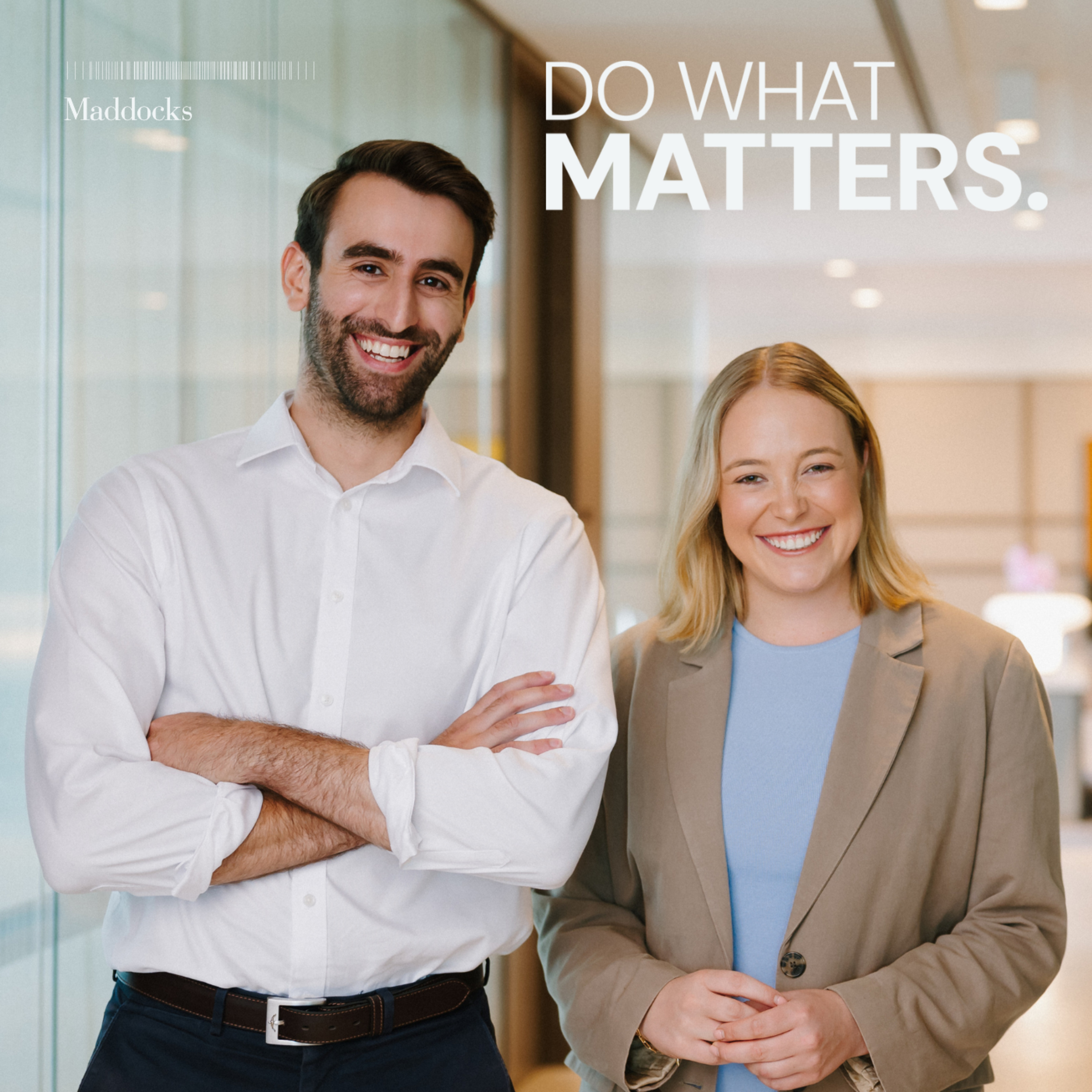
Do What Matters | Getting to know Maddocks - our practice & people
22m 51s
In this episode of the Do What Matters podcast, hosts Pete, Emily, and Charlotte interview senior associates Claire and Billy about Maddix's practice teams and their personal career journeys. Claire details her path from joining the Canberra office as a paralegal in 2016, progressing through the grad program, and later moving to Melbourne in 2020. She contrasts Commonwealth government work—focused on probity in procurement and grants, with heightened political scrutiny—against state-level work, noting Canberra's growth since her departure. Billy, who joined in 2014 without clerkships, describes his specialization in front-end construction transactions, such as drafting and negotiating contracts, while clarifying the team’s broader scope includes back-end disputes and regulatory advice. Both offer advice to early-career lawyers: Claire encourages curiosity, contextualizing small tasks, and independent research before seeking help, while Billy stresses pacing oneself, humility, and kindness, framing law as a marathon where skills develop gradually. On what matters most at Maddix, Claire highlights cross-team collaboration and a safe environment for questions, while Billy agrees, emphasizing how teamwork improves client outcomes and sustains career satisfaction. The episode concludes with lighthearted banter about shared experiences and future collaboration.
We would like to begin by acknowledging the traditional owners on which we are recording today, the Warondry people of the Cooling Nation. We pay our respects to their elders both past and present. Hello all and welcome to episode two of the Do What Matters podcast. Thanks for tuning in again. As always I'm joined by my co-host Emily Kid and producer Charlotte Verly. Today is all about getting to know Maddix, both our practice groups and people and we are joined by two of the firm senior associates, Clay Grundy and Billy GeoLarmus. Em how are you going today? I'm well thank you Pete, I'm really excited to have Claire and Billy on the podcast. I think it's going to be a pretty fun episode. Charlotte how are you today? I'm great, thanks guys, very happy to be here again and very keen to hear our insights from Claire and Billy. I know. So I guess we might as well just dive straight into it. In episode one we covered a little bit about the ESP and commercial teams in Melbourne. And today we're going to discuss the rest of our practice teams. Pete I know you rotated through property last year as a grad. This team has now merged into our national real estate group, but could you talk a little bit about what property does? Absolutely, Em. So our national real estate practice involves our public sector property team, which advises public sector clients, such as state departments, local councils and other authorities on land and property issues. And then it also incorporates our development focus lawyers, which advise local and overseas property developers, landlords, tenants, owners, corporations and private clients on a wide range of development and property related projects and transactions. Wonderful. Here in Melbourne we also have a public law team, which includes our planning and environment team and also provides general government advisory services to local, state and Commonwealth clients. We have our dispute resolution and litigation team, which does disputes for both private and government clients and our construction and projects team. The construction and projects team has a front end, a back end and a regulatory side. And we're very lucky that Billy is here today who's going to tell us a little bit more about that team. Aside from that, there are some differences in our Sydney and Canberra offices. For example, Sydney's home to our healthcare team and Canberra operates a little bit more in the Commonwealth government space, which I think will be able to get Claire to tell us a little bit more about soon. So now we're going to focus more on our commercial and construction teams with our guests. So let's get them involved. By the way of introduction, we've got Claire with us today. Claire is a senior associate in our government, not the perfect commercial team. She works with me, Claire moved down from Canberra a few years ago and is originally from Sydney. So we're looking forward to her telling us more about her time at Maddox and how she ended up in the Melbourne office. Pete, would you like to give us a little introduction to Billy? Yes, Billy is a senior associate in our construction and projects team and was also my clerk of ordnator when I clerked through the construction team two years ago. Billy has been involved in all aspects of Maddox life, having worked in the Melbourne office for over a decade. I hope I've got that right, Billy. We'll hear more about Billy's journey and work to come. So let's get stuck into the questions, Emma. Yeah, wonderful. So Claire, we might get you to kick us off. Do you want to tell us about how you got to Maddox and how your journey progressed once you started working at the firm? For sure. So I joined the Canberra Maddox office in 2016 as a paralegal and was just sort of helping around at that time. It was a very small office. I think there were fewer than 20 people in the Canberra office at that time. Then I was given the opportunity to go into the Grad Program in the Canberra office and I mean from that it was fairly linear. I got my full time contract. I moved to Melbourne at the start of 2020 left Canberra in 2019. So cracking, start to my time in Melbourne, joined the team, joined the Melbourne office, went into lockdown and here I am five years later. So clearly the trauma didn't stick. Lucky you get to hang out with me every day now. Honestly it's your pleasure. So the pleasure is all mine. So some of our listeners are actually based in Canberra as our inside source from the Canberra office. Would you be able to tell us a little bit more about what work you did when you were in the Canberra office and how that might differ from the work that you're doing down here in Melbourne and more broadly I suppose from Sydney as well? Yeah absolutely. So the Canberra office is entirely Commonwealth Government focused. It's all its clients except for a few I think small private clients or pro bono clients. All the clients are Commonwealth Government entities or associated with Commonwealth Government. The team I was in in the Canberra office was the Probeity team, led by a seminator of Stolfie. Sonny Lee I was now a partner in that team as well. Probeity at the Commonwealth level is very different to Probeity in the Victorian State Government or I imagine in New South Wales as well although I can't really speak to that. Probeity at the Commonwealth level is incredibly serious. It's heavily regulated and it applies to any process where the government is spending taxpayer money so whether that's a divestment process, a procurement, a grant process there's always a Probeity consideration and so that was the work I did there. In terms of other differences I guess Commonwealth work seems to require different perspectives and I guess more international considerations. So as well as the nuts and bolts of what you're doing day to day there's always sort of a broader political overlay to consider. It's not to say that's not something that we consider at the state government level but I think at the Commonwealth level it potentially feels heightened or there's a greater degree of scrutiny that makes those sorts of considerations feel more relevant in front of mind when you're doing the work. That being said obviously I haven't, I've been out of the Canberra office for five years now. It's a much bigger office now. We've got a whole bunch of brand new people, so many more lawyers than when I started and many different teams as well so certainly the information I have about it now is outdated. We will get someone who is live from the Canberra office. I think that's a calling for us to get a day trip, I'll take the Canberra office. I think you should probably check it out. I think they have really great snack selections. Wow Helen Keane shout out, keeps it stocked up. We can go to the parliament, we can do it all. I don't believe that. I lived in Canberra, I went to camera girl's grammar and forest primary school. I lived in Canberra for a number of years in Monica, that's why I've got the BSB number that I have on my Commonwealth bank. So if you want proof, try to make some money. Absolutely. Alright, well I think we're going to get to confidential then. So Claire, did you move to Canberra? Yeah, so I moved out of home at 18, lived in Sydney and decided I wanted to try something different. Slightly different, not wildly different. And so I went to Canberra. Also I was interested in politics and international relations and law and at the time ANU was delivering up a really good program and I thought hey why not go to Canberra, check it out, say what happens. So I did my degree there and then in the last year of my degree I was a paralegal in the Canberra office and honestly just loved my job and my life so I stuck around for another four years. Thank you for that. Billy, do you want to tell us a bit more about your Maddix journey and the Maddix construction and projects team? I can do that and Pete, I must say you were right. I have been here for just over a decade now which is crazy when I say that loud but I came to Maddix in 2014. I originally applied as part of a market offer to get into Maddix because I didn't do any clerkships at all and I was one of those unique characters that thought it'd be great to be a lawyer. So here we are. Joined in 2014 as a grad did four rotations at the time and then I ended up settling in construction for a few reasons. One I did the unit at unit and my lecture has happened to be two partners from the team that I work in and they sold it very very well to me which is why I ended up there. So since 2014, similar to Clevr, I've been fortunate to progress from being a grad to a lawyer to an associate, then a senior associate where I am in that position today and the area that I specialize in is transactions. So I do a lot of work in terms of giving advice and drafting and negotiating contracts which is actually quite a lot of fun. It's very very very very, I mean look I find it fun. You know maybe others don't but yeah it's a lot of fun. And could you talk a little bit more about the different aspects of the team? I know from my grad rotation in the construction team there is the front end and back end aspects of the team but the construction group also does some regulatory work as well. Yeah absolutely. So quite rightly Pete, we are a very big team made up of front end work so it's work that involves contract drafting, transactions in terms of trying to get the deal done. So that work can be like I said drafting and negotiating a construction contract. It might involve the consultancy agreement with an architect or engineer. It could be drafting licenses, cost sharing deeds and the like.
We also have backend lawyers, so backend for those who don't know are people who do disputes. So we assist in litigation matters, mediations, arbitrations, claims advice and the like. So all forms of ADR that I know so many people at Uni love that word, we do. And construction is probably one of the biggest areas that actually has all different forms of ADR, including expert determination, should add. And quite rightly Pete, we do have a regulatory practice. So we give advice on matters relating to the building act and building regulations that could arise, you know, it could be in relation to aspects involving particular permits, but yeah, our team does it all. I would agree, when I was in construction it was super interesting. It was unbelievable the amount of different things that are going on in the team, and it's so great to have experts in all different areas, so that you can really get a flavor for whatever it is that you might be interested in. So you guys have both been at the firm for a little while now, and you're both a little bit into your career as lawyers. We were wondering if you had one piece of advice for your younger self when you were in the position that some of our listeners might be in. What would it be? I might, I'll throw it to you first, Claire, put you on the spot. We should add that we are already quite young. Yeah, I was going to say, first of all, I'm not a day over 21. So I don't know what you're talking about. No, we are children. So I think my main piece of advice would be try to stay curious and try to feed your curiosity. I think particularly if you're starting workers in junior lawyer, a lot of the time the work you might be given can feel perhaps not as deep or interesting or engaging as you might wish. That can feel a bit defeating sometimes I think. My advice would be to remember the broader picture and try to contextualize your work and your efforts. I think lawyers typically are curious people. I think we go into this industry because we find puzzles and problems and issues that we want to sink our teeth into and consider more deeply. And I think sometimes if we don't feel we're a really essential integral part of getting to the absolute root of a problem, we can feel a bit left out. That or disengaged, but the reality is that every part of a matter, every task contributes towards finding a solution or unpacking a problem or communicating a messenger and issue in a really effective way. And I guess the other thing I would say is if you're doing work and I wish I'd thought of this or been told this when I was a more junior lawyer. If you're doing work and you have a question or going into a task, if you have a question that needs to be unpacked first of all, you should never feel afraid to ask. We love questions. I think lawyers as people love questions. It's really important to our culture and the matter that everyone feels they can ask questions and be supported in that way. But secondly, I would really encourage you to do your own research. First, dive in, be curious. Don't spend hours and hours trying to get to the heart of a problem if a quick question will solve it. But doing that kind of preliminary thinking yourself, I think it's a really helpful tool to train your brain to approach a problem differently, consider multiple perspectives, and consider different aspects to a solution before you go in and seek guidance on it. I think that's a really useful task, particularly later in your career when you need to be able to provide advice on the spot. If you can train your brain to think about things with curiosity and context and broadly from the get-go, I think it sets you up really well. I think that's a really valuable piece of advice that is something that I personally actually have not really heard before. So thank you for sharing that clear. I think we might throw the same question over to you, Billy. It's a very, very good question, I've thought about this a few times because having been peaked, particularly as you'll remember, a seasonal-clark coordinator, I sometimes think back to things that I would tell myself if I was in that position again. I think for me it's probably reminding people out there that law is a marathon. You really, really need to pace yourself, particularly if you want to have a long and successful career. I know that we have this urge to get on to matters that are the best and interesting, but sometimes in order to get the need to develop the skill set. So it's about making sure that you realise if you want to have a fulfilling career that you do need to pace yourself. You will become important one day. I can't stress that enough. You will have clients who will contact you directly one day and it's an amazing film. They're like, great, they want me to help them, but it's important just to pace yourself. One of the only other things I would also say is whenever I've ever looked at somebody coming through Maddix to be a grad and eventually get to the pinnacles of becoming an equal in another essay or hire. I'm looking at someone who has the building blocks to learn. And what I mean by that is, I'm never going to expect somebody to come through the door at a very early stage to know everything. So a level of humility and understanding that that person can really learn and develop is fundamental to a law firm. Probably the third thing would be kindness. One thing that I've always said to younger lawyers is you do your grad year and you want to make such a great impression. You then become the first year where your email signature block says, "Loyer now." We just see that stage. You are at that stage in LNP, that's exactly right. And I recall feeling the anxiety to try and do a good job. And then I thought, great, I did it. Then I got to first year, all sorry, second year. And I'm like, "Oh my gosh, that's what I was supposed to do when I got given that task." Because then you're remembering what you've done in your grad year, what you've done your first year, but then you're like, "Oh, this is what they want me to do in my second year." So in other words, the trajectory kind of goes up in terms of how you feel because you put pressure on yourself. Then you get to third year and you're like, "Actually, I didn't realize the stuff that in my second year and first year wasn't quite exactly what I needed to do." Now I get it. And so you kind of keep going up, but then it plateaus because that idea of what you thought you were doing right gets easier. But then it becomes a different dynamic for you because then you've got client relationships to manage. You've got to manage staff members and ensure that your colleagues feel connected. So kindness is important because it's all part of the learning that you go through as lawyers. So as long as you surround yourself with great people, great mentors, great teachers, and you always have that positive attitude that you want to learn, then your career is going to be a great one. I think a lot of what Billy's saying actually resembles a lot with me. I remember our conversations when I was a clerk and when I was in the construction team, I'd never studied construction law when I was at uni and had literally no idea at all what I was doing. But I think as a student, as long as you give it a crack, you take initiative and you ask questions and you consider what the right questions are. That's all you can really do at the beginning of your career. So that's a really great answer. Thank you, Billy. What we might do is wrap up with our final question. We're going to be asking all our podcast guests this season, the final same question. Could you please tell us what matters most to you about working at Maddix, whether that's from a cultural perspective, your work perspective or anything else? We might start firstly with Claire. Thanks Claire. What matters most to me at Maddix? It's Billy. It's Billy. And you know what Billy's response is? It's working with Claire. It's actually, I think there's a lot in that. I think something I really value at Maddix is the collaboration, the cooperation, the opportunity to contribute to and foster this culture of community and connection. And from a work perspective, it means that I pop my head into Billy's office. Well, recently it's sort of been three times a day. We have hung out so much. Yeah. Like, if you think about the matters that have crossed our way now, it's a whole new world. It is. It is. But it means I can ask honestly silly questions and feel safe in doing so. And it means that the work that we get to do together is influenced by different areas of expertise and different perspectives. And it's so much fun working with people within your team, of course, but also people from different practice groups. I think I think we can feel so siloed and it can be easy to fall into this perspective is the only perspective kind of thinking when you're continually approaching the issues that we address. From the perspective of your team or with your own personal expertise and the opportunity to get outside that bubble and talk to people in other practice areas and work with people in other practice areas and put together really interesting pieces of work. I value that so much. And I think that's a really big feature of the Maddix culture to me. It's that culture of, as I said, like openness, cooperation, friendliness, curiosity and having the opportunity to ask questions of people from different teams. At all levels and feel safe in doing so. I think that's probably my answer. That's pretty fundamental. I'm hoping that we will still continue obviously to work together. Oh, well, have it scared you off. No, you haven't. But you're so right. Like if you think about it, in order to get the best outcome for your client, you know, the advice that you give may require you to collaborate with other teams.
which is important and you know I've been thinking about my time over the last or over a decade like I've been fortunate to go you know working there Sydney office some days I've worked once in the camera office you know I ranked those one the happiest days ever it was so much fun it was so much fun Sydney is of course a lot of fun too as a gentleman but the level of collaboration people talking people willing to you know hear about what you do it really helps like I think that the way that I've networked at this firm through you know asking people questions has meant that if somebody randomly who joins say my team goes oh I've come across this issue I'm like oh go talk to Claire that's her area you know what I'll set you up in the combo on teams and here you go and I think that is our strength it's it's the people that we work with you know it's it's it's just having the ability to approach someone not to be judged or to be scared because again if you're not inquisitive as Claire said you're not really getting the best out of what you can deliver but no Claire it has been a pleasure working with you very many day any day we've delivered a training session to have me yeah recently where we got to work to get a nice big that was a lot of fun it was we've also recently reshuffled our office in terms of seating and now we sit right around the corner it's a whole new world it is such a whole new world turns out I have so many construction questions I want to question you so it comes up well yeah I and I will say from a junior level like we definitely feel the same way about the firm and it's nice to know that you can go to people in different teams and people of different seniorities and you know you have a nice relationship with them you're able to get the help that you need so thank you so much for that and I think even a testament to what you were both saying is the fact that you've sat down and done this podcast with us today so thank you for giving us your time and truly yeah it has been our pleasure so we really do thank you for that I'm sure the listeners I can really enjoy this conversation I personally have learnt a lot and that is pretty much all we have for this episode anything from you Pete? No I think that'll be it for episode two thanks so much and thank you to our guests thank you bye thanks thank you for tuning into the Do What Matters podcast brought to you by Maddox on the mic if you like today's episode and want to hear more make sure you subscribe wherever you listen to your podcasts learn more about today's topic by visiting maddix.com.au or follow us on our socials
Podcast Summary
Key Points:
The podcast episode introduces Maddix's practice teams, focusing on property, public law, dispute resolution, and construction.
Claire, a senior associate in the government commercial team, shares her journey from Canberra (starting as a paralegal in 2016) to Melbourne, highlighting differences between Commonwealth and state-level probity work.
Billy, a senior associate in construction and projects, discusses his decade-long career at Maddix, specializing in front-end transactions (contract drafting and negotiation), with the team also covering back-end disputes and regulatory work.
Advice for junior lawyers
What matters most at Maddix
Summary:
In this episode of the Do What Matters podcast, hosts Pete, Emily, and Charlotte interview senior associates Claire and Billy about Maddix's practice teams and their personal career journeys. Claire details her path from joining the Canberra office as a paralegal in 2016, progressing through the grad program, and later moving to Melbourne in 2020. She contrasts Commonwealth government work—focused on probity in procurement and grants, with heightened political scrutiny—against state-level work, noting Canberra's growth since her departure.
Billy, who joined in 2014 without clerkships, describes his specialization in front-end construction transactions, such as drafting and negotiating contracts, while clarifying the team’s broader scope includes back-end disputes and regulatory advice. Both offer advice to early-career lawyers: Claire encourages curiosity, contextualizing small tasks, and independent research before seeking help, while Billy stresses pacing oneself, humility, and kindness, framing law as a marathon where skills develop gradually. On what matters most at Maddix, Claire highlights cross-team collaboration and a safe environment for questions, while Billy agrees, emphasizing how teamwork improves client outcomes and sustains career satisfaction.
The episode concludes with lighthearted banter about shared experiences and future collaboration.
FAQs
The national real estate practice includes a public sector property team advising government clients on land and property issues, and development-focused lawyers advising developers, landlords, tenants, and private clients on property projects and transactions.
Melbourne hosts public law, dispute resolution and litigation, construction and projects, and commercial teams, along with planning and environment work and government advisory services.
Canberra is entirely focused on Commonwealth Government clients, including probity work, while Melbourne handles state government and private clients across various practice areas. Sydney is home to the healthcare team.
The team has a front end for contract drafting and transactions, a back end for disputes and litigation, and a regulatory practice advising on building acts and regulations.
Claire advised staying curious, contextualizing your work, and doing your own research before asking questions to train your brain to approach problems from multiple perspectives.
Billy emphasized pacing yourself, being humble and open to learning, and practicing kindness, as law is a marathon that requires building skills and relationships over time.
Chat with AI
Loading...
Pro features
Go deeper with this episode
Unlock creator-grade tools that turn any transcript into show notes and subtitle files.
 PodcastTranscript AI