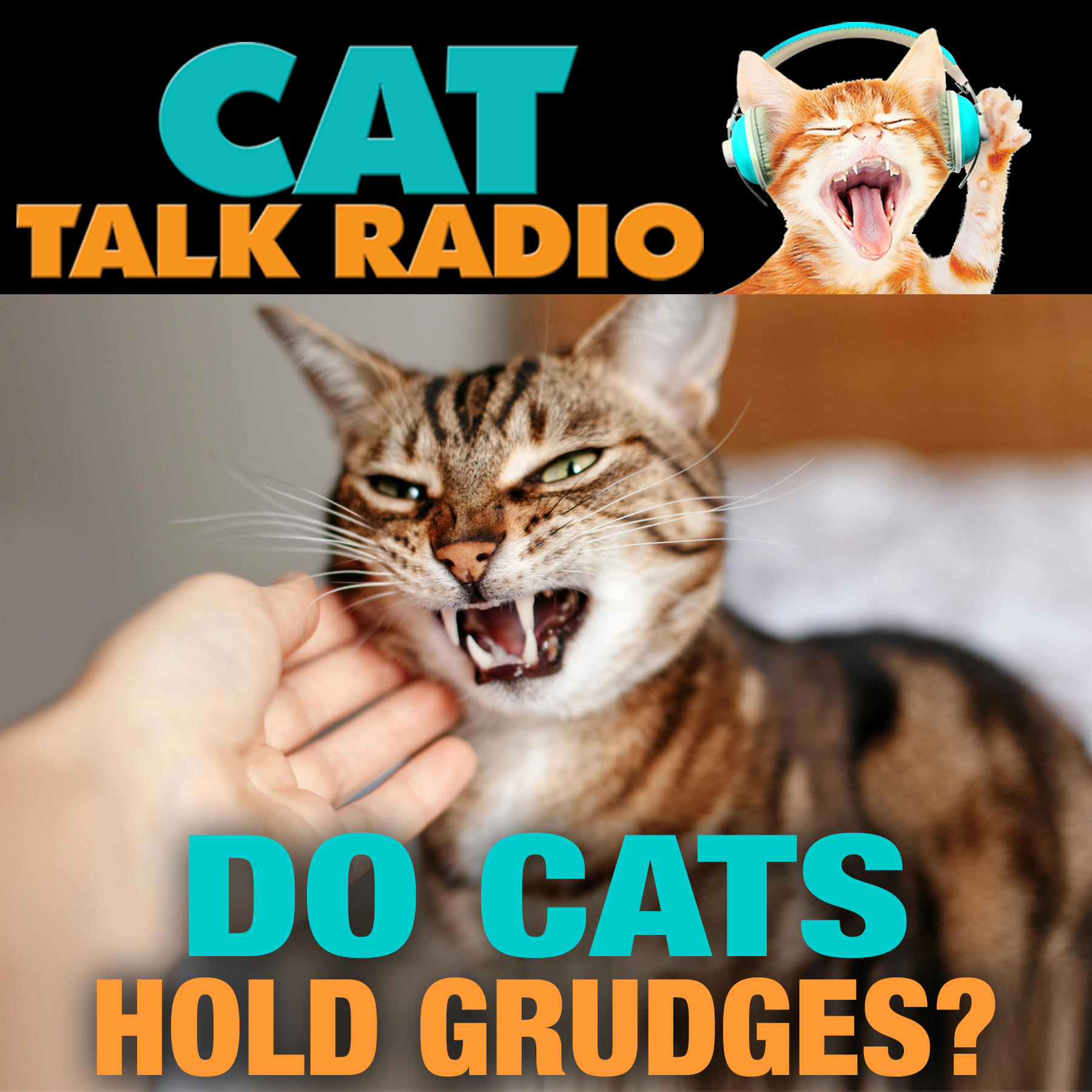
You're listening to Cat Talk Radio where meows make sense and kitty chaos gets a makeover.
Hosted by the fabulous Mollie DeVos, a certified feline training and behavior specialist, this
show is your go-to for decoding cat behavior, solving pesky problems and learning how to
keep your whiskered roommate happy and entertained.
Get ready to pounce into some per-worthy wisdom.
Here's Mollie!
Welcome back to Cat Talk Radio.
I'm Dewey Vaughn.
And I'm Mollie DeVos, your certified feline training and behavior specialist, and I spend
a lot of my time helping people to understand their cats better and bond with them better,
too.
Hey, well, and today we're going to dive into the most common question cat owners asked.
Do cats hold a grudge?
And my first answer is, hell yeah.
I know it sure seems like they do sometimes.
You know, you can accidentally step on their tail or when you take them to the vet, oh
my gosh, or pill them or something like that, and then bam, they won't come near you.
I mean, it happened to me with Pico.
We feed him in our laundry room, our utility room, and it was dark, it was night, and I
was going back out into the kitchen for something, and usually I can hear him eating because
his little bell will hit his plate.
Well, this particular night, he was crouched down super quiet.
I didn't see him, I didn't hear him, and I stepped right on his tail, and he won't eat
there anymore.
We've actually had to change the location of where we feed him because when I tried
to feed him there, he would like, as soon as he would hear me coming, he'd run away and
stop eating, and then we had a hard time getting him to start eating again.
And so, yeah, yeah, absolutely, it seems like they do.
I know I have felt the same way.
I've stepped on his tail before and went, oh my god, and I often wonder when he looks
at me like, I know you're getting close to me.
And so, yeah, I go, okay, I'm not going to step on your tail, just don't put it in front
of me.
And he's like, I'm okay with that.
Yeah, yeah.
And people will often say, Molly, my cat is mad at me, just like I thought, you know,
my cat mad at me, she or he is holding a grudge.
But is that really what's going on here, Irene?
Think about it.
Or is it something else behind that behavior?
Well, stick around, because today we're going to bust this myth wide open.
We're going to talk about feline memory, emotions, and what science is really saying
about cats compared to dogs.
All right, Molly, so your turn to shine high and tell everybody, let's talk about the
most obvious.
When people say cats hold grudges, what do you really mean or what do they mean by that?
Well, let's, usually what it means, I think, is that the cat avoids them, you know, like
Pico running away from me once I stepped on his tail in the utility room.
You know, your cat won't cuddle with you anymore, or even sometimes they'll hiss at
you after whatever it is that you've done that they find offensive.
But that's our human interpretation of the situation, because we're wired to think in
terms of grudges and resentment and revenge.
But all those emotions are tied to complex social structures, if you think about it.
And like I always say, cats really don't have those.
Okay, you're right, I guess.
You always say cats didn't evolve in tribes with scorekeeping and politics and all of
that.
They're solitary by nature, hunters in the wild and living sometimes by themselves.
Exactly.
I mean, evolutionarily, holding a grudge doesn't serve a cat, if you think about it.
It wastes energy, is all it does.
What they do instead is respond to stress.
Because if something frightening or painful happens, you know, like having their tail
stepped on or the carrier comes out, they remember that event and they associate it
with negative feelings.
But that's not the same thing as resentment, it's really different.
Okay, so let's bring in some science.
Cats obviously remember stuff, because they know where their food dish is at, they know
where their litter box is at, you know, they know where the bed is at at night.
So they jump into there, they know where their beds are, but how good are their memories
really?
Well, pretty impressive actually.
There was a study from Kyoto University in, I think it was 2006, and it looked at cats'
short-term memory, which is also referred to as working memory.
And they found that cats could remember where food was hidden for about 16 hours.
And that's more than dogs in similar tests.
Okay, really?
Wow, so cats can out-remember dogs when it comes to certain things, huh?
Yeah, and it was that study that made some people conclude that cats are smarter than
dogs, you know, when people go, "What's smarter, cat or dog?"
A lot of people will point to that study, and them being able to retain information
longer as being proof that they're smarter.
And then there was another study, it was published in Behavioral Processes in 2017,
and it tested cats' episodic-like memory.
And that is referring to them remembering specific events, like what they ate and where.
And it turns out that cats could recall what kind of food they'd eaten and where they found
it even 15 minutes later.
And dogs, by comparison, tend to rely more on cues from humans than their own recall.
All right, we're going to get a lot of protest outside.
Dog owners, we're not really calling your dog dumb.
Yeah, we're just talking about the science, so be careful what you say, Molly.
Well, this is a cat podcast, you know.
Yeah, you're being a little biased here.
I'm just citing science.
Okay, so when people say, "All right, so cats are better at remembering things for themselves,
especially if it's about food."
Big surprise, right?
Right, exactly.
But here's the kicker.
Memory doesn't equal grudges.
Just because they remember an event doesn't mean they attach long-lasting negative emotions
to it like humans do.
Okay, so when people say, "My cat still hates me because I stepped on its tail," what's
really going on?
Well the cat remembers that being close to your feet was painful or scary.
So, you know, like Pico, he's going to avoid that for a while.
You know, every time he sees my feet, especially in a dark room, especially in that room, he
runs out.
And I mean, you know, it's not hatred, it's self-protection, certainly self-tail protection
in this case.
Okay, so let's talk about emotions.
You know, who's really got the emotions?
Is it the humans or is it the cats?
So do cats even feel things like resentment?
Well, cats definitely feel emotions.
They feel fear, they feel contentment, I think they probably feel frustration and certainly
affection, but resentment requires a level of abstract thinking that cats just simply
don't show evidence of, you know, instead what we're seeing here can better be defined
as a stress response.
Like after a vet visit, you know, when our cat comes home and hides for half the day
and just, you know, yeah, takes them a few days to get over that.
Right, and to get back into their natural routine, that's not a grudge against you for
taking him to the vet, that's just residual stress from the experience.
You know, their nervous system is still in that fight or flight mode.
And some cats will even redirect that stress onto you or other pets in the home, you know,
so they're appearing to avoid or lash out to the person that or pets that they normally
trust and, you know, that's called redirected aggression, they're redirecting those feelings
and fears to other targets.
Which looks a lot like grudge, right?
Yeah, but it's biology, not bitterness.
Okay, so if our cats aren't really holding grudges, what can we do then to help them
bounce back after a stressful event?
Well that's a good question and I have some tips for us today for that.
First of all, give them space, you know, don't go trying to make up and be all kissy kissy
face and chasing them down for cuddles right away, give them, you know, give them a minute
to decompress and then, you know, always use, you know, positive reinforcement.
So reestablish your connection with positive associations, you know, break out the licking
lap or the wand toy, you know, or, you know, scratch them where they really like to be
pet in touch once they approach you or even the stress location again.
So like if I gave Pika licking lap in the utility room after I stepped on his tail, well then
things probably would have been better quicker and, you know, desensitize over time.
For example, if we're talking about a vet visit, bring out the carrier without taking
them anywhere and reward them for exploring it or getting near to it or feed them in it
and give them treats in the carrier so that it changes, they have a paradigm shift of
what that carrier represents.
And you know, you could probably use some pheromones that, you know, put some feel-a-way
in a calming diffuser of some sort.
Certainly before a known stressor, like a vet visit, I, that wouldn't have worked for
me accidentally, you know, stepping on his tail, but, you know, when we're talking about
vet visits too, we need to know that, you know, we can anticipate there being some non-recognition
aggression is what it's called when a cat returns.
If you have multiple cats, they recognize each other by the way they smell.
And so when you take one to the vet and it comes back smelling different, then the house
cat doesn't recognize it anymore and thinks it's an intruder and tries to drive it out.
So, you know, there's some things you need to do there, like put the returning cat into
a room by itself, let it get the house smell back on it.
You can speed up that process by dusting them with some brewers so that everybody smells
the same, but he smells a little different, but the same.
And then there's not quite as much stress, but that's, you know, knowing that there's
going to be a stressful situation.
You can strategize ways around your cat having a fear response to that.
So, we're basically helping them rewrite their memory of that experience with all the positive
stuff.
Exactly, exactly.
You know, science shows that cats have strong long-term associative memory, and that means
they're going to link events with feelings.
And if we consistently pair the stressful things with good things, like the lichenapse,
why it's always my go-to, because it's like, you know, over the top, you know, over time,
we can reduce that stress response.
You know, we do this in Feline Right at Home.
And for listeners who don't know what that is, if you go to felinerightathome.com, this
is a free shelter program that teaches volunteers and staff how to help the super stressed cats
in a shelter overcome that and become trusting again.
And we pair those stressful situations with the amazing lichenlap, right?
And Vatacraft even provides lichenlap free to shelters who are participating.
And it's a free program.
So if you're volunteering at a shelter, or you work with a shelter, or you just love
your local shelter, tell them about it and tell them to check it out, because it really,
really works.
We're using counter conditioning.
Most cats associate the shelter environment itself as being fearful and stressful.
And then strangers that they don't know, and in some cats case, you know, maybe they haven't
even had history with people touching them.
And all of that is very, very scary.
And so when we pair that scary experience with something they can't resist, like the
lichenlap, then it changes their feelings about it.
So that, that's one way to deal with it.
Oh, okay, let me boil this down.
So bottom line is, really, do cats hold grudges?
Don't we cover that?
No, they don't.
But they do remember events.
And they definitely remember who feeds them, right?
But what looks like a grudge is really stress, self-preservation, or even fear, right?
Okay.
So what is actually, that's actually good news, really.
I mean, it means your cat isn't secretly plotting revenge for the trip to the vet.
Right.
Well, maybe they are.
But no, right.
Yeah.
So they're really just trying to feel safe again, you know, and you can help that by
being patient, being kind, and of course, lots of positive reinforcement.
Again, if you haven't tried it, get some lichenlap and, and give it to your cat around a stressful
situation.
And you'll be surprised how quickly it reforms their feelings about that stress.
Okay, folks, so here it is.
Don't take it personal.
Your cat isn't mad at you.
Right.
They're just being, well, cats.
Yeah.
Well, that's all the time we've got today.
And if you want to learn more about helping your cat through stress, head over to our
website, catbehaviorsolutions.org.
We've got lots and lots more podcasts and resources and blogs and things like that.
Check out our past episodes.
If you love what we're doing, share this podcast with a fellow cat lover or support
our work through a donation link in the store on our website.
And if you have any questions for us, please email them directly to
[email protected].
That's right.
I love your questions.
I'll always answer them.
And if I don't answer them, you know, I will respond and let you know that we're going
to use them in an upcoming listeners' questions episode.
So please, this is our, I don't know, 320-some-odd podcast and we're running out of ideas.
So ask questions.
I love to hear from you.
Thanks for tuning in with us today.
And remember, raising a happy cat starts with understanding their behavior.
So until next time, keep calm and purr on.
Bye everybody.
That's a wrap on this episode of Cat Talk Radio.
Don't be a stranger.
Follow us on social media, hit that subscribe button on YouTube and check out our online
boutique for products your kitty will love.
We'll be back with more cat-tastic convo.
But until then, go smother your cat with love.
 PodcastTranscript AI