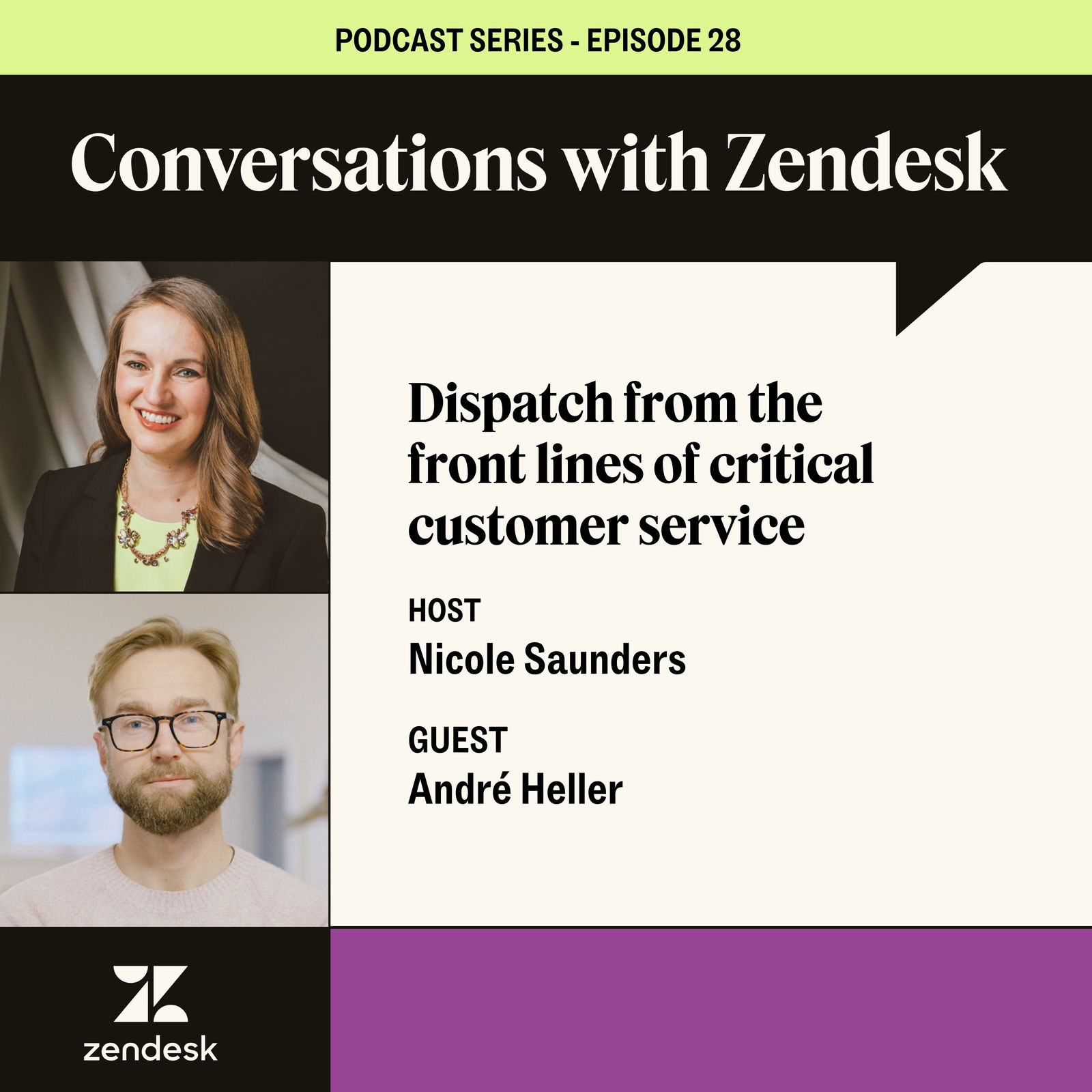
Dispatch from the front lines of critical customer service with the International Rescue Committee’s André Heller
26m 37s
The discussion highlights the critical role of customer service in humanitarian work, exemplified by Zendesk's Tech for Good program and its collaboration with the International Rescue Committee's Signpost project. Tech for Good offers free product and support to nonprofits, enabling them to scale efficiently. Signpost, launched in 2015, uses Zendesk's platform to provide refugees and asylum seekers with information and guidance on navigating bureaucratic systems, addressing issues like domestic violence or asylum processes. Starting in Greece, it reached 70% of the refugee population with a small team and has since expanded globally. The partnership centralizes communications across social media channels, improving efficiency and providing analytics to better understand client needs. Signpost is now exploring AI through a prototyping lab, developing AI agents that prioritize safety and accuracy in high-stakes humanitarian contexts, with a commitment to transparently sharing results. This approach balances technology with face-to-face support, ensuring inclusivity for those without digital access. The work demonstrates how private-sector tools can be adapted for public-sector use, empowering individuals to make informed decisions for themselves and their families.
understanding what options exist, understanding how to navigate those options and how to exercise them is key for them to be the agents of change that are fully empowered with all the knowledge and know how enhanced to make the best decisions for themselves and their families. And so our goal is empowerment through information, which is very similar to a customer service experience. It's just the stakes are totally different. In honored world refugee day, today we're going to hear from an organization that is providing truly critical customer service. The kind that you offer when your mission is to actually save lives. Now, the vast majority of customer service isn't that critical. Resetting a password or making sure an order arrives in time might be important, but it's rarely life or death. That's not the case for nonprofits that work at the front lines of the most pressing challenges facing our planet and society today. These teams must find innovative ways to scale with their limited resources, boost their efficiency, and ultimately help more people. Before we dive into that main interview, joining me is Alana Raimo, Zendesk's director of the Tech for Good and Agents of Change programs. She'll tell us a little bit about her work and the impacts that these programs are having. Alana Raimo, welcome to Conversations with Zendesk. How are you doing today? I'm doing great. Thanks so much for having me. So I would love it if you could start off by telling our audience a little bit about what is Tech for Good and what do we do? Absolutely. Tech for Good and Agents provides free product, pro-borrow support, and grants, nonprofits that are providing critical customer service to communities it made. So when your resource constrained and you're in the thick of mission critical work, you don't really stop to think about transitioning to a tech platform from your notepad in Ken, but it is also true that music besting class off when I could save you hours of hard work and hope you streamline your workforce so you can focus on the most impactful tasks. So that's what the Tech for Good team focuses on. How can we help organizations with small teams and big ambitions rapidly scale their work so they can achieve their goals faster? Now of course we're going to be speaking in the main interview today with Andre Heller from the International Rescue Committee about the Sign Post project. Can you talk with me a little bit about that collaboration with Zendesk and what that looks like from our side? Yeah absolutely. Well we've been working with the International Rescue Committee for quite some time when they originally came to us for a much smaller project where they were like I said we could use this type of software and they started implementing it at kind of a smaller scale at first and they found that it was hugely helpful to their work. Like I said got them off that, Nerpad and Penn and they were able to do their work so much more quickly. The Sign Post team was born around 2015 and they were looking through the International Rescue Committee's tech platforms that were already in years and they saw Zendesk was one of them and they tried it out and they were like this is perfect. This is exactly what we need to scale and that's what they've done. They were able to take Zendesk and starting in just three countries they've now grown to about 30. I think that there's a lot of interesting innovation that happens when we take these private sector solutions and apply them to public sector use cases. What are some of the lessons that we've learned from some of these collaborations and what kind of problem solving are we helping to accelerate knowing that they're working with such serious needs? Yeah well I think most importantly our nonprofits are working with really small team and various resources so they've got that scrappy foundation that I think a lot of private sector companies could learn from but for the most part they're using tools that private sector companies need to use so things like providing information and local languages through the channel that clients are most familiar with whether it's WhatsApp or Facebook Messenger or something email. Our nonprofits are using that just as much as our private sector customers are. Also tactics like using chatbots to provide 24 hour support and increase customer self service or evaluating data from support tickets to improve response times and these are all things that for profit non-profit companies need in order to provide the best customer service. Well it's an amazing program. I'm sure people would like to learn more about it. Where should they go? What's the best way to find out more about it and are we accepting new applicants? I'm so glad you asked because absolutely we are we're looking for more tech for good applicants up until August 15th this year and you can go to azindice.com/techforgood to learn more and find our application form. A big thank you to Alana for coming on and sharing a little bit about our tech for good program. We will definitely put that application link in the show notes and once again that's zendesk.com backslash tech for good and the deadline for applications is August 15th. If you're interested in more opportunities like this or just want to keep up with the latest news from zendesk and this podcast please be sure to follow us on LinkedIn. You can find us at zendesk.com backslashli. All right without further ado here is our interview with Andre Heller director of the signpost project at the International Rescue Committee. Andre Heller welcome to conversations with zendesk. I'm doing well thank you. How are you? I'm doing quite well. I'd love if we could start with you just telling us a little bit about the IRC and the signpost program and your role with those organizations. The IRC it's a multi-mandate aid agency whose origins date back to Albert Einstein in World War II and since it has grown on to become one of the largest global providers of humanitarian assistance. The signpost project was launched and initiated by the IRC in 2015 and it's an IRC led initiative that is also interagency so we work with other I&GOs and local NGOs to deliver on our mission. I understand that zendesk and signpost have had a strong collaboration over the last year and actually even won some awards for that work. Tell us a little bit about what that collaboration has looked like. Well zendesk and signpost have been collaborating for a number of years now. I started working with zendesk personally through signpost in 2020 where we joined forces to figure out how to make our work more scalable and more efficient and also safer and more secure and basically we got together and we adapted the customer service platform that zendesk works with for a humanitarian context in doing a sort of a light touch form of digital social work that really helps people overcome obstacles and problems and make really big critical decisions when there's a crisis and we do that through empowering people through information basically and helping them unpack really complex difficult problems and questions and kind of equip people to navigate their own journeys. And so we started this collaboration to find a more scalable approach with the tech and teaching people how to use it and having more stable systems and platforms and it really revolutionized our work at signpost. It took the program that was very difficult to maintain not especially scalable kind of costly and it transformed it into something that was quite extensible. So there's like thousands of programs that look like signpost all over the world but there's no like kit in tech stack to enable and supersize those things at efficiency and that's what inspires us to really feel confident that what we built together with zendesk is a solution that is valuable and meaningful in the world. Talk to me a little bit about what customer service looks like in your space because of course most of the time I'm talking to like tech CEOs and we're dealing with helping customers with purchases or resetting a password or setting up a system. It's a little bit different in your space like you said you kind of had to customize the platform. So what does customer service mean in your world and why is that efficiency that you were speaking about so critical? Well it's a great question. In a sense what we're doing is using a customer service platform to do social work. It turns out a lot of the workflows are really not that different. It's a similar kind of process that you engage in. Somebody reaches out with a question or problem. You help surface an answer. You want to do that as quickly as possible. Give them a good experience and then they should be able to continue along their way. Just what we're talking about is very different things like it's not how did I lose access to my password or can I get a refund on a product. Here it is. I'm in a situation of we'll say domestic violence and I need to understand what are my options to escape. And so it's a much deeper process that involves a lot of touch points with other agencies and other local service providers who could play a role in supporting someone in a journey from harm to safety or in a lot of cases where we work it's with asylum seekers. People who are looking to become refugees sort of formally in one country or another and trying to figure out how do they navigate these really complex dense bureaucratic systems that are put in place sometimes deliberately to be very difficult and challenging for people to navigate and they take years and you know and
like lawyers often and things like this. And so I offer that context in the sense that that's what our customers experience are. And they're not really customers of artists per se. They're more clients of ours. And these clients are basing a lot of difficulties and challenges. And they themselves hold the power of their future in their hands, understanding what options exist, understanding how to navigate those options and how to exercise them is key for them to be the agents of change that are fully empowered with all the knowledge and know how in hands to make the best decisions for themselves and their families. - What have been the most critical things that you've been able to implement in your time, working on signposts that have really made a difference for what I would think of as an end user, but for those clients, for those individuals that you're supporting? - Yeah, end users are good term also. - We say clients at the IRC, clients of our services, but end users, it's the same terms. - It has been a sort of step-by-step evolution. Signpost is a program that engages people on social media with information products that help them navigate their journeys and that answer questions and problems that they're facing. We are able to do that because people communicate with us in two way communications and they express what problems they're facing. And they tell us about the questions and the concerns that they have. They tell us where they don't have enough information where something is confusing, where they're hitting barriers or obstacles. And with some of those inquiries and questions and discussions, we already know answers to them and we give people that information. And with other ones, we have to research it. And so we have research teams from price of journalists and other kinds of specialties that will go out and find answers to that. So if somebody is missing a certain kind of paperwork and there's a certain process they have to do to get that will help search for certain information, will create new content that talks about that and will publish it. So oftentimes we'll promote content on social media. People will ask us questions about it. And when they click on that content, it takes them to our website where they find a service map and where they find a whole bunch more self-help articles. So that's how a Sunpost works in general. That's the model that we started with in 2015 in Greece when we first launched the Refugee Info, which was the first Sunpost project to respond to the big influx of serians fleeing from the violence and insuriate the sort of pipe of the civil war. But that same model stands today. Once we started working with Sundesk, we were able to plug in all these different social media channels that we were working with across all of the different programs in the world. And it would all have a seamless, centralized back end or communication. So it just increased our efficiency immediately and overnight. It also gave us all these analytics and insights into what kinds of conversations we were having on a basis of the ticket forms that we would fill out. And we sort of put those in customized them so that we could help people as best as possible and understand what needs were and sort of aggregate the data on that a little bit more seamlessly. So that made a huge difference. And then since then it has been like incremental. It's been sort of one thing after the next that we've been able to build on top of a very stable platform that we've been operating with. And we had some really exciting things that we'll be able to do with that technology. And nowadays we're also leaning in on AI to help respond to simple questions as a first step, drawing from the knowledge base of articles that our chains are created. And it turns out that Sundesk again is the perfect hub for that where we can build a bot that works through one hub across 15 different social channels rather than having to have a bot plugged into every one of them. So it's really the backbone of what we do. It's on post. If we didn't have this hub, we wouldn't be able to do-- or it would just take a lot more effort and time and work and waiting for way more technical to do a lot of the functions that we do or have to pay super high dollar for an enterprise system. It sounds like that efficiency is really critical. I mean, your work can literally mean life or death for people that are reaching out to you. And so you have to be able to innovate, scale your response efforts, that kind of thing. I worked in the nonprofit sector early in my career and so I have a little bit of familiarity with this. But certainly, I think many of those organizations have limited resources or maybe limited manpower. What are some of the ways that you are really working to meet the needs of these communities given those resources? That's a great question. And really, signpost was developed as a model to do more with less. It was invented as an adaptation to a reality where it was very difficult to do this kind of work face-to-face at scale. So going back to Greece in 2015, there was tens of thousands of people coming in a month. I don't have the exact statistics, but thousands and thousands of people dispersing throughout the country. But everybody had the same needs. So to meet them at scale would have required thousands of personnel to do it. But instead, we used social media and we were able to do that same amount of work with a very small team. Handful of people were able to create the project and reach, in the end, it was 70% of the refugee population in Greece, which is huge. A wildly successful program with a budget-- Yeah, fantastic. Yeah, it was like a miniscule budget by a relation that was about normal cost. And so it was where it started. Like, one of the things that we struggle with, and that's reality is that because digital is more efficient, doesn't mean that we shouldn't do those face-to-face approaches also. Because a lot of people don't have access to smartphones or not digitally, literatefully, or may have a device, but they don't have credits for Wi-Fi and things like that. It's a great point that you make that not everyone you're working with will have access or reliable or consistent access to phones, to internet, to the technology, where they can access these self-service resources and the things that you're doing at scale. How do you balance, prioritize, determine where to put humans into the mix and where to use the technology? It's a great question. And every program that we run starts with an information ecosystem assessment. And through that, we determine how many people use devices, like what percentage is and what demographics use devices, what channels they prefer, how they get their information, how they share information. Sometimes this suggests that digital approaches or social media approaches will have a very small audience. Other times, it's quite broad. Usually it will indicate where there's a few gaps one way or another. And so we'll design our programs around the most commonly used channels and then couple it face-to-face work for those demographics that are less well reached through that digital work. That audit sounds like a really interesting exercise to go through and something that many organizations can probably benefit from when they're thinking about how to approach their audience and understanding what those channels look like and what those pieces are. What do you find are the best tools to collect that feedback from your community? Well, in the first step, we tend to do more classic survey tools, some quick, scrappy survey platforms that a lot of eight agencies used. It's called Kobo Toolbox, which is just like a survey form that people can use on mobile device. And they get a lot of information, do focus for your discussions, and they've got to record it there. After that's over, and once we set up our system, it's really a number of different analytics tools that we work with to sculpt and guide our programming. Zendesk itself is a really powerful tool to offer insights and analytics. We work with Google Analytics for our website. And then we derive insights from some of the analytics that are baked into the social media channels that we work with. And in the future, I'm sure we'll be doing more insights derived from AI and stuff like this, as we grow and develop. Amazing. So it sounds like you have a very comprehensive way that includes both qualitative and quantitative information. In thinking about AI, I understand that signpost has created an AI prototyping lab. We'd love to have you tell us a little bit more about that and what some of the goals are there. Basically, a year and a half ago, when everyone started talking about generative AI, we knew that the time would come for us to need to understand what's our relationship with this new tech. We had to wait a little bit for the tech to get good enough to work with. We basically determined over the course of late last summer through the fall that we should know how to build our own AI agents. And that program launched in February of this year. The purpose of this is to outfit AI agents for use in a humanitarian context. And maybe going back to that difference in context between normal customer service work and humanitarian work. The sensitivities, the risks, the needs, they're quite different and they're quite distinct. So we needed to be able to safeguard people in a way that goes way beyond the kinds of commercial applications that we think about the need for precision and complete and concise information. It's just much greater. If it's a humanitarian context and someone misses something, maybe they didn't go to the right hospital. Maybe they thought that they didn't get the right [BLANK_AUDIO]
asylum and they actually did. They could have devastating consequences, like the stakes are so much higher. And we have a duty to do no harm. We're going to publish everything that we do as well to help demystify AI for the rest of the AIDS sector. And then when we pilot, later the summer will publish results from the pilot and so on and so forth. So we're committed to this transparent approach towards working with AI. I think that we need a lot of that in the world right now, given how how confusing and obscure and strange. We need to like myth bust and demystify this thing. It's just a tool. We're building agents. They do a certain job. Here's the parameters. Here's how it works. So we just want to like make it all really transparent. And we want to lower the bar of entry for smaller organizations to benefit from listening to technology. It's a very noble mission too to be working with that degree of transparency and really trying to create those resources. I'm sure not only a lot of organizations in the nonprofit sector, but other organizations and groups worldwide will benefit from those efforts. What do you think success with AI looks like for an organization like yours and what are your hopes? What are the things that you would love to see it help with? So I think that success is a journey, like not a destination for sure. Absolutely. Everything is changing so much with this tech. Like six months ago, it wasn't there's so many different foundational models that have been improved upon or had new versions released. So really, the goalposts are always going to be shifting. So what success looks like with the AI work is huge jumps in efficiency and capabilities that are available to all that are solving more and more problems and that are creating a digital workforce for the future of age response. And we think that those those new agents, this new AI agent should be working at the service of local agencies around the world, not just these big multinational NGOs like IRC, but really that that's available to everybody or at the early stages right now. So here's these grandiose ideas and here we are like, can we make the bot let give better answers? Because like this one worked that well and you know, we'd work that phase today, but we think we're going to make some swift progress in our first designs. And yeah, hopefully we just maintain a really positive dynamic moving forward and we make all this good stuff happen. What are some of the lessons that you've learned that you think might be broadly upstickable for other customer service organizations, other nonprofits, any key takeaways that you would share out to help other people in this kind of a process? I would just say that this is our mantra at signpost information products that you're building really need to be driven by your community's needs. And so being responsive, truly being responsive and being dedicated towards being responsive builds trust and built acceptance of your work and creates much more empowering environment for people. So I would just say to anyone working in this kind of field and I'm considering our work somehow akin to the customer support, just be responsive to community needs and really create your information models on a basis of those self-expressed interests, problems, and needs that people encounter and let that drive your strategy. Well, I'm a community builder by trade and I echo that sentiment. I find communication and transparency and responsiveness are the key. That's what keeps people working with your organization that helps people and it's what keeps them coming back and being part of it. Absolutely. And then being able to even report back on that saying like we got this, we got like creating that process is it's not enough to say that the information's out there. You have to build pathways to that. Like and this is whether it's management of personnel internally, like internal communications or external, like it's not good enough anymore to say it's on the website or it's anything. Now you have to build a process that needs to be dynamic. It needs to be responsive and reactive. So yeah, and say like let that drive strategy a little bit. All right. The last question is an easy one. We like to ask this of every guest, which is that we love to celebrate great customer service experiences. Do you have an example from your life of the time that you as the customer got really effective service from another organization? I can think of one. I don't know why this randomly comes to mind. I hadn't thought about this question before you asked it. So this is going to be super random. Okay. Well, I had ordered these like kind of walkie talkies that are used in rock climbing. I'm a rock climber and they didn't arrive. They arrived at the wrong address in a place where I was renting an Airbnb to the rock climbing in Squamish, British Columbia. We needed these for this really long rock climb. I called the company and they confirmed that they sent them what they thought was the right address, but they didn't know. But they just sent a new set in good faith that it was to the right address. They arrived the next day. Eventually the other ones arrived also. I sent them back to the company. It was really nice. They delivered on what they needed to before we needed it and they just believed us. They trusted us. In the end, everything worked out swimmingly for everybody. But yeah, it was a really good positive experience. I felt like it was that trust piece that I thought was really reassuring. Yeah, they treated it like a human. Yeah, they believed me. It was good. That's great. Well, Andre, thank you so much. This has been a really fascinating conversation. And thank you in your organization, probably amazing the work that you do. The whole huge thanks to Zendusk and all of those within the company and its leadership that make this possible. Honestly, it is such an amazing, empowering partnership. I cannot say enough good things about the work that we've been able to accomplish together. And I really look forward to many more years of it to come. All right, listeners. Thanks for tuning in this week. We'll be taking a brief summer break, but we'll be back again at the end of July. Be sure to follow the show on your favorite platforms so you don't miss any of our new episodes. And as always, if you like what you hear, please consider giving us a five-star rating, sharing us with a friend or colleague or leaving us a review. We really appreciate your support. Until next time, I'm Nicole Sondres, Zendusk, the intelligent heart of customer experience.
Podcast Summary
Key Points:
The Tech for Good program by Zendesk provides free product, pro bono support, and grants to nonprofits delivering critical customer service, helping them scale with limited resources.
The International Rescue Committee's Signpost project uses Zendesk's platform to offer digital social work, empowering refugees and asylum seekers with information to navigate complex systems.
Signpost started in Greece in 2015, using social media to reach 70% of the refugee population with a small team, and has since expanded to about 30 countries.
The collaboration with Zendesk centralized communications across multiple social channels, improved efficiency, and enabled analytics to understand client needs.
Signpost is developing an AI prototyping lab to create AI agents tailored for humanitarian contexts, focusing on safety, precision, and transparency, with results to be published later.
Summary:
The discussion highlights the critical role of customer service in humanitarian work, exemplified by Zendesk's Tech for Good program and its collaboration with the International Rescue Committee's Signpost project. Tech for Good offers free product and support to nonprofits, enabling them to scale efficiently. Signpost, launched in 2015, uses Zendesk's platform to provide refugees and asylum seekers with information and guidance on navigating bureaucratic systems, addressing issues like domestic violence or asylum processes.
Starting in Greece, it reached 70% of the refugee population with a small team and has since expanded globally. The partnership centralizes communications across social media channels, improving efficiency and providing analytics to better understand client needs. Signpost is now exploring AI through a prototyping lab, developing AI agents that prioritize safety and accuracy in high-stakes humanitarian contexts, with a commitment to transparently sharing results.
This approach balances technology with face-to-face support, ensuring inclusivity for those without digital access. The work demonstrates how private-sector tools can be adapted for public-sector use, empowering individuals to make informed decisions for themselves and their families.
FAQs
Tech for Good provides free product, pro-bono support, and grants to nonprofits offering critical customer service. It helps organizations with small teams and big ambitions scale their work efficiently.
Signpost adapted Zendesk's customer service platform for humanitarian use, enabling scalable, efficient digital social work. This partnership started in 2020 and revolutionized Signpost's operations.
In humanitarian work, customer service involves life-or-death issues like domestic violence or asylum navigation, requiring deeper processes and high stakes, unlike typical password resets or refunds.
Signpost engages clients on social media with information products, uses two-way communication to answer questions, and creates self-help articles. Zendesk centralizes these channels for efficiency.
Signpost starts with an information ecosystem assessment to determine device use and preferred channels. It then designs digital programs for common channels and couples them with face-to-face work for less-reached demographics.
Signpost uses survey tools like Kobo Toolbox, focus groups, and analytics from Zendesk, Google Analytics, and social media channels to gather both qualitative and quantitative feedback.
Chat with AI
Loading...
Pro features
Go deeper with this episode
Unlock creator-grade tools that turn any transcript into show notes and subtitle files.
 PodcastTranscript AI