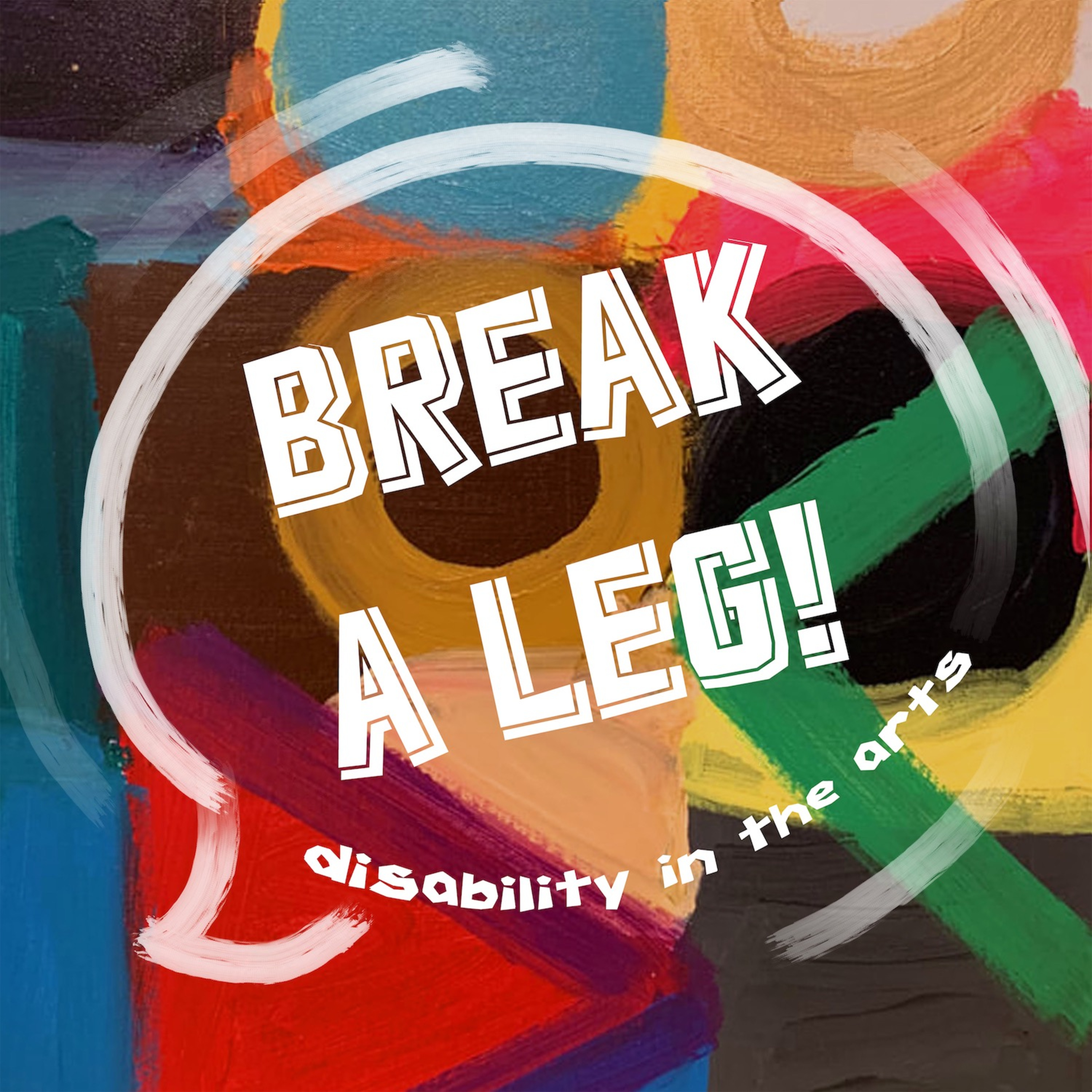
Disability on the Stage and on the Page with Alethea Bakogeorge
from Break A Leg! Disability in the Arts
68m 8s
In this episode of *Brickleleg*, host Nicole Zimmer interviews Alithia Baker George, a physically disabled actor and arts accessibility professional. They explore the Moro reflex, a primal startle reflex that persists in people with cerebral palsy (CP), causing involuntary jumps even when stimuli are expected. Alithia explains that CP is a neurological condition with diverse manifestations, such as her spastic monoplegia affecting one leg, and challenges the misconception that it is a childhood disease. She notes that medical systems often fail to prepare individuals for adult CP, leading to accelerated aging, increased pain, and the need for mobility aids or surgeries like hip replacements. Alithia shares her journey into theater, inspired by *Canadian Idol* and *Wicked*, and describes the complexities of being a disabled performer with sometimes invisible disability markers. She faces industry challenges, such as being mistaken for injured rather than disabled, and navigating audition rooms where decision makers may question her identity or fit. The discussion highlights the need for better representation and understanding of CP across all ages, emphasizing that disability is lifelong and not a monolith. Alithia’s career reflects both the highs of achieving dreams and the lows of systemic barriers in the arts industry.
[Music] Welcome to Brickleleg, a podcast that explores the relationship between disability and the arts. I'm your host, Nicole Zimmer, and on today's episode, our guest is Alithia Baker George. Alithia is a physically disabled actor, arts administrator, and arts accessibility professional. Hello Alithia. Hi Nicole, it's so nice to be here with you. Thanks for being here. I'm so excited. You said yes. Absolutely. You know, one of the greatest things about being in this community of disabled theatre artists is getting to meet more and more artists through social media. And that's really how you and I connected. So it's great that we get to do this together. There really is. I'm so pumped for this episode. If you don't mind, I would love to like talk more about your impressive resume. Oh, thank you. So Alithia has worked extensively in the American and Canadian theatre and originated the role of Chrissy in the US National Tour of Daniel Tiger's neighborhood Live, King for a Day. And she works in access and fundraising at the musical stage company in Toronto. And you're in Toronto right now. So Breacle Egg is officially international, which is so, so dope. Yeah, excellent. Yeah. So our first segment is Spilling the Disability, where we take a look at historical or current events or share some interesting facts relating to the disabled community. Alithia is actually going to be taking the lead with this one. Because you have a pretty interesting fun fact for us today. I think I do. So in infants, there is this very interesting primal reflex called the Moro reflex. And some people might know it as the infant startle reflex. So essentially when a baby feels like they are falling or that they don't have support of their limbs, their muscles will sort of extend and then retract. And you'll sort of feel like you're jumping or falling. It's like that feeling of suspension and then falling when you're on a roller coaster. And generally a non-disabled individuals, that reflex goes away somewhere between four and six months of age. But in people who have cerebral palsy, like myself and Nicole, that startle reflex may never go away. So if someone like me or Nicole encounters something startling, like a loud noise or someone sneaks up behind us, we may jump even if we know that that stimuli is coming. So like for me personally, one of the ways that my friends always used to make fun of me when I was younger, and I say this with complete love, one of the ways they used to make fun of me was we would go downstairs to the basement of my house, where my family liked to keep their soft drinks and chips and snacks and stuff in a downstairs pantry. And to get to the pantry, you would have to go down a flight of stairs and then turn a corner. And once you turn the corner, obviously you can't see what's around the corner. So some of my friends would like to run down the stairs ahead of me, turn the corner and hide behind the pantry shelves, and then jump out at me because they knew that I would scream even though I had full intellectual knowledge of the fact that they were going to jump out and scream. Just because I startle so easily and you know, it's a biological thing. I can't control the fact that I'm going to jump. So it's funny, but sometimes it's an opportunity. And DBS, and DBS. So if you know someone with CP, maybe don't sneak up on them for fun. Maybe do just to see what will happen, but like maybe don't do it all the time. I don't know. Anyway, I call it the factor of like my body always feels like it's going to fall or I'm jumping or you know, I call it my lizard brain because I'm like, it's my lizard brain. I don't know what you call it, but like the chat mom, whenever I'm in my manual wheelchair and somebody knew is pushing me. My body is so tense because my body is ready to hit the ground at any point. And I'm just so tense. But I mean, Nicole, I think there's something to that with like the idea of it being the lizard brain because at least from what I've read and like granted, I was a musical theater major like I am no scientist. But granted from what I've read this the startle reflex is some sort of biological holdover from like when we would have needed that as a reflex to survive in like more prehistoric versions of the humans that we once were etc. So you know, it probably is our primal lizard brain on some level saying like, hey, maybe you don't want to fall. Do you know the like the this is what CP is off the top of your brain? I don't. I mean like the thing with cerebral palsy is it's like a neurological condition that consists of some sort of brain damage that is incurred. And it consists of some degree of brain damage that is incurred either at birth or shortly after birth. And you know, the brain damage is such that it can manifest in a variety of ways. So like for me specifically, it means that like my brain does not necessarily communicate that well with certain muscles in certain parts of my body. And I have a type of cerebral palsy that's called spastic monoplegia. So that means that the muscles in one of my legs are spastic more spastic than you know a non disabled person's muscles would be. But there are a variety of different kinds of cerebral palsy, you know, there are certain kinds of brain damage that can affect muscle tone in different ways. So there are people with cerebral palsy who have multiple limbs affected. There are people like me who have you know a certain side of their body affected. And so you know whether or not I can say like this is what cerebral palsy is for all people is probably not accurate. Yeah. Because you know I I experienced it differently probably that I experienced it probably much differently than you do Nicole. I mean it's not a monolith. People think it's a monolith and it's not. Because I think I also have the spastic, what did you say? Well, I have monoplegia so it only affects one of my legs. Okay, so I have spastic cerebral palsy, but I have like it affects my left side more and it also affects both of my legs and most of my left side. Yeah. So I think they would probably say that you probably have like spastic diplegia because that's like one side. Yes. See, I love how you know more about my disability than I do. You could tell that I didn't pay attention to the doctor is growing up. I was like, yeah, all right. Can I do some more fun now? I mean what I will say about that is like it's not I don't think that you should be putting yourself down for not paying attention to the doctors growing up. I think that there's a real perception out there that cerebral palsy is a children's disease and that is not in fact the case. It is something that is diagnosed in childhood. It is something that I guess happens to you or that you are born with in childhood. But it is not something that you can ever cure. It is not something that you can ever grow out of. And I know that like when I was growing up, I had a lot of doctors, especially because I only have one leg that's affected. I had a lot of doctors essentially say to me like, oh, you know, Alicia, if you work hard enough and you stretch enough and you do this that and the other thing, you know, you. If you do all these things and you work hard enough, you will not be you will not be disabled when you are an adult. And in fact, that is very much not the case. In fact, I have found that in. So I'm 25 and I've found that in the past, especially in the past five years, my body has been worse than it ever was in childhood when I was like in physical therapy. I've been in physical therapy all the time and learning how to fix the way that I, you know, learning how to quote unquote fix the way that I walked. And, you know, receiving a lot more consistent medical attention than I am now. So, you know, there's there's a there's a real perception in the medical community that cerebral palsy doesn't affect adults. And so I'm not surprised that like you don't know how to describe it that I.
sort of choke up when I feel like I am asked to, you know, describe what CP is because I'm sure we've come up with like, we've grown up with medical providers that's indicated to us in our youth that CP wasn't going to be as big a deal long term in our lives than it actually ended up being. And due to the perception that like people think it's a childhood illness, there's also so little focus on like what CP is going to look like for you in adult. Exactly. You know, nobody ever told me when I was 12 years old and thinking about, you know, not wanting to wear my AFO, my ankle foot arthosis, my leg brace to school anymore because I was concerned about how I looked because I was about to be a teenager. You know, nobody ever told me then that like my body might stand up to that and stand up to walking independently without a mobility aid at that point in my life. But nobody ever told me that I might hit a point in like eight years from then that my body was going to start to go back downhill and that my body was going to start to get worse and worse. So, you know, I don't blame you for not knowing a lot about CP because I think a lot of people who have CP are not well prepared by the people who are supposed to be providing them with care. Well, thank you for that. I do have some, okay. So actually, I've just googled it and according to Google, cerebral palsy or CP is a group of disorders that affects a person's ability to move and maintain balance and posture. CP is the most common motor disability in childhood. cerebral means having to deal with brain and palsy means weakness or problems using the muscles. So, it's a real fun ride, you guys. Yeah. It's the most common motor disability in childhood. So basically, we're the basic bitches of cripples. So basically, Google is telling me I'm a basic bitch, which is, you know, accurate. One of the things I didn't know about my CP growing up was that the way that I used my muscles is actually putting a lot of stress on my body as a whole. And whereas I could deal with that when I was 16 years old and my body was still like brand spank and new, I find that now that I'm in, you know, that I'm headed towards my late 20s and I'm really starting to feel like I'm truly aging for the first time in my life as opposed to growing. I do find that I am aging more quickly than my peers. And I've spoken to, you know, several other people in my network who have CP and are in their 20s and in their early 30s. And they all say the same thing. Yeah, we're aging more quickly. Yeah, we're aging more quickly than everybody around us. You know, it's just, it's just kind of wild. Like I think to myself, you know, I probably need my right hip replaced. My doctors think I need my right hip replaced in about 10 years. She's only the hip replacement by the time I'm 35. And obviously people don't generally get hip replacements that young. I mean, luckily, it is a fairly easy surgery and I should have a good recovery. It is, it is funny to me when people say to me, oh, this is what you have to look forward to. And I think to myself, oh no, I'm 25 and we're already there. We're already doing it. It's fine. Well, it's a real issue in the medical field because people who focus on cerebral palsy do not think that adults with cerebral palsy are quite a good sexy. It's not a very like, you won't find fame and claim working on adults with cerebral palsy. And I was like, that is such, you know, it's bullshit because like what do they expect? Like we turn 18 and it seven and goes away. It does not. Which is why like, I remember being around, you know, ages 10 and 11 and being like, oh yeah, this will be done by the time I'm 16. I'll be a regular 16 year old. And I was a regular 16 year old. I just did it in a chair, but like, I didn't see any, any like disabled adults with cerebral palsy growing up in the media. Yeah. Or like, because like, like I knew there were just disabled adults, but like they were older people or they were like veterans or they, you know, had spinal cord injuries. Like I, I don't know any older adults with cerebral palsy in my life personally. I know they exist because I saw a crib camp and it was amazing. Yeah. And it should have won the Oscar. Do not talk to me about it. I'm still salty. Yeah. Like three weeks later. It's great. Um, oh, wait, the another one covered your physical damage. Let's talk about your career. You're an actor. Um, you just finished an amazing run. Uh, you just finished a production of She Kills Monsters. And, you know, I'm always really interested, uh, talking to all artists that like, what, like, when did the theater bug bite you? Yeah. So for me, I think, I am very much a child of 2000's reality TV competition programs. So one of the, I think one of my very first obsessions as a child was the Canadian Idol franchise, specifically the Canadian Idol franchise because I am Canadian. Uh, and I just remember being so enamored with the people who were on that show and being so convinced that one day I was going to grow up and win Canadian Idol. Um, now of course, that did not happen. Canadian Idol was canceled far before I ever turned 16. Really? So regrettably I was never even able to audition. Um, but that was, you know, I think the first season of the first season of Canadian Idol aired when I was in first grade and watching that show was my inspiration to join choir and watching that show was my inspiration to start getting integrated into some of the arts offerings that were at my elementary school. And, you know, I just continued to do things like that throughout my childhood. And I was one of those kids who never really knew what she wanted to do as a career. And I always felt really, really stressed by the fact that I never had an answer for anybody at family dinner parties and stuff like that when they would say, Oh, you know, what do you want to be when you grow up? I never, I never had an answer. And I would burst into tears because the idea of not knowing what I wanted to do and the idea of disappointing people because I didn't know what I wanted to do was so hard for me to wrap my head around. And so, you know, I just, I got bit by the theater bug just by, you know, being involved in the arts growing up. But then I saw my first Broadway show when I was 14 years old on my 14th birthday. What's your last name? My dad took me to my dad took me to see wicked. Oh my god. Classic. Classic. Exactly. The exact show that you would expect somebody who would be the theater fan in the late 2000s to just like love and latch on to. Yeah. My dad took me to see wicked. And I remember sitting in the audience in row M of the Gershwin theater and thinking to myself, I have to do that. And I think it was a surprise to a lot of people in my family because I was really intensely academic. I'm still really intensely academic. I'm still such a nerd. And it was a real. You read like five books a week. It's amazing. It's incredible. I mean, that's incorrect, but I am trying to read 65 books this year. Oh my gosh. We'll see. NERD? Exactly. I am a nerd. And it was a real heel turn for me to say to my family, actually, I really want to pursue the arts. And then you fucking did it. You fucking did it. Congratulations. Gold star for you. Thank you. Sometimes I still can't believe that, you know, 14-year-old Alethea went to go see a Broadway show and wanted so badly to be a professional actor. And now I am a professional actor. Yeah, no, but dreams come true every day. They do. They do. But you know, it's it's very different than what I imagined it would be. Can you tell us what it's like being a a disabled performer for you in the industry nowadays? And you know, all of the highs and lows that that come with being in the industry.
street. I mean everybody struggles in this industry. It's basically like you buy a ticket to be on the struggle bus. But how is it personally for you? How has it been? Um, you know, I understand that this is a podcast and so none of you can see me. So I think it might be worthwhile me explaining just a little bit about my disability. So for me personally, Nicole, I know that you are a wheelchair user. And I've had a slightly different relationship to mobility aids over the past couple of years. So like we were saying when we were talking about the different kinds of CP, my kind of CP is generally considered to be fairly mild. Um, and when I was growing up, it was always expected of me that I was going to walk independently and not really use that many mobility aids, you know, like I said, I always wore an ankle foot orthosis. So a kind of leg brace on my affected side growing up. Uh, and then eventually I stopped wearing it for a little while. And then of course, as I got older and I noticed my body continuing to age, I have since gone back and I have, you know, started wearing that leg brace again. Uh, recently I just got my first cane that I use for when I'm walking long distances or when I'm on a little bit more uneven terrain. Um, but you know, it's, it's, it's interesting being a disabled performer with markers of disability that are not necessarily always visible. Yeah. Um, I always feel like I'm straddling a very weird line between being visibly disabled and invisibly disabled. Because if you watch me walk across a room, you can tell that there's something wrong with my gate. Yeah. You can tell that I don't walk like a non disabled person. But if I'm wearing wide leg pants, for instance, and you can't see my leg brace, you might not necessarily be able to tell why that is, you know, you can tell that something's off, but you can't immediately tell that I'm disabled. And so I think sometimes as an actor, people in this industry look at me and they're not really sure if I'm disabled or if I'm a non disabled person, just having like a really bad day and forgetting to pick up her feet. Yeah. Um, you know, am I just like a really tired, non disabled person? Right. No, I'm a tired disabled person. I want to be very clear. I'm very tired. Those being tired and being disabled are not mutually exclusive. We're very, all of the time for very reasons. Correct. Um, and so I think, I think for me, the thing that has been challenging as a disabled artist is not really knowing where I fit in the industry and not knowing how to explain to decision makers behind the table what they should do with me. Because I feel like a lot of the time I walk into audition rooms and, you know, I get, I get a variety of reactions. Sometimes I'll walk into an audition room and I'll be wearing my leg brace and, you know, I'll be meeting a group of people behind the table that I've never been introduced to before and they will look at me and they will say something like, oh my god, what happened to you? Because they take one look at my leg brace and they think that it's a cast or they think that it's a splint or they think that it's something that is just born of an injury rather than coming from this disability that I have literally had since the day that I was born. So like, I don't know what it is to be non-disabled because I've never been non-disabled. But some people, when I bring my body into the room, some decision makers think that I'm a non-disabled person who's just been injured. Similarly, sometimes I will go into audition rooms for a specific reason, you know, maybe a theater wants to meet artists that they perceive are more diverse in one way or another. And so, you know, I'm a white woman and I walk into these rooms and sometimes I can tell that there are people sizing me up thinking to themselves, why are you here? And I totally get that. I totally, like, they're right to be suspicious. I'm a white woman. But, you know, then I find that the onus is on me to explain to those people whether they've said like, what's wrong with you or whether I just get devived in the audition room that like they don't really know why I'm there. Then I have to like explain things about my body in a way that like, you know, I don't, I don't mean to speak for you in any way, but in a way that like, maybe you don't have to because you're a wheelchair user and people understand that as a form of disability. Yeah. It's like, I, when you were saying this, I was like, that's really intimate to be telling a bunch of strangers. Totally. It's so hard. I, you know, I walk into these audition rooms and I'm getting ready to, you know, I, I, I was trained as a musical theater performer. So it's challenging for me when I walk into the room and I have this expectation of, okay, I'm gonna walk in, I'm gonna greet the panel, I'm gonna go to the piano, I'm gonna sing my song. And it's always challenging for me when I walk into a room and the people behind the table say something like, oh my god, what happened to you? And then I have to explain, oh, I'm disabled, I've always been like this. It affects my body in this way because I know for a fact that the blonde Anjanae who was in the room before me singing the history of wrong guys from kinky boots did not have to come into the room and share things about her medical history in order to get the panel to understand her body in order to get a job. Yeah. And that makes, that makes it difficult for me to do the work that I actually came in the audition room to do because if I'm standing there, you know, before I'm looking over at the accompanist about to have them give me my belt tones so that I can start my piece and I'm thinking about, oh my god, did I say the right thing? Did I present my body in the right way? Because I told them that I'm disabled, are they not gonna want to see me dance, you know, are they not gonna want to put me in the show because they don't think that my body can handle it. If all of those things are going through my head, you're gonna have to audition. Yeah, in the five seconds before I'm supposed to, in the five seconds before I'm supposed to tell a story compellingly. If all of those things are going through my head, I'm not gonna be able to do my best work. Yeah. And so it really undermines me as a performer that there's not a deep enough understanding of what the spectrum of disability looks like. Because I feel like if certain people who are physically disabled in certain visible ways walk into an audition room, the panel knows what they can expect from them, and the panel does not know what they can expect from me. And that's hard because, you know, I can't, I can't build trust with people that I've never met in 30 seconds in the context of an audition when I'm trying to get a job. Like there's a huge power differential there for one thing. And like for another thing, like I don't know you, like I don't know if I can trust you with intimate details about my body, and I shouldn't have to. Right. So, you know, it's difficult for me because I sometimes, I sometimes really do feel that in those situations, unless I'm going to explain every last detail about my body and about my disability, I really do feel that sometimes I'm perceived as being too disabled for non-disabled roles. Yeah. Because sometimes I can walk into an audition room, and if I'm dressed a certain way, and if I don't wear my leg brace, sometimes I might be able to get away with, you know, making the panel think that I'm not disabled, but I do often feel that I'm too disabled for those roles, but then not disabled enough for the disabled roles that are in the canon, because their understanding of disability is not nuanced enough. Right. Right. And also when you, like, when you feel like you're getting away with like passing, do you feel dishonest because like, this is not what actually means. Absolutely. Absolutely. I, you know, it's a lot of, it's a lot of pressure. It's a lot of pressure. Absolutely. It feels dishonest to walk into an audition room and for me to try to downplay my disability. But sometimes I feel like I have to. Yeah. Because like I said, if I feel that I
can't get work playing the disabled roles that are available to me, then what other option do I have except to downplay my disability as much as I can and try to be cast in non-disabled roles? And like, of course, the logical answer is, there just needs to be a deeper level of understanding within our industry of what the spectrum of disability is. And we need to start casting disabled actors in non-disabled roles in the first place all the time. And you know, it's difficult for me when I walk into an audition room and I'm representing myself in a certain way that may or may not be perfectly honest. And then, you know, should I get that job, then I am in the position of, okay, but like, what if something happens to me or what if I'm having a bad pain day or what if I need my access needs met in this room are the people who hired me not thinking or not knowing that I was disabled going to be mad at me for not being more upfront. So it's very fraught. It's like either I have to disclose everything about my disability in the audition room and run the risk of not getting the job because they don't understand disability or I have to withhold it for as long as possible and potentially put myself in situations that make me uncomfortable or where my needs aren't being met. And you know, risk harming relationships that I'm building with people who are offering me work. So it's really tricky. It's really tricky. It's a catch-22. I will say, like, you're between a rock and a hard place, man. And I don't think it's just the industry. I think it's society as a whole does not understand disability. And I'm like, all right, what do you do? I feel like with, like, every time I meet somebody new or like, I'm in a room full of strangers, I'm like, my body is my body, but I also, like, I feel like an educational tool. And sometimes I don't want to educate, but like, if I'm not going to educate you, you know what I mean? Totally, totally. And you know, I feel that this is another way where disabled artists in general are at a disadvantage compared to non-disabled artists because I mean, you and I are the exception. Both you and I went to theater school. So we are trained disabled artists. And we had the privilege of being introduced to the industry and introduced to professionals within the field in ways that many other disabled artists do not. So I, you know, I also don't mean to sit here and be like, oh, what was me? What was me? Because I know that there are so many people who would kill to have the opportunities that I've had. However, it is still way more difficult for artists like you and I to get things like representation in this industry compared to our non-disabled peers. So, you know, for my friends who have agents, they are lucky enough to have somebody be the go between, between them and the people behind the table in the audition room to say like, this is what you need to know about my clients before they come in to share their work with you. And I, you know, I'm not represented. So I don't happen to have that. So really the onus is on me to go into these rooms and explain my disability and be that educational tool to the team. And I wish I didn't have to do that. You know, I wish it were easier for disabled artists to gain representation and get the supports that they need so that we don't always have to be our own advocates. Because that can be really tiring. And I wish, I just wish there were more interest in disabled artists because it's so hard, it's so hard to have to manage all those aspects of your career and keep the big picture in mind. Right, right. Exactly. You mentioned earlier in the conversation about nuance. Can you like talk about the, like what you mean when you say like nuance in terms of like disabled characters, you see like get representation on stage or the screen. Yeah, I think that like there's a lack of diversity of representation of disability right within the theater canon. Yeah, I think that oftentimes when you see a disabled character in a show, they are somebody who is disabled in one very typical stock way. Yeah, you know, being disabled seems to be their primary character trait. Exactly. Exactly. It's either they're disabled because that's the great tragedy of their life or they're disabled because that's their motivation to become the villain or they're disabled because they're there to be the inspiration in the story. Disabled characters are so infrequently allowed to have their own full humanity the theater canon. Yeah. And so as a disabled artist who straddles that line between being visibly disabled and invisibly disabled, how I feel like that plays out on me, is it requires me to police my own body when I'm making artistic work. Then I'll explain what I mean. What I mean by that is so for instance, as you mentioned, one of the great joys in my career so far has been originating the role of Chrissy in Daniel Tiger's Neighborhood Live King for a day. Now, if any of you have seen Daniel Tiger's Neighborhood, the lovely show for children on PBS, you might know Chrissy. Chrissy in the PBS show has an unspecified disability and she walks using forearm crutches. In Daniel Tiger's Neighborhood Live King for a day, the stage show, Chrissy not only used forearm crutches, but she also used a posterior rolling walker. So those are two mobility devices that I don't necessarily use in my day-to-day life. So I had to learn to use them on stage. And you know, it was something that I'll be honest. It was something that stressed me out because I feel as a disabled artist that there's a lot of, I feel a lot of responsibility when I step on stage as a disabled artist to represent my community in the best light possible. And it's difficult for me when the roles that are out there for me to play are not necessarily roles that line up with my lived experience. Yeah. Are not necessarily roles that I feel show disabled people's full humanity. So I feel a lot of pressure to represent my community in the best way possible on stage, just because I know that the amount of representation of our community is still so small. But what that ends up meaning is because there's not a huge diversity of what's on stage, it often means that I have to put myself into a box of representing disability that doesn't necessarily feel true. Off to me. Yeah. And yeah, and it doesn't necessarily mean that it's bad because I think that I did a good job in Daniel Tiger. I hope that I did a good job in Daniel Tiger. I mean, I did that show for I did that show for almost a year. So I hope so. Good grief. But you know, I sometimes feel like I have to police my own body and make myself seem either more or less depending on the role disabled than I am. And it's it's challenging because sometimes I just wish that I could play a role that has my lived experience with disability. I don't feel like I've seen that on stage. I'm we're going to make it better, Alicia. We're going to be like, we're coming the industry. We're coming Hollywood. Alicia, what do you because you talk about wanting to play a role that like wanting to, you know, play a role that fits your lived experience, which I totally understand. God knows we need more disability representation, but what do you say to people who respond to that, you know, you sing that and saying, well, that's acting. Like you're not playing yourself. You're being an actor. That's your job. I mean, I think there's a difference. You know, this is such a cliche, but you know, there's that old maxim that acting is behaving truthfully under imaginary circumstance.
And so obviously, at least for me, as an actor, it's easier and it's more fulfilling and it's richer when I get to play characters who are closer to myself. And I don't just necessarily mean in terms of my disability. I have a much easier time playing women who are queer like me. I have a much easier time playing women who are unabashedly earnest. I have a much easier time playing women who are nerdy. I have a much easier time playing characters who speak at the speed of thought. Because those are all things that are intrinsic to me. And so when I see that in a text, I can instantly look at it and know how to interpret it and know how I would feed myself through that character in a way that makes that character more true to life, more realistic, more easy for me to repeat performance after performance in a very consistent manner. It's always fun to play somebody who is deeply outside of that realm. But I would say that that is not where I or where most actors are most successful. And that's why we have the concepts we do in this industry of things like type, you know, things like, you know, Jennifer Lawrence, I'm just picking somebody random. You know, Jennifer Lawrence is your slightly brash. Cool, blanchers. Yeah, slightly, slightly brash intense leading lady. And you wouldn't necessarily call on Jennifer Lawrence to play, you know, something like what Anya Taylor Joy does in the Queen's Gambit. Because it's just a slight, it's just a totally different feel of what comes most naturally to those actors intrinsically. And it can be totally fun to push yourself and try something new. But it's also really, I find that the times that I have felt most fulfilled as an actor are when I can explore slightly different facets of myself, but that are grounded in enough things that I know to be true about myself that I always know where like that character's North Star is. Like if there are, if there are just too many things that I can't get a handle on how I would react to those situations or those circumstances personally, I'm a much more difficult time creating a character or a performance that feels really fleshed out because I'm just I'm just guessing at that point how that person would operate in their lives. So you know, like there's that joke that I know I made when I was in theater school and I'm sure that you heard when you were in theater school of, well, everybody here is just getting a degree in learning how to play pretend. Or everybody here is just getting a degree in pretending. And for me, but you know, that's the way they're doing. Oh, like my minor was in crying. Yeah, I worry about it. Yeah. I think everybody is being a little bit facetious when they say that, but there is some, there is some level of truth to that because acting is the elevated version of the playing pretend that you do when you are a kid. And you know, what I think is interesting about that is like, if you were a kid and you're three years old and you don't know anything about, I don't know, outer space. And somebody on the playground asks you to play astronauts with them. You're not going to know how to pretend to be an astronaut accurately. So to some degree, you need to be playing within your realm of lived experiences or at least within your realm of understanding. Yeah. Or else you're not going to give us successful performance. Yeah. Exactly. Like what they say to writers, like, right, what you know, and I'm like, okay, I can write about an alien crash landing into earth, but I can also like, I can also write about the girl that he needs who is disabled and like working at like a nine to five that she hates, you know, like, yeah, it's just the story gets so much more in depth. Yeah. Because like, the audience knows that like, to be honest, anybody can write like a shitty alien story because nobody's actually there to fact check us besides the US government. But I don't think they're at that point yet. But everybody knows what being a human is like. And so they can relate it. Yeah. They can relate to it on a deeper level. And if you write a story about a disabled person that's not accurate or that's not grounded in people's lived reality or that, you know, only uses the disabled character as a plot device. We will totally fact check you. Exactly. The disabled people in your audience, the one in five people in the world who have a disability are going to be able to tell. And not only that, the one in five disabled people who see that piece and encounter that character are going to be, are going to be able to tell when that character is just being used as a plot device. And when there's been no meaningful effort made on the part of the writer or on the part of the actor or on the part of anybody on the team to make that character fully a part of the world that they are supposed to inhabit. Yeah. Yeah. I mean, and also speaking for myself and I don't know about you, Alicia, I'm a very, very picky disabled reader. Like I'm a bit like, if I, I'm reading this book right now and it has a disability, I'm very excited. And I get like 30 pages in and the author is like doing great with his research. Like I can tell he did, he actually talked to a disabled person, which isn't always the case. And then there was this one moment where he was like, the author wrote that the characters wheelchair, his power wheelchair got up to 20 miles per hour and I was like, no, no, that bullshit. That's bullshit. Power chairs for those of you who don't know, go up to like five to six miles per hour, seven or eight tops. No, there's no way. There's no way he gets to 20 because you know what that is? Dangerous. And no wheelchair manufacturer worth their salt will risk being sued by a bunch of pissed off parents because their kid was playing Daredevil and went too fast and quit. And then he crashed into a tree because let's face it, I would be that kid. I would be that kid. So I know when you guys do your research and when you don't and you know what, I will call you on your bullshit, I don't care. And you know, that's not to say that non-disabled people can't and shouldn't be writing disabled characters. Because in fact, I'm here to say that they can and they should because disabled people deserve more representation in media full stop. And if we are only depending on disabled artists to provide that representation, the gap is going to close far too slowly. Yeah. So I'm here to say that like non-disabled people should be writing disabled characters, should be doing a lot of research, should be taking the steps to mitigate those mistakes. And you know, with something like the book example that you just gave, I think that's like a wonderful opportunity to hire more disabled people and bring them more on board your team to make sure that things like that don't make it to print because that mistake could have been caught by one more sensitivity reader or a play can be improved by one more session with a disabled dramaturg or, you know, any other number of combinations that bring actual disabled people with actual lived expertise into the room, compensating them for their time to say, "Hey, this is how we can make this piece more successful." Yeah. And I will say about the book, the author does a wonderful job. I just got really like, it took me out of the story for a little bit and I had to be like, "Of course." Yeah. And I don't mean to say that disabled people are sitting here lying and waiting, watching your shows, reading your books, watching your plays, waiting for you to make a mistake about disability. Yeah. I know that whenever I watch a show or read a play for the first time that has a disabled character in it, I always go into it. With the greatest amount of good faith, I want that piece to be incredible. I want that piece to be a good representation of disability. I am willing to give anybody the benefit of the doubt for putting a disabled character in the media that they are putting together. And you know, mistakes like the one that you were just talking about, Nicole, like, "Yeah.
Yeah, they will stick out like sore thumbs to disabled people who are in the know. But like ultimately if the rest of your story is carried out in an authentic way, you and I, and I think most disabled people are able to look past that. All I'm really saying is that like there is more opportunity within the entertainment industry at large to bring more disabled people into creative processes so that the media that we have is just going to continue to get stronger and stronger. Because why have a mistake if you don't have to, of course, but it's not like we're the scary disabled people, cancel culture police who are just like waiting for you to make a mistake and like all of a sudden, no, like you've represented disability in such an awful way. Like we have to send you away. Like no, that's not what we want. Like we want it to be good. This is what we've been waiting for. Yeah, I will say in grad school, it was kind of hard for me to accept when a non disabled person wanted to write a disabled role. I have changed at like obviously like I'm much more open to being like, yes, you can do this, but please know, please do your research. It's like, it's not like running out of aliens. There are disabled people in the world contrary to like popular belief and kidding. I'm kidding. Um, I just remember being much more like it wasn't that I was like, I was just like a bit more jaded and a bit more like closed off because I saw so many better representations of disability written by non disabled people. I was like, just stop writing them. We'll do it ourselves, but like the disabled community shouldn't have to take that mantle and I've learned that we shouldn't have to take that mantle if we don't want to. I mean, we can write whatever we want to write. I mean, I write about disabled stories because I'm like, this is what I want to write right now, but I do have plays inside my head that don't even mention disabilities and can be played like the characters can be played by either non disabled people or disabled people. Um, yeah, I mean, I think I think that sort of ties back into what I was saying at the start of this conversation that, you know, the, the ideal for disability representation, you know, I, I, I obviously don't presume to speak for everybody, but I at least think that I can speak for you and I, Nicole, I think that our, our ideal of disability representation is having more stories about disabled people in the canon in general, more stories about disabled people that do not center on disability in the canon and more opportunities for disabled artists to play roles that are not specifically written to be disabled because there is such a vast spectrum of what disability and what life with the disability looks like in reality that deserves to be reflected in our storytelling. Also, can I, can I put one more on there as well? Um, yeah, more opportunities for disabled people behind the scenes. So we can have a seed at the table, the, the, um, eponymous table that everybody's talking about. Like we even bring our own chairs sometimes. It's great. Like we, we don't need much. We just need the chance to, you know, make our own art. And also if somebody needs, you know, a different point of view, we have a different point of view, literally for some of us because I sit down all the time, all I see are everybody's asses, everybody's asses. That's my, my, my, my, my, you guys. Um, sorry, mom. Sorry. Um, Alicia, how have you seen any improvements in the industry in the last couple of years? I have, but I wanted to know if you have as well. Absolutely. You know, I think, especially working here in Canada. So it's interesting because I, I went to theater school in the United States. I started my career as a theater artist in the United States. I worked there for a couple of years. Um, but I am Canadian and I moved back to Canada a couple of years ago. And it's always interesting to me to compare the differences between working in theater and entertainment in the United States and working in theater and entertainment in Canada. And one of the big things that I've noticed is the difference in disability representation in the United States and the difference in disability representation in Canada. And I think that part of that has to do with the fact that the United States has a very robust federal accessibility legislation, the Americans with Disabilities Act, whereas there is no federal accessibility legislation here in Canada. I did not know that. I did not know that. Oh my gosh. We do not, we do not have federal accessibility legislation here. They are in the process of bringing the Accessible Canada Act into law, but that is only going to affect certain kinds of businesses and certain government entities. So there's not accessibility legislation that touches everything in the way that the Americans with Disabilities Act does. You know, in Canada, we have provinces in the same way that the United States has states. So I live in the province of Ontario and we happen to have a provincial law here called the AODA. So the Accessibility for Ontarians with Disabilities Act. And that was a law that came into effect probably about 10, 15 years ago. I do not know if you can accomplish many of the things that the ADA accomplishes, but it will not be fully in effect until 2025. And so, you know, all to say that's like a long explanation about Canadian politics that you may or may not need. Scott, feel free to, you know, take only what is relevant of this. No, I love it. I love it. I'll all to say, it's interesting to me because I feel like when I moved back from the US to reestablish my career in Canada, I did notice that I felt that there were more opportunities for disabled artists south of the border. And that there were more theaters who were more willing to cast disabled artists in the US and more theaters who were more willing to program work by disabled artists in the US. And there was here in Canada, but as I've been back in Canada for the past three years, I have noticed a lot of improvements. I have seen a lot of theaters adjusting their language in their casting calls and in their calls for submissions and in their program announcements, saying things like, we prize a human centric work environment. If you need access needs met to participate in this process, let us know. We're saying things like we are very much seeking submissions from deaf disabled, neurodiverse artists as part of this process. So you know, I am noticing more and more awareness from the community. And I am noticing more and more instances of relationship building because I think it's important to remember that when we work in theater, all of us are playing the long game. All of our careers are predicated on relationships. And all of our career moves are made possible by meetings that we may have had six months ago, a year ago, two years ago. And so it's interesting to see now that people are investing more in those relationships so that hopefully three years from this moment, we are going to see more disabled artists on stage because those theaters now are taking those steps to say, hey, we really want to meet these artists. We really want to invest in these artists. We really want to create the conditions so that artists of all stripes can succeed in our institutions. And hopefully that will bear a lot of fruit. Yeah. No, that sounds great. So all of the Canadian politics, I really loved, because well, I thought you guys were like straight ahead of us in terms of like, you know, accessibility, but it's. Sure. There's a reason why people say that the Americans with Disabilities Act is a landmark piece of human rights legislation. And it's because almost all of the disability rights legislation that has come after it in almost every jurisdiction around the world was based on the ADA. Large portions of the AODA here in Ontario are based on things that were learned from the Americans with Disabilities Act. So you know, it's it in some ways. Yes, it is disappointing that Canada does not have the same degree of disability legislation that America has had for 30 years. On the other hand, in some ways, it is helpful because we've had 30 years to watch America and say, this is what works and this is what doesn't. Here is how we are going to have our own legislation that addresses the unique factors that we have going on in this province and in this country.
Um, you know, would I say that the AODA is completely successful as a piece of legislation? No, but I also acknowledge that it won't be fully in effect for at least the next four years. Um, and I'm, I'm, I'm looking forward to seeing how things change in this province and in this country and in our industry just as, as our understanding of accessibility, right, deep ends and deep ends because I feel like I do feel that socially, even in a way that I did not feel five years ago in the United States, I do feel like there's a, there's a bigger and maybe some of this is attributed to the pandemic because I think that there is a deeper understanding of disability now in society than there was maybe even like five years ago when I was in the US. And I think some of that maybe does have to do with the pandemic because I know that some of the experiences that we have all been going through as a society during COVID-19 have been things that the disability community has been dealing with for years. And so there has been a moment over the past 14 months for disabled people to step into those positions of leadership and advocacy that they so rightly deserve. And to speak to society as a whole and say, actually, the things that you are experiencing right now that are so difficult to deal with, these are the things that disabled people have been dealing with for years at a time. In some instances, for people's entire lives. And I do think that society as a whole is starting to become more aware of the place that disability has in our culture and how we need to be more cognizant of making our society more accessible because it benefits everybody and it actually harms all of us when our society is not more accessible. I totally agree. I have one more question for you. Alicia, I keep reading articles that say that Hollywood is going to have a disability revolution. What are your thoughts on that statement? I mean, I certainly hope so. Yeah. I think, yeah, I certainly hope that Hollywood has a disability revolution. I certainly hope that that means that in the next 10 years that we are going to see more disabled talent in front of the camera that we are going to see more disabled talent behind the camera that we are going to see more disabled talent in writers rooms that we are going to see more disabled talent becoming incredible stars across a variety of mediums. However, I do think that it's going to require a great deal of reckoning from the entertainment industry as a whole. Yeah. Because I think that the entertainment industry moves at such a punishing pace for everyone. Yeah. You know, it is not lost on me that in theater and to some degree in film and television as well, we work incredibly punishing schedules. In theater, you know, the six day work week is still standard. In film and television, working through a traditional weekend and, you know, doing a shoot at three in the morning is completely acceptable and not at all unheard of. And I think that we need to acknowledge as an industry that if we want to have a disability revolution in Hollywood or in any facet of the entertainment industry, we need to create the conditions for people to succeed. Yeah. And those conditions might not necessarily be the way that we have always made art. It might not be working six days a week because that's the way that we can cram the most amount of usable hours into a process. It might actually be extending everybody's contract by a week so that you can work a five day rehearsal week. And yes, that does mean you're paying people more and getting less stuff done. But that means that the work is more sustainable for everybody else. And I think that, you know, those conditions need to be met in a variety of facets of the industry before we can even consider truly having a disability revolution because you have to consider like a revolution at what cost. Like do you want a disability revolution if only certain people can push their bodies or push their minds in a certain way to be able to make that work? Or would you rather just reform the entire industry to make it more accessible and sustainable for everybody so that everybody's work can be valued so that everybody has the chance to be working at the top of their game instead of just the privileged few who can afford to push themselves so far to make quote unquote great art. I would rather our industry just be a little bit more kind and a little bit more gentle. Wow, wow, I like you hit the nail on the head girl. I don't. You're correct. You are correct. Well, I honestly, I think that's a great way to wrap up this amazing episode. Alicia, I'm so glad you you had the time to come talk to me. Um, so Alicia, what upcoming projects do you have at? We can perhaps plug for you on this great podcast or ours? Yeah, I in addition to my work as an actor that we've been talking about today, I'm also a full-time arts administrator and I work for the musical stage company, which is Canada's leading not-for-profit musical theater organization. And we have a lot of really exciting accessibility initiatives coming up this summer that I am so excited to get to share. So if you're curious about any of those, you can visit musicalstage at www.musicalstagecompany.com. And if you'd like to keep up with me, you can always follow me on social media. I'm @aliciamb everywhere. So Twitter, Instagram. She's really funny on Twitter, you guys. She's really funny. Thank you. You're welcome. Come hang out. It'll be great. Yeah, yeah. Um, Alicia, thank you so much for being here. This was a fantastic episode. I'm so glad we had this time to talk and um, hopefully we can do it again soon. Thanks so much for having me. Hopefully the next time that we do something like this, we'll get to be in person. That would be incredible. Actually, I would, I would love that. Thank you for listening to this episode of Break a Leg. And thank you to our guest, Alicia, for joining us today. Follow us on Instagram and Twitter @Break a Leg pod. That's Break a Leg P-O-D. Let us know what you thought of the episode or tell us who you think we should have on next. For a full transcript of each episode, use the link in the episode description. The easiest way to support this show is by leaving us a review on Alpha 5 just and make sure to click that subscribe button. Break a Leg is produced by Scott McDonald and our cover art was created by Sasha and Alexander Schwartz. I'm Nicole Zerrer and I will see you next time.
Podcast Summary
Key Points:
Alithia Baker George, a physically disabled actor and arts accessibility professional, discusses the Moro reflex (infant startle reflex) that persists in people with cerebral palsy (CP), causing involuntary startle responses.
CP is a neurological condition from brain damage at or shortly after birth, with varied types (e.g., spastic monoplegia, diplegia) and is not a monolith; it affects individuals differently and does not disappear in adulthood.
There is a medical misconception that CP is a childhood disease, leading to inadequate preparation for adult challenges like accelerated aging, increased pain, and need for mobility aids or surgeries (e.g., hip replacement by age 35).
Alithia’s theater career began with childhood inspiration from *Canadian Idol* and a pivotal Broadway show (*Wicked*), leading her to become a professional actor despite initial family surprise.
As a disabled performer with sometimes invisible disability markers, she faces challenges in the industry, including being mistaken for injured rather than disabled, and navigating assumptions in audition rooms about her identity and fit.
Summary:
In this episode of *Brickleleg*, host Nicole Zimmer interviews Alithia Baker George, a physically disabled actor and arts accessibility professional. They explore the Moro reflex, a primal startle reflex that persists in people with cerebral palsy (CP), causing involuntary jumps even when stimuli are expected. Alithia explains that CP is a neurological condition with diverse manifestations, such as her spastic monoplegia affecting one leg, and challenges the misconception that it is a childhood disease.
She notes that medical systems often fail to prepare individuals for adult CP, leading to accelerated aging, increased pain, and the need for mobility aids or surgeries like hip replacements. Alithia shares her journey into theater, inspired by *Canadian Idol* and *Wicked*, and describes the complexities of being a disabled performer with sometimes invisible disability markers. She faces industry challenges, such as being mistaken for injured rather than disabled, and navigating audition rooms where decision makers may question her identity or fit.
The discussion highlights the need for better representation and understanding of CP across all ages, emphasizing that disability is lifelong and not a monolith. Alithia’s career reflects both the highs of achieving dreams and the lows of systemic barriers in the arts industry.
FAQs
The Moro reflex, or infant startle reflex, occurs when a baby feels like falling. In non-disabled individuals, it fades by 4-6 months, but people with cerebral palsy may retain it, causing them to startle easily even when expecting stimuli.
Cerebral palsy is often wrongly perceived as a childhood condition. Many adults with CP find their symptoms worsen with age, leading to faster aging and increased physical challenges, such as needing hip replacements earlier than peers.
Spastic monoplegia is a type of cerebral palsy where spasticity affects only one limb, such as one leg, due to brain damage that disrupts muscle communication. It varies widely among individuals.
Many people with CP grow up with medical providers implying it won't be a big deal long-term, and there is little focus on adult CP. This lack of preparation leads to limited knowledge about the condition.
Alithia has a less visible disability, so she faces confusion from industry decision-makers who may mistake her leg brace for an injury or question her presence. She must often explain her disability in auditions.
Alithia was inspired by watching Canadian Idol as a child and seeing her first Broadway show, Wicked, at age 14. This led her to pursue acting despite initially being academically focused.
Chat with AI
Loading...
Pro features
Go deeper with this episode
Unlock creator-grade tools that turn any transcript into show notes and subtitle files.
 PodcastTranscript AI