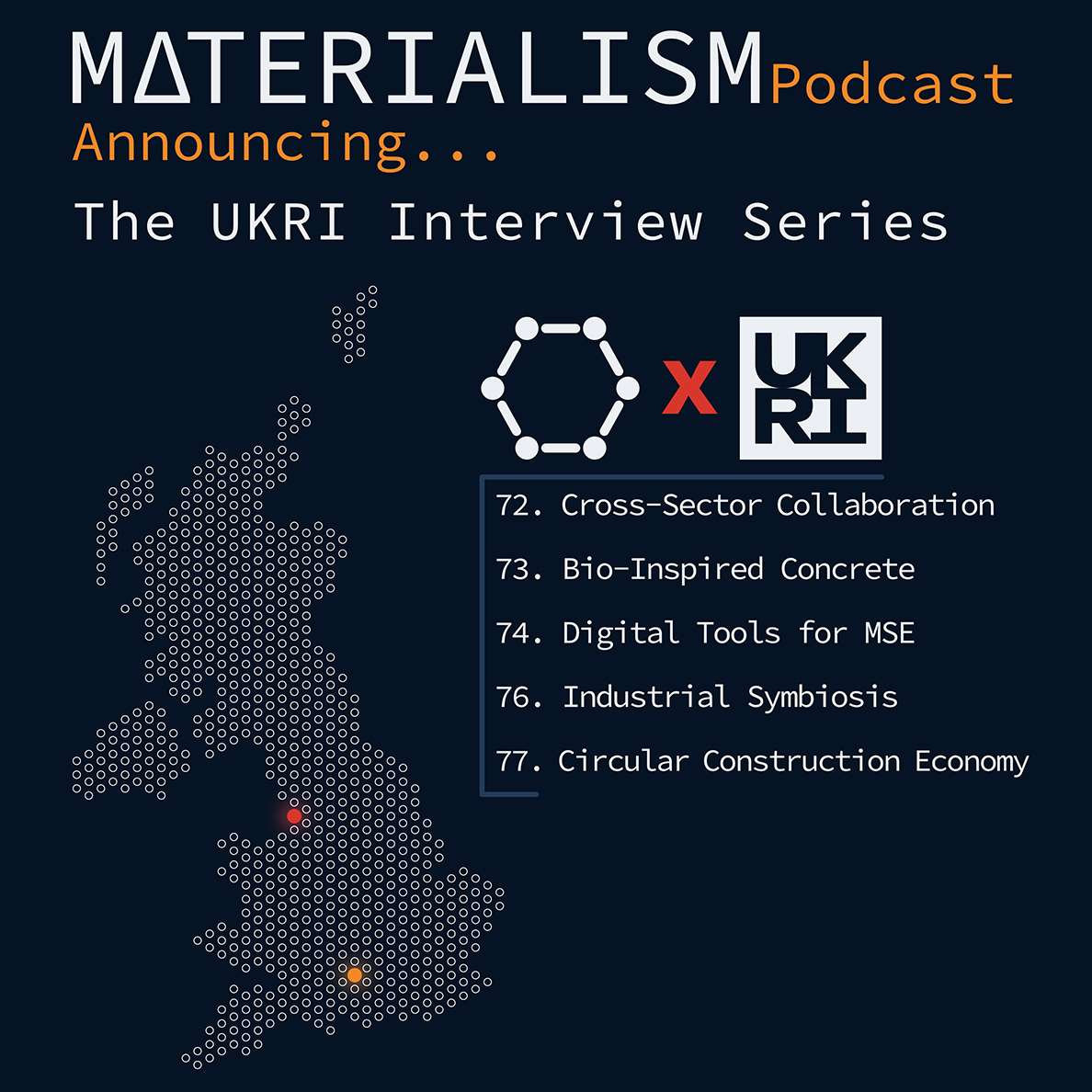
I would like to describe a field in which little has been done, but in which an enormous amount can be done. This field is not quite the same as the others, and that it will tell us little of fundamental physics. But it will tell us much about the strange phenomena that occur just below our perception. In contrast to the natural philosophers of the past, the scientists of this field delve into the recesses of nature and show how she works in her hiding places. Their quest is to understand and create the imperceptible. After all, there is plenty of room at the bottom. Hello and welcome to the materialism podcast, an exploration of the past, present, and future of material science and engineering. I'm your host, Taylor Sparks. I'm an associate professor at the University of Utah on the material science and engineering department. And if you've been listening, then you know that I am also on sabbatical in the United Kingdom. So I'm here for a year based at the University of Liverpool. And while I was coming over here, I knew that one of my goals was to interact with the UK materials community. And I've done that by visiting different schools and giving seminars, attending conferences and meetings. But we're also doing something else where we have a series sponsored by UK Research and Innovation, where it's going to be a series of episodes where we talk about transforming foundational industries. This is part of the Innovate UK Transforming Foundational Industries Challenge. Now UK Research and Innovation, this is a funding agency in the UK, and they cover a lot of things, everything from arts to science, medicine, technology. And it's awesome to see that they are also making these big investments in materials research. So we have a number of episodes that cover a wide variety of topics. And today in this episode in the series, we're talking about digital tools for materials production. And those who have listened to our previous shows know that on this podcast, we talked about things like materials informatics or computational material science quite a bit. But these certainly would be part of those digital tools for materials production. But there's more to it than that. And to get into that, we are joined by two experts. We're joined by Chris Oswins of the Materials Processing Institute and Tom Whitehead of Intelligence. So guys, do you want to go ahead and introduce yourselves? Sure. Thanks, Taylor. That's great to be here. Great to be part of the podcast. So my name is Tom. I'm from Intelligence. My background is in theoretical physics. So I did my PhD at the University of Cambridge, working on condensed matter modeling. And since transitioned over to intelligence, intelligence span out to the University of Cambridge, was spun out by my PhD supervisor, actually span out to take some of the research in materials and chemicals development using machine learning and take that into the industrial context and mean that we can apply it to people's sort of real world problems. Okay. Very interesting. Chris, how about you? Hi. Yeah. Thanks very much for the opportunity. I'm Chris Oswins. I'm currently managed the Digital Technologies Group at the Materials Processing Institute. I'm another physicist by background and I've worked in the steel and the metals industry for 31 years now, originally as a modeler and then that role generally evolved into, from finite model into CFD to other forms of process simulation, including expert systems, neural networks, and then over the years, this has now evolved into looking at all aspects of industrial digital technologies as we like to call them and how they can be applied to the foundation industries. We're not for profit research and technology organisation. So by not profit, we have no shareholders and any profits we do make get invested back into the company. We focus on bridging the gap between the universities who come up with some of the early stage concepts and low TRL level ideas and get them through what Dyson called the value of death where things fall aside that they don't get into production. Okay. Fantastic. Tom, I'm curious if this was a spin out of the company, were you working on the same tech while you were there as a student? Is this just like an extension, but a better paid version of being a grad student then for you? Pretty much. Yeah. So my research focused on a slightly different area, but I was definitely engaged in those conversations on how can we use machine learning in theoretical physics and how can we sort of get some value from that? Okay. And then once it's spanned out, once it's got the real impact for a world impact from it. And what type of materials is intelligence interested in supporting? So we try and work across a whole range of fields. So our approach is generic and so it's applicable to a lot of different problems. So I guess we've worked in a lot of added manufacturing scenarios. So looking at how can we optimise process parameters so that how can we optimise sort of powders? We've worked with NASA on some sort of heat exchanger ideas. We also work in the chemistry chemicals industry. So looking at things like catalysts, small molecule drugs. So we try and apply the same tools to a whole variety of different areas, which means that we can take it out of some one of the things and translate it across to all the others. Cool. And Chris, it sounds like materials processing institute is mostly related to alloys. Am I wrong about that? Our background is definitely in the steel and metals industry. We were for many years the process research centre of steel and British steel before them. So that's our background. But since then we've certainly branched out into other industries and we're working across the foundation industries with cement, with chemicals, glass, ceramics, et cetera. But again, as Tom said, we see the technologies as being sector agrossing, you know, in developing a technology and apply across multiple sectors. And the foundations, industries all have basically the same qualities when you get into it in terms of legacy kits, gathering information, et cetera. Okay. All right. So let's dive into it then. How exactly, you know, what's your opinions on? How is it that digital tools are going to be able to help materials production and development? For maybe it would help start with, how do we, what are digital tools? We've talked about modeling tools, you know, things like DFT, MD, you know, finite element, things like that in the episodes, prior episodes. We've talked about materials and formatics. Are we missing something in that sort of quiver of things that could fall in the category of digital tools? So I guess for me, one part that sits almost ahead of those, and I know Chris can definitely talk about this, is the data collection and the data aggregation part, which is that many of these digital tools are built on solid data that's telling you the right story. And Chris, yeah, probably you can come in on this, the historic data collection has definitely not been there to form the basis of that. In your view, is this a problem that's already solvable? Is this just like community adoption, or are we still needing a technological fix for this? Well, I think it's underway. The advances in computing power, the advances in sensor technology means certainly in some of the harsh environments we face in the foundation industries, it's now possible to measure and collect data that 10 years ago just wasn't possible. Temperature wise can now put smart sensors in places where there's no need for batteries because they can use the waste heat or the vibration that is inherent in the process to power themselves. And therefore, you're moving away from, well, we can only monitor something for a very short time because before batteries are announced. So there's far more that we can measure and therefore, you know, record and one of the old edges is if you can't control what you can't measure. So there's an awful lot of potential in that area. And then to move on, the data collection platforms and the way we can bring data from what were very isolated systems in the past where temperature information was just maybe displayed once on an operator's screen in an isolated pulpit into central databases and data lakes or data warehouses, whatever we like to call them. So that way of bringing far more potential now to aggregate data together and then apply it to that process or feed it upstream and downstream to all the parts of the manufacturing process. So you two are both the companies that are clearly very forward-looking in terms of these digital tools. What's your impression working, because essentially you guys work with other companies, it sounds like you're helping them bring them into the future. Is there reluctance? Is there resistance? Because doing this means retraining staff in a minimum. It means probably making investment into sensors. It means investing into electronic lab notebooks or some sort of data archive. There's a lot of things that have to happen. What's been the feedback from companies that you've been working on? So I guess one of the things we hear from lots of customers is that the people at the management level know that we have to do this. We have to move forward to these digital tools, because otherwise we're going to lose the competitive advantage because someone else will do it. So from the top, there's definitely a really positive push towards the adoption of these tools. I guess what we then see is some of the barriers on the sort of day-to-day level are the people are experts at the jobs that they do today. So if they're working in R&D and in materials, setting their material science expert, they're not necessarily a digital tool expert. They're not, in our case, a machine learning expert, and they don't necessarily want to be. They want to be good at the very area of interest and area of expertise. And so that barrier, I guess, exists there as something that we try and overcome through easy-to-use tools, so things that you can click a button and get an answer that's giving you what you need, rather than some really complicated system that can give you all of the answers, if only you know how to use it, where people, to be honest, don't necessarily want to. So that trade-off of usability versus functionality, that's definitely an interesting barrier. Okay. So clearly, we need data. I think your spot on, that's one of the things in our digital tools that we need to be working on. How do we collect it? How do we access it? How do we train people to interact with it? What else is missing in this sort of portfolio of digital tool? I think one of the things we always miss is data bytes that we can correct as much data as we want, but by itself, it's not useful. Just having a massive data warehouse, it's how we turn that into information that operators will, you know, will use in real time to actually optimize the process or to compare historical data to actually look after the event or what went wrong and examine failures or failure production. So it's really how that data gets back to the operators. So to give you an example, we've been very keen on using smartware, smartwareable tech, such as the little headsets, to actually provide real time data to the operator during the process. So they're not tied to a console, they're not tied to a web screen, and they see in real time, you know, projecting to the line of site because it's augmented reality software warnings or errors on as part of the production. And the next step to that is to really get the models that sit behind this, not just to give them a warning or an error, is to actually say, this is the remedial action. So is that science fiction? You guys are doing that right now because that sounds incredible. I'm fictional like cyberpunk, like it's telling me just what to do in different parts. This is so cool. Is this happening now or is this really at the proof of concept phase? We have our own steel plant on our site and we have all the data collected into an IOT platform. And then from that IOT platform, live real time data is deployed in just apps built in unity that can sit on your Android smartphone, can sit on a tablet, but can they also sit on some of the wearable tech. And we have apps for different parts of the process that show live data and warnings about parameters heading out of the desired range. However, that is really exciting. Do you have an example from industry that you can share where that's actually an application where it's making an impact? Well, like I say, I can share the example is making an impact on our own site. So because we have an AF production site, it's not just for research. We get commercial melts in. These do fail from time to time. We've actually managed to reduce our failure rate on our plant and therefore the need to redo the melts through these of this technology. And that's part of our role to very much to demonstrate these technologies. We bring our customers in. We show them live in real time how it works. And therefore we hope improve the adoption of these technologies in the foundation industries. Okay, very cool. Anything else that's missing in terms of technology, what else falls under this digital tools categorization? I guess one part is the integration between the digital and the physical. So we're in a machine learning company. We like working computers, but then it's what we've seen some of our customers, particularly in the inks industry. We work closely with a company called Domino Inks here in the UK. They're looking at taking the outputs of that machine learning, putting it onto an automated robotic in generation system that can then automatically generate those inks, run experiments on them, feed the data back in at the beginning, and have that sort of almost almost close loop of digital systems interacting with each other. I say almost close loop because having a human in there is pretty key, particularly in the materials industry, whether it's perhaps safety critical, application is going on. You really need a human to have looked at it and checked that nothing's crazy is going to happen from the machine. I would echo that with, you know, we're very keen in still making process to actually engineer out the humans in some cases and have that robotic element. So when we're adding additions to the steel to actually get the right composition, the AI model would then predict the kilograms of magnesium, silicon, et cetera, that need to be added. And then some a robotic system would actually deposit into the system automatically set the next heating process in operation. Do the test again to confirm that we've got now got the right composition of steel. And if not, you know, repeat that process. So we're trying to automate out the human elements in what is a very dangerous industry. Can I ask a controversial question on this? You know, I'm fascinated by this idea of serendipitous sort of materials discovery. And you're probably likely aware that many of the big discoveries in materials have been sort of fortuitous accidents. Do we run the risk of limiting future discoveries if we completely automate things, if we move towards pattern-based models for prediction for generating compounds, suggesting materials? Are we, like, if we take humans out of the loop, do we actually lose something, or are we going to have to be thoughtful about how we programmatically inject, you know, changes, right? New nuances and happy little accidents that can lead to new materials to discover. What are your thoughts on this? So I guess, what example we've got of where this was quite fun and came out with a good result is some of the work we did with NASA on heat exchanges. There, they were asking to optimize this heat exchange of configuration, and the machine learning came up with the idea, why not put a fan in the configuration, in the heat exchanger, it's going to push air through, it's going to make it more efficient. And that's, it's not entirely serendipitous, we did sort of have that option in the system, but it wasn't what the scientists were necessarily expecting to do, and, you know, it was just a new idea that was coming out of the program there. So I think the machine learning and artificial intelligence approaches can do that new idea generation, if we set it up right, exactly as you said, if we set up the system so that it's got this idea of exploration coming up with new ideas beyond just trying to immediately peak find and find the best straight away. Cool. Chris, any thoughts on that? I think it's an area of huge potential, because looking at steel alloy development and trying to predict material properties, then there's a huge potential there to automate that process, which is done very manually at the moment, including very small test cases that we then produce 10 kilograms of material, then test and then scale up and test and scale up and test before we know we've got the right properties on a large scale. And if AI machine learning can really help that to streamline the process and narrow down the range of grades that we make to try and get the right properties. But yes, again, I would defer to Tom in this area, the idea of thinking out of the box of a material that is widely different from your existing ones is something that I think would still be quite some aspect of human intuition to try something different. Okay. All right. So I think we've introduced a few things which I think are actually pretty key. We need this architecture. We need the tools that can work with it. We need a way to query and interact with it. What are the problems with this, right? What are the challenges that you foresee that are preventing us from doing this today? To us, it's the biggest pain point is although people are very keen on the adoption of digital technologies across the board. The foundation industries are very cash constrained at the moment. And there is huge, there were many competitors for the same investment and proving the case for digital technologies is exceptionally hard over other things such as carbon capture and storage and energy reduction. Even though, from my point of view, they're all together. Process optimization, to me, leads to energy savings because you're wasting less material. So you should be optimizing your current process now to make future savings. Quite often, the younger generations of people come into the industry are very old-fade with the digital technologies, but some of the older, more senior people have, shall I put it, a bit more. This is an IT project. We've had many that failed in the past, so we're not going to invest. So de-risking and proving that the use case is something that we try and do or start very small with very easily identifiable business cases and then we try and build it up to larger digital projects. Yeah, that's sort of a challenge, right? You either pick like a really trivial problem and you let the AI sort of help you resolve it and then the end result is like, well, that's not very exciting, right? Or you swing for the fences and you go after something really big and it maybe doesn't work or it takes a long time and then you get a lot of criticism, so we've definitely found it because I work with companies as well doing this and we've kind of tried to negotiate that. You don't want to pick something so trivial that they say, that's not useful, like, okay, big deal. We go up, but you can't like say, in five years maybe we're going to see something amazing because ultimately, it is an investment and so you kind of have to ride that line between the two. Tom, what are your thoughts? What are the pain points that you see when companies try and implement this digital tools technology towards materials production? I think everything that you said from Chris has just mentioned there, we definitely see. I guess the idea of trusting what the digital tool is saying is definitely one aspect. So a lot of tools are kind of back boxes. You don't necessarily see why it's coming up with a proposal. And people don't like that, particularly if you're an expert in the area, you want to understand it and understand why that's been suggested. And I guess there are machine learning approaches, we try and take part of this as well, which is more of a transparent box, sort of gray box, where you can sort of see some of what's going on and still get insights out and still get domain specific insights out. I guess another part, which picks up directly from what Chris is saying, is the idea that it's an investment for today that's only going to show benefits in the distant future in a few years' time, how we can get over that. Some of the customers that we work with identified that what we're doing today is not going to last those five years anyway. In those five years' time, we will be doing something different because what we're doing today is not sustainable. So how do we take that first step? Maybe this step that we're taking, perhaps with intelligence, perhaps this won't be the step. But we've got to try things. We've got to try those options and hopefully some of them will end up being more efficient. OK, what are some of the challenges that you think are facing this in? I think the skills side of the thing is a big challenge and recruiting the right people into manufacturing and the foundation industries because they're not sexy. They're not where people want to be working because the scene is old fashioned, the scene has dirty, etc. There's competing challenges from the gaming industry, from FinTech, where do people want to go who've got the right digital skills to help the adoption of these industries. That's a perception issue in my opinion that steel making, for example, everyone receives as old fashioned dirty, polluting, but the amount of technology that goes in at the moment to produce one ton of steel from the raw materials is tremendous and the amount of automation and the amount of process control and everything that's already been done. People don't appreciate, they just see the smoke out and the dirt and the pollution and the fact that we're pushing for green steel, the fact that we're pushing for hydrogen-reduced ion to actually reduce, remove these old blasphemy, etc. It's a huge potential to green the steel industry, but it's not seen and we just have a bad image sometimes. I mean, that's how we're doing shows like this, right? I've been very passionate about this, trying to help students understand that not only they can work in these really important industries where there are jobs, but they can be good paying jobs. They can be ones where they're actually making a very positive impact on society, where they can be using cutting-edge tools. They can be a machine learning expert and still make steel. I don't think that students knew that that was a possibility. So how about this question, would you rather hire really good material scientists who understand structured property processing really well, but don't have any of the data science tools and you'll teach them or you'll hire just data scientists who work with them on teams. Do you want a hybrid? Do you want them just straight out of materials and you'll teach them the data science tools? What are you looking for when it comes to academic preparation or training for students? So I guess one bit that some of the customers that have engaged with this successfully found is that when they're hiring people from universities, they don't necessarily need to be data science or machine learning experts, but knowing that it's an important concept and knowing that data collection and collecting your data and storing it correctly and being able to handle that, knowing it's an important thing to be focusing on, that really adds the value. So if your material science expert, if someone who knows you're domain, would also understand how to connect them off to the digital side, that's really helping. And I guess we work quite closely with Johnson Matthew, who are a big materials and chemicals company here in the UK, they have got a variety of data scientists experts who they can parachute into technical teams to help support them on that transition and that seems to be working quite well for those guys. So there's this idea that we're going to collect all this information, this data, right? And it's one thing to put it into a database, but that's not the same thing as knowledge, right? Knowledge is sort of the higher level abstractions of this information, which is actionable and useful. How are we going to make sure that we don't lose that as we go about training workforce? There's turnover of people. How do we make sure that knowledge is there that it's retained and that we've built upon it? Yeah, so I think it almost comes right back down to that idea of retaining knowledge and making sure that it's stored in a way that's usable and accessible to people so that when your expert in the field retires in 20 years, their knowledge isn't lost with them. Or even worse, if they go and work for a competitor, their knowledge perhaps doesn't go with them, or doesn't all go with them. It's also retained in the company. And so that's where some of this machine learning and artificial intelligence tools definitely really help because they're collecting, I'm not sure it goes higher than knowledge, but they're collecting that information in an interpretable and useful manner that you can then make decisions based off, which is why we want the knowledge in the first case. So maybe it's not quite knowledge, but it's definitely capturing that, capturing and storing that information. We've always found a good blend of the process experts, the data scientists and the general, you know, is the way to go. Anytime we've attempted modeling or whether it's CFD or FEA in isolation without proper consultation and input from the process experts, we haven't really got anywhere. So it's the blending of the two. It's a good unified team who cover all the areas is the way forward. Okay, then the last question I have for you is, let's imagine in 25 years, I'm about ready to retire. I'm getting my Hawaiian shirt on, I'm ready to bail out of this industry and wish you all the best of luck. How is it going to look differently for the people that are, you know, what would digital tools mean and how will they be in use in 25 years or so? So I suspect in 25 years digital tools will not be perhaps a phrase, it will just be their tools. They're just part of everything. It's like it's not new, it's not novel, it's people expect that when they go to work, they're going to be using tools that are digital tools that are physical and combined in them altogether. And I think it's part of that. It's going to be those integrated workflows that we talked about earlier, go straight from your computer onto the hardware, they can talk to each other, everything interacts and that'll probably to me be the difference in why people work is everything so that we're integrated. Not my streaming anchor. Yeah, I hope you're right. I remember when I first came to Utah and I gave my job talk, so this was what, 10 years ago, and typical academic when you pitch your job, you say, here's the research I'm going to do that's like a safe bet, it's an extension of what I've done before, and you're like your medium risk, medium reward stuff, and then there's your high risk, high reward. And for me, that was materials and formatics. That was developing digital tools for materials, right? And man, the eye rolls I got, like that this isn't even material science, and fast forward, and it's everywhere. It's absolutely prevalent, like we're chatting about it today, we've had GE, we've had big companies all in on this, and I certainly see that trend going forward, that it is just this adoption where it's not surprising at all, it would be surprising not to do it. Chris, what do you think is going to happen, 25 years from now, how will things look different? I think though, different on the production side as we slowly evolve through our traditional factories and manufacturing sites to the concept of a smart factory, which has got the AI data et cetera to ultimately the dark factory where the human control, you know, part of the process control and actually optimising has gone. So it's run by the AI system, the AI system controls the robots that we've mentioned before to actually do as much of the material production itself, and the human aspect of this is oversight and the checking and actually making, you know, developing the robots and the AI capabilities to actually run these factories. So we're taking out, hopefully in my mind, a lot of the unsafe, dangerous jobs that are part of the production and replacing them with higher tech, higher skilled jobs in actually the AI and machine learning development. So is it replacing jobs or just changing jobs then? What's your view on that? People are worried about automated labs, automated fabrication that, you know, what are these engineers or what are these fact technicians going to be doing? Is it a view that we're going to pay people to stay at home because we don't need workers anymore? Or will we still need experts? I think every time there's been an industrial revolution through automation, the forward model team production lines, computers in 70s, there's always been this debate about it will lead to mass unemployment redundancies because everything we've done, but I think the nature of jobs changes. So yes, some of the more traditional jobs will gradually be phased out, but there always seems to be a demand for new jobs. We couldn't have envisaged the amount of people that would develop in apps and everything else 10 years ago before the inventive, you know, smart mobile phones, et cetera. So I just think the nature of work and what people do will change to the better, and it will be better quality jobs, which don't have the danger and the dirty side of some of the two other productions that we have at the moment. Maybe that's a good place to wrap up. Absolutely. We will continue to rely on steel, on concrete, on chemicals, on all these things around us, but we can maybe find much better ways to go about manufacturing them, processing them in ways that don't have the negative impact on the environment, that have better safety, and it's pretty exciting to think of these digital tools that are making that possible. Okay, thank you for listening to this episode of the materialism podcast. We hope you liked it. Obviously, we would love to hear back from you. You can find us at
[email protected]. We're pretty active on Instagram. You can find us at the @materialism.podcast handle. You can find us on Twitter all over the place where easy to get a hold of. UK is the UK's innovation agency. As part of UKRI, they provide over a billion pounds per year government funding for UK organizations to create a better future for inspiring, involving, and investing in businesses developing life-changing innovations. They also support innovative companies to grow through Innovate UK Edge and connect innovators with new partners and funding opportunities through Innovate UK KTN. The Transforming Foundation Industries Challenge is a program funded through Innovate UK. They recognize that decarbonizing the UK's foundation industries is a non-negotiable step in reducing global warming, meaning the UK's net zero targets, and speeding our transition to a low-carbon economy. The Transforming Foundation Industries Challenge is providing funding and support to create a cleaner, more efficient, and more competitive sector that is fit for our future. If you're an Innovative UK-based business or you're looking to innovate in the UK, find out more by searching Transforming Foundation Industries. The Materialism Podcast is also sponsored by Materials Today. You can visit materialstoday.com to stay up to date on the latest happenings in the Material Science field and read some of the fantastic articles that they published. You can also head over to elsevere.com to find out more about their journals, books, conferences, and related programs. We would love it if you would leave us a review, five stars on iTunes, Spotify, Google Play, wherever you're listening to your podcast, that will help other people find the show, and that would be pretty rad we think. Special shout out to the people who make the music for the show, that's Alphabet and Cololite. I know we've said this like 65 times now, but if you haven't checked them out, you should do it. They make cool stuff. We dig it. Anyways, that's it for today. We hope to see you in the next episode. See you everybody. [Music]
 PodcastTranscript AI