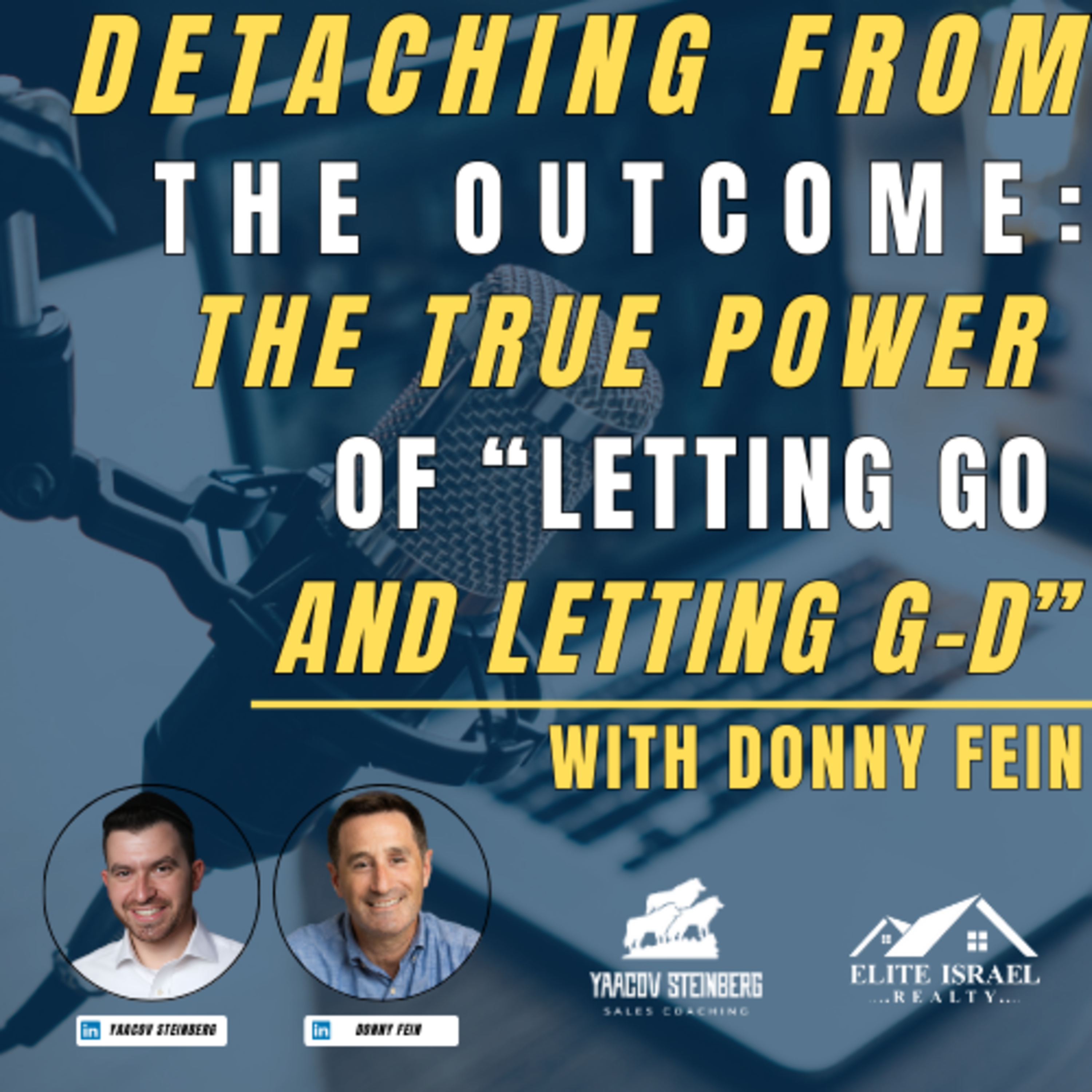
Detaching From The Outcome: The True Power Of “Letting Go And Letting G-D”, With Donny Fein
from Win More, On Purpose
76m 45s
In this podcast episode, host Yakov Steinberg and guest Donnie Fine explore the theme of detaching from outcomes in business and life. Yakov introduces himself as a sales coach who assists professionals in building confidence and clarity in sales, sharing his success stories. Donnie discusses his real estate work in Israel and his charitable efforts, framing detaching as a shift from obsessing over goals to valuing the journey—emphasizing integrity, relationship-building, and personal growth. He explains that this approach makes work more enjoyable and meaningful, reducing the "commission breath" often seen in sales. Both speakers share personal experiences, like Yakov's mishap on LinkedIn and Donnie's business philosophy, to highlight how detaching helps navigate challenges by focusing on effort and learning rather than controlling results. They conclude that this mindset fosters resilience, trust in a higher purpose, and ultimately leads to both professional success and personal satisfaction.
Hello and welcome to the live podcast to win more on purpose. Today we have Donnie fine with us on detaching from the outcome, the true power of letting go and letting God. For those of you that are new here, the agenda is going to be a conversation between myself and Donnie. We're all here learning together. So right down those questions, there will be a Q&A at the end. And there will be a special offer. So stay tuned until the end. As we are alive to start off, people you can put into the chat. What is that you're focusing on in your business and introduce yourself, what you do, where you're coming in from today. And for those of you who don't know me a little bit about myself, my name is Yakov Steinberg. I'm a sales coach. I thank God I've been doing this now for five years full time. And when I first started, I noticed that people were able to build six, seven figure businesses on the road. Good at what they do. They're passionate. Some put along the way they've learned how to speak to people. But they hit this glass ceiling along their journey either because they were making it up as they went along and then only get you so far. Or they didn't want to be the stereotypical used car salesperson, sleazy pushy, getting people to buy things didn't even feel they necessarily needed. And that's where I came into the picture. Mine said, technique skills really helping people to have that confidence and clarity to know who they needed to reach out to, where to find them, what to say to them and how to say it. And thank God I've had the pleasure of working with quite a number of people that are pretty well known on LinkedIn. Be a high-efficient, how do you block? Any green bigger or Ellie Bosch just to name a few. And the people that have worked with me have seen amazing results, whether it be six to seven figure businesses seeing a 50% increase in the first 60 days of working with me, $100,000 companies give or take, have been able to see a 150% increase in the first 60 to 90 days. And so thepreneurs just starting out have been able to see 200, 240% increase in the first 45 days. Donnie, really excited to have you here today. Tell us a bit about yourself and let's get this show on the road. All right, Yacke. Thank you so much for having me and really excited to be here. I've heard some great things about the podcast. You've had some great guests in the past, of course. And I'm really honored to be here living here in Ramapaya, Chammesh. I run a real estate company here in Israel. Excuse me. We basically have one part of the two of us. We've taken on the difficult task of pleasurable and very, very rewarding task of focusing on bringing Oble to Israel. Most of our clients come from Australia. England and the United States. And that's where really where we focus on our goal is to help people from start to finish from when they're thinking about making all the way to renting a home, buying a home, whatever it is, whatever it is they need. We're here for them. In addition to that, I also run a, a stuck up WhatsApp group. I've created something called its opportunity where we raise money for struggling families in Israel, anything from rent, food, that's really what we try to focus on. To wish in medical procedures. And, uh, our show, we've, I have about 1200 people on our groups and think we're, we're making a dent in the, uh, in the world. Absolutely amazing. Yeah, I've definitely had the pleasure of hearing quite a lot about the midst of opportunity group. It's an amazing group helps people in so many different ways. So absolutely kudos on that. And I'm really excited to get into today's topic as well. I mean, the idea of detaching from the outcome, I think is something that so many of us have heard. And yet I feel like there's a gap in what does it actually mean? So I think the first question I would ask on this topic is, how do you define detaching from the outcome? So I kind of live my life like this and it's coming in a, in a weird kind of way where I never really started out this way. You know, I started out when the college became an accountant and it was really about getting the paycheck and, you know, then, then I started getting the bug of doing deals, not necessarily real estate deals, but they got into the insurance world. And you really focused on, on just, you know, hustling to get the deal done. And then I would say, I don't know, really when I started the real, this real estate business about five years ago is when I started on this journey of realizing that, wait a minute, it's, it's not about the outcome. It's about the journey. It's about how are you going to accomplish your goal and in what way are you going to do it? Are you going to do it? Are you going to take shortcuts? Are you going to try to, you know, not be so nice to people as often people are in business? Or are you going to take the high road every single time? Whenever you're faced with, with, with a challenge, I talk about challenges in my business all the time. I'm, you know, the real estate world, it's, it's kind of cut through, especially here in Israel and, you know, you really have to have your eye on the goal, but at the same time on every step of the way. You know, it's, it's, it's, it's something that you, you have to, you have to grow into. You have to focus on, you have to want to do. But yeah, at the end of the day, you really have to realize that when you detach from the outcome, it's, it's, it's almost like a pleasure, more pleasurable experience. Not only for you, but for the whoever you're helping with, whether you're selling candies or selling or selling, you know, car parts, it's, if the process is pleasurable and, and done with integrity for you on, on your part, then the client will, will appreciate that. And then also you realize it's, it's really not, not about that. Whether you made this hell or not, you've made somebody happy. You've, you've now come closer to SM. You've worked on yourself. And that's, in my mind, that's what I called detaching from the outcome. It's not, they said it's, it's not, it's not about the outcome. It's about how you, how you get to your goal and every step of the way. And every deal that you do changes you as well. Wow. Amazing. So in other words, as opposed to so many people who are focused on the goal itself, we're focusing more on how do we get to that goal? Right. It's, it's focusing on the today and being present in the moment as opposed to more a long term. Right. Yeah. So you're definitely, you know, for example, you know, I give a lot of examples of my business because that's, that's, that's what I know. I'm learning along the way every day of the way. Every, every day that I'm working is another, it's another opportunity. Somebody calls me and, and it's like, and when I first started, it was like, all right, this guy, he's got a big budget. He can be stuffing in a buyhouse. Now I'm like, you know what? Now what we do is we take a step back. We talk about the relationship. My biggest problem when I sell a home is how am I going to detach from my client? Now we've been talking for three, four, five, six months, a year, two years. We've been talking to them almost every day on WhatsApp, on email, helping them. Now they go to home. We've accomplished the goal. What do I do? Where, where, where, how do, where does our relationship hold? Oftentimes and my clients will, will tell you that we, we've become close friends. I've become very, very close with my, you know, our families become close. My wife becomes friends with their wife and, you know, we established a relationship. And I think that, that speaks volumes for how we, how we do business. We don't look at people that are calling us as just, you know, numbers. It's, it's, um, we're growing each, each day. And we're trying to get better in terms of establishing relationships. It's really all about relationships. And then in turn, you'll see, you'll see the deals will close. You'll see the, the, the, the brach who will, will come in. Hashem will see what you're doing. And you just, you know, me and my partner, we would say what we, we add to a higher, higher authority. And, um, when I first started in real estate, if you'll stay kind of fell into my lap, I didn't, I didn't plan on, I'm, I'm doing this. Like this, but, but as soon as I did, I said to my wife, but I'm going to do it with honesty, integrity and transparency. So those are the three, three rules of a, I'm always following, um, three philosophies. And I'm always following in order to, uh, in order to get the deal done. Amazing. Why should we detach? It's a great question. That, you know, people do things that people do a lot of things. And they forgot to ask why it's, that's actually a fantastic, fantastic question. I think if I can get a little, you know, deep over here, a, a, a person, why, why are we here? Why, why are we even, why are we, why do Hashem bring us into this world to accomplish a goal? The goal is not to have a massive house, a fancy car. Um, the goal is to, is to become closer to Hashem. So when you, when you detach from the outcome, I believe in some way argue Hashem knows the outcome. You're always everything in your life. You're, you're, you're given to, to pass in, in your life, you could choose one, you could choose the other. One is the, the high road, the, the, the low road, one is the easy road. One is the, the, the, the difficult road. Sometimes the easy road is not the high road. You know, sometimes that's the difficult road. But that's, that's the road that's gonna, that's gonna get you to, to, to where you want to be. Um, but at the end of the day, you're going to be in the same place. Question is, do you want to do it easy or, or difficult? Do you want to do it? And, but sometimes difficult, sometimes the easy way is not, is not the right way. You're going to get to the same, to the same goal. So you got to, you know, if you're not, if you're not focused on, just always finishing and closing that goal and getting ahead of everybody, then you're, you're kind of, you're kind of missing the point. You could really grow as a person. You could really, I, I could tell you from myself, my partner, um, my friends, we, we talked about this all the time. How in business, you could really take lessons and, and become a different person. Once you start detaching from that, that, the, from the, from the close, that, you know, and you focus on what's in between that today and, and the close. Yeah, I would also say, I mean, one of the things that we talk about from a sales perspective is, you know, detach from the outcome. And we see.
speak about that because there's this concept in sales called Commission Breath, right? And effectively, Commission Breath kind of means the idea that your breath smells that you're just trying to get a close. It's about you versus about whatever you're involved in. And a sales perspective, it would be involved in the sale in life or in different things going on as we'll get into the conversation every circumstance can have its own ability to detach from that circumstance. But that being said, I think the idea comes down to the reason to detach is because it allows you to live your life in a way that doesn't require you to be stuck on the outcome. Right? We mentioned a minute ago, like what is detaching on a big part of it is the journey itself. Right? And we hear people talk about this on social media as well. I mean, Gary Vaynerchuk is very well known for speaking about, you know, enjoy the journey, right? Don't get stuck on, you know, your end game, because you're not going to be able to enjoy every day. But essentially, I think it's the same idea, right? When you're involved in a sale, you could be obsessive about the sale and constantly calling and constantly trying to follow up and, you know, oh my gosh, but I could have done this and I should have done that. Or you could take that step back like you said earlier, and put it at arm's length, not from, you know, arms late within the relationship, you can still try to have a great relationship. But in terms of trying to force something to change, because ultimately, you can't choose how anybody's going to act, right? We can only do the effort that we can put in whatever that effort is. And we hope that we're doing the correct efforts more than that. We're just overdoing it, right? We're going to get to that a little bit later. But that's how I would say is, you know, a reason why we should be detaching, because it's not going to help us to do it any other way. No, I just want to add something, you know, Gary, you mentioned Gary Vee. He, he was a big part of me doing kind of like a 360 in my life. I'm sure you've heard it, you know, he has a video, a two minute clip on, on permission. Who's permission? Are you waiting for to do something? Who's permit? You know, that when, when I first started my real estate company, I was like, this is crazy. I'm going to start a real estate company. Israel, I barely even, my Hebrew is not the best. I've never sold anything, you know, and, and, and I heard that video. And, and it was just not who's permission. You, you're waiting for yourself to give you permission, only permission from somebody else, the only person that permission I need from is from, is from Hashem Hashem gives me the green light. That's it. But it's not just, it's not just in the business that you're starting. It's also in how are you going to approach your business? Are you going to approach, you know, some people, my think they need to act a certain way when they go into a meeting, they need to, they need to dress a certain way. When I first started my business, that my real estate business, I, my, my goal was, I'm going to be that real turn. Israel that wears jeans and a t-shirt. I'm not interested in wearing a suit in general. I don't like wearing suits. I don't particularly like wearing buttoned down shirts. I'm going to wear jeans and a V-neck t-shirt. And, you know what? Thank God. I think because of my, my, the personality that I was getting over what you were saying before commission breath. I never had a commission breath since I started. I had that when I was selling insurance years ago. I could tell you that I had it. But also, I was, I was a lot younger and a lot dumber. And I just didn't realize that you really need to, you need, you need, you know, I've one partner, Rob, but I have a third partner, a chef, just like it, you know, when a child is born through this partner's mother, father, and the chef, that's, that's the way it works. If you forget that, you totally missed the point. So, you don't need permission, or you can give yourself permission to be that guy, be that, be that person in business who is just better than everybody else. Yeah, and I would also say, like, you know, even, even delving into that, it's about being a bench, right? And sometimes we mess up, right? I did this just the other day I was having a meeting and I mentioned to my refer earlier that this is going to totally come up in the conversation. I do, I'm a sales coach. So I do a lot of conversations on LinkedIn and I teach people even had to have conversations and social selling and all these things. And I had someone who cold DMed me a year ago. And I decided, you know what, I'm going to message them and see whether this message is actually doing them any good. And if that, I'll give them some free time and maybe it'll lead somewhere. I've done this so many times in the past, I've had people become clients from it. Others, they've just been able to change their lives and be so much better. Great. I messaged him, can I ask you a question? He says, as long as it makes me laugh. So this was my mistake. I tried to do it, he wanted me to do. And he didn't find it funny what I said. Instead he took it the opposite way. He thought that I was taking this message and shoving it in his face. And he's like, that's how I was a year ago. It's so not okay to, you know, make someone feel bad. And, you know, and I was like, I'm so sorry, like I didn't mean anything about it. And like, I went, it went like into this 20 minutes of me just trying to tell him how I was sorry and trying to get him to forgive me. We're at the end, he's like, okay, I forgive you. I see that you really feel bad. And I was like, can I send you a voice note? Because I wanted him to hear it in my voice, like I really did feel bad. And this was my intention. And I, you know, I've seen some of your journey and whatever. And I wrote up this whole message when he said no. And before I knew it, right, as I went to send it, it goes, LinkedIn tells me we can't send your message because you're no longer connected to this person who blocked me on LinkedIn. Oh my god, that's horrible. I was like, oh my gosh. And then I was like, I'm talking to Donnie fine about detaching from the outcome. This is God putting me in a situation where I needed detaching this. Because in the moment, my heart was like broken. I was like, I don't believe it. Like I'm like, I'm like, this guy has such a bad view of Yacht of Steinberg. He thinks I'm such dirt. He's like, I don't give second chances to rude people. I was like, what happened? I was like, you have these soul backwards. I'm so nice. I'm always giving free time. Like, this is so not me. And I was stuck in that in that mode of I need to fix this. But I can't fix this. There's no such thing as I can take care of this thing. Right. The most I can do is try to do the best that I can do in any case scenario. And I reached out to my own coach and I was like, I know this guy was at this event. Should I try to get in touch with people and see someone knows me can speak to him and he's like, look, you could. But is that really what God wants from you right now? Or you can just take a lesson and instead, next time be funny, not try to be funny. And instead, he said, send a message and improve where it says, Hey, I came across this pitch. You sent me a year ago. And I remember it didn't really land with me. What can you tell me if it was effective or have you modified it since I'm always looking to learn to see what's working. What's not right? And I was like, yeah, that's a great idea. I'm going to go with that. And I've been working on it. And it's not so easy to just let go of this like, because I for sure have to just it's five steps, seven steps. And I'll be in front of this guy and someone who knows me will be able to talk to him and say, Hey, you got this all wrong. It was a slip of the keyboard. He made a mistake. Like I'm telling you, you have the wrong view. But that's not that's not detaching from the outcome. Right. This happens for a reason. What that reason is no idea. I think it's bad. Maybe it's really good. Who said it's bad? Right. I was reading. There's a Ruff Miloch Biederman has a sheets that he puts out or this booklet he puts out every single week. And I was just reading from this past, I think it was this past week or maybe even the week before how he told over the story of this wagon driver in the old home, Altaheim, and you know, any time that's something happened, he said, who said it's good? And if something bad, I mean, he said, who said it's bad? Right. His, you know, he is horse ran away. And everyone's like, Oh, it's so terrible. And he goes, who said it's bad? Next day, the horse, you know, later on that day, the horse comes back and brings four horses that it found with them because he was hungry. He told them a great food. He gets at home. So all of a sudden, he's got five horses instead of one. Not bad. And they're like, Oh, so exciting. He goes to said, it's good. Next day, his son takes one of the newer horses. And he says, you know, every day, I'm going to take a different horse. All of us in a week later, one of the horses, the newer horses he took out, you know, bucked him off the back and he broke his legs. Everyone's like, Oh, he's so terrible. He said, who said it's bad? Right. And it just kept going where the army came and they couldn't take his son because his legs had been broken. And it was like one thing after the next. And every single time he said, who said it's bad? Who said it's good? Right. It looked good. He said who said it's good. It looked bad. Who said it's bad? And I think it's the ultimate detaching from the outcome. Because when we don't tie a significance, the things that happen, a significance to a reaction that we got, a significance to something that happened to us, we can just be present in that moment. And we're not focused on, is this bad? What does that mean is this bad? That means that right now it looks bad, or does that mean in the future, it's going to be bad or both. Most of the time, it has more to do with the future than it does with the right now. Because I think that's something bad is going to happen because X, Y, Z happened. But in reality, how do you know that it's good? How do you know that it's bad? The only the future will tell you. So when you detach from that future outcome, I think that that is like the biggest detaching possible. So I think it's macro versus micro when you're looking at things from a micro level, which is what we generally see things, then you're like, oh my gosh, you know, it's, oh my gosh, I got to fix this. But if you look at it from a macro, I think Gary Vee talks about this a lot.
Also, this is you know, you look at it in the big picture. The story is not over. It's almost never over. You know, and it can continue and you don't know what's going to happen in the future. So you just be like you said be present in now. How are you going to the only thing we can we can control in this world the only thing is how you react your reaction your your your emotion a little bit. You know, but I really think I really believe that if that's the only thing that you can control is your reaction. And if you react in a negative way, you you put out some sort of negative energy and it's just you're not you're not going to you're definitely not going to get the outcome that you want. But if you're if you're in the moment and you're not thinking about what you're detaching from from the outcome. You're just this is now this is what I have now this will have to work with right at this moment. And you and you do you say the right thing you do the right thing make the right move. Then you'll have you'll see success. Yeah, it's I always say and I've been saying this for years it's we can't change the cards were dealt only how we play the hand. Yeah, right. That's that idea. I think the next place that I would want to delve into a little bit is what are the benefits of detaching right we spoken a lot about what is detaching we've been brought different stories and stuff that kind of brought it out. It's microverse macro, but what are the benefits of doing this process. So I could tell you first hand that's that's that's you know, mental health. A person that is going through this process detaching from the outcome, living in in the moment, trying to do the right thing always trying to be better. When I say be better, I don't mean to be the most competitive. I mean to be the best person that that you can be. You have this this I don't have to say in English, you know, you're this calmness to you. That it's like it's almost like nothing nothing can can bother you. Nothing can go wrong. You really you're in a mentally healthy state and you're it's and it's it's almost like you're you're in a happy state is really very little you're letting everything roll off your shoulders is very little that can that can bother you once you realize that you have no control over anything. Then this you know what I can tell you as a parent I four boys I love my kids, but they know I had to push my buttons you know my oldest is going to be 25 in June my my second turn 23 today. My third just turned 20 and then I have a 15 year old was going to be 16 soon and since the little they know how to push my buttons. If I knew then what I know now then I would probably have been a different father do I ever regrets know but because there's one of this that's what I did. But and it is something I you know I almost wish that I could talk to myself as it as a 24 year old and say to yourself down you you don't have control this kid he's going to go to sleep. You know you're in the yelling it's not going to help it's not going to make him go to sleep you have no control just love be gentle kind the same way you wouldn't you want to be in business they want people to treat you. You know if you're if you're in a business deal and you're in a meeting I've seen I've been in in closings here and one lawyer they get they get angry at the other lawyer. The you know the second that lawyer gets angry with you other lawyer he's he's got the fist up he's he's he's he's becoming a punching doesn't it doesn't help doesn't help if both lawyers I did we just have a signing this this past week. Thank God sold a nice apartment and both lawyers were doing a good good job but one of the lawyers was having an issue between him and his client. The other lawyer who he didn't have an issue and he could have just sat there and did nothing said nothing he would have been perfectly fine. He went above and beyond and helped the other side to figure out their their issue of course it's good for it's for the greater good of both sides but this lawyer did something what I thought was spectacular and he didn't have to do enough to do that. He got up and made a few phone calls really trying to figure out what the issue was and and they ended up you know closed. It got a little tricky there but it wasn't for this particular lawyer. You know maybe what it flows anyway but it would have taken a lot longer been a little bit more stressful and he really like he kept he kept the tone very low in the room that day. That's amazing I think also there's a stress factor that comes in right because when we attach ourselves to an outcome we get very stressed about it right I was speaking to someone today and I was saying you know he was talking about a specific deal that we were he was he's been working on. And I said to him look you could be obsessive about it they call that being a stalker. You're constantly calling in every five minutes and every this and every that it's uncomfortable or you could take a step back and I said this happened to me just the other day I had someone who I've been going back and forth with he didn't see the value necessarily what it is that I was you know offering to him and went back and forth. And I offered him a phone call and he said you know what let's do that and I kept taking a step back and every time I took a step back he leaned in and he said oh wow you're good. And then I said okay thanks I'm like do you want to and all of a sudden we'd have this conversation again and then we were supposed to have a phone call this past week and he just no showed on the call nothing I sent him an invite he just he didn't show up and I messaged him and I called him. When I was supposed to a couple of hours later I sent him a Jeff like dude are you okay. Nothing nothing and I reached out to my own coach and I was like. Should I just leave this alone. Or should I like be on top of it a little bit he's like you probably don't even want to work with a client that's like this right is this the type of client you want to work with and we we dove into that a little bit and I was like no I don't want to be working with people. I'm going to be working with people that make me have to work so hard right sales there's follow up in sales we both know that and we need to do our due diligence we need to do what we would call the correct effort the correct to stop us right from a Jewish perspective and that's 100% But there comes a point in time where it's not correct anymore and then we need to check ourselves at the door and go is this still the right thing and I just backed off entirely I wrote it on my you know I have a close ratio sheet I keep track of what I'm in the middle of and we know what's going on I marked it as a dead deal. He messaged me today. Hey sorry I never I never responded to you I was like hey no worries I'm like I'm still as far as I'm concerned it's it's a dead deal right I'm like no worries. I'm not saying you want to talk now like is that why you're reaching out he goes no I'll get back to and I'm ready I said okay no problem I'm waiting for you right he goes yes it's great right I'm not changing anything but I'm so chill about it because I've marked it as nothing happening anyways. I have no pressure to move anything forward but the best version of being able to be in sales would be never feeling that pressure right because you give that over to other people right and in general you want to always be acting for yourself that you don't need anything. You have everything you need you have all the money in the bank that you could possibly want do you still want this client you want it done in this way is this the way that you would act if you didn't have any pressures in your life right it's always checking yourself and seeing is this really the best version of me is this the best way that I can go about it and is worrying about it even going to get me anywhere. Right like we were discussing when we were talking about the podcast we're like there's that famous you know I think it's a meme where it's like are you worried yes there's nothing you can do about it no so why worry right are you worried about it no right it all goes to the same place at the end of the day right I think that's one of the biggest benefits within this process of detaching is all that stress and anxiety and worry and nervousness that comes along with being attached to whatever it is. Those away when you are allowed. God to step into the picture and you let go and let go. Exactly my wife's grandfather used to love going to movies the past a way a few years ago and used to say if you're going to a movie with high expectations it's always going to stink if you're going to a movie saying no expectations you know it's always going to be at worst a mediocre movie. It could be a great movie what if you go and thinking that it's going to be a great movie it's almost always going to stink so it's a lot about expectations so you're thinking you're going into into a sales into a sales deal and it's going to be awesome and then all of a sudden you realize the clients not interested. You're like you're you're you're you're you're you're you're pushing it you're pushing it you call the guy you message him and he's just not interested he's on he's gone he's already got to the next deal but so now now what are you going to do you're going to keep on pushing it you can also move on to the next deal move on just move on. And mentally it's I think it's it's so healthy once you realize that there's lots of there's lots of buyers lots of clients out there some.
They're just not ready to make the move, but if you are, if you like, just to go back to the beginning, if you think about the process, you, you take the high road, you beat that person, that sales person who is just honesty, integrity and transparency, that person, when they're ready to, to, to buy something, they're going to call you because that's what people appreciate. Absolutely. I am curious. I know this is something we talked a little bit about when we were talking about the podcast, but why detaching? How or why did this become a thing for you, getting a little bit personal over here? So it's been a while, isn't it? Okay, you're in it. That's also a very good question. You ask good questions. So, so again, why detached is for me personally in my life, I, I, I want to be happy. I want to, I want to be, I want to feel whole. I want to be connected. I want to be connected to my computer, my phone. Yeah. Okay. So I'm addicted to my phone practically. I'm on mine at all the time, but I wouldn't be able to accomplish a lot of things that I accomplished without my phone. It's my mobile office, but I want to, I want to be a better person. I want to, I want to be, I heard, I'm very bad with timing. So it's, let's say it was five years ago, friend of mine passed away and his wife spoke at the La Vaya and it was just, it blew me away. And I went home to my wife and I said, she, my wife didn't come to the wife. I go, and I go, you need to listen to, to what the wife said. She goes, and it's a little bit depressing. I said, but I want to live my life. So that God forbid one day after 120, when I passed away, my wife or wherever it is, we'll say the same speech about me. He died young and you want to, you, you want to, you, you want to be that, that person who is just different, better, you want it. Like you said, you want to be a man. You want to be a good human being. Do you want to be known as somebody who's helpful? Do you want to be known as somebody that's grateful for all the blessings that God has given you? And when I say known as, I don't mean to do it so that people, that's how people think of you. You feel good about yourself when, when, when you're doing it. And that makes you want to do it more. So it's not only about the money. It's not okay. And I really believe that if, if you live your life that way and you treat your business that way, the money will come. You'll be successful. Are there successful people who are the biggest jerks in the world? No doubt. I don't care about them. I really don't care about them. Stay away from them. I tell, I talk to my, my, my partners and my, my family about this a lot. I don't want negativity in my life. If that's the type of person you're going to be, I'm not doing business with you. And if we do, it's on my terms. The nice way. So why, why is, because that's how, that's how a person should, should live, should live their life, to be, to be connected. You don't want to, you don't want to be controlled by, by your, by your business. That's, that's not, that's, that's a part, that's a part of your life. It's a, it's a part, it's a very tiny slice of your life. When are you going to retire and that's not going to be part of your life anymore? So how are you going to continue? Are you going to continue after what are you going to do? What are you going to do after your retire? You can continue being that jerk. No, you've, you've now spent the last 40, 50, whatever it is, years of your life, working on yourself. Now you can go into your old age knowing that you've, you've lived a fulfilling life. Well, it's very deep and beautiful. How have you seen it? The shift since you've, you know, started really detaching from the out. And how is that affected your business and its growth? So I'm going to get personal here. A bunch of years ago, I had my own personal struggles with, with my financial problems. And at one time, you know, I just, it was about mindset. And it happened. I know some people struggle with it. I actually spoke to somebody the other day. And he was telling me that he's also, he says, he has financial issues. And I was like, maybe take a different approach to your business. It's so hard. I'm like, it's literally waking up in the morning and deciding to live a different life. It's deciding to, so it's affected my life where I've seen blessings from it. Blessings in every aspect of my life. Blessings in my business. So financially, blessings in my family. It's, it's really, I, like I said before, I wish somebody would have told me about this 25 years ago. Maybe they were telling me maybe I wasn't seeing the signs. I saw the signs and it's just, it's been a different life since then. Well, absolutely amazing. And I could say also from my own experience, I mean, I've definitely had, you know, financial situations, I think we'll call it over the years. And I'm sorry to cut you up because I really want people to know more people than you think have financial situations. Then everybody goes through it at some point or another. Right. The question is what, what they call it. But yeah, I think, you know, I, I remember when, when I've had, you know, my own financial struggles or even on a general basis, like people can owe you money. You can owe other people money. There's only so much you can do to actually take care of that. If you don't have money coming in, right, they call it, you have a money problem, right? It's not, sometimes it's because you're not budgeting properly and all of a sudden you fall into a hole and you don't realize what you're really doing. And it's knife that, you know, when I was much younger, that was where my mistakes came in and I was young and dumb, like you said earlier. And I dug myself a hole and it got worse from there because it's snowballs. But a lot of times it's because you don't have enough money coming in. And therefore you're not able to get through the regular expenses. But either way, whichever of those things it's, wherever it's coming from, it's not ultimately in your control. How you're going to be able to deal with it. It's these are the hands that your dealt. This is the hand that your dealt. How are you going to play the hand? Right. Right. And we're going to talk a little bit, you know, more about this, you know, and I have another question that'll come in a little bit that delves a little bit deeper into this specific type of situation. But it's the same idea when I, when I just focus on what I can do, right? Like in sales, I always tell, you know, the people that I'm working with, you can't, you can have a target, right? That target could be a financial target. It could be a certain amount of meetings that you want to have. That target is always a moving target. But we use that to reverse engineer what are our goals for it. And that tells you what you're supposed to do every single day. I can control how many times I pick up the phone to call people. I can control how many messages I send out. I can control how many action steps that I do. I can't control how many actual conversations I have, how many actual discovery calls I have in a day, or anything else for that matter. Because that's me trying to pay attention to what everyone else is going to do about the actions that I'm taking, which is impossible. Right. Right. So ultimately it's only what are the actions that I can do right now that can help it and move forward. And I found like, you know, it comes down to a couple things when we talk about faith, right? There's a moonau, which is faith in general and be talking as the actual practical putting it into real life, right? And, you know, it comes down, I think, to gratitude. Right. When we realize how much really comes from God and, you know, my love spoke about this and show the other day. And he said it comes down to gratitude, right? We don't talk necessarily enough about the power of gratitude and how we, when we realize how much is actually being done by God, by that higher power that we believe in, do we then realize that everything's in control? Right. It's not what I, what I want or what I think I need. It's what actually needs to come in my direction. And that has nothing to do with me. Right. So focusing on it and worrying about it isn't going to get me anywhere. And it's those expectations that we set up for ourselves of, I need to make this a man of money or I need to buy this thing or I need to do this, you know, and I need to be able to have the money to take it. Well, that is what sets us up. Like you said earlier, when we get rid of those expectations and we just try to do the right things, so we try to take the right actions, we see blessings. Right. And they just show up all the time. And when I've had hard times, I found that one of the simplest things we can do and this also comes from my left, it's just scream out to God. Hey, it could be something as simple as father, dad, whatever it is, you're going to call on God. I'm stuck right now. There's nothing I could do about the situation. I'm doing my absolute best. This is on you. There's nothing I could do about this. Please help me with this. That's it. There's nothing else that I can actually do anyways. Right. So ultimately trying to do more than that is just going to be a frustrating, complicated situation that I'm going to be creating myself. It isn't going to do anything for myself and my peace of mind. Right. Right. So the one to quote Michael Safty and he, he nails the definition of the word be tuch on as reliance. When you rely on your on Hashem, on your father and heaven and God, when you rely, it's like it's like a baby who relies on their mother for milk. That she's the only.
Only one that can give it to him. And she will give it to him, 100%. When you need something, you have to ask for it. You have to be very specific when you're talking to us, Chef. It's a whole other podcast on talking to us, Chef. But it's all part of the same thing is, how are you talking to us, Chef? How much are you talking to him or are you doing? You could do all day and not talk to us, Chef. To talk to God. You could make all the phone calls you want. But if you're not saying to God, before I came on this podcast, I dove in Marv. And I said, Hashem, please put the right words into my mouth that I will say on this podcast. That's relying on Hashem realizing that Hashem is the one-- God is the one that's making all these things happen. And if you're not relying on him, he's not going to give it to you. He's going to give it to you in a different, more difficult way. Or once you re-lut and then you spoke about gratitude, gratitude. Forget about it. That was a word I literally as a kid never even thought about. The more gratitude you have towards God, it's like when you're a children, when you give your child a gift, whether it be a conical, whatever it is. And you give them a toy water gun, just thinking of-- when you can give your kid these days-- because only a kid's ever wanted his phone. So it's a toy water gun. It's just a water gun, dad. I'm going to care for this. All right, well, I'm not getting anything else. That's it. I'm done with you. But oh my gosh, thank you so much for this water gun. It's amazing. I love this water gun. You're going to get more water guns. You're going to get the water to shoot in the guns. You're going to get more gifts, because that's what even-- conversely, well, we need to rely on God for everything. He wants us to be grateful to him. And when we are grateful to him, it's a secret. You're turning yourself into a vessel for blessings. Yeah, it's funny, because when you said that, it reminded me there was a plan in time where there was a thing going around where parents would give their kids a banana as their gift for a holiday, whatever it was, to see what the reaction of the child would be. Because this tells you a lot about your child's character. And I remember, I'll never forget, there was this clip on this kid must have been 3 or 4. And she was like, you got me up in the banana. Take you. I love bananas. And she went on and on. And it was just mind-boggling how this kid was just overjoyed about getting a banana as-- it must have been like her Christmas present or something. It was mind-boggling. Was that-- It's been something like awesome. Well, that's what all of us should be. Like, you got me a banana. Like, I got-- you're being successful in some witch-way shape performing your life. Are we recognizing that? Or are we looking at it as a banana that should have been a $5,000 gold watch? Like, what is he we looking at it as? So I think that's very, very powerful. I want to get a little technical. I'm going to take a twist for a minute. And I want to get a little technical with detaching from the outcome. So when someone has competition, isn't that a stress within their business? So if you really believe-- and it's funny that you're asking that because I-- I have a good trick question. I put a lot of thought about that. I'm going to tell you a story what happened to me literally yesterday. So I don't believe this-- for me, personally, in my business, in the Israel real estate world, I don't believe I have competition. Not because I'm the best realtor, just because I will look at other realtor as my competition. They're going to close their deals. And I'm going to close my deals. And one thing is nothing to do with the-- as a matter of fact, I strangely and very happy when other realtor's closed deals. Number one, I'm happy for the realtor. Number two, now they've sold a property. That property's not off the market. That makes my life a little bit easier. It's less properties. So but the real estate market in Israel is very tight. So now they've taken a good property off the market good. That means another Jew is coming to Israel. I'm so happy for them. But if you really believe that God, that Hashem, provides you with everything that you need, and he decides at the beginning of the year what you're supposed to get, there's no such thing as competition. This past job is-- I was reading a book, my partner gave me a book, "Parnasa" in-- sorry-- "Muna" in business. "Muna" in Parnasa. I think it's written by David Sutton. Anyway, so I told a story about a candy shop owner, that two candy shop owners cross-street from each other. One candy shop owner always had a full store, the other one-- not so much. The one on the wrong side of the street went over to the other store. And said he goes, I'm going to go there and check out why is he so successful? What am I doing wrong? Maybe I can get some pointers. Guys walk around the store, and I guess the other store owner picked up like, hey, this is the guy from across the street who goes, oh, what are you doing here? Can I help you? What's going on? Do you need to buy candy? The guy's like, well, I own the store across the street, and I have no business. I see you're always full. What's your secret? And so you would think, what would you think the answer would be? I'm not telling you my secret. Get out of here. But if you rely on God, the God Hashem, realize that this is not your competition. This is just another guy that he himself wants to make a living. The guy said, well, I'll tell you my secret. Whenever somebody comes to my counter and takes a candy, bag of candy, I weigh it. And I give a little more. I said, you know, whatever it is, a couple of candies more, and the customer says to me, this is overweight. What's going on? Giving it to you, out of the goodness of my heart, I want you to be happy. So that's, you know, now the customer walks away with good feeling. Of course, the next time they want candy, they're going to come back and they're going to tell all their friends. This guy, he's amazing, you know? So the other-- so the guy-- thank you. He goes back to his store and starts doing the same thing. The next week, the store is full also. But he's like, wait a minute. If my store is full, maybe the guy across the street from me, maybe he's losing business. He looks over the counter, looks over the crowd. He sees the store across the street. And he sees the store as full his store is. The other store is even more full. Now they're both winning. It's amazing. That was-- I read that book on Shabbat. Sunday, I get a monophone call with another realtor in the neighborhood. You know, I do-- I'd like to do-- it's also very important for me to have a good rapport with other realtor in the neighborhood. I like to do business with them. Some of them are amazing. It's one guy, he says, you know, down to you have an incredible reputation. What's your secret? I go, Mr. Realtor, it's so funny that you asked me that. Because I literally just read this story yesterday about the candy shops. And now I'm going to tell you my secret. And I went on to tell them about honesty, transparency, integrity, being better. Those are our goals-- our goals are not to sell a million houses this week, this year. Our goals are to be known as just good people that are helping people by homes in Israel. And he was very-- and he was very thankful. And by the way, I said to him, I said, by the way, you already do these things. You just don't realize it. But now when you're in the future, when you're working, think about be aware of these things that you're doing, the good things that you're doing. Because he also has a great name. And I bet that he's already doing everything that I told him to do. He just didn't realize it. So when you do things and you're aware and you're present and it's purposeful, then you see the blessing from it. If you're just doing it, OK, you may see blessing, but you won't really see the blessing. I love that purposeful plus present. Yeah, for sure. I love that. I think another question that-- and I mentioned earlier, we're going to get into this a little bit. And this is, I think, a bit of a touchy question. But I think if I was going to ask this to anybody, it would be two. We mentioned earlier, both of us have been through financial struggles. What do we say to someone when we're trying to tell them, look, you got to detach from the outcome and let go and let go? What do we say to someone who needs to pay their rent or buy food and doesn't have? It's challenging. It's like, it literally breaks my heart. You just-- there's no other answer other than be grateful. Count your blessings. More often than not, this person has a beautiful wife, has a beautiful children, has a roof over their head. There's still so much to be thankful for. The electricity is still on. You-- we just paid-- for the next opportunity group-- an electric bill-- no, sorry, a water bill. So this guy hasn't paid his water.
built in three years. And the water company did not shot his water. Apparently, there's like a rule in Israel where they'll never shut your water. Okay? May be super, super grateful. Be, jump for joy that you still have water in your house. They haven't shut that off. Be grateful for the things that you have. And, and, and, the Simhah, if you were such a Simhah, you know, worship Hashem, God with, with, with happiness, be happy about these things that you have, it's, it's the only thing that a person can do. I could tell you, I'm kind of shifting focuses here, but I spend a lot of time with helping families. And I think a lot in my mind about what's the common denominator between these families who, by the time somebody comes to me, they're a rock bottom. They have nobody to help them. No, I'm, I'm the last resort. You know, there are organizations that can help families. They've already been there. They're a rock bottom. And, um, I, by the time they come to me, they've, they've given up. So now I, not me, the group, we come and we, we kind of like swoop in. Okay, we're going to take care of your, we took, we paid his water bill. Guys made a water bill in two years. We paid his water bill. You know, now the guy's going to go, the water bill is paid. I can go back out into the world. But I always said, don't, don't wait till that moment. Your water's still on. Okay, so the bill hasn't been paid. And it might be hard to fall asleep because you worried about, you worried about that tomorrow they're going to turn off your water and you have little kids that need to, they need to drink and take shops. Okay. But it's still on. Be thankful. Don't give up. And, and I think through that attitude, a person can slowly claw their way out of their, out of their, their pit. Just today, there's a woman who I know who, she wrote a lot of money. And we helped her. And she, I'm telling you, she never gave up. She, she did, she did jobs that most people wouldn't want to do. She really got into it and, and she, she's like, I'm going to get out of this. We helped her in numerous ways. Today, she left a message. I am debt-free. I have, I have chills just saying it. But this woman never gave up. She's been through health for the last 10 years. Divorce, difficult children. You know, but she always with a smile. Okay, it was a difficult, yeah. Always with a smile. I'm telling you the reason why she's debt-free today. And she, now that she can really take the next step to making her life even better, all about attitude. She really never gave up. Really inspiring. Beautiful. Beautiful. And I would say, yeah, I mean, it's, it's about, it's about mindset. It really, really is because like we said earlier, there's nothing else that we can do except our reaction. And like the Reba says, you know, he, he, the khabad Reba used to say all the time, "Tracht, good, vets, that good." When you think of it, it'll be good. Yeah. When you are in that grateful mode, when you're being thankful, this woman said that all the time. The one who just got out of that, she says all the time. Yeah, because when you're in that mode of counting your blessings, you're being thankful. You're just trying to be happy with what you have. You're attracting good, because you're, you're, that's the, the frequency that you're at will call it. Right? And that allows more blessings to come into your life. Right. So I think that's a very, very powerful message. And please, God, a lot of people will be able to claw their, their own way out of whatever it is that they're going through with that. I hope so, because there's a way, there's a way. Definitely. Another question I think that I want to delve into, we touched a little bit on effort earlier. Hishtadlas, as it were. I had hishtadlas play a role on all of this. And how about the idea, maybe I'm doing too much ishtadlas. Okay, so I, I thought about this a lot also. And, you know, I run my Midspr opportunity group and I have my real estate company. People always say to me, what do you, how much time do you spend on each? And I'm like, I don't really know. I think I spend six hours a day on the Midspr opportunity. And then two hours a day on, on, on the real estate company, you know, obviously, I mean, you know, sometimes it's, that's not every day, but there are days like that. And because I could sit here all day, I have three screens in front of my debts get all the time. So one has WhatsApp, one has my real estate stuff and one has my Midspr opportunity stuff. And it's really just one big mishmash of things. But, you know, you have to, you definitely have to have hishtadlas. You have to, you have to do work. You have to work. If you're, if you're, if you're, if you're working eight hours a day, do you have to work 16 hours a day? I don't know. I don't think so. There's so many other things that a person could work on. Meditation, connecting, disconnecting from whatever, from whatever negativity is in their lives. Before you start going from working eight hours a day to working 16 hours a day, kind of, you know, think about what, because when you have the right mindset, the positive mindset, the relying on God, the gratefulness, the time that you spend working, you'll be so much more productive. If you're thinking, oh man, I got to all the time, I got to pay this bill, I got to do that. I got to, I got to close deal. You're not going to be productive in the time that you're, that you're working. Everybody, also everybody needs a break. You need a break. You need outlets. I'm a big believer in outlets. I personally, I'm mountain bike and I run. Those are those are my outlets. You know, whatever I do with my family, also, like, yeah, you really have to feel you can't sit at your desk 20 hours a day and then sleep four hours a night. That's not healthy. So there is a happy medium. I do believe that for everybody, it's different. But you have to do a B testing on your status. What works? How many hours? If I'm working eight hours a day and I'm making this, if I work 12 hours a day, will I make X plus Y? But I'm not going to, how long does it take to prove it? Give it a couple weeks, give it a month. If it's not working, it's not working. And it doesn't mean that it needs to do 14 hours. No, eight hours you're making X, 10 hours, 12, 14. Like at some point, it has to end. You have to have the quality of life as well. So, as a stylist is really, I think, very personal. And you know, you really have to, there are certain things that a person has to accomplish during the day. I know, you know, for me, it's, I have to do my Daffy Omi and my Schneimekra every day. I have to take care of my physical, well-being and my mental well-being every day. Those things take time. You have to take the time to do them. And that's part of the journey goes back to the beginning. It's all part of the journey and the mindset and and and and and and detaching from the outcome. Because if you're totally married to the outcome, you're not going to take the time to do these things. And you're going to put in more stylist and more stylist. And it's not going to help. It's not going to help. Yeah. And it's interesting because I've also done a lot of thinking when it comes to, you know, to this conversation. And I think that one of the things that I came out with was a lot of times, it's what's normal? What's a normal amount of time to work? Right? Most people will say it's seven, eight hours. Let's say people who are just starting a business, maybe to be a little different, they can put in 10, 12 hours if they're just, you know, in startup mode and a proper startup. Okay. I think we need to take a look and see what is, quote unquote, normal within the situation of what it is that I'm doing and then see, okay, this is what should be. Now, what is it that I'm capable of doing within that time with all the things that I need to do in my life in order to be happy? Right. In order to make sure that I'm taking care of my family, my wife, myself, my, you know, whatever it is, whatever the different lists that you have that you need to be taking care of. That all needs to fit in. That's what God wants from us in my opinion, right? He wants us to be this whole picture of that journey of being happy. He's not looking for someone to, you know, grind at that stone and be there 12 hours a day and making themselves nuts and never ever having a chance to take off and giving themselves a break. That's not going to make people happy. It's not, I don't think what he's looking for in us at all, right? He wants us to have an enjoyable existence. That's why we're here. We're here to get closer to God and to do that through enjoying the journey and being grateful, we can't possibly be in that positive frame of mind of being grateful and happy if we're constantly bogged down by the responsibilities we have and we're never, ever giving ourselves a chance to breathe. That's not going to lead to happy outcomes. There are two things that you just said, happy and then perfect. People confuse being happy with being perfect. Hashem expects, we expect ourselves to be perfect and we want to be happy, but being happy does not mean being perfect. We could strive to be perfect. Again, it's really what I really want to drive home here is that it's it's not about the outcome, it's about the journey and you could strive to be perfect.
No one will ever be perfect, but if it's only striving for that goal in a positive way with the proper mindset, you'll be happy. You'll be on your way to perfection. And that's where we want to be. 100% 100% I would say we're going to go a little bit over time because I just there's a couple of other questions I want to hit. You mentioned mental and physical health, right? So where does that come into play in this whole entire process? It's almost everything. It's, you know, you really need to be successful. You need to be mentally healthy. If a person's not mentally healthy, okay, I'm not talking about people that have major chemical inventors. I'm talking about, you know, the average human being, you have to be mentally healthy. You have to be able to be present. You have to be able to handle certain situations. Life is throwing, you know, what I'm not making and I'm passing by trees. It's almost like like Star Wars. The stars are coming out. The trees are coming out. You're going, you're flying down a mountain and it's super fast. You got to be ready for that. You have to be ready to pivot at any moment. You have to be ready to change at any moment to just just be. Go with the flow. So that's if we're if you're not mentally healthy, you're not going to be able to do that. I was riding my bike today. We were going, we did, we today we climbed a lot with the bikes. And there was group of five of us. One guy I hung back with him and we were talking and he's like, he's like, man, I wasn't I didn't expect this, this, this amount of climbing today. It wasn't ready for it. And I wanted so badly to say to him and if he's watching this podcast. I want to say like when you get on your bike, you got to be ready for anything because most of the time we got on bikes, we don't really know where we're going to think of we live in Beach. I'm just five minutes out of our house, all the mountains. I don't need to I don't need to drive an hour. I'm I'm mountain bike at least twice a week sometimes more. But we get on the bike. We don't know where we're going. We go with the trail with the trail takes us. It could be up. It could be down. It could be rocky. It could be steep. You know, so you have to be ready for you have to be ready for everything. The other question he said that was mentally, oh, physically, physically also same thing. Same thing. I you know, when I was when I was first in an accountant out of college and remember there was a guy. He was not healthy. He was not healthy and and he could tell it in from the quality of his work. He was able to be around him. It was difficult. It was hard to watch him. It was hard to watch him struggle through the day. I know he's telling the oh, I'm like look at all look at all the partners in the firm. You know, in the county firm. They were all how do you get to that to that level. They all seemed. At least when I was young now that I'm a little bit older, I realized some of them not so normal. Not so mentally healthy, but physically almost all them were were physically healthy. They all they whether they played golf or basketball, whatever it was hockey. They they took care of their bodies physically and I really think it helped them in their in their business as well. Beautiful. Yeah, and I would say as well like a big part of mental and physical health. They're tied together. A lot of times we find that, you know, I see for myself when I'm, you know, focusing. They are separate in the sense that like I can focus on the things that bring me joy to help make sure that I'm mentally healthy that I'm working on myself and I'm trying to constantly better myself. Right. And those things help me to be in that mentally right place as I'm going through my day. And then there's the physical side of things, which I think ties into that as well as making the space to be able to take care of your health and physical health doesn't necessarily mean that you need to be lifting weights or running around. It's also connected to the way that we eat. It's connected to the activities that we do or we choosing to, you know, walk the extra couple of minutes versus, you know, taking the car or the bus or whatever it is. Yes, of course, it's very good to make sure that you have actual physical activity in your everyday life. But it's the choices that we make, right? And I think that that plays a big role in the mindset that we come to the table with. 100% When we're in whatever situation that we're in 100%. I'm going to throw a little bit of a curveball. Okay. Being with the fact that you work in the midst of opportunity group and you're also in business, although they're both meshed. Once a person becomes successful, what do you think is important to keep in mind? You have to stay grounded. You have to, you know, a person. I mean, I think you're the way I see what you're asking is when a person is going from borrowing money from my friend to pay my rent or midst of opportunity to help you to somebody that's now on their own two feet and they're successful. They're paying their own bills. So it's not I've seen this happen and I've had talks with people. Okay. You have a job. You just went five years struggling. It was it was the worst five years of your life. Now you're on to God willing. You're going to have good years. You're going to make a salary. You're going to have, you know, your rent is is whatever 5,000 shackles a month. Now you're going to give me a couple of shackles and the bank, a couple dollars in the bank. Don't go and blow it on fancy shoes or fancy car. Don't go and blow it on on on on on trips. Try to take it easy. Oh, modesty is is is is a big is a big thing. Not just in the Jewish world. I think in the in the whole world. It's one of the reasons why I love living where we live in Beach Amps. Because in general, people here are very are very they live. Some people could have significant amounts of money, but they live a modest life. And I think it's it's important to stay grounded to keep keep in my mind of your goals. I have you can't see it now. I have across my desk over here. I have a couple of goals in my life. They're oh, they're staring at me right now. You know, you know, one of the things says keep calm and don't buy anything. Because you know, I can easily go on Amazon and order stuff or you know, and you just it never ends. You just keep on keep you have the money. Number one, put money and savings always always have a rainy day fund rainy month fund rainy year fund money. Think of you know, money you can have to make weddings and and where it was and God willing. And you can have to help out your children when they get married. Try to keep money aside for that, but it all comes from being being modest and not not spending or your money. It's not not going crazy and obviously giving charity. So that's that's really, you know, is the number one thing charity is a huge has become a huge part of my life. Not just because I help people give charity, but also because I've learned how charity when you when you give you get it's it's you know, the not new the what's it called a palindrum. I'm not by leo d said it and I have it on my website means for opportunity.com. That was not a plug for the group, but what it is on it is on the group. But not new is a palindrome back and forth. It's the it's the same letters and because when you give you get and it's it's a very, very important lesson. And it's giving doesn't always have to be money giving can can be you see on a group chat somebody's car broke down. Are you going to be like, ah somebody else can go help him with car or you're going to be out there in 10 seconds with your cables jumping his car. You know, it's it's you know, what how are you going to live your life just drop everything. It's it's really like you have a deal on the table. I can have a real estate deal on the table. Let's face it. These are not life or death deals most of the time. If you walk away from your desk for 10 20 minutes, the deal's still going to be there. Okay. At least in my industry, maybe in some other industries and things move a lot quicker. I'm sure, but I can walk away from my desk for 10 20 minutes to help a friend on the street who's whose whose car broke down or who's who needs a lift to the to the supermarket. So and those things don't cost anything. Help your neighbor bring bring their bring their their shopping into their grocery. Into that into the house. There's so many little things and your children see all these things and and they being the best example for your for your children. They'll see that you don't even have to tell them you after a while the children will see that you're doing it and they'll do it too because children they don't they don't want to hear their parents giving them directions. They don't want to hear their parents yelling at them or telling them what to do. But the best thing a parent can do is just be it be a good example to their children. My parents were excellent examples for me in terms of in terms of volunteering and giving my in laws also for my for my wife and for me and you know and I children see it and it becomes. It's your you then through all that again become more mentally healthy. You are physically healthy. And it's just I would say that if somebody that's that's become successful. That doesn't mean that you need to be you know making six figures a month or a year. Just now you're now you're you're no longer in the red. You're in the black making money. Give charity. Stay modest and just live trying to live a happy life. Beautiful. I guess my last question and ending this off would be.
number one step in the beginning of this whole entire process. In the whole process of when you when you're touching from the outcome, I'm touching from the outcome. Okay, I was thinking, uh, charity still. Um, it's, we said it before mindset. A person can literally wake up in the morning. And I did it. I'm telling you what I, I, I did it. If, if I'm, I'm a simple guy, I'm not, I'm not anything spectacular. Never was, never will be. I'm just, I'm just, I'm just in the everyday Joe, everyday, Jew. That's what I call myself. Um, you could wake up in the morning. I'm going to be a different person today. I'm going to have a different mindset. And it could, it could really, the snap of the other thing is, oh, okay. Like I said before, unless somebody has some sort of chemical imbalance, that's a different story. We're talking about the, you know, the, the average person here, I really believe that it's, um, it's just changing the mindset. And you could put steps in, in your, in your day to day on, on how to detach. And you could, while you're having conversations with, with your family, with your, with your peers, with your, with your clients, just try to work on having the relationship, be, be present, uh, with them. And I think it'll go a long way, but it can happen very quickly. It doesn't have to be a whole long. And, and I'm sorry for all the therapists out there. I don't believe a person needs a therapy to get to that mindset. It's really about making the decision. Again, you control your own reactions. You control your own reactions. And the one of the reactions is, is this mindset? Well, I think this has been an absolutely impactful podcast. I'm really excited that we had you on. Thank you very, very much for your time. And I just want to point out at the end, like I do on every podcast. I have an entire page of notes that are, I mean, this could easily be two pages if I would have spread it out a little bit more. But one of the things that I, I like to point out at the end of every podcast is you gotta pick things and move slowly. If I try to do every single thing I have in this page that would enhance my life, I'm, I'll probably trip fall, break my nose. It's not going to be pretty. It's not worth it, right? Pick one thing, go slow, choose the one thing that spoke to you and start with that and see where it takes you. In terms of we said earlier, people should stay tuned in order to get a special offer at the end. Donnie Wanney tells us a little bit about that. So I just want to offer to all your amazing listeners out there. Number one, feel free to go to minstrapatunity.com, join the group as a giver. If people have, there are reactions on the website, you'll see people message me all the time, you know, since I joined the group, my life has changed. My, my, my, my, my relationships have, have changed. I've learned how to get, I've personally changed since I started the group. I really, I learned, I did, I did not know what it was to be a giver until I joined the group and the people, just two weeks ago, three weeks ago, sorry. A guy calls me up because I'm making a wedding. Actually, not that, in two weeks, he's making a wedding in two weeks and he goes in America and he goes, I want to, I want to, I want to support a wedding in, in Israel. On the same night is my wedding. I go, okay, so when's the wedding? He tells me, took a week, but we found a wedding and usually we raise a certain amount of money per, per wedding. We don't pay for the whole wedding, but we help. This guy, and don't forget, in Israel, weddings are much less expensive than in America, especially when the people are struggling. They really make very, very simple weddings. I told them the amount, told them what's the wedding, what it's going for, what the family story is. I couldn't believe it. The guy literally, the whole amount, the full amount of the wedding and he's like, he's like, and the most beautiful thing was when he gave me the money, he gave me X amount of money, minus $100. He goes and my, and my, my daughter, his daughter who's getting married is going to give you another $100. Like he got, he got his call at the daughter involved in giving. So now she's going to stand under the chapa at the wedding ceremony and she, at that very moment, at the same moment, is going to be a wedding that was struggling family in Israel that they paid for that may or may not have happened if it wasn't for that their help. I mean, it's so beautiful. So that, that's what it really would have focused on on the mid-stripe tournament group. I love helping the families, but the people who are on the group are just beyond. I really believe that it's a gift, it's a gift that a shaman has given me and I want to give to other people. The other thing, of course, more business related is if anybody is looking to make Aliyah. I think I'm a fantastic resource for Aliyah in general. And I always say, I've been here 16 years. I've been through a lot. I've been through a lot of struggles, a lot of challenges. I've overcome a lot. I still have more challenges ahead of me. I don't know everything about Aliyah, but at this point, whatever you need, I can put you in the right direction. So I'm happy to talk about Aliyah, happy to talk about Israel real estate. I want to offer anybody who calls me and I do this really or for a tiny body. 20, 30-minute phone call, just send me a WhatsApp and we'll schedule a time and we'll see them happy to help people along their Aliyah journey. Absolutely beautiful. We're going to have Donnie's LinkedIn profile, of course, in the description. So people can reach out to him there in order to speak to him about all these different opportunities. And like I always say at the end of these podcasts and these live podcasts, we're here to speak about things that are timely, interesting that you can add to your skill set toolbox. If there was something specific within the podcast you wanted to speak to myself about, you wanted to take your skills to the next level. You could feel free to schedule a 30-minute free strategy session. They do move quickly, so please grab them while you can. But they're there for everybody who wants, it'll be in the description as well, of course. Donnie, I just want to say thank you again. This has been an absolutely amazing conversation. I don't usually go this far over time, but I think that if there was going to be one podcast that I had to go over time, this was definitely the one to do it and the person to do it with. So I really appreciate the time. And even for myself, super impactful, I've got like I said, a page full of notes. It was reinforcing a lot of stuff, but it also brought a lot of stuff to the core that I didn't necessarily even think about. And I really appreciate your time. Thank you so much. It's really my pleasure. If you want to do a part two, I'm up for it. We'll definitely keep that in mind. And to everyone else who's here joining us listening in, thank you so much for being here. Have a fantastic rest of your day. Until next week.
Podcast Summary
Key Points:
The podcast focuses on the concept of "detaching from the outcome," emphasizing the importance of valuing the journey and process over the end result.
Host Yakov Steinberg is a sales coach who helps entrepreneurs overcome sales barriers, while guest Donnie Fine runs a real estate business in Israel and a charitable group.
Detaching involves focusing on integrity, building genuine relationships, and personal growth during business interactions, rather than being solely driven by closing deals or financial gains.
Practical benefits include reducing "commission breath" (desperation in sales), enjoying daily work, and trusting a higher purpose, which ultimately leads to better results and personal fulfillment.
Personal anecdotes illustrate how detaching helps manage setbacks and reframe perceived failures as opportunities for learning and alignment with a greater plan.
Summary:
In this podcast episode, host Yakov Steinberg and guest Donnie Fine explore the theme of detaching from outcomes in business and life. Yakov introduces himself as a sales coach who assists professionals in building confidence and clarity in sales, sharing his success stories. Donnie discusses his real estate work in Israel and his charitable efforts, framing detaching as a shift from obsessing over goals to valuing the journey—emphasizing integrity, relationship-building, and personal growth.
He explains that this approach makes work more enjoyable and meaningful, reducing the "commission breath" often seen in sales. Both speakers share personal experiences, like Yakov's mishap on LinkedIn and Donnie's business philosophy, to highlight how detaching helps navigate challenges by focusing on effort and learning rather than controlling results. They conclude that this mindset fosters resilience, trust in a higher purpose, and ultimately leads to both professional success and personal satisfaction.
FAQs
Detaching from the outcome means focusing on the journey and the process rather than just the end goal. It involves acting with integrity and enjoying each step, which ultimately leads to personal growth and stronger relationships.
Detaching allows you to live more fully in the present and avoid being consumed by results. It helps you grow as a person, build genuine relationships, and trust that things will unfold as they should.
By focusing on the relationship rather than just closing a deal, you build trust and long-term connections. This approach often leads to referrals and repeat business, as clients appreciate the genuine care and integrity.
Avoid 'commission breath' by not being pushy; instead, focus on helping the client and building a relationship. Emphasize honesty, transparency, and being present in each interaction without forcing a specific result.
Detaching encourages you to learn from each experience and challenge, fostering self-improvement. It shifts focus from external achievements to internal development, aligning actions with values like integrity and faith.
If a potential client misunderstands you or blocks you, instead of obsessing over fixing it, accept the lesson and move on. Trust that there's a reason for the experience and focus on improving future interactions.
Chat with AI
Loading...
Pro features
Go deeper with this episode
Unlock creator-grade tools that turn any transcript into show notes and subtitle files.
 PodcastTranscript AI