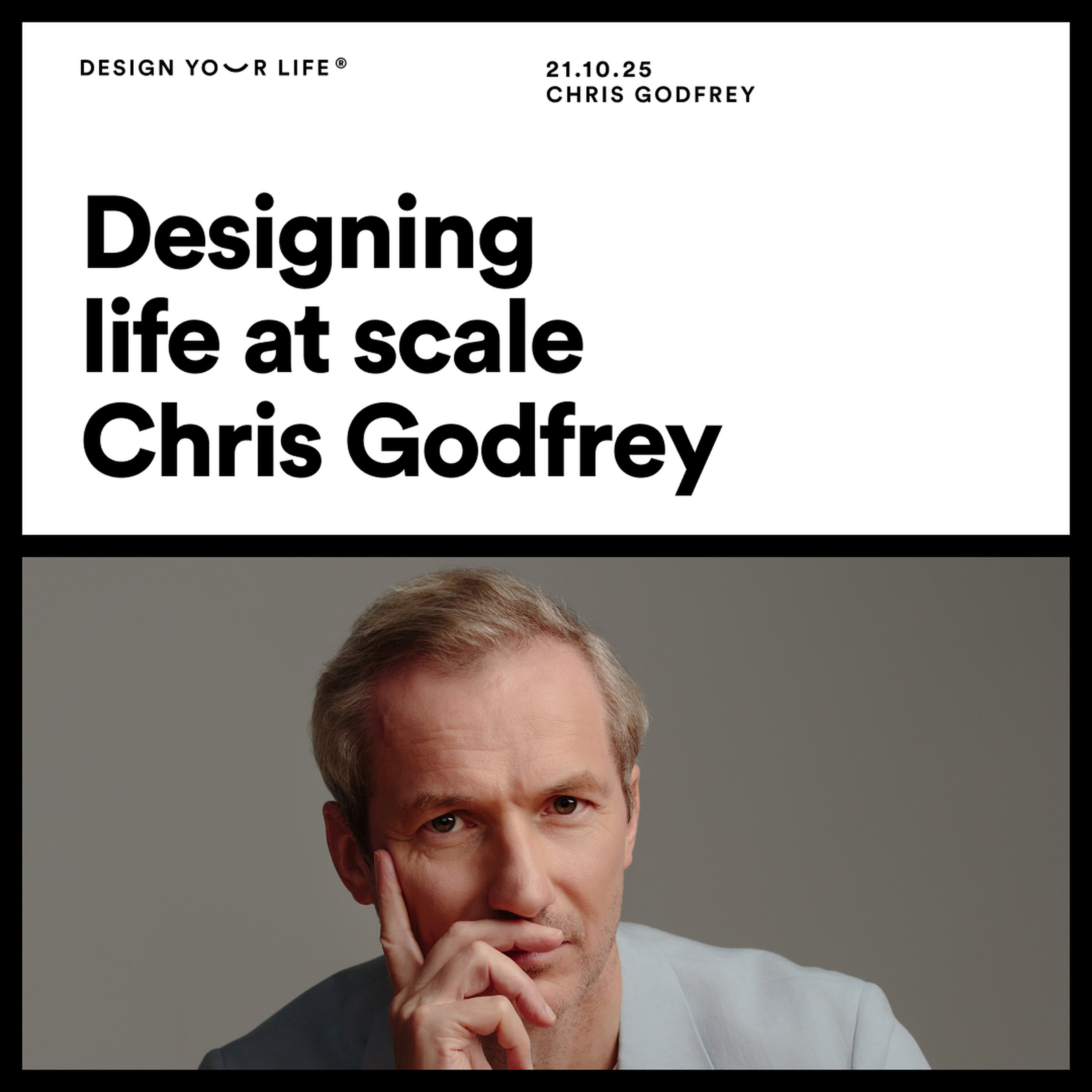
Design Your Life is brought to you by Frost Collective, a strategic creative studio solving problems with big ideas designed for real impact. Welcome to today's episode of Design Your Life. Today I catch it with Chris Godfrey, the Singapore based co-CEO of HBA, a globally renowned interior design firm. Tunis we chat about his journey from Yorkshire to Singapore and how he's driven incredible growth for the 60-year-old brand and why designing for wellness is a critical part of every HBA project. [Music] Design Your Life. Hey Chris, welcome to Design Your Life. How you doing? I'm well thanks Vince, pleasure to be on the podcast. Thanks for inviting me. It's wonderful, thank you so much for attending and it's really cool that you're sitting somewhere in Singapore right? I am, yeah this is home currently in Singapore's been home for about 12 years now. Wow, from the UK originally, where about where did you grow up? Originally from Yorkshire, from whole and yeah this is some distance away in every respect as opposed now. Yeah, a world away and it's interesting over the years I've had so many people from York
shire and there's a lot of talent comes out of Yorkshire which is really good to see. And seeks warmer clients than maybe? Yeah, yeah, exactly, yeah. Most of them are pretty miserable, no you're not miserable but a lot of them are kind of grumpy, I have to say. But that's just a facade. Absolutely, yeah. I'm a world polish con. Just talk about what life was growing up in Yorkshire and what was the family life like upbringing? Yeah, I mean, interesting to reflect back on now and I'll say firstly, very modest and a very particular time in hindsight growing up in the 70s and the 80s in Yorkshire and very different to the here and now. It was a very humble upbringing but I think a very happy one ultimately. Certainly, a very carefree one I would say and I think that is maybe key to some of this stuff. Parents were born during the war, early 40s and I think I would say they embraced the 60s revolution. So we were a product of that and you know, it's kind of interesting growing up in a fairly loose manner in a fairly rough part of the world. Come takes this key and looking back, it was an interesting beginning. So we were now super intrigued by how loose they were. We lived on the outskirts of the city and it's a lot of expanses of open land and it was fairly safe time. It has to be said, well, it was a challenge in some respects. It was Maggie's Britain, in for me, in the senses. It was a three day week. So black hours and all kinds of stuff which is hard to even think about now in our lifetime. But we were free to kind of find our own way, shall we say. I was very much what's called a latch key kid which is out at seven in the morning and back at 10 o'clock at night. Don't don't until dark. It was a fairly safe time all said and you could do that. And certainly that was what I responded to that sense of discovery and resilience and finding things, I suppose. And were your parents creative? Yeah. My father's certainly without question and still remains so. He is, I think the moment says a Renaissance man, he could turn his hand and still does to anything. He never went to school, high education certainly but everything self taught and a real talent and I can say that with all objectivity, supreme time. And so we were, we were immersed with creativity and in quite unusually so I would say when I talk about a Renaissance man, he made all of our furniture and it was all done in the bottom garage at the bottom of the garden and it wasn't and it was pretty avant garde. It was it was experimental furniture. Wow. When I was a tiny kid, our first 3p suite was made of deck chairs and then the living room was entirely decorated in newspaper. I mean, we as I say it was not his beginnings. Well, did we were you embarrassed by that as a kid or were you cool with that? Well, initially and I remember all my friends were, what's his house like? His dad's a bit crazy, he's me and he's me. It was the kind of the talk of the street but looking back, absolutely fundamental. The bedrooms were all co-aged and then from excerpts from the Sunday Times magazine for example. So he collected these magazines and as I recall, I can't remember if it came out weekly or monthly at that time but the magazine was like the thickness of a cosmopolitan. It's a half an inch thick. Wow. And it was every page and I remember distinctly every page was beautiful, black and white, beard architecture, industrial archaeology, moods, fashion and he piece these together, painstakingly over months to create this ensemble, like a Hockney-esque psychedelic infamine. Yeah, it was incredible. And that was literally our bunk beds in the corner of these rooms and literally immersed in this stuff. And yeah, so I often joke about-- Did your mom have any say in what publication it was? I don't think she had much say in any of it, so she said that was figured highly. Yeah, so-- I'm doing this. Yeah. So that was his canvas, literally. That's amazing. I guess it exposed you to designing your environment later led to your architecture interest. Yeah, and although, as you said about being in barris-dove or not even-- or at least not cognizant of, it wasn't clear at that time and then I suppose like most kids, yeah, you either follow or you rebel and-- and certainly, although I was only good at art at school, it wasn't obvious that I would follow a profession, if you like. And that came out of happenstance ultimately. So again, trying to paint the context for this period in time and wasn't-- I left school with particularly no qualifications and there wasn't really much opportunity for someone like that in the North Wing and that particular time and kind of crazy to think so now, but I was actually going to join the Marines. Yeah, well, I can see that. Yeah, and I think some of that characteristic may be still remained. But it's almost impossible to think that that was my perceived option. That's what I believed was available to me and I should be pursuing and thank-- they pushed it hard. They pushed it hard, you are a team behind the Marines and the Army. You're right. Team for all the schools. Yeah, right. At that time, were you looking at your career path? Yeah, you're right. It was and as I say at that particular time it felt like the option and a couple of my very close friends did make that their option and their life. And I was fortunate in that I failed one of the exams because I had an excellent at the time, a skin complaint so that I could kick me out before I could start and my dad kind of rescued me by getting me a YTS and apprenticeship with an Architect's practice as the print boy. Wow. Well, that's a big pivot. Yeah. Isn't it? And I think that was him very gently putting his arm around me and sort of don't go to the military. Anything but, if you lie. Yeah, wow. But yeah, it was the most formative humbling beginnings in the industry. It was the very, very bottom. Was that in Yorkshire as well? It was, yeah. So in my hometown, yeah, in Ho. And so I started this job and actually the practice that I joined had a, I think it was founded in 1878. It was one of the oldest architectural companies in the UK. And then in a fairly small town, this incredible company which had about 80 staff at the time, which would have been significant. And its offices were this grade one listed merchant house, absolutely stunning environment. And it really was, it was a practice of a, of a bygone generation, even then, as I say, founded in the 18, 1800s. But it had this extraordinary apprenticeship scheme, which I was fortunate enough to work my way on to whereby he'd
They'd take on one school leave a per year, like myself, who hadn't really got it a foothold or a direction in any way at that time. X-Marine. Yeah. X-Marine, exactly of two weeks. Yeah. And they'd take on a 16 year old school leave and put them on the print machine in the days when architects drawings were on, I'm going to see them. They were on. And you printed these things by hand. And if you survived the year, so the first apprenticeship was just print these drawings day in day out, but you had to read them and you had to learn how to copy them. So it was like a passive apprenticeship. But if you survived the first year, you were handed over to the oldest person in the company. Yeah. And it was his or her, well, I have to say exactly. He says that the T-boy, but it was, I was going to say his or her, but it was exclusively hymns at that time in the architects' office. You were handed over to him and it was his job to impart as much of his experience and knowledge as he could in the next year, which is phenomenal to think that there was such a scheme at that time and place and such a dedication, I suppose, to both the beginning and the endings of careers. Quite like the symmetry of that. So what was it like working with this elderly architect? And I'm worried about that because I'm actually 60 myself. So I guess I'm in that category. Was he open to teaching you all that he knew? Yeah, very much so. And I think he was a really maverick character, first and foremost. Yeah, he taught me more than what the drawing board could, I suppose. Yeah, nice. Every, every, very, very, very learned, very cool for a certain, yeah, for person at that time and place and every, every phone call, every drawing, this full of character. Yeah, wow. Yeah, he's, he's definitely a. Did your life change when you came into contact with him and what he was doing in his, his world and his approach? Yeah, he did. It did. And, and didn't take most of it forward, thankfully, but, but I think an attitude to work, to being a creative in a commercial environment and, and marrying those two quite well. Work was fun at that time and people, people made sure that it was. It was very collegiate. And, and I think that the fact that there was a 16 year old, paired with a 63 year old, is quite telling. That was, it wasn't just a, a, a polemic thing, you know, the book ends of the business. It was, it was about everybody being part of a group. And, and, and, and investing in, investing in people. So, there are the things that one looks back on more than the, the, the technical teachings of the, the day-to-day, the day-to-day mechanics. But I think again, because, because everything was hand drawn then and, and, and, and I only hand drew from my career, I managed to circumnavigate the, the, the, the digital world somewhat, of like, I can wish I'd wish I'd learned. But I think there was an art to communication there. That's how I would frame it now. And I remember they had all these teachings like, you know, never draw a line unless you know where it's going. And, and, and these, these, these little sound bites about pure economy and communication. And, these, yeah, they can only, these, these, it was less about what was in front of you on the sheet, more about how to achieve that in, yeah, the most crystalline way. As you were saying that, I had a friend of mine who was a printer apprentice in England, a long, long time ago. And he said, one of the cruel tricks of his apprenticeship was the guys in the printing company sent him down to the Brighton Beach with a bucket to catch the foam of every seventh wave. And I thought, so it was like your guy was far more kinder and far more helped you embrace the career. It was all of that stuff as well, yeah, going, going to the DIY shops of the long stand and all. And I've come here for a long stand. Yeah, I've come from long say it was. It was all the classic stuff. I hopped every day as well. Oh, fantastic. You know what's really, it's, it's really interesting. I was kind of when you reached out, when we had a chat a little while ago, we reached out to each other. I was just like overwhelmed by what you've managed to achieve in your career. Like you're going from, you know, Yorkshire, going through all you did, to now be leading the world's largest hospitality design firm, HBA, which is a phenomenal practice of scale. You know, I think it's like 11 offices, is that right? Oh, way more. We're in 25 countries and, you said, very blouse, eh, yeah, 25 country, yeah. Said it in a world weary way. Not incredible. I just said over 15 different verticals. So we are, we're very, very complex and truly, truly global business and, and, and a very dynamic and entrepreneurial one. But it's fast. I find it fascinating that kind of the kid that almost became a marine that didn't do good necessarily academic. I'm in that same boat. I was absolutely useless and terrified by any form of career. And it's just incredible how you've gone from that and a creative person to being such an entrepreneurial business leader. I mean, that's not something that just happens overnight. Can you help me understand that journey? Because it's like, or when you did turn it on and what, what made that change? Yeah, and there's lots, there's lots of steps along the way, obviously. And this has been really interesting to, to even think about talking about some of these things with you because, um, it's, it challenges you to, to, to piece things together and try and understand how it's related to your question. How one gets from one place to another and over half a lifetime, hopefully. I can pinpoint three or four key, key steps when I graduated from Arts School or Glasgow School, and I, as my whole cohort did, I moved down down to London. I would say actually just as, just to preface that. Prior to going to uni, I, I, I, I under took a few night school courses and I got myself a bit more qualified in, in preparation for uni, I still managed to get through the side door as one could at that time, but I, I, I, piece together a few qualifications. But I suppose more over in my four or five years before going to college, I worked and I built buildings, which is highly unusual now to think a 16, 17 year old would be given opportunity to, to make, to make real physical structures. And, and I really, oh my god, should it to think, but yeah, you, you were chucked into the deep end. That's incredible, isn't it? I think maybe not where it started as well. I, I did find my vocation not on the print machine, but shortly thereafter, I did find something okay. This is really interesting and I'm going to jump right in and I, and I did so. I really applied myself in the four or five years that I worked and I, and I learnt and inordinate amount and I, and I did therefore, I get opportunities to build things. So, by the time I, I graduated from, from art school, I was, I was pretty employable, but then a good degree. And, and, and I, and I had a great foundation. So, I suppose then in moving to London, I did manage to get some interesting employment opportunities, but I, I chose to join very small practices. I started with a, um, practice in, so shortage area, which was too too, a bit of a scary place at that time. Yeah, yeah, yeah, I remember and, and I spent, I spent the next decade or more there. That's the best part of 20 years following. But I joined, I joined Start-up effectively or first and, and again, I think that gave me the opportunity to, to play a bigger role than if you were joining a, a bigger business. They were, there were small projects, but they were very carefully designed and, and, and executed. And I liked having been a technician, I suppose, before college, and I liked detail, and I liked getting right the way down and resolved, resolving things and, and these small practices doing very beautiful, small projects suit suitably well. And he's a say, allowed me to, so utilize my skills. So, I, um, I, I worked for one or two of these, and, and, and in the second practice, so a couple of years each, and the second practice, I, designed a, a house for a, by slund and developer, Pline Hood, who'd basically take a, kind of, eaten townhouse, uh, rec and employee coming in, I guess, to do a really nice one-off development sort of a, a Westland and developer who would buy and say, an eaten townhouse or such like, and, and we would do a very, a, a very nice renovation project on, and you would put it back on the market, make a load of money and we might just about make ends meet, something like that. Um, and after I'd done one of these projects, the client approached me and, and asked me if I would, I would do the next project for him myself. So, I'm probably about, well, no, I'm 28 at this point and I, and I said, yeah, okay, I'll, I'll, I'll give it a go, I'll, I'll do a project on my own directly with you and, and when it's fr, to myself, when it's finished, I'll go and get a real job.
again, I'll just just chance my arm, I'll try this one off project and see how it goes. I did that and then it was successful and so far as he was happy with the project and he sold the apartment and from my perspective the fact that he was selling this project emotionally it was on the in the window of an estate's agent's office. So he said it had a degree of advertisement about it, accidental of my account but this apartment was seen by some some window shopping Swiss German couple also interestingly also who were at retirement age and so they were they were they were Swiss German couple they lived all around the world more laterally in Japan they'd never owned their own apartment in their whole working life they'd always traveled at rented but but and lived an extraordinary life and were coming to London to retire effectively and to shop for their retirement home and and and and they saw this little project that I'd done in the window of one of the estate agents and inquired the apartment had already sold but they they said well could you help us find an apartment and could you connect us with the guy that did that one and complete happenstance but that turned out to be a really beautiful exercise and foundational stone in in the next steps by career I suppose so Connor and Peter were and I say very very worldwide from gentle wonderful people they'd spent their life collecting art and object art and all this stuff like I say they'd traveled they'd lived that experience but they'd never housed any of this stuff and and and when I took the commission well a couple of things I remember the interview and I remember the guy he's a very astute guy was a sort of lawyer UBS bank or something a very high high place guy and he said we're going to go with you because we want to have some fun I thought I was really interested so the first real commission and okay this is this is a pretty interesting but before I met them and this is the really the really interesting Biasco's before I met them they were still in Japan I remember about three months before the commission to me but I didn't meet them for three months and in the interim period I I asked them if I could have access because they'd already shipped all their stuff I asked them if I could have access to their safe storage in order to try and get to know them in advance of getting to know so so I spent a few months forensically rummaging through and how much stuff do they have? well quite a lot because they were collectors and then but I spent this time kind of forensically trying to understand the client and this was never intentional but is I okay they're not here this stuff's here how what could I do in the entry and to get going and it became yeah it became this kind of forensic exercise of routine through these boxes and finding this incredible stuff and then but this became a way of thinking thereafter because I like the idea of trying to create the backdrop to somebody's life right not as a designer of interior as an architecture you're not the foreground you're just you're creating the envelope for people to live in to get fresh refreshing to hear that though yeah but that was like I say that was born out of an accident but it happened very early in career and it did allow me to kind of take that as a way of thinking so it's literally here's all the foreground here's somebody's light they've lived this they've collected this is there this is the essence of them as I abstractly got to learn about it and so what could I do what can I do to support that life not to run over that that life and some it wasn't like how the hell I'm going to make this fit into an apartment well it was because the boxes yeah they bought this and was a massive like three four thousand square foot loft apartment I was a loft there's a big place so they were cool cool characters and but yeah when the boxes arrived it kind of filled the double height space it was a real and it was a real 3d jigsaw puzzle was well to trying to reconcile the two that became a good exercise with a great client and as I say formed a few ways of thinking a blueprint for what I cooked forward and I didn't go back to work that that project turned into two and two turned into four and before I knew it I was kind of off on a new path wow and did you create your own practice on the back of that it did yeah so I ran scape architects ran that for about 10 years so from from 1999 to about or to 2008 crunched oh god yes that was a terrible time it was it was it was I saw someone working with me now from those days which is which I'm very proud of yeah yeah it's great I often think back about those early years and I did everything everything without the plan everything organically over that entire 10 year period and I did everything from the heart I think ultimately it was real it was hobbyist stuff but it was pure and it was it was you know completely with belief and and and it really in hindsight taught me the the the cause and effect of every decision we make in in business and in life and they were completely inextricable at that time I was and every single time you work closely with the owner or the person commission you to achieve the life that they wanted to live versus you inflicting your design on them yeah totally and and I think as I say I was maybe blessed through that happenstance to to reverse the typical thinking but I certainly embraced that and it and it's something I really enjoyed truly and and it's a privilege to design someone's on then so it's really profound thing if you if you treat it seriously it's from there it's a really big responsibility it really is and I and I I suppose because I was I was young I took it as such I took it as such a responsibility and and and I think you know but but from a design perspective if one can learn early days that you're not designing for yourself you you're you're only a designer in my mind if you if you know he's actually who it's for and what the intention is and you put your if you put yourself to the side then you're free to design in my mind so that's yeah that's kind of what it became with with the other clients that I had it was yes in all entirely private clients doing small projects in in London and around and just word of mouth you attracted more opportunities yeah but we but we touched on short it and an incredible time where the where one could find themselves with opportunities it felt like it felt you were there at the same time that's was we touched them and big transformation happened there huge and you really felt like you were in the midst of something certainly it was it was tangible wasn't it the energy was incredible the the can do the can do sense was was prevalent and that's that suited me really well I guess a lot of it was that reuse too of Victorian buildings and warehouses that had I guess declined over time with the like as lack of industry that was there yeah it's true and then I think that's that's one of the benefits and drawbacks of a of a design career a spatial design career in in London for example is that most of work is refurbishment isn't it this is trick tricky little interventions and but that's where you that's where you also learn the complexities of projects and yeah amazing so what did you do you ran that for 10 years then what happened yeah and then then the world changed and so we escape was going really well before global financial crisis which brought an abrupt end to an extraordinarily abrupt end evaporated in very short time I remember I remember it was yeah it was a terrible time it really was and 10 years of work disappeared in six weeks flatting I know it's very unprepared for that but my my own situation was it was challenged that my son was born August 2008 and in the you know the height of the madness and and as a result of that my my wife is sick for months following so I found myself in an extraordinary moment in time where everything was up in the air yeah business disappear another window wife not in the best shape and a new born in hands so it's like and one of those catalytic moments I suppose where where only change only change can happen and new ways forward so I was fortunate I would say and in that I I don't know that yeah I got I got in contact with another startup business and I was about to say actually I was acutely aware in the in the two years prior to the good financial crisis that I'd kind of taken that business as far as I'm concerned about it.
I could on my own, it's fair to say. And I was already thinking about how can I partner with other people? How can I take this further? And so an opportunity arose for me to join a start and this was, I suppose, it was perfect in many respects in that I was looking, as I said, for partners who could bring the equal and opposite to me to what I was at that time, which was creative, I would say, and not much else, business people, if you like. And the company that we formed was with three business people. They worked for the big developer of London at that time, and they were business development people, marketing execs and client managers. And I was the creative. So we formed a company called 1508, which is one of HPA's competitors now, and various businesses. Yeah. And that was really great opportunity to carry forward and I suppose what I started and the models that I developed with others, and with others that brought structure. I suppose the scape years were a set purely organic from the heart and reactive. And here were three people with business plans and with investors. And it was a new world to me, but again, when I jumped in too and kind of needed in order to give myself structure and to go further forward in business and in life ultimately. I guess it's survival too at that time. It was. It was a tough time and there's no denying that. It was survival. It was a safe haven in a storm, but it turned out to be way more than that. It was the next chapter, if you like. So I guess that was your first exposure to a proper business or strategic business? I would say yeah, to such an extent. It was the polar opposite of what I done myself previously. A lot of time, effort and attention went into stress, it went into clarent and very, because we did take investment, very careful about and very strategic about where are we going and how are we going to get that. And that was, yeah, I said, and this was very instructive for me. And it's exactly what I was looking for, I suppose, in it. And we achieved a lot because of that. And that was the big education ultimately is that it worked. We aimed to grow quickly, very clear about what the target market was, very clear about what we wanted the business to be and we got there. And was it hospitality? It was initially, it was an amplified version of what I was doing before. It was high, high, high end residential. So for ultra high net worth clients around the world and those developers that were ultimately targeting the ultra high net works around the world. So it was kind of symbiotic, commercial and private residential, but they did have aspirations to move into hospitality and indeed now, as said, or a HBA competitor in the hospitality arena. It was a hospitality project that we won in year one of 1508 that connected me with HBA. That's actually how the next step happened from my small medium to large. Do you unpack that? So how long were you at 1508 for? In total about four years. The first four years of the business, let's say from 209, I think we started there. The project that connected me with HBA was kind of interestingly. As a startup business, probably only six, eight months old when we had an opportunity for a developer to pitch for a four seasons project in Goa in India. No track record of hospitality and no portfolio of work that certainly would convince anybody to commission us for our hospitality project at that time. So I pitched to the four seasons by drawing a three meter long cartoon of what the process of a project would look like if you were to employ it. It said, "What can you do? You're nothing to show. Show them what you'll do." So I cartooned out the life of the project with them and we won it, which was a bit bizarre, but we won it. It just so happened that HBA, with the diurns of that industry, number one in that industry, had been commissioned to design the hotel and 1508, the branded residences. So that was the point of cross over, I guess, between the residential world and the hospitality world. And that was a relatively new model at the time, branded residences in hospitality. So we found that kind of happy hybrid and we collaborated with HBA and it was a really, really great project. Brilliant team, spread around the world, but everybody bought on so well and inspired each other, drove each other and it really created something first class. So as a result of that, initially, HBA contacted me after they presented and asked if we would create a JV with them. So the two companies did a JV for a year or two. Whereby, HBA would utilize their global network and they would look to bring opportunities to these young kids with a London studio. So it was an interesting genesis. But I think ultimately clients would question HBA, so why do you need to do that? Why can't you do it yourself, you're a HBA? And I suppose ultimately that's a question that I asked myself and ended up taking the models that I started and applying them for HBA on a bigger scale directly. Yeah, wow. How long ago was that, and I guess it was a much smaller business at that time? Yeah, so that was the beginning of 2014. So just over 11, 11.5 years ago, being with them now. So initially I joined HBA to set up a new division for them, which was their residential division. And as I suppose this was partly the 1508 model previously that HBA really liked and which we took forward together here was an integrated design model from landscape to master plan, to architecture, to interior to furniture. So we were freaking away, we'd assembled a team that could handle a certain scale, entire three-dimensional design process. And that's what we established with HBA as a new model. And I developed that over the course of 10 years and built it up to be a significant part of the group. It's worth saying because you mentioned the relative size of the business then and now. So when I joined HBA, I was a product of a strategy that my co-seo and it was being the long-standing CEO and you had devised which was to grow HBA through diversification of business lines. So the core business, since here design for hospitality is 60 years old this year. The other divisions of which the residential arm was one, her between 16 and one years out within the business that. So my joining was at the early days of the diversification and expansion plan. And that's something that again, it's what drew me to HBA initially. Is this very entrepreneurial spirit of HBA and then and the opportunity to create enterprises at a global scale. So I've part of that and now in this role, I guess, having become one of the key benefactors of that model and the key exponents of it now in terms of continuing that idea of how we move around the world, how we look at new geographies, new verticals, new business opportunities. So it's quite natural for me. I think I found my spiritual home in HBA in its approach to itself and the business of design and the entrepreneurial spirit I think, things that comes with being a creative. And so they were the things that were obvious to me when I first met them through that postseason project, it was so clear to me then and became obviously the catalyst for me joining and then became even more clear when I went inside and so finding myself in this role, we can get, we can talk about self-determination later but finding myself in this role, it feels the most natural thing for me to be doing now to be helping perpetuate that and give those opportunities to people too. Yeah, it's amazing, you're made to see kind of your stepping stones to where you are now, it all makes total sense when you look back at that, doesn't it? I just think it's interesting that often creative people don't necessarily kind of create that connection with business and the running of a business to the point that it affects, you know, that it actually enhances the growth of the organization and the business. I mean, it's really interesting too, you're thinking about all the. opening other offices, you're in 25 countries, obviously there'll be different scales in each place. But like, it's interesting that thought of like, why do you need to open up, why do you need to open in another place? Didn't you do for a time, try to do it all from one place? To replicate a brand or bring people into the organization, from other practices and bring them on the HBA, kind of brand vision and values and potentially kind of style approach. How does that get managed to get a role that out? Because again, most people probably, other people probably just say, I will work for my base here from around the world. On projects, I don't need to replicate what I've got here, if you don't want to make it, like you get two sides to that. But you can see the benefit of being on the ground, of course, with connections as well. Yeah, and there's a lot I could answer there and I'll try to, go back to the very beginning first, the one you mentioned about my three or four steps and find them out self-indisplicit. And I think what I mentioned earlier on is really pertinent. I think in hindsight, I was lucky to do my own practice first and then going into a bigger arena. Most people served their time in the bigger places and then try and do it on their own legs. Yes, that's right. And I think this allowed me to, as I said, when we talk about creativity and business, when everything is on the line, and it was at that time, as I say, might the end, particularly of the scape gears was really challenging on it. It made very clear exactly what you need to do on why. And you're probably trying to be good at everything at that point, right? Yeah, but also, and you'll know this well from growing businesses too, you find yourself once it reaches a certain scale that you're the guy that does everything around the business rather than the key purpose of the business. You're licking the stems, doing the tax return, buying the station, all that kind of stuff, which is the opposite of what is your drive and your cost skill. Yeah. And that's a trap one has to avoid falling into it. But now, but certainly, as I said, when you have clients, when clients give you responsibility, when they pay you directly to do something, when then you have to pay 10 people before you pay yourself, you learn the business of design, you have to, because that's how it worked for me. I took what was left in those years. And so he really is as fundamental as that. So I do think it's now within a very different context and scale, but those, those principles or the learnings or a universe or they have to be mine. Then when you talk about, sorry, our expansion, we, being at the four of the hospitality industry, that we follow markets quite, quite simply. And the HBA story is, it was quite phenomenal, as I said, 60 this year and born in Santa Monica LA in '65. And as a young design company is founded by two graduate surf dudes, you know, and at that time, we weren't afraid to move with the markets. I think it was London in '83 from, moving sort of gradually eastwards from California, a couple of stations in the US, and then London in '83. But more tellingly, I think we were into Hong Kong by 1978 and even mainland China by the early '90s. So as a design company, very entrepreneurial, very willing to go to try. And I think that's the spirit of a design company that can do attitude back. And obviously, as I said, the design, sorry, the hospitality industry is typically one of the first flags in the ground of a new or developing economy. So we've tended to move around with that and continue to do so. My taking on this role coincided with the COVID years. And as I started playing this wider role in 2001. And that was in my mind, the awkward or was clear, especially in hindsight, is that was the opportunity to reframe what we do and how we do it. Everything was up for consideration through those two years. Everything was changing, how we work, how we communicate, how we live fundamentally. And as I say, that was by intention or not. That was the time that I took this wider role on. And it gave an opportunity to try and strategically marry the two. Where is everything moving in the world? Why is it doing that? What are the narratives here? What are the real geopolitical games that we're trying to see? And we're still seeing them, of course, on a daily basis at the minute. It's never really stopped, gone on for an ad infinitum. But I think we're acutely aware of how everything is shifting and moving now. So in this tenure, it's been trying to understand HBA as a business and how to make the best of what we had become organically again over entire lifetime. And how to overlay that with the shifting tectonic plates of the world. And how can we be nimble, dynamic, hell-cutting? Yeah. So I think that's what's kept us at the front of the industry for so long, I would say, Vincent. And that's the spirit, again, from within the management team that keeps us lively and moving forward. You work on some of the world's leading brands, designing hotels, residences, and experiences around the world. And what's the future of this luxury hospitality look like? I never liked the Sufseer questions. If we tie the first part of an answer back into the one I just touched on. What we've-- and I didn't maybe fully answer your second ear prior question, sorry, we've seen-- obviously, globally, we've seen a major return to everyone's country first, domestic first, the breakdown of globalization and global relations to a degree, and the returning to domestic first. And this does relate to your second question. So in terms of HBA's strategies as well and evolutions, we are looking at how we should respond to that. Where can we have more atelier-sized studios that service particular markets, rather than big global studios that travel on planes to go to projects, those days are can of over. And so we've devolved in line with that, with those steps, not just in hospitality, but in, yeah, in the geoeconomic politics. And so we are looking at how we're building atelier throughout Europe, throughout South America, territories that we've not been in, or as prevalent in previously, and where we see-- where we see modest but very nicely sized markets and opportunities to build, to build businesses. In terms of hospitality landscape, I suppose, related to that, there is a lot more domestic tourism currently. And so I think that that is a direct response not just to the post-COVID environment, but to-- but with the fundamental understanding of place and context and authenticity, I think that for me, they were always irrefutable design tenets, but I do think that that's more omnipresent now, the sense of authenticity, of locality, of being rooted in place. Obviously, what wellness is playing a significant role in the post-COVID world, and rightly so, and that's holistic approaches to wellness. And therefore, what certain brackets of the market are looking for in hospitality realm and tens of wellness, and technology will play an increasing role-- authentic experience, because I think is the key driver for those and locality. It's really interesting. You said we did notice here in Australia after COVID. There was a huge-- I don't know if people were playing this priority COVID, but it seemed like there's a lot of retreats, wellness resorts, small ones as well as big ones. And kind of in a way, not the big guys that were doing it, but much more smaller families maybe doing it or small investments. It kind of felt like, finally, Australia's, I guess, resorts and destination hotels, et cetera, were massively improved. I mean, I guess it's probably a global trend, but it felt like it felt like it was because of COVID, but I'm sure it was happening prior to that, where people were then going, OK, domestically, let's look at how do we enjoy Australia, for example. And--
all that it has to offer as opposed to flying to another country to forward that. Maybe maybe because we were strained at the time, but you see a big change. Yeah, whether we're strained or constrained otherwise, absolutely. That's what I think, that the rise of the domestic following and people reviewing their own country and what it means to them from a lifestyle perspective and also different mention lifestyle, different demographics of travel and now as well. Gen Z wants is significantly different to what you are I might be looking for in hospitality arena. And so I was seeing with the, as you say, a significant rise in the boutique and the non-branded in the local and the rooted versus the big change, but we also see the big operate to brands reacting to that and creating a whole brand architecture of different offerings that try and address the different hand demographics. Is there kind of a global design approach like have you found like around the world have different, all these different countries you're working in? Do they have their own cultures that are very different or do people apply the same kind of thinking to every destination, every hotel and every situation or country? Yes, a really good question and it's really pertinent to what I'm doing in the here and now because I'm going back to and taking on the CEO role and starting to rethink about the business. It was clear to me, I said that we developed all these businesses, had all these geographies, all of these people and then an incredible array of talent, culture and skill. But we weren't necessarily making the best of that in terms of truly being an integrated global practice. We were lots of different people in lots of different places, doing lots of different things, which is to to credit and detrimenting sort of equal measures. So the last few years of about have been about gently providing the kind of requisite amount of infrastructure that allow each and every one of those business units to be what you described local, to have video synchrosies, to have personalities that are of that place or understand that place and are attractive to clanks that want to do same, coupled with the support of a truly global enterprise that can deliver to a standard global earth. And that's been the happy hybrid that we've been working on perpetually over these recent years because it's imperative for us that not just do we have those local skills and understand these but that we can allow people to express themselves within hedge beer. We want different people. It's not about the two or three that sit you know, sit cooperately at the top but absolutely about the designers, the design partners and that's the spirit we want perpetuate. But I said we want them to be able to benefit from a well-eiled up-to-date operation that makes us fit on a completely different level to what all of those little boutique studios could ever be on their own. Yeah exactly. I mean that's what's made me think that you create the infrastructure and the business mechanism to enable them to do their thing, to enable them to, as you say, do the thing that they probably wouldn't be able to do in a smaller practice. Yeah so I'm still, I suppose back to my early story, I'm still lick in the stumps and doing the vapor turns now and allowing all those guys to do what they do. But it's exactly that. We provide the tech, the digital, the HR finance. Just a huge portfolio. Yeah the documentation, we all of our, all of our imagery, all of our documentation, all produced in-house and has been to Tony for 25 years. So those standards are still second to none. They've been built over a lifetime and we estimate we don't even have complete data. And for example, we estimate we've finished more than 15,000 hotels, then in that 60 years, which is. Extra right. Yeah it's a phenomenal body of work. And we're still, we work on maybe three or four thousand at any given time projects. It's incredible. And so yeah, so trying to make, especially in the digital realm now, trying to make benefits of all that we've done before from an execution point of you know leveraging off of all of that knowledge, all of that data and allowing the creativity to come to the fore and underpin the creatives with that. And it's, it becomes super powerful and more relevant than ever. I guess you wish you had that when you were doing a Skype. We have scratching out ink with a razor blade. Yeah. Yeah. Now you do. You kind of think that would make a phenomenal difference. But I think here's the opportunity to make that phenomenal difference, add a, add a global scale. And obviously the benefits are immeasurable by comparison. So that's where a lot of the thinking is currently. Yeah. How do you stay well? I do eat well. Firstly, I mean the practical ones. I eat incredibly clean and I've gone into fitness over the last ten years in a big way. And I would have never imagined, oh, we've always played sports and so I would never imagine that becoming a key part of who I am. But once I understood the mental benefits of physical fitness and insight, okay, this is really good for me. This gives me not more clarity and a lot more energy and it allows me to do a lot more. Yes, especially under the under in the situation where your responsibility got greater and greater. Yeah, yeah, it did. And they correlate my ramping up of thinking about myself in these ways. It adds a lot of the corresponds to the increase in the responsibility if you like. And to that, I've got my wife would disagree, but I think I've got good compartmentalising because you have to. You have to have to know when the day is finished. And I would hope I'm pretty good at mentally switching off. Not easy always, but reading a book. I still like to have a book in front. I've always got half a dozen on the go any given time and I like that. And I think in staying well through an inquisitive mind, going back to the beginning of the chat, my dad mid 80s, he's still the same person because his mind is restless. He's still painting. He's still sculpting. The TV never goes on until after 9pm. And I look at that now and think, yeah, keeping one's mind active and positive is wellness. Do you think he did that deliberately or is that just how he what he knew? He's just one of those things. It's just a restlessness that you can never you can never satisfy that. And I would I believe and that and I believe that's hopefully what will keep me well for as long as possible. And I think you know of trying to not take one's self too seriously as well helps. Talking to a young Chris looking back, you know, the the younger apprentice or the or in fact the kid at school that was thinking that he was failing fast. And not that the Marines is a bad career choice, but you know open how does one open that mind to understanding that there's what the opportunities are around in the world, what the opportunities that might really make, that they may find that they absolutely love and do for a lifetime. Yeah, it's a great question. It's a tough one obviously because you've only got your own journey to reference. But as as we've talked about, there are many there's many crossroads and there's many bends in in the road. And and where where you start off is by no means where where you end up. And and I think for me, it's been it's been relentless application in whatever form that's been I total total commit by jump paint. Make this the best she possibly can you know always think about tomorrow and and yeah, they I believe in I believe in probability I believe in hard work. I believe that opportunities come if you're willing to challenge yourself first and foremost. Have you designed your life? You're designing everybody else's lives and certainly the places to live and thrive in have you done it for yourself? Yeah, and and and a great a great metaphysical question obviously and and you're right. It became a profession in a sort of way for a while to do that. As as I would hope that the chat somehow conveys it's maybe to date a life of two halves, shall we say and everything up to the birth of my son and all that happened around that and it was freestyling all the way. And I suppose this is this is every every dawning moment for every parent but it was and it was broadly unstructured but but it's fine to finding your way finding your way growing up
I would say that, yeah, but for me becoming a parent was super fundamental and at that time where the challenges were all around me in real ones, existential challenges. And at that point, I was like, "Okay, I know why I'm here. It was super clear to me at that point, right? I've got a job to do here. I've got to look after this person and this person and I've got to get on with it." And it was super clear and I've never looked at it differently from that day. So I know why I wake up, I know what I'm doing and it's still the same person, it's still the same spirit, but it's with much more purpose and I thought about it. I would say I am the architect of my existence now. Wow, that's cool. Chris, it's been absolutely. I was thinking to go look at every single building you've designed, actually, walk around and stay in hotels around the world. It's been spectacular having on the podcast. I'd love to meet you in person one day, I haven't seen you in London or whatever, but thank you so much for being on the podcast. Thanks to you, I enjoyed joining with you and look forward to the day we meet. Design Your Life is produced by producer Luca Frost, editor Louis Frost and designer Joel Roberts. If you enjoy the show, please don't forget to subscribe and leave a review. And if there's anyone you'd like me to speak to on the show, please get in touch by our email
[email protected] Design Your Life.
 PodcastTranscript AI