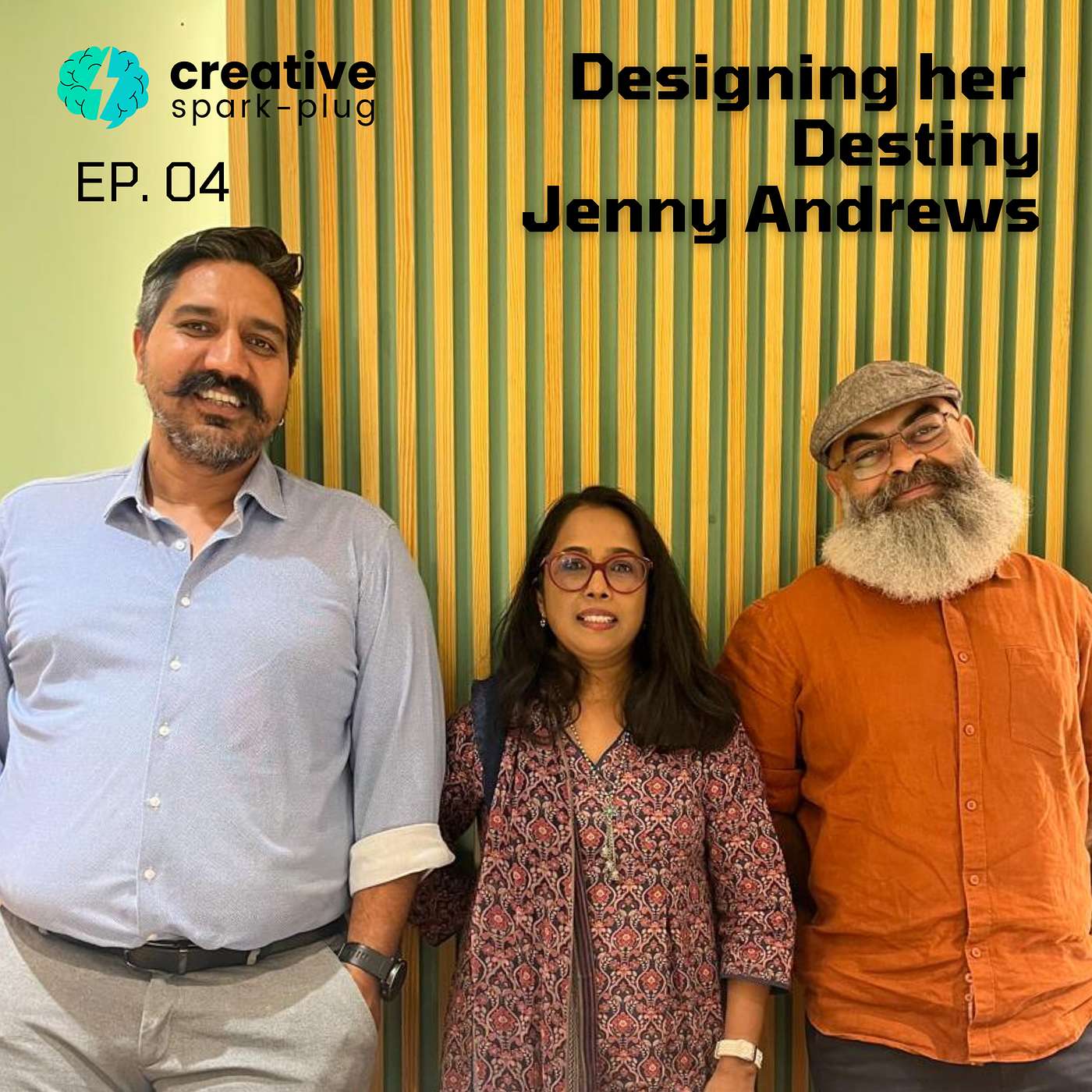
Jenny Andrews, founder of Studio J, shares her unconventional journey into design. Despite a mechanical engineering background and being a national-level runner, she cultivated design skills through sheer curiosity and hands-on learning. During an internship, she secretly revisited construction sites to study partition work and immersed herself in mundane tasks like folding blueprints, driven by a passion to understand every detail. A fortuitous meeting with designer Maninaga Subramanian at a market redirected her path into spatial design. Jenny credits her engineering discipline for ensuring precision in her work and her athletic background for instilling focus and resilience. She describes herself as a quiet, visual learner who methodically absorbed Bangalore’s transformation through running, ultimately combining technical rigor with creative insight to build a successful design career without formal architectural training.
[Music] Site meetings would happen from 3 to 4.30. And then after that you would drop me off at the closest place and I had to figure my way out to go back home. And I what I would do is I would take the same auto and go back to this site and stay there for about 2 hours just to figure out how the bloody the partitions are being made. Fortunately my boss didn't know that I was doing this for almost about 2 months. And I think at one point he came to know and he gave me a firing. He said you have no idea what the hell are you doing? Why would you go back to an ITPL kind of a site and get into the you know at 6.30, 6.30 to 8.30 Rajesh, I would sit there and just be with the workers. And today I would be really scared to even do something like this. And then I had this I think the feeling of nothing is going to go wrong. I mean like I never even had even thought that even 1% you know and they were very welcoming. The the main line contractor including the fall ceiling guys or whatever at the you know the cup and tree the fall ceiling electrical guys. I looked at the B.O.Q. drawings. I would they would teach me they would just say madam this is how it has been made. He had shown me every joinery detail that was there inside the site so I have actually learnt it in the site. But I think that comes with an innate calling for wanting to learn. No the other person is also going to genuinely see it. So I learnt a lot there 6, 7 months of doing this continuously. I guess that we have today is a little unusual Jenny on the house. Jenny Andrews Jenny Andrews is a friend first so we know her very differently from how we know other creative entrepreneurs creative individuals. It will be difficult for us to keep this particular conversation formal Jenny owns Studio J. She is one of the most successful designers of our times. Both Rajesh and I have been fortunate to be associated with her. Rajesh a little more than me. I am jealous of it. Is that what Studio J means? But I am hoping that it is J for joy. There are a few pertinent enquiries we have into your journey as a creative individual and as an entrepreneur. But before we get there what we would quickly like to ask you is you were born in Bangalore. Yes. And you grew up in Bangalore. You grew up in Bangalore. And you stayed back in Bangalore. I stayed back in Bangalore. How boring but yeah can you quickly bring us can you quickly bring us to a journey of when where you were born. I won the hospital name and till you founded Studio J what brought you to that. We know the fact that you didn't go to architecture school or design school and you kind of kick most architects and designers. You know what side? Both sides. Yeah. Nice. That's what we wanted to hear. We didn't want to say it ourselves because you know they are going to judge the hosts. We can't use bad words. So yeah, you were born in Bangalore and to a time family. Yeah. So parents came from Madurai and Karikudi it's a pretty much a very beautiful village back. So when I went back almost about 15 years later I was astonished with the architecture which was there at that place. And probably I don't know it's quite strange when I look back. I looked at the buildings, I looked at homes, I looked at the temples there and I was just wondering is this such a great place to be in or to be born. But you know unfortunately I was born here in Bangalore so parents moved from Madurai and Karikudi and we were here. We studied in a Convent School in Artina Gher. Then raised I kind of stayed in Bangalore. We didn't move because one dad worked, he comes from an automobile background. And so hence I saw a lot of mechanical and automobile engineering stuff as I was growing up. Dad was an Ashley athlete at that time. So I think the first thing of my childhood that I remember is tying up the lace of your shoes. That's the first memory that comes to me. I have been a national athlete too. I was 1500 and 3000 meters state level runner. So running I think is just there in my gene and I think I used the running throughout. I think in anything even if it's about life. Metaphorically too? Yes absolutely. So that's how it is. So you know and how did engineering for me happen was through the sports quarter. And I remember those days in college 22 kilometers which usually children of the age of 17 would want to go by bus and I would just run and go to college. So I was crazy. I don't know. Sometimes I wonder is it the mindset DNA or is I don't know what that is. But I love running for me. That was very meditative. It was very rhythmic. I probably have seen Bangalore develop to what it was because I would know the number of bottles. Exactly what it took from my home to college. And I knew the number of stores which had newspaper clearing in the morning. I knew the number of stores where you would get roggs. I would know what's the shortest route to get into the hostel women's hostel to change and so on and so forth. So everything was just I think I realized that I was my very visual person. You're a very visual person and you witness Bangalore as in the process of you running around. I've seen Bangalore actually transform from what it was then in the 1980s to what it is now. So getting into engineering and sometimes I wonder dad just decided you know that you are supposed to be a mechanical engineer and that's how I was there. And I was the only girl in the class and they were 99 boys, government college. There was so much noise around me and I remember in many such classes I would just wonder what am I doing here. I mean like it's just so noisy and obviously the teachers would try hard to maintain to bring the discipline in and you know there was automobile. There was strength of materials, hydraulic, pneumatics, air conditioning, subjects, sheet metal, welding sheet metal, forging. But I think I did enjoy the process because everything was about you're creating something you know my practical classes were great. A little bit more to share in one of the machine shop you know classes. I was just it was impossible for me to actually do you know we're supposed to make a model we're supposed there's a process of cutting late in on a late machine. You cut your knurling and then you're creating the thread forms right and every time when I'm supposed to actually press the button for the knurling to happen I would miss it and I have to wait for that second entire process and then you wait for it to start again. I think I waited for about 20 minutes it was I was just missing it every time and I literally broke down and I said you know if I'm not able to kind of work in in concess with the team that I'm put in then what do I do so I stayed back that day post the machine shop class. The practical class and I stood there alone and I completed my model and when I handed over the model to my you know the in charge for the machine shop he said he told in Karana he said. You know I don't know he said you know which means that you're not going to let go of like that you're not the one who will let go probably you know you're the one who would make it happen. Obviously I moved out from there completed the course but I had a lot of challenges you know during exams because obviously I don't know my I realized that I was not technically made to be in a mechanical and but somehow scrapped through then. I got into internship and during internship I had two internships dual internships that I chose to do one was for us to complete the project the thesis that we had to submit a. I was a proto kind of a thing with the boys you know there were eight boys on my team and the other I consciously took up I just decided on one one I think it was one morning I woke up I said I want to do my internship with the architecture you know I'm with an architect and that's where I I think I reached out to one
and I did my internship. And it was the six months internship. And I think I learnt everything in that six months. When I would say everything is about even sharpening your pencil, how do you write, how do you, I think one thing that came up really strong to me was how do architects really draw and how do they do blueprints, how do they, you know, there's a way that architects write. So in about three months, I would write exactly the same way that my senior reporting architects handwriting, it would not be even one person different. He was shocked. I think I don't remember his name, but he was pretty shocked. He said, how does one just write exactly like my handwriting? So that's where, you know, I think in architecture design, the first most important step is to emulate and see how the processes and work on it. I did not shy away from learning how to sharpen the pencil. I did not shy away from asking my co, you know, architects who were there, how do you write and how do you, how do you draw on a tracing sheet and how do you do blueprints and you know, those days we had these blueprint rooms which were kept a little aside from the studio. And I think it's ammonia. Ammonia chamber. Yeah, it's the ammonia chamber and not everyone wishes to go in because it's got a very strong, pungent smell. And I remember talking to this person who was the office assistant, who was, who's job was to bring all the drawings in place folded. And that was my first experience of asking him, how do you, how does this blueprint come out? And how do you fold the blueprint? Because folding of a blueprint is also an art those days, you know, you, you have to fold a drawing in a certain way because when you go to a meeting which is especially architectural sites, these are huge A zero sheets. So when you open them, you easily open them. So that, I mean, I even till later remember him, he kind of taught me how that happens. And I really enjoyed the process and every time during lunch break, when everybody, I think the lunch break was an art, but I spent 20 minutes for my lunch and I would run to the blueprint chamber. And I would like, so how many drawings are there? How many drawings? How many sheets? So please give, I'll, you know, and, and that table was kept in such a way that you will have to stand on the floor and it was a raised platform where you actually fold. And luckily, I, you know, for the height that I am, I did not have any problems. So I managed to literally from one thirty to two, I would be folding blueprints. It's very strange when I look back and say, what's it? What's it? It's, you know, I don't know, you know, who does things like this from, you know, during lunch when you basically want to have fun. I know somebody does things like that. Pardon me? I know somebody who does things like that. Oh, really? Yes. Is she a Jenny Andrews? Oh. So, you know, so that's the, I think there was a lot of passion that was that was passionate, passionate and some kind of an energy that needed to be, you know, to bring in a focus. So I think that that's something that I remember. I was feeling that, I mean, if I want to witness, I had to witness somebody like that. I would also believe that this person loves to be comprehensive and this person doesn't want to leave any stone unturned in the process of learning. Passion, of course, very evident. I mean, I think it requires two and a half minutes of conversation with you to know that you're actually a very, very passionate individual. Grounded, approachable, sweet heart from that point of view. And but a very passionate individual. Rajesh, do you have something to inquire about? I have a whole set of things. I want to go back, I would like to go back a little to your school time and understand what was your nature like during school? Were you into drawing? Were you into painting? So what exactly or how were your initial years? And what, what was your, what were your hobbies? What any extra curricular activities that you did that eventually led you to get into design? See, I was a complete sports person all throughout. And any, so I was the school captain, I was the house captain, I was the class leader, I was the, what do you call somebody who picks up an overall cup for the school for the house? So I was, you know, and I was also in the band set. Now, very strange. And I was also the school captain. And I think one thing I remember is, my nature, I was a very quiet child throughout. And I think even till I became an entrepreneur, I was very, very quiet. I would hardly be able to even hear my own voice. Things have changed, being an entrepreneur. I really walked on myself and I still work on myself. So going back to childhood, a very quiet child. I kept storing energy within me, waiting for that moment of me to run on the track. So that's where I feel that I really kept my energies really compact and within me. When it comes to studies, I really worked hard because if you have to be in competitive sports, you can't do this, you know, two months, I shall run and take two months or break, you can't do that. So waking up at 430 was such a natural thing for me. But I, you know, obviously my dad was such a, you know, I thought he was from the army like a military. Would you call people who are these commandos or whatever? So he would just put the other up so loud. I would just freak out and jump out of bed. So one was dad's second. I think I had a great handwriting. My teachers would love me. I remember the days when I would sit in the class and you know, my teacher would just open up the book and she will show to the whole class. This is how notes should be. And I would like wow, you know, but I was not the one who would really feel happy. And you know how you have to actually enjoy the process that's happening around you, the recognition that you're getting. So obviously I was not enjoying it or I rather feel that I held, you know, I was holding back even that process of, you know, enjoying that entire thing. So I didn't, I seemed very stuck up and quiet and, you know, but in, so when there were submissions, I think my submissions were worth enough for them to put it up on the notice board. So I would do this strange thing. Okay, this is something that I don't think I ever shared this with anyone, but I would do it now. So I would tell the teacher that I want to go, you know, for a, for a break, you know, to the Lou and I would go and I would just quickly run and come and stand in front of the notice board. And admire my work, which is what the notice board for, I mean, like this is hilarious for it. I would stand there for 10 to 12 minutes and then I know that the class will get over, right? That run into the class. Excuse me, ma'am, and then walking. I have done this many a times through the day. I don't think, I don't know what it was, but I would do that. And my biology teacher would love me, my English teacher would love me. So sometimes I look back and I think that I should have had a little bit more fun with my teachers, you know, I didn't have this really. Were you, were you into sketching? Did you draw a lot? Yeah, I used to draw a lot and I, you know, drawing a lot more than that, I used to draw very. So I used to draw less, but the drawing was really good, you know, and doing, you know, those days used to get those sketchy card balls, which was large big ones and I would just draw and sketch right and, you know, make it worthy enough to go up there and they would just be zapped. I'm like, but do very less work. I'm not the one who would have the time to actually, you know, create more and give it or present it to the school. So I think I was very natural when it came to drawing. So that's how my childhood school and that school, it was mechanical engineering also helped you develop that a little further along with machine drawings and stuff like that. Yes, it did. Because I think it's very realistic when it comes to engineering, right? You always have this problem solving. Everything is accuracy and the entire measurements that you have, mm and centimeters, they really, you know, you can't just do anything without having those technical aspects in mind. So it really kind of built that. And I think the engineering aspect of learning and experience really puts design in the sense that you can't go wrong. You have to get it 100% right. And I think in my entire. two decades of being in design, I don't think I ever, you know, come across an experience where we created, started building something and it's never what. I've heard a lot of experiences from other designers that, you know, they tried doing it, it didn't work and they had to break down and, you know, things like that. So, I think this engineering kind of really got that. Designing to, I don't know if I can use the word perfection or perfect or doing it the right way. That kind of helped. Okay. And so, generally the trend is anybody who does mechanical engineering moves into industrial product design or basically industrial design, which means that doing a lot of products, that's the general trend that I have seen people who have a bit of a creative bent and if they have done mechanical engineering, they move towards industrial design or product design. Yes. How did you decide to move into spatial design, space design? See, there was nothing planned. So, I'd like to share one incident that happened. I mean, it's, it's probably an incident that changed the course of my life. I wanted to post me completing, you know, engineering and looking out for jobs and stuff like that, as I was moving around. I found, I came up with a Trakala Parishad which had, you know, a master's in fine arts painting as something that you can do a course. Probably it takes about five to six hours of your time of studies that you have to go to college and study. So, I applied for it and I got selected. So, I remember, you know, during one of the submissions that we had, we were supposed to submit portraits to the college, you know, we had to do that. And, you know, people from Mangalore would know the place which is the Mangumandi, which is near Arthinagar, the Sultan Palya opposite that. So, you know, I just decided I'm going to walk into this because one of the summer it was really hot then and I walked in and I found these, you know, the workers who are really, you know, portraits, especially when you look at human faces, which are at the at the 55 and 60s, which has really worked through their life, right? You can see the real, you know, the textures, the shadows, the lines on the face and I met this old man probably could have been close to 70. And I said, I need a couple of portraits of you. He and his wife were there. So, I started sitting there and I was sketching. And as I was sketching, I had this shadow which fell on my drawing sheet, you know, and I looked up and there was this tall gentleman who was who just looked at my drawing. I said, hey, hi. Are you from Mangalore? I said, yes, sir, I'm from Mangalore. Here, this is my card and he pops his listing card to me and he says, you should come to my studio and meet me. Very good work, by the way. What else catch do you have? Then I removed my bag and I followed some of the drawings and whatever sketches I showed him, I said, you're very good. You should just come. Okay, here's my address and he walked away. A very tall, good looking design now. Okay, now, so that was Maninaga Subramanian of RDNM. So, that's how I met him in a Mangalore place where we settled Mangos. So, he had come to pick up some Mangos for his clients. So, I got the card. I finished my work. I stayed there for about another two to three hours till the sunset and I went back home. And the next day, post the class which gets over at 130, I just decided I'm going to go meet him and his office was in Laval Road at that time and we, I had a TVS champ those days. 90s, I think, yeah, 90s, late 90s or yeah, late 90s. So, I said, okay, and obviously, you know, I had this feeling that I was the superman going on a champ. So, I went to meet money and it was a very beautiful office that he had in Laval Road on the first floor. So, I went there and so he interviewed me and my interview was just a couple of minutes, like two, three minutes. He asked me, what time will you be able to come? You know, these are all bunch of designers and then he introduced me straight away. It took me into the studio, he introduced me to some three to four artists and he said they're all from Chitra Kula Parashit and then he asked me to keep my drawings to everyone. So, everybody had a look at my drawings and then he said, you should just come. Whenever you want to come and work, you can come. And that's how my first exposure to, I don't know, I didn't know that was spatial design at that point. I didn't know it was retail design. I didn't know it was visual merchandising. But I love the fact that there were multi-disciplined people there. You know, we had, I think in RDNM at that point they were artists, they were industrial designers, they were, I think there was no retail at that point. I think he was the first retail designer coming from Neville, Neville, Neville, Black Crown, if I'm right, yeah. And then he was also the first designer back with Titan. So, I think my exposure of, for me it was just, you know, baby steps because I used to assist the artist in drawing. So, my routine of life then started that morning at 630, I'm up, I go to college till 230, 230. I sit in, you know, in Chitraka, Parishwade, if you go in, you will find those stone rocks still there. So, sit and have finished lunch. And then I'm on my TV as champ, I would go to Laval Road. I would stay there and work till 9 o'clock. And then I would head back home. I really loved the process for me. I don't know. I really loved the idea that I'm able to learn and I'm also able to work. But it's quite hectic, but I think this, the fact that I enjoyed the wind blowing on my face when I was on the bike, I enjoyed the fact that there was so much colour around me. And there were nice people. I think the first project that we had, I started was Cottage Emporium. That was the first project. Then there was Sun Silk. I think Mania that point had designers who were working on point of sale. So, that was my first exposure to point of sale. So, that's the, that's how the journey started. And I think I was, I enjoyed working with Ardena Man with Mania's direction. There were, even in fact, all the designers were very, very what you call inclusive in nature. I kind of learned quite a lot there. I've heard stories from you about this phase with money. Yeah. Where you did a few, I would not say crazy, but yeah, still crazy things like go back office and then go back to the site and stay there. Oh, that was not money's office. Okay. I'll tell you. So, yeah. So, before money, what, before RDNM, during my internship, there was this company where I wanted to kind of understand interior design. And I took up that job for about six to seven months. And in that six to seven months, my boss, he used to handle client servicing and projects. I just wanted to be around with this gentleman because he was one, he, he had so much intelligence and so much, I mean, there's so much knowledge and everything that you would tell me that you have to do it this way, then I would just follow his, his guidance and I would carry all the files with him and do the site. And I wanted to see the site. No. So, then the IT boom also had happened around the same time. And I remember in ITPL, he was holding, you know, these large projects with 40,000 square foot for IT companies and it was interesting for me to go back to site and check. So, okay, what he would do is our site meetings would happen from three to four thirty. And then after that, he would drop me off at the closest place and I had to figure my way out to go back home and I what I would do is I would take the same auto and go back to the site and stay there for about two hours just to figure out how the bloody the partitions are being made. And I think the contractors are still in touch with me. You know, there was somebody called Rampal, there was somebody called, you know, the Sharmas around, you know, the entire team of execution team, you know, business owners. And I would go back and fortunately, my boss didn't know that I was doing this for almost about two months. And I think at one point, he, he could
came to know and he gave me a firing. He said, you have no idea what the hell are you doing. Why would you go back to an ITPL kind of a site and get into the, you know, at 630, 630 to 830 Rajesh, I would sit there and just be with the workers and you know, figure, you know, look at things. And I think this, I don't know, is it a risk or is it, no, I don't think I look at this. - And those ITPL was out of town. - Out of town. - Like it's like going to the world of Muradav today. Today I would be really scared to even do something like this, right? And then I had this, I think the feeling of nothing is going to go wrong, yeah. I mean, like I never even had even thought that even one person, you know, and they were very welcoming, yeah. The main line contractor, including the fall ceiling guys. So whatever, at the, you know, the cup and tree, the fall ceiling electrical guys, I looked at the bio-queer drawings. I would, they would teach me, they would just say, madam, this is how it has been made. He had shown me every jewelry detail that was there inside the site. So I have actually learned it in the site. But I think that comes with an innate calling for wanting to learn, no, the other person is also going to genuinely see it, right? So I learned a lot there, six, seven months of doing this continuously. And then I spoke to my boss, I told my boss, see, this is not going to change. I'm still going to continue to do it. Either you decide what you want to do. You want to stay back with me, please stay back. If you still want to go ahead, you want somebody else to stay with me. You can, you know, get another designer to work with me. But you know, the nice thing is my boss stayed back for those two hours. He would be there. And I really overlaught to him because, obviously, everybody has their own life, right? But he still stayed back two hours, not saying anything, but he would continue with his calls and he would manage to do his work in those two hours. And those two hours, I would loiter around inside a site, which is about 40,000 square foot large. So I think this comes with, I don't know, this seems like a blessing, right? If you have people to help you grow and learn. So yeah, I have a lot of gratitude towards the people who have contributed in allowing the learning process to happen naturally. So you in touch with him is very? Yes. Yes. Money is also in touch with you. Yeah, of course. Yeah. A waste, we think happened, you know, recently, you know, we got involved in creating visual communication for the brand Wewix recently. Wewix is a white wood brand, which is in Chennai and-- Orange color with white. Yeah, the white. Yeah. Now I think it's the red and white that we have. And I bumped into money. And I bumped into money on their way back from-- no, I actually saw him in the-- during the inauguration. And he was with them. And by the time I realized that I need to look for him in the-- it's a three-floor store, I couldn't find him. So he'd already left. So I was with my team members and I told him, you know, my first boss in retail was around. I've not been able to talk to him. So we got into the train. It was a 530 train. You know, Shattabdi coming back to Bangalore and we were seated. And I finished my call with my team. We had a Google Meet. And I finished. And then one of my colleague came up to me and said, you know what, Chennai, your boss is just right behind you. I said, wow. So you know that four hours of fun that we spoke so much with money on-- this just happened about, I think, three to four months ago. Such a sweet gentleman. When he-- next day, he sent me three bunches of flowers across. So for me, my boss sending flowers to me is like, I think that's arterio happiness. Money did that, OK? It's like flowers. Do you know money? Yes, I know money. He was one of the first people I met in Bangalore when I went job hunting. And the level road is where-- I think I'm not so sure whether he was in the level or any more. No, I think when you had reached, I think, by the time office had moved to Branten, that year, right? Branten, grass, Branten, grass, so. So what's nice is, though it's been almost two decades ago, money still remembers. And he, in fact, spoke to my team. We were four of us, I think. Three of us there. And he told all of us that you're a nice thing about Jenny. She's very passionate. She's very consistent. And she's not the one who will give up. These three things he mentioned. And it's nice to hear your boss say that. And I think with the number of architects and designers that he has worked with being the first designer in the country, I'm sure he's met so many of them, right? And it really makes me-- my heart go warm, really, with a lot of gratitude because he's able to at least remember me those days. So that's something that this happened very recently about four months ago. OK. So what happened? I mean, you worked with RDNM. So after your college, you went to intern with an architect. And then you did the Chitra Kalapari Shiddh Kholz, and then got into RDNM. What next? How did life pan out after that? I think I took a break. I worked with him for about four years. Four years? Yes. With money. Four years with money. OK. That's a long time, right? Yeah. Entrepreneurship really kind of-- many times I do remember everything that I saw in RDNM come back to me as an entrepreneur. Because it's not easy. It's not easy to have clients pay up and run the business. Where this is because design in India-- this is my experience. I always feel that obviously we choose our clients, right? The clients who have the same value systems or mindsets where we are able to understand design language, resonate with the aesthetics of design. And at the same time, I think the value systems need to be very similar. I think I've been quite blessed that way to have good clients come away. But here and there, we've had-- follow-outs as well. And in RDNM, there was these huge challenges that were there which I could see around me because I was not a team lead. I was one of the artists there who had just started to learn. And I was handing a couple of projects. But over a period of time, I realized that the money is where a issue-- M-O-N-E-E-S, where a issue. I remember walking into industry, ex-Fuzzle Nakhviz office. And I said, so we've opened about four stores for you. I'm yet to receive the payment. Can I collect the check? And I picked up the check and I walked out without even-- money has never asked me to do it. Neither did the accounts ask. But I don't know. I did it out of a very natural tendency because four stores you've opened. And I know that they haven't paid us. And I collected the check. All I did was I went and gave it to the accounts. And I think money at that point really, I could see that he was overwhelmed because he never knew that somebody in the team would actually walk up to the client's office cabin. And obviously, Fuzzle, Nakhviz and Shrinam Shrinvasan, were the founders of the company, I guess, at that time, walking in and just getting your check out and coming in, giving to the accounts, never happened. So I think that was the time when he realized that you need-- I think every designer in our country should have the innate quality of looking at it from a very entrepreneurial lens. That will really help all-- it'll help agencies perform better. It'll help agencies look at the finances better, have the cash flow coming in better. Now, this is something that I'm talking about now. At that point, I just did it out of-- I don't know what the intention was, but I just went and picked that up and I came back. It's tough to work with money because obviously, he comes from a very perfectionist kind of an attitude. And it is very quite dangerous because I have been one through all my life and I know where one needs to draw the line. And if you don't draw the line, how much it can actually suck up your own life of being wanting to be a perfectionist? It's quite dangerous. And there's a lot of downfalls in being a perfectionist. You can be a great leader, but because of this attitude of being a perfectionist, you can be quite dangerous to the team because you really can't put the pressure back to the team members. And I've also seen that there's a kind of a streak of temperamental things that can come in because of this innate quality of wanting to be a perfectionist. The outcomes can be varied. And what happens there is you lose out on people and people management skills really go out of the window. And I completely, you know, I put the. with what then happened. And the best part is, you know, I realized that he's still practicing, which is really good. I mean, I, he must be doing extremely well in what he's doing right now. So it was, I think that any agency having 45 people working within the agency and running that it's, it's like, I mean, I think it's quite challenging. Every entrepreneur would understand what it was to be a design entrepreneur 20 years before, you know, two decades ago. It's very challenging. Because designers not something, we, you know, what I see is, it's okay if design can be given free, you know, that attitude. It's okay. But we'll absorb it. We'll absorb your design fees and we'll see if it can be made Turkey. And that's completely not okay. Because pure design agencies don't look at execution as a part of the revenue model, right? It looks at it from a design agency perspective, right? So these are so many, I'm sure he's gone through a lot of challenges. And I completely see that the amount of design that was generated at that point of time was really huge. Even today, when you look back, I see my great work, absolutely great work that was being churned out. I have something to ask to this particular aspect because I think all of us kind of touch base with this in some sense because yes, 15, 20 years ago when we were starting off the first few years of our practice, so to say, this happened. People expected us to do our job kind of free of cost. And if they liked it, they would at some place compensate it or give this open ended promise. My concern is a very personal question to you. You seem like a person who goes all in. And all of these things, of course, you're very passionate about it, you're thorough about it, you want to learn, you got this insatiable hunger to be able to figure things out. And you take it and you start and you enjoy the process. You enjoy the breeze on your face and extra is not a concern. In all of this process, didn't you ever feel taken for granted or didn't that happen to you because you're like right up the alley of somebody who wants to misuse somebody who's sincere. I mean, I know you've met great people in money and I've had great people. But you know what? I think yes, there are failures as much as you know, the winds have happened. You know, we as human beings, what I've realized is that we have this innate quality of omitting what the failures and the pain points because you that's how your coping mechanisms work. But as you have, you know, I have as you rightly asked this question, yes, of course, there has been because when you are so passionately, you know, creating, creating, at one point, you always need to keep that that you are a businesswoman. If one operates from a sense of being a designer, there is a lot of downfall that can happen because you have to consciously keep reminding yourself that it is business and then you're running the business. You have you have salaries to pay, you have cash flows, you have you have whatever, all of that which comes in the business part is what you need to keep that up all the time. This is prior to studio J also your thought in the same way? No. So, you know, post my working with RDNM, I worked with a company called Arvind Brands and I was I joined in as a visual merchandiser for the brand Lee. So from there, then I moved to Levi's, I was a consultant with Tanishk, I used to kind of work with the design team closely on a couple of projects and then I also launched the furniture line for this company called Merino Laminits, an entire furniture line when they moved it. That was when modular came in. So, I remember going to Harpur and you know getting that entire line of products out. Then post that I joined Pantalones which is the company called Home Solutions Retail India Limited where I was one of the core designers within the retail spatial design and visual merchandising part for collection I and Ezone at that point of time. Levi's I think was the right space for me because I was luckily at that time, India Levi's team got the rights to create design by itself and not follow the guidelines given by the APAC team and I think we created some amazing stores at that point. I think I was completely immersed in creating what I code, I built a team as well. So it was a great space, you know a freedom given to me to create designs which stands for the brand and also to ensure that the team is also created who will be able to kind of take things forward. So when the retail, I think there was a dip sometime Rajesh. 2018, around 2018. 2018. So that's when I realized that from the late 90s, still 2010, I've been working continuously and trust me when I say it, I have not been available on any of the holidays because retail obviously you're opening up a store just before your festive season or you know you have a Diwali you're opening, you're trying to meet the season or you're trying to meet the New Year's or Christmas. So I realized that I didn't have time given to myself and family and that's when I quit Livas in 2010 saying that I just without any future plans, you know I just decided to quit. So taking a break from work, I think that was really good for me at that point of time. I never knew that I would take a decision like that. So that's how the entire journey of me being in the corporates working with the brands, understanding sales, business goals, marketing, brand building and then retail and then VM. So that's the journey that I've had. Okay, this handsome man was Pankaj Varneykar. The architect who gave me opportunity to do internships just by me walking into his cabin. You know I need to set this okay, I must oh gosh okay, I walked into his cabin and he said you know Jenny I just thought that there would be a six six feet tall lady walking and then I said I would disappoint it. I said that but I'm like he he said no okay so what do you want to do? I said I want to join in for internship would you be able to give me then he said yeah sure. So I've added easy I don't know what that is he just looked at my drawings and he said okay and then he called the architect to say Chalayar isko Sat mirak though you come Karsak Diak Deelho. This is how I got into Pankaj Varneykar. But guts to him as well right to look at a talent and be able to say Ajayar. I think it was the voice that I spoke to him with the confidence that I called him up straight and then he was in the so it's also a visual so when when you hear somebody you have a visual you know how they would look right so obviously that's what he meant that that he would have a six feet tall lady walking and unfortunately it's not six feet it's five feet so I don't know and I even asked him are you disappointed and I'm just wondering the girl who never and trust me when I say it I I haven't been I would be a very silent quite girl and I think all my old colleagues would say that but I've also been a bit naughty. Okay before we go down to the fun and games because there is fun and games in your life as well I wanted to ask you something very almost personal if you ask me couple of things that I see difficult or potentially difficult in your case is the first for the fact that you did not come from so called for the lack of a better term I'm using the term pedigree you know but you all of these stories are how you picked up the abilities of other trained professionals yes some opportunity came by your way but you leveraged it you walked through the door and you took that opportunity great guts to you as well I mean I think that's a great story in itself one was to you know pull yourself up so that you could perform there's another side to it wherever you are not from a certain framework that you are expected to be from to do a certain job it gets tricky at times because a person is not looking at you as being capable of it like in my case I'll give you a personal example a lot of times I say "are you to to architect me" "there is no space so much money" "I've heard this" so in my head I was like yes I'm not an architect but it's not that I'm incapable or don't reveal eyes me for that the same thing with industrial design I was told the same thing and it kind of became a pivoting point in my head saying that yes it's true I did not undergo that curriculum or course but from here onwards I'll learn and I'll still create value right so but it is kind of discriminatory and it's not nice to be at the receiving end of this discrimination when you don't come from that backdrop so to say or background with that academic tappa for the again it's an easy term to
use. Did you experience something like that for yourself? I did. I think I, I, I, I experience is something very recently, but I'll go back to one in one, you know, experience that happened. So there was this, a two day course by an ID and I, which talked about design management. So I was super excited. I said I should enroll myself for this course and I got, you know, I think I was in the West when I was when I did this course. So I went in for the class and the entire day, you know, an ID is an ID and I am. So they were doing design management. They were talking about design thinking. There was a schedule of how an ID has done, been involved in multiple projects in the past and they were talking about recent projects, more like case studies. And, you know, so they were at least about 45 senior practicing designers in brands and companies, corporates who were who had joined that course. And I remember the second day, the NID National Institute of the Bangalore, I think Bangalore and I'm the bad, all of them were there. And I happened to just, you know, one of the deans came up to me and he said, so what do you do, which bread are you working from? And, you know, it was coffee time. So I just showed him, you know, I had carried my laptop. So I, you know, kind of showed the projects that we've been working on and this and that. And then he said, I think you should just present this idea that you're working on. So we were doing a new project at that point of time and he said, no, I see, I have a 45 minutes lot and we really trust me when I say it, I have that slot. Why don't you just go and present? I said, I've just come here to learn, I can't go up to stage here. He said, no, no, you please go, please go and just speak. And I think they were, they were three or four of them from an idea and to work and they were four professors from Bangalore and I presented, I presented the entire process of how spatial identities can be transformed for human interface, you know, what are the things that you need to keep in mind, how courageous you have to be in design, how do you pick up elements of brand positioning and how do you really bring the, the essence of the brand with the spatial design coming together. And 45 minutes, I was upon stage and I presented and I walked on the stage and I realized that, you know, there was so much amount of love in that space because that's accepting you for who you are. And they were very surprised that, you know, you're not from an idea, you're not from an idea, I don't know, I'm not from an idea. And they were like, my God, you should come, you should come and teach our students, we really want our students to learn from you. And for me, I think I really want to share this is not coming from an architectural background, not coming from a design background. It was fabulous for me, it felt really great to go back to design school and teach design. Okay, that's a milestone that I really thought, it's, it's, I think it's a milestone that I achieved out of my own journey, right? So, so it doesn't matter, you know, I would like to say that it doesn't matter from where you come, it's the it's a journey that you choose to. And it's also today, I think the mindset that how much you can actually learn, you know, the consistent learning that you want to have, right? And be courageous, trust me when I walked into multiple meetings, multiple rooms where you have a bunch of intelligent men and women coming in, trust me, my insight says that you just won't understand what they speak, but I still courageously would show up, you know, I would not want to, because you, you can just run away. I mean, I, I feel it's very easy to run away. But I think the tough thing happens is when you show up, when you go in and when you are inside that place, which really makes you feel uncomfortable. And my recent experience, I had a bunch of, a group of an audience that I had to interface for a particular project. It was the most toughest period for me because obviously they thought that, you know, I think in multiple conversations, it was questioned, saying that, do you have it in you? This is very recent. So, the last two decades of my life, I've always had encouraging people. I've always, you know, I don't know, it has been orchestrated around where I've been given opportunities to evolve and learn and grow and share. But recently, this was about five years ago, four, four years ago, that I went through this really tough time as to sometimes you question yourself, are you made to be here? Are you imposter syndrome? Yes, I don't know. And I think for me at that point of time, it was the most challenging time because one, I had to protect myself. Second, I had to come out of it. And third, not break yourself so hard that you'll not be able to stand up and rise and walk. And I think that phase is more like the, you know, that you rise from the phoenix. For me, that moment, I've gone through that. That was very recent about four and a half, five years ago. And I said, I'm going to be away from certain kind of people who don't really encourage you because I've always had great people around me, you know. And nobody has ever said that, you know, Jenny, this is what I'm going to give you. This is what you should do. No, they have just allowed me to evolve. I don't know whether it's destiny's childhood or what that is, but, but, you know, to answer your question, there's been injuries as well. So how much of one wants to remember? I think I consciously don't want to remember the ones that have really, you know, drained energy out of me. I'd really want to remember and things that really makes me happy, makes because that's where you thrive, that's where you grow. Jenny, I have a little bit of a difficult question to ask, but before that, I want to applaud you for something. When I ask this question about facing being at the receiving end of discrimination, it's actually a question that pushes you to dark corners in your own head, right? But you took the question up also to first narrate an incident where you've had encouragement and positive vibes or something that propped you up, but that's probably what makes you Jenny. But that doesn't mean that you don't have dark corners. The idea is not to push you even further, but for the audience and I would like to definitely enquire into how does Jenny, who's otherwise a very positive resilient, consistent individual, deal with unwantedness. An unwantedness is not always discrimination. It's a whole series of things, you know, somebody turns around, somebody betrays you, somebody says something and does something else, somebody's taken you for granted, somebody trivializes you, somebody, all kinds of things, failure for instance, an unwanted thing in everybody's life. How does somebody as energetic, as Jenny, deal with, do you have an incident to mention, or would you be comfortable mentioning an incident that you feel is something that took you a little difficulty to deal with, as Jenny as well, which is all positive energy. If you're uncomfortable, you don't need to. No, I really would like to share this. This was about five years ago. I don't know, when I look back, I'm seeing a complete, I can't dissect it, per se. I can't dissect the fact that there were certain experiences from experiences which were painful or there were certain experiences which I felt that I was betrayed or there were certain experiences in a very holistic manner, what, you know, putting all of that together. I think Rajesh has seen me during those stages that I five years ago and five, four years ago. I think it's also the biology, biological flock that works in a woman, right? I think so. I realize that when things don't work, when there is challenges on your professional front, when there is challenges in your biological front, you're also getting into that stage where things are not going well inside your body. It can go up till the mind. Your mind can actually have both these challenges that it's dealing with, right? Your professional front, you have people, people within your team, you have people, you're dealing with outside, you also have to ensure that the business is going well and on the other side, your biological clock of a woman is also kind of giving the stress to the mind. So I think that was a phase where I didn't know what was happening to me and I also enjoyed, I went through, because I've been in fitness for sport and fitness is a part of my life. I realized that somewhere the injury happened and I went through, slipped this and it was around the same time that work, you know, I was exposed to a group of people who had this natural innate talent to make someone
You know, you have this people who will joke about somebody's, who will joke about somebody else and make it a good laugh. You know, there's people who, I believe, you know, today you can watch Kapil Sharma show, why does he, you like it because he makes a joke of himself. He is making a joke of his people who are there within the team, right? And then he's giving happiness to people outside, right? But there are certain kind of people who will make jokes of somebody else. You know, very recently, as somebody who was in our office, who made a joke of somebody else being, "Hey, what man? You're growing horizontally." And this starts laughing. I was like, "What are you doing? Bro, how do you actually?" They could joke like this and laugh. And then he started laughing, "Oh, I don't know. All of us are in this one. You're supposed to laugh." I was like, "I can't do this. I can't do this." I'm capable of doing something stupid like this. But that's, if you're a friend and you have no other way, it's okay. Safe place. You're okay. But this is the first time you walk into the office and then you're making a joke of somebody who knows two decades ago. I was like, "Bro, this is not okay." And that way you're doing it in a space where you're not supposed to joke. So, you know, it's quite weird, but you know, jokes apart, everyone has the threshold to hold on to, right? You don't know what the threshold is of another human being. So, there have been a certain insensitivity. And when I was going through that, and along with that, one is your biological clock. Second is your, you've gone through an injury. I didn't know what was exploding in my head. You know, there was complete. We were not able to diagnose what it was. And my fitness, obviously, I couldn't run. I couldn't do weight training. I couldn't do anything that I would enjoy to do in the mornings. And then plus the mental health that we talk about is the most dark corners of. I've ever been. I've never been in those dark corners, you know? And then you realize that you just don't know what's happening. It was the most difficult time of my life. It took almost about three and a half years. And I still worked. I still worked with Rajesh. We were doing projects. We executed. But I don't know if he knew that things were integrate. I don't know if he knew that. Sort of. So I did my best this evening then. But dealing and deciding that you have to kick your ass to come out of it is something that you will have to do it to yourself. I went into therapy. I did a lot that I could to come out of those dark corners of life. You know, I've been in Indra Naga for the last 14 years. And everything just seems so different during those times. Suddenly a seventh wing doesn't look like seventh wing because there's something going happening inside of you. So I think women from a perspective are not just being a designer or a designer or a designer or a entrepreneur. It's about women taking care of their own priorities in life. You need to set boundaries. You need to protect yourself. You need to choose the right kind of people that you want to work with. You need to choose the right kind of clients. You need you. You're going to work with. You need to choose the right kind of. You need to take break from work. You can't just work the way that, you know, I have worked. And actually I'm going to write a book of what all things that one shouldn't do. Rather than writing a book of what one should one do in life to be successful. I will dig that topic. But before that, I think he had, but you and I were discussing about Janice journey in life. One of the enquiry points for us was, see both of us will always be men. So I have that point to us. Yes. In fact, there are quite a few points going back a little on your point that, don't you take get taken for granted if you're doing so much. I think Jenny pretty well answered it and also to add on to that. Generally, the mindset is that the more you do, the more granted you are taken for, but that's not the fact. I mean, the truth is that when you're doing so much and when you're involved with doing so much, especially for somebody else, it's not your office. So the trust factor comes in and then automatically you're given more and more work. So if you're not taking it as work, you don't feel burden, but the moment it becomes work, the burden and the feeling of taking for granted starts coming in. So and also, I think it's back then when Jenny was working or then when I also started, which was much later from what Jenny had, the duration in which Jenny had worked, add a similar approach to work life that right from taking careers to making tea to even sweeping the office. Could be getting over. So it was not that you were taken for granted, but it was that trust factor started coming in that he is a reliable, you know, she is a reliable guy or a girl and then they do that much more. So that's just a perspective that I wanted to put into. Now coming to you, Jenny, I'm in continuation with your with Bashobe's question on discrimination. Here it's not more of a discrimination thing, but it's more of a general human tendency that and especially in the Indian context, I mean, I don't mean it in any disrespectful way, disrespectful way to anybody, but generally the mindset is, oh, it's a woman. So there are a lot of backages that come being a woman, especially being a woman designer and a movement designer on design entrepreneur. So what is your experience being like over the last what for on 30 years? 20 years. 20 years. So what is your experience being like? Have you been? I'm sure there have been a lot of easy ways, but there will be a lot of difficult ways as well. There have been times which have been a lot more difficult. So what would you just like to know your experience around that? How conveniently, you know, as you've shared the question, I realized that I've conveniently kind of eliminated all the difficult words, you know, out of memory, but now that I remember, yeah, okay. When I had the first child, I, it was in the corporate journey. I went back after the maton, you know, you have maton, it's been for three months and I went back and my job was in there. They had given up, they had given the job to some of the else. And I, I don't know whether it was impulsive of me or whether I was hurt, it was hurtful. I remember that emotion. I walked up to the HR and I said, okay, I want to put in my papers, I want to leave. Ideally, environment, you know, we talk about a work environment which allows which nurtures women to grow and be there, you know, because they obviously need to take care of a child back and the child is just three months old. She's going through enough. I think today things have a lot better, you know, we're talking about two decades ago. I, I lost the job in just 24 hours of me getting back to work. And I've been working, you know, more than saying working woman, I've, I've always seen myself as a human, you know, I've never seen it in any form that I'm a girl and you know, I'm a woman and the other person is a man, I've never seen it. And I feel that in what we, what we talk about inclusivity, right, where two genders are coming together to work together to nurture each other. So it's not just the challenges of what a woman goes through. I think men go through enough challenges. And I think that's a huge topic that we can talk about some other time, but to answer your question, yes, they have been challenged. I've kind of, you know, lost the job. So it was heartbreaking for me. And when I walked back, you know, home that day, I was shocked. And I said, how can I just lose a job because I'm a mother? And so it's, it's difficult. It's because for you, work is so important. Otherwise, I wouldn't have reported to work, you know, three months from when I was given, you know, the lead granted, grantedly. So that was my first exposure to what we call as discrimination. The second experience that I went through was being a very high performer. You know, I'm one of those, you know, I've always heard my boss is saying of fantastic employee. I've had my, you know, boss boss appreciating my boss because I've done some good work. I've always been, you know, kind of been like that. And probably it's you another thing I remember, you know, those days in urban brands, these stores were about 247. And somebody as young who's not even learned visual merchandising would sit in, in a corner of that place and, and learned everything and would manage an entire, you know, those days 247 stores handling that from one place, ensuring visual merchandising is all up for the new campaign, new season, you know, and it is today, it's a lot more, um, easier because you're
only sending a very knockdown component that goes into the window. But those days we actually used to have these large visuals pasted inside each store, which is about 1000 square foot would have at least about 300 square foot of visuals being pasted. And when the campaign hits him, which is the spring summer or the you know you have fall winter, all the 247 stores would be done up from that one place that we are seated here. How did I manage and I think that comes with a lot of discipline and also to manage the operations of how you need to handle your work, right? So being a high performer, being somebody who's learned everything on the job, the second experience that I went through was when I wanted to lead, I wanted to head the function. And I think it was an international position and I remember the marketing director and the HR director during my praises said that you're a mother of a child who is six years old and I don't think you will will you be able to travel that much. You know being a woman, it's very difficult to have to be a function head. And how does one determine how does one you know advise something like that and bring in a male you know lead function, they brought somebody from outside. How does one comprehend something like that when you are actually working in a way that there is no difference about being a man or a woman? And I quit that company immediately. I said please relieve me, I'll give you seven days time, please relieve me immediately. It's good for me and it's good for everyone because I really want to not be in this place. And you know fortunately you know she, the HR director by the way was also a lady. How can, I mean we go through this experience, you can only question them, right? You can only question the experience as to how come a lady who's just had a baby. Now she's had a baby and she's just come back in about three months and she is actually telling me that I can't be the function head because you have a six year old daughter at home and she would need you more. I mean that sounded like you know obviously they would have had their own agendas but I decided that you know it's not worth it for me to stay back at that place and that's how I quit that place immediately. In about seven days I was out of the you know out of the corporate that company. So these two are the instances which I feel that was hard for me but I think I am a kind of person I would shed all of these things and I look forward for the good of things in life and they're much more beyond this right. So I think these two instances you know now that you've asked me I'm able to remember the way this wouldn't be in my memory at all. And meaning it's a coping mechanism that you don't want to even remember this. It's been how long since you started Spigogi. It's about 11 years. 11 years. So almost about 10, 12 years of after work. Yes. To experience working with other people. Almost 15 years I think looks like I'm just might be getting the numbers wrong. Might be a 12 years. So what drove you to start on your own? It just happened Rajesh. There was nothing planned at all. I went back to school so I studied and I am I did an entrepreneur program. Women's entrepreneur program for about eight months. And I basically when you are supposed to submit right you have to submit a project or you have a submission post the course and I did not have any intentions of looking at running a design agency at all. I thought I should do something in food, food business that was something that I really liked. And I did a lot of case studies and all that I had made it. I had made the business plan ready. But when I was submitting it, I don't know something inside of me said that it's so I don't know if I'll be able to even just for the sake of submission you can do it. But are you really wanting to pursue this? And I think I went back. I met a couple of design entrepreneurs at that time. I think I did meet a couple of them at that point of time just to understand what is the design industry like? Like and you know what's the numbers looking like and where is the industry heading and how is it kind of working within the economy? Contribution and things like that. I found no numbers anywhere. The NASCARM did not have numbers. Here I did not have numbers. Then I kind of put things in place out of meeting a lot of people. I think I met Sundar, I met John, I met Jacob, I met a lot of people who are all from the 90 background running design. And luckily Bangalore had all of them here. And I think they are still there. And I think Bangalore is the leading design hub at least in the sense that I see it. I would still continue to believe that without a question on that but continue. So that's how the business plan was submitted. And here again, Studio J as a name is not something that I had curated or I had come up with. This very good friend of mine, his name is Rajeshwarkadi. He is basically, he is my friend's husband. He said Jenny, you should just keep it Studio J. And he just pulled out, I don't know what he did. When he opened up his laptop and he pulled out the jay bird and said this is like the jay bird is exactly like you. This is how it should be choppy and all the time with high energy and it's a group bird. It really resonates with your personality. That's how the logo was designed by Rajeshwarkadi. I think he just took about two days to just come up with the name. And over the table across the table we just decided and that's how Studio J happened. And then he also, I think he got the website link and all that and he said come on, you have to start practicing. This is what it is. You have to go out and do this. I mean, like I don't know. It's something that just happened. So this was not that I had decided to start an agency. But over the years, you've already got quite a few awards. Well recognized. Yeah. I think 10, 11 years is neither too long, not too short. Yeah. Probably for a designer, I think it is still a fairly short time to achieve the fame that you have achieved in 10 short years as an entrepreneur. So what are the awards that you won and which one has been your favorite? I think we've not gone international. I must confess that. But the national awards, yes, we've picked up quite a few. Recognition has always come through whether it's your clients or awards or media publications. We've always got that through. And I think I completely give it to the team. Not that this is not something, not cliche, right, to say something like this. But I genuinely think it's the entire team who comes together to work. And obviously I do carry the straights of being a perfectionist and it's quite, I keep telling it's very dangerous. And I think that's something that we should talk about. What is the flip side of being a perfectionist? So I think design direction, for me this is very meditative, whether there's any project that comes, I get this crazy ideas during my sleep, I morning when I wake up, I really know exactly what is the kind of language we need to give, what stays the things, what's the joinery details I must tell you about. So it's very, I think that design direction is more of flow of my thoughts. It's nothing that I sit and then start working. Everything is just happening simultaneously as I'm doing my day to day work. I probably would be doing accounting, but I get this great idea behind, it's just there over me like a hello. And then I'll have to just go and look for it and pull the things together and then I give the direction to the team. It has been quite bang on when I'm able to bring that to the table for the team. And I think that's how we've kind of, you know, the journey with here in StudioJ has been. Any popular award that you won? I think VMRD has been one place that you know kind of recognizes retail designers and vision matches. I think I kind of like going to that event because you obviously bring the peer groups together, you get to meet new people as well. Of late the last, I think six to seven years, five years, I kind of refrain myself in applying for any of the awards, in also going out to these events. I don't know, it could have been just a evolving process for me. But I think I'm ready for the next phase. So I think a cycle of 11 years, 10 years, everything just like how the marriage rate, seven years and then everything else changes. Is that how it is? So here I don't know if on the ownership 10, 11 years, then everything has changed. I've really working.
even now uncomfortable situations I get myself consciously into that kind of a place so that I'm able to learn, I'm able to evolve, I'm able to meet people and I think for me people have been this one source of learning all throughout my life. So recently the last three months I have consciously made an effort to go out and meet people. You know I've been to places that I have not gone to, I've called for meetings which I usually don't. I'm like this doctor sitting in a studio, you know, the clients come to us and then they say, okay this is the business challenge, this is where I want to be, is there some design intervention that you can work with us? But I think now the operational part of you know how we are going to work is different, I have stepped out. So I'm meeting a lot of people now. I don't know if I've answered your question Rajesh right? I wanted to ask about two other things. When I walked into a studio, the first thing I bumped into or the first thing I took note of very categorically is this large table and a whole bunch of youngsters. Like it's kind of a level I like it's so many answers sitting there and looked at them and one of them I think recognized me. Yeah, yeah she did say that you taught her at school. Yeah, yeah. That being said, what do you get out of what forms do they bring for you? A different perspective because I think the personality that I carry is of this wanting to do things perfect way, wanting to give all completely to the client and pushing boundaries of how much you can, I don't know if this is very, I look at it in a very comic way that if you're in a service industry it's very comic. You can't, it's karma. He's meant to take the service from you, you're meant to give him service for whatever, that transaction. Interesting perspective. So that's the way I've seen it and that's the way I also operate. But the twist to this whole thing is to have when you have youngsters there, what excites them is very different from what you know would excite me. So and I think I'm able to see that perspective. I'm able to, I'm learning, right? I'm learning to see what really calls for for a youngster to come to work, what calls for for them to actually step out of their bed and start the day. So it's very different and I think I'm in the learning process. I would like to dig into this a little bit more because it's exciting to me, where do they come from according to you and how do you leverage that? I think instant gratification is a very important thing for them. That's an attribute. That's not a good or bad, that's how it is. Yeah, so I and you'll have to figure your way out when you're dealing with youngsters. See if you've come into my office, you'll see that the entire office is very zen kind of a space. We don't have any, you know, what it is to walk into an, I don't know whether you, a normal design agency will have quotes, put in, you'll have all of that, right? Here we've kept it really simple in plain because that's more like a meditative space and you come in and work. And I've also tried, but bringing in discipline is very important, you know, apart from the youngsters being, they have the way of working on it. And I think it's, they're all in the learning space. Now, when we talk about youngsters, we immediately the next topic that comes to me is your academics. How strong is the academics? How deep is your academics? What is it doing to nurture the young designers coming into the industry? What is the industry wanting to receive and how are they, what are they looking at? And, you know, when we talk industry, per se, then also our agency is within that industry. So there is a little bit of gap in there, okay? And it is challenging because what happens is when they are qualified to be an architect or qualified to be a designer, it cannot be hypothetical in their thinking. It has to be realistic for them to come and offer that services, you know, with whatever academics. And I feel that there is a huge gap there and these struggles are, struggles are there because you are not able to, if you look at resources from a very business perspective, it's not viable at all. So what do you do? You have youngsters because then you say that you need them because you just can't have senior, senior guys sitting in the creative, you need a blend of people, different kinds of people. So I don't know how other agencies are functioning, but I'm sure they have the same challenges that we are also going through. What do you see in them as a potential? As a potential would be them bringing new ideas of new ways of bringing in ideas to the table. You know, we follow a certain way of doing things. They are bringing a different aspect of doing the same thing in a much better way. You know, they are able to do that. Yeah, they're much better. They know exactly what needs to be done. You know, you don't need to work hard to do some things, right? So they know it. It's a lot more easier. And I'm learning that. I think that is one perspective. Second would be them knowing when to switch on and when to switch off. I think people from the place that, you know, I think our generation that we've, I don't think you would switch off when you get back home. I don't think even you switch off. We've been talking about it. So I don't think you will switch off even in your sleep. You know, the scientifically, the brain actually is not switched off if you are not in your deep state of sleep, right? But I think people like us, I don't think I've gone off into a deep sleep where my, my business is not working. The totalist is not working. It's crazy. And I really don't like that, you know, because the harm is more. And I love the fact that youngsters are able to switch on and switch off. And I also see another thing, you know, I just innate the brilliance of when you, when the environment changes and you can really see them bring that their different self to the table, you know, like for example, at least with whatever that we understand, we are able to say that, okay, you know, this person is like this. This is the nature. This is how he or she would be in any kind of an environment. No, the youngsters today have, they know when they're at work, how should they be? They know when they're stepping out for fun and you're moving around, how should they be? They have set personalities in different spaces, which is really good. I think it's really commendable. I mean, I am not, I'm the same everywhere, yeah, stupid, I think that is, imagine you are at work, you're the same, you're going out for a drink, you're the same, you go for a meeting, you're the same. Like, I think that's so boring. All right, two perspectives, I think that's debatable. The pro-ad's pros and cons of being consistent. No, I don't think it's consistent. Like, it's, I think it's boring to have the same personality everywhere. When you're sitting in a meeting, you're the same. When you sit at home, you're the same, you, when you go for a drink, you're the same. I think the youngsters have, I mean, you should really mingle, I don't know how much you. I'll put it slightly differently and I think it's the thing to learn from them. Yeah, this is something that I would really want to learn. Which is, I feel they're more present than we are. We are obsessive. like idelforefact that we can and we to White Day we are never surprised we have never called out to each other You are not the kind of to keep made I don't apologize to him I don't apologize to him I telling her they apologize she's never the tag this is who we are we are obsessive there's a pro at a con to that and I think in being who they are that's a pro to it they are present where they are they are partying their other people are off the party is full on they are talking now they are going to the room and I think from that point of view there are a lot more vibrant and a lot more present where they are so I completely agree with that I need to learn that and I don't know how thick skinned as well Rajesh, what do you think? I can kind of relate to I mean I agree that we really need to learn to switch off but that's a trait that needs to be developed like for me I understand that you call me at 12 o'clock I can take a silent talk work you call me at 4 in the morning I can't sit in talk work but when I switch off I switch off so then you're able to do that but that's because I may be also because of the three kids that I have at home who are too young to even allow me to do anything else so it could be because of that is it something that recently you've learnt or is it something? It's happening I think it's just like even if you ask me if I sleep well in the night yeah if it's two hours, four hours, whatever I switch off so that's something that I can be just have to learn but my dad's like that the dad's the way you explained your. It's great if you're able to switch off I would love to I find it. that so challenging for myself. But I think awfully consciously I do that. I'm trying, I'm working on it. I wanted to ask you something else that we have kind of discussed and I was very excited about it and I wanted to know everything about it but it's about time can't be tired. So I might as well ask it right now. You have plans for academia. Would you like to share some of your things? Yeah, I think it's a continuation of your previous question. I think that there's a huge gap between architects completing their architecture, designers completing their design school and with their certificates are coming out. Either they have two things. They're very confused as to where they need to head, which direction they need to head. Or they think that they can manage the world. They can handle all the design projects in the world. I've seen both kinds of students coming and working with us. I find that there's a huge gap. One is the mindset. What's the kind of mindset and values that you bring to the table, to your own life and to people around and the other is the skill that you bring. I feel both should be in a way that you'll be able to cohesively work together with human beings. Or you could be able to function on your own. I feel there's a gap there and that gap is something that I would really want to help in bridging that in whatever way that I can. I'm sure that I've not been somebody who has, I've been teaching students, I've been teaching mentoring and teaching is a part of our design. When somebody is a designer and you're leading a design studio, it's a part of the process. But I'm walking towards this. I think there is a huge potential that we can give back to the industry. That's the way that you can do it. Rajesh, I can go on with her. I think it's progressively coming to the end. We really need to learn to put a hard stop to things. But this is a good conclusion to my next question. But that also I think we'll end it with that. It's already been quite a long time and every episode we do this. I would like to conclude with this thing wanting to know from you. Do you feel that there is a difference between, I mean when you come, you've come so long in the profession. If you had a formal education in the similar field and then come into practice versus without a formal education and then getting into practice and learning everything on the go, what's your take on that? What would you, I mean I'm not saying which you recommend, but because it's never right to say this is right and that is wrong. Every experience has its own learning, but what's your take on this formal education and then getting into the same field of, you know, line of work versus without a formal education and then moving into a particular type of work? See, I'd see it this way. Whether you have a formal education or you don't have, I think what quality that you need to carry as a human being is, you know, that passion and wanting to work hard and achieving setting goals and chasing them no matter what and that's the value system that you carry. That needs to be really in place. One is that, second, there's no magic to, you know, to creating something, there's no easy way route, you know, there's no magic that can be created without hard work. A formal education really is a great thing to have because that kind of gives you, it's like being on a hundred meters sprint and you have a, your block on which that you kick start, right? So that's very important. My journey, the way I see it is, I've had an amazing and reaching journey. I feel that, you know, there's so much life lessons that I've carried every day is such a new day for me. I think my personality has been also molded because of the fact that I come from some other academics and I'm doing well in something else that I'm doing. I think there are a lot of people like me, you know, I've met recently, I met a homeopath who's a content writer who's doing some amazing work. I read her content and I was like, wow, and she, she has a very design aesthetic sense to her content, right? So these are, you need hybrid models like us around because that's where you're, you know, there's, one is also to have an enriched environment or an experience for people around us. So I say that, but to answer your question, yes, a formal education would always be easier, you know, it doesn't need to live. One thing at least the way the place that I am in, I think life shouldn't be hard. You don't have to work hard all the time, you know, you just need to have this very meditative, just like how design is very meditative for me. I think creating a career also to oneself has to be a very easy meditative process. And for that, I think a background of design or your academics in the right sense is very, very innately important. It is. So what, what we, what we learned from you was having a passion with a never give up attitude and taking ownership and accountability of whatever you're doing definitely takes you a long way. So I am hoping that that's the message everybody gets out of this. And yeah, thank you so much for coming by on the short notice. It was great to have you over for this episode, but we'll definitely do a lot more with this lot more that needs to be understood from the design perspective. This was more, more from a design education perspective, but we definitely like to know what it is like to be working more in the design field itself. So yeah, I mean, that's about it. I can go on, but this is a person not in some sense, stayed from the heart for her. I think you give a lot of courage to somebody like me who constantly sees himself as being in a situation where I was not meant to be. Especially because I've been told that at a point of time where I was trying to wear my head up. So, to a few people and you're definitely there that look at her, it's not that, which fancily I think impact the road here, values are a road to it, can she believes in herself and she continues with that. So just hold on to that. It will get difficult from time to time, but you'll breeze through. So from that point of view, thanks a ton. You quite the role model from that point of view. Yes, we have friends. If it's absolutely kind to say this. Thanks so much, Basro. This is not like, and I don't know, this seems like a hard-to-hard conversation that I've enjoyed. Thanks Rajesh for this. And hope to come back to Shemou. Thank you for being part of Creative Spuck Plug. We hope you enjoyed the show. We look forward to you joining us in all the future episodes as well. If you enjoyed the show, please do leave a comment and share it with your friends as well. Also, be sure to check out our social media handles on whichever platform you are using. The details are mentioned in the description.
Podcast Summary
Key Points:
The speaker, Jenny Andrews, learned practical design skills through hands-on site visits and self-driven observation during her internship, often staying late to understand construction details.
She has a background in mechanical engineering and competitive running, which instilled discipline, precision, and a problem-solving mindset, later influencing her design approach.
Her transition to design was unplanned; a chance encounter with a designer at a market led to an opportunity that redirected her career from engineering to spatial design.
Jenny emphasizes passion, comprehensive learning, and attention to detail—from folding blueprints to emulating architects' handwriting—as key to her development.
She describes herself as naturally quiet and visual, with a childhood focused on sports and art, which shaped her disciplined yet creative personality.
Summary:
Jenny Andrews, founder of Studio J, shares her unconventional journey into design. Despite a mechanical engineering background and being a national-level runner, she cultivated design skills through sheer curiosity and hands-on learning. During an internship, she secretly revisited construction sites to study partition work and immersed herself in mundane tasks like folding blueprints, driven by a passion to understand every detail.
A fortuitous meeting with designer Maninaga Subramanian at a market redirected her path into spatial design. Jenny credits her engineering discipline for ensuring precision in her work and her athletic background for instilling focus and resilience. She describes herself as a quiet, visual learner who methodically absorbed Bangalore’s transformation through running, ultimately combining technical rigor with creative insight to build a successful design career without formal architectural training.
FAQs
She learned on-site by staying after hours with workers, who taught her construction details like joinery and partition work, and by asking questions during her internship.
Her mechanical engineering background instilled precision and problem-solving skills, ensuring designs were accurate and executable without errors during construction.
It was unplanned; she met designer Maninaga Subramanian while sketching portraits, who invited her to his studio, leading to her entry into the design field.
Her passion, visual learning style, willingness to learn from basics like blueprint folding, and persistence in mastering details were key to her success.
As a quiet, sports-oriented child with natural drawing skills and attention to detail, she developed discipline and a visual perspective that later aided her design work.
She immersed herself in all tasks, from sharpening pencils to folding blueprints, emulating senior architects' techniques and spending lunch breaks mastering practical skills.
Chat with AI
Loading...
Pro features
Go deeper with this episode
Unlock creator-grade tools that turn any transcript into show notes and subtitle files.
 PodcastTranscript AI