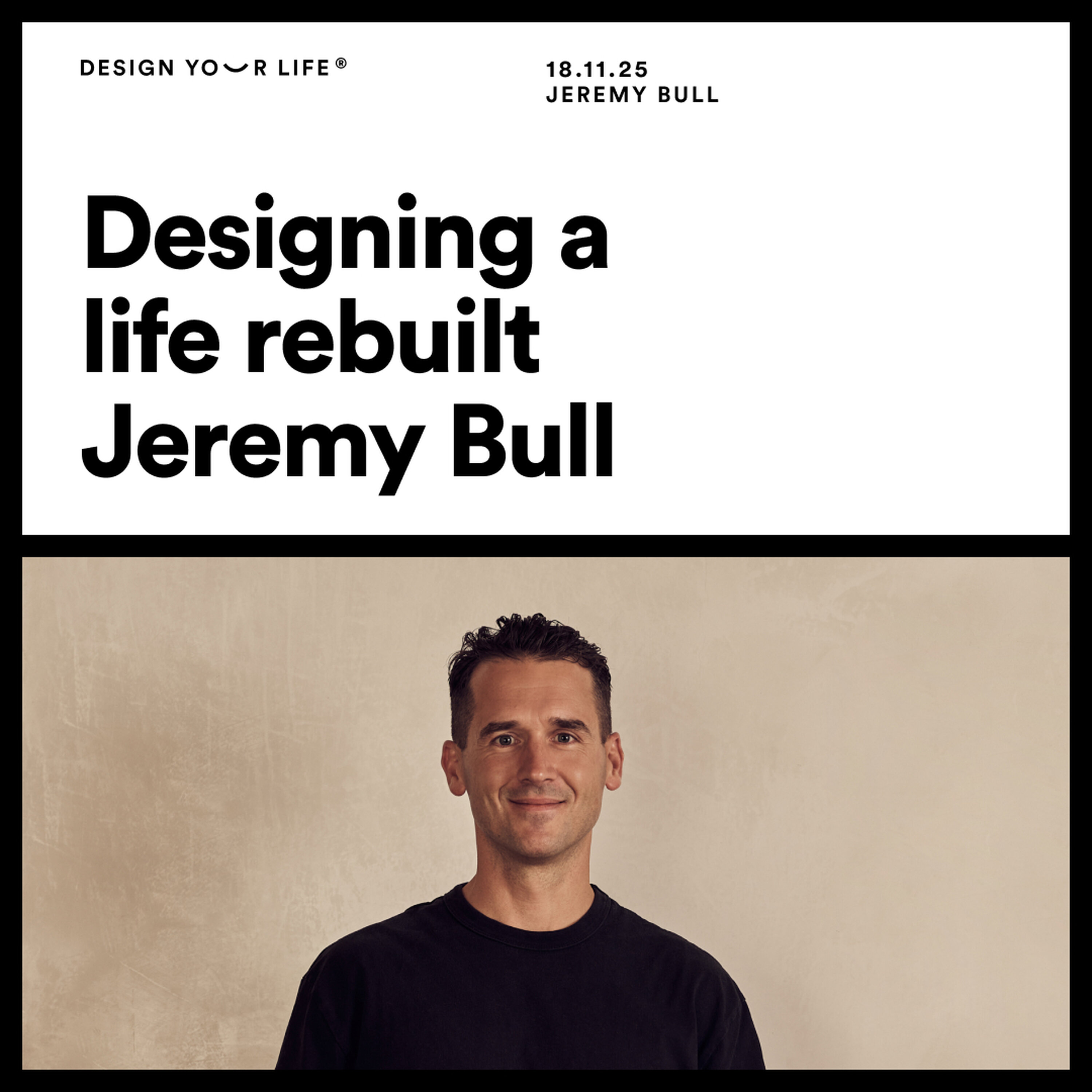
Design Your Life is brought to you by Frost Collective, a strategic creative studio solving problems with big ideas designed for real impact. Welcome to today's episode of Design Your Life. Today I catch up with Jeremy Bowle, founder and principal of the award-winning design studio, Alexander and Co. here in Sydney. Tune us be told about his journey from self-destruction to self-discovery and how he rebuilt his life and practiced with purpose. And why true design always begins with feeling. [Music] Design Your Life. Welcome to Design Your Life. We're here in the Sydney studio. It's so good to have you here Jeremy. Thanks for having me, Finn. I'm looking forward to it. We met the other day at your studio in Bondi Junction, which is mind-blowing. We'll come back to that in a second because I just love how you've designed that. The setup you've got with your house next door and the multiple houses and studios. It's just beautiful and I'm incredibly envious of that. Tell me a bit about your life growing up. The earliest memories in the Middle East born in Riyadh in Saudi Arabia in the late 70s. And lived there and moved to Australia in 1985. It sort of came across when I was a young bloke. I guess the kind of formative memories were segregation on buses, sitting with my mum in the kind of cage section of the back of the bus. She's living in. What actually wasn't as bad as it's when you're there and you're a young person. It didn't seem to be much, but you hear the conversations about, you know, having nothing up to show your knees or your ankle. Living in compounds, so we were expats. My dad was a non-collegeist and he worked at the hospital in Riyadh and we were moved around from compounds to compounds. Which was actually a, like a pretty amazing way to live as a young person. Back then, pre-screen was to have these sort of communities, compounds of what they were called. So most of my really early memories are expat communities, expat friends, living in compounds, which were largely these sort of enclosed, safe expatriate villages. And we lived in maybe four or five of those, traveled around quite a lot because we were in the Middle East and dad and mum were largely funded by the hospital and moved here, like I say, in 1985 and started at school on the North Shore Sydney. And I guess still then, you know, that was still a time when you used to get on your bike and ride to your friend's house and kick a football down the street. Very, very different environment. Yeah, well, I think it was very different from the Middle East. It's certainly very different to what it is now. My memories were, it was, were longer with the suburb that we were raised in. My memories were that there were still horse paddocks and people's backyards in 1985. So the subdivisions hadn't quite taken place to the degree they are now. So it's just really kind of different. And largely living in a way that was, you know, I remember myself being kind of quite kid who was pretty happy with my own company. When did you have the kind of interest in creativity and architecture? Architecture, I think, is kind of like chapter seven or something. I think that it came, it's maybe coming now. I think it kind of way, way later than kind of creative processes, which for me mostly drawing and imagining, like I think imagining and then trying to draw it, has been probably always there, always as far as my memories can go back. And I think architecture was like maybe an accidental discovery that happened after school. And has continued to develop over, I guess, the last 30 years. And it's, you know, a passion, but it certainly wasn't a part of my origin story at all. So how did all start? How did you, did you go to design school or architecture school? Finishing my HSC in the 90s and kind of spinning a wheel. Like I had, I was talking to my sons who are now kind of getting ready for Year 11. And I think I had physiotherapy, psychology, engineering, architecture, something else, you know, on those kind of options that you put into your career. So there was this, just nowhere. It was not very unstrategic collection of decisions and then just got into architecture. If it could be any more ad hoc than that, I don't know how. But kind of, it was that undeliberate and I would have been happy to have started on any of those courses at the time. Incredible. Yeah, it probably took another four years to start to enjoy what I had kind of put my name down for. And really through the lack of getting a couple of really good teachers, I would say, I would put them in the bucket of life changing kind of, you know, life coaches, people who are accidentally in the right place who were able to kind of redirect or direct me and help me kind of find the passion in architecture or find the magic in it. And was it through your, were you just have this love of drawing? Is that what kind of drew you to that? Yeah, I think very, like I think, like there's a creative thing. There's this sort of, there's a component to me that wants to come up with ideas that's been there. I think it could have been, I think it could have come out in just about any way. It could have been literature, it could have been graphic design or, I think the chance of landing into the built environment was really a huge luck thing. And it was just the medium that is now where I kind of work, but it could have been anything. I don't think there was a singular burning focus on being architectural. But as it went, you know, and I started going to construction sites and seeing things being built, I think that there was, like a really big falling in love moment with, you know, how the impact and the influence of that art form and the opportunity of that art form and as it's gone along, I mean, this is kind of amazing, say that the sea gets deeper, the further you walk in, I think as I have gone in, I have fallen more and more in love with it. You mentioned last time we caught up that you were, you were unwell in your 20s. How was that experience and how did that shape your life and how you lived today with your family? I probably mentioned, I was profoundly self-destructive teenager, made it an art form. It was my first creative pursuit. Self-destruction. And had-- So you didn't work out? I worked very hard at it. So got very, very sick as the kind of short version of the story and spent my 20s from-- a 20 to 27, largely in and out of hospital with an inflammatory bowel disease, which I kind of acquired in my early 20s, probably in some part, if not in the substantial part, to the fact that I had spent from, you know, 13 to 20, really destroying myself with drugs and alcohol and smoking and everything that was going on in my head at the time. So spent my 20s in and out of hospital almost without pause for seven years. So it was very, very sick. Had my last surgery when I was 27, which was a kind of multiple bowel resection and didn't weigh much. And the doctor came in and I kind of came out of-- kind of this tube sticking into me and I come out into some conscious state. And he came in and he drew in the air with his finger on the wall, this diagram, and he said, "Here's where you are." And he said, "You can't go any lower." He said, "That's the good news." The only way you can go is up or you can die. And I thought, "Ah, that's quite a big piece of news to get, that's 27-year-old." And I sort of came home, I think, from hospital. It was a mace-added bike with stitches, I'm like, "My stomach." And I thought, "Whatever I'm doing, it's just definitely not working." So however I'm living and thinking and existing evidently as sure I am that this is the path forward as this kind of stupid 20-year-old. This is clearly not working and I'm going to have to do something different.
I think I came away with a sense of, if that's what going towards death is like the first time, I just definitely don't repeat that. And if that is a way to live, I definitely don't want to do it that way. So I think it was a sort of a pretty structural turning point in the way that I saw myself in the way that I saw my body and kind of my relationship to all of it. And I think the first piece was trying to then reconstruct a new reality with a really damaged body and a probably a very damaged mind. So I think my first, you know, middle-life crisis was in my, sort of, 27th year, was just, how do I re-understand what this whole gig is about in a way that's more productive and less terrible? Incredible. I mean, thank you for being so open and honest about that too, because obviously it's an incredible, incredibly personal kind of situation story of your past. And I guess, but you were studying architecture at the same time, right? Was it architecture that told you to this? Was it? No. Were you excited about that? When were you studying, like, in what, 25 years? Yeah, so I started studying in about 97, 98. So I studied through that sickness and I actually also worked through the first couple of years. I was working post-injuring my kind of university degree. I was also sick. So kind of, like I was the beneficiary of hugely patient employers who were able to see me come and go with the illness and university sends the toll, right? You know, you read it in your scores. You're clearly not doing very good work. I definitely wasn't doing good work. So I think. What did you love it? Yeah, I think it was kind of, like, maybe more pathological than that. I think it was entangled, pretty entangled dance with the whole thing. It's really cool that you continue to do it though after that. Like you've clearly excelled once you saw it yourself out. Doing architecture, because although we do interior and architecture and kind of object design now, back then I was really like a technical architect and worked in firms where I was doing technical architecture. So just drafting. I wasn't client facing so much. I have a really limited client facing role. I had a limited career role and it was a technical role. I think the benefit. Pretty boring. But if you just want to see it and do a thing in relative isolation, it was actually. It kind of offered, like, it offered something that probably are needed, which was, "Here's a safe place. Use a chair. One of your chairs." It's maybe not a safe place. No, those were incredibly. We'd come back to those chairs. Well, those chairs, anyone listening to "Nose" or "Cher", we sold them. We had about 30 of them in our studio in Surrey Hills in Foster Street. It's funny, because German, I just laughed about that. He came in with a bunch of other people and bought our kevy chairs, which were designed in 1958. And obviously comfort in 1958 was a very different kind of standard than what it is today. He's actually sitting on one today in the podcast room here. So we still have a few left over, but that was really funny too. The beautiful looking chairs. It's so beautiful and incredibly uncomfortable. I spent 60 hours a week for six or seven years sitting. One of these is just going, "What is this chair?" With a numb ass. Totally numb ass. But the point of all that is the chair indeed. And the role was probably a really great place for me to kind of read. But I have these kind of memories that are going to choose as I'm really far behind. Like if I look at my PR, my peak, who have worked really consistently through their 20s, you know, that was like, I had a friend from school who was like, you know, two I see to the head of Australia in government. And I'm like, "Gosh, I'm like this guy on kevy chair." Drafting someone else's work, I'm way, way behind. And I think that was a notion that I had to kind of come to terms with. What does it mean to be like behind in front? Where are we going? What are we running to? A friend of mine at school said every rat runs his own race. And I was like, "Okay, how do I come to ease with just this race that I'm running, whatever the hell it is?" So yeah, the role was probably incredibly boring, but it was probably the cul-face where I learnt just like technical process. What's important job, of course, is not to say I said it's boring, it shouldn't be seen as being derogatory as an important part of the process. I think it's a totally critical part is that some things take time and to build your brain, to build your internal processes, it just takes time. So the routine was good for you. Yeah, it was kind of rehab, architectural rehab. Well, it's interesting that too, the rehab, I mean it's amazing that you, me clearly look incredible. I mentioned the day how well you look, how healthy you look. And as a person that kind of designed your life is all about kind of redesigning your life and designing a life that's better for you and healthier, better you. And we all go through, you know, some of us have harder times than others, but we all go through hard times in our life. And it's really cool to understand and see how people navigate that. You know, it might go on for a long time until they've actually realised they can't keep doing this anymore and something's got to change. And so it's really wonderful that you saw that light, you know, maybe that doctor kind of, you know, made you go holy shit, I can't keep doing that. I'm sure your parents were concerned as well. But it's that you're turning a corner, isn't easy. And what did you do to kind of, what did you do to kind of apart from the job? What did you do to kind of stop that habit of, I guess, self-destruction? I think that moment when you're like, I've been sick for so long, all my mechanisms have been built around. And my ideal future state where I'm going to be well. I think the first thing post that huge balsajr I had towards the end, and I was like, oh, I'm actually kind of well, I've got rid of these disease from my gut. It was very difficult to know how to live as a healthy person. And I think that was the first kind of catastrophe, it was sort of then going, what do you do now? Like there's no, you know, you have to lie around and sleep and I was in pain and I had to move from my apartment back to my mum's house and sleep on the couch. And I think the first thing was like, oh, actually, I can do independence properly. And I can go out and do things that I couldn't do. What the hell? Like what am I, what do I do? So the first catastrophe was just looking at the options in front of me and going, well, there's no reason to not do them. I guess the kind of notion was that would be a really good thing. I think the first thing was that was a really, really terrible and really, really hard thing. And the first thing I did was start going and seeing a psychologist, which I was also kind of novice at, I'd never seen one. And that started a relationship, which has gone on until now, actually. So 27 to 20 years. I've been seeing psychologists or counselors or coaches or people who are working kind of compassionate inquiry. So I think that started a journey of how do I rebuild a brain that's more effective and rebuild a body that's more effective. But certainly the first thing that surprised me was becoming well is the first catastrophe that I had to deal with that I was not quite expecting. What was the surgery? Being just being well. That was a catastrophe. Yeah, because suddenly, suddenly, the thing that you always wanted, the thing that you had always hoped for, the thing that you couldn't get to because you were limited and stuck and sick, suddenly you had it. And so I think it was kind of like, there's an existential moment of what now I spent seven years building all of my resources and processes, deliberately or undeliberately around survival. And now all the resources can go somewhere else. And what do I do? Yeah, so like I think it was a fairly big existential dilemma. That's amazing. Well, I mean, a good dilemma, wasn't it? And it's so cool that you put all that effort and energy into turning your life around. Did it kind of creep up on you that, hang on, I have actually achieved what I was trying to do? Well, that's what I think is kind of more existential. Like, yeah, on paper, you're like, well, great. Go for it. I think internally, it was felt much more complicated than that. It's like all these other questions opened up. Like I spent seven years trying to stay alive. I spent seven years trying to eat. And now none of that was an issue and everything else was a possibility. And yeah, although you might go, all of the first thing you should do is be really stoked to be really enthusiastic and go do it. The first thing I did was not that. It was go, what the hell? Yeah. Here's all of what I've wanted. Well, I don't even know how to engage with it. Like, this is a world I don't live in that I'm unfamiliar with. Amazing. So when was it that you started Alexander and Co? In 2013, we founded. Okay. With your wife, right? Tess. So we have four sons and Tess wasn't working at the time that I founded. So I have been working in collaboration with another architect for three or four years before that.
found in the practice without really any consultation with tests, we're actually with none. I had spent the day before founding with a great friend who remains a great friend and he had a wife who is now passed away who was very sick with cancer. And I was at his house and I was like, I'm like, "I'm just not happy. I want to do something different." And this friend of mine said, "Why don't you just do your own thing? Why don't you set up your own company?" I was totally never going to happen. And I can't do that. Look at me. And his wife, who's a beautiful angelic and unwell woman at the time, just looked at me and she said, "You absolutely can do this." I'm like, really? And she's like, "Yep." And sometimes, my experience of life is sometimes you just need this random piece of positive affirmation from just anyone and you'll go do a thing. So I sat down with Nick, I'm like, "Well, let's do a website." He's like, "Well, you need a domain name." And I'm like, he's like, "Come up with a name." And I'm like, "Well, I know I don't want a mind to be my name. I know that whatever I do, I want to have some kind of concept of succession that can be passed on, that can be scaled." I was really sure about that from my previous two employers. So just use my mental name. And just on the spot, set up a URL. And register it. I laugh anyone who asks the URL, because I didn't have any email address at the time. So every year, when we get prompted to repay for the web address, it goes to my mate who set it up. And so every year, he refords it to me. So for 15 years, he's put it up and re-setting. It's time to renew your registration. Like, one day we'll fix this. So then I came home to test it. I'm like, "Oh, test I've resigned." And we had two kids who were probably three. Now twins, all our twins. And she's like, "You've resigned." She's like, "We've got two kids. I'm not working. I'm like, "I know it's going to be fine." And she burst into tears. And that was the start of the practice. But I think, you know, after she kind of recalibrated, the test has always been in the back of the practice. Also working within the practice. But it was done on sort of a fairly cloaked dagout, when I registered the practice. I hadn't thought to consult. It's-- It's strange as that might have sounded. Now, yeah, we had a family in kids, but I just went and did it. And then turned up with it. And asked for-- what did they ask for? Figurinous, not permission. That was the MI at the time. And what were the early days? Like, did you have any clients at the beginning? Or would you sit there waiting for something to happen? Well, from the previous practice, I had one client. I thought, oh, that's probably-- so it was going to take, you know, as me at a cafe with a kind of old laptop. So one client was all I needed to pick up my salary. But I'm like, oh, I have this kind of idea. You know, we'll be a practice. We'll be a company. So I went and got a desk share, day one. I'm like, I'm going to treat this like a real job. Like, it's really going to do something. So I'll put on my little outfit. I'll go to my desk share, which is in our tarman. I'm going to treat this like proper work. And it just went very well from the beginning. In terms of-- we did a couple of projects. So it really well received. And we were able to put on staff. And it was very, very unready for what it meant to run a practice. I think running a practice would be way too generous to say how it was actually run at the beginning. It was kind of probably not that slick in operation. But it went well. And we were able to kind of grow. And we went from our tarman. And then we got an office in Paddington. And then Paddington, we moved. We had to keep breaking our leases because the team got bigger. We moved to Redfern. And then we moved to Redfern again. And that was the final lease hold before we then built our own building in 2020. So it was surprising that for me, it was really surprising that it went as well as it did. And it taught me that I needed to learn just a whole huge collection of things about business. And people that I had no idea were a concept. I was an architectural drafts person who set up a practice. And then it was like, oh, there's money, there's people, there's HR, there's, you know, how do you manage yourself? How do you make yourself a leader in a way that's just not totally damaging to the people around you and productive for the people around you? And all of that's been, you know, the last 13 years. Yeah, well. And how did you do that? Did you bring kind of advisors in to support you on that? Yeah, well, we've had coaches. We've had coaches in the practice for maybe the last five years. I think for the first eight years we just made the same stupid mistakes. We certainly made the same stupid mistakes over and over. And you're like, oh, this is probably a me problem. I'm pretty sure, you know, I can't take a context, change it, change the people in the context and create the same problem over and over and over and less. The only consistent component here is me. I maybe need to get to it with myself. And what was the work that you were doing? Was it at that time? Have you always done residential projects? Obviously, that incredibly beautiful, the homes that you've been working on over the years. I look through the website, beautiful website as well. And in terms of the homes that you're designing for people, the stunning. We've, thank you. We've always done houses, but so, you know, we had a mortgage. We had a place in Banda Junction where Tess and I lived. Tess wasn't working. We had two kids. And the first thing was just kind of coming to terms with the economic situation that I had put us in, which was, I'm going to need to make enough money to pay our mortgage and keep everyone fed. And I was like, oh, well, you know, how I might take three or four years to do. So I'm not going to give me a lot of marketing content. So if I'm going to market something, I'm going to need to do something which is a quicker, sort of project life cycle. So we started doing interiors, which I had done in my previous place of work, also at the same time. And I have these architectural heroes, you know, like kind of the Rem call houses and the Herzog and Dymoron of this world. It's kind of really impressive thing is, and I had always imagined myself as trying to, you know, at best, maybe you've just copied them. But for us and for my kind of circumstance with tests and kids and we had two more kids in the first two years of the business, I'm like, I'm going to need to do something which just generates some income and moves faster and can market faster. So we started doing interiors almost purely as a like a life strategy, which is I need to get a marketing message out there. I need to be able to brand and I need revenue coming in. And we'll get to the architecture a bit later when we can afford to do it. So it's always been ticking along, but the interiors were a life, that was like a life hack. And we got pretty good at them too and we've kind of kept going and they're lovely and they're, I guess, you know, now we think of the practice as an integrated design studio, what we do architecture in the interior design and we try and tell the world that we do it all. But certainly in the beginning it was like, I've got to pay bills, like I'm a guy in the world just doesn't know what I'm doing, but I know I need to keep food on the table. Are we doing it out of Bondage Unction, your home in Bondage Unction, or do you have a studio? Not at the time, so from Artam and from that desk chair moved to Paddington Street, we had a little shopfront, which we shared with Alexandra's team at Deakus back in the day. We both got that little office, so she had one side of the office side the other and then we moved into Colleta who, or a Fed out company, they had a bit of space space. So we sublet from Colleta, from Roberto, and then we moved into our own warehouse studio in Crepe Buckingham Street and Redfern. And then we bought the neighbours house and we built it during the first COVID, so during 2020, it was an opportunity that we were able to take. Yeah, I mean it's for people listening in, it's Brisbane Street, right? Yeah. In Bondage Unction, in Bondage Unction is famous for its big mall, but it was actually a train junction, a tram junction, I think, where it was. Way back to Bondage, to Bondage itself. We used to live in Millhill Road for a while there, which is in Bondage Unction, which is beautiful little street and a lot of Victorian houses. When Luke and I went to your studio the other day, we were just like blown away by it going, wow, something's beautiful tree line street. You walk in and it just feels like it's one of the best studios I've ever been to in my life. Thank you. You done a great job and in your team kind of wondering in and out having a coffee or lunch or having a meeting, you designed it beautifully in it sits right next door to your home. If anyone is designed their life, you certainly have. You've done it phenomenally well, it's just incredible. Very envious of how you've done that, because I think I and a lot of people would like to live in that way. But what was the deciding factor around that? How did you work out how you wanted to design how you lived and worked? Was just by coincidence that next door came up for sale and you thought maybe you'd make them to a home studio? I think there was a couple of factors. One is my dad, kind of baby boom and my dad wasn't around when I was growing up.
really great not to recreate that, it'd be really good to be there in a way that my dad wasn't. The workshop that we were in in Great Buckingham Street was on the top floor and it had this terrible lift that just kept breaking. And we went to the strider where like you just like you got to walk up like all these flights and this lift doesn't work and like are you gonna fix the lift? Really didn't go anywhere. And so we started looking for commercial spaces around Redfern because I was like I will go get it, we'll go buy our own. And so we started looking and we went spoke to something mortgage broker and I will yes you is if you buy commercial space you need 20% of the deposit up front the terms are a bit different. But if you buy a house it's 10%. And that's a lot of money when you're starting. Well yes we're a start up so it's like 2018 so we've only been in business for five years and like I've got to do all that but I've also got to securitise it with my own house because the bank's not gonna lend it to us so we had a neighbor out who hadn't lived in the house because there's an old bloke. He hadn't lived in the house for years. He was in care and we'd already we'd knocked down the fence in the backyard long ago and so we used his backyard and then we used his driveway because he didn't drive and we're like test we only took over the place. Test where's really stuff if our favorite comes back where stuff because we use his yard and we use his drive what are we gonna do? And we're looking for an office in Redford and we're like well okay why don't we just offer a house to buy his house? So we offered an aft aft and his estate and they're like yeah no worries so he bought his house and it allowed me to go well if I'm gonna securitise my own house against this thing it's really close it's gonna allow me to be close to the kids which is gonna solve that kind of problem I had with Dad but I think that the whole kind of the whole way that the creative came to be was like the timing looked really good because it was COVID and there was that whole work time from home migration but really I was like okay if we do this and if the business fails I need to go to sell it as a house. As a house. So whatever we do we've got to do it so that it can be really easily fitted out and inexpensively as a house so we designed a house and then we left the walls out that made it bedrooms and we're like we'll just build that and we'll make sure that the bathrooms are all different so they've all got you know all the stuff that we do and you can see all the finishes and we'll just build a house so if the business tanks put the walls in we'll flick it yeah and then COVID came along and then everyone worked from home and then you've suddenly got this like work from our home thing that's right next to your house that's really you know surprising like kind of really pretty building to work in so like we were hugely blessed with timing but almost the entire strategy was built on you know that that assurity then the first X number of years the businesses likely going to flop and you need to be able to have an exit strategy that doesn't leave you paralyzed and that was really how it came to be as it's gone on and you kind of build a bit more confidence and you capacity to to do work and to to to do it well over and over the outlook changes it becomes a little bit less um not cynical but a little bit less bearish and they're less fearful of you going out of business yeah okay yeah I think you kind of I don't think that that crosses my mind but it's certainly due to 2018 and 2019 when we kind of bought the place and so now you're like oh well we have a we have a business which is good and we have the need for these spaces and we can do this and this is actually good for our team it's good for our clients and our clients have a really great experience of the business so you know it expands yeah talk about I mean I think it's spectacular and as I mentioned and just it feels it just makes you feel great but it also it's your design I guess you're living you're working living in the thing that you do your own work yeah so when you look at all the homes that you've done for other people which are unbelievable um talk about your kind of your philosophy around designing well you you kind of talk about the positioning of the businesses we enrich place through people um talk about that kind of positioning and how you approach your projects you know when we're very in the very very early days before we had a brand before we had a logo um I I had worked in practices which were kind of like you know very modernist and very um passamanias you know like architecture was a modernist game and you sat on uncomfortable chairs and like you had to you had to be a bit of a masochist like you had to hate yourself a bit and you end those you know you went through university where you were told that there's no money in it um you know you're gonna drive it taxi in your spare time and blah blah blah like this all just sounds like such a shit story like this is a bleak outlook yeah and I'm like well what would happen if architecture was like a kind of luxury product and and when we've kind of started the business um like mr. Porto which was that online company he was kind um I was doing his thing and and I was really into Saint Laurent and and what they had done to re-brand and I'm like well let's let's look at making a logo and trying to come up with a company vision that turns architecture and interior design into like just a luxury service yeah so we took the logo of mr. Porto and we took the logo Saint Laurent we mashed him up and I just drew this logo which was Alexander and Co and that was kind of the birthplace of the logo but also the the thinking about the business that architecture didn't have to be pious and it didn't have to be panics like you didn't have to hate it um or just a service yeah it didn't have to be just like this hard thing where you got utilized to give someone a design where there was some celebration of the celebrity and of the art form and of the experience of consulting which like I hadn't seen in my in my where I'd work like the experience of consulting for a client was like yeah it was a service like I don't know dentist you came in the idea thing in your left I'm like what would happen if you know what would happen if a client's experience of this was just like the experience was half of what they wanted was just so good yeah certainly when we were thinking about Alexander house you know I'd done a if you look at listen to the first episode number one of masters of scale which is that read Hoffman podcast there's Brian Chewski which was Airbnb and they do this whole exercise you know if we were a one star service two star service and they go through it like 10 or 20 stars and I'm like what what would happen if Alexander and Co as a service was like a 10 star service it's like well it would be like a club a client would walk in and they'd have their own key and they'd walk in they'd sit wherever they want they'd have a meeting anywhere they want they could choose their own sort of menu of experience they could make themselves a coffee or wake you make it fall I mean I think they wanted to do this a shower because they'd been with the gym they get like it was a club and so that was really built into the Alexander house but the ethos of the experience as a consultancy was built in at the very very beginning from from the logo but as we went on within the business the the other thing that really kind of came out is although we're working the built environment everything here is manufactured by people everything here is designed by people and and in fact the architecture is the very very very final little artifact of these massively complex processor relationships and go back to the beginning of the practice I was still learning to relate to myself let alone my own team and I'm like well I think one of the things we need to work out is how how do we understand people within this business both clients our own internal team the makers and the craftspeople and the builders just the whole thing how do people become the the context and also the objective and architecture is like a byproduct of it architecture is what is going to spit out the back but the relationships and the quality of how we think and talk and relate and take care of one another and utilize each other's skills that'll be the number one thing when we were thinking about our practices of B-Corp and we were thinking about our practice ecologically the thing that kept coming up is there is there is things we can do and they're limited in terms of how we build buildings and we can do some stuff but we were working in a largely wasteful environment the one thing that we are absolutely in control of each of those relationships within the practice and so we started and we started doing this kind of work with indigenous elders around like what does it mean to decolonize your practice and like well this is about your intention like what do you intend to do and like what's the product like what's the thing that I tick and they're like no I forget about the box ticking and the and I don't forget about the mural you're going to slap on the wall like that's stuff silly what's your intention and how does this become intentionally about you know what the culture is that you want to sustain about your relationship to to kind of land to one another and so as the practice went along what we started and continued to be really focused on as the relationships with the people and how do the people think and relate and relate to our clients and provide this incredible experience as client journey and and that will be the first thing we do and the thing that will be the byproduct will be the architecture so I think it was a kind of shifting paradigm from where an architectural service actually where a people service and where a consultancy and we consult with people and we make with people it just so happens that there is a spatial environment that's the byproduct of all that so I think that's a really strong thread within the practice
That's interesting. Good is not about the home first then. It's about the experience of creating the home. When you look at the homes, the homes are full of rich materiality. Like it's just there's so much beautiful materials throughout the homes that you design. I guess there is a trend for that now, but I guess you were doing it prior to the trend. We've had that moment where everything was beige, white walls and very minimal. Now it seems to be a lot of design publications or full of, sometimes over the top interiors. It's more and more. Whereas there's an absolute elegance in your places that you are at designing. Talk about how you do that as well with your team. Designing for others, I guess you don't necessarily just kind of enforce a way of living on other people. How do you then work with the client on designing a home that actually works for them? But is elevated beyond what they can do themselves? You know Esther Peral back in the day when Esther Peral had a podcasting on where do we begin? Is that kind of idea of where do we begin? I think that idea of how do you bring your client stories out? How do you facilitate it? How do you become invisible to the process? I believe the client just gets to tell their story and you'll make it happen. So I think that the idea of how we work in a consultancy and it sounds a lot like this, go on. Tell me more. Tell me more about that. So much of what we're trying to do as a consultancy is to facilitate a client telling their own stories. And so I think that when we do it well, these spaces are kind of like a sort of psychological landscape of just the client telling us their story. So a lot of what we do is we are expert advisors and we're expert consultants in so far as we listen really well and we just ask the client to tell us more. And we try and hold off from giving them an air quotes a solution for as long as we can. Really until we know what their solution is. So I think we always get asked is there a house style? There probably is something you'd call a house style but there's definitely a house approach. There is definitely a house attitude to how we consult and the kind of psychology of understanding what a client wants to tell you. And then trying to turn their story into something which is special. Like that is absolutely something that I stand by is the process that we run is, is it tell me more. That's how we do it. So when a client comes to you, they want to refurbish a home or they bought a home. And what's your job for example? Like do you just, I'm looking at no mad apartment. You just design the whole interior space, like choose all the materials or the furniture, the art, etc. Yeah, we can do. Sometimes we don't. Sometimes we do. Yeah, it depends on what the client wants. Sometimes we do the house and the interiors and also the furniture. I think again, it's sort of just a response to what the client's asking for and sometimes they don't know what they're asking for. I think the process is a patient sort of process. Do they have much say in it? Do they have? I think they have entirely all the say and then there's places where a client doesn't know or might think that these are aesthetic decisions and they try and redirect them and give them an alternative form. Unbelievable. Like this one, Bonda Junction House. Yeah, that's our own house actually. Damn it. That's 15 years ago. That's the death of. Or the test there as well then. Yeah, that'll be testing it. That's it. Yeah, the femme fatale. Yeah, but when a place is designed well, how does it make you feel? Surely that's the main thing. How do you gauge a great place? Is it by your feelings? Yeah, the feeling is. Not just the financial increase in value, but. No, well, depends on which client you ask. Some say more ambivalent. But I think largely everyone, regardless of what they say, wants to feel something. Human beings, we're weirdly connected to memories and to nostalgia and to the future and to hopes and dreams. So we're kind of this entanglement of what we want to become, what we've already been, the things that we loved about what we've been and the ideas about where we want to go. I think all of those things end up having a feeling of some sort. If we're designing anything and there is no feeling, I think that that would be a hugely disappointing product. I think the more a thing can feel in the right way, whether it's that enthusiasm for something that's been or the enthusiasm for now or satisfying some vision of the future, what we call a desired future state. I think that the feeling is a huge part of it. And certainly within the practice, the first rubber hits the road moment is when you sit with someone who's new and you go, "Tell me about the feeling." And they're like, "What are you mean?" "Where do you feel it?" And I ask this question and it just shits the team. "Where do you feel it in your body?" I'm like, "What do you mean where do I feel it in my body?" So the first thing is like, "Well, what is a feeling? How do you know it's a feeling? Where do you recognize it? And how do you turn that into a spatial objective so that there's a product?" But the feeling is a huge part of this story. Huge. I kind of intrigued by this kind of like craftsmanship because there's craftsmanship that is being used in these interiors now with the materials, genuine materials, not fake veneers and all this kind of stuff. I don't know where this craftsmanship came from because it was possibly a lost art in some time. Or was it? Or did you get in just in time to kind of the next generation, help the next generation to learn how to make beautiful cabinets and bricklaying? It seems like it can be a reassurgence of this kind of skill that possibly could have been lost. I've always believed that whatever we do needs to have a realness to it. So I think that the idea of something needs to feel substantial, that's always been there. Probably what has happened as we've gone along is we've been able to work with people who did the craft, who did the thing and you're like, "Oh wow, there's so much that I don't know. Is that these guys know?" And half. It really makes it, too, doesn't it when it's done well? I was speaking to Duncan who does a lot of our concrete work. And I'm like, "You know, there's a whole epoch of our practice which came about just because you did concrete." And we're like, "What are all the things we can do with it?" And then you know, Duncan's not doing his concrete. And you take it out of the cast and have all these air bubbles and imperfections in it. And you're like, "Oh, that's amazing. Like when you make something and it's real, it's totally imperfect." And all these graces and scars and at ages, you know, like a brass, like a burnish is where you touch it and stay shiny or you don't touch it. And concrete as air bubbles and what you start realizing is this massive amount of information we just don't know. And all of these materials, when they're real, they come to life. Other than they come to life themselves or they come to life through the makers. And I'm like, "Well, how do we do that project?" So that there's just oodles of space for real things to just do what they do. One of my mates, Sean Connelly, the chef Sean Connelly, he's kind of catch fries is like catch cries, like unfuckable food. And he's always like, "Oh, you know, I'm the bone in the shell." I think the same thing is true for the design. The easiest way not to stuff it up is just to use stuff that's already really good. Like, use an eye fillet or use an oyster. Like, just serve it up. Like, I think it's the same with a solid timber or a solid piece of brass or a brick. Is largely the work is done by the material. And your work is just to set back and give it the space. I think more and more as we live in a world of very, very fast-trained, high-high cycle and this sort of visual onslaught. Pinterest is just this incredible resource and gets used so destructively. What we're dealing with is the infiltration of just visual mourners. And with an image or with an impure trust, although there's all these ideas, there's certainly nothing real, like if they're just images. So I think so much of the tension is, how do you exist in a world where images are just everywhere? You can get a bot to make you an image and yet we can't live in that world. So it will be a great deal.
How do we do realness and how do we do it? How do we do it kind of calmly and feel really confident that it doesn't matter if it's not the hottest thing on Pinterest right now, it's going to be better. And I think so much of that is you just use real things and you celebrate all the bloody imperfections and all the stuff ups and it's kind of like human psychology, right? Just allow it to be. Choose some good stuff and allow it to be. It feels that with that shift in, I guess, Australian interior design, I don't know if Instagram influenced that, but there was a time that shift now is, is it Australian to you, these disinteriors? I guess it's coming from it, but how much of an influence by, you know, I guess, old European interiors, etc. Where they did do, you know, wooden kitchens and things like that. They weren't kind of, wasn't IKEA, everything wasn't IKEA, IKEA is, or how are you set? Yeah, I had this teacher at universities, but I'm kind of lecturer, I called Kavalka Tunian and Kavalka is a lecture series on what was called critical regionalism. So I'm going back to the late '90s. Critical regionalism was like, you know, you have these resources which are regional. And so you build these pieces of architecture that look very regional. And you know where you are because the buildings look like they're using the resources from where they are. And it's times when you still have that, like, you know, we did this thing in New Zealand and it's all this grey-schist stone. You're like, that is a New Zealand stone, a quince sound stone. But I think that, you know, what, one, like, I'm not from here, like, you know, my relationship to this space is not, I wasn't born here, but even still an Anglo-Saxon guy who came from somewhere else. I don't really know. And we live in this global place where supply chains are global. And imagery is global. And I don't know within the course of my practice what it means to do something which is in, you know, in Airquats, Australia. I just don't know. I think that there was a time where we were probably more, you know, in Airquats, critically, regional and Australian architecture because you could choose like Blackbutt and like Granite. And we all know what those things look like, but that's gone. And now everything is global. And the imagery is global. And supply chains are global. And I am inherently a big global in terms of where I've come from and where I am now. So I think that the work is climatically responsible. I think that the work tries to be as much as we can within the context that we can be environmentally responsible. And then I think the work is really connected to lots and lots of ideas, lots and lots of experiences that our teams have, that I've had, memories of places that I've been or intend to go. And everything is like the furniture, the cutlery, the vases, the flowers, the art, everything it works together. As you say, it's global source, globally source. Yeah, I think that, you know, try as we might, you can't wrap yourself in a kind of local blanket so much. I don't know whether that's a good thing or a bad thing. I don't know if it's irresponsible or responsible, but I'm like, we just, we are just connected to it all. I think that the half the problem is trying to make sense of that opportunity in that connection and trying to do something which still feels relevant in a place. And you're curating the places where people and families live. How did, what's the, what's the feedback from those experiences that you've designed for them? I guess, like, you know, if the question is, what did the clients like it? Yeah, yeah. To be more direct, yes. Well, they don't call me when they don't. No, like I think there's times when you make errors, there's times when you stuff things up. There's times when you just do work, which is in the eyes of a client in complete and you have to go and finish it. I think residential projects are measured very, very differently to commercial projects, commercial projects. They tend to stand on their own two feet. Did it work or did it not work? Commercial, they did it to make money. So we live in both worlds because we do multi-reason. We do kind of place-making hospitality. We do residential. So the way that feedback loop looks really different depending on the different projects. And you get it in every flavor. But I do think that the client, that's probably the one thing that is absolutely critically regional right to a project is that you have a client. I think the best clients are the ones who want to live in the house who really have a connection to the house and who drive you to do something which is specifically in the response to them and their brief. Actually, the most difficult briefs are when the client's, like, look, I've got this thing. I'm going to be here and there. And I'm going to live in it, but I'm probably going to sell it and just do a thing. I think those briefs are really hard because, like, what do we respond to? We're going to end up regurgitating something because we don't know how to get the information from this client. Because they're not committed to-- Yeah, they don't care. Yeah, yeah. Like, they're not going to say no and push us and agitate us and provide us. And when we sit down and we say, tell us more, they're going to say, well, you tell me what you want to do. Like, I think in all of these projects, they benefit from tension. They don't thrive on ease. They benefit from the tension of being challenged. What do you think the future of home design looks like as we move toward denser cities and changing lifestyles? Like, I think about this a lot. I think about urbanism a lot. That's that kind of really interesting legislation, which is the low-medium residential legislation, which has come through, which is sort of focused on densifying. I think the question of how we live, what does a vertical village look like? Or what does intergenerational housing look like? Or in a world where housing is just so expensive, how do people cohabit? Like, how do we make this-- how do we make a more productive model? Like, I think I'm not-- I don't have a utopian vision. There's no kind of look abusier. We're going to do this thing. And it's going to solve this problem. I just don't think the world as simple as that. But I do think there is a huge opportunity for people to agitate the model. And I think there is an appetite for people to want to have more options in the way that they live. So I think aesthetically, I don't know. Eestetically, I don't care. From an urban point of view, I think there is massive, massive number of explorations that have to be done to work out what are all the different permeations in which people will live together and live vertically or live horizontally that we haven't needed, maybe, although we just haven't solved for yet. So the kind of-- the rim call housey and kind of thesis around densification or congestion. Like, I think there is-- I think there's just huge opportunity to make more interesting, more complex, more vibrant spaces because the people are there and we've got to solve the problem. What it looks like, I don't know. And what about scale? Because when you look at your two terraces, at the time, they were kind of, I guess, working colleges, working people's colleges. terraces are all kind of joined together, very much like the England English model. But you've taken-- well, the reason I'm saying that is around kind of how much do we need, because they're actually small, originally small, but you've obviously expanded on how they are laid out and how they use for the today's way of living or working. I kind of people, in the old days, people think-- I mean, some of the houses you've done are enormous and spectacular. But it's almost-- the great example is your next door to your bondage junction house is how you've done that with, in that kind of-- that footprint, but with that material palette and use of light, et cetera, and furniture, how you enhanced a space and then increased the relevance or the scale of it without-- well, you have increased another floor, I think, and you'd rather be dug out the ground or whatever you did. But there is, I think, and today you can actually do so much with a lot less. You don't need a big place to live. Like, I have a small place up in Clareville, and it's a tiny little cottage. But it makes me feel incredible. Like, the space is-- it's not a big grand place. It's very simple, and that simplicity and that very-- the scale of it makes me feel lighter and happier, I think. And I guess the-- maybe there's a shift from having-- a shift towards sharing a coal living, as you mentioned before as well. Over in London, I went to a hotel that was Mason and Fifth, fantastic. And there's a few of them. And they have a room, a lower price room for the night. We can have long stay for three months, et cetera, beyond that. But within the facilities, there's an incredible kitchen that you share. There's a gym, there's a pool, there's work spaces. It's designed for sharing. Your home space is the--
place that you sleep is much more, I guess, smaller and less important. But maybe there's a shift there happening across how we live more generally, to what kind of cross generational living as well, which has been tested in other countries and Denmark or can we wear. That's been very successful. So it is kind of a time for rethinking, the evolution of how we live and work is constantly changing. Yeah. And also around, you know, for a lot of places, a lot of homes are, certainly the higher end homes are for people that are going to afford to spend a lot of money on their home. How can others who don't have that money necessarily increase the quality of their living without a major difference? There's like, there's no correlation between the size of the house and the quality of the life. Like, there's no, they don't move proportionally. Because we live in a funny world where houses are a commodity and in the east where we live, they are a tradable commodity and they're a wealth building exercise. But in terms of needs, there's no cause for the scale or the complexity of what we build. They are there purely because they can be commodified. The terrorists that test and I live in with four kids, we laugh because, you know, there's a single hole that come in all the rooms, come off and when everyone goes to bed, they lie in bed and they go, "Lobby, mum and dad, they yell from the bed and everyone just yells goodnight to each other." Like the Walterns. It's like that and it's like, like, there's a night always laugh because we're like, we live in this teeny little house and everyone can just yell goodnight from their own bedroom. We're like, "We like that." So I think that there's no correlation between scale and satisfaction. And there are a commodity and there are wealth building exercise and there are apparatus for people who want to trade in that space. But largely you can't inhabit most of the building that you bought. And you know, if you go to people who are renting, well, if you, I'm, say, I'm subletting a bedroom in a house, the thing that always comes up to, "My mind is, what we do is multi-reize. Why aren't people designing apartments which are deliberately sublettable?" Like why don't you have an apartment building where you have, you know, communal kitchen, communal dining and then four bedrooms. And the bedroom has got its own tab in, tab out, and some level of autonomy. So I can operate in there. But actually, if I want to, you can use that kind of living bed, like it's there. Like if you go, I was fortunate enough to do a course at a Harvard state at the business school and they have these living groups. And like they've done that forever. Where you live in a living group and you have some shared resource and then you go into your own room, which has got its own smaller private resource. I'm like, no one's doing that. I'm like, why is no one doing that? It's crazy. Like you could have a lesser cost for the room and still have all the humanity of the house. That's an interesting model. It's, from what I can see. Now it's kind of, if it's taking place, I just haven't seen it and maybe it is. So I think there is models like that. You know, there's sort of campus models or shared utility models, which I think are a rife, but a bit like you, for me, the scale is not nearly as good as the convenience and the connection and the interest and like that for me, or index as way higher than it's big or, you know, it's in the right street. Yeah. So look, I think short answer is, I don't think scale is a solution to anything. I think there is space for complexity in breaking down preconceptions about how we live. Yeah. So how we live, you know, our own personal space is to be less, but to be more kind of a sharing spirit without it kind of going to the kind of commune kind of territory, which people naturally think is going to be. I know nation are a developer here in Australia, built to rent. And they've done some beautiful up in Maryland, it's done a beautiful building that has incredible technical gym pools and wellness center and shared kind of cooking facilities and, you know, places of families come and have celebrate birthdays, is this unbelievable. Yeah. So I think it's happening. Yeah. This is probably not happening fast enough. And like, you know, we do built to rent, or we do kind of student accommodation where there is like a shared kitchen. And I think that sort of starts to scratch the surface. But I think that if you are multi-residential, sorry, a multi-generational house, you don't necessarily want to share a kitchen with, you know, 200 other people you don't know. It's funny when you walk around, if you go to a supermarket, you just see, I think it was a fact that I heard or repeat this so many times in the podcast that some of like 80% of people walk into say, "Willies, not knowing what they're going to buy." You know, what not knowing? They got to buy some food. Not everybody knows how to cook. Yeah. Like, we're all kind of like, doing our own kind of parallel things. But there's an opportunity to share, you know, share together, like buy the food together and share it. Yeah. Be more cost effective. It'd be more sustainable. Yeah. You know, even connection and loneliness, like it kind of goes, like just totally endemic, isolation, component of being human being today. Like there is all sorts of territory that we probably need to explore to make life a little bit more enriched and be more connected. And that's an exciting opportunity. I think so. How do you stay well? I meditate. So I meditate every day. I have sort of a past and a practice daily. I go to the gym. I do weights. I walk with tests. We have a salon that gets used a lot. I move my body. I fast. AE well. Really? Yeah. Okay. We'll keep that up. Have you designed your life? I continue to. It sounds like you're doing an incredibly good job with you at UNTES and the family and the business and incredible what you've achieved. Thank you Vince. Well done, mate. Thank you. We'll be having you in the podcast. It's great to be here lovely. I'm having a conversation with you to really appreciate it. Cool. Thanks Jeremy. Design Your Life is produced by producer Luca Frost, editor Louis Frost and designer Joel Roberts. [Music] If you enjoy the show, please don't forget to subscribe and leave a review. And if there's anyone you'd like me to speak to on the show, please get in touch by our email
[email protected]. Design Your Life.
 PodcastTranscript AI