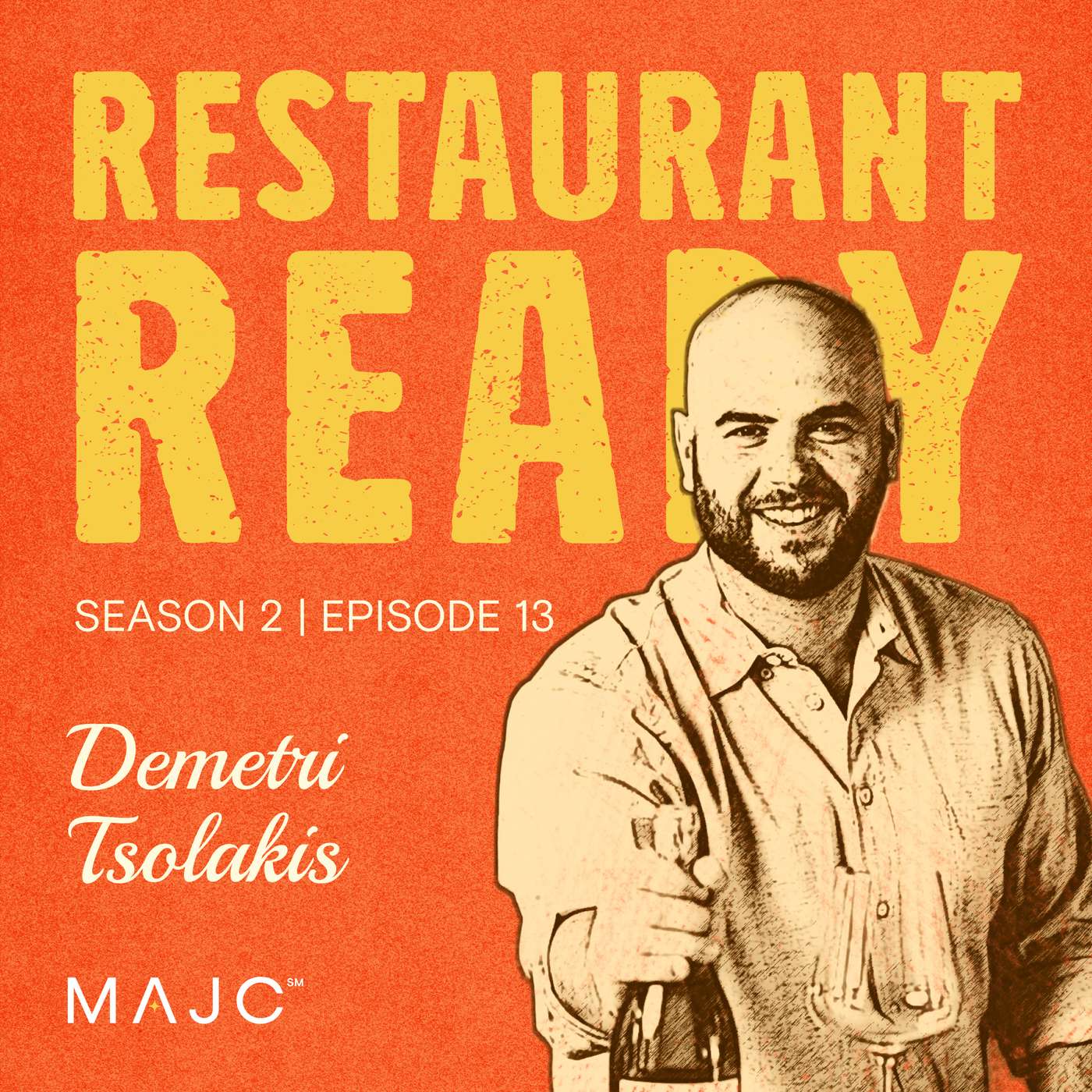
Demetri Tsolakis on Why Hospitality Starts With Your Team
44m 12s
The conversation features Dimitri, a restaurateur who grew up in his family's Greek-American restaurant. Despite a detour into investment banking to please his parents, he found the corporate world unfulfilling and returned to his true passion: hospitality. He argues that hospitality is a vital, transferable skill that creates connection and welcome in any field. Now, as a professor at Boston University, he finds mentorship fulfilling and gains valuable insights from students about evolving industry trends like sustainability and digital media. His restaurant, Kaya, received a prestigious five-star review by successfully blending modern, sustainable Greek cuisine with an approachable, luxurious atmosphere and exceptional service. Dimitri champions a philosophy of non-transactional, spontaneous dining, inspired by the carefree Greek "agene" lifestyle, aiming to make guests feel like family from the moment they walk in.
Hey everyone, want to connect directly with industry thought leaders like today's guest? Well, magic has built an online community of hospitality professionals where insights and tools help drive sustainable profitable businesses. To get early access to the Magic Community, visit magic.ai. That's m-a-j-c dot ai. I didn't receive this. I read it and it's from the great Greek philosopher Homer and I think when he said, "I guess, never forgets the hopes that you did him kindly." That's a model of my restaurants. What's up y'all? Welcome to Restaurant Ready. I'm Matt Jennings, award-winning chef, restaurateur, writer and consultant offering valuable insights into the hospitality industry by way of meaningful conversations with my lifelong peers. And I'm Carolyn Grillo. For nearly a decade, I've been crafting content for the world of food media from leading websites and award-winning magazines and cookbooks to Emmy-nominated TV shows. I'm here to serve up honest conversations, fresh insights and tasty stories. Restaurant Ready explores and exposes the personal and professional tools used by the greatest hospitality leaders across the globe in order to thrive in their pursuit of greatness. Join us for another delicious conversation today on Restaurant Ready. Dimitri grew up in his family's Greek American restaurant where hospitality became second nature before he could even see over the counter. After earning a degree from Suffolk University and starting a career in investment banking, he returned to his first love, restaurants. Today he brings a blend of family tradition, business insight and future facing perspective to the industry. His work focuses on dining trends, scalability, marketing and storytelling and the belief that hospitality itself is the ultimate competitive advantage. All those early years we were doing paper in can. We didn't have social media. We were playing CDs. So I learned a lot doing it the old school way, but really what it meant for me is it was in my blood. I loved hospitality. I loved creating these memorable experiences. I loved guest interaction. I never found that fulfillment in working in finance and investment banking. I really only found it working in hospitality. So as soon as I was a young age, I can reach over the counter of my family's restaurant, pouring Pepsi from a fountain machine. As soon as I had an interaction with guests, it just changed my life. I knew in the future I wanted to do something that evolved around creating these memorable experiences and having guest communication. I just couldn't see it any other way. So fast forward to where I am today. I ditched the corporate America world. I ditched the nine to five and I became a 24 hour employee laborer to our workforce. I love it. Yeah, but you took that detour into finance before coming back to restaurants. What made you leave investment banking and return to the industry? I mean, it had to be more than just the relationship building and the guest experience. Listen, I only went into it to make my mom happy. She was the proud Greek parent. Her child was going to college. She was graduating. She didn't want to see me go that route. My parents were immigrant parents coming from Greece. They came here to live the American dream and they worked a lot. They worked holidays. They worked, you know, open to clothes, you know, seven days a week. We did holidays at the restaurant sometimes. And that's what I realized why we lost so many of our Greek towns, you know, Detroit, New York, even Boston and Rosendale. We lost our Greek towns because a lot of those children weren't going and becoming, you know, restaurant tours and hospitality veterans. They were becoming doctors and lawyers because that's what the parents wanted. I did it for my mom, you know, I went into finance, but I'm like, mom, I can't do this anymore. This nine to five thing is just not for me. And it was so transactional. It was so corporate America. It was such a structured lifestyle that I kind of like to break them all. I like to be spontaneous. I like to do things out of a whim. And in the end, like I said earlier, it just wasn't fulfilling, you know, going in and having clients that you talk money all day that they benefit from. There was really no benefit from me. I didn't find it fulfilling in the sense that I went home every night, loving what I do. And I tell us, you know, and I also teach on the side that Boston University of hospitality class. And I always tell my students, you know, you'll go to school, you'll graduate, and you'll get a job. And that job is just where you're going to go and be miserable. But as soon as you find that passion and that purpose, you have your career. So there's a huge difference between a job and a career. And when you talk to people about in their career, they're happy. They're usually passionate about it. But when someone says I'm going to get my job, you can tell they're the miserable type. So for me, it was that a hospitality became my career, finance was my job. But I'm glad I did it. I learned a lot from it. A lot of the things that I work on today in the restaurant industry, in the hospitality industry. So I don't regret it. But it's not something I could do lifetime. Fun, quick anecdotal story. One of the most profound hospitality experiences I remember as a kid was actually I did some growing up in Medway. When we lived in Medway, there was a little diner up the street. And it was your classic kind of American diner, right? Breakfast on weekends, all the things, right? Turkey clubs at lunch, meatloaf at dinner, sort of thing. But the guy that owned it and ran it, his name was Dimo. And Dimo was Greek. And she started to kind of like fuse in some of his Greek specialties into the menu. And I remember going with my stepdad, who was like, it was kind of his haunt. He would be the guy that like everybody knew his name, he'd sit at the counter, he'd walk in, it was like cheers, like, "Hey, Bobby, you know, I remember those first kind of moments where I was like in a diner, but eating Greek food and being like, what is going on?" It was so profound because I think it taught me that at an early age, even though it probably couldn't contextualize it at the time, that like, there was this great incredible influence that was coming into this restaurant that could have just been an everyday situation and somebody who was making it really unique by extending themselves and telling a story. And I don't know, it stuck with me and here it is all these years later. So full circle to a degree. It was crazy because even for me, I can remember like where I was in Greece, who I was with, who I was sitting next to when I had my first Greek wine under age, of course, no, because in Greece we drank at a very early age, but I remember all that. So I think as we're developing in our brain, you kind of fall in love with it. And I fell in love with my culture at a very, very young age. You know, I went to school not knowing English. I was that kid who had that weird lunch that my mom would send in that kid's like, "What are you eating? Is that a bologna in cheese sandwich?" I'm like, "No, it's Musaka." Like, you don't eat that?" And they're like, "No." But my friends always love coming to my house for lunch and dinner, not their house. We weren't having that in season, so I print spy. And we were having a big Greek version of it. So yeah, at a very young age, you know, I fell in love with my culture. It was made me different. It set me apart. And that's what I know. I used that to kind of create, you know, when I created in my concepts here. So yeah, from that early age, I remember it all and I continued to bring that back to life. You have such warmth and such natural hospitality. I feel like it would be wasted in another industry. I just, I actually can't imagine you doing something else. I made my investment baking really hospitable. And I think that's what set me apart. You know, my clients like me because I think the hospitality part of it, I think it's every industry just needs it. And more and more as I'm dealing now with teaching even that BU, like I mentioned, with students, I'm trying to tie in, "Where does hospitality fit within environmental engineers or what does hospitality fit with the students who want to go to pre-law or pre-med?" I'm like, some always making these connections. And I'm like, listen, I go, "Has, but how does just a skill? It's one that makes you feel at ease. It's one that makes you feel, you know, welcomed." And in the world, we live in right now, that's effed up. I don't know if I can swear on this. But I think it's safe space. I think it's the saving grace of normalcy to go out there and feel catered for and feel that sense of normalcy in the someone watching you and a hug, like even like a virtual or a warm hug, that welcoming that I think we've kind of lost. Only hospitality gives that to you. And if it's over the phone, if it's in person, if it's online, there's so many different ways. We've turned now virtual hospitality and digital hospitality and all of these new words that I would have never known growing up, like I said, on pen and paper and changing CDs. So, hospitality is always evolving, but I think the traits of it and the foundation of it have not. And I think that's what's missing in a lot of industries is hospitality. So, you're teaching at BU, which is where I got my master's in management for hospitality. And I can absolutely, absolutely see you fitting in there and the students really loving you. And how is being a professor shaped your perspective on the industry? And you talked a little bit about sort of seeing hospitality with the bigger lens. Is there anything else? It really means we love it again, because I think we sometimes forget why we do it. I think sometimes we forget the basics and the foundation. It's just simply as a greeting and how you greet someone. So, it kind of gave me that energy again. I've always had it, but to go back and even start teaching my team again and not like the foundations, but diving deeper. You know, we're so good at hospitality and my concert is, but how do we elevate? How do we compete with ourselves? How do we go beyond and do better? That something's already working. And honestly, the teaching has given me access to and demographic that I'm the longer part of, you know, obviously, you know, I'm not
in my 20s and my early, my late teens are 20s. I'm actually 42, going into a classroom and hearing the feedback of what this demographic wants. There are serious demographic. They control a lot. They're shaping our industry. They're demanding change it, and I applaud them for it. They want sustainability, go for it. You have to jump on. There's a lot of things I'm learning, what they look for in a restaurant, what they look for in social media. Are they on TikTok? Are they on Instagram? What attracts them? What gets their brain going first that maybe old school, we didn't have that available to us. We really have to go back in the day with the flyers and hand them out. I remember embossing, going to cars and putting flyers on a windshield just to announce something. We're now you just go on social media. You're announcing it goes viral. So I've learned a lot, believe it or not, from these students, and I've learned a lot actually from my international students. So I feel like what I can give them, I'm also getting in return. So I'm really enjoying it and I find it so fulfilling. I'm at a part of my career that I love the mentoring. I love being able to go into my office and teacher. Share some light on a topic that might be unknown to someone. And the same thing in the restaurant, which I'm doing pretty much every day. And I'm Greek wines or Greek food, Greek ingredients, Greek techniques, Greek culture. It's a whole new world, it's a whole new language to a lot of my team. So to be able to go out there, I'm even getting dorky and making presentations, I'm a regano. And not just saying, OK, why are we here as Greek or regano. But I'm getting into that mood again as I was a student. And by researching topics, I find interesting, more health benefits, more why we do things, more wellness, and incorporating that into my teachings after the classroom. And while I teach the students in the classroom, how I made it to where I am today. So I became a teacher like in and out of the classroom now. So I really enjoy it. And I guess I find it really fulfilling. I love hearing what you're saying about the mentorship aspect of teaching. It's so true. And I think to be our best selves as leaders in the industry, we strive to kind of reach the point where we feel like we can give back to teams in meaningful ways. We're back to students in your case and teams. It's funny. I just literally got an email yesterday, which I have not read yet from a kid. Well, now he's grown men with a family and children. But somebody who I brought in as an intern from Johnson Wales very early on into my first restaurant, mentored him through the restaurant. And then when we made our move to Boston and opened our second restaurant, he came with us on that. And he came on this incredible journey and grew so much. But he was one of those people that I was always just kind of like, did I touch him? Did I get him? Was there enough? Like was there enough kind of contact points for him to feel like he actually was getting something from the relationship? And he moved on to do other things. And it was always kind of unresolved. But yesterday, he sent me literally like a diet drive. It's got to be like three page long email. And I just kind of like glanced at it. But it's like there are things in there that are like, like I had to not read it because I was getting emotional. So all these years later, right? He's now a grown man. And I'm like, okay, good. Like it came full circle. Like I see that there's been a value. He's reached out to me. He's like, please read this email shaft. You know, like, and I'm just like, that's what it's about. Those moments are like, I think when I feel the most fulfilled. I love that. So when you 20 years later, like, oh my God, I remember you. Yeah. Oh, wow. You know, I love those moments. And for me, even I love the students who are like, I'm in hospital and I'm because of you. My first semester that I had one student said, you know, I was about the transfer of North Eastern Bud because of your class. I'm staying at BU. And I was so like touched by them. Like, oh, really? Because of my class. It's like, you really gave me an entrepreneurial mindset that I may not want to open a restaurant. But I have an idea of that really caters towards people. So I want to learn more. So those are the fulfilling moments I keep talking about. You know, when I see that, I'm getting goosebumps now, just thinking how many people that I've impacted in that way. Yeah. And it feels great. And it feels great that someone calls you the M word as a mentor. It's just something that unfortunately these days we're getting bad labels now. When you get that nice label, it's touching. It's reassuring. Yeah. Well, let's talk a little bit about your restaurants because Kaya just earned a super rare five star review from the Boston Globe. I'd love to hear about what you think resonated the most with both the critic and also with your guests. For us, when we did Kaya, we didn't know we were getting into, you know, a fine dining kind of scares me, you know, luxury, those words on that. They're not really my style of eating. So I would never put that out there. But when we can make like luxury and fine dining affordable and approachable, that's what we want to do with a Kaya. We didn't want to have me and white loves and white tablecloth. We wanted to be, you know what? We can give you these great techniques, these great ingredients and amazing service and ambiance. But when I get to charge the dollars for that, you know, I don't think a dollar sign should have an equivalent to a feeling or luxury. I think it should be approachable and affordable for everyone. But when we did Kaya, we wanted to do something modern because you know, Cressy plays a little bit more about the regional Greek, Bar-Vlaha is very, very authentic, very traditional roots of Greek food from northern Central Greece. So I'm like, let's have fun. Let's bring in a chef who was a great resume in dealing with technique and sustainability and, you know, zero waste and taking runoff water and using that somewhere else. So I wanted to like really focus on the hygiene lifestyle. And that's what they do. It's a short period of time that these people in Greece and the islands have their season. But we wanted to do a modern or contemporary approach to Greek food. We wanted to give a chef the opportunity to reinvent or reinterpret their own way. Other than me saying, okay, here's the region of Greece. Focus on that and hear some dishes. You know, it gets kind of boring. So when we did Kaya, we said, we're going to give you the opportunity. Take this a gene lifestyle, take these ingredients and take these dishes that are known. But re-imagine them. You know, come back with something that will shock me as well. And I was blown away. Our executive chef, Felipe, he Brazilian background and brought in these techniques I've never seen before, dry aging fish. And it's a sustainable approach to everything. And I was shocked that he could recreate a Greek traditional dish in a new way. We earned those five stars. I think not only because of the food and that program, but overall, we kept seeing the word of hospitality. You go into these restaurants of mine and you feel like you're a family and that we haven't seen you for years and we're like, oh my God, we're going out the red carpet for you. And that's how we are with everyone. It's important that you don't become transactionalized. And more and more, I'm seeing this in restaurants and it really grinds my gears, as Peter Griffith said, that you go into a, I'm quoting Peter Griffith, I can't believe it. You go into a restaurant and there's not even a greeting anymore. It's just like you have a reservation. It's like so interrogating and you kind of feel out of place like, should I? Do I need to? Is there a possibility? Like you have to beg now. You know, can I eat for an hour? And it's those approaches that kind of turn to me off. And I said, we're going to open a restaurant, a little bigger footprint than my usual 50 to 60 seats. We can have a larger bar, have more walk in space, have more spontaneous visits because right now the worst thing I hated was hearing that I can't get into Couser C or Bar Vla for two months. I'm like, yeah, it's great, but I don't like that also too because I want to make it approachable for everyone. I want people to walk in Thursday at seven o'clock if for dinner. For me, I'm going to make reservations. I can't tell what I'm going to be hungry. You know, for me, it's torx that I don't have dinner. I love that you don't make reservations. Rarely. Walking in and really think, can I get a seat at the bar? Is there a table available? You know, I just not the table person who said, I'm going to be hungry at seven o'clock next Thursday. You never know. And then something happens during the morning, you want to eat that cupcake. You're like, no, I can't have it because I want dinner tonight. So I don't like playing that game. I like to eat when I'm hungry. So I want to make a restaurant that had that more availability and seating and more availability to not plan ahead and have those spontaneous visits because that's what the a G and is. It's a very carefree approach to dining. You go to the beach all day, you're hungry, you walk up to the local tavern and say, what do you have today? And they tell you. And that's the mentality, that Greek mentality, that carefree dining is what I want to bring into Kaya. And the critic loved it. She loved the food. She came, I believe, two or three or four times actually. And each time she just mentioned hospitality in the H word over and over and over that. She left feeling a different way. You know, when you feel cared for, you know it. It's the best feeling when something looks out after you. And I feel like we've lost that in the industry or in society even. And it's a great thing that I see my team really care. And that's what I appreciate the most is that hospitality is I think becoming more and more important in the actual food you serve for me. And I feel it's all the time. It's not what you serve, but it's how you serve it. I feel that at every one of your restaurants that I go to truly, I feel that hospitality and I know it's like I know you've been there. Our warmth comes through in all of your teams. We sat at the bar at Kaya once and had a wonderful experience with two really wonderful bartenders. And then we had friends visiting from Houston and we brought them to Kaya. And that was wonderful as well. We sat at a table and it was great. And both times we were treated with such care and warmth and left feeling better than when we got there, which is I love hearing that. And it makes me happy. But I think what a lot of people also forget to is the hospitality starts within. You have to show that to your staff first. If you don't, you're like one of those owners, operators or manager or coworker that doesn't show that same care that you'll serve a guest. It's a domino effect. Imagine starting your night off on the wrong foot. So for me, I always say, how does it start within? It's how you greet your team. It's how you greet the dishwasher on the back. Everyone's a human there. no one better than anyone or position. You know, it's really hard.
you go in and you exemplify know yourself. So for me, that's one of my biggest things to talk to all operatives. Really, hospitality starts within. Demetri, you guys are known for being huge on atmosphere. How do you think about creating experiences and creating a space where the room, the vibe and the food are all kind of moving at the same pace and everything is in sync? Well, for me, it's all about branding. It's just an extension of your brand. It's from the logo from the feel of your social media presence, your marketing efforts. Everything you put out there, you're going to have that connection from what they see out there in the digital world, the virtual area or whatever you want to call it into the restaurant. So I'm doing a story about BarvLah and I'm coming to the concept and I know I'm going to be telling the story of the vlog people. No one's going to know what the vlog people are, but you come into BarvLah, see images of them. You'll hear the story from the staff. When they say ambiance, it really just isn't the colors of the wall, the art, the music. It's really the staff story telling as well. It's your plate where it's those moments are not just so generic. And when we put together all that, we're not just doing you know walls and paintings and music. We're going into utensils and plateware and coffee cups because we want to have things that no one else has, but it's also part of the story. You know, at BarvLah, I'm getting the pottery from the vlog people, but it's a part of Greece that no one knows about. It's not the blue and white islands or the Lindsay Lohan parties that you hear lately. It's literally about the roots of Greek food and culture as really no one knows. Even Greeks would know it. So when I went to Greece, I felt like I was, you know, rediscovering Greece for the first time, but I wanted to bring that back in in every way possible from the uniform, creating a space that's going to transport you to another part of Greece and doing Greek food for different ways because we do have four concepts with Greek. It's hard. It's not your average. What I never wanted to do is what my family did, you know, back in the day, you could be a blue and white, have a Greek flag and call it Poseidon's Temple and people would come to you. My family was Miko no Svon Miko no Stu Miko no Stuari not that creative, but I'm telling the story of four different ways. I'm making Greek food regional and the ambiance has to match that. The feeling of kaya being the Aegean, it's going to match that. The feeling of northern essential Greek with the vlog, no magic shepherds, it's going to match that upscale wine barring cross sea, bring out different components throughout Greece and then your street food component being Greco, you know, we have to also match that with ambiance too. So I'm taking parts of Greece and I'm incorporating them into, you know, my restaurants based on the concept and the brand. Very important. Even silly things like and I tell my classes, the soap I use in the bathroom, when you go into my restaurants, you know, kaya and krasi, the soap, you know, it's Esau, but when you leave, your hands are so soft and smell so good for three days, you're like, oh my god, my dinner at krasi, it's a way that people connect, you know, we did a hikata to my cocktail bar in a drink with aroma. So everything plays a huge role in what people remember. It's not just what you start again, how you serve it. So it's really important that you have those little details, you know, and that people can connect and remember that experience. So I want to talk a little bit about leadership because this is something that you and I have spoken about off camera before and when I told you that I had a great experience at kaya, your response was wasn't even thank you so much. It was, it's my team. My team, I'm so glad you had a good experience with my team. My team carried that out and you seem to have really excellent teams. How do you think about building teams and leading people? It's not as easy as it used to be. I feel like anymore right now. I feel like I'm in hospitality starting within. You have to show that generosity and care first. You have to check in. You have to make sure they're at their best. You have to constantly play the therapist role that sometimes can be draining and I know when I'm not no good and I have to say, you know what? I need to remove myself for this, but in the end, we're just caring people and we care about everything, the environment, the people around us, their friends, their family. So if someone has bothered, we're all bothered. So I think all you can really do is just lead by example and just show you care because it's really the only thing that we can do as humans right now is just show that we care. And I think that's what led to this loyalty. We haven't you know lost a manager and any of our concepts unless they've moved, but I think in the end, it's it's that care that you put out that you make someone feel family and that's the underlining mission of all my company, Sonia. You know, we do that ancient Greek philosophy of turning a stranger into a friend. And like I said, it's first starts with staff. When we interview, it's not like, oh, let me see your resume. It's not judging you. And that's what I tell students as well. When you do a resume and you go up there, you feel like you're being judged. Like am I good enough? Am I going to get it where for me, a resume doesn't even exist. I want to have a conversation. I don't know what you doing your own free time. I want to know where your passion is or where you put your most of your energy in to all these kind of old school tactics that we've grown up like, okay, you need a resume. You got to do that. You got to do that. It doesn't really work. Don't tell me your responsibilities in your previous job. I know what that role entails. Tell me what you accomplished. Tell me what you learned. Tell me what you liked. What you didn't like. When at least the conversation, I feel people are their best selves rather than having be scripted or having to come out here and stay back information and remember and recite. You know, there's no greater feeling just going out there carefree and just going with it. So I think for me as a leader, my biggest thing is I love loyalty. I respect and I honor loyalty. And as soon as you're loyal, I will do whatever it takes to make these people set for life. I've made people who were put after the host team to me and an hour business partner. So I want to reward. I'm constantly rewarding. But again, it's again, it's not just me. These leaders are also leading me. They're checking in with me. Are you okay? Do you need anything? So it's a mutual respect. And I couldn't be more proud and happy of my team, but also they also care for me as well too. So I'm also very appreciative. So you promote a lot from within your team. You open new places, not so that you can promote people, but you open new places. And therefore, your team can grow and take on more responsibility, right? Definitely. Definitely. I don't want them being stagnant. I don't want them being the same role more than like two or three years. I kind of want to shift them around. No, we shuffle around between the restaurants. Here's a new scenery. We say, oh, we have a problem here. Do you want to take it on? And they'll go on. And we always want to get the opportunity to what interests someone on the team. But as soon as the position becomes available, which is rare, we always want to go within first. Is anybody want to tell anybody want to talk about this with us too? But what really gets me you you said is so open new concepts is I want to grow my team. I want them to want to move up. You know, I want GM to become a director. I want server become a manager. Like I want them to see that the work they're putting in has its benefits. There's a long term success here, not just you're going to have the same job. No thing is going to become a career for you as well. And as you develop these leaders within your organization, you've even been known to bring some of the top folks along for the ride as partners. So I'd love to hear a little bit about that and you know, giving them some skin in the game. And I think from the perspective of like how do you know somebody's ready for that? But also why is that important to you as an organization? It's really important because it builds team. It builds loyalty. It has you all working towards the same goal. And I think that's the beautiful thing about it is when you have people as passionate as you or wanting to be challenged or just wanting to constantly learn. It's someone that I know I can have next to me, you know, for like, in the end, it's just a reward. It's not the same you're going to have to be with me for us really. But if you decide to leave her or move on, at least that reward is always there for you. You can always benefit from it. You put the time in, you made it happen. Why not take a long like lifelong benefit from it as well? I can't just say, okay, it's going to be mine forever. I didn't do this alone. The fact that I'm on this podcast, it literally shouldn't be me. It should be everybody in my restaurant. But I know you can't do that. So I'm here on their behalf, speaking to them, but I made certain people partners who I realized and recognized that had this passion that they cared for the concepts for our guests and for our team. Obviously, I can everybody can make everybody a partner, but the ones I have, I want them to know that staying it is a plan. There's long term goals. Stay in it. Stay in it. It's always that reminder. Stay in it. We're more or more there. But again, it's just an appreciative token that I can do it to give back because it's not just me creating the success story. It's really a team of people that are part of this. Let's talk a little bit about the future. I'd love to kind of hear some perspective from you on looking ahead. Right now, there were kind of ending. Well, when this airs, it will be a different time. But in the moment, as we speak today, we're kind of ending Q4 and entering Q1 or 2026. What trends or innovations do you think operators should be paying attention to right now? Like what's really important for them to find success within their own establishments? Don't hate me for saying it, but embrace AI. That's one for me right now is we're doing a lot of our procedures and our policies and operational stuff, switching into virtual and AI. I feel we need to embrace it. We don't need to replace humans, but we should make AI part of our team. Let's humanize AI, incorporate it into your workforce because they can execute, they can research,
and they can scale much quicker than the three of us can together. For me, I'm looking at many, many different techniques and softwares out there. We recently switched to an AI platform accounting firm, which has changed our game plan and the way we see costs and real-time numbers. It's been fascinating. I sometimes waiting for a report or an invoice copy just took too long with a human. But when it's at your fingertips, if I get hit by a bus tomorrow, knock on what I won't, the business can survive based off AI and the click of a button on the phone. But that stuff, that's back end, that's more of the time that we spend too much money, too much time on reading reports and scrolling through invoices. That's the stuff that takes my team away from doing what I hired them for. I didn't hire them to be bookkeepers and invoice scanners and plumbers. I hired them to be hospitalians. I hired them to be guest-facing. As soon as you're stuck three hours in the office, three hours out of desk, doing inventory and accounting bottles, that's a miserable part. That's where they lose the interest for the industry. So anything that we can incorporate that speeds up processes, faster than a human, we'll do it. We're not replacing anyone, but we've learned to really, really embrace AI. I'm trying right now as going into Q1 is take my fast casual concept, Greco. In scale it, we'll have seven locations in a couple of weeks to seven when I'm open. But from there, I've learned scalability. I've learned that there's a lot of firms and institutional investors and private equity that can really scale you and grow you much faster than me going to family and friends saying, "Hi, I need $50,000. I need $100 from you. 25 from you to get one restaurant open." Again, things that are to move at the pace of society, because we're a society on the go, you need AI, you need these larger, scalable players out there to really help you assist you in these goals. I can't do it myself. So I'm always looking and I'm always learning myself as well. But like you mentioned earlier, I would never replace the human touch though. I'm doing things more to make my team's lives easier and my own. I can take this call in an hour and not worry that a reporter's due because AI is probably doing it for me or doing something that I would have spent an hour doing. So as long as you're not sacrificing the brand, the voice, the tone with AI, because you can also sense which brands are doing that. I'm like, "No, no, you lose it. You losing it." Get AI, the busy work, and you now become more of the voice stuff. So that's my biggest thing. It's like we're learning more and more about AI. We're using it more and more. Back at the house so we can have more time to be creative, be more guest-facing again and not waste times and the basements of our restaurants. So of the trends that you see coming up or that you see other restaurants doing, what do you think is overhyped? Overhyped. There's so many that come and go, "I feel like we wake up every day and there's a new trend." That's one thing I don't get on is the trends because I want to do things I'm going to last forever. When people were jumping on kitchen fees, when people were jumping on all these other things, I'm like, "It's getting so expensive to go out to eat at restaurants. Let's not really charge our guest everything. I don't pay attention to trends. I really kind of stay out of the trend thing because I feel like you're doing it just for a small amount of time. We're doing things for lifetime. We're doing things and setting foundations. And what are some trends out there right now that we can discuss? Oh God, I mean there's so many, but I think you've hit it on the head. It sounds to me like the ethos of the group that you run is anti-trend, which I think there's your trend, right? Like that defines who you guys are as your DNA. I think it's great. Like a special martini is like, "Okay, they've been around forever. Why are they going viral all of a sudden?" And it's just like, "Just have a good one and do your way. We do it three different ways, which is great at my restaurants, but we're not calling it. Oh my God, the viral, especially on martini, we never say that word viral. I don't think the word viral sounds good in a restaurant virus. Does this sound good? Help the partners. No, it just does not sound good. Let's talk a little bit about scalability because I know that that's kind of an expertise area for you. You've said defining scalabilities key. And I'd love to kind of hear about what or how scalability and hospitality manifests itself. How do you maintain consistency while you're growing into those operators who are listening or watching this right now who are thinking about going from one to two units or two units? Or two to four units or whatever it is? What do they need to be focusing on? And maybe what are some mistakes that you made along the way that you can kind of shed some light on? You know, it's a great question. And since we can't clone people and say, "Oh my God, it'd be so easy. It's not as easy as people think." When it comes to scalability, you know, when I started scaling Greco or just even Greek restaurants, what really got me, I think, kind of level headed in the thing, here's why we can do it. All these softwares I'm incorporating, all these things that allow my managers to not worry or stress about doing the tedious stuff. Scalability for me is just having a great set of procedures in place that gives you more time to talk with your staff or do the physical training. If everything is simplified, it's not that hard. Our biggest thing is opening seven Greco's when we double up to 14, how is it going to feel without losing the quality and the consistency? So how do you keep that? And I think the more time you have on the floor working on it and not in it, no really, really helps you as well. We went to a DC market with Greco saying, "Oh my God, we're Greco. They're going to know us." Nobody knew us in DC when we went there. They already had great yeetos. Who did we think we were going in there saying, "Okay, we're a fast-cattle from Boston. I'm not saying love us." Our first year wasn't as easy. People in DC are very different than people in Boston. I may have saw many similarities, but it wasn't. It was a very, very different energy in going into DC. So I think when you're looking at scalability, you have to really see if you're fit for where you're trying to go or the neighbor who you're trying to go into. You can't go in with ego and say, "Oh, just because we're successful here, we're going to make it over there." Luckily in Boston, people love our brands and if they have an anniversary and want to brush them off, they're going to go have one on the other too. Automaticly, we have that repeat clientele, but I think the biggest thing is creating this sustainable brand is really having those yeetos as you said behind you or those core values or your brand pillars. Let people know your staff and your guests who you are, what you believe in, your commitment to quality community or whatever it may be. I think that's really important and I think that's what people feed off. I've learned even from my students, people do a lot of research. They want to know who's everyone. They want to know what your thoughts are on this and are you for the environment? Whatever it is, it's the sustainable purpose I were trying to create is carbon copies, you know, we're copy and paste. And it's not as easy as we think. Just researching the area, going through research, the community, research the neighborhood and seeing if you're that fit. But for me, it's becoming easy just because of those softwares and those procedures we put in place. I also have a great support team as well. I've both a company where we have directors, a creative director in-house, marketing director, director of guest relations, director of hospitality. We play every role because we don't leave any one star review on red. We don't leave any emails in our inbox as we don't leave any voice meals in the phone because it's important. It's important to us. But I'm still learning about scalability. I'm still out there trying to see how am I going to do it. You know, as I shift away from just, you know, family and friends and my network of investors, it's getting really, really expensive to operate restaurants and open restaurants. So we're always looking for ways to kind of even cut the bottom lines we can survive what's going on every day we wake up and something new, you know, a new challenge here and they're new challenges there. But we're resilient industry. We come together and I think that's a beautiful thing that this industry has taught all of us that, you know, we fight for everything. Dimitri, we didn't talk about the M.R.U. at all. Do you want to say anything about the Massachusetts restaurants united? You're the vice president, right? I don't know how I have time to fill all these roles teaching M.R.U. The center. I feel bad for you. Sometimes I'm like, I'm not going to be able to make this one or that one. But it's a great organization. It's what I'm passionate about. They're a great group of founders who started it. It's a great group of individuals currently on the board. And it just shows how resilient we are as an industry and how we come together to fight for what matters. And what I love about it more than just being restaurant owners and operators. That's a voice for staff. And I think that's a beautiful thing about it where they might not know where to go. And maybe they're going to a trendy general and they don't know what to expect. The M.R.U. is a voice. It's a resource. It's someone who's going to listen to someone who's going to direct you. You know, even if you're having a conflict at work, you want to know how to deal with it best. You know, I feel chat GBT can give you these things. You sometimes need these organizations. And I urge more and more people see what's out there for organizations because it's a community. And it's a great thing. Well, I want to give people the whole picture of Demetri of all the thing. You're involved in so many different areas of restaurants and hospitality. So I wanted to give you a chance. I couldn't do more. I do more because it's an industry that I love. I feel like I stay under the radar actually. And honestly, I'm out there putting my name and face on everything. I sit back. I'm a very, very kind of home body. But I do love wrestling. I do love going out. But when I'm hungry, like I said, I'm not going to make a reservation on your restaurant. I walk in like a critic. He'll be walking in everybody just so you know.
Speaking of when you're not at one of your own restaurants, where are you eating? This is the hardest question to answer because I have so many friends in the industry. I love every restaurant out there, but I'm the type of person who where I like running sweat, dancing to hoodie. I don't like dressing up. I want comfort and I want ethnic. You know, I want to go to restaurants that I can Google a recipe for or get a piece of steak and cook. So I love Thai, Asian, Ethiopian, Indian, home the walls, neighborhood spots. I'm eating those restaurants if I'm eating out more often than not. But you know, some fine dining places. I love Mooseyport and Ostra, that Columbus Hospitality Group vibe. I love Monoma Hanayam and Brooklyn. Oh, Mahaniam is so good. It's so good. One of my favorites, I think it's under the radar that I'm constantly going to more and more. It's one of those restaurants I can just walk in and usually have to wake that's always packed, but I love prairie fire and Brooklyn. And Brooklyn, yeah, that place is great. There's just something when I walk in there and another folder, they're not going to say come back into our, they're going to say, what could you see right away? So have a drink with us. And it's just, I don't know, there's just an approach there. And I don't go and say, I have barvlaw on the street and I'm not that person, but just they recognize me, some guests recognize me. It's just a great feeling. I just feel so welcome there. And it's a person that keeps wanting. Yeah. Warm atmosphere. Yeah. And the food is great. And the service is great. The drinks are great. And that's one place I keep wanting to go back is prairie fire. Okay. Prairie fire. And right to meet you. And does on what the best advice that you've ever received about hospitality is I didn't receive this. I read it and it's from the great Greek philosopher Homer. And I think when he said, a guest never forgets the hopes that you did him kindly. That's a model of my restaurants, you know, and that's you can have a great burger. You're going to have a great steak, but it's going to be that server, that manager, that host, that chef. It's going to be that person that really made the experience. And I feel like Homer, I'm getting goosebumps. I feel like Homer was telling me that we're telling Rick's giving me that advice. Do you directly? Yeah. You're directly good old Homer. So I think that's probably the best advice. And that's one I think people should take back into their restaurants and say it's not just good food. It's not just amazing, you know, service. It's everything. Demetri has been a pleasure having you on restaurant ready. Thank you so much. Do you want to give a quick shout on where people can find you out in the world or find your restaurants? They can find most of my restaurants here in Boston and Brooklyn. We have a couple of Greco locations in DC. I'm a back bay resident Instagram. Demetri Chalakis. My name, if you want to see my life, I don't post much. You'll see me in the swap cancel the hoodie, go into the gym and go into the grocery store and go and go now for Ethiopia. Is the opium food. Yes. Yes. Yes. I love it. Are you still working out with? I'm from home with Ramon. I had the same trainer for a while and he just kicked my ass. I mean, listen, it's important. It is. Woof. I've seen. I think that's what makes me so energetic. Is it having a nice balance? And I think that's where a lot of people get too caught up in their overwork or their burnt out. Stop before you get there. That's my advice. You also travel a lot. Yeah. I do travel. Yeah. Which I think helps with that sort of balance of getting away from the restaurants a little bit, experiencing the world recharging. Thank you for my team. I can do that. But again, I bring back a lot of new ideas, a lot of education and just a recharged to meet you, which I think is the best version of myself. Well, this is not a recharged to meet you. I would like to see the recharged version. Yeah. I had hair until I was 23. I saw the rules of the hair. I knew it was a little stressful environment. I was in. Hey, listen, y'all. If you want to tell us your story, hear previous episodes or check out our other content, visit magic.ai. We're super stoked that you tuned into the show. You can subscribe wherever you get your podcasts. And while you're in there, you may as well leave us a review. I'm Matt Jennings and you've been listening to Restaurant Ready.
Podcast Summary
Key Points:
Dimitri's passion for hospitality was ignited in his family's Greek-American restaurant, leading him to leave a corporate finance career to return to the industry.
He emphasizes that hospitality is a foundational skill applicable across all industries, providing a sense of welcome and normalcy in the modern world.
Teaching hospitality at Boston University allows him to mentor the next generation, learn from younger demographics shaping the industry, and rediscover his own passion.
His restaurant, Kaya, earned a rare five-star review by focusing on modern, approachable Greek cuisine, sustainable practices, and genuine, non-transactional hospitality.
A core philosophy is creating spontaneous, carefree dining experiences inspired by the Greek "agene" lifestyle, making luxury feel accessible and avoiding over-reliance on reservations.
Summary:
The conversation features Dimitri, a restaurateur who grew up in his family's Greek-American restaurant. Despite a detour into investment banking to please his parents, he found the corporate world unfulfilling and returned to his true passion: hospitality. He argues that hospitality is a vital, transferable skill that creates connection and welcome in any field.
Now, as a professor at Boston University, he finds mentorship fulfilling and gains valuable insights from students about evolving industry trends like sustainability and digital media. His restaurant, Kaya, received a prestigious five-star review by successfully blending modern, sustainable Greek cuisine with an approachable, luxurious atmosphere and exceptional service. Dimitri champions a philosophy of non-transactional, spontaneous dining, inspired by the carefree Greek "agene" lifestyle, aiming to make guests feel like family from the moment they walk in.
FAQs
The Magic Community is an online platform for hospitality professionals offering insights and tools to build sustainable, profitable businesses. You can get early access by visiting magic.ai.
Dimitri grew up in his family's Greek American restaurant, later worked in investment banking, and returned to hospitality, blending family tradition with business insight to focus on dining trends, scalability, and storytelling.
He left because he found finance unfulfilling and transactional, lacking the passion and guest interaction he loved in hospitality, which he views as a career rather than just a job.
He integrates Greek culture, ingredients, and techniques into his concepts, creating memorable experiences that reflect his upbringing and love for Greek traditions, making his restaurants unique and authentic.
He teaches hospitality, focusing on how hospitality skills apply across industries. Teaching has re-energized him, provided insights from younger demographics, and reinforced the importance of mentorship and foundational practices.
Kaya aims to make fine dining approachable and affordable, blending modern techniques with Greek traditions. Its five-star review highlights exceptional food, sustainable practices, and warm, non-transactional hospitality that makes guests feel like family.
Chat with AI
Loading...
Pro features
Go deeper with this episode
Unlock creator-grade tools that turn any transcript into show notes and subtitle files.
 PodcastTranscript AI