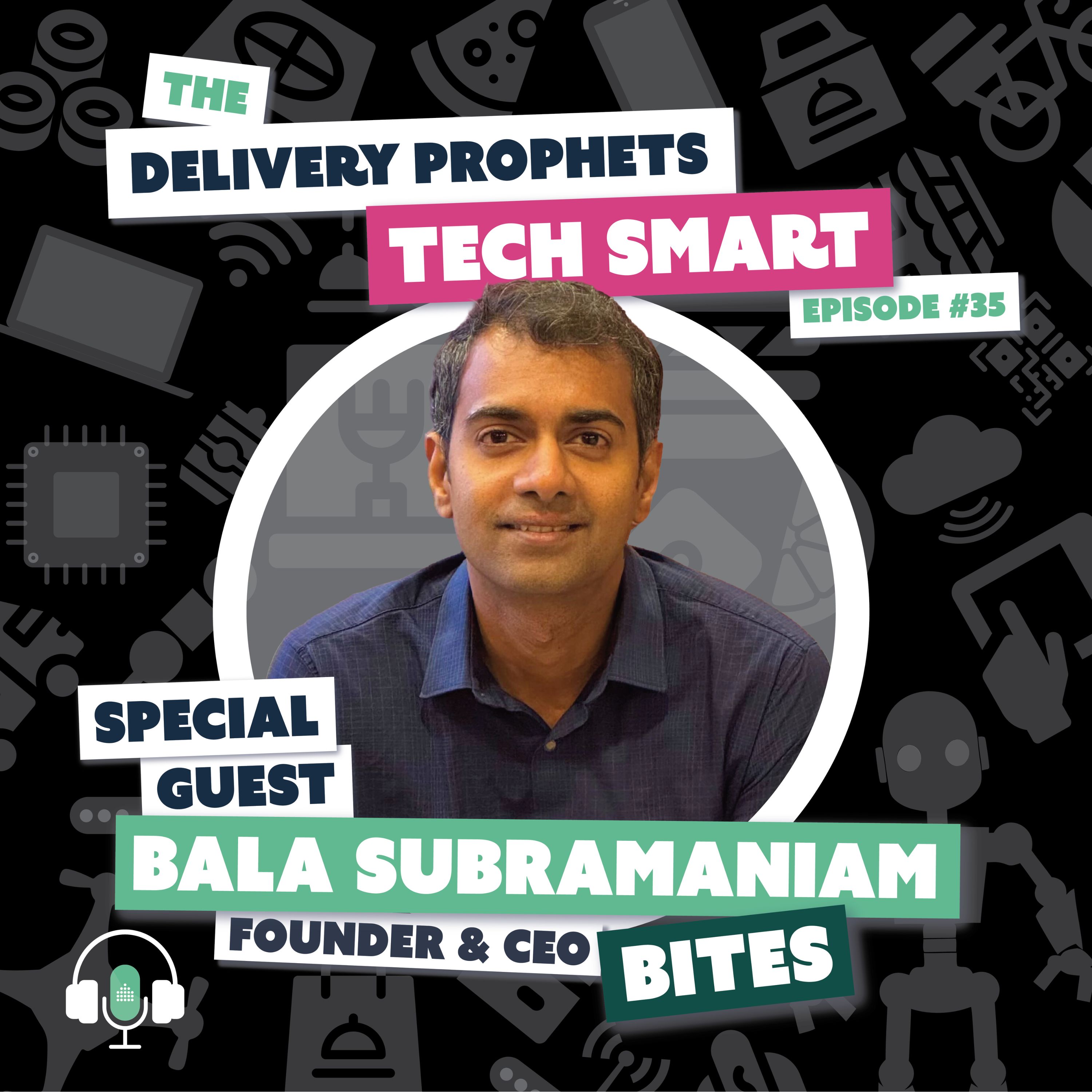
Welcome to this edition of the Delivery Profits Text Mart brought to you by the Delivery World together with Bites and we'll learn a lot more about them I'm sure as a podcast proceeds. We're really grateful for the thousands of you out there who tune in regularly for the delivery profits. As I always say without you we're just a bunch of guys and gals talking to each other in a recording studio. I'm Peter Bachman and today together with Balor Subramanian at CEO and founder of Bites we'll talk about delivery tech and delivery in general and ways to make it accessible and above all profitable. No doubt we'll get onto other topics too as we try to get a deep understanding of the tech forces shaping this rapidly evolving sector. So welcome Balor you reached out to me only two or three weeks ago. I hope it was because I said something interesting but maybe it was because you wanted to disagree with me. First of all thanks Peter for having me on the board super grateful for this opportunity. Yes it was because we are an ardent fan of your work not because we disagree with you. Although we sometimes disagree that's part of any hildy debate but thank you very much. It's good to disagree because it makes you think you know maybe there's something there in that disagreement. Absolutely absolutely and I think looking forward to kind of like charting in detail about like the restaurant world, the technology adjacent to the restaurant and what we think could be the future of delivery in the next like five to ten years. Yeah so I think you've got some very interesting views and I look forward to progressing with them. Can you just tell us just a little bit of your background? Absolutely. The name is Balor Subramaniam, product technologist from Silicon Valley. Being in the valley for close to fifteen years started out my career with the enterprise software world in Microsoft and LinkedIn and luckily found my way to consumer technology with Instacart back in 2014. So this was the time where pretty much you hear this phrase called Uber for X which is the time the gig economy was like picking up, illustrating into many verticals and I was very fortunate to have been part of that grocery delivery vertical from its early days. So from 2014 all the way to the height of the pandemic I was part of the company was responsible for leading the marketplace logistics and fulfillment organization. Pretty much anything that happens behind every successful or not so successful grocery delivery was part of me and my team's work. And then in 2021 I took a little bit of a break to spend time with family post the pandemic and then found my way to Amazon because I still wanted to kind of stay in the logistics world but of course wanted to learn a little bit more about the longer delivery windows and different kind of logistics problems and what better company to work with than Amazon if you are trying to be in the logistics world. So I got an opportunity to lead the product and technology for Amazon's last mile. So this includes all of package delivery across the world did that for a couple of years and then 2023 is when I started looking deeper into some of the problems that I wanted to kind of be part of as an entrepreneur and it was very closer to what I do every day and what my family does every day which is food delivery. So we were of course looking at our food delivery bills just like any other family of four does but the funny thing was that the bills were getting fatter and fatter but we were not. So I felt like something was wrong with this and as a QES product person started looking deeper into it and I felt like there is an opportunity or rather a problem first and then an opportunity comes next, the problem being before delivery changed once and for all post the pandemic and I think as consumers and as restaurant owners the leverage kind of shifted away from the two main players of the ecosystem to the middlemen with delivery apps. I think it's very helpful for our listeners who come from all around the world to know where you are and you're actually in San Jose. Correct. In San Jose. Okay. So here's something that I prepared earlier. We've published dozens of episodes of the delivery profits and now we've added TechSmart, the new stream for owners, founders and leaders of tech companies in the restaurant sector and especially in delivery and a constant refrain throughout all these episodes is the power of the aggregators and from the restaurant's operator's perspective what they can do about the apparent shortcomings of the dominant restaurant delivery model. I say apparent because these shortcomings may not be shortcomings to everyone. The aggregators have different objectives, different priorities, financial pressures and methods of operation compared with restaurant operators. What this says to me is that anyone's view about the way that restaurant delivery works depends on many things, who you are, where you're coming from, what pressures you work under, what your plans are and if there are many views on shortcomings there will be many solutions too. This has been the history of our modern world, automobiles can be gastrovent, diesel, electric, hydrogen powered, even steam driven if you go back far enough. One objective then is how can I get from here to there and there are many solutions and that applies to restaurant delivery too. How can a restaurant capture the order and deliver it to happy customers at a sustainable level of profit. There's no lack of ingenuity being honest to find the solutions. So what do you think of that and how does that fit in if at all to what you were talking about before? I think maybe we can double click on the aggregator point and I think my perspective is similar but a little bit more evolved over the last two years or so. So maybe if you can allow me to expand on that. Of course that's why you're on the show. So to me, I think if you look at the evolution of restaurants or restaurants, if you may call it, it went from dining only to phone in the early 2000s where people just call and get the pizza order or the Chinese take out or something like that. And then it went into okay, everybody needs to have a web presence because I'm going to use my laptop or my phone to find the restaurants and that's where the SEO kind of game started. And then finally, where we are today is the app era which everybody has smartphones and with the power of the Android and iOS operating system, anybody can create a presence in your pocket and that's through the apps. Every transition of this, I felt the service provider was always in control both in terms of the data, both in terms of the experience and more importantly, both in control of economics. The real problem happened for the restaurant industry because the last transition, which is to the apps or to these marketplaces happened too fast, especially during the COVID. So every one of these evolutions had a lot of opportunity for the service providers to take their time, understand the technologies that are available and figure out what really works for them and then present that view to their consumers. So what people did or still do depends on the wider ecosystem as it were, whatever is available, what other people are doing. Is that a key point here? In Italy and we are all creatures of habit when something starts happening, we just do more of it and that becomes a norm and we forget what happened like two years back. I just wanted to make sure I understood that point. If you look at what happened during the COVID era, right, of course, there was no other way to kind of get food outside your bubble. So the only way to get access to the restaurants was through these delivery apps and to their credit, whatever investment that these delivery apps, whether it's door dash or Uber Eats or Prabhub, all these companies have done over the last let's say eight years or so before the pandemic. It kind of had that serendipitous moment where like, okay, all the things that they were doing, incurring losses, like aggregating supply, aggregating restaurant selections, all kind of came to fruition at that time because there was no other alternative. And of course, as consumers, what can we do? Like we are trying to put food on a table for our family and so many things is happening in the world at that time. We are not going to think, hey, is this the right thing for the restaurant? Is this the right thing for the industry five years down the line? Is this trying to order food? So all of us used these delivery apps right fully. So, and I think that shifted the leverage a lot to the middleman. What ends up happening in that case is like when there is too much. The middleman being the aggregator. Middleman being the aggregator is your spot on. Oh, is the aggregator or was there a cause of middleman, would you say? Ultimately, aggregators, probably if you look at the US market, right, it's like Gaudash, Uber Eats and Prabhub. Those are the top three and heavy weighted by, of course, door dash. But most of these aggregators, I would just call it with the consumer side aggregators. Of course, there are a lot of other things on the other things on the back end where people aggregate on the channel and all those. But that's more like operational. Ultimately, what matters is who is in front of the customer. And I think today, whether we like it or not, it's the delivery apps that is in front of the customer between them and the restaurant. That was one big problem that kind of happened. And as you rightfully said, we are all creatures of habit. Nobody went back to all ways of doing things, whether it is either going to the restaurant or probably calling the restaurant and I don't think you need to because when there is a convenience, why would actually you do something that is not convenient to you? So I think that habit kind of stuck, but it shifted the leverage a lot from restaurants to these delivery apps. And that, of course, gave the power to strong on the unit economics, right, whether it's commissions or racking up the prices and all those. And if you fast forward to where it is today, and again, restaurant owners are super smart, right, like they understand how to make things work for each of the channel. Like, they know that, hey, my dining is X dollars profit and Y dollars cost. And I'm going to make sure that my margins are kept that way. Today, everybody, including the consumer knows that it's super expensive to order on these delivery apps, but there is no alternative available and creating an alternative is also not that easy. Like, it took like billions of VC dollars over the last decade coupled with the pandemic. So both of these are not going to happen again. Neither God willing, there's no other pandemic. And I don't think billions of VC dollars are going to get poured into this industry also. So to me, the real problem that we as a restaurant industry and restaurant tech together are faced is like, can you create an alternative that is fundamentally more efficient? Because when something is fundamentally not efficient, the cost gets passed on to somebody in the ecosystem. And today, that is getting passed on to the restaurant and to the consumers. So that's basically where we are. So summarizing your points, I think, one is the aggregators are coming on the middle and have offended the financial economics of that traditional restaurant model alongside that you haven't mentioned it, but there are other issues about loss of understanding of and relationship with the customer, the restaurant ceases to have it. And you're saying, flying, that's the way of the world. However, there may be, or there must be, I don't know, depending where you come from, a better way, is that what you're saying? Absolutely. And I think there is a better way. And I think there are forces in play today that weren't existing maybe two years before or like 18 months before driven by the AI cycle where this can actually be put back into the restaurant's hands as leverage. Right. So things have changed. They are changing. If we'd had this conversation two years ago, you may not have come up with what you're going to tell us, I think, in a minute. Is that right? Absolutely. There's always there, the vision to create a decentralized network of restaurants and point-of-sale companies. But as you said, the consumer is kind of like caught with the current options that are available. It's not easy to create a marketplace with 200,000 restaurants in yours, or it is just not possible. Like neither startups nor anybody else has the capacity to do that. And that's why marketplaces are very hard to break from the top down because once you've aggregated the supply, it's just too hard to go and replicate it again. So it's a hard to break down from the top down, are they relatively easier to break down from the bottom up? Correct. And I think that's where AI comes in. I think what AI can do is it can democratize access. Just like what internet and Google did back in the 2000s, I think AI has an ability to do that. And I think that's where like bytes and the ecosystem that we're trying to create comes into play, which is we believe by bringing together the technology that is in pretty much everybody's pocket today, right? Like charge, GPT and cloud are two of the most used, eventually it will become like super apps. And I think food delivery and food ordering at the forefront of that is inevitable because commerce activity are starting to happen on those apps. And we want to be the platform that enables every restaurant brand, whether it's a sushi shop next to our house or whether it's such a potlay with like 7,000 stores, we want to kind of like provide that ability that the consumer benefits and more importantly the restaurant actually benefits by being on these platforms. Right. Okay. So AI is going to allow more people to order more food, but not use the aggregator. Correct. Because AI fundamentally is a normalizer. Right. But what is the advantage of these apps, right, I kind of see three advantages. First is the selection. I have my Indian food. I have my Mexican food. I have my late night, boba and I have my Sunday afternoon ice cream all in one app. So that is the fundamental power of any aggregation. Second is the user experience of this and the personalization of like, hey, you've ordered these many lunch and dinner, these money number of times and that data actually powers better recommendation. That's number two. And the third one is the convenience of the delivery. So if you unpack each of these components, the real service is only the last part, which is the act of delivery. And whether we like it or not, delivery is kind of a commodity, right? Like any gig economy, a driver available today, whether it's in US or Europe or India, there is like a service charge to deliver something from point A to point B, adding that has been quote unquote democratized. So whether you get the demand from restaurants on website or restaurants on app or from road ash, you can always like someone a driver from any of these third party platforms pay them. I don't know $5 or $6 depending on the distance plus tips and you will get the delivery. So the act of fulfillment and operations at the high level is kind of like figured out if you think about the real problem that exists today is the inefficiency on the demand site. Like today, if you look at these apps, it is structured in a way to quote unquote extract more money from the restaurants. It's it's not structured in a way to set up the consumer to kind of see the restaurant first. Like the way I tell myself and into my team is delivery apps believe the customer belongs to them first or in sometimes the customer only belongs to them. And then they channel the customer to the restaurant. We believe irrespective of the channel, the diner always belongs to the restaurant and the channel is a channel is your fundamental point. I mean, the people who disagree with you, as you've said, but fundamentally you're saying and it's difficult to disagree with you that the restaurant owns the customer doesn't matter if it's a diner order, doesn't matter if it's a phone order, doesn't matter if it's an app order, doesn't matter tomorrow, if it's an order from chat GPT. I believe that the diner belongs to the restaurant first. Right. So we have a situation where aggregators control an element of the business sufficient for them to charge a lot of money. However, if you look at it more analytically part of that, the last mile delivery is a commodity. The order capture is something that AI will increasingly be fit to do and that then leaves an element that the aggregators do. Well, there's an element that aggregators do. What are you going to do about it? Just to clarify, what do you mean by the element aggregators do, sorry? Well, okay. So at least my understanding what you said is there are three elements. One is the order capture. One is the last mile delivery and then there's everything that's in between those two. Yep. That is the experience. That is the experience of what is in the app and all the operations and all those stuff. Right. And especially the unique opportunity that these AI agents led by chat GPT provides, it is actually normalizing all of these user experience into a conversational style. Of course, there will be a different sort of like UX components and all those. But the interesting thing about these chat GPT is like it is stripping off all the complexities of the UI and it's actually saying that hey, you only need one super app to kind of do everything. Like, if you are researching about your family vacation in Hawaii, you probably have one. And then if you are trying to order food, probably it's the same. And if you are trying to kind of do something else, let's say you're trying to research about the score on today's game. So it is quote-unquote the next generation of like what Google kind of did 20 years back. So if you look at what Google did, it kind of democratized information, which is like it's going to index 100,000 or millions or billions of pages and it's going to give it to you in like 10 blue links. But AI does it's kind of the same plus about which is there is also an intelligence layer that is created on top of those 10 blue links and it's actually giving you even more of a succinct information. So all of the activities that were possible on internet, especially commerce will also be possible on chat GPT and Claude and all the other AI agents that are going to come along. And based on some research, you can see this going. Commerce activity will usually start with small purchases first before big purchases. I don't think people are going to buy houses on chat GPT any time. So they might still go to, you don't know, you never say never. But they might still go to Zillow and get their agent and get that done. But if you look at the smallest purchases like the movie tickets, the gift cards, food delivery, those kind of things are within the $30 to $35 range and those usually are the ones that lead the transition anytime. And that's why we believe we are at the right point at the right time where the mission of where we started has become much more relevant and much more timely in the era of AI. So I think that's where the main thing because we've always thinking about how do you decentralize this? And we use the word a lot in bytes in the company, in our blogs, in our pitch to the restaurant and to the point of sale companies, how do you decentralize this? Because today, the power as you said is with the aggregators. Of course, we are trying to create a decentralized network, but at the end of the day, the consumer is the one that has to choose to come to this decentralized network to order instead of actually going to these delivery apps. That is actually a very, very expensive behavior change. It needs billions of dollars of marketing budget. If you open a app store today in US, you see DoorDash first. How do you compete with that? How do you compete with somebody who's spending $300 million trying to win over that first slot on Apple Store? It is not possible. So you have to look at where the tailwind is and today the tailwind is with Chat GPT. So I think that's where the phenomena becomes very interesting, which is how do you kind of take the decentralized network of restaurants, point of sale companies and drivers and then present it as an option on the LLMs, on the AI agents. And now the consumer also knows the best affordable way of the cheapest food option is always directly ordering with the restaurant. They know even today, but why are they not ordering because the experience is pretty bad right? That seems to be a great point to stop for a second. The key word I've got in my head is decentralization. So I'll say a few words and then we can come back to it. If you're enjoying the show, please consider supporting us by leaving a five-star rating on Spotify, Apple or wherever you get your podcasts. Your ratings and reviews mean the world to us and help more people discover our content. Plus, it's the best way to show your appreciation for the hard work put in by all those people working behind the scenes. So go on, hit that five-star button. There are full instructions in the show notes. And let's continue with today's fantastic episode. So Bala, you mentioned centralization. What does that actually mean in practice? Great question. So I would love to start off with a couple of analogies because that's the easiest way that I can explain to everybody, right? So imagine you're going to a grocery store, okay? So you see shelf packed with CPG products, your cereals, your bread, your cookies, all these, right? At the end of the day, what the retail store does is they are actually bringing, they are kind of an aggregator in their own world, right? They are the aggregator of the brands. But again, the word being decentralization comes back to the same products in some form. You could also get it in the farmer's market, okay? You can go to farmer's market and you can go and get your bread. You can go and get your cookies. You can go and get your vegetables. Maybe this selection is less, but the act of shopping for your groceries is the same whether you go to a farmer's market or whether you go to a grocery store. The difference is in a farmer's market, there is no middleman. You are going to a person that is making the bread and buying the bread. You are going to the person who's making the cookie and buying the cookie. But when you go to the grocery store, the person in the middle is actually the retail brand and then you get that. So think of this in the world of, let's say credit cards and crypto, right? When you are swiping a credit card in somebody's store, how does the money go from your pocket to the merchant's pocket? It goes through like a huge network. It goes to your bank and it goes to MasterCard or Visa and that goes to their bank and then finally it gets to their pocket. What happens in a crypto world? There's nobody in the middle. You swipe a card, let's say a crypto card when it's available. The money goes from your card to somebody's card. So the simple way to think about decentralization is you remove anybody in the middle between the service provider and the service consumer. And if you can create a network that connects the service provider and the service consumer together through technology, then you have achieved decentralization. So there are several examples of this in several industries, right? But I think what we are trying to do is like take what has worked, whether it's the credit unions of the world, whether it's a farmer's market of the world, whether it is crypto of the world and see if the lessons apply to the world of food and delivery and restaurant online order. That is where fights comes in. Right. If you've got some tentacles, what is the solution, what solution are you working on? The way we think about the AI first restaurant ordering is basically two sides, right? Like what happens on the restaurant side and what happens on the consumer side? Let's actually start with the restaurant side, right? The hardest part in creating a marketplace, as I said rightfully, is the aggregation of the supply. What I mean by that is you need to have a selection of restaurants both local and across the nation on brands. And that needs a lot of like sales apparatus, like you need to kind of dispatch thousands of sales people in a expensive and that flows back into access cost. Instead, we believe that the decentralization has to start with a point of sale companies first. Just today, if you look at United States, there are close to a million restaurants available, like that's basically an approximate number, right? Like close to 900,000 to 1 million restaurants in America, about 40 to 45% of that is independent restaurants. And then the rest is of course like mid market, enterprise and all the way up to the McDonald's and the Chipotle's of the world. Each of these are powered by an operating system, which is the point of sale. And this point of sale in my opinion is the linchpin to solving the food delivery problem that exists today. And when I say food delivery problem, I mean the unit economics, which is the aggregators in the last 10 years have created a parallel stack. Like if you look at how Dordash and Uber Eats started, like nobody integrated with these point of sales, right? Because these companies were focused on other things. Their goal was to kind of like solve a kitchen problem, their goal was to solve a dining problem and figure out how to make money from credit cards, right? But as Dordash and Uber Eats was creating an automated stack, the way I think about decentralization is we want to create a platform where we give a strong leverage also to the point of sale companies to be participating in any online transaction. Whereas today, if I place an order on Dordash, it's not just the restaurant that loses the money. It's actually the point of sale also that loses the ability to monetize that transaction. Because the entire industry of point of sale works based on much in services, which is I swipe a credit card. They make a little bit of money, but that's an exchange for the value that they are provided to the restaurant. Whether it is the back of the house, the cadias, of course you, I don't want to go into the full ecosystem, right? But point of sale is the operating system of restaurant, living and breathing. So we believe if we can bring in a consortium of point of sale companies through that, we can actually provide the online ordering for the restaurant. Because as I said, I don't think there can be a revolution in online ordering if you are following the same playbook of Dordash and Uber Eats because the expense of actually finding the supply is the hardest part. And the way VCR ecosystem evolving is actually through the point of sale. So if you look at there are like close to 600 or 700 point of sale companies, it's also a huge market. And certain people focus on enterprise, certain companies focus on mid market, certain companies focus on independence. What we are creating and very soon you're going to announce some partnerships is we believe that when we bring point of sale companies into the ecosystem of bytes and decentralized network, that creates the right opportunity for them to take this decentralization to the restaurants. And when we do that, we achieve two things. I've removed an entire cost of restaurant supply because I'm not going to walk into restaurants one by one to add them to the platform. Two, I have also provided an incentive to the point of sale companies to participate in the online ordering in the process of delivery because today, the only way that they can get is when somebody goes to the website and nobody goes to the website today. Pretty much 90% of the people just open up Dordash and Uber Eats. So we have kind of connected the two gaps, which is where is the point of sale companies losing today and where they scared the most about Dordash and then how can we remove the cost of adding restaurants on by one. And I think when we put this one on one together, we create an opportunity where we go through the point of sale companies to create this decentralization. And in exchange, we use their payment processing. So it's like a win, win, win for everybody. The point of sale companies now becomes the face for the customer and for the restaurant to actually get AI first ordering the restaurants win because there is no commissions. And then the bytes ecosystem wins because without actually going through the restaurants one by one by one, we are relying on the point of sale companies to take what we are built to the restaurants. And that's basically how I see this decentralization evolving with point of sale companies being in the center of this. It's really fantastic and a really novel solution. You know, people talk about thinking outside the box. What you have done is to say, let's start again. You know, things have changed over the last couple of years. Let's think again. Again, my interpretation of what you're saying is the system already exists for orders to be progressed through a restaurant. So once the order has been captured, the method of you called it operating system and that's fine. That's a good way of expressing it. It already exists and its point of sale companies. And there are several hundred point of sale companies, but I guess there is probably a handful that are dominant because that's the way most markets work. So from your perspective, is it a question of getting a few large players on board? And that opens up your whole system. How do you plan to move from here? Great question. So thankfully over the last two to three months or so, like we have created the attention that is needed in the industry. And we are working with three to four point of sale companies in the process of signing something. Unfortunately, I cannot reveal the names, but listen here and hopefully we'll be able to break the news when it arrives. Absolutely. And then Peter's podcast will be the first one that I can break the news. Hopefully in Jan. I agree. Once we are able to kind of like get two to three of them. And I think, as you rightfully said, it's the two to three that are diversified in different market. Maybe one or two enterprise point of sale that we are talking to and one or two really, really big independent ones that we are talking to as well. So once we are able to do that, I think we create the attention and we create the demand and technology that is needed for the rest. And I'm sure once one or two point of sale companies and their restaurants sees the benefit, everybody else will come to the party. Well, it all sounds really thought through, really sensible. I keep summarizing. That seems to be my role in this particular podcast. Summarizing orders are increasingly going to be captured through AI. You can already see the potential and it won't take long given the way that AI is moving that it becomes commonplace. So the order comes in. It gets progressed through the point of sale system in a restaurant at no cost, no additional cost anyway to the restaurant and to the benefit of the point of sale companies who are effectively going to get additional business, the delivery business. Once the order has been made up and it's then delivered by, I call it, commoditized delivery system. That is a totally new way of thinking about restaurant delivery in my view. Absolutely. And I think this demand side is already kind of like happening because the food near me or the pizza, the enemy or the Indian food in Mexican food near me is already one of the top 10 queries on Google. So that of course is going to be translated into chat GPD like very, very soon. But today, there's no commerce activity. It's all 10 blue links and it probably opens up the restaurant link and when you click the link, it opens up the same old sub-optimal experience. Instead, what will happen is as more point of sale companies comes into the bite's ecosystem. We will be that archestration platform between the AI agents and the restaurants through the network of the point of sale companies. So for example, when you search for order Mexican food near me and let's say you're sitting in San Jose. We will be able to kind of say, hey, here are the 10 options that are available as Mexican food near me. Just like how SEO kind of works on Google. So we will be that for the lack of better word AI or like AI engine optimized experience. But instead of just 10 blue links, because we are fully integrated with the point of sale, we will be able to show the full menu in a again limited experience, whatever chat GPD allows us. And then you will be able to add items, you'll be able to check out and you'll be able to play right then and there within the chat GPD interface. That's on the demonstrator. Now, what happens on the back end is again, because we are fully integrated with the point of sale, the order directly goes to the kitchen. It goes to the printer and the restaurant operator doesn't even have to worry about this new channel because we are just piggybacking on a network that already exists. The only problem is this network doesn't give them any orders. Unfortunately, 99% of their orders comes from door-dash and Uber Eats in a separate tablet in a separate printer, but we are not set out to create a whole new ecosystem. If anything, we are actually creating an AI first decentralized network on top of a point of sale operating system and point of sale network that already exists. Okay. So I think that's probably a good point to end this conversation and maybe we come back again in a few months and see how things have gone on. But we've been talking about an AI first decentralized system. That's the phrase that I'm going to carry on using from here on. So we've just got a couple of minutes. Ballet, is there anything that you wanted to have said that you haven't said? Looking forward to partnering more with the point of sale companies. And if you're really interested in being part of this decentralized network and early adopters of this AI first food ordering revolution, please contact me at
[email protected]. We are looking to create a consortium of the point of sale companies, starting with a big enterprise ones, to the independent ones, to any regional point of sale. And very soon we are going to be announcing our first five cohort of point of sale partnerships in January, looking forward to going forward. You're moving fast. So it's
[email protected] and you're on LinkedIn as well and wherever. Okay. Great. So what remains to me to say is thank you, bala, for being such a great guest, to bites to sponsoring this episode of the Delivery Profits Tech Smart. And here's a reminder that whether you're a delivery company, a marketplace app, a technology company, a restaurant owner, an investor, or simply someone who loves to order take out. The delivery profits is the perfect way to stay informed and ahead of the curve in the world of delivery. You'll find the delivery profits and the delivery profits Tech Smart on Spotify, Apple, or in any of the other places where you normally get your podcasts. And please support the show by leaving your five star rating. And there's more at www.TheDeliveryDoctWorld/TheDeliveryProfits. Tune in to the next edition of the Delivery Profits for the Insights, Infuse and Analysis that will keep you ahead of the game in this exciting and ever-evolving industry. And with that, it's goodbye from today's Delivery Profits, that's bala and meat. Goodbye.
 PodcastTranscript AI