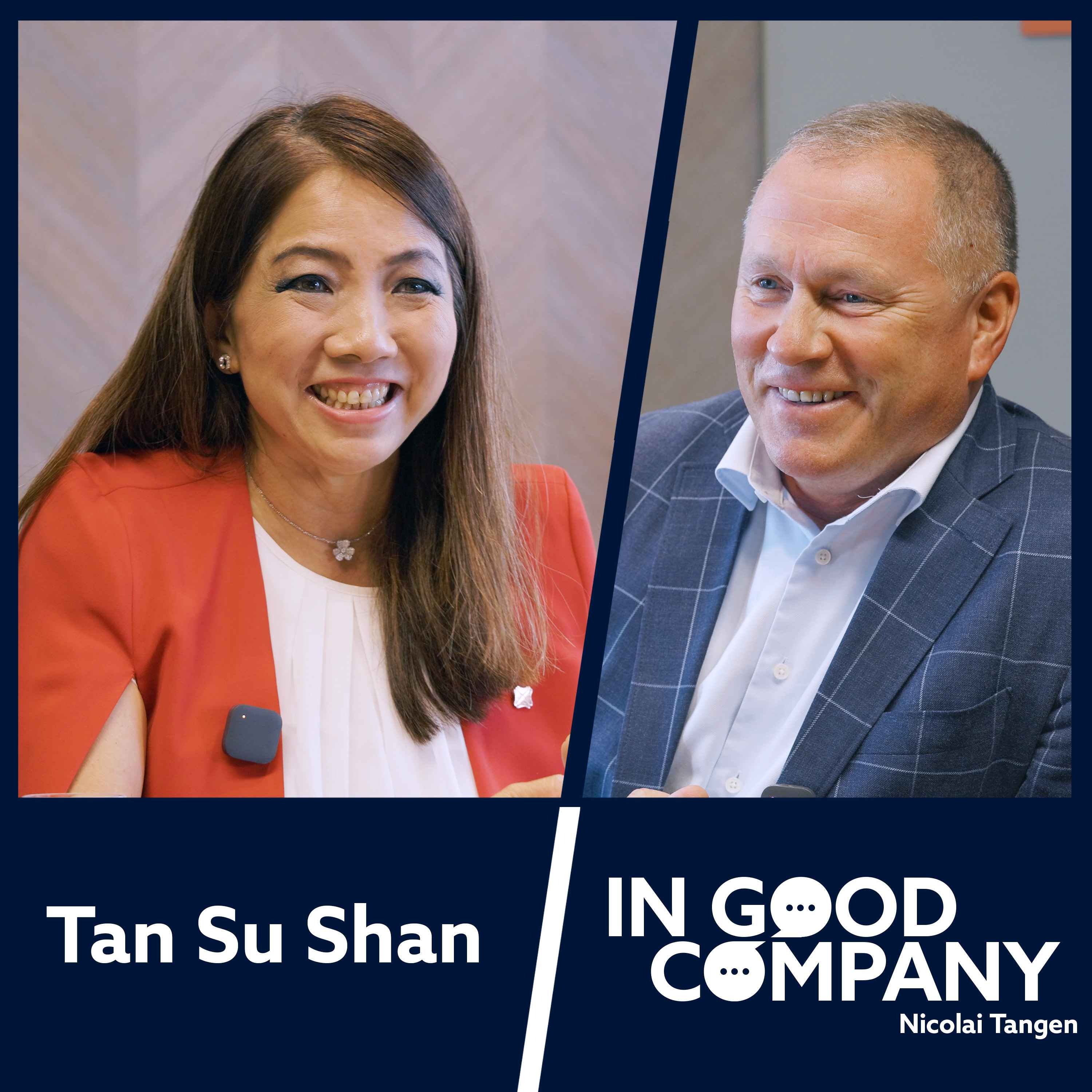
DBS CEO: Transforming Southeast Asian Banking, Embracing Diversity and Balancing AI with Humanity
56m 35s
Nicola Tangon, CEO of the Norwegian Sewing World Fund, interviews Sushan, CEO of DBS, the largest bank in Southeast Asia. DBS transitioned from a development bank to a digital and disruptive bank while maintaining trust and dependability. Singapore's success is attributed to trust, integrity, stability, and being open for business. Insights include diversification in volatile times, managing stakeholders, and building a successful wealth business. Asian wealth characteristics differ from Europeans, focusing on younger, concentrated wealth and business transitions. DBS culture values doing the right thing, commitment to Asian markets, and empowering employees for innovation.
Transcription
9649 Words, 51249 Characters
Hi everyone, I'm Nicola Tangon, the CEO of the Norwegian Sewing World Fund and today I'm in particularly good company because I am in Singapore and I'm speaking to Sushan who is CEO of DBS, the largest bank in this part of the world. And not only that, Sushan is one of the most important and powerful women in global finance, so big thank you for taking the time. Yeah, I always, yeah, it's not, I'm not comfortable with that, but okay. Well, that's just the fact, that's just the fact. Sushan, DBS, tell us about it. So we were formed two, three years after Singapore was born in 1965, DBS was the development bank of Singapore. Really, to develop Singapore in those days, we were a small, unindustrialized little island. And I guess we have evolved from our development roots down to being the largest commercial bank in Southeast Asia. But I like to use the D word because DBS, you know, although it stands for development bank of Singapore, I think we have evolved. I think we've gone from being a development bank now to being a very digital bank. I like to think we are a disruptive bank, but I also want us to remain the dependable bank and also the data bank of the future. How have you helped develop Singapore? Well, in the initial days of Singapore's birth or independence in 1965, we knew that as a small country with nothing, we had no natural resources. The only thing we had were humans, were human beings. So you have to open up for trade, you have to open up for talent. So if people, goods and services, and money, financial hub, if you can build a financial hub, a trade hub, ports, you'll get people, you'll get talent, you'll get GDP growth, you'll get jobs. So that's how we started. And our early development roots, we worked with part of the economic development board, was to grow Singapore industry. It was support authority of Singapore, where there was Singapore Airlines, all the new industrial growth parts, industry parts. In the 70s and 80s, there was a lot of manufacturing. We were financing a lot of manufacturers. We were bringing in MNCs from Europe, from your part of the world, from the US, from Japan, setting up factories here, going from kind of middle to high end manufacturing, precision manufacturing. Electronic manufacturing, and then increasing moving into services. What do you think a lot of countries can learn from Singapore's success story? I think the bad rock of what we do is better than trust and integrity. So, in this world, where the world is getting so volatile, and so bifurcated, and east and west, and bridges are being broken, relationships are broken, global order, the rule space world is now no longer the case. I think if you have a jurisdiction that's number one, clean and transparent, number two steady, and number three open for business and rule space. So, we say the cost, we're responsible, we're open, we're transparent, we're rules based. I think there is room for that. In this volatile world, who doesn't want a sort of stable island of stability? Is there another set of features that make you Singaporean? What does it mean to be Singaporean? Gosh, that's a big question. But, you know, as a Singaporean born and bred here, I would say we are lower abiding, we are open-minded, we keep wanting to stay ahead. So, in Singapore, we say, you know what, have you heard of the word kiasu? It's a Singaporean term, so kiasu is a local slang for scared to lose. So, it's almost like a paranoia, if you will, because we're small, we're paranoid. Because if we don't keep moving forward, we'll be left behind. Absolutely, well only in the paranoia is alive. In the paranoia is alive. So, we're a little bit of a kiasu island, and we keep having to involve to stay relevant, to stay ahead. So, I'd like to kind of think that that's the Singapore DNA, in a way, another D word, and hopefully that's, and I think that's also the DBS DNA, just keep moving forward to stay relevant. But also staying responsible. Absolutely. The government owns a part of you through Tamasek. In which ways is that important? I think that gives us validation. I think it is what I would like to call a Tamasek halo, if you will. It's the stability of ownership. It's also support Tamasek has a strong stable of Tamasek linked portfolio companies, who have an ecosystem of support for each other. They also get the best, you know, best of breed of people coming in and out, so we get access to talent, to ideas, to disruptive technology. And so, the network, it's not just a capital that's the network, it's expertise and the support that's important. You said you wanted to be behaving in the sea of volatility. Is that really possible in today's geopolitical situation? Not easy. How do you think about it? The geopolitical fractures and ruptures that's going on just now. I think about it as you need to be diversified. So, you can't rely too much on one or the other. When the tariffs came, everyone thought, "Oh, shots, if you're only selling to the US, well, you're going to be suffering badly, you're going to have to find new areas of growth." So, diversify your marketplace. If you only get supplies from one country, most people get supplies from China. And then, "Oh, you might want to diversify your supply chain as well," right? So, China plus one. So, it's diversifying and also where you bank. If you think about high network families, in the past, they were either banking in the West or, you know, in the US or in Switzerland or Europe or in Asia. But today, most people want to diversify. They want to have all three areas and they probably have gold. They might have used to have a lot of US dollars, not their thinking. I might diversify into other currencies, different asset classes. So, I guess the diversifier is important. But how also, you know, I think we, if the rest of the world, and it does look like quite a lot of countries, are still the same. We want to abide by a rules-based global order of trade. Then, I would like to think that trade outside the US, T-O-T-U-S, like we call it in DBS, we call it totus. Totus at 89% has room to grow. Has room to grow and that could be intra-Asia. It could be Asia to the Middle East, GCC countries. It could be EU to Asia. It could be within ASEAN. We see a lot of pockets of growth potential and trade outside the US, and I think we should focus on that. Moving on to your personal journey. You've been with DBS for a long time, but you've been. 15 years. But you've been CEO for six months. So, what was the biggest surprise by becoming CEO? I think the fact that, you know, you have to manage so many different stakeholders. It's not just the board and, of course, I've been used to managing customers and teams and the board. But it's investors, like yourself. It's the government. It's a lot of media. It's a lot of. There's a big public persona. Do you think that's from? Do you like it? Yes and no. I mean, it's finally, if I get to meet people like you, but it can be quite intrusive. Like, you know, there will be a lot of stories, and I'll think like, hmm, it's not even a story. You know, so you take the good with the bad, I guess, comes with the territory. But you have to be careful on your guard more often than not. But having said that, it's been an honor. I mean, you know, being Singaporean, being, I guess, the first woman for DBS, not the first Singaporean, my boss, my previous boss was. But also inheriting what I think is a really good foundation. And having the support of my chairman and my board and my shareholder has been good. Because you know what? Right after I took over, bang, liberation, they happened, right? I have a lot of admiration. So it was like, wow, okay, baptism of fire, right? And so it's been interesting. Who do you talk to if you are in doubt about things? I talk to a lot of people. I talk to, so when liberation day happened, I talk to a lot of my board members who open the doors to some of the biggest, you know, US dollar traders. And I talk to shareholders. I talk to people like yourself to get a sense of what kind of prison they were using to measure risk and how they were diversifying their risk. Are you surprised by how financial markets have recovered? Yeah, I mean, it's incredible. Why do you think they have recovered so shortly? I think there's been a lot of liquidity in the markets. And I think the economic slowdown is real. I think if you look at real commercial asset growth, it's been quite tepid, right? There was a front loading of supply chain financing and trade pre-tariff. But now that's slowing down. When the pause button got pressed by liberation day, that led to a drop in investments. And I think that's that's showing up in the numbers. And as rates start to grind down, rates have been very low in Asia already, rates crashed in Asia. So there's a lot of liquidity out in these markets, particularly in Hong Kong and in Singapore. So that I think has spurred quite a lot of investments into financial assets. So in a way, not that surprise, but, you know, it's incredible. I mean, this wall of worry seems to have disappeared. Absolutely. Let's talk about worries. I mean, early on in your career, you demoted yourself. I did. So when my boss and my chairman hired me, it was to set up the private bank. And when I came in and looked in DBS, I thought, wow, there's so much potential in the consumer bank from retail to the priority bank. And if I wanted to build a really good private bank, I can't do it standing alone to create scale and impact I had to be part of the consumer bank. So I asked my CEO, please, downgrade me. I won't report to you. I will report to the consumer banking head. He thought it was unorthodox. He said, why the hell do you know what to report to me when I'm the CEO? And I said to you, she's the only way it's going to work is if I report to the consumer banking head. And we can create a wealth continuum. And, and, and my, our impact can be much larger. So he said, it's unorthodox. I'll have to go back to the board. So he went back to the board. They'll create my demotion. So I joined and got demoted. One step back. What did you do to your ego? Did you think it was, was it good for your ego? Yeah. Why? Yeah. I think, you know, in life, you often have to stick, you take one step back to take two steps forward. And it's not really, you know, at the end of the day, you don't really choose your bosses and you don't. And, and a title isn't that important. I think impact some more important. Some people think differently. Don't you think, I mean, I would suspect, I mean, in particular, men, I think are very tied up to the title. Probably. Hopefully, you know, less so these days as, as people, as organizations become more flat. I think most people want to have impact. And, and, and, and if you really are impact-driven, then the title doesn't matter. If you can have huge impact with a different title, why not? That's so much more meaningful. I think that's why a lot of men think it's difficult to retire, because they're so, you know, they have such a hang up with the title and the importance coming with the job, you know. So, you know, well done for doing that. But, but then you have been instrumental in building the wealth business in DBS, very successfully. What, what does it take to build a wealth business? I think number one, you need to understand your customer and their needs. So, Asian customers have unique Asian specific needs. You need to understand that. Number two, you need to combine both that physical, personal relationship with a great digital platform. So, digital, if you will. Number three, you need to be open architecture. What does open architecture mean? It means you're not wedded to anyone, product provider. You want to have an open shell, so you can get the best. If you like the US market, find the best US, you know, fund manager, if you like long short or you like, you know, whatever. Whatever products you like, make it open architecture so that you can really look the customer in the eye and say I'm going to do the best of breed, or at least what I think is the best of breed today for your needs. Because if you manufacture and you sell your own product, it could be a conflict of interest. Put a foundation you deal with very wealthy people, right? Any reflections on the common characteristics of wealthy people? Very different. Gosh, you know, depends on first, second, third generation, when they were born, what they went through. But I would say Asia, wealth is generally a bit younger than European or American wealth. And so a lot of the wealth creation has been from their business. Either they just IPO, or they've invested well in their business, or they've done well in real estate, etc. So it's fairly concentrated and fairly chunky. So for you to be relevant to their wealth, you really need to understand how was your wealth created? Was it in shipping? Was it in warehousing? Was it in real estate? Was it in technology? And then when you understand how the wealth was created, then you can kind of get into one of the real needs for your family office or for your personal wealth. Very often, Asian wealth remains pretty concentrated. If they know and love technology, they want to be in technology, right? So you kind of also have to play your role as the trusted advisor to say, really, there's a lot of correlation risks in your portfolio right now. Do you want to diversify into a different currency or different sector, for example? The fact that the wealth is more recent, newer, more concentrated, more entrepreneurial, what does that mean in terms of how wealth the Asians are different from wealthy Europeans? Well, I think a lot of them are going through that business transition today. So if their businesses are now moving from the first founding generation to their needs, you're now seeing a real change, right? So number one, some of them might have children that want to take over, some don't. And if they don't, then they will need a solution to sell their business or to find a solution for liquidity, for liquidity solution. And then you put the next generation and all they're thinking about is digital assets, tokenized assets, crypto assets, whatever, or the Mac 7. I mean, I was listening to your podcast and there's a lot of talk about investing in tech, but the concentration of the new generation wealth in the Mac 7 is huge. And so how do you manage that? The second generation tends to be more global. The first generation tends to be more local or regional, if you will. So being able to toggle that move, provide a solution, because if the first generation thinks I need to sell, then you have to help them sell, whether it's an IPO or a trade sale. The second generation comes in how do you structure? Then the third generation are coming in what you do for them. So it is, it is a journey. And also for Asians, a lot of us come from, we have currencies that are quite volatile. You know, you think about the rupee, the rupee, the RMB, the RMB, the multiple currencies, some more liquid than others. So we also have to think about how do you protect your currencies as well. When you look around the area and you see the work ethics, the hard people work, the kind of entrepreneurial spirit and so on, and you compare this with Europe, what are your infections? Oh, I can't say-- You don't have to be politically correct. I'm not an expert. I can't say I'm an expert on the European work ethic. So let's just put it out there. But I've been impressed by the creativity and innovation of Europe. And I would say that Asians tend to work longer hours. That's true on average. And you're right. So work ethic that's kind of drummed into us into our culture from when we were young. You know, your parents said you must work hard. You go to school, your teachers said you must work hard. You start your first job, your bosses. You know, you've got to work hard. 996 and all that. So the work ethic is pretty strong. But having said that, you know what? I think there is a change now. And you look at how much time people spend on gaming, for example, the young people, not just even, you know, adults, young adults or, you know, middle age adults. And also spending a lot of time on gaming. I mean, like video games and, you know, gaming consoles that you did the socializing in their virtual games as well. There's a lot of of the move of Asian pop culture now, whether it's K-pop or, you know, demon hunter type of animation, along with pop music, along with gaming, along with the blockchain and new generative AI and AI. I think the Asian cultures evolving really quickly. And for us to stay ahead, we got to look at how our young, how our teenagers and young people are kind of morphing. The young Asians quite different from their grandparents and their parents, honestly. And that's exciting. We need to stay ahead. So, for example, I've been telling my colleagues and I have been trying to figure out how do we create banking solutions for the gaming population, for example. And we're setting up, how do we create banking relationships with teenagers, for example. How do we also create, you know, a whole banking ecosystem for those of us who love the digital asset ecosystem, for example. So these are all new tracks, right, which if you want to stay relevant, you got to learn. Absolutely. And I think Asians by and large are quite, quite agile. How would you describe the DBS corporate culture? I will say our corporate cultures evolved, but what hasn't changed is really the purpose that binds us, the development roots that we have, means that, you know, we are bounded by a culture and our purpose of just doing the right thing. Like, if you know you're doing the right thing, you don't, there's no need to explain yourself. I said I start working here. I'm lucky enough to get a job. I, I work here for a couple of weeks. Just how would I feel differently here than I would in an American firm, you think? Okay. I mean, first of all, Asians are home for an Asian bank. So the difference is this is our home. We're not going to be upping and we don't go and leave when the chips are down. We stay. We are staya. We are a staya. So we are committed. So when we say we're going to be in this country, when this country, whether it's Singapore, Hong Kong, China, Taiwan, India, Indonesia, and the rest of the Asian markets that we're in, we're in, we're committed. That's our home. So that's one difference. The second is, I guess it's the digital DNA that we have. So it's don't be scared to experiment. Right. So, and don't be scared to tell the boss she's wrong. And you have something here and this is the weird amazing room now. What is this racoon? My racoon is spelled W-R-E-C-K-O-O-N. So, but it sounds like a racoon like this, like the animal. But we empower our young and listen. Any, any staff, whether they're in a meeting with a senior like me or any other bosses, they have a right to put their hand up and say, I want to racoon your idea. I want to be, I want to have that psychological safety to tell your idea down. And speak up because if you don't, then you're not doing your job. So we have meeting Mojo's as well. Mojo is spelled M-O-J-O, the meeting owner and the joyful observer, J-O. So the meeting owner, sexier gender, the joyful observer has the right to say hang on. We're going down the wrong path or hang on. Let's get more voices in the room to be heard. So I would like to thank that at DBS, we empower people to speak up and no matter how junior your voice is heard because that's embedded in our processes and in our culture. How do you maintain this culture of innovation in a 40,000 people company? Not easy, but a lot of it is just practice, practice, practice. Do fail, fail, fast, move on. So what I inherited as CEO is really a digital mode and a data mode. We started the data lake in 2016, called Ada. And we changed the way we managed to manage through customer journeys. So as opposed to vertical product journeys is customer journeys, account opening is a journey, applying for loan is a journey, getting a transaction done is a journey, doing a supply chain financing is journey. So when you organize around journeys and you have data, live data, dash box that informs you the turnaround times to slow the customers complaining, the system's hanging, all the pricing is wrong, all the customer likes the journey, all the buying more products now. So having that feedback loop, we have streams in all our meeting was because we check the data all the time. We try and have data and form meetings. So it's stand-ups, quick meetings. And we call it managing through journeys. And I think the way we manage the data lake that we have has enabled us to create that framework in which we now bring in new stuff. So you're telling me about agenting AI. Okay, I'll bring it into my my my mtj, my journey, customer journey, generative AI. Okay, I'll bring it into my journey and now watch the feedback loop on the machine. How does the customer like it? Are they liking it? Does it work? Does it not work? Where did you learn this obsession? Where the client satisfaction? Oh, we just keep, oh gosh, you know, that was in 20, long time ago, about 15, 14 years ago, when we first joined, we were the worst bank for service, like lakhs. And you know where we went? How bad was it? Bad. So you know who's the best in Singapore, Singapore Airlines, right? Singapore Airlines. So we went to Changi. We went and we learned Changi is the airport. But near the airport, there's something called SQ called service quality run by the wonderful folks at Singapore Airlines. And we called it red. I wear red and black a lot because that's our colors. But red stands for respectful, easy to deal with and dependable. So Asian cultures, we have to be respectful. So we learned that from SIA, like, you know, how when they serve you, if there, they turn the glass on. No, no, they look you. They give you eye level. They don't look down on you. And if you're angry, they taught us how to at least accept and acknowledge the fact that the customer is not happy, have acceptance and acknowledge it and be respectful and how you deal with them. And then be easy to deal with. Don't make life very difficult. You're sometimes banking going to a bank. It's like, what's going to a dentist, right? So we try to make the banking journey as painless and as joyful as possible. And then dependable, which is, you know, when you need us most, don't don't remove the umbrella. You know, when it's raining, you know, come up with the umbrella and help us through so through COVID through all the tough times. But I mean, it's not like just if you take the whole stuff to the airport and the end of it one day, right? It's an evolving journey. How did you manage to change an organization? So you have a lot of these ambassadors. Actually, you know what? We actually hired quite a lot of retired SIA staff. And we put them in our in in our branches. And you create pride, you know, like it's like Ritz Carlton, ladies and gentlemen, serving ladies and gentlemen, we want us to start to be proud. You know, you come to work and you're happy and you're proud to be working for DBS for POSB. And we want, it's that Asian culture of treating people with respect, especially if they're older than you. It's really a nation sort of, you know, culture, but also learning from each other. So when we have red heroes, we got red stories, we, you know, I just wrote a thank you to someone who's been with us for 40 years. And she got so many compliments from our staff, from our clients. And I said, you're my ambassador and she is our ambassador, you know. And so it's having all these service ambassadors show the younger stuff, you know, this is the way forward. Are there any other companies you're learning from or any other people? All the time. We learn from, you know, anyone from, from, I don't want to upset anyone by missing them out, but all the big tech companies were constantly learning. You know, whether they're from China, from, from the US, from India, wherever we bring them in, we spend time with them, we learn from them, we go and visit them. Korea, for example, we've always been really, you know, inspired by what we see in Korea, whether it's, you know, Hannah Bang, Kakao, you know, neighbor. Obviously, Amazon, AWS, Google, Microsoft, we spending a lot of time with the, with the AI guys, the generative AI guys as well. And of course, in the banking industry, you know, I and Jason, a great, great example of how they, they were managing through journeys a lot earlier than us. So given all this, what do you think DBS will look like in five to ten years time? How are you going to be different? Our aim is to be the best AI enabled bank with a heart. So we're still human. I still believe that humans want humans to human relationships. But a lot of the mundane boring work like writing reports, you know, filling up KYC forms and doing mundane transactions can be done by an AI robot. So it can be done more accurately, probably by an AI robot, but keep those humans, human relationships, keep those customer relationships, take out the mundane work, but also have empathy and have respect for our customers and stay there for the long term. Let's do a little bit more on the AI side. Last year, you said that you saved $750 million on the user AI. Just how have you made the bank AI ready? So do you remember what I said about managing through journeys and, and using data dashboards to measure. So we do a lot of A, B testing. So send an offer this way. Don't send an offer. Price it this way. Don't price it this way. So all these A, B testing, we put it in a trial dashboards. And there's an instant feedback loop. Customer liked it, didn't like it, transacted, didn't transact. And that is instructive. So the incremental revenue for all the nudges that we give out to customers gets captured by this A, B testing. And that is what we measure as a sign of whether the machine learning is working, whether the AI is working. And so that was $750 last year, hopefully over a billion this year in incremental revenue. How do you get people to really use it properly in the organization? Because it's difficult to get people to change habits. It is. How do you do it? Well, just, you know, really keep nagging them. Right. Oh, I'm making it okay. You know what? The key is to make it, first of all, as the boss, you have to do it. Okay. Right. And I remember in 2012 when I tried to digitize the wealth business, I realized I can't just leave it to my digital head. I have to as a business owner own the wireframes, own the UI, own the app, own end to end journeys. And I think it's making everyone in the organization own their own journey. Make them proud that, oh, you know, my app that I came up with, the experiment that I came up with worked. Right. So we all went through the process of trying to make our own app. And now we're making a make sure everyone goes through the process of doing your own generative AI journey. And just learn by doing. Don't learn theoretically learn by doing. Make your mistakes, share your mistakes. And more importantly, if you had a good idea and you worked it and it worked, share it. So like I was in Taiwan last week. You know, Taiwan, we bought the city banks, wealth and cards business. The cards team, cards team said, oh, we're experimenting with converting our service calls to our card customers into tech. So voice converted to techs. And in that conversation, the service stuff was saying, oh, you know, Madam, do you need an estate plan? Have you thought about your children and your grandchildren? How are you planning for the future? And when we turn that voice to techs, it goes into the AI machine learning model. It comes up with a propensity score, which then instructs us, oh, this is the potential wealth client or not. And it's quite, you know what? It actually works. The journey works really well. The customer gets called if they have a high score and they are converted to a wealth customer. How do you think the AI will change the business in the long time? I think the way we organize, you know, because right now, as I said, there's the workflow and the work process. But if the AI takes on a lot of the mundane work, it could be reading documentary trade, it could be writing the report, writing the call report, it could be spitting on the pitch book. I don't know. It could be a lot of things. And some of these jobs will move. So for example, I told you the service center now. A lot of the service calls can actually be answered by a very good generative AI enabled bot in your post login. So if we can do that and do it well, soon you can have agents that do transactions for you, right? So it's a matter of time before that happens. So that happens and a lot of those jobs will will disappear. What does it mean for our service center people is they have to, they have to do something else. So in fact, they wouldn't want to sit to me. You know what? This job's gone. I'm going to do something else. And as it is, I have 200,000 SME clients, not everyone has a has a relationship manager. Hey, wouldn't it be great for all of them to have a relationship manager? So hello, if you used to do service, can you not be a relationship manager? Can you not look after the SME clients? So then you basically will own a pool of clients that hitherto had no relationship managers. Do you remember what I said about human to human interaction? I think this enables a lot more human to human interaction whilst the mundane job gets done by a bot. Talking about human to human interaction and moving on to your leadership style, how would you characterize your leadership style? Inclusive, hopefully empathetic. Curious. Why is that important? It's an important, I don't know if it's important, but I like to learn. And you know, whether it's learning about gaming or the digital asset equals system or about health care or whatever I think. Learning keeps, I think you're a learner too, I can see that you're definitely very curious. And I think if the leader is curious and they open minded and they learn, then that keeps the company relevant and moving forward. How has your leadership style changed with experience at age? With age, I guess, I've learned to be more straightforward. So just say it as it is, tell the bad news up front. So if it's a deal I don't want to do, you get to know from me quite quickly. So I don't waste your time and you don't waste mine. How has it evolved? I think I have become a better communicator, I've learned to frame my ideas first, think big, and then go small, then delve small. So think about that helicopter view. What does the world look like? Where do we want to play? What do we not want to do? I think about what we don't want to do a lot, which is as important as what you want to do, and then delve into the details. You are known for working extremely hard. I think I heard a story that you even brought your blue and berg terminal to the hospital when you were giving birth. That was because I had a margin call. In those days, there was no bloom. I didn't have, there was no smartphones. So we had to bring our laptop with all those blue and bergs together. Do you expect other women in DBS to work as hard as you do? You know, I think if you love your job, you don't think you don't see it as work and it's fun and you enjoy it. So we don't dictate hours and we're quite flexible. Men or women, you have a kid, please stay at home and look after your kid. If you need to go to a concert for your child, please, if you have a aging parent, please look after them. We're not dictatorial about FaceTime. And do I expect women to work as hard as me that a lot who work harder than me? And there are others who don't and it's fine as long as we have outcomes to show. Who are we to dictate what kind of work they do? You mentioned the importance of being both direct and empathetic. Is there a trade-off between the two? Is there a trade-off between being direct and being empathetic? I think you can be direct and still empathetic because if you're not direct and then you're not being empathetic, because you could be beating around the bush and wasting their time. That's not showing empathy. I've heard you talk about reverse mentoring. Because you need to look at the trends going forward. And as you age, you may create that intergenerational gap. And like the Koreans always say, you want to identify the future trend. Look at your teenagers. So having, surrounding yourself with young people, making sure they teach you what's going on, what are the trends, what are they seeing, keeps you relevant and keeps you fresh. You said you were a learner. What are you trying to learn now? No? Well, obviously, I've been trying to learn a lot about how Jennie and I are in a genetic AI work. That's for both, you know, I'm curious and I need to learn that for work. I'm also now trying to learn about gaming and how, because I don't game. But I think it's important to enter the gamers' ecosystem, so I'm trying to learn about that. That was Twitch and Discord and these communities and how they can play a game and talk to each other at the same time and how that community evolves. Why do you need to learn that? It's just as, you know, when we were growing up, we were playing and going to movies and stuff. And people thought maybe our parents said, oh, don't go to movies or don't spend too much time on TV or movies. Actually, it became very big industries. Content became a very big part of our world. You know, gaming is now already a big part of the new generation, but it could be something else. And also in a time where a lot of Monday work gets done by robots, I think there will be this unleashing of creativity upon us. So being creative is important. And so left brain, right brain, I think CEOs need to have both. So now you want to learn about gaming. How do you do that? So, hey, I wake up. It's just like, hey, I'm Sushant, I want to learn about gaming. Where do you take it from there? So yesterday, I invited the former CEO of the biggest gaming company in Korea and Japan for lunch. I made him sit down with me for a poor guy, an hour and a half and I was like, explain to me what is the guy thinking of when they go into the game? And he said, you really don't know? So I don't know. You know, what are the games that are hard today? And he gave me the names. And then what do they do? How much is the console? And what kind of chair do they sit on? And how much time do they spend? And then they shed with me what was fishing? Do you know what's fishing? I don't know. You see? You can fish in a game. Okay, what is it? What is it doing? It's when you can date a friend. You can say to another friend, hey, let's go fishing. So you're actually in the game and you actually go and fish in the game. You're literally fishing and it's a quiet moment. And people do dates, virtual dates, fishing in a game. I didn't need to learn about gaming. Talking about quite a time, you also meditate together. Well, I had a bad spat in my life in my mid to late 20s. When I lost my job, I lost my home, I lost my then relationship. And I thought my world was going to crumble down upon me. And that's when I learned, some friends of mine taught me to meditate because it enabled me to see myself as a third party, to see the world as it was and to realize, you know what? Calm yourself down. The world isn't so bad. You got your health, you got your family, you got your friends, you know, everything else will be okay. And I found it very useful to kind of detach myself from my own situation, to see myself from third party eyes and to calm myself down and to tell myself, you know, it's going to be okay. So, also, I don't have a lot of time to meditate nowadays, I should do. I do have, I'm not a yoga, I go for long runs, I listen to a lot of podcasts. I'm more of a listener than a reader, I love listening and I love music. So, yeah, so those quiet moments, I think when you take yourself out of your everyday, you know, noise, just to see things from a third party perspective, it gives you perspective. This period you talk about, what do you think it did to you as a person? It made me more resilient. It made me appreciate the ups with the downs. It made me realize that when things are very good, don't lose your head. When things are very bad, don't lose your heart. Well, it's a good business advice. Now, you also talk about it often, the importance of sleep. Yes. Tell me about it. Oh, Ariana Huffington. Do you know her? I don't know. I know all of her. Huffington posts. We invited her here to give a talk to my colleagues and I. And she proudly went on stage and said, "Sleep your way to the top." And of course, we all laugh, but what she meant was. In the old days, she meant something different. I know, right? What she obviously meant was, if you have good sleep, you perform well. Absolutely. You perform well. You do well. Your company does well. You get promoted. The company goes up in value. It's a win-win situation for everyone. And it's true, right? Don't you feel like you do? No, I have an app in the middle of the day. I wish I could. What time do you have in there? At roughly two to three in the afternoon. So, do you have a bed in your room? Yeah, I have a sofa. So, you sleep for two. So, two thirty to three is your quiet time? Well, yeah. So, I do like 15 to 20 minutes. Okay. But you have to. So, we have sleeping pods here. But you have to tell everybody that you do so that they don't think you are slacking, right? Yeah. I think I'll do that. Because it's not really slacking. It's getting more energy for the evening and afternoon. Yeah, this catnap is so important. When do you go to bed? Too late. Don't ask. Too late. And that's my resolution is to start going to bed a bit earlier. Yeah, but on the other hand, why do you want to change? I mean, it's not like you're doing badly. So, why are you sure we should have. Are you sure you should have resolutions to change your life when you are doing well? Only because I want to work out, you know, I want to get up earlier and do. What's your morning ritual? I do actually do a small workout. And then I come to work and, you know, I read the papers. I come to work. And then it's bang, bang, bang. What are your charging stations? Where do you relax? I run. So, sometimes I run by the bay. You can see the bay. Sometimes I run at home. Or if I visit a new place, or if I like to run when I can. Or if I have little pockets like last night between end of work and going to a dinner, I had a quick run as well. I run, I swim, I do yoga. And whilst I'm doing that, whilst I'm running, I listen to podcasts. I love, you know, listening to Kathy Woods or to, you know, Peter Diamondies, Singularity, Salimie Spinal. So, it's just that that's my kind of. When I'm relaxing, I'm also learning absorbing information and learning new stuff. Well, I also know another podcast you can listen to going forward if you want to. I'm listening. And I'm going to add Nikolai tangent to that running list. Well, you're very kind. So Jean, it's been tremendous talking to you. What a pleasure. And you are very impressive. And it's been great. Thank you so much. Thank you. So, Nikolai, now that you've interviewed me, I feel that I can't waste this huge opportunity to reverse interview you. So, thank you for agreeing even though it's so last minute. Fantastic. Love you. So, how does it feel to be the manager of the world's top and number one southern wealth fund? Does that have a huge responsibility? It's a huge responsibility, of course, but I don't feel. I don't think much about it, to be honest. But you don't? No. It's an honor to kind of manage the capital for the country because the fund is very important in an Norwegian context. But I have so many great colleagues who help me do this. And so, I don't feel that I'm particularly important. But how do you set the terms for the fund and for your colleagues? How do you. What is the role of CEO in a southern wealth fund? Okay. The role of a CEO stands for Chief Energy Officer. Oh, Energy. I like that. So, I think it is to give energy. It is to give direction. It is to give. You know, impulses. It's to. Inspirations. Inspiration. Yeah, totally. It's to inspire. And it is to make people go somewhere they may not. Don't want to go initially. And so, it is to motivate them, give them responsibility and make sure it's fun. Yeah. Have you had to take your team somewhere that maybe was challenging and they didn't want to go. Totally. And how did you do that? How did you motivate a whole team to go down a path that they were reluctant to go down? Well, I think you have to explain why they should go in that direction and why it makes sense. As, for instance, we are a much more open organization than we were in the past. We are the most transparent fund in the world. And in the beginning, I thought, you know, that's good because then other people can see what we do. But I think transparency and openness is so important because it makes us absorb impulses from the world and technology from the outside in a much better way. So one thing is the openness. The second thing is the whole, you know, level of ambitions. I think if, when you tell people about your ambitions, if they don't start laughing, they are not high enough. They don't start laughing. They must laugh. When you tell them what your ambitions are. Ha, ha, ha, laugh. Okay, so tell me what you said and then everyone laughed. Well, in the beginning, I said, listen, we want to be the number one large investment fund in the world. And everyone laughed. Yeah, because he was just at the time, what size were you? This is five years ago. Now people don't laugh. So I think that's important. And then it is, so your ambition has-- So your ambition has-- And then it is with performance, which is important, you know, how you define performance, how you get there, how you work with methodology and process, and then speed, you know, to make sure there is a high speed. Speed is a mindset, and you need to-- Speed is a mindset. You really need to drive it all the time, you know? Yeah, yeah. So chief energy officer, giving inspiration, giving speed. Then what drives you? How, how, why, how do you have so much energy? Ha, ha, ha. You do this huge day job, then you have this fantastic podcast, your famous-- Well, I mean, you know, the podcast. So the podcast is part of the transparency we do. And we learn a lot from the podcast, which we are taking into the organization, and to share all that information with the Norwegian people. And people who are interested across the world, I think it's a big plus, right? So, you know, our applications are going through the roof. We have a lot of very clever people who want to work with us and so on. So I think that makes a lot of sense. But energy, where does it come from? You know what? It's interesting. There's very little research that has got into where energy comes from. Yeah. But it's probably a combination of us want to show the world. I mean, you want to show the world. I want to show the world. Yeah. We want to do the-- we want to be the best we can. We want to do something great. Yeah. But earlier, you shared with me that you take this cat nap from 232-3, which I think is fantastic. I want to say that also in my reverse podcast. Because you're right. I mean, you have ups and tides. You know, you have apps and flows of energy. And sometimes in the day after lunch, for example, it's going to be low. And you take that quick cat nap. It just propels you forward, right? Yeah. It gives you that more energy for the second half of the day. And what inspires you? It inspires me to meet people like you, to meet leaders across the world. I read a lot of books. What are you reading these days? Well, I'm on the-- I'm on the jury of the Financial Times Business Book of the Year. Oh, wow. And so I got 16 books, not too long ago. So I'm reading those 16 books. And actually, tonight, we have a meeting in the jury to take the 16 down to six. Do I have a sneak peek or what thoughts you like? It's okay, because by the time I-- But there are some really great-- There are some incredible books. I do read a lot of those types of books, but I tried to read very widely because I think that's part of being open-minded, to learn from science, to learn from psychology, to learn from sport, from art. I think that's how you become more innovative and more creative. Yeah. So, changing tech, let's talk about the markets. Where do you think we're headed now? I think it's incredibly difficult to know because, you know, last weekend, I was up in a mountains with seven of my cleverest friends. And we do these once a year, and we record what do we think about various parameters for the next 12 months. So it's time to vote, too. We were listening to the-- Last year we were called OK. And we were 80% wrong. Wow. 80% wrong. 80% wrong. Because none of us predicted the tariffs. The situation between the US and Europe. The fact that India is now closer to China. You know, you just-- you name it and we didn't predict any of these things. Now, had we predicted all these things? We would have thought that stock markets would have been down 20%, 30%. And it's up to-- I would have got it wrong, right? You get it wrong and wrong. And so I think what it's all about now is you cannot predict anything. Yeah. You need to make sure the organization is extremely agile. Yeah. That it is robust in all different types of ways. And robust-- I mean, robust in a cyber-- from a cyber point of view, from a balance sheet point of view. Yeah. To have redundancy in various places. And then I think it's to work on speed. So to me, these-- Actually, three things. So agility, speed, and resiliency. Yeah. Yeah. Now, that sounds like what we're going for as well. It is so important to be resilient in this day and age. But also to have the agility and the speed to just take on new stuff, right? And to pivot when you need to. And so how do you see the geopolitics? I mean, you invest in Asia, don't you? And you're now investing Asia. Do you come to Asia every year? Yeah. OK. When you come every year as someone from the West, what surprises you about Asia and what maybe worries you about Asia? Well, it's very impressive. Innovation is very impressive. Work ethic is very impressive. The way you navigate the geopolitics is this. It's very, very impressive. I mean, you talk about the bank wanting to be the safe haven. In a way, this is kind of the safe haven compared to a lot of other places. Yeah. So I think you're well positioned and I think you're making them also it. Yeah. Yeah. What do you think a bank like DBS can do more of to be better? Well, I think my impression is that you're doing a lot of the right things. Of course, the big thing now is the AI and to which extent that could dislocate. You know, the banking landscape, you have a new entrance. You need to be on top of your data stack and the data quality relentlessly focused on customer satisfaction. Yeah. Yeah. Which you are. So it's interesting. Do you worry about, you know, the weaponization of data and also the weaponization of technology? I mean, we've seen the weaponization of everything right from payments to trade, supply chain to chips. And increasingly, the east and west tech stack is kind of bifurcating, if you will. We're trying to diversify and make sure that they're both interoperable. But how are you seeing this whole type bifurcation in your world? Oh, it's extremely interesting. And, you know, I kind of think it started in, you know, to be serious, let's say five years ago. And technology is now embedded in kind of weapons. So in the power struggle, pharmaceutical research, self-driving cars, battery technologies, you know, technology is embedded everywhere. And you are, you know, in a way, the, as you said, the world is a bit splitting into here and it is, it is a clear negative. Yeah, you cannot optimize on cost anymore, right? You're going to have, you know, you have to have just in case, not just in time, right? Yeah, yeah, yeah. And I guess, you know, that brings us to also the way one invests in this sort of, you know, when, because you're global, right? Do you invest globally? How do you think about allocating assets? Do you look at companies more above countries and above currencies? I think you have to be very diversified and very long term. Very long term, which is how long? Well, we are, you know, 50, 50 to 100 years. Wow. At least we try to be, but it's difficult. One of the toughest things in life is to be long term. Because you come into the office on Monday and it's just like, you don't do anything, Tuesday, you don't do anything, Wednesday didn't do anything. You come home to your husband and wife and say, hey, what did you do today? So, Sean, no, I did nothing. And five days in a row, you don't do anything. So that's kind of the ability to sit still is very, very hard. It's very hard. It's very hard. Wow. I never thought of it that way. It is so interesting. But that means when you move, you really have to do your work before you move. Yeah, no, we are helped because we have a mandate from the Ministry of Finance, which tells us in broad terms how we should be invested. So we don't need to make these large asset education decisions ourselves. We are really helped by anchoring in the parliament and a good process behind this. So, tell us about what Singapore and Singapore can learn from. What ten Asians and Singaporeans learn from Norway? Well, I think that's a very tough one because I don't do politics. And so I look at Singapore and I admire the long term thinking, the planning. Well, Norway has long term planning. Norway is very green, very sustainable. We have a lot of great things in Norway, right? We have a lot of great things. I think it's. You all speak green English for a start. Why is that? Well, because we have very small nation and we. That's like us, so we all have to learn English. Of course, of course. Absolutely. You are well. Finally, you are. We are five. We are five. We are five. We are all six now. We are all five. We have a bit more space in Norway. We have a lot more space. So it's easier to get up in the mountains or in the forest than be on your own. You have more space to meditate. But no, I think Singapore and Norway are two great places. Very good education system, right? Yeah, it's pretty good. Yeah, yeah. I think that's the bedrock. It's being open, being open-minded and being international, but also embracing learning and staying relevant. Absolutely. Totally agree. Well, it's been a great pleasure. Thank you for allowing me to interview you. My pleasure. And I look forward to the next time we meet. Absolutely. My question. Thank you. Thank you so much.
Podcast Summary
Key Points:
DBS evolved from a development bank to a digital bank focused on disruptive banking while remaining dependable.
Singapore's success story is attributed to trust, integrity, stability, and being open for business.
DBS CEO emphasizes the importance of diversification in the face of geopolitical volatility.
Personal journey insights include managing multiple stakeholders, the impact-driven approach over titles, and building a successful wealth business.
Asian wealth characteristics focus on younger, more concentrated wealth and the need for business transition solutions.
DBS corporate culture values doing the right thing, commitment to Asian markets, and empowering employees for innovation.
Summary:
Nicola Tangon, CEO of the Norwegian Sewing World Fund, interviews Sushan, CEO of DBS, the largest bank in Southeast Asia. DBS transitioned from a development bank to a digital and disruptive bank while maintaining trust and dependability. Singapore's success is attributed to trust, integrity, stability, and being open for business.
Insights include diversification in volatile times, managing stakeholders, and building a successful wealth business. Asian wealth characteristics differ from Europeans, focusing on younger, concentrated wealth and business transitions. DBS culture values doing the right thing, commitment to Asian markets, and empowering employees for innovation.
FAQs
DBS was formed in 1965 as the development bank of Singapore to help grow the country's economy. Over the years, it has evolved into the largest commercial bank in Southeast Asia with a focus on digital banking.
DBS played a key role in developing Singapore's industries by providing financing to manufacturers and attracting multinational companies to set up operations in the country, leading to economic growth and job creation.
Countries can learn from Singapore's success by prioritizing trust, integrity, transparency, and being open for business. Establishing a clean, transparent, and rules-based jurisdiction can create stability in a volatile global environment.
While DBS was initially known as the Development Bank of Singapore, it has evolved into a digital and disruptive bank. It aims to remain dependable while embracing innovation and technology to stay ahead.
DBS sees its relationship with Temasek as validation and stability of ownership. It provides access to talent, ideas, and disruptive technology through a network of support from other Temasek-linked companies.
The CEO of DBS was surprised by the need to manage various stakeholders beyond the board, including investors, government, media, and the public. Balancing different interests and public scrutiny was a notable challenge.
Chat with AI
Loading...
Pro features
Go deeper with this episode
Unlock creator-grade tools that turn any transcript into show notes and subtitle files.
 PodcastTranscript AI