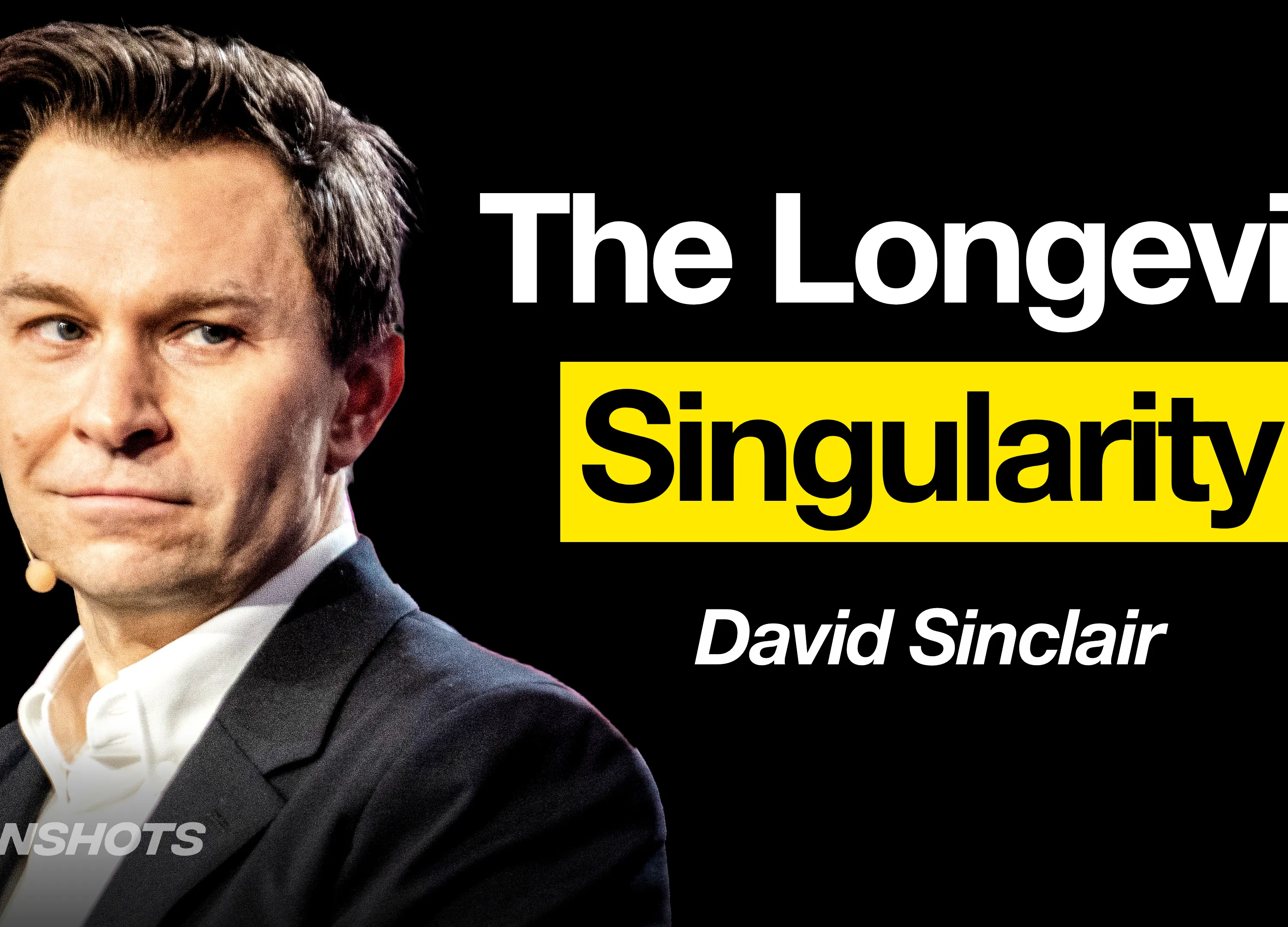
David Sinclair on the Longevity Pill, Age Reversal Timelines, and Updated Protocols | EP #250
32m 32s
This transcription features a discussion about an upcoming milestone in longevity science: the first human epigenetic reprogramming trial, using three Yamanaka genes (OSK) delivered to the eye to cure blindness. The speaker, a leading researcher, explains that this technology has already successfully reversed aging in multiple mouse tissues, including brain, muscle, kidney, and joints, and aims to eventually work throughout the entire body. While the current gene therapy delivery method (AAV) is expensive, a cheaper small-molecule pill is being developed using AI and will soon enter clinical trials as part of the XPRIZE competition. The speaker asserts that there is no biological limit to human lifespan and that age reversal in humans could be proven by 2026. He compares this breakthrough to the Wright brothers’ first flight: initially for the wealthy, but eventually accessible to all. The conversation also highlights the broken grant-funding system, which stifles radical science. An alternative model, "Friends of Sinclair Lab," raised $6 million privately, allowing rapid, unburdened research and enabling immediate action on new ideas, such as curing a student's kidney failure. The speaker believes the longevity revolution is inevitable and accelerating.
This feels like another right brother's moment. Once you can fly, everything changes, and I think we're about to learn whether we can fly or not. I'm pretty sure we can. (upbeat music) - The used to sure, you are days away from the first human epigenetic reprogramming trial. - Three of the Yamannaka genes, a subset of them, they're going into the eye of a patient shortly to see if we can cure blindness. We find that every tissue that we go into, as a field, we see benefits. - A spain age reversal improvement in memory, motor neurons, so ALS, the immune system, muscle, kidney, mentioned liver, skin. - A true longevity therapeutic, when given, would work throughout the entire body. And that's the objective here. Is there an upper limit to how long humans can live? - I'm not saying that, but I am saying that. - Now that's the moonshot, ladies and gentlemen. - David, please, I grab my hot water and lemon. What are you drinking? - Coffee. - Coffee, all right. - I couldn't find any matcha. - Well, you know, I mean, coffee actually is good for you. The studies show caffeine is, you know, I probably do about three cups. And I think it's also that decaffeinated coffee, it's all the other molecules in the cocoa, in the caffeine bean. - Yeah, coffee comes in and out of fashion, but the fashion is definitely in the positive right now for longevity. So it's not a bad way to start the day. Caffeine's fine, people ask me, is it okay to drink caffeine? And Serena and I drink tea all day, pretty much until, you know, we can't take any more caffeine, but it is good. - And we're gonna talk about your longevity protocols as well, but what I'm excited about is to give everybody an update on our approach towards longevity singularity to add that term together. The moment in time that we really know that we're extending the Healthy Human lifespan. Let's begin on the news. Dejure, you are days away from the first human epigenetic reprogramming trial. Tell us about that. - Well, if you've been under a rock, let me tell you that we've worked out, maybe we can talk a bit about the science behind it, but we have a drug candidate that came out of my lab. It was published first in 2020 on the cover of Nature magazine, and the title on the cover was Turning Back Time. And we reported, and I wanna give big credit to my student, Wancheng Lu, who worked for many years to try and find certain genes and combinations that could safely reverse aging, but not go so far that you could cause cancer or lose identity of the cell. And he found it. It took a long time, and in retrospect, it looks easy 'cause we now know the answer, but it was tough at the time, and he was ready to quit, 'cause in my office almost crying, and I said, "You gotta try. "I have a good feeling." And so he found three genes, three of the Yamannaka genes, a subset of them. These Yamannaka genes, I think you all know, what we use to make stem cells, but we don't wanna use the technology to make stem cells. If I turned you all into a giant lump of stem cells, that would not be good, and might die within two days if you use all of Yamannaka's genes. So anyway, we have three of the genes, we call them OSK for short. They're going into the eye of a patient shortly to see if we can cure blindness, having succeeded, really well in mice and monkeys to cure their blindnesses. - So life, yep. (audience applauding) I know a number of you are investors along with me in life biosciences, so super excited about that, heading towards reversing blindness. What would be in success and fingers crossed? Where would you head next, which organ systems would you go after after that? - Yeah, so what's remarkable about the technology is, we didn't choose the eye because we thought it would work best. In fact, I was recommending against it because the eye, you know, curing blindness is not something that's easy. I thought the liver would be a good way to go. And that's probably the next place we go in the human body. What other labs and ours now are showing and seemingly now every month or so another lab publishes on this technology, so it's not just my lab, it's great, it's being reproduced and expanded now, that we find that every tissue that we go into as a field, we see benefits. And so it's not just the eye, we see benefits. Well, I'll just list my lab's work. Brain age reversal, this is all in mice currently. Brain age reversal improvement in memory, in old age and out time as models. Modern neurons, so ALS, which is clearly an incurable disease, currently, but we think we can help there. The immune system, muscle, kidney, mentioned liver, skin. The list goes on and the liver, joins, a new paper came out from a different group, just last week that I tweeted about. And so yeah, we all experience some kind of back pain or joint pain in our lives. And there's not much you can do. This technology seems to regrow the joint and the cartilage and even the bone, which is great. Really important point here, a true longevity therapeutic doesn't just work in one cell type, doesn't just work in hepatocytes. A true longevity therapeutic, when given, would work throughout the entire body. It definitely is that that's really our goal. The reason we're going after one tissue at a time is because it's untested technology in humans and the FDA just recently allowed life-buyers sciences to go into the clinic. But if we'd said we're gonna inject this technology into the whole body, the FDA would have been, I think, a lot more cautious. So we're going tissue by tissue now. But I don't see a reason why, as we learn more and we see more safety, that we couldn't go intravenously, that we need some technologies to be developed. Right now we're using viral-like particles to target the eye and the liver. Those are great for targeted, but a whole body is either gonna require something like the lipid nanoparticle or even a chemical semolid. - We'll talk about that. So the current therapy that you've developed and it's using an ad-new associated virus and A-E-V and these gene therapies have traditionally been expensive, anywhere from like a half million dollars to two million dollars per treatment, is that a rough order of magnitude? - We wanna treat millions of patients actually. We're going after glaucoma. So I hope it's not that expensive, but my goal is to bring the price down as fast as possible. - And towards that end, I'm very excited about the other, so just to lay it out, right, the current treatments that are going into trials are using these ad-new associated viruses, which are an expensive mechanism for delivering the OSK, but you and your amazing graduate students have actually developed an alternate, and I think it's your entry into the longevity X prize as well into the health spend X prize, which looks to be, I don't call it magical, but the potential of this extraordinary, could you speak about what you've developed? - Sure. So we developed this current technology that's going into humans shortly. In fact, patients are being recruited right now, so it's imminent. That technology for us in the Sinclair Lab is 2017 technology, and actually quite literally, I like to point out to my students that what we published is literally what's going into humans, which I've said to you separately, that's really rare that your PhD student makes a drug that goes into humans, but he did it. But yeah, the point is, since 2017, we've been working in my lab on bringing the price down, finding new ways, and the cheapest is a small molecule. Small molecule can be made potentially for a few cents a pill, and we find that the dosing, even with ER100, which is the viral candidate drug going into humans, you only need six weeks. So in six weeks, some doctor may even know the answer whether this works in humans, 'cause it's going to be fairly obvious if someone can see again or not, we'll see better. These chemicals could be very cheap. We've been working on them. We've been using mostly artificial intelligence to screen billions of molecules in silico, and we're now at the stage where we're in the lab using AI and visual visualization, machine learning, to tell us whether cells from old humans, 92-year-olds, their skin cells can be reversed back to a 20-year-old. And we know OSK works, the gene therapy works, and we're looking for molecules that do that. And I can say we already have a proof of concept, which is a cocktail of molecules that, some of which we published on already a couple of years ago, and those we hope to put into a clinical trial, into humans, but within the next couple of months as part of our ex-price competition. Amazing. And how much might that cost just to give people a sense of the price point? While the adenous associate virus gene therapies are in the hundreds of thousands to low millions, how much might a three molecule pill that you're taking cost you for treatments? Well, yeah, right now it is a three molecule cocktail. Ultimately, if it reaches the mark,
market, it will be one. I don't plan on taking three to market. There's all sorts of reasons including the FDA makes it very difficult to make cocktails. And they make you test each one and the combinations, which is we will find one. But the three factor molecules, they're expensive to make. They're hundreds of thousands of dollars right now to make it in a kilograms scale. But that doesn't have to be with scale up, it really could be a lot less. I don't want to say how much. But one day I hope it'll be like metformin, which is it's pretty cheap. Anyone on the planet could afford it. We were on moonshots pod together and I encourage you guys to see that episode. It's an amazing dive that I did with David. You predicted a couple of bucks a month as a potential range. So I just, it's really important to understand that this longevity revolution were about to hit is not just for the ultra wealthy. I mean, one of the precepts of the health span X prize that Dr. Jamie Justice runs is that we are encouraging the development of therapeutics that are accessible to 8 billion people. Right. We uplift humanity as we do this. And so, you know, I like to say that when technology first comes out and it doesn't work well, it's the wealthy who experiment with it. And by the time it works really well, it's available to 8 billion people. That's going to be true here. It is. I always talk about the right brothers because this feels like another right brothers moment that if it works, maybe even bigger than that. But the right brothers, people who said it wouldn't work. It will never happen. New York times a few weeks before right brothers took off said it will be a million years before humans fly and then they did it. And then suddenly everyone said it can be done. But it wasn't for everybody. It was for the wealthy to fly initially in the early part of the 20th century and even up until the 60s and 70s. But it will, it will happen faster than that. I can see a future where, within, you know, certainly within our lifetime, we'll have these pills available. And the important thing is I'm not the only one. I may be most advanced in the work that we're doing. But there are lots of people and lots of money behind us. So even if we deviate or things hit a snag, which I don't expect, but that could happen. It's going to happen. So that's the real point here is 20 years ago. I didn't know if it was going to happen in our lifetimes. I was trying to go as fast as possible and trying to get the word out to raise awareness and bring in really bright students into the field. That mission, it's still ongoing, but I would say it's been successful. And now I think the wave is such that it's going to happen in our lifetime. That's something that would be crazy if it didn't. And it may be sooner than we think. It may be 2026 is the year we learned that age reversal is possible in humans. This is part of our singularity, folks. Part of this incredible moment of everything, all at once, everywhere getting reinvented. And it's speedrunning every speedrunning start track. I do want to say something about Peter is, you know, he does a lot of good for the world and he's unique in doing that. One of the things that he's done among many for the field of longevity, the ex-price with Jamie Justice. And if you've donated to that prize, thank you. It's a wonderful cause. And I can tell you that I would not be putting our chemical cocktail that we've now tested extensively in animals into people if it weren't for the ex-price. We're trying to accelerate the future. Yes. Thank you, buddy. Thank you, Peter. A couple of points to pull out. We could spend days on stage together, but oh, I'm trying to consolidate. I think people need to understand as well that the conversation around longevity and the pioneering work that you did early on had a lot of pushback. A lot of people, there was a negative stigma against doing work in this field. And yet you saw the potential and you persisted, which is what the great scientists and thinkers do, despite what your fellow scientists or, you know, I, and so I just want to thank you for that. It's not easy. I've been on the inside. You're a dear friend and I've heard the trials and tribulations and you've persisted with sereness support and less. And thank you for that. A couple of key questions here. And I just want to pull these out. You know, is it just 120 we're aiming for or 130 we're aiming for? You know, people say, okay, well, we might extend health span, you know, it's extra few decades, but, you know, we're going to time out. What do you think? How do you answer that? Well, as I wrote in lifespan, the book, there is no law that says we have to age. That anyone who says that there is a limit doesn't know what they're talking about. It's doable. We can live hundreds of years. That's already happening in the animal world. And you know, some people live into their well beyond 100 up to 122 is the maximum. There's a lot of room to go with what we already know is possible. Now, can we go beyond that? Can we go beyond a whale even? Well, I don't see any reason biologically or physically, you know, looking at physics. Why there is a limit. It feels weird to say we can live hundreds of years, maybe thousands of years. I don't know yet how we're going to get there. But what I've seen in the last five years has blown my mind. The fact that there's a reboot system in the cells that can not just make a cell healthier, but literally reset it so it is young. Not just behaves young, which is what we did for the first 20 years in the field, is young and stays young. It's reprogrammed literally. The fact that there's a backup copy and that we now know you can reboot the cells over and over and over. We don't know how many times because the mice actually, we did it multiple times in the eye and then the mice died of old age, but they had really good eyesight. So we want to try and do this multiple times in a whole animal and we're working on that. So I don't see an upper limit. And you know, often I'm quoted out of context saying, oh, we can live forever or that kind of thing. And I'm not saying that, but I am saying that the me of fact that the right brothers could fly, we could see that one day there would be the Concord jet and going to the moon, the same with longevity. Once you can fly, everything changes. And I think we're about to learn whether we can fly or not. And I'm pretty sure we can. Yeah. And at the speed at which science is going, right? The work that we just saw from Lila, the work we're going to see from other speakers, the whole field of AI is, you know, this accelerating future in which the added time brings us all these additional breakthroughs. It gives us added time and the exploding goes greater than one. I want to go back to that moonshot podcast we did because there are a number of members in the room here who are part of fossil FOSL. It's Friends of Sinclair Lab. So when I interviewed David, God, I don't know, it was a year ago. It feels like ages ago, it's a year ago, I think. And my moonshots podcast studio here in Santa Monica, David was, was glum and I was like, what's going on? And he was like, our funding just got cut because of the battle between the White House and Harvard. And I have to let all of my graduate students go. My dean has said, you gotta let them go. And it's like, WTF, what? No way. And it's like, whenever, I mean, hopefully this is your Juno move. When you see a problem that exists, your answer is no, I'm going to solve it. And so, at that moment, we sort of, I sort of spun up, I said, okay, listen, I'm going to, let's create something called Friends of Sinclair Lab. I'll contribute the first 50k, but let's ask the moonshot audience to participate. And we announced it. Max Song spun up a few QR codes and a website instantly. Thank you, Max. And the outpouring of support was, was nothing less than extraordinary. I think, you know, your budget, the budget you were getting from the government was how much that got cancelled then? How much per year? It was in the millions, all the million, two, three million. Something like that, yeah, including the fellowships that my scientists have brought with them. Their career got cut short too, at the time. And we were able, over the course in the next few months, to bring in, I think, on the order of $6 million of private annual support. With amazing. Thank you. Now, I just want to hit on this, because there's a perversion in the way we fund science, which is when you write a scientific, I'm going to say this for you so that you don't I don't have to say it and get in.
by anybody, but this is my understanding and experience of it. If you're trying to propose something radical for a grant, the people reviewing it don't want radical science. They want predictable science that they know the answer is going to be there. And you're writing a grant for something that might take a year or two to get funded. It is retro-espective, it's reactive, it's backwards. And there's a 10% chance you get it. And the 10% chance you're going to get it. So what I love is that through the Friends of St. Clair Lab, some of the people who have given us 50k, I don't see any of this, all of this goes to his research. I'm so grateful to all of the Friends of St. Clair Lab. Some have given up to a million. It's this money goes directly to David and his grad students genius. Like where the highest signal is right now. Let's do that experiment. It unleashes you to do work on the cutting edge. It has, we're actually in better shape now, thanks to you and all of the Friends, than we were a year ago. And we can actually go so fast. It blows my mind. We used to be limited by these grants. And I was spending half my time writing grants. Literally, it's a lot for scientists. And the system's broken, clearly. It's a huge waste of capital. We've got PhDs, professors, some of the smartest minds in the country who just are at their computers typing grants all day, instead of doing the work. But yeah, it's really changed how we do science. We're going so fast now. An example of that is we have these, by monthly, every second month, we have a Zoom call and the Friends get together. And on the last one, so my student was presenting her data. And she said, sorry, I couldn't present last time. My kidneys are failing. I had dialysis today. I need a new kidney. And then one of the members-- >> Fred Blundey, who's a member of our community. >> Yeah. >> And he's one of the benefactors for the health span prize, one of our benefactors at the ex-price as well. So-- >> Fred said, how fast can we cure this as well? Let's do it. And he goes, all right, I'll find that project. So we can get started within weeks of an idea, instead of years, if ever. It's amazing. It's the way science should be done. And what I want to do now that this model is really proven to work brilliantly, is to teach the best minds across the world that this is a much better way of doing science. And everybody benefits. The world benefits. The members benefit. I think it's very exciting for the members because they get to-- >> They're personal relationship with you. >> They really do. >> You're texting you and they're visiting the lab and they're having dinner with you in Serena. >> Yeah. And they get the same feeling I do as a scientist. They-- we make discoveries. And how exciting is that to learn before humanity does about how how uh-- the world is going to look in the future. And that's the best part of being a scientist is learning things that you just didn't think could even be possible before everyone else. >> It truly is extraordinary. So I want to thank all of you who are members of the Friendsist and Clare Lab Fossil. And maybe you might even share during the Q&A here your thoughts about it. I want to spend the last few-- >> Oh, I just wanted to say about the Fossil program. We have about 70 members. >> How many? >> 70. >> 70, wow. >> It's been wonderful. And um, but we are going to limit it because if it gets too large it's not a community. But there will be a wait list. But I think today if you're interested please either write to Peter, Max, and Marissa who is down the front, my chief of staff. >> Marissa, just stand up one second to be able to see you. >> And she'll give you a business card and you can-- >> We'll reach out to one of them or my team if you want to be involved in supporting it. >> Yeah. >> And it's not a commitment but we'll tell you more about what is involved in what the community is like. >> I mean sort of like throwing yourself a touchdown pass in the longevity game. I think of it that way. But I'm not a sports guy. Let's talk about your-- let's talk about your longevity protocols David. What are you doing right now to maintain your boyish like complexion and physique and head you towards longevity escape velocity? >> Well thank you. I'm not sure that I deserve that but it's fine. Definitely too many days on the road with Serena for-- >> Yeah, so you guys run the airplane all the time. >> Yeah, that's out downfall but it's-- what I wrote about in lifespan is still holds true. So if you haven't got the book or you do check out page 304 that is the-- >> Just speed run if you would. >> All right. All right but don't post this. This is between friends. I mean I suffer from my face showing up on people's website selling products so this is an issue. >> You're not promoting any products very clear. >> Yeah. And this is also for my father who is now 86 and in perfect health so-- >> And so mom if you're listening please take notes here. >> Yeah. The three main ones that we've been taking for over 15 years. You remember the good old story, Res Veritrol in Red Wine, that's still a staple for us and we've got some really good data that we're going to submit to nature on that. So that's mixed with some olive oil or some yogurt or a small amount of something oily or progenacious, a lot of protein, so it dissolves. If you just drink Res Veritrol take a pill it mostly passes straight through you. So that's a good one. That's an activator of CERT1 which is a longevity enzyme we've worked on for many years and by the way I haven't told this publicly but the CERTUans if you know about them and you've read my book, we find it they're very important for the reprogramming. So the early work from my career is all linked into the information theory of aging which is the basis of our work now. Res Veritrol, NMN, NICATINIMIDE mono nucleotide but online it's called NMN. Don't confuse that with M&Ms. You will not live longer and then the third one is a glucose lowering medicine. So the one of choice, well there are two of choice and I cycle between them, Serena and I do that. So METFORMAN is requires a prescription, that's a diabetes, times your diabetes drug, relatively safe as a medicine. We take a gram a day of that but it can give you an stomach upset. So there's a natural version of METFORMAN which is known as burgrine which has a lot of clinical data as well that has benefits as well including lowering a blood glucose and actually glucose levels are really important. So look at glucose, look at pasta, look at carbs especially processed carbs. If I could just add on that. One of the things that we found at Fountain Life looking at our members is the number one thing that correlates with heart disease is not your HDL, your LDL, your L-Polytale the number one thing that correlates with heart disease is your hemoglobin A1C, your glucose levels. Thank you buddy. Yeah. Well good, I mean there's a whole symphony, we carry carry bags of supplements so it would take a while to go through those of course but a new one that we've added in the last couple of years is nato kinase. If you haven't heard of it, it's an enzyme, I'm sure you know as well. Yeah, my father's on that now too. It's really the only thing that's been very clearly shown in large trials of thousand plus people to reverse plaque in the body. It's also natural, it's an enzyme that comes from nato, the Japanese breakfast that smells like vomit. Oh my god. Some people eat nato, serena likes nato, I hate it so I take the pills and you need a fair amount. If you look at the clinical trials, I think it's at least 8,000 units of that. Know how much? 10,000 serenas telling me from the, from the crowd. So 10,000 units, if they, I think if they gave them six, it didn't work so and it took a year so you need to be consistent but I'm doing the experiment, I'm going to have my carotid ultrasound it again to see if my IMTs it's as you know as a train physician. And that's also another thing, make sure that you're not going to die from something stupid like a stroke or a heart attack if you don't need to. So you can get a CT scan which is radiation which we know in my lab accelerates aging. So I prefer to, if I can help it avoid radiation, but ultrasound's very safe and you can do it in 20 minutes on your neck. Yeah, you guys, do you guys do? We do and those you on the longevity trip every year, we give you a carotid scan. Yeah. Okay. In terms of food, you've gone vegan? Mostly. I struggle because there's a lot of good food out there. I'm a sucker for a Japanese sushi but it's serena who inspired me. I always need to credit her with a big change in my life. She taught me a lot and last night at a gathering we had for the friends of Sinclair Lab, I freely admitted that what, what turned me on with serena was her talk about Navita Clacks and DeSatinib as a Sentalitic. So it was like, wow, this book has amazing. Keep talking chemicals. It's turning me on. How do you feel about alcohol? I've changed. Again, serena's inspiration. Before the data came in which is now damning for alcohol, even one glass of alcohol a day correlates with a small
brain. I stopped drinking alcohol a few months after I've been serena you too. No, no, I've been much much to the chagrin of someone who is my spouse who's a sommelier. Wow. Yeah, it's unfortunate, but we got to be driven by the science, not by what we want, but I would say a few times a year, it doesn't hurt to celebrate with a bit of alcohol, but daily is what I was doing serena. I said, "What are you doing? You're eating cheese and red wine every night?" And I said, "It's the Mediterranean diet. What are you worried about?" So you said, "No, stop it. Eat this and see what happens." And within a month my biomarkers were inflammation went way down, so I've stuck with it. Yeah. I think the benefit for alcohol is the social lubricant in terms of having you relax and enjoy. I think one of the biggest challenges I have, David, and I think perhaps for you is this piece of travel and work and stress. It's a counter-veiling force. It is, and again, serena changed my life because I'm very hard on myself. If I'm not number one at something, I'm not happy. And so I lived most of my life until I met serena on edge, ruminating, stressing that I wasn't good enough. It was really a bad thing. And then she came along and she said, "Just try to breathe." She told me meditation, which I'm still trying to work on. But I have learned not to worry so much. And it's hard to do if you're an A-type, probably most of us in the room, but it's changed my life as well. I'm sleeping better. I think I look better. I feel better because if you're always tense, it's going to accelerate your aging. That's proven. And the other thing that really helps, which is worth knowing, is your blood pressure and your cholesterol and your blood sugar, these are good ways to live longer. Get a pet, get a partner, but just make sure that you're socially surrounded by people who love you and you are not lonely because loneliness will kill you. More hugs in your life. Let's hear it for that.
Podcast Summary
Key Points:
A human epigenetic reprogramming trial using three Yamanaka genes (OSK) is imminent, aiming to reverse blindness.
The same technology shows benefits in multiple tissues (brain, muscle, immune system, liver, kidney, skin, joints) in animal models, suggesting potential for whole-body rejuvenation.
Current gene therapy delivery (AAV) is expensive, but a cheap small-molecule pill (potentially cents per dose) is being developed using AI and is entering trials via the XPRIZE.
There is no known biological upper limit to human lifespan; the speaker believes age reversal in humans may be proven by 2026.
A crowdfunded "Friends of Sinclair Lab" initiative has enabled faster, grant-free research, bypassing the slow traditional funding system.
Summary:
This transcription features a discussion about an upcoming milestone in longevity science: the first human epigenetic reprogramming trial, using three Yamanaka genes (OSK) delivered to the eye to cure blindness. The speaker, a leading researcher, explains that this technology has already successfully reversed aging in multiple mouse tissues, including brain, muscle, kidney, and joints, and aims to eventually work throughout the entire body. While the current gene therapy delivery method (AAV) is expensive, a cheaper small-molecule pill is being developed using AI and will soon enter clinical trials as part of the XPRIZE competition.
The speaker asserts that there is no biological limit to human lifespan and that age reversal in humans could be proven by 2026. He compares this breakthrough to the Wright brothers’ first flight: initially for the wealthy, but eventually accessible to all. The conversation also highlights the broken grant-funding system, which stifles radical science.
An alternative model, "Friends of Sinclair Lab," raised $6 million privately, allowing rapid, unburdened research and enabling immediate action on new ideas, such as curing a student's kidney failure. The speaker believes the longevity revolution is inevitable and accelerating.
FAQs
It involves using three Yamanaka genes (OSK) delivered into a patient's eye to potentially cure blindness, following successful tests in mice and monkeys.
OSK uses a subset of Yamanaka genes to safely reverse aging without causing cancer or cell identity loss, and it has shown benefits in tissues like the brain, immune system, muscle, kidney, liver, and skin.
The aim is to make treatments affordable, potentially as cheap as a few cents per pill for small molecules, accessible to 8 billion people, similar to metformin.
No, the speaker believes there is no biological or physical law limiting lifespan, citing animal examples and the ability to repeatedly reboot cells to a young state.
It’s a private funding model that provides direct support to David Sinclair’s lab, enabling fast, cutting-edge research without the delays of traditional grants.
The speaker compares current age reversal breakthroughs to the Wright brothers' first flight, suggesting that once proven, it will revolutionize human health and lifespan.
Chat with AI
Loading...
Pro features
Go deeper with this episode
Unlock creator-grade tools that turn any transcript into show notes and subtitle files.
 PodcastTranscript AI