Data Governance - The International Edition with Angelina Medeiros
from The Data Governance Podcast
23m 29s
In this podcast episode, Angie Madiros discusses implementing data governance in U.S. community colleges. She emphasizes that success starts with leadership support to prioritize governance and clarify complementary roles across institutional research, IT, and academic affairs. To engage stakeholders, she recommends framing initiatives around tangible outcomes, such as meeting strategic planning needs, rather than abstract concepts. Common drivers include mandatory federal and state reporting, but internal, college-specific metrics often resonate more for buy-in.
Angie highlights practical steps like developing a data dictionary to standardize terms and addressing data quality through documented policies. She notes that governance is an iterative, collaborative effort—bringing people together to define processes helps overcome silos and builds a shared understanding. Ultimately, data governance should be viewed as an ongoing journey, requiring continuous adaptation and community-building to stay effective amid changes like AI, rather than a one-time project.
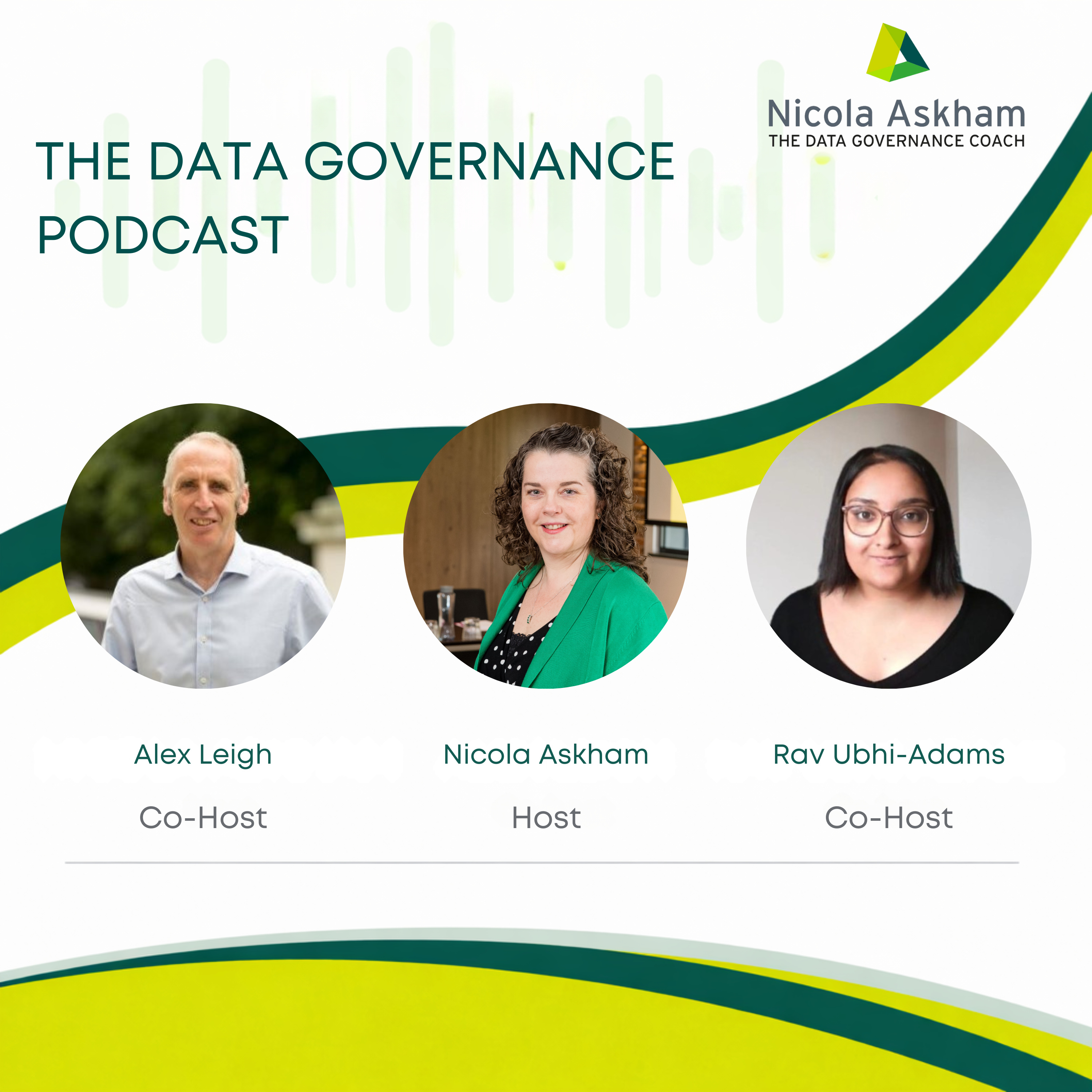
[Music] Hello and welcome to season 13 FSA 5 of the Data Governance Podcast. And this week is the first week that we have Alex and Raab in the hot seat as hosts and they are interviewing the wonderful Angelina Madiros. And she's telling us all about how she's addressed data governance in higher education in the US. Honestly Alex and Raab were so excited after speaking to Angie that I can't wait to dive in and have a listen. And do hang around to the end and in the outro I'm going to give you yet another book give away that my publisher has agreed to. So stay tuned to the end to find out more about that. Let's hear what Angie has to say. [Music] So we're taking over Nicholas podcast today and we have an international flavour to our guests. This is Angie Madiros who's going to introduce herself shortly. Thank you Angie for being with us. And yeah we're going to be really interesting today because we're going to be asking questions about things differently done in different countries and also Raab and I will this officially wanted this podcast because we want to understand more about data governance and HE and F.E. in in the US and outside the UK because you know we're probably focused on the UK so thank you very much for being with us Angie and would you like to kind of introduce yourself and give us a little bit of view of how you've got here today. Sure thank you thank you so much for having me today on the show I really appreciate it. I'm serving as the Associate Vice President of Academic Affairs and Effectiveness at MassaSoi Community College which is a public community college in the state of Massachusetts and the United States. So I've spent about 15 years in the community college sector and the thing that's been interesting is I've gone across a few different areas and so that's shaped my perspective on how to best carry out data governance. I have been an institutional research information technology services and now I'm in academic affairs so it's always been really interesting to you know think about data governance across those different areas. I'm also a licensed mental health counselor that's where I started out I started out in human services and I think it's just a great way of connecting you know my view of data governance because it's about the people right is both people is about working with others being collaborative and making sure that everybody has you know a shared role and a very clear role in how they carry out you know different data governance practices and higher education so so thank you very much I'm excited to talk about you know data governance today and I'll tell you a little bit about how it is in the community colleges. Yes fantastic thank you and yes we are you know you're amongst friends here we are we are we are all ourselves in Nicholas well for it was data as people business we're not the technical side of the of that argument so we have some questions as you know we're going to start off asking you one and we wanted to actually ask you one that we'd ask Nicholas we interview Nick look up weeks ago and we want to ask you the same question because we were interested in if it was different so one of the things that we certainly find out in HE is you know it's kind of a brand with lots of different silos in it it doesn't really feel so it doesn't feel like one organization and the idea of trying to establish kind of best practice to all you know if you're talking to researchers or you're talking academics or even students it's we find quite challenging so we were kind of really interested to understand you know what are you what are you kind of establishes best practice how do you kind of evidence that and how do you kind of get people to work to take on that maybe over some of what they're they're currently doing. So I say a best practice really starts with leadership alignment right so you know leadership at the very top level understands you know not only what data governance is but what it does and how it functions and how it will impact others at the college you know in a community college it's it is as you said a little bit siloed but I think everybody has their own role and it's it's complimentary but it's not the same right so it's very clear institutional research you know we do a lot of compliance reporting we are able to do many different surveys we work with students information technology services is more the technical approach how do we want to carry out different security measures when it comes to data you know so they have a very clear role but it's complimentary to some of the work that institutional research does and then you have academic affairs which is the heart of the institution and you know they have many other roles policies procedures around you know the way data's handled but they all work together right so I think you know having very clear roles and responsibilities help people understand but also having leadership say this is a priority this is important for our college and this will help us make better decisions because we'll have the information we need everybody understands what it says and how to use it and you know that's usually how I carry out you know different data governance practices making sure everybody's aware of how it functions rather than just what it is do you sorry what do you think do you think it's possible to drive data governance practice upwards or do you think you always need to start top that or do you think there's something in between is it do you just kind of need different messages or is it just if the leadership message is why people will get on the train no I think it's both ways right so it's I am very social in what I do and so you know again human services I'm always you know very social I communicate a lot I talk to a lot of different people but I think sometimes I've spoken to folks where leadership doesn't quite understand and that's just because maybe it was it was just never explained to them it wasn't you know it wasn't you know per you know the data wasn't provide the information wasn't provided to them appropriately or they just didn't understand how this would look so I think it's important to really bring in leadership because that sets the tone across the college right it'll set the tone and it'll say this is a priority this is how it will function and then you know others will notice that right because it's very visible you know as well so I think it's all of it but at the same time you know having that leadership support really sets the tone for this is a priority and this is you know how it will impact the work we do yeah we we find that we find you know get senior leaders on board and then a lot of not all of it but a lot of the work is done for you because you've got somebody to really coax people along but it can be difficult to get some of those people on side sometimes it's the people that aren't the most obvious roles for example people in an HR area leadership team there might be very very actively seeking data governance in terms of identifying those senior roles and trying to convince them do you have any hints and tips or tricks on how you would get those senior roles over the line to support any type of data governance initiative. Sure so I always look at the end result right so I think a lot of times I'm approached for different data or outcomes or metrics that just don't even exist just because you know we just we're not set up that way or we just you know I have certain information but it may not be exactly what they need so I always try to start at the end and kind of say hey remember when you know you were looking for some information to help support you know a strategic plan you were doing or try this is how we can get there right so it's kind of like starting at the end say hey I know you would really love to have this information this information is important to you it's important to your staff well this is what we have to do to get it you know we have to put some systems in place we so I try to start with the end result and say you know look this is what we could you know help and we we try to you know really look at our strategic plan to guide the work that we're doing and we also try to try to stay very close to our mission right we're here to support the community we're we're here to make sure that our students are able to you know reach their goals and go beyond here or you know advance in their career so we don't always have the metrics to back that up though and I think it's more important now than ever to say here's the value of the work that we do and you know being able to communicate that to senior leaders helps a lot and then I think they start to realize oh okay you know so that's what we're trying to do we're trying to make it very concrete and also relatable to their needs in order to get them to to sign on to hey here's some of the work we have to do to get there yeah yeah is there any so in the UK there are some consistencies regardless of the institution on what type of messages can really get that by in not just from senior staff from a lot of the board of staffing base um here you a lot of the time it's statutory data returns they are kind of non-negotiable government required and funding body required is there anything that would be a consistent driver over in the states for community colleges yeah so well in the United States we all have to do federal reporting for iPads that's the big you know post-secondary database that we do so if you receive financial aid through the government as an institution then you complete iPads reports in so that's there's 12 for reports there's a lot of information that's collected there and it gives a good baseline of student enrollment demographics student success outcomes it's it's good but it's not always very specific and it may not be exactly what folks need at the state level we also have reporting that we do and those metrics are a bit more useful because now we're comparing ourselves to other community colleges to say hey you know we're doing really good in this area but hey maybe we can do better in another area and hey let's reach out to that community college and say what are you doing to support this group of students for instance because we'd like to move the needle and be able to do that as well so yeah we have a lot of
standard reporting that we do, and that's a huge function of institutional research that's the area of the, of the, in higher education, the department that would take care of that type of work. So, there are consistent things, and they are shared publicly. A lot of it is public, and you're able to say, you know, how your college is doing in terms of, you know, compared to other sister institutions. So there's those types of metrics, but then there's the additional stuff that's very specific to your college that you also want to try to work on, right? And though that could be a little bit more complicated, right? Because we're spending so much time doing the compliance reporting. We also want to make time for the data that's really important to our leadership and also the broader community. Would you say the latter that really pushes the, the dial in terms of buying into data governance? Yes, I would say so, because it's relatable and it's more concrete, and I think that's when people really understand what we're talking about, right? So you say data governance. Sometimes people shut off, you know, just at the word governance, because, you know, maybe they've been involved in something that's, you know, you know, it takes a lot of work. It could be very involved. And so sometimes I'm like, we're just talking about getting the data you need. Just talking about, you know, the metrics that are important for your area and for strategic plan, like that's just what I'm talking about, and formalizing the way people are using and producing data. That's really, I try to break it down in that way too. But yeah, making it relatable and useful, that's when people start to understand the value of this type of work. Yeah, I mean, often, you know, in the UK, we say the data is absolutely highest quality, just before it leaves the building. And then, you know, unfortunately, the time is second to get, then it's really all seen the value of it. I think talking about the value of DG is really interesting. Again, it's clear I think you've made a lot of kind of good points about, you know, telling you, we're trying to help you with your job. It's not an additional thing. What kind of, I mean, do you come across similar things that we come across around, you know, definitions are very difficult in the education because we have lots of different definitions that overlap with each other. Data quality is kind of difficult because there's lots of different, lots of shared data. Do you get those same kind of issues and, you know, what kind of, what kind of resolutions you've been able to put in place around that? Oh, absolutely. Absolutely. That's a universal thing, I think. So I try to make things as simple as possible, right? So I try to be very clear and very simple in what we do. Now, it's not always easy, but I start with the data dictionary, right? And that could be something that you spend a year on. But once, once you're able to get, right? That's what I did, you know, at another institution where for about a year, we focused on the data dictionary and just getting people to understand, you know, what we're talking about when we say retention, what are we saying when we say persistence? There's different, you know, there's different definitions for that and different language. So I think starting with the language is, you know, I think it's the best part and it's the most interesting part and that's when you start to get to know people too, right? So we, we formed a large group that, you know, cut across many different areas of the knowledge. So there were folks at the table from probably every major area. So it was a big group, but it was kind of a fun activity to do. It was almost like an icebreaker where we, you know, we broke down these definitions and we said, well, this is what it means for me. This is what it means for, you know, other reporting, right? Because people have other reporting that they have to do and they have different, different definitions too. So agreeing upon that is, is interesting as well. But I think first having that type, those types of conversations, starts to bring people to the table and then they start to understand what we're talking about, right? So having those conversations first is really helpful to kind of address some of that, some of that work, some of that confusion sometimes too, right? So that's a, that's a key initiative. Data quality is another, a whole other thing, right? But I think around data quality, what, what we did is we had a few policies and procedures that we needed to document around that. Data governance is more than, you know, the policies and procedures. But you really need to have, you have to have a good clear understanding of where data are coming from, who owns the data. And that's the work that maybe isn't as exciting, but once you have those in place, you know, once you have the systems in place, then the quality starts to follow, right? So you have the language where people understand language, you have the quality, that's when things start to get better, right? And then you start, you then you're able to really start to make data more accessible, right? So now you're, you're feeling good about the data. Now you can make it more accessible to the community. People have a good understanding. And then you have to make sure people can use it. That's sometimes the hardest part. But once you get past that, you know, that's kind of the, the way that I've been able to, to carry through on data governance and to address some of those very difficult issues. The, the understanding in using the data is challenging because then you need data literacy. So that's another, you know, then you have another project to work on. But yeah, it's an ongoing, it's an ongoing process that, you know, I think following those, those steps really, really helps, you know, in the community and to address some of those common issues. Yeah. Yeah. I'm going to let my guys take some of them. I've just got to, just for me, that, that about bringing people with you was sometimes I think people say, what's the history of data given as an information governance? And, you know, it's, it's not about complies, it's about like sometimes it feels like having it done to you. And sometimes you're having it done with you. And we find that that approach is the only approach that, you know, because certainly, you know, people like I can, they're very independent people, you know, they want to know your methodology, they want to get into it, you know, they, they, they, they, they want that they are curious people. And you've, I think you've got to behave in a way to, to, to, to meet those needs. So, so we just, to hear that, because yeah, we, you know, that feels like, if somebody said, you know, what would you do? I think we would, we would, we would let that point. So anyway, well, we've got a question. I'm just badly on that. Yeah, just reflecting on the experience that you kind of gave us just then going through a data dictionary and quality and, you know, touching a little bit on literacy, it sounds like you have kind of interacted a lot with a lot of different people across the organization. What are the key lessons that you've learned in doing that other than people can be very different? What are the main lessons that you've learned that you would tell somebody say new coming into data governance that they need to be aware of? Hmm. So, I'd say that it's an ongoing process, right? So, and I think that's okay. And I think it should be, especially as we have a lot of changes coming on, you know, we have AI now. And what does that mean for data governance? And, you know, how do we have a policy around that? It's changing so rapidly that, you know, there's so much going on. So, I think to just make them aware that it's always going to be ongoing and you really need to create a good community. So, you have a good group of folks who will go along with you, right? So, you're like you were just saying, you know, going along, you're bringing people along with you. Yes, you need to bring everybody along with you for this ongoing process that you'll be doing, you know, always. It's always something that will be part of the work that we're doing. And that's okay. Like, I don't, it shouldn't be stagnant. It should be an ongoing process. I guess sometimes I could feel discouraging because it's like, oh, you know, we finally did that. And now, oh, there's something else. And, you know, but I think it's a good thing. I think it should be an ongoing process and to be okay with that. But bringing people along with you, finding a good group, finding your data advocates out there because they're there. You know, you have people that, you know, get it and other folks that, you know, maybe don't understand it or are so much interested into it in it. But, you know, you'll find your group of people and start bringing them along because it's a long ride. Yeah, we always say it's best to push on open doors, isn't it? You can pull your effort where you can kind of get some traction and some momentum quicker and others very soon like to follow, don't they? Yes, because that's breed success. Don't go after the hard ones first. That's definitely less of a weed load. I mean, so clearly, you know, you've kind of been kind of on this journey. We always say debt, you know, it's a lifestyle change. It's not a diet. What happens next? I mean, you've mentioned AI, you know, what is it? Kind of in this role, obviously, you know, with some questions. What do you think you're going to do differently in the future? What? And how much is that driven by kind of mass pressures that you have and how much of it's driven kind of by the world's sort of changing around you? Mm-hmm. Yeah, I think AI, you know, I've learned a lot about it. I've used it for different things. I'm starting to explore more with that, but that one's going to be, I think, a lot more difficult. And I think broadening the work that we do already, right? So I already like to create a community of folks who now it's going to have to get even broader where it's like a, it's a college-wide thing now because it's influencing everything. It's absolutely impacting our students and our faculty where, you know, how do we work with AI? You know, how do we explain it to students? You know, what do we even do? I think it's, we really have to figure out as a community, not just a data governance team, right? It's going to be a whole community to figure out how we best serve our students and continue to serve our students, you know, with AI, you know? So I know it's very challenging for many faculty. And you know, students have different perspectives on it. I've heard different perspectives from students, some like
get some don't like it at all. They don't use it. So it's really interesting. You know, you assume all students are using it, but not not all of them are. I think some of them are actually against it because they say, you know, they're here to learn. They're not here to learn from, you know, you know, one of one of the AI products. So I think really leaning on the community now, it's going to go even bigger to try to figure out, you know, what we should do. We don't have policies. I've looked at different policies. I've looked at different, you know, schools to see what they're doing, but I don't think anybody's quite figured it out yet. And I don't know when we really will. So I think the only thing we found is that one size fits not. We've seen people try to impose policies and that's not going to work. So I think the idea of like, you know, really understanding your your co-workers is the right way to go and yeah, people are scrappling with it. And yeah, we see this in the UK. So our 20 minutes have just gone like that. We had loads of other questions going to ask you, so we're going to have to have you back, right? Definitely because there's so much more we should talk about. But let's try and finish up it. I mean, just to be on, if you would, we get us to this question all the time. I'm starting out in DG. I haven't got a lot of support. You know, I might be weasemijuni in the in the university of the good station. If you could just give them or give yourself that one piece of advice going back at the start. What's thinking it'd be? I would say start small. I think it's okay to start small because then you have some momentum and you can have, you know, a quick win to and I know people say that often, but but really like once you wrap up that, you know, first project and you're able to share it with others, I think it gets the right attention. It shows that you're able to follow through on something like this. So start small. If there's a small problem, you know, in an even a day of addiction, or I know it's a bigger project, but one something like that is done. I mean, that really is a game changer. So go for that first policy. Go for that, you know, that first procedure that you document and that'll really give you the momentum you need. So start small. It's okay and that'll get you going. So that was a really fascinating interview, wasn't it? I love the fact that when asked about best practice for data governance and you started talking about making it a leadership discussion first. That really resonated and you know, that was only the start of her sharing so much practical useful advice. I'm sure this is going to be one of those interviews that perhaps you want to rewind and listen to again. Before you do so though, my lovely publishers at Co-Compage have been kind enough to do another giveaway of my new book. So if you could share about this podcast on LinkedIn, making sure that you tag me and if you do a post about this podcast, it doesn't have to be this episode. It can be if you like or the podcast generally. By closing the business on the 16th of February, then one of those posts will be selected to receive a free copy of my book. Good luck. I hope you will join me back here next week when we are going to have just a bite-size episode with me next week. Looking at whether you can implement data governance in an agile manner, I hope you'll join me then.
Podcast Summary
Key Points:
Effective data governance in higher education requires clear leadership alignment and defined roles across departments like institutional research, IT, and academic affairs.
Gaining buy-in involves starting with end-user needs, linking data initiatives to strategic goals, and making governance relatable by focusing on practical outcomes rather than technical jargon.
Key steps include establishing a common data dictionary, ensuring data quality through policies, and fostering collaboration to address challenges like differing definitions and data literacy.
Data governance is an ongoing, adaptive process that benefits from building a community of advocates and staying responsive to emerging trends like AI.
Summary:
In this podcast episode, Angie Madiros discusses implementing data governance in U.S. community colleges. She emphasizes that success starts with leadership support to prioritize governance and clarify complementary roles across institutional research, IT, and academic affairs. To engage stakeholders, she recommends framing initiatives around tangible outcomes, such as meeting strategic planning needs, rather than abstract concepts. Common drivers include mandatory federal and state reporting, but internal, college-specific metrics often resonate more for buy-in.
Angie highlights practical steps like developing a data dictionary to standardize terms and addressing data quality through documented policies. She notes that governance is an iterative, collaborative effort—bringing people together to define processes helps overcome silos and builds a shared understanding. Ultimately, data governance should be viewed as an ongoing journey, requiring continuous adaptation and community-building to stay effective amid changes like AI, rather than a one-time project.
FAQs
Leadership alignment is crucial as it sets the tone and priority for data governance across the institution, ensuring everyone understands their roles and how it supports decision-making.
Start by linking data governance to tangible outcomes, such as strategic goals or specific data needs, to demonstrate its value and make it relatable to their priorities.
Key drivers include federal reporting requirements like IPEDS and state-level metrics, which provide public benchmarks and compliance incentives for data governance efforts.
Begin by creating a data dictionary to standardize terminology and involve cross-functional teams to agree on definitions, then implement policies for data ownership and quality control.
Data governance is an ongoing process that requires building a supportive community and bringing people along, as it evolves with changes like AI and institutional needs.
When data governance is framed as a tool to provide needed metrics and support daily work, rather than a technical burden, stakeholders are more likely to understand and engage with it.
Chat with AI
Loading...
Pro features
Go deeper with this episode
Unlock creator-grade tools that turn any transcript into show notes and subtitle files.
 PodcastTranscript AI