Speaker 1This is the Experts Podcast, where we pull back the curtain on Australian media. Join Nick Hayes as he speaks with prominent journalists, producers and media personalities and the experts they call on to break down the big stories, find out what it takes to work with the media and how to establish yourself as a media presence in Australia. The Experts Podcast is a production of Media Stable.
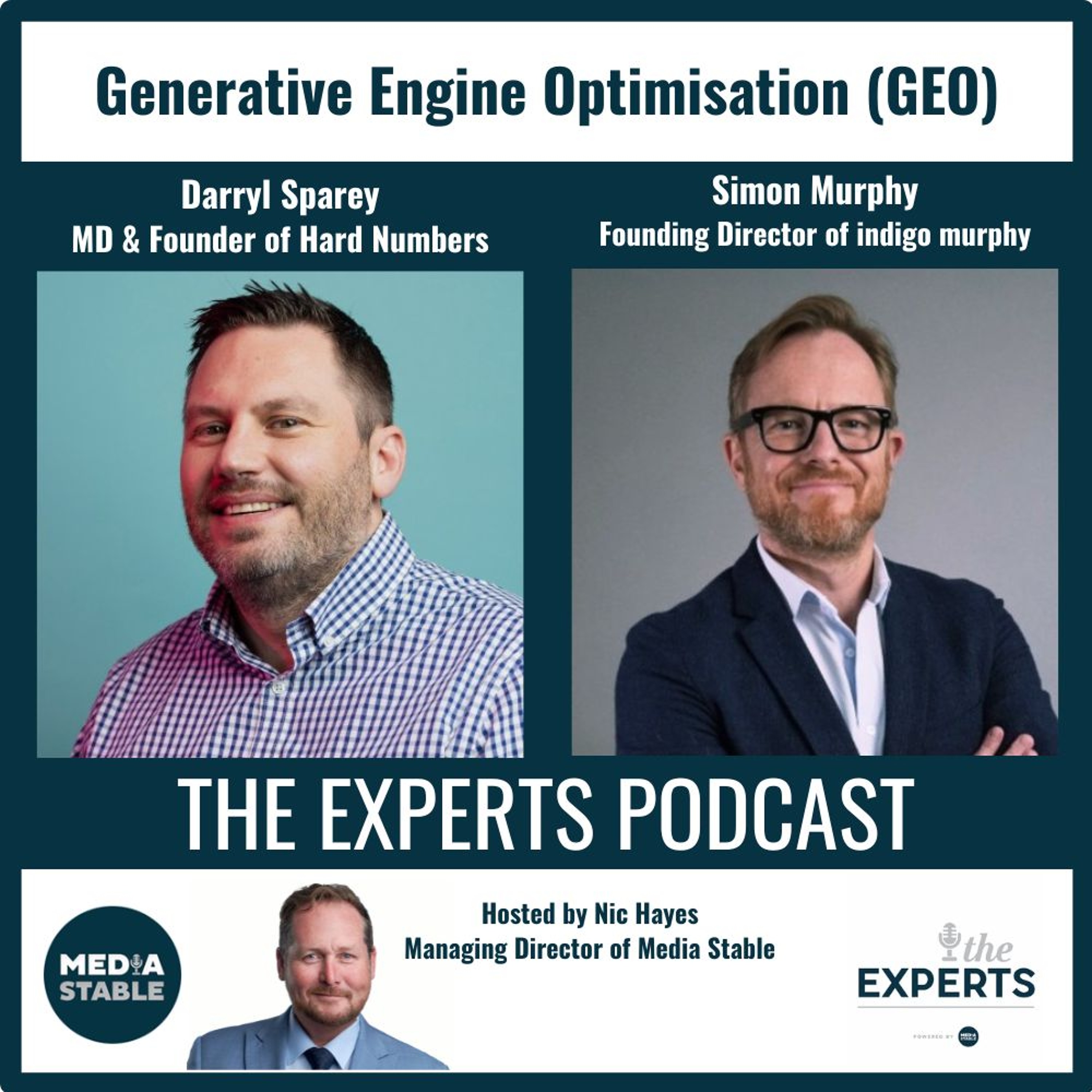
Speaker 2Well welcome to the Experts Podcast, Nick Hayes with you. Great to have your company. We're going to be diving deep into a topic that I am quite passionate about because it's something that I've been probably building up to for the last 15 years of my working life. Earned media plays such an important role when it comes to demonstrating your authority, your expertise and who you are as a business owner or a particular area of expertise that you cover. It's how you get it out there. Earned media is a great place to do it. Now, if you're like me, you've probably dabbled. A few dollars into the dark arts of search engine optimization, SEO as we call it. Haven't I spent a few dollars on that in the past? There's a new one out there. It's called GEO, Generative Engine Optimization. And I've got two fantastic experts to have a chat to about this. Daryl Sperry from Hard Numbers. Simon Murphy from Indigo Murphy. Welcome, gentlemen. Hey, Nick. How are you doing? Daryl, I will share with the audience, we used to work with each other. We worked at Precise Media in the UK when we were probably a little slimmer, a little better looking, and one might say still fancy, footloose, fancy free because there was no children sort of biting at the ankles. How are you?
Speaker 3Yeah, yeah, I'm good. Thank you very much for a good friend. Good to see you looking so well and clearly thriving down under, my friend.
Speaker 2Thank you, Daryl. Yes, thriving on too many reds and too many steaks. Simon, I have. Karen, you had the pleasure of knowing you for the last sort of six to 12 months. Simon, tell us a little bit what you're doing in the PR earned media space.
Speaker 4Yeah. Well, thank you, Nick, again, for having me. And nice to see my UK sparring partner in crime, Daryl Sperry. Mr. Sperry and I do a bit of work on and off together. So, yeah, potted history very briefly, 30 years of PR agency, both big and small. I'm now running my own PR agency. I'm now running my own business, but I come from the big end of agency town. And throughout the course of that 30 years or so, pitching earned stories to media has been central to what I do and helping build clients' reputation and trust. Most people will be aware that earned media, which is, in a sense, the traditional media, the newspapers and so on, radio, et cetera, they have been on the way in recent years, as advertising's dried up and social media's picked up, and youngsters in particular get their news from different sources. But the great news is, and I think it's going to be central to the discussion today, is that earned's back, baby. It's back. It's incredibly important, particularly in this new age of AI or generative AI, whereby chat engines or LLMs, large language models like ChatGPT, Vexity, and Claude, are using a sighting. Earned sources, newspaper, radio, and other sources as well, but really seeing them as incredibly credible sources about the topics that they get asked about. So the more you appear in earned, the better, more likelihood that your visibility and the quality of your visibility will pick up. So left big agency, and I'm now working with the likes of Daryl, advising firms of varying sizes on how to get ahead. Um, in both generative AI and also traditional earned as well.
Speaker 2That's music to my ears, Simon, because it's, it is all the hard work and hard earned media that we have been generating and worked with over the years. Sometimes people will, you know, they'll question the credibility, they'll question the very value of it. And Daryl, this is over to you because hard numbers, your agency is all about the data behind the scenes, the proof. You're talking to a lot of PR companies. In fact, it's very rare. I doubt. I doubt that you are actually in your office because you seem to be speaking at every single conference at the drop of a hat.
Speaker 3Is that what you're up to? Yeah, you're onto me, mate. You rumbled me. Look, you know, GEO is a huge opportunity. And I passionately believe that a rising tide raises all ships, right? The market is big enough for us all. If we capitalize on this opportunity and don't let it go in the way that we did with SEO and with social and things like that as a PR and communications industry. And part of that approach was back in October 2024, we were one of the first companies, definitely first PR agencies, probably one of the first companies in the world to analyze where ChatGPT, what were the sources that ChatGPT was citing when it formulated responses to the world's, about the reputation of the world's 100 biggest brands. And what we found was that. Earned media coverage drove 61% of all LLM responses. And when it came to particular pillars of reputation, so around trust, it was cited in 65% of responses. And when it came to value for money, it was cited in 72% of the responses. So what that ultimately says to us is earned media is the key source that ChatGPT and other LLMs will use to formulate. Opinions about the reputation of, of brands globally. And for us as professional communicators, that's good news, but we've got to be across this and we've got to update our skills and our approaches and things like that so that we can capitalize on the opportunity that that creates for us.
Speaker 2Brilliant, brilliant and beautiful to see some very hard numbers there. Great statistics. I love statistics. It's, but the statistics don't lie. I'm going to stay with you. Daryl, just, just for our listeners, the difference between SEO and GEO.
Speaker 3Okay. Um, I'm definitely not one of those people out there that saying SEO is dead. Okay. Like SEO is still a really important part. And actually the vast majority of links that are cited, um, when ChatGPT provides a link or any other LLM in response to, um, to a question is effectively. By doing a live Google search, what's called rag retrieval, augmented generation. Okay. Um, not to get too technical. Um, so hopefully, um, so, so basically, um, you know, SEO is still a really important part of the mix because all of the, the different LLM. So, uh, Gemini obviously uses Google chat. TVT says it uses Bing publicly. Um, you know, uh, Claude uses brave, et cetera, et cetera. They all use a browser to help them get information to formulate. However, there are things within how you optimize content for generative, uh, engines, um, and the kinds of content that you create and the places that you put that content that are different, you know, SEO, if you really boil it down and that there will be people, I'm sure shouting at their, at their earbuds when they hear me say this, um, is, is about really optimizing. Yeah. Optimizing for, for, for, for link building, you know, 50% of SEO is basically, um, links from third-party sites back to, back to your site, um, for a small number of high domain authority sites and, and getting links from those sites back to your site. Geo is more about being in a broader range of places that are authoritative sources on, um, about your category, your product, your service, the topics that, that, that you want to engage with your users about, um, and having a greater spread of coverage. And it doesn't matter about whether there's a link back to your, um, from a geo perspective, whether there's a link back to your site or not. Then from a technical kind of onsite perspective, it's how you present your content and how you use things like schema markup and other things to, to make your content as machine readable as possible. So it's as easy as possible for an LLM to kind of pick up your content and use it to answer a question. Hopefully I didn't get too technical with that. And hopefully everyone was able to understand that.
Speaker 2Darryl, we are fortunate that it's not you that's delivering technical does not reach or feature in amongst your conversation, which is a beauty for the audience that's listening today. Simon over to you. So I suppose that, you know, Darryl's sort of classed that beautifully, the difference between the two, but it all comes down to consumer behavior, what we use. And we have seen an increase in the, the use of LLMs, large language models, the, the artificial intelligence, people looking to that as opposed to Googling a company or an individual. Yeah.
Speaker 4Yeah. That's a hundred percent right. And it's not just generational either. I mean, notwithstanding, of course, youngsters, uh, and I say youngsters as a, as a, as a proud Gen Xer, um, but you know, Gen Z, for example, over 52% turned to, um, some form of LLM to make, uh, an informed decision about, you know, lifestyle or purchase decision. Um, also in B2B, it's incredibly influential. In fact, I'll tell you this. Arguably, B2B decision-making really led the way in generative search and some phenomenal numbers from what I call the early days, by that I mean about a year old, but regularly updated in the 90th percentile, whereby B2B decisions, purchase decisions are being made within generative AI. So yeah, it's incredibly powerful, not just in terms of floating brand visibility, but also increasingly for that commercial purchase decision. And the higher quality that that reference, that earned citation is, the more likelihood that you're going to see the searcher go and purchase that way. So it's an incredible tool. I mean, I refer to, and I've been banging the drum for quite a while now about the great communications reset, but it's not just reputation, it's also the commercial opportunity as well that comes with it.
Speaker 2Brilliant, brilliant. And I love how you talk about one year. You know, this GEO has only been around for three years. Like it's not like it's been around the SEO. I can remember the early days of that, just getting your head around that. I think people are only just starting to understand it, let alone get on top of it. And now GEOs are up and about. I've got a favourite saying, and I'd love to hear both your views on this, is that, and it's a comment that we make particularly when we do a Meet the Media event, or we're communicating with those that are looking to get their expertise out there. People read editorial, they glaze over advertising. And I think that glaze over advertising is where I look at SEO at the moment and the way that you can jump up higher on the numbers. You can get yourself placed in position, not because you're good at what you do or that your product is good. Your product is any better than anyone else's. You've just paid more to be there. GEO doesn't quite do that, does it? Because it's searching across all of the different platforms, and it's taking real content to deliver back to the consumer. So are we going to see a consumer sort of just jump off SEO or jump off a Google search, for instance, which is using GEO, by the way? I know I'm fully aware of that. But is that where we're heading, where we're going to just look for the real content as opposed to who's paying the most for it?
Speaker 3I think it's a really interesting question. And there's probably two sides to that. I think absolutely, and picking up a point, a thread from Simon is that authenticity and expertise on a particular topic is really important. And we see this from the research that we've done, particularly when we look at other third-party research that we've looked at as well. There was an iPullRank study that looked at about 8,000 searches in relation to what is the best laptop, what is the best flat-screen TV, what is the best mobile phone, et cetera, et cetera. And when you ran those searches on perplexity, perplexity had a tendency to cite, like, for questions in relation to consumer electronics, things like Engadget and Witch and stuff like that, that were all like kind of consumer review things. That have expertise in consumer electronics. And if you asked it questions around, like, what's the best share to invest in or best stock or best company, you know, what's the most investable company, et cetera, or like questions about investments, et cetera, it would cite things from, like, content from, like, Trading 212 and NerdWallet and things like that. So what that tells you is there's a sort of a semantic understanding of the relevance and kind of topical authority that AI has when it selects sources. So on one part, you're absolutely right. On another part, there is a threat, and it's something we talked about just before we got onto the call, which is there's a lot of very bad advice being peddled by folks in relation to this, because this is a new and interesting, a new area, you know, in relation to, like, hacks, things that you can do, like, to quickly, you know, improve how you appear on these different gen AI platforms. And, you know, paid is a part of that mix. People are really heavily pushing newswire distribution. They're pushing, you know, advertorial. They're pushing other things, which absolutely work now. And, you know, I'm not saying don't do it, but I am saying just be aware that just because something works today doesn't mean it's going to work in the future, because these algorithms change all the time. The models change all the time. And you've got to be keeping up to date with that. And you can't talk in absolutes of, you know, you've got to distribute all of your content via a newswire. And if you don't, you'll never be, never appear on, you know, a gen AI platform, because it's just not true.
Speaker 2Right? Yeah, but, Daryl, I mean, this gets over to you, Simon, on this one. But that's been since day one. SEO has always changed. The social media platforms, the sites, they change the algorithm. There is no plain book. There's no rule book out there. It is doing it. But, Simon, are businesses doing enough to play in this game? Because they can't just fix up or add an FAQ to their website, change a little bit of metadata on their website and hope that they're now, hey, we're GEO approved. They've got to do a lot more work behind the scenes.
Speaker 4That's right. They do. Look, it's a black box. And Daryl says rightly that the algorithms change the whole time. You might read at one point, oh, Reddit's really super. And then a month later, it's no longer in vogue. And LinkedIn instead, LinkedIn thought leadership. The answer is it's still early days, even though we've come through that sort of peak of excitement through the trough disillusionment. And believe it or not, AI is less popular in the U.S. than ICE, the enforcement agency right now. So it goes to show just what a sticky area it is. But regardless, it's super important. And I've got some stats that back that up. People are using it. People are buying it. They're buying from it as well. That's the other important thing, particularly as a gentic AI gets increasingly popular. But still, we have to remember, this is the black box. And it changes and it learns and it gets updated arguably twice a year. But people don't really know. So therefore, as an owner of a business, you have to be across the whole mix, really. That's one thing. You've got to be pulling lots of levers. You've also got to be asking questions where you show up in the different LLMs. And as Daryl rightly said, they all have a different flavor. Perplexity is much more B2B. Chat GPT is much more consumer, arguably. So you've got to figure out where your LLM is, where your audience is. And then you've got to ask it questions about your brand and also your competitors, emulating the sort of questions you think your clients and your customers are going to ask. And then it is really in terms of raising brand visibility within those answers. And trying to respond to what you think the prompts are going to be. And it's quite an arduous process. And that's where someone like Heart Numbers comes in to help and do an audit. And then being across both the earned aspects, the owned, and also third-party entities like Wikipedia, which, of course, you can't write your own wiki posts. You can certainly do an editorial contribution. Reddit, if you're brave. LinkedIn, thought leadership. But you really need to be across the whole lot and then come back to measure it. So it feels like a heavy lift. And in some ways, it is. But from a communications perspective, we've got all these skills. It's just retraining the muscle. And what I would add, Nick, and I can see you wagging your finger, but what I would add is from my perception over the last year, the big end of town has really got its head stuck in the sand. It's not doing enough. This is an opportunity, folks.
Speaker 2This is it, Simon. This is exactly where I was heading down the path of because there's a lot of CEOs and MDs that will be listening to you. They'll be listening to this. They'll be sitting there and going, well, what is it that my comms team are doing? What is my marketing team doing to improve this? Are they actually doing anything?
Speaker 4Well, my answer to that is go into your favorite LLM and say, tell me about company X and see what comes up. You probably won't like what you're going to see necessarily. I'm going to hedge my bets there and then take that and ask you constantly what's going on.
Speaker 2Excellent. Because I've actually done a chat GPT on the, both of you. I'm going to share you some results very, very shortly because I get it. I love it. You know what? One thing about chat GPT or even AI, the large language models, all of them is that even from a creative perspective, we don't actively use it to make content, but it's not a bad little starter to kick off a few ideas or inspire a few things to do. Because if there's one thing in media that we do, and from an earned media perspective, you cannot deliver an AI driven piece of content that's going to get passed. It just will be knocked off straight away. So there's just a little message to everyone. It's something that we talk about a lot. But Nick, would you like some stats for that,
Speaker 3my friend? Because you know I like numbers. I've got some stats for you. Give them to me hard, Daryl. Okay. So research published very recently from SEMrush, right? They analysed, finalized 42,000 blog posts. posts and they analyzed them for where they ranked on google in terms of position one to ten um and uh were they written put them through a a tool to say does it look like it was written by ai or does it look like it was written by a human and there was an 80 uh point five percent probability that um the majority of the content in position one of google was written by a person right um and when you when you compare it to like ai john generated content right it accounted for like less than ten percent of the um uh uh position one content that they looked at okay so what that tells us is to exactly to your point don't rely on ai to write your content of course use it as a thought starter of course use it as a as a way of helping you to write your content but don't rely on ai to write your content helping you to not start with a blank page but don't ask ai to write your content for you because you are not going to rank well from an seo perspective and and and therefore you're not going to rank well from a geo perspective either
Speaker 2and you're not going to rank well from a human perspective 100 that that is the key here yeah it is the absolute key humans do not want to hear from machines they want to hear from other humans and i and even if you're not a great writer if you're not a great content writer you're not going to rank well from a seo perspective generator you it is it is very easy to sort of fall into that trap of just punching out crap crap what i call it and it's and what do they call it the sloth the the the slop the ai yeah it is it is so nick here here
Speaker 4is also an opportunity you you operate a niche business you provide a niche product write about it from your own content point of view go into that expertise don't hold back you don't need to sort of keep it two or three lines because the more there is the more niche and expert and authoritative it is the more likelihood um that you're going to get picked up as the expert ai does pick up it now um does decipher between slop and what's really good domain expertise and then the good old anchor bias which is in the back of all our brains when we see it come up float up on chat gpt or complexity we tend to believe it so experts count they
Speaker 2do experts it is it is the new gold um it is i i still say it has been the gold from day one but it's just got such greater value it's sort of trading what oil prices are trading it at the moment it's sort of uh it's gone gone through gone through the roof um we won't talk about that uh it's uh that's a topic for another day so gentlemen you're two leaders in this space you're kicking goals both from a the teaching perspective the advising perspective of for both corporate individuals um communications companies just one tip a tip from you each is to sort of how can businesses quickly now just shift and change and have a think about how they're approaching from your from from your lens what what can they do
Speaker 4so so as a communicator and and that's my goal uh that's my area be bold and know in yourself that you have inherent value you've got three three c's which i can't lay claim to scott galloway professor scott galloway very influential uh u.s marketer talks about curiosity uh connectivity and curation and i think all three of those elements are key to getting your story across this is why the communications um discipline as such will not uh will be uh enduring for a long time to come now with that with that in mind it is about experimentation uh it is about using all your uh own and earn resources that you have to hand writing for humans so i talked about the deep expertise but right as you would speak and then you've got to continue to monitor and adjust and as you do that it'll get easier and easier more intuitive and that muscle will get stronger but remember it's not just reputational opportunity it is a commercial opportunity and that should be what what's driving you particularly if you're a challenger brand and you want to take to the big guys because i assure you the big guys are not doing enough
Speaker 2yep and so i mean that is a message that i can hear coming from you today is that the big players in you you reside in victoria australia uh the asx 200 those big brand companies uh they're missing the opportunity i think they're still sitting as if it's 2004 and uh we'll just hit the seo guy get our rankings up a little higher um but then they're not doing enough in that space daryl what what's your one tip that you'd give to someone who is exploring the the the geo space to to find out whether it's actually working or it's working well for them yeah
Speaker 3uh can i give you two tips one is going to be a slight plug if that's okay but i'll make it quick well the plug is fine just give us your tip okay cool all right first off um start monitoring this stuff so we we call it a like a prompt library build a build a a set of prompts that um focus on the kind of user persona that you're targeting how you talk how how they would talk about your product service category etc in natural language and what the kind of usps of your product versus your competitors are or what the buying criteria are for the users and then track how you are showing up on the different llms for those um for those searches on a on a regular basis and that's something that you know we do for our clients but there's plenty of um tools out there that enable folks to uh to do that as well and then just before you go further there
Speaker 2daryl what kind of clients do you work
Speaker 3with so in the uk i mean we we've done um we've been very fortunate i think that by being quite early to the geo thing um and it being something that impacts companies with a reputation to protect particularly in regulated industries it's led us to working with really quite mature companies on this in this space and ones that probably wouldn't otherwise have worked with hard numbers you know we probably wouldn't have been on their radar otherwise because you know we're we're 20 headcount agency we're only six years old you know the big banks insurance companies financial services businesses that we've worked with typically look for bigger more global more you know sure etc kind of businesses but yeah we've worked with footsie 100 you know companies and large financial services companies that are in the area of services and other regulated industries um on exactly this stuff because i think you know as i said earlier they've got a reputation to protect and they can see the kind of opportunity but they can also see the threat factor you know here particularly as we have the great decoupling of impressions from traffic you know and everyone can see that whilst you know um impressions are increasing traffic particularly from organic traditional organic searches declining we've got a and one of the ways in which we can do that is through through how we show up on gen ai platforms um and the one slight plug ever since like just super quickly is if anyone is wondering how are they going to get started in this area we wrote a um uh what started as a blog post it was supposed to only be 600 800 words ended up being 2200 word um uh opus on geo um and then um uh uh we um we uh turned that into a 3000 word ebook it's downloadable on our website if you go to bit.ly capital geo uh lowercase for uppercase pr um you can download it uh you can download it there and it's everything we will have
Speaker 2we will have a link in the show notes so if you're listening get into the show notes and have a read and it doesn't surprise me that a 600 word end up being two and a half thousand words from you daryl sperry yeah yeah yeah it's uh it would have just kept going and going and going i love it gentlemen i did do a chat gpt shirt search before i came on to speak to you both uh this evening and uh the question i did put into chat gpt is daryl sperry credible on geo go on i'm interested now short answer yes but with a very specific answer i'm interested now short answer yes but with a very specific answer i'm interested lens and some clear limitations uh it does say that you're a strong authority in pr-led geo geo uh he leads head hard numbers it's a pr agency actively developing geo services and audits he's been publicly discussing how earned media influences ai outputs and citations his work focuses on how llms source editorial content which is central to geo mechanics i then went on to say that i'm a big fan of geo and i'm a big fan of geo and i'm a big fan of geo further simon murphy because it then asked me the question would you like to would you like me to tell you a little bit about simon murphy he said simon yes he is definitely up there he's still with daryl in that third tier space because you both well third tier now this is the interesting thing that has described you because you're not actual geo uh founders you haven't come out and provided content on that space you haven't naturally worked in it but it's something that you've grown into from the beginning and you've grown into it and you've grown into it and you've from your background. and it's so important because I think if you were a finder of it or if you've discovered it or made it, there's only very few limited people in that space, but you're actively working with brands to see how this works well for them and that's important.
Speaker 4It is important. And look, Nick, to that point, you know, I don't think anyone owns the GEO space and I'm all for communications folk. You know, I'm banging the drum constantly going, this is a communications reset folk, step up, take the reins, and it should be storytellers. It is the chief storyteller. So that person doesn't necessarily have to sit in the comms team. It might be the founder, it might be MD, it just lives and breathes the company and wants to get that story out there. So no one owns it, but certainly everyone can benefit from it. And what I would say is that AI really amplifies the gap between those who are. Who articulate expertise and those who don't. So, you know, there's the opportunity.
Speaker 2Such a great point. And, Daryl, I raised it earlier before, that reference to those that think GEO can solve everything. If they're telling you to put all your eggs in the one basket, there was a post that you did put up on LinkedIn. I did love it because there are a lot of snake oil salesmen in this space. There is a lot of dodgy content that is flying around and a lot of people believe that they know everything. They know everything that's going on. What's the best way to deal with that, Daryl?
Speaker 3I wrote a poem for my little boy. I wrote a poem for both my kids before they were born. And I basically tried to teach them all of the hard lessons that I've learned to try to help them to get from A to B a bit more quickly. I've read you sections of the poem, actually, Nick, that I wrote for Javier. You have, Daryl.
Speaker 2You have, Daryl. I'm just now letting the audience know we're raising this to an R-rated podcast. So. LAUGHTER Parents' responsibility.
Speaker 3Yeah, yeah, yeah. So one of the things I wrote for my little boy in the poem is, like, I wish that there was such a thing as shortcuts like there aren't. Yeah, love it. I wish I could tell you there was a quicker way to achieve your dreams. But, you know, the sad truth is it's slow. It takes time. The road is long. And it takes, you know, hard effort. And that is true. I think that is a truism of everything. I have yet to find a hack to become a millionaire, you know. I've yet to find a hack to, you know, to rank position one on Google. And I've yet to find a hack to, you know, get clients to be top of the citations on, you know, on GEO. What I can tell you is I can get you there, right? But it will take time and consistent effort across a range of different mediums to help you achieve that. There are no such things as shortcuts. There's no such things as hacks. But if you do the right things and you do them consistently, you know, another thing I say to my kids all the time, success is consistency over time. And it's nothing else, right? You just go at it and you go at it consistently. You give of your best. And then you'll get to where you want to get in the long run.
Speaker 2I love that, Daryl. I love that. And we'll take down the R rating because it was another poem I was thinking that you might have been reciting. So we'll take that R rating down. But it is the journey, isn't it? I suppose it is that journey. And I guess what we do need in this space are good advisors, good leaders that can take us along this journey because it is a minefield. And I started off the podcast, The Dark Arts of SEO. And look, I'm not saying it's dead either. But what I do know, is that the amount of time, energy and money that I have spent to try and raise that to a level where it does get on the first page, it is seen, it is getting results. But I'll share this with you both, is that earlier or late last year and early this year, we had five incoming inquiries of which, you know, you ask straight up, where did you hear about us? I put you through ChatGPT. I said, do you put MediaStable through? No, you just put Earned MediaStable. Or put Media Relations and Expertise. And that sort of, it pleased me to hear that because that is nothing more than the time and energy that I've put into the content I've put out there. I haven't put dollars into Google's big, wealthy buckets of money. So that does make me feel better that we're on the right track. But guiding, and Simon, this is to you, because I know that you work with a lot of businesses, ASX businesses and large businesses. Who should we be talking to? The CEO, the MD, the marketing manager? Who are the people that you should be talking to?
Speaker 4Well, look, it's a mix. It's a mix of the lot. Typically, I'm going in and talking to the chief communications officer or the head of corporate affairs. But more often than not, and this is positive, they're bringing in the digital folk as well. So we're having a joined up conversation about SEO and GEO because as Daryl said, you can't disconnect the two entirely. And that will be the case for time to come. And marketing, of course, is coming into the mix. But ultimately, what started with reputation is now becoming reputation plus commercial outcomes. So, hey, look, I don't mind who takes the reign, whether it's a CEO or a CCO, but they should know that there's real opportunity there if they can get that story told and told well in a way that raises. Raises their visibility in these chatbots.
Speaker 2They work side by side together, reputation and commercial ability. If you don't have. You've got to have both to actually do this. I think you've got to be doing it for the purposes of commercial gain and your reputation is everything. And, Daryl, that's straight over to you on that, is that you talked about reputation, protection of that. But this is for me and me personally. Reputation is one thing, but for people to discover me, new opportunities. New business, new business. It is important.
Speaker 3Yeah, yeah, yeah, 100%. And I don't want to say that brand and performance is a false dichotomy because it's not, you know. And the research shows from much cleverer people than me that when you work those two channels in concert with one another, you get better results. I was at an event last week organised by Inclusive where they had Vicky McNamara, who's VP of Marketing for Workday, and she was like, she was talking about how you can't see brand and performance as separate. Your brand activity needs to connect to revenue, otherwise it's going to be cut. And your performance activity needs to support the brand. Otherwise, you know, brand search, traffic, et cetera, is going to plateau. So you've got to think of these two things in concert with one another. And, you know, I see brand as a kind of correlative for reputation, right? So, yeah, I couldn't agree with you more. You've got to think, you know, and hopefully, you know, when we started Hard Numbers Up six years ago, you know, that's what we wanted to do. We wanted to create a business that connected to creative to the commercial.
Speaker 2Love it. Love it. Gentlemen, we nearly did not do this podcast. It's, well, not because you jumped onto Trevor Young's podcast to jump ahead quite a little few episodes ahead of me, but, yeah. Bournemouth beat Arsenal on the weekend. Oh, yeah. I'm a very, very sad gooner. I haven't really got out of bed since. And I know you're a B-Town supporter, Daryl Sperry.
Speaker 3Of course, my friend. Of course. Well, funnily enough, we made a small acquisition of another agency and we brought four people into our business. And two of them are gooners. And we had a couple of gooners in the office as well. So we've sort of got this, like, little, you know, Arsenal enclave now within hard numbers. And, yeah, I was persona non grata in the office.
Speaker 2Well, you've always had a very special talent of attracting the right people, Daryl. And as you and I did work back in the day at Precise Media, it was a lot of fun. And, look, gentlemen, well done today. I just, I feel like everyone's got a really good insight into GEO. The difference between that, obviously, with SEO and what is a really, really emerging, emerging platform that businesses and from small to big can really get involved with. And I love that first tip. Go and chat GPT. Go and LLM yourself and see what it comes out. And, Simon, you're suggesting it doesn't come out too positively.
Speaker 4More often than not, it doesn't, unfortunately. But, you know, you can do something about that. And that's it. It's a great starting point.
Speaker 2And that's the moment. And that's the moment for businesses. That's the moment for business owners, for communicators. You might be holding the communication reins for a bank, a health fund, whatever that might be. But get on top of this now. Because if you're not, you're going to get way left behind. And it is still very much emerging. And find people that know what they're doing. Get the right people behind you to do what they do very, very well. Daryl Sperry, Simon Murphy, if people want to get in contact with you, tell me how they can do it.
Speaker 4indigo murphy.com say that go
Speaker 2say that again silent
Speaker 3IndigoMurphy.com. Beautiful. And I'm at Daryl Sperry on most platforms, and hardnumbers is hardnumbers.co.uk.
Speaker 2Yeah, jump on LinkedIn, follow the great man Daryl Sperry and Simon Murthy. You can very rarely see that Daryl's in the office. He seems to be the speaker of the UK. Simon, it's probably time we got Daryl over here to Australia. Got him running around doing the circuit here.
Speaker 4I reckon there'll be an avid audience. So, yeah, welcome, Daryl Sperry, Australia visit 2027 or maybe 2026.
Speaker 3Yeah, maybe, maybe. I'd love to. John Crowell, who you know, Nick, has offered to put me up in his place as well if I come over. His mansion. Oh, well, look at that. Yeah, I'll be in his summer palace maybe, not the main wing.
Speaker 2I'm sure we could afford you. I'm not sure we can afford the aviation fuel by the time of 2027. It's a bit frightening. Gentlemen, a great chat tonight. Well done. It's pleasing to hear and see the real practitioners out there doing the thing and advising in the right pathway because I think the way that you both go about it, it's definitely the genuine thing as opposed to a lot of the other things I see on social. They are telling me. Such different things and I'm not thinking it's the right thing. So, always trouble there. Well, you've been listening to The Experts Podcast. My name's Nick Hayes. I look forward to having your company next week when we get to speak to another expert and another media. We'll see you then.
Speaker 1You've been listening to The Experts Podcast, a Media Stable production. This podcast is hosted by Nick Hayes. Emily Morgan is the executive producer. If you'd like to know more, visit our website or email us at info at mediastable.com.au. Thank you.
 PodcastTranscript AI