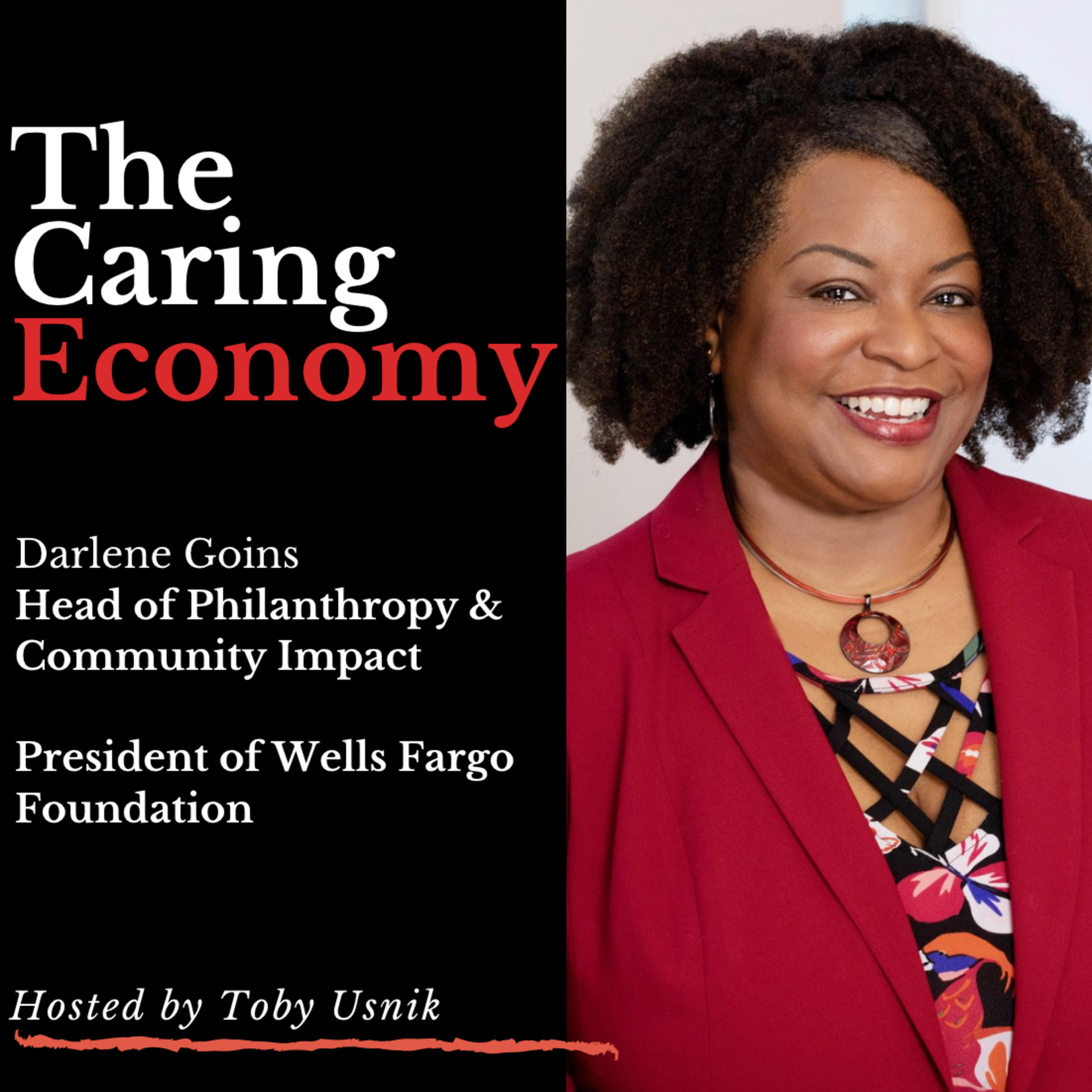
Darlene Goins, on Funding Decisions That Don’t Make Headlines
21m 15s
Darling Goins, head of philanthropy at Wells Fargo, discusses her journey from engineering and data science to leading community impact initiatives. She emphasizes using data-driven strategies to address financial inclusion, highlighting programs like the Banking Inclusion Initiative, which aims to provide affordable banking and financial coaching to unbanked and underbanked households. Partnerships with organizations such as Operation Hope offer personalized financial guidance. Goins also addresses affordable housing, advocating for holistic approaches that include wraparound services like job training and childcare. She stresses the importance of financial literacy, explores AI's potential to enhance nonprofit efficiency, and shares career advice encouraging risk-taking and authenticity. The conversation underscores Wells Fargo's commitment to leveraging scale and resources for community equity and economic fairness.
(upbeat music) - Good morning, good afternoon and good evenings. And happy New Year's as well, ladies and gentlemen, wherever you are in the world, welcome back to the caring economy. With me, your host, Toby Eustnick, we're now in our 19th season. And today our guest, Darling Goins, she leads philanthropy and community impact at Wells Fargo and serves as president of the Wells Fargo Foundation. One of the largest corporate philanthropies in the United States. In that role, she oversees strategies that advance housing affordability, financial health, small business growth, and a more sustainable low carbon future for communities across the country. Darling previously led Wells Fargo's Banking Inclusion Initiative, a decade-long commitment to expand access to households and earlier guided financial planning philanthropy and investing in efforts that help people reduce debt, build savings, and grow wealth in underserved communities. Trained as an engineer with advanced studies in economic systems, I'm way out of my depth already folks. And with earlier leadership roles in data and analytics, wow, she brings a rare blend of quantitative rigor and community insight to the work of making our economy more fair, inclusive, and caring. Welcome to the caring economy, Darling Goins. - Thank you so much. It's an honor to be here. - I'm sure you hear this a lot, but I'm intimidated, but you're such a brainiac with all the data in the quant. - Very rough. - I myself proclaim Data Geek. - Do you have to be living in, you're in San Francisco, right? Do you have to be, is it in the water out there? - It probably is, but I've always been mathematically and analytically inclined, so. - For you, great role model too. So Darling, we always ask our guests to give us sort of the three minute, four minute digest of their life. Where did they grow up? How are they raised? Were there any mentors or bumps or pivots along the way? And so over you? - Sure. - So again, thanks for having me on the podcast. It's really an honor. So I grew up the daughter of a United Methodist minister. Though I moved around quite a bit as I was growing up. I lived mainly in Southern California, but a big change for me was right before high school. My dad decided to move us to Harlem in New York in the mid 80s. And Harlem in the mid 80s is not like it is now. So I got to see a lot of socioeconomic disparities in different communities. I got to see firsthand from him and his work about the importance of service to others, the importance of finding one's purpose. And that's something that's really carried through my entire life. I think of my time at Stanford. I became a member of Delta Sigma Theta. So we're already incorporated, which is a sorority that was founded not only on sisterhood, but also on service. So that's always been very important to me. At Stanford, I studied engineering. As I mentioned before, I'm very mathematically and analytically inclined. And I had a chance to do a lot of different things in my career. I started my career after grad school as a data scientist. I spent some time in project management, product management, sales. Always really focused on helping businesses make better decisions through data. And really driving towards business outcomes and results. And then about a little over a decade ago, I had an opportunity while I was at FICO. An executive came to me and asked if I could figure out a way to help defy credit scores for consumers. If there was a lot of confusion around credit scores in the marketplace at that time, there were educational scores that would give people a different impression of their credit worthiness. And so I developed a program called FICO Score Open Access through which financial institutions could share FICO scores with their customers for free. In fact, Wells Fargo still does that with our credit close up product. And yeah. And so that kind of awakened in me that service to others that purpose around really educating people, giving them the data that they need to chart their financial futures. And so I had an opportunity to come to Wells Fargo. And first lead our free financial education program, then lead financial health philanthropy, go over into the business, which is now consumer banking lending. And I let the banking inclusion initiative and then come back to public affairs a little over two years ago to lead philanthropy and community impacts to the service the president of the Wells Fargo Foundation. So that service to others, that purpose, yet still approaching things with that business mindset, that data-driven mindset is where I am today. And I feel very blessed to be able to do this work. It's very cool. I wonder if you can assess for us the state of financial literacy, particularly for young people. I just finished a book for a client that said it won't be published because he didn't want to pay me. But it is written for young people, an ABC type book. Their organization is like CE. I know we do a poor job, I think, as families and communities and governments to educate people about financial literacy. So the FICO scores are a real issue, I think. But that's my view. But I wonder if you might comment on where we've been or where we are vis-a-vis financial literacy. Yeah, so it's interesting because financial literacy, financial education, it's really a life skill that all young people should learn. I think about my 18-year-old son. Fortunately, in his freshman year at college, he took a class called Investing for the Future. And they learned all about different financial concepts than FICO scores. And I got an interesting text from him, mom. Did you admit that the FICO score? No, I didn't invent him. But I think we need to do more for young people to prepare them, especially when we think about some of the decisions that they're having to make right out the bat as they move into adulthood, whether it's figuring out how to pay for higher education or how to pay for their first apartment and all of those things, they need to learn that so that they can be more successful as adults. I used to do the chair de-oxxions for council and economic education. And the basics, you could teach a two-year-old the difference between need and want. And then the beauty of compounded interest-- it's something-- if you get it, you understand why you're not going to buy the $10 latte at Starbucks when you're 15 years old and save some of that for later. So now I digress. But anyway, so the data piece, I'm reminded Jack Welch, a GE back in the day, is a quote that's attributed to him. But I'm sure others have said it before. In God, we trust all of this bring data. Can you say a little bit about why data? There's the fun, mathematical aspect of it, but you've seen how it really matters, right? Yes. Data is its facts, right? And so I think it's very important to really be grounded. In facts, be grounded in root causes behind things and approach different strategies and opportunities with that knowledge in mind. Otherwise, you could be throwing a strategy at a problem that makes absolutely no sense. And ultimately, we want to see change. We want to see positive outcomes for communities. So I think it's really important to think through the data aspect as we're making different philanthropic investment decisions. To that point, you had 10 years, I believe, with the banking and inclusion initiative. How did you measure success with that? What were some of the tricky things that were hard to get through? Or how do you have your breakthrough moments? Because that needs to keep going. But I do see progress. I have a friend who used to run a similar group at JPMorgan. And there's a real commitment from the top down above commitment. You need to have the boots on the ground. And I wonder what sort of lessons you leaned? Sure. So with the banking and inclusion initiative, which we launched back in 2021, we really saw coming out of the pandemic, the uneven impact on different communities. And if you think about that time, we had economic impact payments that were coming from the government that were just a real safety net for families that were struggling during the pandemic. But those payments first went to people who had bank account information on file at the IRS. And so if you didn't have a bank account, you had to wait. You had to wait for a check to come. And that wait was really hard on a lot of households. According to the most recent FDIC study, there's over 5 million households that are unbanked, meaning they don't have a checking or savings account with a financial institution. And so those people had to wait for a check. And they had to figure out how they were going to get the check cashed. So probably going to a check cashing place. And that's eating into the funds, the much needed funds. And so we felt like we could do more. And we should do more as one of the largest financial institutions in the country. We could use our size, our scale, our resources, our relationships to make a difference for those over 5 million unbanked households, as well as the nearly 20 million underbanked households. In the country. And so two main parts of the initiative were around increasing access to affordable bank products and services and really making financial education and coaching more accessible. So on the product side, there's an organization, cities for financial empowerment fund, that created bank on standards. And those are checking account standards that make the products better for people who may be new to banking or maybe had struggles with banking in the past, things like low monthly fees, no over drafts, other features that access to online banking, things like that. In fact, I just took my 18-year-old to open a bank on our bank on Certified account over the winter break. It's called Clear Access Banking. And so we really increased
the promotion of bank-on-certified accounts of clear access banking to make sure that unbanked households knew that there was a solution for them. We looked at working with different partners to do different types of promotion to reach the unbanked population. So that was one key piece of that initiative. The other key piece was around making financial education and coaching more accessible. And there we worked with an organization, National Nonprofit called Operation Hope. And they have a really interesting model called Hope Inside. So they hire and train financial coaches and then they put them inside different institutions. So it might be in a workplace or in a faith-based organization or inside of a bank branch. And so we worked with them to put their financial coaches put Hope Inside Wells Fargo. And so we now have 40 Hope Inside Centers. So they have their coaches that are co-located with our bankers and our bank branches in low and moderate income communities. They're able to serve surrounding branches. They can serve over 150 branches. And you don't have to be a Wells Fargo customer to take advantage of the coaching. We felt like that was important so that people could get personalized guidance and understanding of their own personal financial situation and then work with the coach to figure out, do I need to build my credit? Do I need to increase my savings? Do I need to reduce my debt and improve their financial situation overall? I'm smiling in part because I know Operation Hope very well. The book that I mentioned previously, the ABCs investing, all the proceeds were meant to benefit them. So I guess the whole world, my client decided that it's a longer story. But I'll send you a copy of the draft because it won't see daylight, but it was with the publisher when he decided to pull the plug. As you know, they're the biggest national organization for financial literacy. And we're already anticipating Spanish edition because that's another underserved community, as you well know. - Great shout out to Operation Hope for sure. Ladies and gentlemen, if you're listening to the Cary and Connie with Toby Eustick Day and you're enjoying our 19 season and you're enjoying this conversation with darling Goins of Wells Fargo, we're talking about philanthropy, dance inclusion and building a more just economy. Remember, you can find past episodes and subscribe wherever you get your podcasts and now back to the conversation. So I wanted to ask you about affordable housing. Mom, I'm on a advisory board here for our community foundation in Hudson Valley. And I know that in most communities across country, but certainly ours, affordable housing was one of the top three concerns up there with food security, transportation, healthcare. What are you seeing in terms of signs of optimism in this space because it is nationwide as a challenge? - It is, it's one of the biggest issues I think facing our country is the housing supply and affordable housing supply. And so we definitely have a focus on housing affordability as well as housing access. It makes sense because a large part of our business and our corporate investment bank finances, multi-family housing, affordable housing. And so we work very closely with that group. In terms of optimism, I think some of the organizations with which we partner are really thinking about it holistically, right? Everyone should have access to a quality affordable place to call home, but that's not enough. There's intersectionality with other issues. And so making sure that residents in affordable housing have access to wraparound services is really a key piece of our work. I think about here in San Francisco with the Sunnydale development with Mercy Housing, California, our corporate investment bank came in with the financing for that housing development as well as financing for a community hub that helps create that sense of community for the residents. And what we were able to do is bring our philanthropy and layer that on and feed an endowment so that those services provided by that community hub could be provided for residents for years to come. So there's a boys and girls club, there's a daycare center, there's job training resources, there's meeting space, a book nook, so people can really be in fellowship with each other as a community. What's your geographic footprint as well as Fargo? Is it all 50 states and any international markets? - So we're not quite all 50 states, although some parts of our business may be in some from a retail bank perspective, we're fewer than the 50 states, but then we also have a big presence in India and the Philippines, we have, I think it's maybe over 2000 other employees around the world in Amia and in APAC. So we have a wide range of areas. I would say, and we look at our philanthropy in all of those areas. - And do you do matching gifts for your employees in the philanthropy? - So we have a program called Community Care Grants and we reward not only givers but doers. So we want it to be more equitable. We know that not everyone may have extra income to be able to donate, but they might have time for them to volunteer. And so our employees can earn community care grants that they can then direct to different nonprofits. - I love that because as you say, it's not as easy for some people to do that in certain parts of the world. I know from having run CSR, building and running CSR, Christy's, each country is quite different. You know, you don't have the news and you don't have the RS and auditing. We did talk about this in advance, but I wonder if you might want to talk a little bit about AI. I didn't know it, but it's everything everywhere all at once today. So I wonder if you're comfortable talking a little bit about it. I'd love to know what your thoughts and reflections are perhaps just personally, or professionally, how it's coming into play at Wells Fargo in the foundation. - Well, I'm definitely not an AI expert. I do use it quite often as a productivity tool, but we also are doing some investments in AI for nonprofits. So helping them think about how AI can make these services that they're providing more efficient. When we think about financial coaching, are there ways for AI to come in and help with that personalization? Maybe more at scale because financial coaching is a pretty high touch, extensive intervention, but are there ways to use AI? So we are exploring different uses. We're funding some AI pilots with some nonprofits, but again, I am not an AI expert by anything. - Yeah, no, I mean, that nobody is. That's the thing. And I know. - Has been dealing with it, even they don't want to recognize it for over 10 years. You'd have Siri and Alexa and playlists. Again, it's a German San Francisco. You're probably more tuned to it, but I've been teaching for three years now, AI 101, just a basic self-talk. And I'm very committed to AI literacy. It's just as tantamount in my mind as financial literacy, because you can't pair the child, student, the professional of tomorrow without exposure to these things. I'll talk to my wife, maybe I could do a partnership with you, because it's not always about money, right? It's about, as you said, to your resume or your matching gifts, you'd find ways to do it. But also, there's, you know, people have so many skills and will to help. And yeah, I married with that in my experience. It's not just about writing a check to a nonprofit. It's also about helping them. They're usually shortly staffed and stretched. You can help them find efficiencies, for sure. But then strategize and think even more broadly, more creatively, the world opens up, is been my experience. And I have to believe out there, you're just, it's the home of tech, right? So you've got so many forces to tap into everything. Also, it seems my observation, and so it might be biased, but it seems like Wells Fargo is really firing all pistons. Like they weren't on the radar in New York, at least, in the same way as JP Morgan or city. And you seem to be in really good growth mode, versus even like being in my melon, you don't hear as much about now. And I don't want you to bash a competitor, but is it, is my observation correct, that you're in a good trajectory? - I think everyone here is really excited about our growth potential. And I think we have a lot of upside. I'll just say that. - Yeah, I know, that's good. Good, let's keep that going. And I love what your work is doing with the bank and for the bank, because then you take others with you, right? Is that collective lift that rises inside? - But my last question is when we always ask people, which is the pearls of wisdom, or the mantras you have in life, what would you tell your younger self, or what do you find yourself often telling both young people who want to be you, so to speak, when they grow up? But also those who might be mid-career later and been disrupted in trying to figure out what's next. Any sort of reflections or words of wisdom? - Yes, a few things. So I often tell people who are earlier in their career to be willing to take risks and say yes to the next opportunity, because you never know how that next opportunity might change things for you. I mean, I think about when I was asked to create FICO score open access, or what became FICO score open access, had I was nervous about it, because we had tried and failed other times to do something similar, but I took a different approach to it and thank goodness I said yes, because it really changed my whole career. I never would have ended up in philanthropy. So it's very important to be willing to take risks and say yes to the next opportunity. I also encourage people to really be their authentic selves, because if you're trying to fit into somebody else's box, you're probably not gonna do it very well. So it's better to just be yourself and you're really doing your employer a disservice if you're not your authentic self, because those different perspectives really are meaningful and having all of those around the table. And then I guess the last thing is, listen, be willing to seek understanding. When I think about our work in philanthropy, We are.
have all the answers, the communities have the answers. And so really listening very thoughtfully and responding and co-designing with community is essential. - I love that. I mean, really if philanthropy can't be the solution, then you need all hands on deck with things like affordable housing and food security. It's also more fun, right? - Absolutely. - But like you, I'm a private sector guy. I've just seen such bench strength and accountability and really in the private sector that is a lovely compliment to what I've seen in government and in nonprofit space. - I do have one. I want to circle back to the beginning. I meant to ask you, so what about your mom? Your dad was a minister. What was your mom's influence and role like when you were growing up? - So she was, she did not work outside of the home. She was focused on raising the kids and being the first lady of the church. She is also a beautiful singer. And so they were in ministry together. - Awesome. I love that story. Ladies and gentlemen, I'm so grateful today we had a wonderful sit down with the president of Wells Fargo Foundation and the woman who really leads the charge there with all things good in my mind, Darlene Goins. Darlene, thank you so much for coming on. Good luck, continue success. Keep expanding and growing and taking others in your wake. It's very, very inspiring. - Thank you. Thank you so much, Tubby.
Podcast Summary
Key Points:
Darling Goins leads philanthropy at Wells Fargo, focusing on housing affordability, financial health, small business growth, and sustainability.
Her background in engineering and data analytics informs a data-driven approach to addressing socioeconomic disparities and promoting financial inclusion.
Key initiatives include the Banking Inclusion Initiative, which expands access to affordable banking and financial coaching, and partnerships like Operation Hope.
Affordable housing efforts emphasize holistic solutions with wraparound services, such as community hubs in developments.
Goins advocates for financial literacy, AI integration in nonprofit efficiency, and encourages career risk-taking and authenticity.
Summary:
Darling Goins, head of philanthropy at Wells Fargo, discusses her journey from engineering and data science to leading community impact initiatives. She emphasizes using data-driven strategies to address financial inclusion, highlighting programs like the Banking Inclusion Initiative, which aims to provide affordable banking and financial coaching to unbanked and underbanked households. Partnerships with organizations such as Operation Hope offer personalized financial guidance.
Goins also addresses affordable housing, advocating for holistic approaches that include wraparound services like job training and childcare. She stresses the importance of financial literacy, explores AI's potential to enhance nonprofit efficiency, and shares career advice encouraging risk-taking and authenticity. The conversation underscores Wells Fargo's commitment to leveraging scale and resources for community equity and economic fairness.
FAQs
The Wells Fargo Foundation focuses on advancing housing affordability, financial health, small business growth, and a sustainable low-carbon future for communities across the United States.
Wells Fargo promotes Bank On-certified accounts like Clear Access Banking, which offer low fees and no overdrafts, and partners with Operation Hope to provide free financial coaching in branches to increase access to banking and education.
Data provides factual grounding to identify root causes and design effective strategies, ensuring philanthropic investments lead to positive outcomes and avoid misdirected efforts.
Wells Fargo finances affordable housing developments and supports wraparound services, such as community hubs with daycare, job training, and social spaces, to enhance resident well-being and stability.
Community Care Grants allow employees to earn grants for nonprofits through volunteering or donating, making philanthropy more equitable by recognizing both time and financial contributions.
Wells Fargo funds AI pilots with nonprofits to explore efficiencies, such as using AI to personalize financial coaching at scale, though it remains an emerging area of focus.
Chat with AI
Loading...
Pro features
Go deeper with this episode
Unlock creator-grade tools that turn any transcript into show notes and subtitle files.
 PodcastTranscript AI