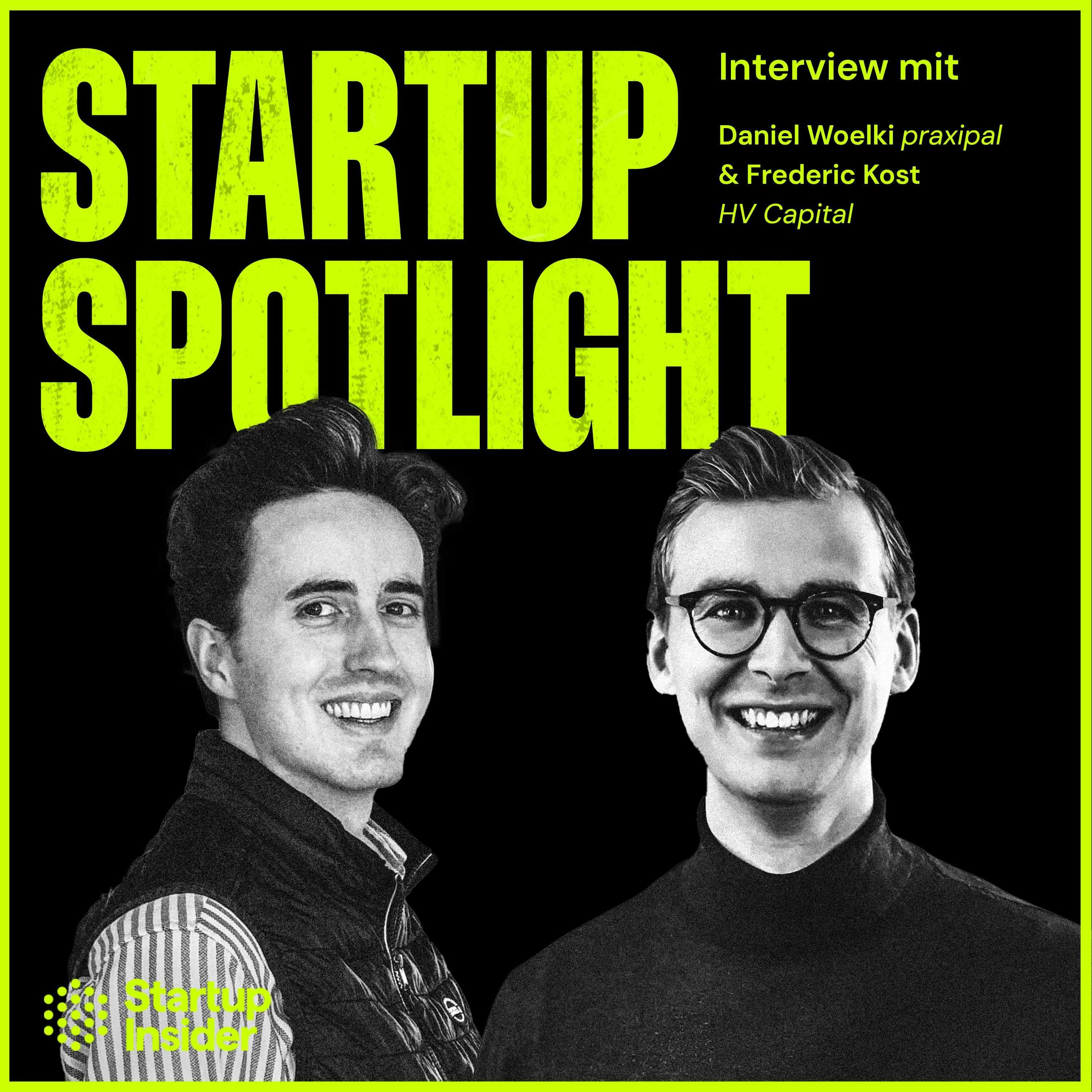
Daniel Woelki (praxipal) will 100.000 Arztpraxen vor dem Personalkollaps retten. Frederic Kost (HV Capital) brauchte nur zehn Tage zum Ja.
from Startup Insider
41m 59s
In the Startup Insider Spotlight, Daniel Wölke of Praxipal and Frederick Coast of HB Capital discussed a recent financial round of 5.7 million euros and how AI can alleviate skills shortage in healthcare. They highlighted Praxipal's AI-driven healthcare workforce solution starting at the reception and its partnership with Ivoris system in the dental field. The conversation delved into the competition in the digital healthcare market, mentioning competitors like Dr. Lip and Yameda. Praxipal's focus on deep understanding of medical practices and processes, as well as its commitment to automation and personalized solutions, were emphasized as key factors in its positioning in the market. The discussion showcased the potential for partnerships between innovative solutions providers like Praxipal and existing healthcare systems to enhance customer experience and drive technological advancements in the industry.
Transcription
7467 Words, 41218 Characters
Welcome to Startup Insider Spotlight.
My name is Jan Thomas and today's guest are Daniel Wölke, co-founder and CEO of Praxipal
and Frederick Coast, investment manager at HB Capital.
And you can already see, yes, founders and investors, that sounds like a financial round
and that's exactly what it gave, a height of 5.7 million euros.
I have to say, a nice tip for a totally relevant topic.
We're talking about how AI can help the lack of the skills and thus also
prevent and at least be part of a solution in terms of health care.
And I think the conversation we've had here is really exciting, because we're looking
at the topic from two perspectives, once through the eyes of the founder and then
of course the investor's view.
We're actually doing a lot of rare things here, but I think it's a really cool
conversation, convince yourself.
Now, as I said, Daniel Wölke, co-founder and CEO of Praxipal.
And as I said, Frederick Coast, investment manager at HB Capital.
Have fun with it.
Daniel, Frederick, hi, you two, I'm looking forward to it.
Hello, I'm looking forward to being here.
Halli, hello.
Yes, is this going to be a mediation talk now?
I probably have to mediate between the two of you, no, you're still in good terms,
right?
Absolutely.
Absolutely.
We've known each other for a long time, so Frederick and I know each other for ten years
in the meantime.
Yes.
You've known each other for ten years.
Yes.
That's exciting.
Yes.
I didn't know that at all.
You could always talk about that.
I just wanted to ask you how you got here, because when you look at your career path,
you almost thought you were more into chemistry or something, right?
Exactly.
We also got to know each other in that context.
That was actually a student academy with a project in summer vacation, two weeks
with the BSF, I think.
Yes.
Yes, you always said that you should get to know investors early, that you know each other
so early.
That was a coincidence.
Yes.
But you didn't wait all the time in contact, did you meet each other now or did you already
know that you were doing something together?
No.
We've always been in contact all the time, that Frederick then comes into the investor
band and I go to the start-up track and meet the way again, that was not visible.
Then maybe we'll do it about Frederick, let's do a funny experiment, as I said, chemistry
that's the bridge.
We'll do an experiment.
Frederick, you show Praxipal and after that, Daniel will tell us how HV Capital is
to be honest.
Wonderful.
That sounds like a good challenge.
Praxipal is actually the company that will build the leading AI-first healthcare workforce
and they start at the reception, at the front desk, because from there the essential processes
go together in one practice and they start specifically so that they call the incoming
phones in key for-autopedy practices, automate and the special thing about it is that the whole
really works to the end, that is, in the best case, so also the medical professional
no longer has to intervene and from there this substantial problem of professionalism
dissolves in practice and then step by step also goes into further processes in the
Praxipal.
Daniel, what do you think of the description?
A very good analysis, we can then also go a little deeper.
I think what I always have to emphasize, I think in this audience now maybe not so much
what I always have to emphasize, the AI that you talk to is similar to humans, so you
can get along well, which also knows how to lead a conversation like this and that's
not like talking to a voodafone bot or something like that, which we still have in the old times
.
The voodafone is now just an exemplar of the old world, so we have nothing against voodafone
at this point.
I don't know if they certainly have better systems now, but that was this exemplary
old bot.
You might have to mention that.
Yes, maybe we can link your website.
You have a whole series of demos with you, that's quite impressive, I have to say.
Thank you very much.
Maybe at this point you actually jumped in briefly, I have to admit, that is also
with the proof that the demo is really impressive, when you actually see how good the technology
in between works and how human beings, like yours, say, are currently working and that
means that the interaction with Luna, how it is called the assistant system, is really
then very smoothly working and then corresponding to the various, let's say, opportunities within
the conversation can be entered.
Before we talk about technology now and also about the go-to market, let's do the second
part of the experiment.
The HV Capital is also exciting for many listeners, you know it very well in the industry, but
to get the insight through the eyes of a founder who has just gone through the whole process
with HV Capital, Daniel, tell us.
Yes, if I had to describe it, that is of course my perspective, HV is the best VC in
Germany, who really wants to continue to support the early phase, the late phase,
which he can also support and has seen, with a super track record, so a very, very
strong brand, I would say, the other thing that comes with it is also very, very good
in terms of human and personal, especially now with Felix and Frederik and that has always
been very important to us, that you are in a tight exchange and that, also in the early
phase in which we are still close to the topic, and we have found a great team and
that has also been confirmed in all the conversations that we have otherwise had, which has given us great
trust in the HV team, is that we have also spoken with existing reasons, that is,
for example, with Voice, also from the HPI ecosystem, and they really only have the highest
tone of the two and I can only confirm that. Felix is Felix Klüger, yes?
Yes, we know him from the podcast, he is also very good, dear greetings at this point.
Now you are talking about the later phases or at least you know all phases, you always have
as a VC, you look for someone to the fund returner, Daniel, what do you want to say,
is there already pressure, is there already pressure on construction or is it now
too early for us to talk about something like that?
I don't think there is really pressure on construction, I think our ambition is very, very big and we
would not go to the venture capital path if our ambition would not also be very, very
big from the founding team and from the team, and in this respect, it is now just another
partner who is in the future, who supports us, this huge problem that we have in the
health system, and that's how we see it.
Can you go to this topic or this path that is currently taking place, your vision,
could you then go without a VC at all? Is that a conceivable case, or can you
give us some bootstraps for example?
At the beginning we also thought about it, I don't think so, there was simply incredibly
much movement in the market, there is incredibly much, incredibly big demand and the demand
is now available at all corners and ends and now it is possible to offer as many
medical practices solutions as possible, and this demand is then maybe in five years in
which the form is no longer there, so that's what we see.
Frederik, maybe not the question, so movement in the market is a good keyword, I think I
think it's very, very difficult for me to put a chip somewhere on the roulette game and
to say that is basically the company that can somehow win this game afterwards, because
there is just so much movement in the market right now, how do you look at it now practically,
what were the reasons why you said that the team and the technological solution and the strategy
work?
It is of course very versatile and of course the whole thing is still in its early phase,
that is, this dynamic will certainly be shown over the next few months, but as you actually
already said, it is the first essential component of the team and we already had a little bit
about the ambition we talked about and there it really comes to make the blow back on the
entrance, I think we are actually too good, that Daniel and I have known each other for so
long and there are really few founding teams that I have met now in my time at HV in
particular, who follow such an ambition level and I also say very structurally deduced
over thought, hey, health care is one of the biggest markets in developed countries in
one of the guidelines, how can we actually say this huge problem that we actually have
that the lack of expertise actually leads to an undercarriage of the fact that it takes place
, yes, and then a very structured run over it is successful, as well as, in this
case, specifically doctor practices are then also addressed, that was, I say to the team
and then Daniel and Martin are both technically trained and also very versatile, I think they
have already seen a lot in their studies on the way and also, let me say, not only on the
academic side, but also in the practical side and I say that's why it's what we
then call the founder market fit, incredibly well given, I remember very much that Daniel
said, hey, at the end of the day, we are a technical team that is technically trained and
also look through these lenses into the market and I believe and that is now, so to speak, the
second part of the market is actually just over the last, I say 12 24 months again, a
substantial step from the, I say, from the awareness on the medical side, that the
technology can actually work and it is not one of the other systems that, now I say,
promise automation, but in fact, they are more in an assistant role, yes, and then when
we look further, the nice thing is that the whole thing is the seed round after the last one, yes,
the team has done very successful pre-seed rounds, where they actually now have
been very impressive over the first months, where they then brought a product to customers,
so that it works extremely well and just Zahnerts prax keyword like the prax in the first
step and Zahnerts prax now also over the coming months are already essential to pay for it.
This market, when you look at the side of the demos from you, then you say that it is
somehow logical that it will come, but at the same time, the market is already there, it is
ready for this solution, because I mean, AI is somehow, let's say we are in the tech bubble,
that is, it has been clear for two and a half, three years now that it will be a game changer,
but is it then at the, so now there are many experts behind it, but do doctors understand that
they have to somehow install virtual assistants? I would also underwrite that. I mean, of course, we have
also just talked to extremely many doctors, customers and potential customers and feedback
was phenomenal, I would say. It is also what we, I would say, typically do in our work with
customers, which is an essential part of our analysis, and it is such a positive feedback,
as in the specific case of Praxipal. Yes, maybe there is another anecdote about it,
which is of course also something that we have asked ourselves. And what we have seen so far is
that the suffering pressure is getting bigger and bigger, that is, businessmen are busy
and for years, when the boomer generation is on the run and we have more and more patients,
we have fewer and fewer staff, you can already feel that it is increasingly increasing,
i.e. the suffering pressure is increasingly increasing, that is very vulnerable if you interact with the
doctors. And on the other hand, I had an anecdote, I had always spoken to a doctor
at the very beginning when we had developed it and it is already a little longer on the way to the market
and there we also came to the topic dot com and internet, and how does that differ? And
then they said to the internet, no one believed at that time, but KI, everyone believes that
it works and that it can help. And that's how you already feel it,
that now also no technical users believe in the technology and that it can help.
And maybe it's actually quite trivial, that really a shift like a ChedgeBT, which,
let me say, is accessible to many end users, is very aware of this. Hey,
there's really something going on now. There are companies that have already started with a similar
proposition over the last 10 years, but that's in connection with, hey, we can really
solve the problem now, and we've seen that in other areas. I maybe even got that through
my children, etc., etc. in the market. Yes, probably many doctors also know that
KI is generally changing in terms of health. Not only, let's say, in the interface of
a practice customer or patient, but really that's also behind it, that you have no idea
about mammography or what that is, I don't know everything. That certainly won't stay
hidden. At the same time, perhaps even more touching fears and hemorrhoids. Do you want to
then practically swing with the front and play with it on the most advanced wave,
or are you more in the waiting mode? So how is your customer contact, your customer feedback?
So far, it's always like that, that we are behind the demand that is in the market,
and that's how it is from the beginning and that's how it is today. So in that case,
we don't feel that yet. There are customers that you meet at a fair that say,
yes, that's nothing for me yet. I think the innovation curve with somehow innovators and
then there's a majority that comes at some point. There's a whole lot in the medical practice market,
but it's just the big difference that not only innovators play around with something like that,
but the mass market is ready for something like that. I thought that, I read that,
it's exciting. You're talking about the Kiefer autopsy line, right? You chose a very
specific segment out of it. Why exactly this one now and how is it going on now? We have
just heard that the dentist is next, but why do you have to be specialized at all?
Why can't you go completely to the width? Well, our approach to thinking about it again is
always that we really want to think about the problem at the end and the problem is that we
have too little staff to do this work. As a result, we reach patients in the
practice and in practice, we are at extremely high stress levels and several employees
sometimes only call. That means the goal has to be to automatically respond and to
work. So in the sense that books and journals are written on it in a different way without
having to assist a person. And this advice has to be written up all the time. And if you
think about it at the end, then it has several consequences. That means on the one hand, you have a great
complexity in the dialogue management and so on, when you have to handle everything on your own,
so it's a user experience challenge. But the further step, you have to understand the domain very,
very well. If I now say, Jan, sit down on the chairs in the Kiefer autopsy and work with them,
then you have to understand first what exactly I have to do here. It's not just about
booking appointments, but you have certain requirements. Which appointments should I book when and
which information can I give out, when and when. And to understand these structures and these domains is
a bit different from the field to field. That's the one thing. The other thing you have to do,
you have to work in the system. So you have to somehow interact with the practice system.
And that means that it is specifically the interface with the IT system in practice with us. That is
also of central importance. And Kiefer autopsy was great in that sense, because we found a
practice partner with the Ivoris system, where we could close a partnership very early
and then also enable LUNA directly to work in the system and to automate the end-to-end processes
in the dialogue with the patient. And on the other hand, we also found that at the beginning,
all possible doctors have come to us. So the need is already great in all areas,
be it radiology, house doctor, dentist, Kiefer autopsy. But Kiefer autopsy is already
out of the box. They have asked themselves to be the first customer. And the first customers
always have to be a bit crazy. And they have to have a certain level of
spirit and innovation readiness. And I would be the technology is now
live for the mass market. But then there are doctors to find out who are deliberately the first customer.
We found that in the Kiefer autopsy more than in other areas. And in that sense, there were two
thoughts that then, for example, made the conclusion. I have started to focus on the Kiefer autopsy.
Who is actually behind this whole game? There are now companies like you,
there are in various branches with various approaches. Maybe we can also talk a bit about
competition, but just to understand the basics. What are the decisive advantages or
the factors behind it? Is it technology? Is it customer understanding? And that's what I wanted to
say. There are companies like Yameda or Dr. Lip or something that have access.
And what you are now building, could they not also build it? Just say that it is a
totally cool add-on, that we simply offer our whole customer. So I think there are
different things you have to take into account. First of all, they do that too. For example,
Dr. Lip and so on. That is an open secret. What we observe in the market where we are
on the road is to build such a technology. Not so trivial and not so easy. Especially
if you have the goal to automate processes at the end of the day. And so far, we have
been that there is a lot announced, but there is still very little to do in the implementation
of the practice. As a system. And the second topic is then certainly a deep understanding
for the practices and the practice processes. We do not believe in a very horizontal approach,
but we always believe that we have to get out of the problem and then really end
at the end for the doctor at the end. And that's why we also go very specifically
from the field to the field and see that this is extremely dependent on the customers.
Fredrik, what are your thoughts on it? I actually think that these big, let me say,
digital health care challenger Dr. Lip naturally have a certain, let me say,
pressure to go into the market. And accordingly, for example, want to launch their own practice
management system. It is always presented as how agile and how extensive it will come,
but I say from the positioning, it basically makes sense from the perspective of Dr. Lip for
itself. At the same time, there are extremely many existing systems, also various existing systems.
And I think that a company like Praxipal, especially there, can be the ideal partner for such
companies, to take this leap in technology, which you then maybe also individually
will not be able to complete. And then at the same time can offer the customer a similar
or maybe even better experience. Because at the same time, we have, we talk a lot about
technical strengths, especially a school in a new system, for example, which simply comes
with a lot of effort. And I believe that this positioning can be very interesting,
both for the practice management systems, as well as for the customers who actually have to change
anything at all. Now there are a few more terms here. So in the end, you have now
both used a few times, then like automation has already fallen. You are now talking about
the whole set of systems, so practice management systems, among other things. What is it that
you think of a company that is developing there? So I hear out a little bit that the
interface to the patient is actually just the beginning. And it doesn't have to be
just an AI voice or do I hear that wrong? Is it rather broad or deep?
It's mainly about the depth. We go into the depths of the tasks here and we are positioned
and we do that with full focus on the front desk, on the reception and all the work that
falls there. And that we start with voice at the end, that has nothing to do with it,
that voice AI is somehow particularly hot right now, but that the passion with the
phone is simply particularly noticeable. If the core topic would have been email,
then we would have started with an email automation. But the core topic is the
telephone and that's why we start there. And that's already about it. The whole tasks
that fall into the dialogue with the patient in a step by step, so that the
staff, that many of you don't know at all today, that this task also takes over
back to the patient. This is often done by medical professionals,
medical professionals. We actually need them to handle the patients in the
treatment and not the whole day on the phone.
At the time, if I were to ask Nelly now, Nelly somehow says that the passion comes
about the not paid calculations. Do you have any thesis behind that?
Does each thesis have its own share or how do you see it?
I don't think this thesis is going to turn out the other way around. I think it can
both work very well and what we see in the market, there is a lot of
suffering pressure that can suddenly be solved now.
But you could of course not coexist next to Nelly.
We coexist in a lot of practices next to Nelly.
Do you think it's also permanent?
Yes.
Yes, exciting. Then tell me something more about the market size.
I think it's totally ... Let's say, this scenario under supply.
I can't win your mission that much, because I think it's very logical,
lack of professional skills for under supply, for a scenario that we all don't want to experience.
But how big is the market now, in terms of knowledge or economic data?
So you just closed your financing round.
That means there is probably a foil to the market. How many do you have?
That's certainly a billion market, you can already say that.
I think there was a big difference.
In Germany or in the German-speaking room?
In the German-speaking room, yes, I believe, and that's the speciality
that we have to go into again, software development and so the products have
already changed fundamentally in recent years and also in the pricing.
Historically speaking, you had software systems that then help.
Yes, that's also in general software as a service, but also in terms of health,
so that we actually built mainly software there that help people,
normal beginners, with interacting with data.
Yes, and in this way, it had an assistance function.
Often, however, this digitalization has now no more somehow simplified processes,
but maybe even complex processes are simply transmitted and not too little work is necessarily carried out.
Now we already have a pretty nice shift in the development, that is, what we are now doing
is no longer building this assistance system per se, where people are able to interact with data,
but the work that a person has done now, sitting on the phone,
carrying out data in the practice administration system,
sending information out, finding suitable terminal chains, books and so on.
This now takes over a AI agent and a AI agent, so to speak, really takes over the human component
and is very comparable to a human labor force, but it is somehow available 24/7.
It doesn't get sick and so on.
And that also reflects in the end how many customers are ready to pay for such a performance.
And that certainly enlarges the market potential.
And if you actually ask that again, because you just took a large order after data,
alone in Germany we have over 100,000 AI and AI practices that can be based on perspective,
as we have just heard, say, the budgets that are suddenly free for solutions in this area,
substantially larger than these historical software budgets.
Because you have to find new opportunities under this lack of expertise at a similar level
and hopefully at a better level in terms of perspective, then also provide insurance.
Startup in Seier.
I think I didn't find any price at the practice party at the workshop, or did I? No.
We currently don't have online, so let's look at the size of the practice.
I would have liked to have calculated it as high as 100,000 practices in terms of volume,
because you are a billion market.
Can we add more details to the next podcast?
Yes, okay, but I find it quite exciting, because I just talked to Matthias Okkenfeldt
about Be2Venture just now, about Legora, you know, maybe in the legal tech field at home,
one big round after the other, all preempted, I think five rounds in the middle of 18 months,
now already worth 1.7 billion.
And there was a bit of the topic again, what actually has such an AI assistant for value?
And that's what you have already hinted at, what prognosis does it actually bring to the front
for a price or for a counter-value or for an accepted value for these agents?
That's very exciting.
I just think that the value of what an agent does in the end is correlated.
And we also see that we are still at the very beginning of this development,
and we can also do a lot more, maybe to what we are doing today.
And I don't know if we want to give a complete exact number, but such an annual contract
value of over 10,000 euros is already very, very good to think about.
And maybe to sort that out again, if you actually look at the last five to seven years,
the loan development also in the head care sector, you can see that the loans are substantially
higher than, say, inflation-friendly, etc. grown, which is also an expression of this
supply factor.
And I say, if you put that in the context, then it is also our perspective that the
realistic in these or, say, even higher areas, depending on how you then, of course,
more value will be created, can be priced.
But I think that's a good point, Freddy, so maybe to address that in a very concrete
way.
I recently spoke to a doctor and he said, 10 years ago, I have a
ZFA of about 1,600 to 1,800 euros a month.
Meanwhile, I pay it significantly over 3,500 euros a month, plus then additional costs and
so on.
ZFA, briefly for the listeners.
It's a medical facility, these are the assistance forces that can work on the patient, but then
often have to use the phone or work on e-mails.
And that's the direction you're looking at right now.
So you're actually really out of the pure software logic in between.
And that's really about the question of what value you're pivoting.
Exactly.
And that's why from our perspective, it's also so important in the go-to market to progress
field for field, to understand the domain well and to go deeper and to build a product
that provides a lot more value instead of, so to speak, to make a horizontal, soft solution
that plays an important role.
That would also have been a possibility.
I spoke to Karo Gabor and Olaf Jakobi here about Motor AI.
I also had the founder of the company, the founder of the company, self-driving systems,
so equipment for the buses.
And also there in the background, 80,000 drivers are missing in the next, I think, three or
four years, because they're going to the race and you can no longer be a person for these
jobs.
And he then let me estimate what such a system costs per year and I was really completely
there.
I have to say that.
Because even though the passion pressure is so high, people are ready to pay for it.
So there's a bit of water on your face now, I think.
Absolutely.
But the value and what the praxis pay, in the end, is also, I think, justified.
If you really had to take over the work that others would have to take over, and then
make it even more correct, 24/7 is reachable around the clock, that makes sense for the
amende too.
Freddy, in all this, if you look at it abstractly, can you build a matrix there and say, I don't
know, there are two axes and the one up there is more attractive than the VC case.
So that's one thing, I don't know, passion pressure, traffic problems, etc.
Then, Ovi, what's not open for AI or what's not automation by AI or something like that?
Well, I mean, many different companies build, let's say, these two times two matrixes
on.
At the end of the day, I think, say, if you would segment the market in general, then
what I personally or personally always find interesting is actually when you choose the
existing segments, which are current, and then actually see how you actually differentiate
or give, if then also partner.
And if we look at ourselves now, for example, in the specific, the practical case, then
typically, as we now think about it, the whole thing is actually five segments, that
means we have these traditional practice administration systems, we have these
challenger practice administration systems, like Dr. Lip, for example, we would then have
classical and new, actually, Gen. AI platform with a focus on voice technology.
We would have wide healthcare software solutions, such as, for example, let's say,
extensive thinking about it, and then just firm like a practical, the very specific one
with an use case, in this case, then correspondingly with the reception and the telephone automation
in the market.
And then theoretically, you could go through all segments and see how specifically
then practically relate to it.
But I'll say, basically, what you say, a high pressure of suffering, I think, basically
just have a lot of practice in the meantime, and the willingness to make changes there
also increases.
Now, the financial round, is that, as I said, the market, that's not just you alone
who are on the road, is that, was the round, was it easy or what are the questions you
also have to let go?
Is there a general question where you say, hmm, I'd rather not listen to you?
So my experience was not that now.
I think all the questions that were asked were totally legitimate.
The round was now not particularly difficult for us either.
So in the end, we, I think, started the round in the beginning of June and then had
closed the round again ten days later and there were many offers.
So we didn't have that in the market.
Did you expect that?
Or you knew, but you already know the whole investor for ten years.
I know not all investors for ten years and we already have a high conviction on what we
do and in this case it was exactly what we wanted to do and in the end something happened.
I think what I say, the practical thing about Daniel and Martin has just done extremely
well is that they have made a very clean structured process and I think in this case, let's say
fair with, in the beginning, all the parties that then took part in the process have
changed, in which they are indeed very well prepared and started to get to know these initial
knowledge or catch-up conversations and then accordingly, because they have been around
for about a year now, they are pretty cool in the different deep lives and I say
to a very good team in the so exciting market, so exciting technology and then accordingly
also the traction that then lies in the background, I do not wonder that the process corresponds
very dynamically and therefore was also competitive.
You would like to hear that, right?
But Daniel, maybe you can say from your point of view, how do you prepare for this process
because within ten days to finish, even if it was structured now and well prepared, what
are the points where you focused on it and why and how did you learn that?
So I think what definitely helps is if you have a good investor on board before the
process starts and our pre-seed investors around Nebula, the Fin Murphy, Anneli, Ajami,
the Anamkara Capital and many of the Angels, they are certainly valuable input givers because
of course they have seen this much more often and more often and can then also give good
context.
But I think the foundation for the whole thing is that you just have to build a very, very
good company that looks at the different dimensions, which also look at an investor
in a right way, just very, very well prepared and then it is also perfect.
You just said traction, what are the points where you are just focusing on it and where
you can also differentiate yourself?
I say from the investor perspective, let's say, in the first step I always find two KPIs
or, let's say, two dimensions pretty exciting, that is once absolute investment size and then
accordingly also the growth with which you usually come to this investment size or with
which you are currently growing, let's say.
And in practice, it was so that they actually only started a short time ago before they
started the round, that is, that is, two or three months before they were launched and
then showed a very impressive speed in this initial growth.
And maybe a general comment there too, we have really with many different companies over the
last few months and quarter also with many different companies that are in this broader
practice management area are speaking, what is particularly out of practice is not
just to win customers for themselves in the first step, but also to bring the customers
live in the beginning, so not just to sign a contract with the investor and then
to onboard the customers and actually deliver the added value.
And that's exactly what the first two dimensions are, and when we go on and there is
the company just still quite young and we will see that over the next quarter and years.
Especially with the AI companies, of course, it's a cross-margin topic and retention,
so how long will the customers really be satisfied to stay with it.
And that's probably in such a case now, it's probably a lock-in effect or I don't know,
maybe you could say that again, but I would have almost thought that you don't have
the same problem here as maybe such a Lovell Bill or a Zuno or something like that where people
try that out for two or three months and then notice that it's like such a fitness club,
I don't use it anymore so intensively and stop and try it again in a year.
That's probably not the case with you.
Exactly, that's very different in the medical field, in the medical practice field.
They really have a real passion for it, they look for a solution and when they have a solution,
when it works, then they also stay with it.
When was it clear to you that your solution works?
The development time, as Frederik already meant, has already taken a statement for a while,
because it's just a highly complex product that you develop in the end.
That the product would work from the value proposition, that was already relatively clear in the early days,
we have already tested many things, just wrote cold emails, doctors and then actually
we once had such a lavina in progress, where we always ran the demand from the beginning.
So that the value proposition works, that was relatively clear in the early days,
how the technical implementation looks in the end, whether you can deliver the value proposition in the end.
That was the question after the pre-seed round and we were able to show that very well to the seed round,
that what is built in the end brings the added value, that the customers do not just like it,
but also really love the product and I think that's a very good basic requirement.
We can end with an experiment, we started with one, now we end with one too.
Daniel, you can describe it from your point of view, if we would talk about it again in 18 months for the next round.
What do you think, what would Frederik expect from your company?
Now I have to think about it again, so my expectation would definitely be that we
take most of the medical practices in Germany over the phone.
A large part? We just have over 100,000 in 18 months.
That's definitely the ambition we have.
I thought I would build such a bridge and would ask Frederik if he would invest in it.
Then he would definitely invest in it. I think there is even pre-empted.
Frederik, what has to happen until the next round, then realistically ask, ambition or not.
I don't want to talk about it, but 100,000 medical practices sounds wild.
I would say basically that having this positive basic optimism is certainly one of the qualities
of Daniel, but currently there are over 100 doctors who are already being operated.
And if we are now in a larger order, factor 10, then I think that is a great success.
But that sounds like Daniel is almost unambitioned, right?
I have to say, the 18 months are certainly a very ambitious time.
No, but I think it's up to us and that's probably the core point.
With the 18 months I haven't really listened to it that much.
That's not what we're looking for in the core.
We're looking at the next 5 to 10 years.
There is currently a fundamental platform shift that is happening.
The entire power of expertise is generated.
We can't get any more clear.
In the next 5 to 10 years, most of the medical practices will be operated with such solutions.
The only question is, are we then the ones who are also worried that there will be such a particularly good solution at the end in the medical practice?
And that's going to be a exciting time.
Maybe you have another purely technical understanding.
You're now going to Austria.
I'm taking it from the demographic side.
You probably have the same market conditions in France or the UK and so on.
But do such systems then also adapt very quickly to the local conditions?
I think the nice thing is that we are on a level, let's say, above the practice management system,
where there are fewer regulatory requirements and also the language-based challenges with multilingual language models are much lower.
And in this respect, there is a scaleability, I think, on the dimension where we are on the road.
There we see fewer obstacles than the other model in this case.
With my question, you're done.
Now I think we forgot something important from your point of view.
I would actually like to add one thing.
I would say the company is currently still, I would say, there is currently the possibility to join the team.
And yes, I think that's right.
I think that's a phenomenal opportunity right now.
One of the ambitious teams is in the healthcare sector and of course also in the AI sector to join.
And I can only recommend it and I would also like to be ready for any reference talks
if there is any interest.
Yes, I think I've already looked at it, you're looking for relatively many technical people, right?
Or how was that?
Absolutely, we're looking for engineering, we're also looking for the go-to-market side,
but we are a very product and engineering-driven team, software, AI engineers, because we think...
I don't have sales at all, or am I mistaken, I don't know anymore.
Yes, of course there is sales, in the end you don't really come around.
What I think has already shown to us is that they are very product and engineering-oriented companies
that want to approach the core and also deep, difficult challenges of this market.
But we're hiring a cross-bord from engineering to go-to-market, everything is there.
Great, I'll give you a thumbs up and then I'm excited.
In 18 months we'll meet at the next experiment here, right?
Wonderful.
Have fun.
Thank you.
Good luck.
Bye, bye.
So, we've already arrived at the end.
I hope you enjoyed it.
If it should be like this, why not go out?
You've been here until now.
Then the short bits to you.
Maybe you can review yourself by recommending this podcast to us.
Either on LinkedIn or especially on Apple Podcasts or Spotify.
And also like to leave a rating or a comment.
We would be extremely happy or motivate us to continue to produce this podcast at this high level and this high frequency.
Yes, then thank you very much for that.
And otherwise maybe again the short introduction to a very special product from us.
We have launched a newsletter for some time, which is aimed at startups that are looking for capital.
So if you are a founder or a founder, especially in the early stages and if you are currently taking up money or want to take up short,
then I think that's the right newsletter in which you can imagine.
Because it will be read by almost 700 business angels and VCs.
So you really reach a huge target group at once.
The great thing is, the whole thing is free for you.
That means, in order to be there, you just have to go to our platform www.startupinstader.de
and then slash newsletter and there you will find a newsletter called deal flow newsletter.
The right one is, as I said, to all investors, investors.
Of course, you can also simply subscribe.
That also means investors, investors can also watch it.
But especially startups looking for capital should always look into it.
If you have any questions, please contact us.
Otherwise, just try it out.
As I said, the whole thing is free of charge.
www.startupinstader.de/newsletter
Have fun with it and otherwise have a great day.
And yes, maybe see you later or otherwise see you tomorrow.
Bye bye.
[Music]
Podcast Summary
Key Points:
Discussion between Daniel Wölke of Praxipal and Frederick Coast of HB Capital about a financial round of 5.7 million euros.
Focus on how AI can address skills shortage in healthcare.
Description of Praxipal's AI-first healthcare workforce solution starting at reception.
Overview of the partnership between Praxipal and Ivoris system in the dental field.
Comparison with competitors like Dr. Lip and Yameda in the digital healthcare market.
Summary:
7 million euros and how AI can alleviate skills shortage in healthcare. They highlighted Praxipal's AI-driven healthcare workforce solution starting at the reception and its partnership with Ivoris system in the dental field. The conversation delved into the competition in the digital healthcare market, mentioning competitors like Dr.
Lip and Yameda. Praxipal's focus on deep understanding of medical practices and processes, as well as its commitment to automation and personalized solutions, were emphasized as key factors in its positioning in the market. The discussion showcased the potential for partnerships between innovative solutions providers like Praxipal and existing healthcare systems to enhance customer experience and drive technological advancements in the industry.
FAQs
Praxipal aims to address the lack of skills in healthcare by automating processes starting from the front desk to improve efficiency.
The partnership with Ivoris system allows Praxipal to work directly within the practice system, automating end-to-end processes and enhancing patient dialogue.
Praxipal focuses on deep understanding of specific medical practices, aiming to automate processes effectively, a challenge not easily achieved by competitors.
Praxipal's approach involves in-depth understanding of medical practices and processes, focusing on solving specific problems for doctors, rather than a broad horizontal approach.
Praxipal has received positive feedback from doctors and customers, indicating a growing demand for AI solutions to alleviate the increasing pressure in healthcare settings.
Praxipal chose orthodontics due to the high stress levels and need for automation in patient interactions, along with finding innovative early adopters in the field.
Chat with AI
Loading...
Pro features
Go deeper with this episode
Unlock creator-grade tools that turn any transcript into show notes and subtitle files.
 PodcastTranscript AI