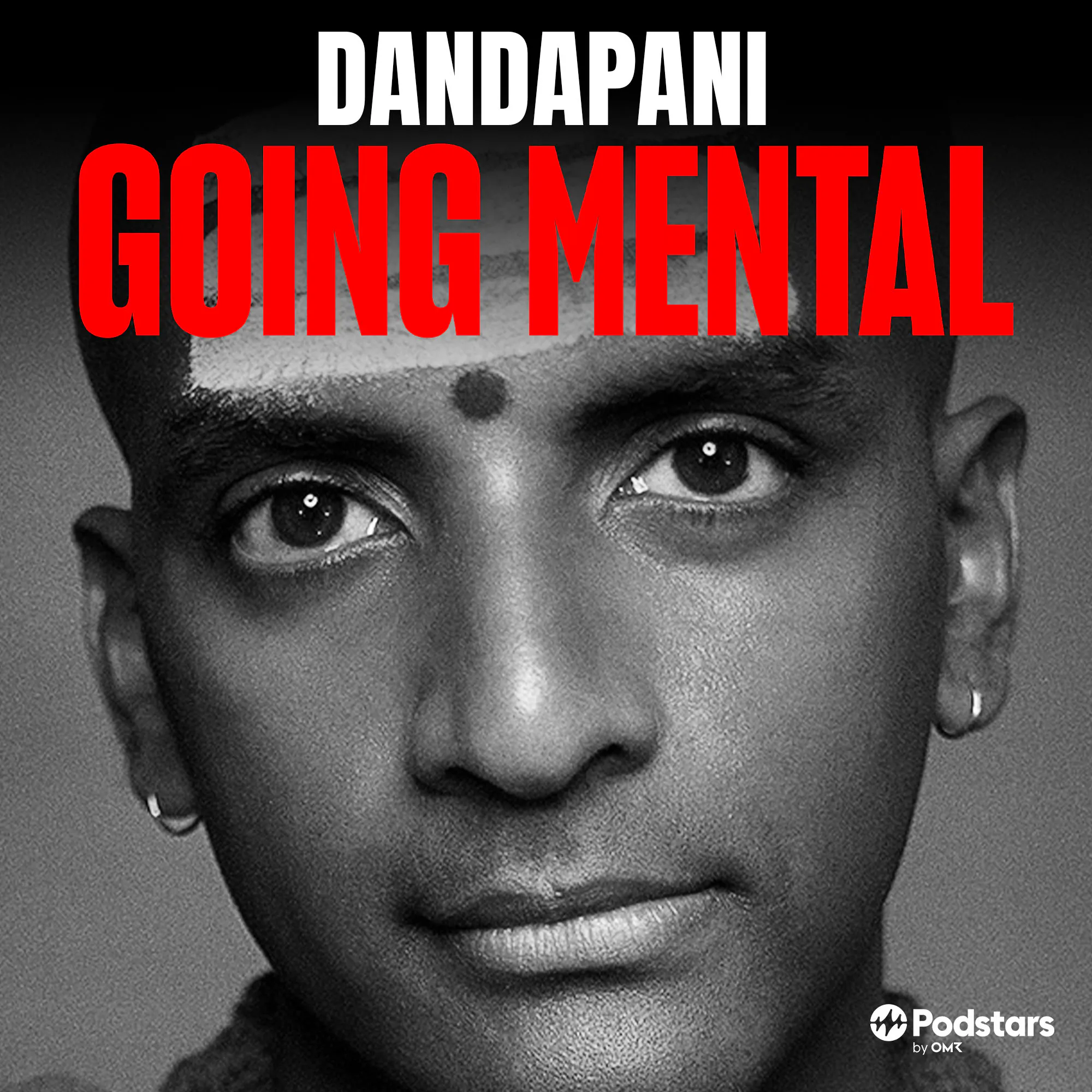
My first time talking to a Hindu priest, a former monk, has dedicated himself to taking control of your mind and focus. You know, you can meditate for six months, every day for six months and after six months you're still a jerk. Imagine if I practiced distraction six hours a day, six days a week. After six months what would I be good at? Being distracted. Anybody practicing something ten hours a day, seven days a week is going to be the Bruce Lee of distraction. If I have one plant sitting in a pot and I had a cup of water, I could water that plant. The following year I add 99 more plants, potter plants in my house and now I have a hundred potter plants and still one cup of water I can't make anything grow. Why do you think that we're always drawn to the shiny things? Purpose focus simplifies sacrifice. Joy, the feeling of happiness is a byproduct of doing something, right? So we have to find out in our life what is the thing that brings us joy. This is my first time talking to a Hindu priest, a former monk who has traveled the world and done many, many amazing experiences, has dedicated himself to taking control of your mind and focus. If I am said that correctly and I am very much looking forward to seeing how these lessons apply to everyday life, to athletic pursuits and perhaps to opening new chapters. Dandapani, welcome to Frodeno Going Mental. This edition, Dandapani Going Mental. I love it. Thank you. I appreciate being on your show here. Well, it's truly an honor and I started by saying that I've never spoken to a Hindu priest before. Can we start at the beginning? How do you start becoming a monk in general? In Hinduism, there are technically two paths. There's the path of the monastic and the path of the household. The household is a family person. So a man or woman that can get married, have family work and money and things. And the path of the monastic, you can either have monks or nuns. And they typically are celibate men or women that live in cloisters with other men if you are a monk and women obviously with other women. And they typically don't earn and work and earn money. And they are living cloisters with each other or by themselves. So those are the two separate paths within Hinduism. So when I grew up, I wanted to be a monk since I was about four or five years old. And when I finally met my teacher, I found someone who, I think to me, the greatest thing was that he could articulate clearly the philosophy, the spiritual philosophy, the goal that the philosophy outlined, the path to the goal, the guidelines which we need to live by. And the practices we need to do for that path to get to that goal. And the KPI is along the way. How do I know I'm making progress? Because I remember him saying once, you can meditate for six months. Every day for six months and after six months you're still a jerk. Maybe you're doing the wrong meditation or you're doing the wrong practice. And I thought, like how profound, you know, because a lot of times people on the spiritual path think like if I'm just doing the practice, I'm making progress. But that's not necessarily the case. Progress is shown through a change of behavior and how we act and react to life experiences. So that basically took me to his monastery, which was a traditional cloistered Hindu monastery on that island of Kwa'i in Hawaii. And so I lived there as a monk for 10 years as one of his monastics. All my life I have had Achilles problems. It is something I've spent months and years on trying to rehab and recover. And finally in 2022, my wife introduced me to pillar performance. What really caught my attention was their athlete approach on clinical micronutrition for performance. Not just general health supplements, but evidence-based formulas designed specifically to support athletes under real load. And they're all tested for purity and bioavailability. When I spoke with Damien the founder about my injury, he mentioned a specific collagen peptide called Tendo forte that they'd been testing. The team arranged to get me some samples I introduced into my daily rehab. And the rest is history. Now available as pillar collagen repair, it provides targeted support using Tendo forte, which has been shown in clinical research to support connective tissue repair and recovery. Collagen repair has in turn made it into my daily routine. First thing in the morning, warm glass of water, half a lemon and some salt, I swear by it. If you want to give it a try, use code
[email protected] or for North American listeners on thefeed.com. That's code going mental for 15% off first time purchases. I mean that sounds fantastic. Obviously brings back memories. The pinnacle of our sport is celebrated in Hawaii over on Big Island. So you know, it's a very different kind of religion, I would say in some sense that people tend to follow. But talk to me about the feeling of entering a cloistered, how would you say it? A cloister. I mean, it means you have to kind of step away from your family, your friends, you start in a completely different world. Is that a permanent thing or I mean, it's a very radical step. Yeah, very radical for sure. In traditional monasteries, I can only speak for Hinduism because they're monastic traditions within Christianity and Buddhism and different faiths as well. So within Hinduism, traditional monasteries, you typically take vows that last two years and then you renew them. And in our monastery after 10 to 14 years of training, then you can take lifetime vows. So you would renew your two-year vows repeatedly till you take lifetime vows. I always kind of jokingly say it's like you date before you marry unless you're in Vegas, then you marry and then you date, you know. It sounds a little more extreme than a 90-day course to wisdom. I think there's a lot of people out there today that claim they have lived as a monk and they've gone to some retreat for three months and lived in some ashram and come out and say, oh, I was a monk. You know, doesn't mean I play football or you know basketball and I can say I played for the NBA or when watching an NBA game and said, you know, I played in the NBA. I think traditional monasteries following a traditional monastic path is a path where you have an alliance to a particular faith. You take vows of renunciation, of leaving things behind. So the monastery, we practice celibacy, we had no communication with the outside world unless it was necessary for our work that we were doing. So I didn't speak to my parents, my friends, relatives for 10 years. Well, my parents, you know, I spoke to them twice a year in the initial years. You know, I had an hour long call with them every six months. So, did you check in, you know, but yeah, none of my relatives never spoke to any of my friends again. So it was a very serious path of renunciation and so much of it was preparing to get in. It's not a binary experience of, you know, you walk in there and you say, okay, I'm going to be a monk today and renounce the world. That can be very jarring. When I found my guru and decided for myself that that was the monastery that I would join and then he would accept me obviously that he also needed to accept me then became started the whole process of renouncing things along the way. So I remember like I was in university at that time, I, you know, would eat a masbara or a snake as bar in and go like, okay, this would be the last masbara probably ever eat in my life again. And I'd enjoy eating it and go, okay, I'm totally okay if I never eat this again. And I would just go through every experience in my life, all the mundane things from food to drinks to listening to music to whatever it may be and just say, okay, well, it was wonderful while I had it and I'm not attached and I seek something different for me greater, you know, and then necessarily for everyone. And I'm happy to give this up for that. I mean, it sounds on one hand you're moving to a tropical island in the middle of the Pacific. On the other hand, you grew up in Australia had an electrical engineering degree, you know, you, it's not like you were escaping a boxer's reality of living on the streets like you, you had a decent life. And I'm just wondering what is the driving force if you're willing to share to go and take that.
extreme step to go and say, "Okay, I am willing to go on this journey to try this journey and to see where it leads me." No, I had a very decent life growing up. I have a beautiful mom who was extremely loving and kind, cooked and fed her her three sons. So it was very difficult leaving home. It's not like I grew up in a broken home on the streets where it was an easier decision to go like, "Well, going here would be better than what I have right now." For me, I met a monk when I was about four or five years old. I'm assuming around that timeline. And when I saw him, I said, "That's me." I saw him in the orange robes, the markings on his forehead, the beads and everything. But it wasn't until I think I was about eight or nine years old that I realized that it wasn't about being a monastic. It was really about the pursuit of enlightenment. And the biggest thing I realized that everything in this life goes through three phases. Everything is created, it exists for a while, and then it goes away. So I thought to myself, "Well, this sucks." Why would someone give me something only for it to go away? I mean, then don't give it to me. So my question is, what is the constant in life? What is the one thing in life that never ever changes? People come into your life, they exist for a while, and then they may go away or they may die. We didn't grow up wealthy, probably middle class or a little bit lower middle class. If my parents took me out to A&W, which was the McDonald's equivalent, and we may have gone to one say, "Yeah, that was a huge treat." The experience of going there was exciting, the experience of eating a burger, French fries, and drinking a root beer was very exciting, and then it ended. I don't know, like, "Well, this sucks." And everything in life goes through that phase. So what's the constant? And the pursuit of that, I refused to believe that we are here on this planet just to collect experiences. That just seems so ignorant to me. In absolute ways of time, because I could re-incarnate a million times and still not have all the experiences this world has to offer me. So if my life is finite, I'm only here for an X amount of time, surely there's something more profound for me to do than just have experiences and what is it and what is that constant and that drove me to the monastic life. There wasn't really about leading a monastic life, it was the pursuit of that constant, that the self inside of you, the divinity inside of you, which has always existed, never goes away, and it's therefore a huge experience. And how do you get there? The monastic path was a more extreme, focused path of getting to that experience. I mean, yeah, in many ways, it's very extreme, but in another, it's also very concentrated, and therefore perhaps also an early investment to look at something that you can read the benefits of later in life, which I always say, you know, to front and the work, always. You know, then you have the benefits the rest of your life, right? I mean, most people do it on the back end of life, but if you front and it, then you can just go through life with a better perspective, a better understanding. And really be able to manage your experiences better in life than you would if you didn't have that perspective. So going into the cloister, you spend 10 years there, you choose not to renew your vows, take me into that kind of thinking. You're ready to step into the world again. Absolutely not. Well, my goal was never to leave the monastery. My guru died three years after I joined, and I felt after that, as the years went by, we weren't as aligned as we were before, and then when my vows came up for renewal, I decided not to renew it. It was the most difficult decision I've ever made in my life. So that's when I chose to leave. So it wasn't that I went in there thinking, you know, it's stay for 10 years and then go out and teach, I had no intention to do any of this stuff and had no desire to teach or share. My goal was, you know, this is my goal. This is what I'm going there to do. So it's just that I made this choice to leave and I had to, you know, find the next thing to do. Yeah. And find the next thing to do. You go from Kauai to New York. And in my mind, I'm just picturing this idyllic island space to New York. The first thing that comes to mind is what broke first? Why broke first? I think the hardest thing was grappling with the fact that I was no longer an asset. I'd wanted to do this since I was about four or five years old. Obviously, I couldn't articulate it back then like I can right now. And it wasn't unwavering my whole childhood. There were times when I realized like, why the hell would I want to be a monastic, you know? And I was born in Malaysia. I spent my early years there. We migrated to Australia. You know, you get to puberty. You see girls. You just go like, why would I want to be a monk? You know, I could date. I could go to parties. I could have fun. Traveled and you learn about, I could get a job and money, you know, by a car. You know, just do all the things that everyone is doing. And then especially even in university where my friends were graduating, I knew people that were in university like a year older than me or two years. I had a me and they got a job and were working and traveling and dating. And you just go like, that all sounds, you know, like collecting experiences. Yeah. And so was it unwavering? Absolutely not. In the sense that was there a time that I thought like, yeah, why would I want to do this absolutely all the time? Anyone that tells you they never think that is lying, you know. And but, you know, this is who I am. This is what I built to do. I know a guy who created Spartan races. Joe DeSena, I don't know if you've ever heard of him or not. And we were chatting once at an event and I asked, you know, he does this ultra long marathon runs, you know, 50 kilometers, 75 kilometers, 100 kilometers, doing grueling races. I said, one's, Joe, do you ever think of quitting? He said every single race. And I said, thank you for your honesty. You know, he says, I said, how do you get past it? He goes like, well, I just, I just need to make it to that rock. And once I get to that rock, I need to make it to that tree. And before I know it, I'm at the finish line. But yeah, I think of quitting every single time. So you know, anyone that tells you that, you know, I become an astic and I've never thought of quitting or never thought of doing anything else, not being honest. I always thought to myself, in long distance racing, that the pain of quitting is higher and longer lasting than what you're enduring at that very moment. That was kind of what kept me alive. Does that resonate at all? Yeah. No, absolutely. Yeah. Yeah, no, that's why I said, you know, this was the hardest decision I've ever made is the decision of actually leaving the monastic life. So for me, you know, what was the odd thing going to New York City was just, you know, I think dealing with the fact that no longer a monastic and this would be my future. Now technically, I could continue to be a monastic on my own, live as a monastic and you know, but I would need to follow the guidelines and rules of being a monastic, which is not to earn, not to work in and money. I would live off donations. I would start my own congregation and people would donate to me and assume the role of a guru that kind of, you know, scenario, which I didn't want to go down that track. The one thing I was very clear about was being financially independent and the primary reason behind that is that I wanted to be able to say what I wanted to say and not be all obligated to my congregation because when I lived as a monastic and I traveled around, you know, monks, no monks and we ran to other monasteries and we saw the gurus and other organization, monastic organizations. I saw how so many of them were influenced by their congregation. So the monastic leader or the gurus, more like the queen, you know, it's almost like you don't have power, you're the figurehead that sits on a coin. And then you've got the parliament that's making all the decisions and things like that. So you had, you know, behind the guru was a board of trustees, which were householders, you know, usually very successful businessmen and women that, you know, had influence, had power, had money and they donated to the organization, kept it running, you know, but here you had to figure it out. So you know, if I wanted to talk about child abuse and someone in my congregation didn't want me to talk about it. And so what do I say? And do I say, no, I want to talk about it. Then there's a potential that he may stop donating to my congregation. Then how do I keep the lights on? You know, now that, you know, I own my own money, I not determine, I'm not dependent on anyone for money in the sense that, you know, I have my own business, my own, I'm
business and I run my business, then I say whatever I want. If you don't like what I'm saying, you know the door you came in, you can just walk out the same door. I mean, I don't care. It really is amazing because again, excuse my ignorance, but I find it fascinating to learn about the ins and outs of such a monastery and that you even have an element of being able to live more purely now that you've converted to a priest too. As I understand, it lives in all life. Like you have a family, you have a business and you set yourself up. Pay taxes and employees. Oh really? Yes, all of those things. Yeah, in the sense, you know, I learned that from my group because he had set up the monastery with a really great financial structure where he could be independent of, you know, I saw people wanting him to talk about this. I do this, I do that and he just go like, nope. I'm not going to donate. It was like, that's totally fine. I don't care. Which allowed him to live a very authentic life. But I think if you become financially dependent on your congregation, then you'd have to do what they're saying. And a lot of it's done in very subtle ways. Yeah, and don't get this person on the podcast. He should try this person. I'm like, oh, okay, well, he's my sponsor. So what do I do? Do I lose my sponsor or could I just get the other person? Okay. Well, yeah, politics and and monasteries. I did not see that coming. But everywhere, there's whole things everywhere. Canyon is supporting today's episode. If you followed my career, you north been riding Canyon since 2015. And what always pulls me in is the same thing that matters in sport. You can trust. Canyon is a German brand built around performance and design proven at the highest level. They push innovation to the limit, combining cutting edge engineering with input from the best athletes in the world. And these world class bikes from road to mountain are delivered straight to your door. Today, I want to talk about gravel. The gravel bike is the ultimate all-rounder, fast on tarmac, but ready to disappear into the dirt. Canyon's flagship gravel race bike is the grail. And it's a bike I am very familiar with. It's one at Unbound. It's one the tracker and the world championships. And what makes the grail stand out is how fast and efficient it feels across mixed terrain. You get confident handling it on the rough stuff with a frame design that takes the edge off without slowing you down. It's light, fast and carry speed everywhere from hard training to a ride to the bakery. If you're looking to get your own grail, use the code for Dino 5
[email protected]. This gets you an extra 5% of all grail bikes and that is valid even if they're already discounted. That's for Dino 5
[email protected] and check out the show notes for all the details. Take me back to New York. You have to start fresh. And I think this is something relevant to many listeners, especially also to athletes. We always have the saying, an athlete dies twice because your identity is so closely tied to being an athlete. And at some stage, you will out live this hopefully and be able to start a new chapter in life. But you are still so closely aligned with everything you always believed in or with everything you always lived for and the routine. Did you manage to transfer the skills that you had learned immediately or was that a process? The tools and the teachings I learned from my guru come from Hinduism and they're timeless. Really, they've existed for thousands of years. So I found that I could apply them right away to life because it's almost like gravity. Gravity worked well in the monastery and outside the monastery. They were kind of universal truths that were independent of where you were, what you were doing. Learning to focus was one of the things we learned in the monastery and coming out in the world. Yeah, I can focus developing world power. I can develop world power in the monastery. I can come out in the world and develop world power. The way I went about applying it was sometimes slightly different because now I have a business, I have a family, how do I apply it in those circumstances. But yeah, I would say all the tools were applicable. None of them were tools that I came out and say, "Oh, there's no way I can apply this in life." It's not that you can't apply it. It's just I've found that sometimes under stress, when you're rested, well slept and well fed, then any situation gives you a lot more time to react and apply the things that you've learned from somewhere else. And that's where I was wondering whether that was a challenge or how you would go about transferring a certain set of skills to another world. And I would say in that sense, it was easier in the monastery because you were living within walls in a cloister with a group of other monastics all in the lines to a same set of principles and guidelines and practices. We went to bed every day at the same time, which was helpful. And now you live in the world, you go, "Why if you're going to kid? Your kid is sick, so now you're staying up late or kid wakes up in the middle of the night, can't go to sleep." And so you're not getting enough sleep, you've got business things that are falling apart over here and you're trying to do this and that. And so it becomes much more challenging to apply the tools. And that's why for me, having a very structured process in life is really clear, which is clarity of purpose, the ability to focus, the ability to simplify your life to your purpose and sacrifice. Giving up everything that's not an alignment with that. And if you don't, then you just get, where I'm if I, you just get pulled in a thousand different directions in the world, which I feel most people do. Because there's no clarity of where you're going, of what you just want. You know, I've had the fortune of working with a couple of really successful athletes. They know what they want. And it says, "This is the one thing. This is what I want." And then it becomes easy, because if you know what you want, then the greatest benefit I always tell people from that is, you know what you don't want. But how do you know what to say no to if you don't know what you're saying yes to? And most people never take the time to figure out what they're saying yes to. So then they don't know what to say no to. It's really interesting because now on hindsight, right, I look at it and as an athlete, I've many a times had some mentor or a close friend tell me, you know, this is so easy. What you're doing, enjoy it because it will never be this easy. I didn't realize that they were referring to the binary nature of sport as such. You know, if you're training six, seven, eight hours a day and somebody tells you it's easy, you kind of, you know, you go box up and you're like, "No, this can't be. How dare you say this is easy. I cannot squeeze another kilo jewel out of my body. But I feel like in the real world, I've become really good at being distracted. And just having having things, you know, where I'm trying to find that next step. And, you know, it gets better and applies certain things. But it's something that I see very often is that we're just getting really good at being distracted because we don't have this binary nature. Yes. And the binary nature is one allows us to be helps us to be more focused. Well, I don't want to say that because I don't want people to think that once we have a goal, we're naturally focused. We have to learn how to focus and practice focus like I talk in my book. It's a skill that we become good once we learn and practice. But knowing what we want allows us gives us a better opportunity not to be distracted. It's, you know, like you an athlete, you have a goal. This is what I want. And it's the 78 hours a day and you can correct me. I'm wrong. It's not that you're just practicing tennis or you're practicing football. You're doing a bunch of other things. You might be doing, you know, cardio or weight training or, you know, stretching or painting a massage or whatever it may you may need to perform. But you're only doing the things that help you get to your goal. Everything else you've renounced. If someone comes up to you and says, you need to learn this and you go like, well, this doesn't help me to get to my goal. So why would I waste time doing this? It's very, very clear because you only bring into your life the tools and practices that are aligned with your goal. Whereas in everyday life, most people never take that approach. They don't, most people cannot articulate in a single line what their goal in life is or what their purpose in life is. And because they don't have the clear articulation of that, then how would you know what guidelines are lit by how do you know what practices you practice. If you said, you know, I want to win Wimbledon or I want to win the golden boot, you know, in the Premier League, then it's very clear. Okay, I have a clear goal now like what do I do during the day to how may get there. And these are the you identify those things and everything else you sacrifice you say no, you say no to. And because people don't have that clarity in life, they say yes to a million things. Well, this new AI tool you should do it, you know, we've got this new social media platform you should be on. Okay, let's jump on that. slide.
Why? Fear of missing out. Fear of the hell. Lack of clarity also. Lack of clarity of what it is I want. You know, I remember, you know, since leaving the monastery 15, 16 years ago, and starting my own business and getting on social media and people would tell me, oh, you need to be on Snapchat now. And then there was this thing that came out, I think, Clubhouse was something like that, which was like some podcasting thing, or I don't know what it was. You need to be this. Everybody's on this. This is a big thing. You need to be on threads. And I'm like, why? You know, how many things do I need to be on? You know, and it's just endless. And it's just a ramification and a dilution of your time and energy. And the analogy I always use is that, you know, if I have one plant sitting in a pot, and I had a cup of water, I could water that plant. Following year, I add 99 more plants, potter plants in my house. And now I have 100 potter plants, and still one cup of water, I can't make anything grow. Right? So my time each day is finite. My energy each day is finite. The more I add, the more I dilute, and the less things grow. But if I simplify my life to my purpose, my priorities, then I can take my finite time, my finite energy today, and just nurture that one thing, or those two, three things, and make sure they grow and be an thrive. But we don't. We just add more plants, every day potter plants, every year, more things, more people in our life, more projects, that same amount of time, same amount of energy. I mean, who can, you know, truly say every year, I have more and more energy? You could probably say, I better manage my energy every year, you know, I work at it. Can you actually say you have exponentially more energy every year? I think once a tough claim to make, even as a monastic, I wouldn't have absent that. Yeah, eventually that's what we're trying to solve for energy. But it does still require a lot of what Elly would keep Choia called vitamin N. What's that? Vitamin N O, the power of saying no to things, right? The power of saying no comes from the ability to articulate what you're saying yes to. Because if not, how do you know what to say no to? There's some things that are very easy to say no to, because you know you don't like it. You know, if you ask me, you know, do you want to go out and have a bowl of noodles? Like, I don't really like noodles, so it's very easy to say no. But if you don't know with crystal clear clarity what you're saying yes to, how then do you say no? If you say I want to win Wimbledon, then someone says do you want to go play golf? You're like no. Do you want to go play tennis? Yes. Yeah, that's absolutely true, right? But you could be having a great time. And I find this in so many athletes that have a clear goal and that have their path set out where they want to go. And they still get distracted by, let's call it, the attention economy, you know, whether it's a podcast, whether it's a YouTube channel show anything like that, that they combine then with their training, right? So you go out. And I always had this thing reading a very early Arnold Schwarzenegger interview, you know, when he said he was pumping iron and muscle beach, like his brain was in his biceps. And it was such a relation, you know, especially from the term meathead, you know, I'm a big fan. That's why I say it with, you know, with all the love. But, you know, for this man to articulate his focus so clearly, do you, how would you go about trying to find this focus? What do you have any, any training tips that you would say, okay, this is something where I find that kind of focus? It's interesting. I think you have first to come to a realization that you don't know how to focus. And I won't say things, but I had the good fortune of working with one of the best football players in the world. And he shared with me, you know, he reached out to me and he said, you know, I find myself in my home with a phone in my hand, the iPad in front of me and the TV on. And I'm playing at the highest level. And I had your talk and I realized people tell me to focus to go on the field and get, hey, we'll one kneel down and the coach says, you know, we need everyone to focus, you know, about 45 minutes, second half, everyone focused when you go out there. No one teaches me how to do it. And I realized that, first of all, I don't know how to focus. I've been told to focus. I can't focus, obviously. I can when I'm playing, but obviously I'm not doing it the rest of the day. So it's not something I'm practicing or becoming good at. So I think once you realize that you've never been taught how to focus, that you can't focus, then begins the journey of focus. It's understanding that focus is a skill. And there's two things required. I need to learn it and I need to practice. And I look at it like playing the piano. I don't know how to play the piano. But if I wanted to learn, if I wanted to play the piano, I'd have to learn how to play the piano. And then I would have to practice it. Learning alone is not enough. How much do I practice? Well, how good do I want to be? If I want to play for my own Ethel on the weekend, maybe I practice five minutes a week. If I want to play for Juilliard, I might have to practice, I don't know, seven hours a day, six days a week, to play for Juilliard. So focus is no different. If I don't realize that I can't focus, then you know, you just carry on like normal. Once you realize you can't focus, then the next step is, how do I learn how to focus? And then how do I practice it every day? So I become good at it. You can't be good at something if you don't practice it. You'd agree with me on this. I would agree only setting yourself the goal of being the greatest that doesn't work. You need to add some training to keep going. And look at it this way too. You know, for your listeners, if I want to be good at playing the piano, I don't know how to play the piano. Do you not play the piano? I do not. Okay. But we would probably both agree for non-piano players that the more we practice it, the better we would be at it, right? Would that be a fast statement to make? I think there's a genetic ceiling, but I do agree with you, yes. Yeah. Okay. So imagine if I practice the piano. We both practice the piano six hours a day, six days a week. After six months, we may not play for Julia, but we'd be better at the piano. Probably be able to play a few tracks or songs or whatever it is. And after a year, probably much better. Imagine if I practice distraction, six hours a day, six days a week. After six months, what would I be good at? Being distracted. And after a year? Yeah. I make tennis six hours a day, six days a week. After six months, I'd be better at tennis. Definitely better than where I was six months ago. No one would argue with that. Right. And after a year, definitely way better than where I was 12 months ago. So why wouldn't I be better at distraction if that's when I practice all day long? And the fact is that, you know, we have 20 hours a day. Most people sleep eight hours a day. If they're lucky, so you awake at least 16, 17 hours a day. And are you really practicing distraction six hours a day? Or is it more like eight or 10 or 12 hours a day? And if it's 10, 12 hours a day, seven days a week, it's not like Sunday, all seven years in and focus. Then obviously after six months, practicing 10, 12 hours a day, you'd be really good at distraction. And after a year? Anybody practicing something 10 hours a day, seven days a week, is going to be the Bruce Lee of distraction after six months. Yeah. And it's really interesting because if you look at, you know, the hustle culture and you look at people telling us before five o'clock, you need to have done your ice bath, you meditation and answered emails. It's just a continuous going on. And that's why preparing for this talk, I really enjoyed reading your book, The Power of Unwavering Focus. And kind of isolating yourself, and like you said, concentrating on one plant, and one glass of water, but maybe just take us into the basic concept of how you view the mind and how you view attention and how it works. It's just before going to just to touch on the first point you made. I think the concept people think is that, you know, if I wake up in the morning, I do my eyes about my journaling and I meditate for 20 minutes, I'm learning to focus and I'm set for the rest of the day. That's why you read my book. I never talk about meditating in my book. I talk about integrating the practice of focus throughout the whole day. My goal is, if you're an athlete listening to this, you have to ask yourself, are you practicing focus, you know, throughout the whole day? If you're a soccer player and you're on the field for 90 minutes for a game, you have 22 and a half hours that you're not on the field. And out of those 22 and a half hours, are you practicing distraction or concentration? You can't practice distraction for eight of those hours and then expect to go on the field for 90 minutes and think you're going to be focused. You're doing the complete opposite practice for what you need on the field or on the court. Your whole day needs to be a ritual of focus so that when you, which means you are preparing for the game, in the monastery, we only meditated one hour a day as a group. And the rest of the day, we were preparing to meditate. Because for us, the preparation was more important than the actual meditation itself.
Because if you prepared really well, and when you set down to meditate, you'd just go in really quickly, because you'd, I'll be in practice in about 23 hours, you know, preparing. And then when you said to meditate, you know, you're ready, but most people take the opposite approach. You know, I'll just meditate for 20 minutes in the morning. Now I'm focused and then I got in the well and all you do is practice distraction. So I think that's a point that's really important for people to grasp and understand. Your day needs to be a practice. And that's why I don't really teach so much and talk about telling people, you know, wake up in the morning, do your ritual, meditate in the morning, because then I think people think, if I just do that, I'm good. If I have a salad in the morning, I can just binge on french fries and burgers. And Pete says the rest of the day, and I'll still have a healthy diet. Doesn't work that way. It's genuinely fascinating because that is the way, you know, we think that we can pay, especially as athletes, very often pay into the pain bank. We've done our suffering for the day. We've done the work. We've trained really hard. And now we need to reward ourselves with something that very often undoes the good work that we've just done. Absolutely. And I'll give an example. You asked about, you know, what are the things we need to learn? You know, I don't do drivers take shift car. I do not anymore. I learned to drive one, but I. You knew how to drive one at one time. Yeah, absolutely. Yeah. So what do you need to know? You need to know the three paddles. You've got your clutch, you break, you accelerate the gears and then the steering wheel left, right, whole straight go forward. Once you know how the clutch and accelerator and the gear works and the bright timing of when to release and shift, you can pretty much drive the car anyway you want to go. You don't need to know about the fuel injection, the carburetor, anything else about the car. You just need to know those few things. You're good to go. The light is no different. Once you have a basic fundamental understanding of the mind, you don't need to dive into all the things that people distract themselves with nowadays, which, you know, I, well, I spent half an hour in, you know, the gamma waves when I slept last night and 30 minutes in this and I was in the RAM and I was in the rap. And I was like, who the hell cares? You know, you don't need to get, unless you want to study the mind and be a professor in it, it's unnecessary information. You never get in your car and open the hood and go, you know, how does the fuel injection work and the carburetor works? No, you just get in the car and you drive it. As long as you know the basics, you good to go from A to B. So when understanding the mind, if you read in my book chapters three to five, I talk about the mind being a vast space and you're not your mind, but rather your pure awareness and I would describe awareness in the book as a going ball of light. And you are that awareness and you can move anywhere in the mind you want to go to. So the, what's the big takeaway here? Awareness and the mind are distinctly two separate things. The mind doesn't move, awareness moves within the mind. Now, at any given point in time, either I'm choosing where awareness goes in the mind or my environment, the people and things around me are dictating where my awareness goes. So if I'm talking to you and my phone dings and I look at my phone, then my phone has taken my ball of light to it. I'm being distracted. Concentration of focus is my ability to keep my ball of light, my awareness on you until I choose to move it to something else. And that is the art of unwavering focus. It's having the choice to hold your attention, your awareness on one thing until you consciously say, "I'm done with this and I'm going to shift." When you allow your environment to pull your awareness to different areas of the mind, then you are being distracted. So I would define distraction as your environment being able to control where your awareness goes. Now, when you're an athlete, and I'm not an athlete, I'm like, "Blade, stop in school, but I'm going to consider myself an athlete." So imagine I'm a football player, a soccer player, a football player. I'm going to go take a penalty. It's the last five minutes of the World Cup semi-final. And I'm sitting there, there's two billion people around the world watching this. If I could keep my awareness on the ball, and my goal is to get the ball, I've done this a million times in training. If I can keep my awareness on the ball and get the ball to that corner of the goal, I'm focused. But if I allow my awareness to go into the kitchen thing, if I miss, they'll always remember me for this. Forget all the other things I've accomplished. They'll always remember he was the one that missed the penalty, you know, by you missed the penalty in the final. Forget all the million other things that's done in this career. That's the one thing they'll remember. And now you're not focused, right? Now you're thinking of the outcome rather than the job at hand, which is get the ball in that corner. Which you know how to do. You could pretty much do it blindfolded because you've done it a thousand times. But if you don't practice keeping awareness on one thing at a time throughout the day, now you let your awareness go like, "Well, if I miss, they'll think this of me. If I score, I'll be the hero." You know, think of how people will remember me and how my teammates, my friends, and this. And you're everywhere except here now because you can't focus. And you think about athletes, you know, like a team in a bus going to the stadium. How many of them are on the phone on social media looking up, you know, who's watching, who's commenting on things. And what social media doing? It's taking awareness from one ear of the mind to another. If I go on Instagram and I scroll, my awareness could be, I see an article on gardening. Now I'm in the garden ear of the mind. Then I see something on Trump. My awareness goes to the Trump area of the mind. Then I see something on the wall on the Middle East. And my awareness goes there. Then I see something on, you know, how to paint your house, you know, with this, like a little tool tip for your house. Then my awareness goes to different area of the mind. And then that 20 minute bus ride to the stadium, my ball of light has been trained to do what? Go to a thousand different places in my mind. So now I get to the game. I'm playing. I got five minutes ago. I put the ball on the spot. Just to take the penalty. What is my ball of light been trained to do? It's been trained to jump around. So now instead of thinking, I just got to kick this into that corner, which I've done a million times, I practice for hours before the game. My ball of light jumping everywhere. So now I'm thinking, what if I score this will happen? If I don't score that will happen, you know, you know, will they renew my contract? You know, will this, you know, will the will these people endorse me for blah blah blah. And as opposed to just doing this one simple thing, because we become good at whatever it is we practice and we practice this traction every day, we become really good at destruction all day long. You can't assume like you said earlier, I've done my six hours, you know, of training gym, whatever else you've done for your training. And then you go, OK, I've got 16 hours left, put my feet on the table. And I can just let go does not work that way. That's when the work starts is the 16 hours afterwards mentally. And where would you say you start? So I'll give you an example. I was racing, I'm an World Championships, right? And I was by myself off the front of the field. And I cycle past the Airbnb where we were staying at the time. And the thought that came to my mind is whether I turned the stove off that morning when I left that house because I was cooking my oats. Right. And so my way of getting back to the here and now is I have a mantra of seeing a rocket, which was a NASA start, which was something that I saw as a young kid. And I saw this powerful image of a rocket coming up. And, you know, kind of, I want I will I can. That was kind of the three things that get me back in the here and now that I would repeat hundreds of times in a race. Where do you think could be other angles that would be good ways to start to get yourself back in the here and now because that's really all it is, it's to be present, right? But you can't be present if you can't be focused. New age people will tell you all the time you'll see cute little things on Instagram by influences telling you being the moment, live in the present. Let's just all bullshit. How can you do that? You know, it's like have muscle. How do you get muscle? You go to gym lift weights. I get muscle. It's a byproduct of lifting weights. How do you be in the present? If I can keep my attention my awareness on you and anchor it in you, I'm in the moment. If I'm physically with you, but my ball of light drifted way and go like, wonder what I should do after the podcast interview. Should I have another cup of coffee? I had enough. Maybe have some cereal. I'm not really not really hungry. Like, what was that you were saying? You know, I'm not in the moment. I'm physically here mentally absolutely somewhere else. So I would say if you're listening, get the book, not that I want to read my book, but if you're really interested in learning to focus study chapters three to five of the English version. It's in 23 languages. I'm not sure how they played out the other chapters, but in the English version of the book, chapters three to five is the most critical thing. You need to know how the clutch, the brake, the accelerator and the gears work and the steering wheel. If you don't get that right, you will never ever drive a stick shift car. You'll always just be, you know, the car will just stall, but you need to know when to release the clutch and when how much to press the accelerator and when to change the gear. And once you get that down, you're good, you're good for the rest of your life. And once you rail on.
that you're not the mind, that your awareness moving within the mind, it's like you've learned how to drive the six-shift car. You don't need to learn all these other stuff people talk to you about, about the dopamine, serotonin, and the dust, and the dent, and you don't need a ring on your finger to tell you how you slept. You know, look at an app, and look at the results. Forget all of that stuff. Keep it really simple. Get back to the basics. Do the work. Do the simple work. The simple work will take you the greatest distance, and most people cannot do the simple work. They want to complicate things, and they never make progress. It's the trouble with humanity of not being able to simplify, unable to simplify, and the simplest practice, the simplest learning will take you the first on your path. And so learn chapters three to five, get the understanding right, and then practice, practice doing one thing at a time. Off the field. That gets you prepared for being on the field or on the court, or on the road or wherever it is you're performing. Why do you think that is? Why do you think, naturally, there is always something that somebody can grab our attention without this kind of training that you speak of? Because I found it very interesting also in your TED Talk which I recommend all the lessons to actually listen to, because you know, we're never taught for focus. It's not a school subject, it's not something that is somewhere there. But why do you think it is that we get drawn away from where we are? Is it curiosity? Is it an instinct? What do you think it is? Because we're never taught to have a purpose in life when we're growing up. No one teaches us this. I travel all around the world, and I speak, and I do like an undocumented survey and ask people, "Anyone here in school got taught that they need a purpose in life?" No. Anyone got taught like who conquered this country in 1457? Everybody raises their hand up. You know? Whenever I talk to have a goal in life, whenever I talk to focus, to articulate what are priorities, what's important to us, you know, what should we pursue in life? What will give us greater fulfillment and a more rewarding life? I have to be a life, you know, how to focus. We get told to focus. We don't get taught how to even manage our money, you know. We earn money, and then the one teaches us what to do with it. So we spend it recklessly, we get in debt. So I think so many people in the world just don't have basic fundamental life skills. So if you don't know how your mind works, you have no clarity around needing a purpose, being able to articulate your priorities in life, then naturally you just get distracted by everything around you. So for the people that are mature enough, and I'll use this word and some people may not like it, if all of it enough to grasp this, then you need to take a very structured approach to this whole thing. And the four steps I use in my framework is purpose, focus, simplify, sacrifice. Get clear what your purpose is. Learn to focus so you can stay focused on your purpose and your priorities. Simplify your life to that. And part of simplification is sacrifice, you know, because I had to give up so much, and even to say so much is incorrect, I had to give up everything in my life to be a monastic. Even talking to my mom, hugging her, maybe knowing the fact that I might never even see her again, in my life, or, you know, eat her cooking, or do these things. But if you have that framework, what is the outcome, a more rewarding life, a more fulfilling life, a happier life, not a happy life, but a life that's slightly happier than it was today. And what's the impetus for this? You know, at the end of the day we have one life. We don't get a second shot at it. We're here for a finite amount of time. How do we want to live that life? You know, we have a choice. But unless we have clarity of our purpose and our priorities, we can't expect to live a deeply fulfilling life. It's interesting because as a monk or a priest, you know, the word sacrifice is obviously something that comes very natural to somebody who's uneducated on the topic, such as myself, when you think, yes, okay, you restrict your life. You just sacrifice so much too to get to where you were and what you did. There's no way you could have done what you did without sacrificing. You didn't go out and, you know, part of the middle of the night when you were performing at the highest level. You didn't eat all the things you wanted to eat. You ate the things you needed to eat. I just never looked at it as sacrifice. I looked at it as having this chance. This was my one shot in life, you know, where I thought this would be or realized this fulfills me more than any meal, than any party, than any of my friends' weddings that unfortunately I've missed. You know, the ones who love me, they're still around. But that. No, and it was the same for me too. Yeah, right. I never looked at it as a sacrifice. You know, I wanted this so much. I was willing to give up everything else for this. In some ways, yes, it was a sacrifice, not being able to talk to my family year after year. You know, did I want this more? Yes, but was it a sacrifice? Yeah, it was a lot to give up, you know. And I think we all make sacrifices, you know, in the pursuit of. when we get so clear and binary of what it is we want. And how does that combine with you saying that joy is the byproduct of your daily activities, of your focus, of your fulfilled life? You know, because you say sacrifice on the one hand. And I agree, and I really, really enjoy this actually, which is why I want to bring this point home, that there is a joy there. And it's your joy. It doesn't have to make sense to anyone else. But for you, yes, that is the joy. Yes. And at the end of the day, joy, the feeling of happiness is a byproduct of doing something. Right? I spend time with someone I love. I feel happy. I spend time with someone I don't want to be with. I don't feel happy. So ultimately, what are the things that I do that bring me these feelings of joy and happiness? And for some people it may be running a hundred miles. Now the person might be climbing a mountain. Now the people might be torturing themselves in the gym for like two hours or training. Or another person might be going to a monastery and living a cell of a life and waking up at four in the morning going about a nine or nine or three meals a day, not snacking in between. And you know, never talking to somebody else again, you know, or having any form of physical contact. And people might go like, well, this is extreme. How can that be joyous? But like you said, it's my joy. It's your joy. And so we have to find out in our life, what is the thing that brings us joy? And in the pursuit of that, ideally we're not harming somebody or hurting people. Right? We don't want to do that. So, and ideally when we live such a life, we also uplift others and inspire others to also pursue a life that is deeply meaningful, that is deeply purposeful. Because I think for me, life is the most precious gift on this planet. The Dalai Lama has a beautiful saying, you know, we talk about death, not to fear death, but to appreciate the preciousness of this life. And I love that so much, you know, because it is truly so precious and it is so fleeting and so fragile, how do we make the most of it? Clarity of purpose, followed by unravering focus. And when I can focus on my purpose and my priorities, the byproduct of it is that I feel uplifted, I feel fulfilled more rewarding. And then everyone that's connected to me also feels more fulfilling and rewarded because I'm feeling wonderful. But if I'm miserable then I can't make everybody around me happy. How do you find the willpower to stay on that course? Continuously, because we're all human, right? And we all have good days, bad days, emotions that run, and you know, you've chosen this path and come all this way. How do you maintain the willpower? The standard answer though, the Dundapani relancer that you know I'm talking about. I would love the Dundapani relancer, obviously I've had enough of Instagram for the day. Yeah, maturity of the soul. You know, so I subscribe to a Hindu philosophy that believes in reincarnation. And that we're soul living in a physical body, the physical body dies, the soul reincarnates and continues on its journey. Not necessary evolution because you know we could go backwards if I just choose to be an idiot this whole life and keep regressing then you know I'm not making progress. So how mature is my soul? The more mature I am, the easier it is for me to stay dedicated to the path. The less mature my soul is, I get on the path, I stay on the path for a few years and then I get off the path, go do something else for a few decades and then come back to it again.
But someone who is more mature who's done this so many times over and over and over again goes like And am I tempted to do other things? Yes all the time and am I just going to do this absolutely? Yes But if you're not mature enough, you just won't and Most people and it's just an evolution thing you maturity of the souls I just seen so many people even come on the spiritual path, you know with More eagerness and enthusiasm than I've ever had and have left after a year or two years or three years just because You know Damn and done it enough. I've done this many times over many lifetimes that you know I turn 52 this year and I'm still Following this path like could go be anything I want to be, you know But this is my path And that's stronger than willpower at the end of the day, you know But it's the consistency over many lifetimes. It's what keeps you there on on this one path going And it's for me it's a long-term game more than one life Yeah, thank you for your honesty. Yeah, and the money I have I have genuinely enjoyed going mental with you and Exploring a completely new perspective And a very refreshing and I think a very helpful approach. So thank you for all your work. I Can only recommend the listeners go and grab a copy of your book. I've truly enjoyed reading it in the preparation for this and Yeah, I wish you all the best Thank you. Yeah, and thank you for having me on on your show and for all the wonderful questions. I really appreciate it. I appreciate a good questions Thank you so much You
 PodcastTranscript AI