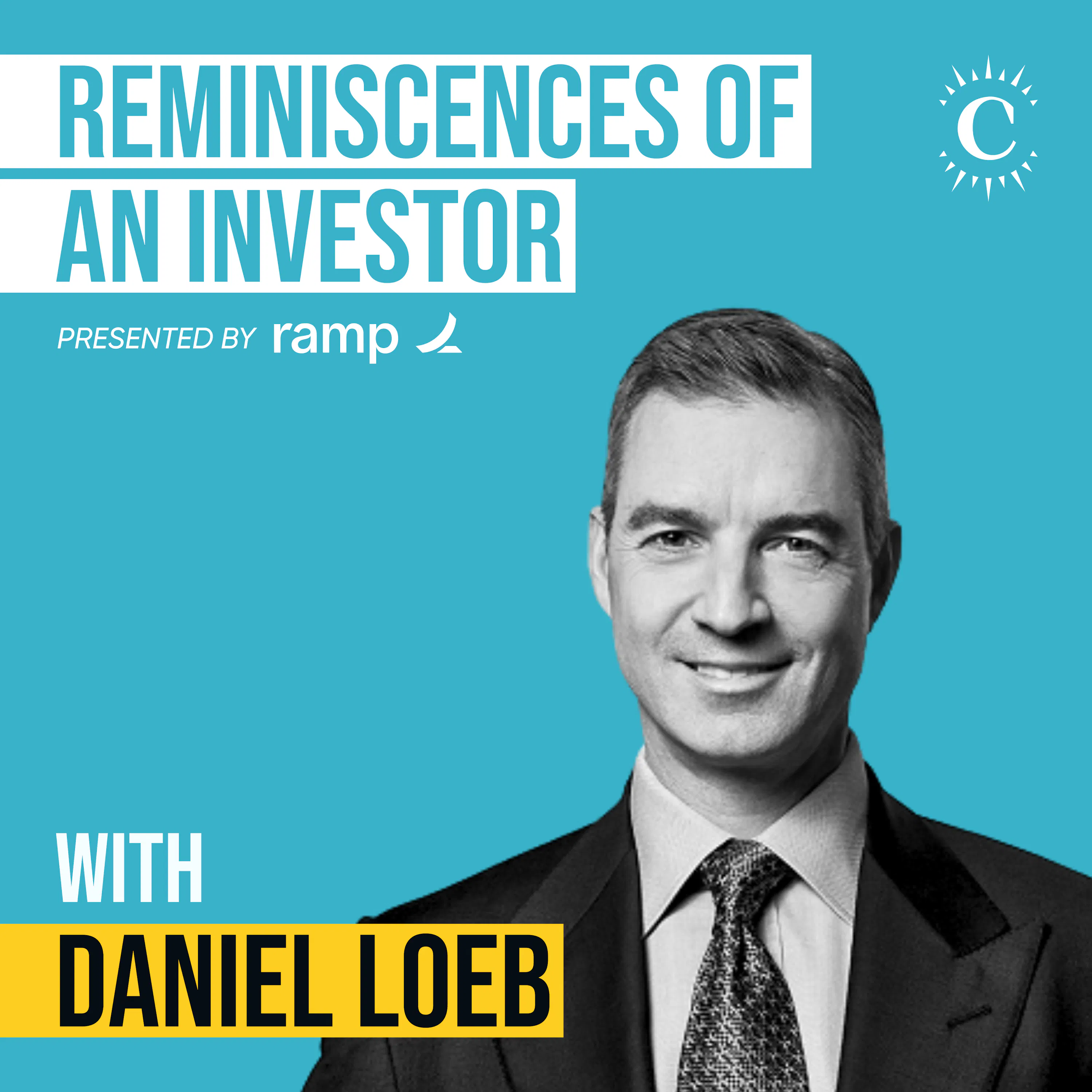
This transcription covers product pitches and a podcast excerpt. Ramp uses AI to automate expense reviews, saving time and money, while Work OS offers enterprise security tools for AI companies. Felix by Rogo automates financial tasks from simple prompts. The main content features Dan Lo, founder of Third Point, discussing his investing evolution. Starting in 1995 with event-driven strategies like spin-offs and distressed debt, Lo later incorporated quality and thematic investing, focusing on high-return businesses. He emphasizes understanding the AI stack—from energy and chips to applications—and highlights Nvidia’s 2021 results as a key turning point. Lo notes that despite AI sector gains, market volatility persists due to human emotions like over-optimism, as seen in stock reactions to strong earnings. He advises focusing on essential topics like oil and AI, avoiding information overload, and recommends books like "You Can Be a Stock Market Genius," "The Outsiders," and "Quality Investing" for different investing lenses. The conversation underscores the need for adaptability in a rapidly changing technological landscape.
Most software companies try to maximize your time on their app to juice engagement. Ramp does the exact opposite. Ramp understands that no one wants to spend hours chasing receipts, reviewing expense reports, and checking for policy violations. So they built their tools to give that time back, using AI to automate 85% of expense reviews with 99% accuracy. And since Ramp saves companies 5%, it's no wonder that Shopify runs on Ramp, Stripe runs on Ramp, and my business does too. To see what happens when you eliminate the busy work, check out ramp.com/invest. Open AI, cursor, andthropic perplexity and versel all have something in common. They all use work OS. And here's why. To achieve enterprise adoption at scale, you have to deliver on core capabilities like SSO, skim, RBAC, and audit logs. That's where Work OS comes in. Instead of spending months building these mission critical capabilities yourself, you can just use Work OS APIs to gain all of them on day zero. That's why so many of the top AI teams you hear about already run on Work OS. Work OS is the fastest way to become enterprise ready and stay focused on what matters most, your product. Visit Work OS.com to get started. Felix Byrogo is a personal finance agent that turns a single prompt into finished client-ready work using your firm's own templates, context, and standards. Send Felix an email like, "Take these comments and turn them for me," or "Update my tracker with the context of these emails," or "Run the ability to pay math on this buyer," and Felix sends back Finnish PowerPoint decks, Excel models, and source research. Felix works the way your team already does, delivering work quickly and accurately around the clock. Learn more at rogo.ai/fuelix. Hello and welcome, everyone. I'm Patrick O'Shanasi, and this is Invest Like The Best. This show is an open-ended exploration of markets, ideas, stories, and strategies that will help you better invest both your time and your money. If you enjoy these conversations and want to go deeper, check out Colossus, our quarterly publication with in-depth profiles of the people shaping business and investing. You can find Colossus along with all of our podcasts at Colossus.com. Patrick O'Shanasi is the CEO of Positive Sum. All opinions expressed by Patrick and podcast guests are solely their own opinions and do not reflect the opinion of Positive Sum. This podcast is for informational purposes only and should not be relied upon as a basis for investment decisions. Clients of Positive Sum may maintain positions in the securities discussed in this podcast. To learn more, visit psum.vc. My guest today is Dan Lo, the founder and CEO of Third Point. Dan started Third Point in 1995 with a few million dollars, and today the firm manages $0.4 billion across equities, corporate and structured credit, venture, and insurance. He is best known for his activist work at companies like Sotheby, Sonys, and Yahoo, and for the public literacy he has written to boards over the years. What I find most interesting about Dan is how much his approach has evolved across those 30 years. He came up as a credit and a ventrived investor at Warbur Pincas and Jeffries, built Third Point, then layered in quality investing, thematic technology investing, and now a very large credit business that sits alongside the hedge fund. We cover how he thinks about the AI stack and the companies inside it, he believes matter most. The difference between good and bad governance, the Sony and Sotheby stories, and the power of writing. Please enjoy my conversation with Dan Lo. Dan, we've all been trying to do this for six years. Welcome. I've been excited to finally chat with you about all things markets. It's such a crazy time, and I was walking in here, I'm like, what am I actually the most curious about as it relates to how Dan runs his life? And one of the questions is the simplest, which is in this time where there's more information than you could ever read, literally what does your day look like to stay up to speed on all the investments that you've made, the investments that you could make? Can you stay on top of the fire hose? I wish I could say I have a cloud code that is organized all the information in one place, and I go through it all, but I check the news and see what's relevant for the economy and what's relevant for our positions. I try not to get too obsessed with the minute-to-minute stuff, because that will drive you crazy. I try to be a little more tactical than strategic. People will ask me about macro, what's important. And I think when people think about macro, they think about all the typical stuff that the government reports. Growth, unemployment, inflation, rates, currencies, where's gold, where's crypto. And I think that all that stuff is trumped right now by two things. Where's oil? And that's going to be dictated by what happens in the war, geopolitics, and what's happening with AI, both on the spending front, infrastructure, and what's the impact of that going to be on society and on the economy. So those are the main things I'm focused on really, kind of deeply understand. What is your model of both of those things? Do you feel like you need to have just a clear view or a differentiated view? Like, how do you process things as big as this where probably no one person can understand the whole thing? I'm not natively a tech person, but I think, given where the world is today, there was a time when you could say, "I'm just going to pont on tech and focus on industrials and consumer and healthcare." I think you have to be a tech person today. It's a big and growing and compounding part of the economy. It affects everything else. So I think, best as I can, I try to talk to smart people regularly. Jensen is laid out well, and everybody talks about the AI stack, starting with power and energy at the bottom, and chips and infrastructure, and moving up through the LMs and software and applications, and how that plays through. And I think that's a good mental model to just think about all of it. And we've played different elements of that through industrials and infrastructure, and hyper-scalers, and things like that. But right now, the socks is up 40%. I don't think I have ever seen an event like that. In fact, if you just go back a few years, some of the conductors were kind of left for dead. They were like road kill in the market. Like people were not thinking about them at all. And I think that all changed when Nvidia reported its March results three years ago. And I think you either were there, or it's okay if you weren't, you could quickly catch up. That was the big event. And now, of course, it's sort of thinking about the Nvidia, the Trainium, and the TPU ecosystems, and how those play out, and relative strength, and how that plays through the different hyper-scalers. And then, of course, the foundational models. I try to think in terms of that stack, but I also think about what's going on in the three most consequential companies today in video and throttback, and Elon world, all of his companies collectively. There's a lot of ways to look through the prison, but for me, that's been an effective way to kind of think about how things flow through. How would you just describe yourself as an investor? You have an early reputation for this incredibly precise ability to go through things with sort of a forensic lens as an activist early in your career. But now, third point is a much bigger, broader, more diversified collection of 25 billion or so of assets. How do you think of yourself as stylistically as an investor? The roots of third point really come out of my experience as a credit investor in my time at Jeffries. Jeffries was like my laboratory for studying some of the best investors. My clients were people like David Tepper, who had not yet started Apple Lusah, but started Apple Lusah. He was like Eric Menditch, who ran the trading desk at Goldman, firms like Angela Gordon, Farrellon. I was able to watch firsthand how the best, I guess at that point, we would call them either distressed debt or event-driven or risk arbitrage investors. So my natural first lens was to think about credit, but on the equity side to think about it in terms of a hierarchy and a mental model, I completely thought about it through the lens of event-driven investing. So merger arbitrage a little bit off to the side, because that's less directional. But on the non-merger-arbit, which is really just a mathematical exercise and earning a return and the risks that you're taking, but in terms of a fundamental investment lens, I think it would be best characterized by those types of firms. And the best book, which I think is still relevant today, would be Joel Greenblatt's book, The Classic, You Can Be a Stock Market Genius. I think the original title was, you can be a stock market genius, even if you're not that smart. I think he took that part out, because investors don't like to think of themselves out. We have a brilliant book. And most of the people I know in that world kind of use that as their framework. Talked about things like spin-offs, demutualizations, privatizations, post-rear equities. That's how I thought about things. It was totally unfocused on business quality, the moat, return on capital. I barely even thought about relative multiples for different kinds of businesses. All I thought about is am I buying something really cheap that has the following characteristics. A new security is often created, which is priced and valued at a very cheap price because of a lack of liquidity. So in a large company or any company spins off a subsidiary, especially in those days, or part of the business, there's a new stock being born. The existing investors at that point in time, especially usually mutual fund types, or folks that didn't want to, for whatever reason, it maybe wasn't in their sector. They just weren't doing the work. So it would just routinely sell it. So there would be this sort of liquidity gap. And if you could figure out the value of the business, those tended to be good trades. And that was exacerbated by the fact that the management teams would go out in the case of a spin-off and do a road show that would
present a very conservative view. Someone might even say sandbag the numbers why? Because people are always creatures of incentives. Their incentive package would be set at the time of the spin-off, so they would come out very conservatively. But there's more. The companies themselves were inefficiently operated within these larger businesses, so margins were lower than they should have been. Sales were probably less. The management team didn't have the incentives to really optimize the businesses. So that was an incredible business model. And that dynamic that I just described it applied to spin-offs, it applied to privatizations, it applied to demutualizations, it applied to newly created companies like Visa or MasterCard. So that was a beautiful business and it was sort of underappreciated for a long, long time. And you could generate really excess returns. It would take that basic framework and start applying it to other things. Like the synergies that come when you combine two companies in a major merger, something like the Union Pacific Norfolk Southern merger, things like that. From 1995 when we started the fund, probably up until the early 2013 to '15, that was our bread and butter and how we thought about investing. - And what changed in that era? How would you describe that landscape today? Does Joel Greenblatt's book still as valuable as it was when you first read it? Are there opportunities like that that still exists or are they too small for something like you as an example? - No, they still exist all the time. The real opportunity today is understanding those types of opportunities and looking for something that combines that with a business quality lens. So let's talk about how my business evolved and how we evolved. I think if you look at a lot of the people who have underperformed or haven't survived the last decade or so, when people were really stuck on the idea of deep value, low multiples, being really stubborn about how they viewed businesses and less flexible about moving into higher multiple companies or growth of your company. So we basically just started to look at companies that grew faster that had better returns on capital that were, quote unquote, quality businesses. I kind of opened up a whole new world for us. So I would call that the other significant part of what we do, which would be quality investing, thematic investing. And that's when we started to organize our team around industry experts and less generalists and less around the transactions. And if I would suggest a couple of books, I'm sure people have mentioned them. I think you may have even interviewed some of the people who wrote them. Probably the two most consequential books that I read that had the most influence on me in that area. One would be the outsiders talks about, more from the perspective of the managers who understand capital allocation along with great operations. So companies like Dan or her trans, dime, and others. The most influential, an eye-opening book to me, was this book, "Quality Investing by Cunningham." And that, I think, really lays out the idea of super high quality businesses with good modes, the high return on capital, and that you might want to own for many, many years. Now what happened last year was really interesting because a lot of these companies that appeared to be super high quality, it's probably the worst year going into the beginning of this year because the disruption of AI, a lot of these apparently high quality companies very rapidly became less so. One of the most distinctive things about you and the business is how much of that you've done, how much changing of your stripes are evolving of your strategy, you've done relative to others. And I'm curious, I'm assuming that's going to have to keep happening in the world, it's going to keep changing probably at a faster clip even than before. How have you done that? And how do you think about the conditions or the cultural touch points? Or what is the key to doing that well across 30 years now for you? In 2013, I was in a room, I was a dinner in Davos, which I don't go to anymore. It was a Goldman Sachs dinner, Eric Schmidt was there and gave it a talk. And he went back to 2013. It was a time of, when you look back at it, we've almost quaint in terms of the technological innovation. This was probably around the time that maybe the Uber app came out and the iPhone was starting to come up with some interesting apps, which were starting to be adopted. The SaaS revolution was sort of at the front end. Companies like Microsoft were starting to find their footing. Think about all the period from the.com bubble through the GFC. In the '90s work, at times of incredible technological innovation. Then yes, stuff was happening, but I don't think we felt there was a lot going on. There are other things going on in those years, but it was the sexy industries at times where natural resources, energy, financial services. So he said to the room, "It will be your natural tendency to think that this increase in technological innovation and disruption and change that we've been experiencing for the last couple of years isn't anomaly. And things are going to go back to a kind of a steadier type of innovation and growth. But hold on to your seats, because things are only going to accelerate from here. And he was really right. I think you could have said that again in 2017. You could have said it again in 2020. I think you can really say that right now. Like it has just continued to logarithmically accelerate. And we're going through something now where we're at the front end of AI. And at this, I think we're just going to have to learn to live with this. In the same way, I don't know that from an evolutionary standpoint, our brains have been able to deal with things like social media and some of the other changes. It's going to take a lot of work for us to just prepare ourselves as a species and even mentally how to ingest all this information. And Brad Gersner talks about this book, "Essentialism." And I think we also have to adopt this idea of essentialism because you can't do it all. You have to figure out the things that are most important and most relevant to what you do. As your business scales up, everything gets more complex, especially your compliance and security needs. With so many tools offering bandages and patches, it's unfortunately far too easy for something to slip through the cracks. Fortunately, Vanta is a powerful tool designed to simplify and automate your security work and deliver a single source of truth for compliance and risk. There's a reason that ramp, cursor, and snowflake all use Vanta. It frees them to focus on building amazing differentiated products, knowing the compliance and security are under control. Invest like the best listeners get a special offer of $1,000 off Vanta when you go to vanta.com/vanta. I know firsthand how complex the tech stack is for asset management firms. And seemingly every new tool and data source makes the problem even worse, adding more complexity, more head count, and more risk. Rigline offers a better way forward, one unified platform that automates away that complexity across portfolio accounting, reconciliation, reporting, trading, compliance, and more, all at scale. Rigline is revolutionizing investment management, helping ambitious firms scale faster, operate smarter, and stay ahead of the curve. See what Rigline can unlock for your firm, schedule a demo at Rigline.ai. Is your sense that there is a lot of opportunity to earn great returns still in this environment? Like the fact that Sox is up 40% this year, we're several years into everyone kind of being aware that this thing is a big trend, and yet still, these things are up tremendously in year three or four. There's so much wisdom in books for investing. One of my favorite books, "Remin instances of a stock operator," quotes, "I think it's from Ecclesiastes," which says there's nothing new under the sun. And the question is, will AI take human nature and the flaws in human emotion out of the investment process? Or might the AI's even adopt some of that under the name of risk management or managing downside or whatever? It will test the theory that there's nothing new under the sun. And the thing that doesn't change is hysteria's, bubbles, panics, and just the extremes of human nature, both optimistically and pessimistically. Think about just this year, why is The Sox up so much? It's up so much because all the evidence pointed to the fundamentals in semiconductors, semi-cap equipment, memory, everything around it being super strong. What happened? Expectations were too high in the same way that Nvidia, after Q1, three years ago, had this monster quarter people piled on. It kept going up. You had a couple of quarters in a row where it put up solid numbers, then shockingly good numbers in the stock tank. The whole sector went down. And I think that we're just scratching their heads saying, why do the numbers look so good? And stock prices keep going down. And then the same thing happened with micron. They had a phenomenal quarter, up 80% way ahead of expectations. The stock went up a little bit because expectations were too high. And then it went down. Now that happens a lot. Happened to meta a couple of years ago. They put up a good quarter. Stock went up. It was like Wiley Coyote. There's no one else to buy the stock. It tanked. So those things happened. And I think that's for the human element.
comes in to understand and to be able to make those tough trading decisions when fundamentals are going one way and stock prices are going the other way to be able to take the pain of losses in the short run. The advantage that someone like me being a fundamental investor who doesn't make trading decisions based on computers is that there are still a lot of market irregularities caused by some very good strategies, but collectively they create these anomaly. So you have quants and CTAs, you have pods, they have a great strategy for them and their investors, but it causes some unusual behaviors because fundamental investors believe that when, as Warren Buffett would say, if a stock goes down, you celebrate it because it's a chance to buy more at a better price, they have risk metrics which have forced selling on the way down, so they do the opposite. It might be rational for their business model, but it's not rational for long-term investors. So you have a lot of these things that will continue to create opportunities I think for fundamental investors. So interesting to imagine where the source of potential outside returns are human behavior, which, as you said, maybe that changes how much that impact prices and structural things like these and absent those to maybe you'd be a less exciting market or something like that. Yeah, but then you'll have corporate transactions that will create opportunities. It feels like there's always something, there's failures, there's credit cycles, there's bankruptcies, it's hard to imagine the computers sitting on a creditors committee and working through the capital structure and being able to transact. If you think about a continuum of public securities and private equity, AI will not do private equity, always need people to do deals, and then you have the stuff in between that requires a lot of negotiation and human interaction and high touch private credit or working through a restructuring. You'll probably always need human beings to do that part of the investment business. It seems like we're entering time as well where governance becomes incredibly important, especially in companies, I mean we sell this play out with OpenAI in the public, where the governance structure and the people on a board can matter tremendously to outcomes. This has been an area where you've spent a huge amount of time thinking, writing, investing, a lot of your great successes have come into the round this topic. When did you first get interested in it or did it come from? My dad, who was a securities layer, was an expert on corporate governance and wrote books about it. He's actually the first person I'd ever heard of who actually talked about corporate responsibility. He's on the board of Mattel and later Wim Sinema. He would go visit these factories where they were sourcing their materials from and wanted to make sure that they were ethically sourced and the workers were treated well at Mattel or Wim Sinema. So he was really ahead of his time on that stuff. What was he like as a person? My dad was incredibly funny, warm, irreverent, really smart. He was the only son of two immigrants from Europe. My grandmother, his mother came from Poland in 1914. His father came from Romania in like 1898, incidentally his mother's youngest sister. She was first of that family that was born in this country. Her younger sister founded Mattel Toys. She was a self-made person. He went to UCLA, did well, went to Harvard Law School, and spent most of his career at one law firm. I'm curious for you to sum up if you think about everything you've done in governance, what good and bad governance are, like just at the highest possible level. How do you think about it? I think we have an incredible system. Let's start with that. There's something beautiful about the American capitalist system in the aspect of it that creates boards of directors that ultimately have a role within both capitalism and a democratic system where the board is responsible and answerable to the shareholders and is responsible for accountability for the management, setting strategy, and key financial decisions. We have a great system in place. Where the short comings within governance happen is when the board members lose sight of what their duties are as fiduciaries, or the composition of the board is such that they aren't really equipped to carry out that duty because there is a lack of deep knowledge or intellectual or talent diversity on the board, or they are thinking excessively about things other than their duty to shareholders. Not to say that the board doesn't have other responsibilities, but I think ultimately they should feed into creating shareholder value. If you go back to Milton Friedman, things that Warren Buffett have said, of course, boards care about the communities that they serve, the products, the employees, proper conduct, etc. All those things are very important. They are not inconsistent with creating shareholder value. In fact, it's part of creating shareholder value. But I think, especially a few years ago, the business roundtable said, we're no longer going to say that board's responsibility is primarily to drive shareholder value. I think it was a distraction from what their real duty is. Bad governance, I've seen, is when they let their loyalty or relationship to a CEO who's not up to the job, overshadow their duty to shareholders. That's probably the main thing. It's very important to understand that boards don't run the companies in a well-functioning company. The board is strategic, not tactical, so they should be really focusing on those things. If the company isn't allocating capital well or isn't holding the management team responsible, or there's some very obvious things that should be done differently, that's when we can come in. What have you learned about the power of writing in investing your obviously extremely well-known for some letters you've written to chairs of the board, things like this, fry your entire career? I just know you're a writer. You've used writing in a lot of different ways. What is great writing to you and how do you use it well? Great writing is really about clear thinking and organizing your thoughts, communicating them to people in a clear way to get a desired outcome. You can also use writing to influence. In our case, it's been very helpful in getting the attention of other shareholders, sometimes the board itself, shaking them up a little bit, getting media attention focused on a board. I think about activism, you've got a few different levers. You can have a financial lever so we can make a bid for the company. You have legal levers, proxy contests, litigation, information requests, etc. Social pressure is actually a very effective way. I think the best way to put social pressure on a company is through writing and PR efforts around the company. If I look across all the different activism that you've done, it seems like maybe there's an interesting theme of you going activists on places or people or companies that hold themselves out as quite high status, but then they're not living up to it, whether that's Sotheby's or some of the Japanese conglomerates or just certain CEOs and their family members on the board, things like this. There's like a status component that would be deserved if being earned on an ongoing basis, but maybe the company wasn't and you saw that gap as an opportunity. Is that a thing? Do I see a correct pattern? Certainly was the case in Sotheby's. Can you tell that story? That's such a good story, such an interesting one. I'll come back to the story about Sotheby's in a second. Board members often feel a sense of status for being on these boards, and I think that in itself needs to be dispelled because I think if you're on a board because you are either getting status or you're getting income and that's your primary reason for doing it, not for representing shareholders, then that's where we come in to try to disintermediate that and take away some of the status or increase the cost of doing that. Sotheby's, I thought, was just an interesting company. It was a pretty small company and a small target for us. It's actually a very good example of what you're talking about because although it was a public company, it wasn't really run for the shareholders. It was run because I think people did feel like it was a high status business had been mismanaged. It didn't really recover from an antitrust violation that spilled into criminal charges brought against the company and some of the individuals. The business itself was a good business, but just run unbelievably, unprofitably. The company had been around since the 1700s, and some of the business practices had not really been updated since that time. We took a position, we bought 9.9% of the company. We went after the board, but really just wanted them to implement some basic business practices that we thought would be better. The CEO that was there, he didn't have a particularly deep knowledge of art. I think he came out of the Rugg division, didn't really have deep relationships with the collectors either. So we came in and gave him a shot for a year and then I think the board came to realize he wasn't the right guy. We brought in a guy named Tad Smith who was terrific from MSG, cleaned up the operations, improved the technology, this all depends on the company.
company. Good result. Yeah, good result. Do you think that there's a lot of that barking out there today? If one wanted to start a career and only do that go find companies where it was kind of mediocre or bad management where if it was good management the company would do way way way better. Do you think there's still a lot of that out there? I think there's probably some of that in the sub two billion dollar market cap space and not necessarily even bad management but B plus management not optimizing. What we're finding is that it's almost like a negative selection process. We'd much rather invest in a great company with awesome management that's doing right things and cheer them on then kind of find something that but for mismanagement the company would be worth a lot more because what you find is that if the things that you've identified are badly run then there's probably ten times more things that are badly run. One of the interesting things about their point is that if I understand it correctly it's something like 60% credit which I think would surprise a lot of people and also when you started I think you started with no institutional investors it was individuals families things like this and it seems like you sort of have felt your way into the strategy. The strategy as it exists today probably wouldn't go on like a clean PowerPoint deck. If you were a new firm doing this from scratch it would be hard to pitch what you have now and I'm really interested by that by a firm which has evolved into its model and it's 60% credit today and it's a blend of other things and I'd love you to just talk about that evolution and why it is and the value of that evolution versus predicting okay here's exactly what we're going to do. First of all third point is a whole collection of businesses. My main focus is on the hedge fund strategy which started at $3 million. It's now about $9 billion today. That fund itself is about 30% credit in total. The rest of the portfolio and moves all over the place. It is primarily equity and I think our equity book is generically around 110 long by 30 or 40 short but that can be all over the place. Going into the war it was down. We really dialed back our risk. I think for the first time since 2009 we did have more credit exposure than equity but we very quickly have taken that back up. The hedge fund were still more equity than credit but across the fund we have a CLO business with about $7 billion in it. Within third point itself we have about 30% which would make it about close to $3 billion in structured credit and corporate credit but that's within the hedge fund and then we have an insurance company that we manage about it. Billion dollars in credit. We have a couple billion dollars in its bestest liabilities that we manage in its own pool and we just started a private credit business which is small. What's the thread that unites all those things like a bestest liability and private credit and corporates. It seems all over the place. I've worked in venture capital. I've worked in risk arbitrage. I've worked in credit. I've worked in equities. Having a view of value and thinking about valuing enterprises whether they're our earlier stage, mid stage or mature businesses and looking to invest in whatever the Fulcrum security is in that enterprise obviously for an early stage company the only Fulcrum is the equity. What does that mean Fulcrum? One that's going to have the best risk reward. It's usually used in terms of companies that have debt and equity. Do you want to be in the equity? Do you want to be in this junior debt? Do you want to be in the senior debt? Let me give you an example. Like when credit Swiss was going through its troubles and being bought by UBS you could invest in the preferred shares. You can invest in the hold co paper or you can invest in the op-code paper which was the most senior within the capital structure. This Fulcrum there was actually the hold co paper. They had the most upside but the op-code paper also did well. The press was wiped out so that was the wrong place to be. But there are always different interesting places within the capital structure to play and having a comprehensive view of these companies gives you a really great vantage point to make alpha generating investment decisions. Let me give you two examples. We had a good enough knowledge of Twitter and XAI to understand the equity value of both of those businesses and without making a decision whether or not we wanted to own equity in XAI there were two financing transactions that came up one for XAI and another one for Twitter. The Twitter debt was a resale of the financing debt that was offered when Elon bought the company. We're going to just only sat on it for a while. It was deep underwater when it got close to par they decided to sell it. Most credit investors were really scared and nervous to buy that even though it was like 96, 97 cents on the dollar. It was yielding around a 12% yield. We were comfortable enough with the underlying value of the business and with the fundamentals that we made that at that time our largest credit position. Then when XAI did a debt financing very few credit people wanted to play in that one because there was no cash flow. Two billion dollars in revenues and a 20 billion dollar enterprise value but we were very comfortable that this was a real business. We looked at them as credit investors but we also were able to bring in resources of our private investing knowledge. Yeah it's a fascinating example of the value of seeing across the whole ecosystem and being able to invest however you want. Which brings me to the question of again as I understand it you're sort of still the single portfolio manager that sits on top of all these assets across all these different buckets. Ultimately you have to make the decision to buy yourself something. Let me just push back on that. Sure. I'm the portfolio manager of the hedge fund but private credit, seal of structured credit, our yield business they'll have their own PMs. I will come in if there's an interesting opportunity. We supersize both of those both Twitter and XAI when I got involved but I'm not even on the investment committees of those businesses. So to zoom in on just the hedge fund where you're the PM you mentioned before you could be a great investor not bother with tech Warren Buffett style or something in now today the market's 70% tech. What do you think of that complex of companies today? The sort of Amazon Microsoft Google big technology companies relative to the last 10 years of watching them and investing in them carefully. What does this set up feel like to you today? I think the set up's great. You can still buy Nvidia maybe the multiple slightly higher right now but there's such a catch up trade in Nvidia at 15 times 27 12 times 28 for the most dominant very fast growing company at its size. I look through our whole semis cap equipment hyper scaler portfolio and I thought my instinct was going to be okay we've got to take profits here I looked at the valuations I looked at their growth rates unless you are really draconian or negative and you think that somehow the AI world is going to roll over in 31 or 32 I think it's most attractive sector right now it's where the bulk of our capital is invested. As a person that was born in this sort of value discipline and made a lot of money and that kind of investing those people who tend to have not evolved as much would point today and say oh it's just like another classic example of like a giant bubble in the making do you feel seeds of that at all are their aspects of the market that feel before I could strange or I don't believe the CapEx numbers are going to yield a return then you would have to believe that they're just fleshing money down the toilet and that they're not going to get a return because the gap earnings numbers are really strong and the multiples on that and they might say yes but the cash flow after CapEx is squandered but these are companies also that are for the most part investing money off their balance sheets and are generating enormous amounts of cash so it's very different from the dot com bubble which we were short going into and had good numbers in those years you don't have the evaluation bubble now on those companies that you had on those companies back in those days you see andthropic's revenue growth and the adoption and the usefulness of its products and the anecdotes that you hear about the next generation mythos and what that's going to do we're barely scratching the surface there's so many layers of corporations they're just getting started so I'm in the Optimus camp in terms of seeing this is something that's going to play out what about the rest of the world that let me tell the Sony story the story of going to Japan and spending so much time there and everything that you learned I think it's a really colorful cool story but it's also an excuse to ask about the rest of the world and what you see going on there I need fuel into invest anywhere whereas the American companies get basically all the attention and markets these days whichever order you want to go into tell the Sony story first that's just an example of this but I'm curious how you think about everything outside the US Israel's an interesting market it's kind of a niche-year market and we had one of our top investments there that despite the war has been one of the best performing stocks in our portfolio in terms of the big markets
There's a lot going on in Korea, Taiwan, Japan. I'm probably more bullish on them, just in terms of hunting ground to find great companies. The European markets are tough right now, given the regulatory environment. They just have a different attitude about business and capitalism. And we're invested in a couple of businesses there, rules, Royce, SML. But the companies that are in Europe, dependent on the local economy, are challenged. Can you tell that Sony investment story and kind of everything you learned through that process? At one point, we own 7% of Sony. There's a list of companies that we, at one point, own significant stakes in that had I not sold would be worth in the mid to upper single digits billions of dollars. It sort of took two runs at Sony. The first time we invested in it, it was basically a conglomerate. It had obviously the main Sony studios. It had a semiconductor business, a life insurance business. Obviously, it had all the consumer electronics. So we advised them to separate these businesses. Certainly, at a minimum, take out the insurance business, which had no place in it. We met with the management team. We had a big deck that we went through. At the end of the meeting, we told them, well, in the interest of transparency, we shared our investment thesis within New York Times. So Andrew Rossorkin wrote the story. They went into a panic when we told them about that. Andrew agreed to embargo the story until the Japanese market closed. The story came out and they had pre-arranged us to go on a tour of their innovation center. But before we went on the innovation center, when we told them that there was going to be a story, they came out as it was Kaz Harai, the time he goes, you told the New York Times, I said, yeah, but just the New York Times, nobody else. He says, okay, just the New York Times, it was wild. We were walking around the innovation center and we were looking at our blackberries at that time. The story went everywhere and ended up being a really good investment. They really pushed back on everything that we recommended. It took them about five years. And I think one by one, they've done many of the things. They've broken out the semi-business. They partially spun out or they planned to spin out their financial services business. The one thing I learned is that activism in Japan is really hard. On one of our first trips, we met with the Prime Minister and we met with his right-hand man, Suguson. I told him I would write a paper explaining to him why activism was good for Japan as a country. And they had released something called the Three Errors. It was about fiscal, monetary, and restructuring. And my suggestion was that they needed to include corporate governance and in particular, focus on return on invested capital as part of their three-era strategy. And I came back to New York. I met with Larry Lindsay and Neil Ferguson. We wrote a three-person paper. They did most of the writing. But we wrote a paper for AEIs and picked up as an editorial in the Wall Street Journal. And they then adopted that. It was pretty cool. But the government actually really wants the companies to do this. It's really the management teams that are more entrenched. Because the shareholders and the government want that. And you've really seen progress since we first went over there. They're breaking up some of these cross-share holdings. They're penalizing companies that trade at discounts to book value. There's a bunch of other things. So I think they're definitely moving in the right direction. If you think about all the investments that you've made, is there any that stands out as the one that taught you the most just about how this world works? I'm just always interested in these like instructive learning by doing versus by reading. You can read all these amazing books, the outsiders and Joe Green Blitz book. And they're great. But it feels like part of investing is you have to get hit in the face or experience things to really imbibe the lessons. Is there any investment through your career that stands out as one like that? I think investing in Danahar has been the most instructive because it really is truly one of the best run businesses. It was also one of the first experiences that I had investing in a super high quality business that internalized some of the best practices of creating a corporate operating system. My partner, then Munib and I actually went to Danahar and got them to boil down their five-day DBS Danahar business system training into a one-day thing for us. It was really instructive. It was a really, really good investment for about four years. What I learned by observing them, by watching them incrementally improve the business quality of the company by shedding lower quality businesses, buying higher return on capital, better quality, higher margin businesses to shift from kind of general industrials into healthcare. I learned a ton and they then stopped working as an investment because of COVID. There were all kinds of irregularities, surges and orders and increases in inventory and then a correction for that. All the benefits that they got from the surge and demand that was a tailwind became a headwind and they still haven't come out of it. It'll be interesting to see how they navigate AI in the next few years. We actually sold it recently, the recent sell-off of gotten back in but in a small way. I learned a lot about how really thoughtful businesses think philosophically and deeply about their operating system, about optimizing and motivating and inspiring their team. Even the fact that they have a system in place and it's also been incredibly instructive watching the diaspora of executives. Larry Kulp was there, right? Larry Kulp was there, the guy from Ingersoll ran, which has been a well-run business. If you hit the sum up that one day, what was it? Just some system for continuous improvement was the thing that you took away. Kulp is a little bit too strong of a word to describe it, but they had a very strong corporate identity and culture. It's one thing to say, we are a Kaizen company and we're dedicated to continual improvement, but what they have is a whole system of implementing improvement across the organization. There are a lot of things that I learned that day, but one of the things I took away is that they would hold people very accountable and individually show when people were underperforming. But the interesting thing about it was that because these things were all addressable and fixable, when they found someone that was underperforming, it was celebrated because instead of shamed, because, look, look, all these things you're doing wrong, we can fix those. They did. They do that over and over and over again and they do it both in terms of operations, working capital, and it was really cool to just walk around a place. It was really amazing how everybody's on the same wavelength trying to accomplish that. Your finance team isn't losing money on big mistakes. It's leaking through a thousand tiny decisions nobody's watching. Ramp puts guard rails on spending before it happens. Real-time limits, automatic rules, zero firefighting. At www.ramp.com/invest. As your business grows, Vanta scales with you, automating compliance and giving you a single source of truth for security and risk. Learn more at www.vanta.com/invest. Every investment firm is unique and generic AI doesn't understand your process. Rogo does. It's an AI platform built specifically for Wall Street connected to your data, understanding your process, and producing real outputs. Check them out at www.rogo.ai/invest. The best AI and software companies from OpenAI to cursor to perplexity use WorkOS to become enterprise-ready overnight, not in months. Visit workOS.com to skip the unglamorous infrastructure work and focus on your product. Rigline is redefining asset management technology as a true partner, not just a software vendor. They've helped firms 5X and scale, enabling faster growth, smarter operations, and a competitive edge. Visit RiglineApps.com to see what they can unlock for your firm. Can you talk about the insurance business? They've built and acquisitions that you've done. Everyone talks about in investing the stuff you're putting money in. For our last discussion of where the money's coming from. Apollo has certainly done this with a theme. There's been a lot of cool innovation in the liability side. How have you thought about it? What have you done? We actually started an insurance company, Dinovo, in 2010. We were backed by myself, Kelso, and Pinebrook. When we started a Bermuda-based reinsurance company, the thesis there, when we started, was we have an executive that will do these reinsurance deals. We will invest the float all in third-point and in treasury. It's sort of a barbell, and we can defer taxes, get leverage on our capital, green light, re-at-the-time was trading at 140 percent of book value. I thought this would be the future. We'll just keep raising money for this vehicle. The problem was that the reinsurance business took a sharp turn for the worse. We had some good years at third-point, but we were scrambling to offset the losses from the insurance company. three years ago, I said, "Well, we have
We had the right idea, but we had the wrong insurance vehicle. We were doing PNC insurance. We really should have just done lane vanilla annuities. From the annuity business, though, it can't invest in the hedge fund. It can only do credit. So a few years ago, we started a reinsurance company. We've done two things since then. We merged our reinsurance company into a closed-end fund that we had in the UK, third-point offshore investors. We re-incorporated that business from Gernsey to Cayman, and we repurposed it from a closed-end investor in my hedge fund into an insurance company. Still has some of the investment in the hedge fund, but it now owns our reinsurance company. That company will then be in a position to do more reinsurance deals, issue primary annuities. And then third-point manages the money in private credit, structured credit, whole-learn mortgages, some direct lending in real estate, some investment grade, corporate debt, and private investment grade. But we also put the equity of that business in things like the junior tranches of structured financings, but we'll also be using it for growth equity investments. What's the hardest investment lesson that you've ever learned? I would have to say our investment in FTX. It looked great. The company was growing fast. We could verify it all on the blockchain. We felt like we had some good company on the cap table with us we did. Turned out that it wasn't what we thought it was, and it was painful because, you know, I think in general, one of the amazing things about our capitalist system and that venture backed companies have this incredible ability to go out and raise capital for interesting ideas. Most people are good actors with good intentions. We've rarely had any kind of mishap. It doesn't mean that you don't do very careful due diligence. I will say that now our due diligence process, we definitely like check bank balances and do the most basic due diligence that probably would have turned stuff up on this. If he hadn't ended up being a crook or very sloppy, the venture investments he made would have. It's like the best venture investor of the Sara. Curcer and Throffet, Solano, everything he did, I mean, the guy had a great nose for a bite. That was probably the toughest. The mistake that we made within the last two years, we obviously were looking for and we've taken some great shorts and things that are being disrupted by AI. But where we've made the mistake is thinking that companies that were controversial, but we thought we knew better that AI wasn't really going to affect this part of the info services business or these guys had proprietary information. That's where we've made some mistakes. There probably will be a shake out there where there will be some phoenixes that rise from the ashes, but that's been the investment lesson of the last year or so. How do you guide your team through this? You've got a bunch of extremely smart, ambitious, I'm sure hungry analysts, investors, etc. What do you tell them going into this crazy uncertainty? First of all, we all have to just start using it. The only way to get good is this is just to use it. We have people at different levels. We have some experts that we have brought on that are native computer scientists that are coming at this as expert AI, people who are working on specific projects, they're coaching the team, but we're also encouraging everyone to use AI. We do higher system integrators. We have a system integrator working with us, but I'm obsessive about continual improvement both at individual level and organizationally. The cloud really enables you to be an individual self-improved. It makes you very autonomous. It'll give you back whatever you put into it. If you put a lot of time and energy and effort into it, I'm encouraging everyone to do that. I think collectively, we're all sharing best practices and some people are running agents overnight and using tons and tons of tokens. Other people are probably more like me, just using it more for queries and things, but we're all very involved with it. Where do you feel like you're in the firm's view is the most different from your peers these days. You're close with lots of the great investors of this era that run firms. Like this one, everyone's trying to do the best they can. Where do you feel the most out by yourself or distinctive in how you view the world? I think we're maybe less pessimistic that there's going to be some kind of apocalypse from AI. I'm still pretty optimistic that it will create opportunities and create jobs and create net jobs. Obviously, it'll lose in some places, gain in other places. The differentiator for us is that we can always default into credit investing. We haven't been in a scenario where we had like a real credit cycle, but I'm very comfortable investing in incredibly stressed times. We really haven't had any since 2020. So going back to like COVID, the thing that we got really right because we had a good year that year, but it wasn't because we piled into stocks. We piled into IG credit, answering the question a little bit differently. Getting that credit arsenal in our back pocket. Why do you suppose more places don't do that? It seems like it would be an obvious thing to provide an advantage, have more options for expressing a view. It's so different. I grew up in credit. I worked on a trading desk. You don't just electronically trade bonds. You have to have relationships with these firms. Part of the reason for expanding into the CLO businesses that we had the high yield market, $1.5 million market, pretty well wired. We were sort of dabbling in the broadly syndicated loan market, which is another trillion and a half dollars. But we also have eyes on a $6 trillion structured credit market. But these are not markets that lend themselves to tourism. When the opportunities really come up, we're already there with relationships and the understanding the companies. What makes a great analyst today in any way that's distinctive from what made a great analyst 20 years ago? The great analyst 20 years ago was like someone that could build a model really fast and understand some really complicated restructuring. When I was, I'll use myself as the example of that ancient dinosaur of an analyst that used to be useful. When I was at Jeffries, Drexel went bankrupt. There was a big disclosure statement about three or four inches thick on this bankruptcy of a company called Drexel Burnham. This thing got passed around and nobody could crack the code on this thing. I was relatively new and I knew I had to differentiate myself. I just spent a whole weekend studying this thing. Ultimately, that was one of the best investments ever in the history of bankruptcy. It was the claims on Drexel because people didn't understand the complexity of the different value pools and liquidations. The claims were overstated. The assets were understated, but it was super complicated. That was the kind of thing that differentiated the analysts of the 90s when I did that. I think now it's somebody who's like a Gavin Baker type, a junior Gavin Baker. Somebody who understands a company or understands an industry and understands the nuances of a technology. Let's get away from technology for a minute. Casey's general stores. I was just one of the best performing stocks. It looked like a tech stock. It was because they were not a convenience store chain. They were a pizza chain, masquerading as convenience stores. I had an analyst who went to Texas and ate pizza. That kind of an analyst today, I think, is what is different. Have you think about the next 10 years for yourself and everything going on in markets? I feel like we're all lucky to be alive to watch this era. I excite you the most about this next 10 year period as an investor. You're lucky you have all these resources and you can invest in anything and credit, equity, whatever. What worries you the most? The thing that worries me the most is just not having the time to do the things that I care about spending the time with my family or being able to go surfing and read books that I want to read. I'm not really worried about the business. The thing that excites me is just the things that have excited me that keep me going. What an awesome opportunity to be able to incorporate everything that you can possibly know about the world that's relevant to study industries, to study technology, to study consumer behavior, to look at the U.S. economy, to look at politics, to travel to the Middle East, which I think is probably the most vibrant, interesting part of the world. I mean, who would have thought 20 years ago or even three years ago that Bahrain, the Emirates, Saudi, Morocco, Azerbaijan would be better allies to the U.S. than NATO? Who would have thought that their growth rates would exceed them or their embracing of technology? That's the stuff that keeps me going. Just being able to incorporate all these different things and also to form relationships with people that are doing interesting things. It's just incredibly fun to hang out with Jeremy O'Brien, who founded Psych Quantum and talk about quantum computing or a lot of RAs who started Nexelcon or the CEOs of the [BLANK_AUDIO]
that we invest in, I've got to know materials from Dan or hers. - It's so cool to finally be able to do this with you. I've obviously followed that third point story for many years talking to you about it and others. And the thing that I really take away is draw your own path. Don't just copy other people. Third point doesn't really look like any of the other firms that have been built, but it works for you and for the team. So it's so cool to finally hear about it directly and do this with you. When I do these, I ask the same traditional closing question of everyone, what's the kindest thing that anyone's ever done for you? - Before I answer that, I do want to talk about the importance of kindness. And I know you know it's important because you ask this question every time you interview someone. It's important on many levels because I think if you elevate kindness as the characteristic that you want to elevate in your hierarchy of things that you want to be honest and truthful and smart, clever, innovative, kindness is very important. I think it goes with forming deep relationships with people, kindness enables you to be empathetic. I think it's that empathy that enables you to connect with people, to learn from them, to be better as a human being. I hate to sound crass, but ultimately it will benefit your business. So I will say on the kindness front, be kind to the people, not just that will benefit from you, be kind to people you have no idea how it will ever benefit you. And sometimes it will. And sometimes it won't. Sometimes you just connect with someone who thinks you're a better person. Good for his own sake. But anyway, I came down to my friend Carter, who when I was, let's just say in between jobs, before I started at Jeffries, I had about a six or nine month period where I wasn't working. And he let me sleep on his couch. And then when I got my job at Jeffries, I suggested to him a bunch of different distressed debt situations. And he trusted me, the few hundred thousand dollars of his money. And then it turned into over a million dollars. And then he then rolled that into my fund. It really enabled me to get my business started. So that was one of the kindest things. I want to say one other thing on the kindness topic. Gavin actually said this. I think he was quoting Palmer Lucky. He said, the one thing money doesn't buy you is friends that believed in you when you had nothing. That's a great line. Amen. Shout out to Carter. Dan, thanks so much for your time. Thank you very much. If you enjoyed this episode, visit Colossus.com. You'll find every episode of this podcast complete with hand out of the transcripts. You can also subscribe to Colossus, our quarterly print digital and private audio publication, featuring in-depth profiles of the founders, investors, and companies that we admire most. Learn more at Colossus.com/subscribe. [MUSIC PLAYING] You know how small advantage is compound over time that's true in investing and just as true in how you run your company. Your spending system is your capital allocation strategy. Ramp makes it smarter by default, better data, better decisions, better economics over time. See how at ramp.com/invest. Learn more at vanta.com/invest. Every investment firm is unique. And generic AI doesn't understand your process. Rogo does. Check them out at rogo.ai/invest. The best AI and software companies from open AI cursor to perplexity use work OS to become enterprise ready overnight, not in months. They've helped firms 5x in scale enabling faster growth, smarter operations, and a competitive edge. Visit ridgelineapps.com to see what they can unlock for your firm.
Podcast Summary
Key Points:
Ramp uses AI to automate 85% of expense reviews with 99% accuracy, saving companies 5% and reducing busywork.
Work OS provides enterprise-ready capabilities (SSO, RBAC, audit logs) via APIs, used by top AI teams like OpenAI and Cursor.
Felix by Rogo is an AI personal finance agent that generates client-ready work from simple prompts using firm-specific templates.
Dan Lo, founder of Third Point, evolved his investing style from event-driven and distressed credit to include quality and thematic investing, especially in AI.
The AI stack (power, chips, infrastructure, models, applications) is a key framework for understanding market opportunities, with Nvidia’s 2021 results being a pivotal event.
Human nature, including hysteria and bubbles, remains a constant in markets, as seen in AI stock volatility despite strong fundamentals.
Dan recommends books like "You Can Be a Stock Market Genius," "The Outsiders," and "Quality Investing" for different investing approaches.
To manage information overload, Dan focuses on essential topics like oil, geopolitics, and AI infrastructure, avoiding minute-to-minute noise.
Summary:
This transcription covers product pitches and a podcast excerpt. Ramp uses AI to automate expense reviews, saving time and money, while Work OS offers enterprise security tools for AI companies. Felix by Rogo automates financial tasks from simple prompts.
The main content features Dan Lo, founder of Third Point, discussing his investing evolution. Starting in 1995 with event-driven strategies like spin-offs and distressed debt, Lo later incorporated quality and thematic investing, focusing on high-return businesses. He emphasizes understanding the AI stack—from energy and chips to applications—and highlights Nvidia’s 2021 results as a key turning point.
Lo notes that despite AI sector gains, market volatility persists due to human emotions like over-optimism, as seen in stock reactions to strong earnings. He advises focusing on essential topics like oil and AI, avoiding information overload, and recommends books like "You Can Be a Stock Market Genius," "The Outsiders," and "Quality Investing" for different investing lenses. The conversation underscores the need for adaptability in a rapidly changing technological landscape.
FAQs
Ramp uses AI to automate 85% of expense reviews with 99% accuracy, saving companies 5% and giving time back to users instead of maximizing engagement.
Work OS provides core enterprise capabilities like SSO, RBAC, and audit logs via APIs, allowing companies to become enterprise-ready on day zero without building these features themselves.
Felix Byrogo is a personal finance agent that turns prompts into client-ready work like PowerPoint decks and Excel models using your firm's templates and standards.
Dan Lo focuses on oil prices driven by geopolitics and the impact of AI on spending, infrastructure, society, and the economy.
He started with event-driven and distressed debt investing, then shifted to quality and thematic investing, focusing on high-return businesses and industry experts.
Stock prices can decline even when fundamentals are strong if expectations are too high, requiring human judgment to make tough trading decisions.
Chat with AI
Loading...
Pro features
Go deeper with this episode
Unlock creator-grade tools that turn any transcript into show notes and subtitle files.
 PodcastTranscript AI