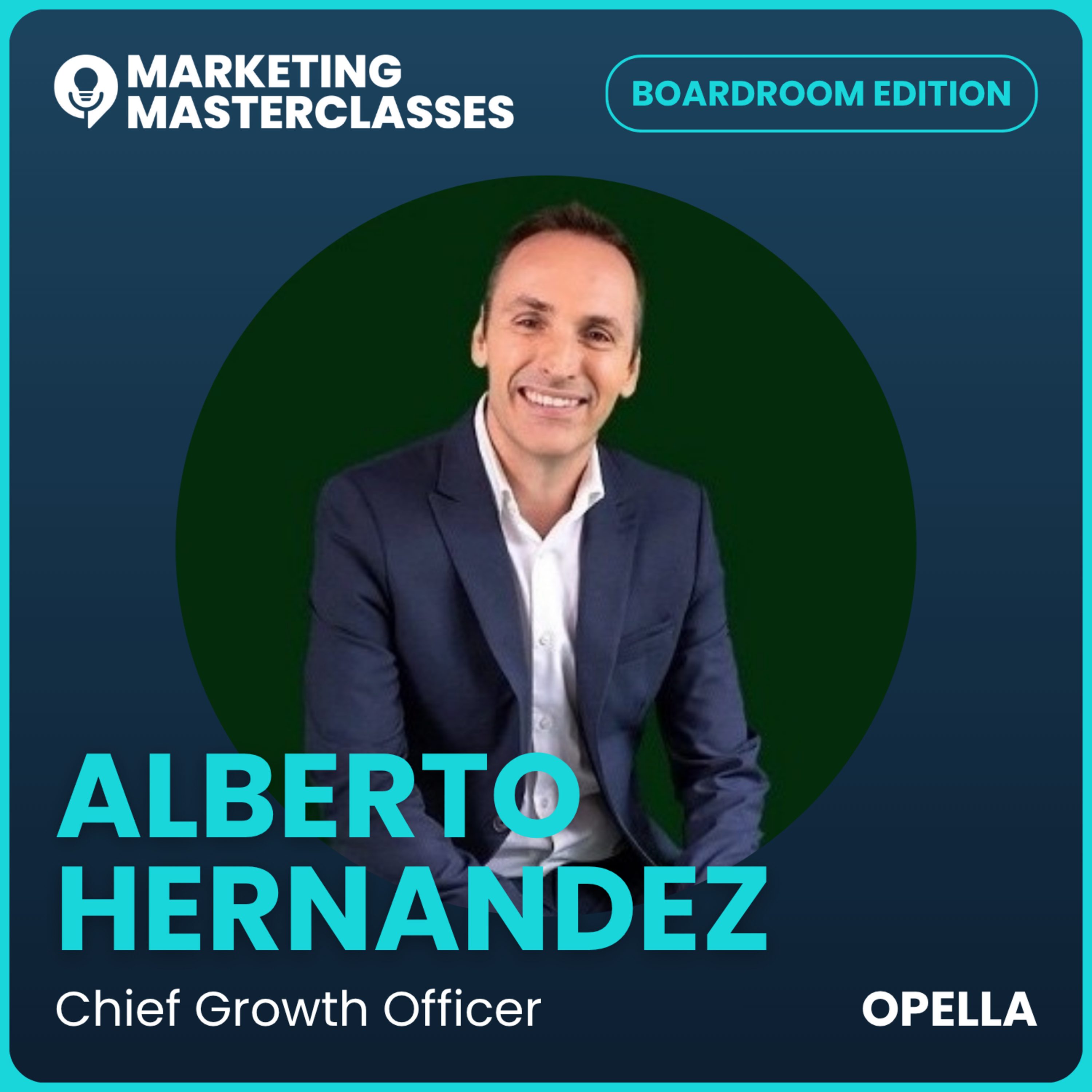
106. Curiosity as a Career Strategy with Opella's Alberto Hernandez
from Marketing Masterclasses
51m 0s
Alberto Hernandez, Chief Growth Officer of Opella, shares his extensive career journey, beginning in the video game industry at Ubisoft before spending 17 years at Nestlé, where he gained foundational brand-building skills and international experience. He later worked at a beverage startup in New York and now leads growth at Opella, a global vitamins and supplements company. Hernandez highlights that growth is uncomfortable but essential, driven by curiosity and courage to step into new challenges. He advises professionals to embrace discomfort, stay curious, and treat others with respect to foster opportunities. Regarding marketing, he stresses the importance of consumer obsession, truthful storytelling, and capturing fleeting attention to build brands. At Opella, his mission is to simplify self-care decisions, addressing the fact that a majority of people with treatable symptoms do not seek help, by empowering them with accessible solutions and information.
Welcome to Marketing Masterclasses, the podcast where we get to meet the best marketers in the world working for the world's biggest brands. And today we have the Chief Growth Officer of Opella, Alberto Hernandez with us. And it's a great privilege to have Alberto who has had an incredible year in consumer marketing. And he's been a business leader for over 20 years in highly demanding positions with a proven track record of creating and implementing best in class business strategies that achieve business growth and competitive advantage. Alberto Carrera spans amazing consumer brands like Nestle, more recently Sonoffi and today Opella which has been spun out of Sonoffi and has the world's third largest portfolio of vitamins, minerals and supplements with over 100 well-known and loved brands. So Alberto, such a pleasure to have you on our Marketing Masterclasses podcast, delighted to get to speak with you today. And we'd love to kick off by hearing about your journey in your own words. Of course. So first of all, Declan, thank you so much for inviting me. Thank you for such a great introduction. And yeah, let me talk to you a little bit about my journey, just so that you get a little bit of a flavor of what you know what the different steps in my progression as a brand builder have been. So I'm originally from Spain, Bernan Brase in beautiful Barcelona. So my career started in my home country and I started in the video game industry. Actually, when the video game industry was booming in Europe, it was a beautiful industry to start your career basically because you could do things completely wrong and still grow triple digits. Which for someone who's starting in brand building, you know, it gave you the opportunity to test and learn on a continuous basis. From there, I jumped into Nestle, the biggest foot company in the world. Then Nestle was home for over 17 years. Started in Spain, then I moved to Switzerland in headquarters, then I moved to Latin America based out of Mexico and from there to the US. Fantastic, fantastic school. A great school for any brand builder, you know, understanding what are the fundamentals of doing brand building, how to how to create long lasting impact in terms of how to build brands and how to ensure that you're driving the man generation. From there, I jumped into a startup, a beverage startup, a small beverage startup scaling up in New York City, which rewired completely my brain into what does it mean to create value through brand building. Great journey, beautiful experience though, you know, pretty intense. Very a lot of highs and lows, let's put it that way. But a beautiful school. And from there, I jumped to what it was, an office consumer healthcare in the US, managing a business, turning around a business that was had difficulties performing and had a lot of competitiveness happening in the market. And my work was noticed by the CEO who told me if I wanted to take on the chief growth officer role for a son of the consumer healthcare, now Opella here from beautiful Paris. So that's what I've been doing since 2022. And we have spun out as you were saying Opella out of Son of the Consumer Healthcare. Now we're independent company, the number three BMS and OTC player in the world with strong brands with leading positions in everywhere. So, you know, happy to be here. That has been my journey. A lot of geography changes, a lot of responsibility and industry changes, as you can see. It's an amazing story. And I think what really shines through is an individual who has a high degree of ambition, who is willing to take on new challenges, experience new markets, you've worked, I mean, growing up in Spain, living in Paris today, you've worked in the United States, and you travel a lot around the world as well. So it would love to just get a sense of where does your drive come from? Is that a childhood influence? Why is it that pursuing these big challenging global roles? Why is that meaningful to you personally? Well, I would say it's a mix of two things, if you allow me, the first thing is it's a stinger for curiosity. Is the need to keep learning, to keep being exposed to new experiences, new opportunities, new environments, new, you know, I would say, contexting, which actually you don't feel comfortable over speaking. So that that need for curiosity, that need to always push boundaries and challenge this status quo has been a constant. And the second one is I would say, I would say, you know, fearless courage to a certain degree, right? Wanting to reinvent myself on a consistent basis. As you have seen from from conversations that we have had, I have a lot of energy. So I need to get that energy out and I think putting myself into a position in which I feel uncomfortable, filled with curiosity and pushing boundaries with courage just fuels me. Hmm, it's lovely and I think it ties in so beautifully with the question I asked you before the podcast was, if you could broadcast a message to the world on a billboard, what would be your message? And you said, "Crowth is uncomfortable. I'd love you to just elaborate a little bit more. We've been touching on it already, but why is that such an important insight for you?" So, you know, growth with the, with whether personal or professional, it always comes with some degree of pain, right? So let me, let me use very well-known, rational behind it, right? Let me, let me talk to you when we were teenagers, Declan. I don't know about you, but in my case, you know, I had to go through some of our faces. I had, you know, pimples, messy relationships, good friends, bad friends, good situations, bad situations. And through that whole process, you learn a lot. You understand what you want in your life and what you don't want in your life. It takes you through heartbreaks. It takes you through friendships that were not as strong as you expected them to be, or friendships that became very strong. And all of that process is a messy process of growing. So, growing is never an area of comfort. Never. It cannot be. It cannot be. And that applies professionally. When you feel too stable, too long, it's a sign that you have to stop putting yourself into a position of growth. So, discomfort actually means that you're moving forward, that you're taking risks, that you're, you know, enhancing that curiosity, but putting courage behind, behind basically making sure that that curiosity becomes a decision making. You know, they say, right, when you're a kid, you have growing pains. I actually believe that that's applicable to how the weak grow professionally speaking. Growth is uncomfortable. And if you're too comfortable, you're not growing. I love it. You mentioned earlier the word fearless courage as one of your attributes. And it reminds me of a model that Dan Sullivan, a, one of the world's leading entrepreneurial cultures in the states, uses. For how do entrepreneurs and businesses consistently make new breakthroughs? And they must follow a model of four Cs. And the first thing is a commitment to change. The second is having the courage to persevere during that difficult period of the unknown. The third is when you build the capability, the new skill set, and then the fourth is when you have confidence. But most people don't want to start because they don't feel the confidence. And I think when you realize that weight, everybody must commit and go through a period of courage, that can brace you for making the big decision and leaping right in. And you definitely strike me someone, as someone who's done that throughout your career. I think it's also important just to duck that although you like new experiences and you pursue growth, you spend 17 years with Nestle, which is just an admittable tenure. And there's an awful lot to be said for that kind of commitment and loyalty. And so for the students listening, I would love to just hear a little bit about how a 17 year career provided fruit for you. And why that length of tenure can be a good thing. So it's a great question. I actually believe in the combination of two things in my opinion that are are opposite and complementary at the same time. I believe that to be a great brand builder, you need structure, but you need agility. Nestle was a great school of structure. It offered me a solid foundation understanding the processes, understanding how to apply resources, how to embrace systems, how to ensure that you have a clear method regarding how to approach brand building on a consistent basis, being able to use the resources of such a beautiful, great engine of brand building like that. Great company is. But it also gave me the opportunity to change. It gave me the opportunity to move from Spain, my home country, to Switzerland in a global role, managing a category that was a billion euro category across the world and learn how to manage it. But then move from global to Latin America to manage infant nutrition.
in the Latin America market all the way from Mexico till the end of the continent in Chile and Argentina. And from there I could go to the US to lead marketing for Gerber, the Baby Food Company, post acquisition of 2009. So Nestle gave me the foundation, but it also gave me the possibility to grow, to change, to put myself in an uncomfortable situation as we were talking at the very beginning. I'm going to tell you something that for me was key. When I was in Spain and I was doing my job and I felt supported and I felt that I had my equity and everyone around me was feeling comfortable about who I was. I felt very strong. I felt powerful. I felt like I had control of everything, right? When they moved me to Switzerland right away, all of that comfort became humbleness. Because you realize basically that everything that you know out of how you have been managing your business and your brand C-Span, gets diluted when you're confronted to the reality of the entire world. So you have to reinvent yourself. So that makes between structure and agility is something that a beautiful school like Nestle gave me. Amazing. And I think as we just stick with this topic for students trying to carve a career path, have you got some other observations you could share with them having such a diverse career, working in big publicly listed global companies like Nestle to start up, leverage start up in New York. And today, you know, Appelle also a globally relevant company, but it's a private equity backed company. So you kind of managed to straddle a lot of different challenges and industries, different cultures as well. What would be your piece of advice to students who are trying to think about what's the best place for me to begin? That's a great question. So I'm going to give you a piece of advice based on my own experience. And I think, of course, everyone has to define their own journey, but something that has helped me as I was moving along. And it's three things. The first thing was the moment that I felt comfortable about something, it was the moment to change. It was the moment to change. The moment that I felt I had full control over a discipline, a brand, a business, it was the moment actually in which something in my gut started pushing me to understand what's going to be next. So I think that willingness to always be, you know, pushing yourself into territories that do not give you full on easiness and comfort is key. Second is, you know, as I was mentioning at the beginning, being curious about what's next, but then being courageous to apply that curiosity into decision-making. Basically, when I think about, for example, when I was in Nestle in some businesses, I was looking outside of Nestle to see who was doing best in class things so that we could learn from, of course, I could benchmark against other Nestle businesses, but doing so would have been a little bit myopic. So looking at what's out there, who's doing best in class work in different areas actually pushes you to understand what is the true best in benchmark that you should be aspiring for. And the last thing, which I think is critical, and it was something that one of my first bosses told me is that you should treat everyone the same way that you want to be treated, that you should treat everyone with the exact same respect, transparency, honesty, and firmness that you expect to be treated. Actually, that first boss of mine told me, you should treat every person that you work with like they would become your boss in the future. So I think that has opened opportunities for me. He has created networking connections that actually has given me the opportunity to keep growing in different instances. Maybe just the last one on your kind of learning and getting out of university and into Ubisoft, which creates some of the world's best computer games, it feels like a dream job for a student to learn to do. And then you soon became a junior product manager there. And he just shares on what that experience was like. Wow, that was amazing. I mean, think about this, right? In college, because it was the I was able to do practices in college. So my last two years in college were split between having to study of course, but then having three to four months of working experience. And I remember my first day at Ubisoft, I joined and the first job or task that they gave me was they gave me a bunch of games. And they told me go play in that room and come back with what do you think the audience, the positioning of the game and the launch plan should look like. So think about this as a college student, the first assignment was to play video games for four hours. I said, okay, this is heaven. Now, right after playing, it made me think about, okay, who's the target for this? How should I make sure that I'm marketing this product basically to make it successful? And it was just by experiencing the product itself that gave me the opportunity to understand that if you really want to market something strongly, you have to touch it, you have to play with it, you have to be involved with it, you have to understand how it works, you have to understand the flaws that it has, the strengths that it has, the power of convincing the places in what you're going to have challenges so that then you can do a whole package of how do you bring that in front of consumers for them to choose you? I love that and it's really a good segue into speaking a little bit more about marketing. And you are an accomplished marketer, you're listed among ad-ages, break out brand leaders, you've been sitting as a judge on Cannes Lion in the health and wellness category. So, lots of great accolades against your name. When I was in Cannes this year, I spoke to a CMO who described and broke down the marketing function into two simple questions, are we solving a consumer problem and are we delivering joy? And I would love to get your perspective on how you think about marketing and its role in business today. So, great question, great question. I think fundamentally marketing or reaching is based on helping people out. You need to understand what's the problem, what's the need, what is the challenge that they're facing that might not be fully addressed with the options that they have at their hands today. So, that I would say consumer obsession and did willingness to be curious about what people are going through on a daily basis is absolutely key. Because if not, you cannot understand how to bring value to them, how to help them out. But then in order to answer that need, you have to do it in a way that you're capable of connecting with people so that they decide to choose you. And the way to connect it has to start with truth. You have to make sure that what you're putting on the table, you're absolutely believing it as the right solution for people to choose you. But then you have to make sure that you're making in a way that it's storytelling strong enough, engaging enough, persuading enough, emotionally connecting enough so that they decide to pay you attention and finally choose you. In our case, for example, at Opelab, at the end, what we want to do is ensure that we're empowering people to have the tools, the means and the information to take better decisions for their own self-care. Of course, we believe our solutions are absolutely the best. And that's why we will present those solutions as our brands in case to help people sleep better or to help people treat their pain better, or to help people manage their stress and digestive their services better. But understanding that need, and understanding how you can make sure that you're breaking through the clutter and be able to command a little bit of a second of attention from people just to pay you that single moment of attention to let them know how can you help them. It's absolutely for me. That's marketing. I love that. I mean, two things you said that the first was like even a split second of attention or a number of seconds of attention in today's distracted world. How can you create an impression and start to build a brand? Cheri Meal more talks about the way people build brands is similar to high birds build nests. It's with the little fragments and pieces of straw that they find along the way. And so, you know, I think that is the consumer experience. We're not thinking about brands a lot. We get exposed to them in little brief fragmented ways and we start to build a picture. So I love that. And then the second thing you said about the truth, and you often hear people like John Hagerdy say the truth is the best marketing. And so how do you tell that truth in the most compelling way? And what are the vehicles for telling that story? So I absolutely love that answer. I would love to hear what success looks like in your role. How do you define
what a good day, a good month, a good quarter, and a good year looks like as the Chief Growth Officer of Opala. - So think about this, Declan, around 60 to 65% of the people that we help with solutions and suffer any of the challenges or symptoms that we treat with our products do not treat, do not treat 60 to 65%. It's basically people that have either headaches, digestive issues, pain issues, sleep issues, concentration issues that actually are not using solutions or products that could actually help them out. So for me, making sure that every day we make sure that one, at least one of those individuals is actually finding a solution that helps them have a better life. - Just so I understand you, globally 60 to 65 people do not treat, which means they're not seeking the over-the-counter medication to help them with their problem, they're living with the ailment when there is a solution on the shelf. - Exactly. So 65% of sufferers of the things that we help with do not treat today. And actually four to five individuals, four out of five individuals, just to give you a reference, are lacking confidence in making self-care decisions. So four out of five people are unsure regarding what are the decisions that they should take in order to take better self-care for themselves. So for us as a company, making sure that taking care of your own health is simple. That those decisions are easy to make. That they're as easy as assembling a furniture from a do-it-yourself furniture company or finding makeup tutorial regarding how to apply makeup on yourself or finding the right shoes to run a marathon. You know, all of those things that we take for granted with other brands that actually are not taking for granted in the brands that we commercialize, in the brands that we put on the hands of consumers is what I'm focused on. So let me push it to the boundaries. Why? Why you should pay more attention to Nike, to IKEA, or to Louis Vuitton when you're making decisions about your furniture, your shoes, or your clothing, then brands that are helping you sleep at night go out to the park with your kids to play because you suffer from allergies and from April onwards, it's difficult to get out. Or get concentration during the exam period with magnesium compliments that help you be more focused or be able to go back to the gym when you have muscle sore after going through a hard session. And if you're not in the gym, you don't feel that you're keeping up with what makes you healthier. So why are we paying attention to some brands and not to others? I think that for me is a key mission, is to make sure that we can be as helpful, as connected, as present, and as iconic as any other brand. I'm getting tingles on the back of my neck because it is such an incredibly inspiring mission-led company. I'm thinking of my own life situations. I have a son Aaron who, when he eats sweets, he, with the color and some sweets, he gets blocked nose and he can't sleep at night. He gets allergies and so allergies helps him to sleep. So he can resolve that problem. And I guess there's lots of people you're saying that don't step into that solution. And I also think like, I use a haircare product for the thinning side of my hair. And I can't think of the name of it, but my wife was telling me, "Oh, no, the product you're using right now, "it's actually not a good version "of that particular substance." And I've been using it for years, but her friend has hair loss and she said, "There's a much better one." And so I think this awareness that, "Oh, I can solve my everyday problems "and that some products are better than others. "It's quite an empowering thought." And so it means your role is, it's very important for you to be able to communicate those stories and reach millions of people and shift that behavior. So I'm inspired by what you do. - 100%. Let me give you a personal example. My daughter, Amelia suffers from allergies. And when, especially in the morning, when she wakes up, it's very evident, very, very evident. So for me, giving her an allergy product that helps relieve her symptoms is absolutely key. I want her to go to school without a rally nose or the water-reize, right? But at the same time, I want her to be in school fully focused. I want her to be in school paying attention. And if I can give a solution like our brand Allegra that actually delivers both, relief in symptoms, but at the same time, it doesn't make you drowsy at all. It eliminates your brain fog. It helps you be focused in school. It solves an issue for me. It solves an issue for Amelia, and it makes my life and Amelia's life better. If I can do that for my daughter because I know that Allegra is capable of doing that, I would love for every parent in the world to know the exact same thing so that they can make a choice. And that's why I was mentioning truth matters, 100%, because that's the truth of our brand. But I need to make sure that I'm communicating that truth in a strong, persuading, connecting way so that every parent understands that they can find a solution for their kid, like the one that I find for Amelia. That's amazing, I love it. One thing I wanted to share with you, we recently spoke with Gopi Kilaal, who's the global chief AI strategist for Google. He's been with Google for 20 years. He's written a book called The Happy Human. And he talks about taking your meds each day. I thought you might relate this. (laughing) Your meds stands for meditation, exercise, diet, and sleep. And just doing the basics to look after your health. But what the point he made is that, while you might be aware of meds, you still have to be the person to do it. No one can make you do it. So it speaks to that, I think, challenge of getting 60 to 65 people, percentage of people make them aware that there are solutions to their problems and get them to take that first step. So I'd love to get your perspective in this world that we live in today, which is such a busy world. And often very difficult to capture, consumers' attention and to land brand stories and to communicate the why behind products, (indistinct) Allegra and some of the other products in your stable. What is the best way from your perspective to build a strong brand and to tell those stories? And maybe you have an example. - Of course. So let me tell you, my, my perspective, my opinion is that it's a, it's a two ingredient recipe. The first one is that you have to be bold. You have to be willing to embrace risks. You have to be willing to break through the clutter. You have to be willing to challenge that to school, to tell your story in a way that resonates emotionally with people that pushes the boundaries. Because if you just repeat the exact same thing that has been done historically, you will get the exact same results that you have been getting historically. And our category, our industry has been too safe. It has been them before and after category. The world is gray and now it's color, if you take my product, there's so much opportunity to enhance or to make sure that we're participating in people's life in a bolder way, getting noticed, making people pay attention to us. That's one. You have to be bold. You have to be willing to take risks. The second one though is, you have to be selfless. You have to understand, since it is speaking, that the conversations are happening and that you cannot be the initiator of every single conversation. There are tons of conversation happening constantly and being able to join that conversation to integrate your brand in culture, to ensure that you're letting go, your brand building to people that understands how to do brand building better than you with new audiences with new people. It's absolutely key. So you have to be bold, but you have to let go. Which I think, in my opinion, that's the two key angles of being successful. Let me give you one very clear example of that in action. So very well-known player playing for the new Jake New, George Giants, Sakuan was on the news because the owner of the new George Giants was saying that basically he would have sleepless night if he was traded to their main enemy football team. And actually that appeared on TV. So he was saying, I wouldn't sleep at night. So, Sequan finally moved to the rival team. - Okay. - And we saw an opportunity, basically, to have second be.
screen promoting one of our products for helping you sleep, addressing the message in an and that and funny way and wiki way to the owner of the New York Giants basically telling them, you know, if you need help sleeping, you might use unison. So it wasn't about unison taking the center stage. It was about some understanding how to participate in a cultural conversation in real time, catching an opportunity that you need to grasp within six to 12 hours maximum so that you can keep the conversation going. It had a beautiful impact on the brand perception. It drove significantly our brand health up. It delivered business results and at the same time it helped us put a self care old DC medicine in the center stage of sports conversation. So a great example of being bold and selfless. A great example of pushing the boundaries but at the same time ensuring that you're not just driving the conversation, you're participating in a conversation that it's ongoing. It's a great example. I've been really inspired by some of the work I've seen coming through some of your products. Another one that caught my eye was around scam influencers. So 71% of Gen Z and millennials say they choose doops over originals. I think the insight there is that the consumer is willing to buy a generic version of the product as opposed to the original that Opella designed which has great science back to us and your challenge is to show people that actually you should invest in the real deal, the real product because you're going to get better benefits. Do you want to just tell me how you brought that challenge to life in the world of the consumer? I'd love to hear more. So basically that one was as you were saying, generic's were getting traction because people say well at the end is more or less the same, is much cheaper. So let me use the one that is cheap which normally the price value perception is substantiated by the fact that we have significant scientific studies behind est of purity regarding our products. How our products are superior not only in the benefits that they're giving but in the composition that they have, the scientific credentials that they carry and the amount of years that we have been carrying about making sure that those products are at the forefront of self-cannon helping consumers. So what we decided to do instead of just pushing those messages out on an unilateral way, we decided to pick up influencers and celebrities that people love and replace them by dupes. People that look like them. Exactly. People that are actually the double hangers. Yeah. In double hangers took over their feeds for a full day and we actually didn't inform anyone about the fact that we were doing it. It was just a pure surprise. So imagine you checking on your favorite influencer celebrity and suddenly you see someone that really looks like them but actually cannot deliver the same message. They can say in content. They're not, they're not, they're not them. They're not, they're not the ones that you really want to follow. They're not the ones that make you feel happy when you're looking at their content. They're not the ones that are challenging your mindset when you're thinking of something different. So basically what it did is we were trying to prove the point that similar is not the same. Similar is not the same. And then at the end of those 12, 24 hours, we brought back the folks to tell people, you know, what you saw was a duped. What you saw was a double hanger. It wasn't me. The same thing happens with entero germina. The same thing happens with this brand. This brand has been studying for so long. This brand has specific type of probiotics in telescopes which are unique. So if you really want the original, if you really want those benefits, you should go for it. So it was a way to tap into culture and disrupt to be able to capture the attention. And did it work? It did. Fantastic. Actually, we got significant market share wins. The brand sales beautiful improvement started showcasing double digit growth. And it's not only that it worked. It worked so well that actually we started replicating it in different countries with the same exact formula, which actually defies the typical idea that a great idea has to be only rooted in one single country and one single culture. The whole idea itself started in Ecuador, which was great. It helped us get there. But when we saw that it was getting traction, we decided to replicate it in Brazil. We decided to replicate in Guatemala. We moved to Vietnam. And actually, we have scamfluencers now happening in several markets at the same time showcasing that creativity travels. It was one of my favorite campaigns. I think it was an incredible insight. And I think I think a lot of ticked a lot of boxes around surprising and delighting the consumer, highly relevant to the product. I just executed in a simple way. So well done. Would love to get your perspective on the world of social media. Social platforms are all consuming in our lives today. Globally, people are spending two and a half hours on social platforms. In a market like South Africa, three hours 42 minutes a day on social platforms. Just how important is getting social rights in terms of the marketing mix for the brands that use out and are you seeing success in those environments? It's paramount. Social media as a total influence system has become key in empowering folks to make decisions about their own self-care. Now, our mission and responsibility as the third largest OTC and BMS company in the world is to make sure that we're participating in that movement by making sure that we're delivering the right information, the right content so that people have access to information that we believe to be truthful and information that it's going to help them make better self-care choices. Now, participating in social media as a brand builder, it has a lot of differences versus what traditionally it has been done brand building. You know, you can forget about the traditional story arc that we used to have in TV. Your first two seconds are absolutely critical in order to capture attention, but then you're going to have multiple picks of attention throughout the content creation. You have to embrace long forming, you have to embrace very, very short forming. You have to embrace, I would say, challenges in storytelling, formatting, that it's very, very different to the way that it used to be. And in addition, you have to make sure that you're letting go. You have to make sure that you understand that in some instances, people outside of your comfort zone are going to be the ones that know how to tell your story better than you. And I think that is absolutely a must. You have to understand that, of course, your brand has to be taking care of and respected. And you have to understand that the briefing protocols and how you establish the credentials and the fundamentals of your brand are understood by the people that are going to create content. At the same time, you have to let them fly. You have to let them be able to tell your story in a way that connects with audiences that you might not know how to connect with. And that is key. I'm going to give you a clear example. We're seeing big stats of people looking at TikTok and YouTube, basically, as the first line of advice before going to the doctor to get a consultation on things like allergies or IBS or belly pain or stress. So if people are consulting those areas and we're not able of ensuring that our story is told the right way in those places, we will miss the opportunity to give them the information that they need in order to make better self-care decisions for themselves. Well, it's fascinating. I mean, the world has changed and there's significant platform shifts. And when there's a platform shift, the way consumers research and engage with products shifts along with it. And maybe the biggest one of the last decade has been this shift towards social media platforms and more recently AI. And I can think of my own wife who has health issues, struggles with her energy and is daily on chat GBT, profiling her food, figuring out what supplement she needs, constantly calibrating and tweaking. And maybe that's not the most sensible approach because AI doesn't always serve up results that are 100% trustworthy. But I think it's indicative of where the world is going and it feels like your space is going to be fundamentally affected by that in the short term. And how exciting is that for you and do you feel like you guys are ready to step
into that new future. So your question is how exciting it's absolutely outstandingly exciting, since it is speaking, because it gives us the opportunity to reach with the right information and the right advice to more people on a real-time basis for them to make better choices for themselves. Now we have to understand how to do it. We need to understand how to be able to influence the yellow lamps with the right information in the right places so that people can actually receive proper advice regarding how to manage their health accordingly. So it requires work, it requires study, it requires test and learn, it requires to ensure that it's a focus for us as an organization. But I also see it as an amplifier of who we can be. I'm going to give you a very clear example, Declan. One year ago, when the entire Genai discussion was happening and everyone was kind of having endless discussions regarding what did it mean in terms of impact for the entire industry, one of the things that we decided to do as an organization is we decided to do rather than talk. So we embraced Genai and created an in-house group of people that was tasked in three months to create 300 pieces of content that were capable of telling the stories of our brands in a way that it was compelling. It could be done through text, through image or video. In six weeks, they came back and they told me we have 350 pieces of content. I reviewed every single piece of content and it was absolutely great the type of work that they were able to create. So from there, I doubled that team and I gave them more resources, I gave them more budget and I told them, now you have six months to create a thousand pieces of content. In six weeks again, they came back with a thousand to hundred pieces of content. Now we have here in Paris, 25 people creating content on a consistent basis for our brands at six times less the cost that we had, which has opened the way to do social media website updates. Basically every single channel that we were just sprinkling through, now we are able to create content at scale on a consistent basis. We call it the factory because we create factory, we create content like if it was a factory. And actually now we have launched it in our Asian region. We're planning on launching it in Brazil. We're planning on launching in Japan in different places, which actually has accelerated the way that we can tell our story in a differentiated impactful, emotionally engaging way with our consumers. So we see generative AI, not as a way of influencing and being able to deliver the right information, but as an amplifier of our vision of making self care as simple as it should be for people around the world. I love it. It's amazing. Cool. What an amazing story. You touched on your leadership a little bit when you were chatting about challenging people and increasing the target to a thousand pieces of content within six months and the team came back with 1200. I'd love to get a sense of what it's like working in your team. And maybe talk to me about how your idea of leadership has evolved over your career. Well, I think, Declan, you should ask my team that, right? Because it's, I was thinking, they will be able to give me, but actually I had a conversation with folks pretty recently, you know, because one of the things that I try to encourage as much as possible is that we have honest, open, challenging conversations on a consistent basis. I believe as a chief of officer, our responsibility in the organization is basically to ensure that we're transforming the way that we operate. And that, I would say, transformationally leadership. It's something that I expect will be part of the entire growth team. I'm always thinking about pushing to the next big thing. I'm always thinking about what's next. I like to celebrate, but I believe celebration has to be short and sweet. So the day you keep asking, what's next? And I value speed. I truly believe that speed is a competitive advantage. I believe that being fast and being willing to take bold fast moving decisions helps you create a competitive edge. It is true that when you move at speed, you will make mistakes. But I truly believe that being that risk management then becomes a fantastic compliment to speed as a competitive edge. And that's something that I really value. Now as a leader, one of the things that I believe I have improved, but there's always work to be done since it is speaking, is to be able to have big picture but go down into the detail. And understanding when to do each understanding when you have to become a coach, when you have to become someone that is actually giving the tools for people to flourish and move forward. And when do you have to get into the mud? When do you have to go into the detail, a discussion to ensure that decision-making is moving fast and furious? And then the last point is I try to do it with empathy. I try to do it with humor. I try not to take myself to serious, sincerely speaking. I have to learn a lot, a lot of things. I have to be much better as a leader moving forward. And at the end, I try to enjoy together with my team what we're doing and they are. I'm going to give you an example. Every Friday, I send a newsletter. It's not a newsletter. It's an email to every person in my organization that I write personally. It takes me two to three hours every Friday, in which I summarize my three key examples or learnings of the day of the week. The things that caught my attention, the things that I see that we're doing great, the things that I believe we can do better. And then I always finish with a personal touch. I always finish with something that has happened with my family of with my friends that I think has given me a good learning or just something that surprised me or something that I believe is, you know, it has some value for me to share. And I do it religiously every Friday. I don't miss it. So I just think that helps me connect with individuals. It helps me ensure that we have a flow of communication that its consistent is regular. But it also emphasizes how much we want to move fast, how much we want to ensure that we're connected as an organization and using our size as a competitive advantage in terms of speaking. Thank you for sharing that example. It's super inspiring, certainly for me as a leader in a business. And I guess you're someone who is extremely passionate about growth. That's what comes through so strongly from this podcast. From your title as Chief Growth Officer to the billboard, you would promote to the world. And I guess you just kind of book ended this whole podcast with the insight that you like to write an email every week, reflecting on the journey. And and it's through reflection that we really internalize the lessons that we're learning along the way. And that we can help others make sense of the journey we're trying to take them on. It feels like a very, very powerful mechanism. And I think the consistency is incredibly inspiring because I think that is what actually gives us gives it its power. Is that weekly consistency that you don't miss that that email to your team and the company. And maybe last question today, would love to hear your perspective on what career advice would you give to your younger self? Anything you would say to a younger version of yourself about how to maybe approach the journey slightly differently knowing what you know today. Wow, that's a great question. I would tell so many things to my younger self, Dickland. It's going to be a full list. I mean, I would tell you two things. The first one would be taking more risks. Take more risks. Things, you know, there was, there was a, that first boss that I told you about that he always used to tell me, Alberto, the worst thing that can happen is that you get fired. Yeah. And I think that is a great piece of advice. Of course, you have to take calculator risks. You don't have to be reckless about it. But I think sometimes I would have love to go even farther in certain areas. That's advice number one. And I think it's going to be very polarizing the number two that I'm going to tell you, but I think it's key as well. And it's breath. And sometimes you're more patient. I would say that they are, they are counterintuitive, but they complement each other. I think understanding when to sit back. Look at what's going on. Breathe a couple of times before you decide. It's a wise way of approaching moving forward. stopping sometimes is a good way of understanding how to move forward. So
Those will be the two sets of advice that I would give in a list of the 100 things. Amazing. Look, thank you so much for the insight. I'd love to wrap it by just one reflection on my side on leadership and again, what I see coming through from you. You mentioned curiosity as a big word. You mentioned empathy and also having fearless courage. So I think those three words are a good way to land and it's three C's which is curiosity, care and courage. And I think that is a wonderful way to lead a team and a company. So I would just thank you for the incredible conversation today for the inspiration you've provided me, but also our listeners and just wishing you all the best of luck over the remainder of the year and into next year on your journey and looking forward to watching have it all unfolds over to you. Thank you so much, Declan. It was a pleasure. Thank you. Appreciate the time.
Podcast Summary
Key Points:
Alberto Hernandez's career spans over 20 years across diverse industries and geographies, starting in video games at Ubisoft, followed by 17 years at Nestlé, a beverage startup in New York, and now as Chief Growth Officer at Opella.
He emphasizes that growth is inherently uncomfortable and requires curiosity, courage, and a willingness to embrace change and discomfort to achieve personal and professional development.
Effective marketing, in his view, centers on understanding consumer needs, telling truthful and compelling stories, and capturing brief moments of attention to build brand trust and connection.
At Opella, his focus is on addressing the significant gap in self-care, where 60–65% of people with treatable symptoms do not seek solutions, by making health decisions simpler and more accessible.
Summary:
Alberto Hernandez, Chief Growth Officer of Opella, shares his extensive career journey, beginning in the video game industry at Ubisoft before spending 17 years at Nestlé, where he gained foundational brand-building skills and international experience. He later worked at a beverage startup in New York and now leads growth at Opella, a global vitamins and supplements company. Hernandez highlights that growth is uncomfortable but essential, driven by curiosity and courage to step into new challenges.
He advises professionals to embrace discomfort, stay curious, and treat others with respect to foster opportunities. Regarding marketing, he stresses the importance of consumer obsession, truthful storytelling, and capturing fleeting attention to build brands. At Opella, his mission is to simplify self-care decisions, addressing the fact that a majority of people with treatable symptoms do not seek help, by empowering them with accessible solutions and information.
FAQs
Alberto Hernandez is the Chief Growth Officer of Opella, with over 20 years of experience in consumer marketing. He previously worked at Nestlé for 17 years, a beverage startup, and Sonoffi, building a strong track record in brand strategy and business growth.
Alberto advises embracing discomfort as a sign of growth, staying curious, and having the courage to make decisions based on that curiosity. He also recommends treating everyone with respect, as they might become your boss in the future.
Marketing is about solving consumer problems and connecting with people through truthful, engaging storytelling. It requires understanding consumer needs and presenting solutions in a way that captures attention and drives choice.
Success involves helping more people use Opella's products for self-care, as currently 60-65% of sufferers do not treat their ailments. The goal is to make health decisions as simple and confident as choosing products from trusted brands like Nike or IKEA.
Growth involves pain and risk, whether personal or professional. Discomfort indicates progress, as staying too comfortable means stagnation. Embracing challenges fuels learning and development.
Nestlé provided a foundation in structure and processes for brand building, while also offering opportunities to grow through role and geographic changes. This balance of structure and agility helped him reinvent himself and gain humility.
Chat with AI
Loading...
Pro features
Go deeper with this episode
Unlock creator-grade tools that turn any transcript into show notes and subtitle files.
 PodcastTranscript AI