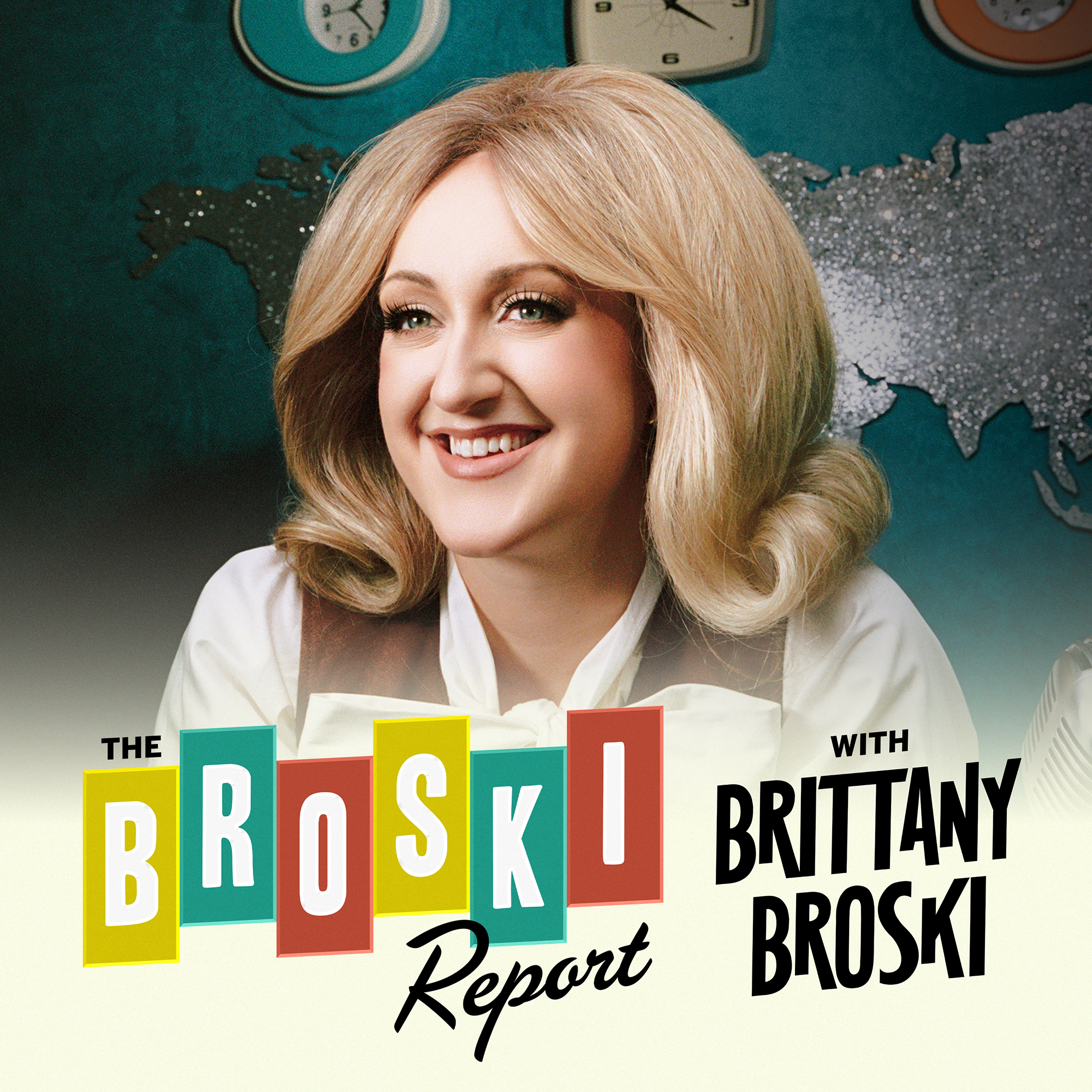
Brittany Broski, host of the Broski Report, opens with a candid narrative about her sinus infection and the green mucus she’s experiencing, clarifying that it’s a normal immune response and not a sign of danger. She humorously critiques Red Bull flavors, especially Juneberry, while defending blueberry and other natural options. The episode dives into the science of mucus, explaining how it protects the body and changes color due to immune activity. She then celebrates a new collaboration with Trixie Cosmerex, releasing a vintage Hollywood-inspired eyeshadow palette that includes blush, eyeshadows, lashes, and lip products, which she calls deeply wearable and beautifully crafted. A major theme is civic engagement, with Broski promoting National Voter Registration Day and urging listeners to register to vote. She explores the nature of fear, identifying death as her core fear rooted in the impermanence of life, while analyzing common phobias like public speaking and spiders through psychological and evolutionary lenses. She draws on classical conditioning and preparedness theory to explain how fears are instinctively formed, reinforcing the idea that survival-driven instincts shape human behavior. The episode concludes with a spooky ghost story from Shay and a music recommendation, ending on a note of empowerment, connection, and the importance of personal agency in both health and societal participation.
Direct from the Broski Nation Headquarters in Los Angeles, California. This is the Broski Report with your host, Brittany Broski. Guys! Oh, loo, guys. Oh, man, it never gets better than that. And let me just go ahead and address the elephant in the room. There is a small colony of the Musonex Green Fat Monster in my nose right now. I am hosting, I am the host, okay? A parasite has entered my body and is feeding for my lifeblood, for my life source, and it's winning, okay? The Musonex, the little fat green monster, the Musonex monster, it's winning. And there's not much I can do about it. You know, you got to just got to let it run its course. But ultimately, I don't know if it's a sinus infection. I don't know if it's my body succumbing to, you know, all the bullshit I put it through, or if it's just maybe a head cold. I was going into you and you, you know, it, but first, something I know will cheer me up. Able to very red bull. Wow. It's never not good. And let me tell you something, dude, that fucking Juneberry flavor, don't, don't piss me off. Some of you guys tag me in Instagram stories. And you say, on my Britney broski shit, and it's the Juneberry flavor. That is the most disrespectful thing you could ever do to me. June, when have I ever spoken about Juneberry red bull? It's just not even good. Blueberry, honestly, it's like a coveted flavor. Blueberry, most gas stations will carry it. And if they don't, you're missing out that coconut flavor. I'm not fucking with it. Juneberry, I'm not fucking with it. That kiwi peach one kind of delicious. They have another one that's like passion for, it's just nothing compares to the blueberry. I will go for a different one. If I have to, the watermelon red bull, I od on one time, an od in the most, you know, ambiguous of terms, ambivalent of terms, because I mixed it with, uh, Tito's vodka, vodka, I hate vodka. I am going to actually put my phone on, do not disturb. Somebody please message me, uh, please, y'all I'm working right now, I'm on the clock right now. Anything y'all need for me, it's going to have to wait, y'all, I'm so sorry. Yeah. I'll have y'all bad. I can't y'all be get a tattoo later. Okay. When you go to, oh yeah, I kind of overdid it on, uh, watermelon red bull, I've talked about this before. I pregamed one night. Burn on red bull is essentially, it's red 40, it's carbonated red 40, okay? And you have to take accountability to certain level that like, I chose to buy this and also drink it. You know what I mean? Like, that's, that's actually on me. That's on me. At least with blueberry red bull, a very natural, you know, deep purple shade, very, it's very much of the earth, it's very much blueberry. I don't tag me in that june berry shit, I'm not fucking with that, y'all piss me off. Okay, sinus infection, why, why does not turn green? And if you guys are going to be prudes and be like, I don't like the breast ear part, she's so gross, grow up. The human body is a marvel and I am hellbent on understanding why and how it works. Everything in life has the inclination to us perishing. All signs point to human life ending, okay? Yet we prevail, we're like fucking roaches. I swear to God, everything should have killed us by now. And now we're half composed of microplastics and formaldehyde and we're being embalmed a lot. We're being preserved. And I think that's beautiful. Okay, green snot also known as nasal mucus is typically caused by an underlying infection or inflammation, awesome, bacterial or viral infections, awesome, such as the common cold flu or sinusitis can cause an increase in white blood cells in the nasal passages. These cells release enzymes that contain iron, which can give the snot a green color. But at the end of a cold can be yellow or green. Let's go indicating your immune system is still actively fighting the infection as these colors are caused by dead white blood cells and other, okay, now see, this is tea. Doctors and nurses out there, I get it. For some people who have a genuine interest in like medical, this is tea because the human body is magical, it's magical, it's magical. As these colors are caused by dead white blood cells and other debris from the immune response. As you fully recover, you can expect your snot to become clear again. Of course I knew this, like I've been on this earth for long enough to know that like when you're snot green, you're sick, but it's good to know that it's, you're at the tail end of being sick. Why does your snot change colors? Don't judge your mucus by its color. Yeah, we're going to Harvard health. Whoa! We have a lot of mucus. The lining of the nose and sinuses makes a leader or more per day one leader. Images. What? Ew! Ew! Ew! Like, one of these smart water bottles? How much fucking mucus? Damn, I'm snot it up. My shit snot it up. I'm clotting. I'm about to clot. We're getting into what? Okay, we give a lot of mucus. The lining of the nose and sinuses makes a leader or more per day. Think of mucus as the body's own moisturizer. It's found on the tissues within the body, such as the lining of the nose, sinuses, and mouth, that come into contact with elements from the outside world. These lining tissues, also called mucusa, have a tendency to dry out and crack if there's two little moisture to, so mucus- mucus serves as important- smir- smir- smir- smir- smir when- when you- what the fuck just happened? Sometimes I short-circuit. You know, Joey and Frankie from The Basement, when Joey sometimes- he does the same shit I do. You'll get talking or your brain's moving faster than your mouth and you just- I was like, I don't remember that. And then you get frustrated. There's that one clip of him doing that where he says something, and then he looks straight to the camera and turns around and grabs a phone off the wall and yells and do it. That is so funny. And he is so me because that's literally me on this fucking podcast. Okay. That's one of the funniest bits that's ever happened on the internet, by the way. And just keeps getting funnier. Like somehow he's cracked the code to where that shit day by day gets funnier and I don't know- some days I'm like, okay, I'm over it and then I'll watch a really good one. I'm like, oh my god, and he changes the words to like Ryan Reynolds, Lofa Brad, so funny. Okay. Back to Mucus. Mucus is thick and sticky. It's getting sticky. That's got that sticky. It can trap dust, bacteria, or other unwanted passerby in our environment and prevent them from entering the body. This also contains elements of the immune system such as white blood cells and antibodies that kill any bothersome trespassers it catches. There may even be other functions of Mucus that haven't been discovered. Wow. The body's kind of like the ocean. Well, I only discovered about 17% of that. Rosva's total mystery. Rosva's tough fucking mystery. When the white blood cells in the Mucosa encounter an irritant or infectious organism, they respond by producing enzymes to repel the invaders. These enzymes contain iron, and that's one of the reasons nasal discharge may be green. And if the Mucus sits around, as when you're sleeping, it becomes more concentrated and so may appear darker yellow or green. Not that is interesting. I always thought if it was darker, that means it's getting worse, but maybe it just means you were sleeping real good. This is the natural order of things, whether they are fending agent as a virus, which is the most common cause of sinus infection or a bacterium. Okay, we can move on. A leader of Mucus a day is nuts. We're some sick nasty creatures. Okay. Let's talk about something that I really, really want to talk about today. Guys, my collaboration with Tracey Cosmerex is out as some celebratory music. Yes! To, to, to, to the moon. I am American, American, red, white and blue. I mean, Tracey, guys, long time coming, long time coming. We've been working on this palette for a day and a year, three years, for real. Like on and off, it's been in production. It's been like, we want to make sure that it's right. We went through a lot of different ideas and we finally landed on this. We went through a lot of different products, finally landed on this. So what it is, we'll put the website in the description. We can put the product up here on the screen.
screen. It is a palette, eyeshadow palette with a cheek, a gorgeous cheek. Oh, also we did a video on Trixie's channel. So go watch that. It's a blush, it's some eyeshadows, it's two sets of lashes, it is a lip liner and a lipstick. And it's all old Hollywood, classic, glamorous, silver screen, tensile town, Beverly Hills themed. Because Trixie and I are both transplants to Los Angeles, like we are not from here originally. I think it's fun that, especially Trixie being a drag queen, like this idea of what classic beauty and glamour is, is kind of, it's been campified, it's been kind of almost cartoonized. And I feel the same the way that I pull references from those kind of eras, you know, like the 20s, 30s, 40s. It's very, it's almost like this whimsical, unreal time period. And I mean that in terms of the media coming out of that time period, not the historical events, fucking bitch, obviously I'm not talking about that. I'm talking about like the classic, this is where our idea of 21st century beauty really stems from. And it's fun to play with those references. So this was such a fun thing for us to collaborate on and to create into, I think what is the perfect palette? It's an interesting color story that's deeply wearable. It matches this time period that we're talking about. And I think it'll look beautiful on any skin tone. I mean, it's just, I wanted to include neutrals, some fun colors, the blushes of stunning color, and then some glitter. We've got some glitters in there, really gorgeous tricksie cosmetics makes really gorgeous pressed glitter pigments. So I'm excited for y'all to get your grubby little fans on it and test it out. Let us know what you think. The packaging is done. I'm so happy with how it came out. But that's not now. So go grab it for the quality of the product, the size of the product. I think it's very affordable. I mean, for real, like tricksie cosmetics is not sold in stores. I mean, it's very like you get what you pay for with tricksie. And I wouldn't collaborate with a company that I didn't personally use myself. The fucking tricksie Juno Birch palette I use all the time. I use the plant gay palette as well. I have a bunch of them. It's like each one has such versatile uses. So yeah, I'm very happy with it. I hope y'all like it. The photos came out stunning, stunning. Shout out to John, shout out to John who photographed this whole that I just, I'm gagged. The whole team who worked on the whole tricksie team is just incredible. There's such lovely, fantastic, beautiful, talented people. So yeah, go check that out. I also, in that vein of just timely, because I am pre recording this, I'm recording this two weeks early. September 23rd, which if you're watching today on Tuesday, when this comes out, is National Voter Registration Day team. We're going to put a bunch of links in the description of the first and foremost being vote.gov. If you are an American citizen, if you have never voted before, if you have just turned 18, you would like to vote. Now is the time. It's never too late to register to vote. Please, please, please register to fucking vote. All of those resources will be in the description. If you're interested, headcount is also a company that I've worked with previously. I think they're great. They do great work. They make it really easy to see if you are registered to vote, if not, how to rectify that, et cetera, et cetera. So happy National Voter Registration Day. Go do that. Go be a civil servant. Go be an involved citizen. And now we can kind of move on to what I want to talk about today, which is fear. Today I want to talk about the power of fear. And I don't really have an outline for this. I have some general bullet points that I kind of wanted to hit, but I was just going to free ball it. So bear with me if this feels disjointed and not well organized because it's not. This is going to be kind of a James Joyce Ulysses stream of consciousness type of shit here that I'm freaking today. Fear to me. What I wanted to do is look up a list of people's biggest fears. And I think if y'all are longtime listeners of this podcast, you're probably well aware of the fact that my biggest fear is death. And not even like a painful death. Not, not, I mean, of course I fear being in pain. I don't know and wants to be in pain. But my fear is more abstract to the conceptual in the idea of life ending, life being finite is my biggest fear. Let's look up. But here's a new one. Okay. Fear of the dark is a very normal, very common terror that a lot of people have. And I want to know kind of the psychology of that because I've been thinking about it a lot. I was afraid of the dark as a kid. And you know, one of the things that triggered my fear of the dark was I watched. There was a scene in Harry bottom and the sorcerer of the Harry bottom and the Queens of the universe. My favorite movie probably Harry bottom and the sorcerers of the universe. Queens of the universe. I think that there is a scene. Okay. I forget what Harry Potter movie it was, but there's a scene where a death eater, have I talked about this before, a death eater is in the forest sucking the life out of a unicorn. Harry comes across the scene and the death eater snaps his head over and it like is terrifying the way that it's edited. And I may have constructed the scene in my head. Maybe this scene didn't happen in the movie. I haven't seen it in so long. That shit terrified me as a kid to the point where for a month, I had to sleep with all the lights on in my room. Like every single light I was terrified. Because why would you do that? Why would a man be there? Why would a death eater be there? And why are you hurting the unicorn? That's literally pathetic. Like literally pick on someone your own size. I just couldn't fathom. Like why would someone do that to a unicorn? I can't believe it. And that was kind of my first introduction to cruelty for cruelty's sake at the same time. So take with that. Take from that what you will. That was a scene as a kid where I don't know what I drew a parallel between that scene of like a death eater bleeding and draining the life out of a mythical, you know, morally, unicorns don't have a moral standpoint. I don't know. Just like this innocent creature, why did I link that to a fear of the dark? Like I did not want to be alone in the dark because alone in the dark means those sort of visions, those that imagery will resurface if I have no other stimuli. Because fear is such a powerful emotion and it's such a powerful cognitive force. So I want to look up why or what are the top fears people have? This is from Chapman News, news. Chapman.edu. Over the past decade, three Chapman researchers reached a cap and from the top and three, two, one go. Freddie from Icarly. Over the past decade, three Chapman researchers have explored the psyche of America uncovering the top fears that haunt the nation. This is a cool ass website design. The Chapman University Survey of American Fears has been changing how sociologists think about the impact of fear. Okay, here they are, the top 10 fears of 2024 by the percent of very afraid or afraid. Number one, corrupt government officials. Like yeah, like yeah, which is a very, very, very, very valid fear. And it is not even an unfounded. Because you know sometimes it's like, oh, I'm afraid of the dark. Maybe that's unfounded only because I'm afraid of the unknown. Oh, I'm afraid of spiders. I'm afraid of snakes, whatever. Like yes, there's a threat there. But that's kind of this baseline, Maslow's hierarchy of needs type of fear. Like that's affecting your physical safety. So it is valid and primal to be afraid of that thing. This is more high level of like, I am afraid of what life and my reality will look like what that will shape up to be because of the corrupt government officials that have the power to negatively affect my reality. 65% very afraid. Number two, people I love becoming seriously ill. Yeah, actually fucking totally, totally, totally, totally, 58.4%. Number three, cyber terrorism, 58.3%. More on that later, maybe because my thing is like, of course, cyber terrorism is terrifying. But there, I've always had this piece of me, like this common denominator of my internet experience, where I have accepted probably stupidly and naively. I never said I was intelligent.
that my information has been online since I was in middle school, like for real. My data has been sold and resold and resold and bought and resold to the point of like, I made a decision early on in my life with little to no agency of I want access to this thing and I'm not really educated enough or interested enough to know what I'm sacrificing in order to get access to that thing. Does that make sense? I just am now probably at my right age of 28. This probably sounds so ignorant because it is. I'm realizing like truly how harmful that is and the access that I have given we all give. The access we all give to people who potentially would want to use that for a negative intention, you know, with a negative, with malintent. So I guess that's a very valid fear. Number four, people I love dying. Yes. 57 percent. Number five, Russia using nuclear weapons. Ballad. Number six, not having enough money for the future. Ballad. Seven, the US becoming involved in another world war. 55 percent, it was tied. Number seven, North Korea using nuclear weapons. Number eight. Number nine, terrorist attack, number 10, biological warfare. Okay, let's let's read this article because this is very, very interesting. This is not the direction I thought this was going to take and I guess I should have known by the the denotation here of American fears because our our realities are so politicized and our realities are so like I was just kind of looking for spiders and snakes and we'll keep reading. Sharks, clowns, public speaking. Do you know what Americans are really afraid of? According to the researchers on the Chapman University Survey of American fears, the nation's number one fear in 2024 is corrupt government officials. This isn't news to the members of team fear. It's topped the study every year since 2015. I wonder how they collected this data. Was this like a multiple choice or was it fill in the blank? Fear of corrupt government officials is always up there, says Christopher Bader, Professor of Sociology and Lead Investigator on the project. We think that is reflecting an overall sense amongst people regardless of political affiliation that the government is just not working. It is corrupt. While people are perennially concerned about not having enough money, the fear of economic collapse last year's number two fear has dropped out of the Tim top 10 list. Meanwhile, fear of cyber terrorism has grown by 9% moving into the third position in the rankings. We have shared the results with FEMA, the Red Cross, the national weather service and emergency managers across the country who have used the information and their efforts to better prepare America for disasters. Oh, this is tea. Fear of climate change and global warming has gone up and down since 2015. It was at 69% of people were afraid of climate change in 2015. Now it's 52%. But it's been steadily rising over the last five years. Very, very, very interesting. I think that well, I have a book called The Politics of Fear or the politics of, yeah, I have two separate books. One is called The Politics of Fear and it's about McCarthyism and the other book is called How Fascism Works, The Politics of Us versus Them. And they're on my fucking nightstand. I need to start them. I'm powering, I'm still powering through about Bable. Because again, I'm pre-recording these episodes, guys, I'm doing over the last two days I've recorded four episodes. Okay, forgive me. I'm running out of shit. Talk about, sorry. But those are two books that I once I read them. I also have another book called Monsters that's about separating the art from the artist. I'm really interested to see what this author has to say because I feel like that's such a hot topic in our generation and like pop culture and it's this ever-present question that keeps coming up. It keeps popping up of, am I allowed to like this thing if it was made by a horrible person? So I'll read that. I'll get back to you on on what the author said because I'm undecided. Like I don't, I think that it's gray, you know, like everything. Everything needs nuance and most conversations online lack nuance. So it's hard to talk about it. So let me read it. I'll read all those books. I'll come back to you with a quick spark notes. Okay, let's hit fearof.net because this, yeah, this is what I wanted. Fear of is a website dedicated to helping people with fears and phobias. It contains a large list of phobias and teaches how to cope with and ultimately cure your fear. Now that's fantastic. Top 100 phobia list. These are the top 100 in the world with the most common ones listed at the top. You can click on each one to learn about causes, symptoms, and treatments. We'll do the top 15. I'm sure maybe you guys want to play along. We can we can try to predict what each one's going to be. Let's start at 15. A Tiki phobia. This is going to be honestly, this is an etymologist dream. All of these phobias, these are all just going to be like Latin roots and prefixes and fucking whatever. At Tiki phobia, the fear of failure, it is the single greatest barrier to success. Valid. Fear of failures, really, that's a slept on one. That's one that's really slept on, I think. Number 14, monophobia, the fear of being alone, even while eating and/or sleeping. I know some people who don't, this feels a bit more abstract, right? Some people cannot be alone, actually. If it's a trauma response or whatever, but some people just prefer not to and maybe their behavior reflects that in kind of a self-destructive way, serial monogamous might suffer from monophobia. Number 13, glossophobia, the fear of public speaking, not being able to do speeches, and I wonder why? Why? I've never had this fear. I don't know if you guys can tell. The exact cause of glossophobia is unknown, but it's likely that certain traumatic events in one's past as a child or even as an adult might have led to this fear of public speaking. Often, the individual coping with dysphobia might avoid speaking in public for so long that what beings as normal anxiety begins, there's a typo, as normal anxiety might turn into full-blown glossophobia. Most individuals who suffer from the fear of public speaking are also low on self-esteem, expect perfection in everything they do, seek constant approval or expect failure. In the case of traditional or orthodox treatment for glossophobia, beta blockers may be prescribed for soothing anxiety, controlling shaking or trembling, and also for lowering heart rate. There are several restrictions on taking such medicines. One must especially speak to a doctor about these meds when suffering from diabetes, depression, or heart rate. Many public speaking courses, associations and clubs are dedicated to help individuals alleviate their fear of public speaking. Talk therapy, cognitive behavioral therapy, and counseling can help people. Hypnosis, positive visualization, meditation, and even acupuncture, getting a tattoo because you're afraid of public speaking. You just have to look sick. Have you thought about looking fucking cool? Okay, then I wouldn't be afraid of public speaking. Maybe get a bomb haircut. Okay, back to the list. Number 12. Phenatophobia, the fear of death. Oh, there's a name for it. Phenatophobia. Even talking about death can be hard. Oh, I don't know if I want to read. I don't know if I want to read this. Oh, here we fucking go again, guys. I recently got a clip on my own for you page of me talking about my fear of death and how I was reading through that article that was like a really genuinely sweet and beautiful eye opening article about you only get one life live it well and like live it well and live it together. That was kind of the gist of the article and I was crying. I was sobbing. I'd say fast start crying again. Don't mind me. It's my biggest fear. Oh, that it's just my biggest fear. Oh, that it's just the absolute Achilles heel of my entire existence and being so yeah, don't mind me. I'll just move on really quick. The extreme and often irrational thought of fear or death leads to the phobia known as the natophobia and before we move on and yes, I'm stalling. Phenatose. Phenatose etymology. The name Phenatose comes directly from the ancient Greek word Phenatose meaning death. This Greek word is related to the verb thnisko which means to die and it's thought to derive from an even older Indo-European route related to the concept of dying or disappearing. In Freudian psychology, Phenatose was used to describe the death instinct or the urge towards self-destruction. I really got to read some Freud. I feel like it might really negatively affect my life actually. Phenatopsis. A sight or view of death. Phanatism. I believe that the soul ceases to exist at death. Phenatology. The scientific study of death. Phenatophobia. The fear of death. What the fuck is going on? Phenatopsis is an early poem by the American poet William
Colin Bryant, a consideration of death. Yeah, I'll be reading that later. I'll be reading that later and freaking the hell out. Post it up in my house, freaking the hell out. Very severe. Very severe. Can I talk? Suckering second task. That's how I feel, dude. Very severe. Oh my God. Severe. Severe. Who says suckering suck attached? Suckering suck attached. Sylvester. Fucker and fuck attached. That's how I feel on the fucking fucker. I am Sylvester. And what is that from Lunitans Sylvester the cat? Yeah, Lunitans. He was always trying to eat Tweety. Anthropomorphic cat. Most of his appearances have him chasing Tweety Bird, Speedy Gonzalez or Hippity Hopper. He was so horny for Tweety. Was Tweety non-binary? He was non-binary. Sylvester clocking Tweety's non-binary gag. Moving on. Moving on. Okay. Why do you guys listen to this podcast? Very severe. Cases of fanatophobia often negatively impact the day-to-day functioning of the individual suffering from this condition. I can I can personally go ahead and endorse that statement. Often she or he refuses to leave the home owning to this fear, owing to this fear. The talk or thought of death or what lies after death can trigger panic attacks in the patients. It's also known as the fear of entomit or the fear of being buried. Yes, that's the fear of mine. Dying phobia, fear of cremation, fear of the unknown. Okay, here's what they have to say about the causes. And again, like I don't know if there is a cause. It's just kind of a general, you know, that saying that's like men come to revelations of things that women thought about when they were nine. Like I had I first had my fear. My first thought that I was afraid to die around the age of like eight or nine for real. Like I don't want to die. It has never intrigued me to a point of like, especially in high school, I had a lot of friends who self harmed and who were very depressed, like dangerously depressed. And I always kind of we gravitated towards each other because I have such the antithesis of that, you know, that disposition. And I think that, you know, things happen for a reason. People come into your lives for a reason. And I was able to provide, you know, a flip side of that sensation, that feeling of like I don't want to be here anymore. Because I'm on the complete other end of the spectrum of like I don't want to leave this place. Everything that I need and want and desire, like my mortal soul, it yearns to be here. And it just like, I think that that's a, but that can get kind of murky, you know what I mean? You're not helping each other. You're kind of just talking at each other. Anyway, I'll go ahead and wave on and causes. As is the case with several other kinds of fears and phobias, the fear of death also results from external events or internalization or predisposition of extreme concepts about death. As children, we learn that death is inevitable and non predictable, but this knowledge can paralyze or overwhelm the person. Mental symptoms, loss of control, feeling of going crazy with automatic or uncontrollable reactions, repetition of gory thoughts, inability to distinguish between reality and unreality. Emotional symptoms. Desired of flee and escape from current situation, extreme avoidance, persistent worry and terrifying or overwhelming thoughts, anger, sadness, guilt, fuck. It is important to consider a few conditions that are mistaken for thandetophobia. Depression, ADHD and bipolar disorders are often linked to this type of phobia. In other cases, undiagnosed conditions like Alzheimer's, migraines, concentration disorders, strokes, schizophrenia, and epilepsy may be related. Diagnosis of thandetophobia is best done by the patient themselves. If the extreme thoughts of the fear of death are affecting your life so much that you are unable to leave the home or compromising your daily functions, then you must discuss this with the medical doctor. Sure. Anti-anxiety medications. Yeah. Hypnotherapy, religious counseling. I don't know if I would. Well, let's talk about it. Would you turn to religion for a fear of death? Because here's the thing with religion. If you're talking about death in the context of religion, that's like to me, and this is speaking as myself and my troubled past with Christianity, if you are given now on top of this baseline anxiety of I don't want to die, I am afraid of dying and this being it and there being nothing after this. Why would you then give me a list of things that I have to do to ensure which is never solid, it's not guaranteed? That gives me war anxiety. What if I do all these things? I live my life according to your doctrine that you have created. Who fucking knows if it's divine? Who fucking knows if it's gifted from some holy power? Oh my god, that scared me. Who knows? If I follow all these rules and I still at the end of my life, I die and I'm on my deathbed thinking, I don't know. I don't know. I don't know. Was it worth it? Why? What was the point? I don't know if tying yourself to a religion is actually gonna alleviate. That's me speaking. I know religion has really, really turned some people's lives around. It has offered a purpose. It's offered an explanation. It's offered a why. And to that, I've said this before, like I am a bit envious of the faithful, you know, that you have this certainty to cling onto. Even if you sometimes doubt it, still it is a certainty that you have accepted. I'm on the flip side of that. I had a certainty and I let it go and look where it's left me, you know what I mean? But I would do it a hundred times over. I would do it any time for real. Like the harmful effects that religion had on me and my friends and my relationships and my outlook on life and my prejudices and my worldview, I would let go of it a hundred times over. So I don't know. I think it depends on are you being responsible with your relationship to religion and what religion is offering you and are you impeding on or limiting someone else's way of life by practicing your religion? That is the asterisk that I would put by that. Talk therapy, neuro linguistic programming, cognitive behavior therapy, relaxation techniques, rap. I will say controlled breathing does help. Sometimes I got a, when me and Elizabeth and Paige were in Ireland, we were going to a function one night with some sexy Irishman there. Okay. And we were nervous as fuck. We were so nervous. And we were telling me, Elizabeth, we were like, I feel like that fucking RuPaul video. He laps and then like takes a deep breath. And I went to search it on TikTok and it popped up RuPaul laugh and blow. Yeah, I'm laughing. RuPaul laugh and blow. And guess what? That's exactly what I wanted. I pulled it up. And that was exactly the video. Self-help techniques group therapy with other patients suffering from panotopia. It really be a bunch of mentally ill, but just saying exactly, exactly. That's what that would be. Me like, I'm afraid of dying is my biggest fear. Exactly. Say that twin. Yes. Okay. In conclusion, panotophobia is a complex phobia, which if left untreated can touch every aspect of the individual's life. Fuck this website. This is not helping. However, oh, here we go. However, one must not lose hope, but opt for treatments and therapies that can help them cope with it. Families and friends can also play a very important role in helping the individual deal with one's fear of death. That didn't help me at all. So let's actually just go back. That was number 12. Number 11, carcinophobia, the fear of cancer. Very, very, very valid. I have that as well. Tripophobia, we all know that one, the fear of holes, the fear of grippy holes, of tight grippy holes. Number nine, aerophobia, the fear of flying. Twenty-five million Americans share a fear of flying. T. Missophobia, the fear of germs. It's also rightfully termed as germophobia. Clostrophobia, fear of small spaces. Number six, astrophobia, the fear of thunder and lightning. Let's read about that. This isn't really like scratching my itch of why are humans afraid of these things. Like, I want to know what primal instinct it's triggering for us to be afraid. Like this website is just not going deep enough for me. In many cases of astrophobia, the sufferer is known to have experienced an electric shock when there is lightning in thunder outside. Many of phobic is all.
also known to fear flooding, which usually results from heavy rain. See, this is all just, it's stupid. This is all very straightforward. Like, one time I had someone get struck by lighting, no, I'm afraid of it. Like, oh, no shit! I wanna know the more like deep psychological, whatever. You're pissing me off, fear of.net, shit's not helping. Number five, the fear of dogs. Cinephobia? Who's afraid of puppies? Who's never be very puppy? Number four, agoraphobia, the fear of open or crowded spaces. Very valid. Number three, aquaphobia, the fear of heights. I have this as well. But it's interesting, 'cause I'm not, when I'm up in a plane, I'm not afraid of heights, 'cause I'm like, I can't fall out. I can't individually fall out of the plane. Like, if the plane goes down, look, we're all in this together, right? It also feels like a video game. Like, when I'm looking at the window of a plane, it's not like, oh my god, I'm 10,000 feet in the air! It's like, eh, it's like a movie. However, when I'm up on a skyscraper, what is that dumbass building in Chicago and also the one in New York? Is it the Rockefeller Center and the. Y'all know the one I'm talking about, with where the floor is glass. And there's a name for it, it's on the tip of my tongue. You can walk out onto this glass. All be it, it's like 12 inches of solid glass that you're walking out onto. And you can look, oh, I just got a chill. You can look down on the city. And there is nothing under you. That is, that's actually gonna make me have diarrhea. Like, my stomach just turned. That is hurt. That's different than being in a plane. Do y'all get me? Do you know what I mean? Oh. The edge. The edge, is that what it's called? There's another one I think in Dallas in reunion towers at the one, or maybe that's in Chicago. That one's in Chicago that I'm thinking of. Where the top of this building is circular, it's like a sphere. And you can lean against the glass and it's rounded. And you can like put your forehead against it and look down and it's, there's nothing. ♪ So that's awesome ♪ Number two, oh, oh, Fidiophobia. I like that word, fear of snakes. Number one, arachnephobia. Yeah, that checks out. People are afraid of spiders. That movie dude, that movie scared the shit out of me as a kid. Arachnephobia, that big ass spider? Arachnephobia. Oh, there's so close, so close, so close. A small California town becomes invaded by a deadly spider species. Starring Jeff Daniels and John Goodman, Jesus. Yeah, that shit. I watch that as like a middle schooler. Oh, no, no, no, no, no, no. I wanna look at why is being afraid of the dark so common. Here's what I'm talking about, dude. It's called nicdefobia, N-Y-C-T-O-Fobia. Nix, N-Y-X means dark, right? Nix. Nix. Etymology. Night, yeah, yeah, yeah, yeah. Comes from the ancient Greek word, NUX, which directly means night. In Greek mythology, Nix is the primordial goddess and personification of the night. Shout out. A shadowy figure present from the beginning of creation. The Latin equivalent of Nix is nox. And that's why in Harry Potter, they say lumus and nox. Thank you. Also, Hozier song, son of Nix. He's so good. He's so fucking good, he's so fucking good. Let's go back to why is being afraid of the dark so common. Our ancestors were vulnerable to predators at night, leading to an ingrained prepared fear of darkness that enhances vigilance. In modern times, this primal fear is reinforced by a lack of visual information, which can trigger a startle response and allow the mind to conjure worst-case scenarios. So it's an evolutionary protection thing. Duh, I think we all knew that. But a part of me is like, is there a layer deeper? A prepared fear. What does that mean? A prepared fear. Oh yeah, yeah, yeah, here we go, here we go. We're on Wikipedia now. In psychology, preparedness is a concept developed to explain why certain associations are learned more readily than others. For example, phobias related to survival, such as snakes, spiders, and heights, are much more common and much easier to induce in the laboratory than other kinds of fears. According to Martin Seligman, there is a result. This is a result of our evolutionary history. The theory states that organisms which learned a fear environmental threat faster had a survival and reproductive advantage. Consequently, the innate predisposition to fear these threats became an adaptive human trait. The concept of preparedness has also been used to explain why taste diversions are learned so quickly and efficiently compared with other kinds of classical conditioning. Classical conditioning meaning, like Pavlovian? Yes. Classical conditioning, I'm sure everyone here knows, if not, you're about to learn. Pavlov and his dogs was a famous theory. I can probably just, yep, let me read it. Ivan Pavlov, the Russian physiologist, studied classical conditioning with detailed experiments with dogs and published the experimental results in 1897. In the study of digestion, Pavlov observed that the experimental dogs salivated when fed read meat. Pavlovian conditioning is distinct from operant conditioning, which is instrumental conditioning, through which the strength of a voluntary behavior is modified, either by reinforcement or by punishment. Basically, Pavlov's experiment was you would ring a bell and the dog would begin to associate that with being fed. I believe so. Let me click on it, but let me make a prediction. That is what I remember it to be. And it got to a point where you would ring the bell, the dog would start salivating and then there would be no food. So they've been conditioned, right? If you've ever heard of that, like Pavlovian conditioning, that was the actual experiment. Yeah, I'm so fucking smart. The process involved repeating pairing of the neutral stimulus, a bell with the unconditioned stimulus, food, leading the dogs to salivate at the sound of the bell alone. That was the takeaway of Pavlov's dogs. Now going back together with operant conditioning, which means what? Operant conditioning originated with Edward Thorndyk, whose law of effect theorize that behaviors arise as a result of consequences as satisfying or discomforting. In the 20th century, operant conditioning was studied by behavioral psychologists who believe that much of mind and behavior is explained through environmental conditioning. Reinforcements are environmental stimuli that increase behaviors, whereas punishments are stimuli that decrease behaviors. Okay, got it, got it, got it. Both kinds of stimuli can be further categorized into positive and negative stimuli, which respectfully involve the addition or removal of environmental stimuli. So that's different than classical conditioning, which is just you associate something with something else. Classical conditioning and operant conditioning became the foundation of behaviorism, a school of psychology, which was dominant in the mid-20th century, and is still an important influence on the practice of psychological therapy and the study of animal behavior. Classical conditioning has been applied in other areas as well. For example, it may affect the body's response to psychoactive drugs, the regulation of hunger, research on the neural basis of learning and memory, and in certain social phenomena, such as the false consensus effect. Well, have a look, cause, well, have a look. Oh, dog cognitive bias. In psychology, the false consensus effect, also known as consensus bias, is a pervasive cognitive bias that causes people to overestimate the extent to which other people share their beliefs and views. So all of TikTok, bro. So TikTok.gov, bro. It is the tendency to see their own behavioral choices and judgments as relatively common and appropriate to existing circumstances. In other words, they assume that their personal qualities characteristics, beliefs, and actions are relatively widespread through the general population. The false consensus is significant because it increases self-esteem. Very, very tea. God, y'all bet, y'all didn't think, I know I got a lot of psychology majors in breastfeeding because you bitches are fucked up and I love you for it. And because you're fucked up, you have a deep rooted desire and curiosity to learn about the human brain, which I love because I have the same thing. I know this probably feels really rudimentary and like elementary to you, but I think it's so important. I took a sociology in psychology class like a summer between sophomore and junior year of college and I really was into it, but it gets to a level that's like, okay, if this isn't my major, I'm not gonna go ham on this, you know what I mean? Like I was taking it as a required elective. Yes, it was relevant to my degree, but I was, you know, psychology goes hand in hand like persuasion.
The persuasion was a course I took in college that really lit my fire. Damn, I loved that class. I took one called Rederick of Western Thought. I took one called Sustainability Ethics. I've talked about this kind of before on this podcast of like communication. A lot of people like to make fun of it. They like to, you know, whatever. But companies will hire a third party communication consultant group to come in and assess like interpersonal issues within a company. Like why aren't messages being communicated properly to, you know, an audience, to a consumer base, top down messaging. And what's really interesting in the psychology aspect of the comm degree is in the persuasion class, we studied orators, you know, like a lot of that class actually focused on Hitler and like Nazism. Because at the core of it, the question is, why was his rhetoric so successful? And we're watching it today with Trump. What is it about these people that is so magnetic? And it's just psychology tricks, like at the core of it. It's because they were excellent orators, which is terrifying. Because it's never really about the words they're saying, the harmful things they're suggesting, it comes down to how they're saying it, and are they likable? Are they likable to the right people? And that's terrifying because humans are so easily swayed. We're so easily won over, you know? And that is so interesting in and of itself. We also, we studied a bunch of other famous orators, but that probably being the number one example. Because at this point, Trump hadn't been elected yet. This was 20, this was early 2016. When I took this class, and I remember being gagged. 'Cause I was like, I've never thought about it like that before. I've just thought, if you voted for that person, that means you are a bad person too. Like surely you saw how scary this world, that this person is suggesting, surely you see through that, right? No, and we're watching that with Trump's America. These people are brain dead, they're brainwashed. The human part of me wants to have sympathy for like, you fell for it, girl, you fucking fell for it. And then the other part of me is like, it's unforgivable. You should have the wherewithal and the discernment to know that this is a self-serving person who has none of our best interests at heart. He is serving his own best interests. And everything else is, it could matter, it could not matter less to him. And it's just like, you have to take stock of the world that we've created at a certain point and how powerful words are. I love etymology, I love language, I love this shit. Like truly there's something about it that lights my soul on fire, but it's because I recognize how fucking scary it is. Words are the most powerful thing we have. Language and messages and meaning behind those messages and interpretation and it's daunting, honestly. Not to draw it back to a personal relatability, but like, some days I don't wanna record the podcast because I understand how important words are, especially my words are. And some days I don't, that task feels way too daunting and it feels like I am not the one. But then I kind of sit in my purpose of like, I have this deep rooted connectivity with you all. Whoever choose to listen, whoever chooses to listen to this podcast, and I, to a certain extent, want to connect with you in this human way, that is, you know, talking about our fears and the state of the world, but also making light of it because I want this to be an escape and I want this to be something that you can turn to, to feel seen and to feel heard and to not feel fucking crazy and to feel that we're all in this together and we will make it out the other side. But some days, shit girl, it's heavy, it is heavy. So yeah, I've always had an interest in passion for language and its uses and capabilities and history and evolution, et cetera, et cetera. Thank you. Okay guys, let's do one ghost story, one ghost story. This is from Shay. Here's the story. I believed in ghosts for as long as I can remember. But one moment when I was 14 made the belief impossible to shake, we lived in a house with a side door that had two locks, a standard door knob lock and a deadbolt above it. We only ever used the bottom one. The deadbolt had its own separate key when we never had. It could only be locked or unlocked from the inside. One afternoon, my mom, my two youngest siblings who were still too young to know what a ghost even was and I left to go shopping. The house was empty when we left, just us. No one else had a way in or out. When we got home, my mom went to unlock the door like always. The bottom lock turned just fine, but the door wouldn't budge. That's when we realized the deadbolt was somehow locked. I just got a chill. That's fuck fuck. She tried every key on the ring, but none fit because of course they didn't. We'd never had a key for it. After a few tries, I said, let me try. And the second I touched the door knob, we heard it. Ew! A clean, clear click. The sound of the deadbolt unlocking from the other side. My mom and I just looked at each other wide eyed. Then we did the only reasonable thing we could do. We let my siblings go in first. (laughing) Yeah, you guys go check that shit out. We'll be out here. You guys go play. Girl, what the hell? Ew, I don't like that. I do not like that. - Thank you for sharing, Shay. Maybe you've got the gift of the gab. You've got the gift of the touch. You're touched. Okay, let's do songs of the week. It's just one, and it's 27 hours by banks. I used to be the biggest, I still am. The biggest bank stand. I didn't listen to Serpentina as much as I should have because three by banks is top five albums of all time to me. Ever, ever, ever, ever, ever, I fucking love that album. This is not from that album. 27 hours from, I believe the alter. I love that song. And I recently rediscovered it. It came on Shuffle and I was like, damn. She's also got a song called Judas Get Into That Girl. Just go through banks. If you're not familiar with banks, lock into banks. All right, team, I love y'all. If you want merch, go to broskey.shop. Go shop the Trixie Cosmetics Club, go register to vote. And anything else I forgot, just do it. Shots just do it like Nike. Do I think they like me? Clean, pair of sneaks with ABs on her bill. Please watch your step. Throw a flag on the plate. Miss a body, get over. Hey, da, da, da, da, da. Pull it up on the butt. Hit the corn. Hit the corn. All right, love you guys, bye. (upbeat music)
Podcast Summary
Key Points:
Host Brittany Broski shares her personal experience with a sinus infection, attributing the green nasal discharge to immune response and dead white blood cells, not a sign of serious illness.
She critiques the Juneberry flavor of Red Bull, calling it disrespectful and unappetizing, while praising blueberry and other natural flavors as more authentic and enjoyable.
Broski highlights the body’s natural mucus production as a protective, self-moisturizing system that traps pathogens and contains immune elements, with color changes indicating immune activity, not necessarily worsening health.
She celebrates a new collaborative eyeshadow palette with Trixie Cosmerex, themed on old Hollywood glamour, featuring blush, eyeshadows, lashes, and lip products, praised for its aesthetic, inclusivity, and craftsmanship.
The episode turns to public awareness, promoting National Voter Registration Day and urging Americans to register to vote, citing the importance of civic engagement.
Broski explores the psychology of fear, identifying her most profound fear as death, rooted in the finiteness of life, and discusses common societal fears like corrupt government, illness, and cyber threats.
She examines phobias such as glossophobia (fear of public speaking), arachnophobia (fear of spiders), and agoraphobia, linking them to evolutionary preparedness and trauma.
Drawing on classical conditioning and evolutionary psychology, she explains how primal fears like darkness or snakes are deeply embedded in human behavior due to ancestral survival instincts.
Summary:
Brittany Broski, host of the Broski Report, opens with a candid narrative about her sinus infection and the green mucus she’s experiencing, clarifying that it’s a normal immune response and not a sign of danger. She humorously critiques Red Bull flavors, especially Juneberry, while defending blueberry and other natural options. The episode dives into the science of mucus, explaining how it protects the body and changes color due to immune activity.
She then celebrates a new collaboration with Trixie Cosmerex, releasing a vintage Hollywood-inspired eyeshadow palette that includes blush, eyeshadows, lashes, and lip products, which she calls deeply wearable and beautifully crafted. A major theme is civic engagement, with Broski promoting National Voter Registration Day and urging listeners to register to vote. She explores the nature of fear, identifying death as her core fear rooted in the impermanence of life, while analyzing common phobias like public speaking and spiders through psychological and evolutionary lenses.
She draws on classical conditioning and preparedness theory to explain how fears are instinctively formed, reinforcing the idea that survival-driven instincts shape human behavior. The episode concludes with a spooky ghost story from Shay and a music recommendation, ending on a note of empowerment, connection, and the importance of personal agency in both health and societal participation.
FAQs
Green mucus is typically caused by dead white blood cells that accumulate in response to infections like colds or sinusitis. These cells release enzymes containing iron, which gives the mucus its green color. It often indicates the body is still fighting an infection, not that the condition is worsening.
No, green mucus is not always serious. It’s a common sign that your body is actively fighting an infection, especially during the later stages of a cold or sinus infection. As you recover, mucus usually becomes clear again.
Brittany Broski’s biggest fear is death, specifically the concept of life being finite and ending. She describes it as an abstract, existential fear rather than a fear of pain or suffering.
Arachnophobia is the fear of spiders. It is common due to evolutionary preparedness—our ancestors faced danger from spiders, so the fear became a survival mechanism. This primal fear is deeply ingrained in human psychology.
People fear the dark because it triggers a primal survival instinct. In ancient times, darkness meant danger from predators. Today, the lack of visual information can cause the mind to generate worst-case scenarios, amplifying the fear.
Glossophobia is the fear of public speaking. It can stem from past traumatic experiences or low self-esteem. Treatments include cognitive behavioral therapy, relaxation techniques, public speaking courses, and meditation to reduce anxiety.
Chat with AI
Loading...
Pro features
Go deeper with this episode
Unlock creator-grade tools that turn any transcript into show notes and subtitle files.
 PodcastTranscript AI