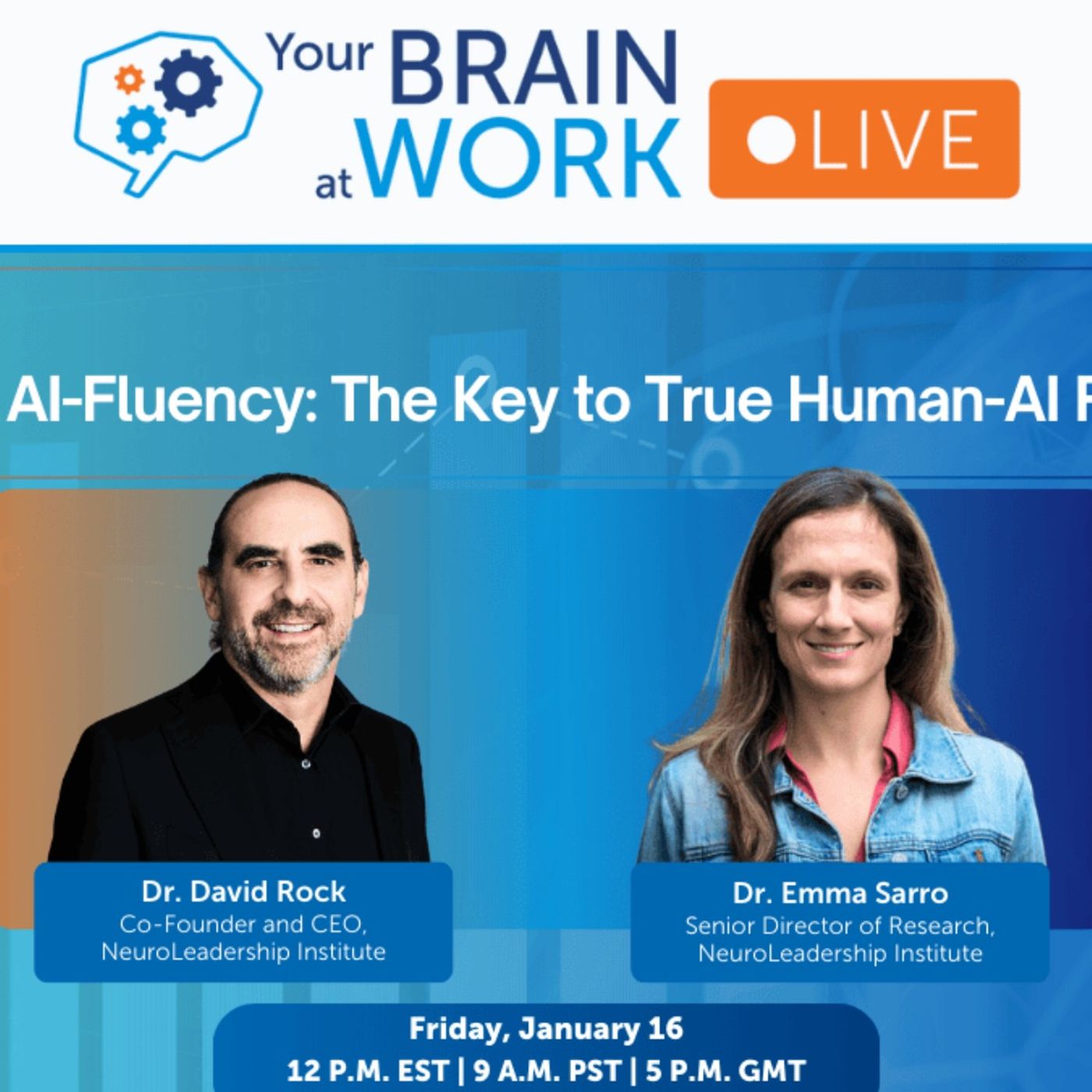
Cultivating AI-Fluency: The Key to True Human-AI Partnership
56m 55s
In this episode, host Emma and guest David Rock explore the concept of AI fluency as an essential competency for modern organizations. They emphasize that AI fluency is not just about using AI tools but about forming a strategic partnership where AI enhances human effectiveness, such as by providing coaching, facilitating research, or offering alternative perspectives. The discussion outlines four engagement levels: resistors, ambivalent individuals, basic users (who risk cognitive disengagement), and fluent users who integrate AI daily to improve outcomes. Research indicates that basic AI use can reduce memory and critical thinking, whereas fluency boosts both efficiency and effectiveness. Examples of fluency include using AI to prepare for difficult conversations, analyze presentations, or brainstorm ideas while actively learning from the interaction. The episode stresses that fostering fluency—through habits like flexible thinking and intentional prompting—is key to leveraging AI for leadership development, performance management, and organizational learning in an era where AI is becoming indispensable.
Hello, welcome. Welcome everyone to another week of your brain-of-work live. I'm your host MSIRO. I lead the research team here at the NRL Institute. And as everyone's joining, please get comfortable, turn the chat, open the chat, and turn it to everyone and tell us where you're coming in from today. We'd love to hear that right away. I'm joining just from outside of New York City. It's beautiful out today. Cold, but gorgeous. We're happy to have you back for all of our regulars. And for newcomers, welcome. We're excited to have you here with us for the first time. It's a great episode to join today. So yeah, I love seeing all these all these locations from all over the world. Amazing. So in today's episode, we were discussing the underpinning science and critical behaviors needed to create fluency, AI fluency. And how building these habits is essential for broader AI transformation of leadership development, performance management, organizational learning. It's becoming more than a nice to have. It's a necessity at this point. So we suggest, as always, to turn off any distractions, move your phone away, do not disturb and any notifications, and get the most out of today. So I'm going to welcome in our guest today. So you know him well. He coined the term "near leadership" when he co-founded NLI over two decades ago. He has a professional doctorate for a successful book center's name and one more coming up. And a multitude of biolines ranging from the Harvard Business Review to The New York Times and many more. A warm welcome to David Rock. Thanks very much, Emma. Good to be here. I'm calling in from Geneva in Switzerland. Hopefully the Wi-Fi is working here. There's a couple of Wi-Fi challenges lately, but hopefully it holds up. And yeah, good to be here. I'm on the way to Davos this weekend for the second time. We might do a talk from there or not, I'm not sure what we're doing next week, but it's such an interesting festival. It's really a festival of ideas. People think about it as the world economic forum. The the Weff is only 10 to 20% of the participants there and of the talks. They're expecting over a thousand different talks this year. And you know AI is definitely a big feature of the topics, you know, ethical use of AI, the sort of the challenges of it, the opportunities of it. But you know, there are many other topics that are going to be happening there around, you know, the environment and education, social welfare, economics of course. It's kind of a it's kind of a world's fear for thinking about the future in a way alongside kind of the world economic forum with all those people. So it should be an interesting week to think about, you know, some of these big questions that we're digging into today. Yeah. And you know, you kind of took the words from out of my mouth. I think I was actually going to send you an email after this to remind you of collecting your insights that we can have an episode in a couple of weeks to talk about this because we'd love to hear what you came away with. We did this last year as well. Yeah, it's a really interesting conference. It's a little overwhelming. It's about roughly a thousand talks in four days. Of course, you can't go to a thousand talks in four days. So the the pho-mo is quite something. The sort of navigating it and all that. It's an interesting an interesting adventure. We'll see. Well, I mean, you talked about this last year, but how many meetings and will contain, you know, AI agents from people who can't attend other other sessions, right? Yeah, there'll be there. There'll be a lot of people recording sessions and putting them through AI. There'll be a lot of the virtual sessions, you know, people are using AI so much. Obviously, it's built into Zoom and Teams and these things now. But they're, you know, the scary thing is you get three different AI summaries from the same meeting and you get three really different summaries. And so you've got to just go to remember that they're not they're not, you know, fully accurate. They're their one version based on sort of the context that I that AI listens through. The sort of, the you know, the country that AI is was developed in. The you know, the work that's gone into that AI, all these different sort of frames result in very different, you know, different outcomes. So well, yeah, we'll see what happens. Yeah. I mean, speaking of, you know, this is a conversation that we've been having for over a year now, but just the idea of using AI. But now it's really on this idea of AI fluency, which you predicted in a recent article as one of the top predictions of this year that AI fluency is a necessity now for organizations. And it's it's the it's the literacy of our era as we're going into it. So how do we build AI fluency? What does it even mean? Like where are you sitting on on a spectrum of AI fluency? So we've been thinking about this for a few months now. Building out a scale of AI fluency. And you know, thinking about how do we push everyone to this fluent, you know, having that skill set. So what is this? Let's talk about the scale. Yeah, I think, I think, I think firstly, you know, with any technology, there's, you know, there's benefits and challenges. This is a really interesting new technology because it sort of upends so much. But, you know, the car upended so much too, right? Invented the car going from, you know, horses to cars upended, you know, so many things. And then, you know, the internet upended so many things, you know, like information suddenly traveling literally the speed of light around the world is just completely disrupted so many things. But, you know, created so much as well. And I think this is a this is an interesting technology. It'll have a, you know, similar kind of effect as the car or the internet. And they'll be, you know, there'll be winners and losers. This is an interesting one because it goes to some of the, you know, what it really means to be human and to think. So it's a, it's a particularly interesting one. But it's interesting to see, well, firstly to think about this concept of AI fluency, you know, there's a really, really big gap between people who are what we call fluent AI fluent. And the people who are, you know, just even one below that to sort of ambivalent, they may be using it a bit, you know, and then there's the people who are really, really pushing back. But there's such a big difference even between the, you know, the fluent people and the people using it a bit. And the people using it a bit for sort of basic tasks, probably experiencing worse performance in terms of not remembering sort of things and it's not it's not helping their performance. It's making their performance worse. Whereas the people who are AI fluent, it's actually speeding up there, not just their efficiency, but also their effectiveness. And I'm sure we've all seen, you know, friends and colleagues who suddenly have started businesses they've been talking about for years. They've suddenly started businesses and, you know, got things up and running because they've got this kind of capacity now to do a lot more. And so there's a really, really big gap in the AI fluent people are just, you know, so much more effective and the people, the others are sort of becoming less effective. So it's this growing divide, which is really interesting. Remind me, though, I think we have four categories that's just anchor off those. Maybe we can put them in the chat as well, just kind of what those four categories are, because I'll be curious sort of where to see where people are, where people think the percentages are in their organizations. Yeah, right. So you have the resistors, right, those actively kind of resisting even trying it and those that are ambivalent, maybe they try it, but they don't really use it, but they're not against it, right. The basic users, and I think this is such an industry group, right, because what the research suggests is that basic usage, as David mentioned, is really disengaging the brain. You're not learning, you're forgetting, you're not motivated. The ideas that you come up with are like so many other ideas, so the diversity of ideas are going to shrink. You're not critically thinking. So all of this research that's coming out is really supporting this idea that if you stop at basic usage and you think that's enough, you're actually almost hurting you more than just being ambivalent and trying to get the work done without using AI. So it's no use to you to stick at basic usage, but really learn how to effectively partner with AI. So using it in a way that you're actually, you're learning, you're growing, you're performing, you feel like you are partnering with AI as opposed to offloading onto AI. Partnering versus offloading is the simplest way to describe it. Partnering to get smarter, but you're getting smarter versus offloading, right, so not have to think. It's a very, very clear divide. And the data that stuck out to me the most was that people developing a document with nothing, about 11% of them didn't really remember much later. If they use a search engine, it's actually the same amount, about 11% don't remember much later. But using AI was north of 80% of people didn't remember much later. So offloading is not just a cognitive, critical thinking decline. It's also just not remembering what you're doing and other people can see it and all this. We'll talk about the fluency thing, but what were the exact four categories? What are the wordings we use? Do we have a poll for people? Yeah, we have the resistors. We have the ambivalent. That's right. Right. Right. Resistors, ambivalent as you're writing it down. The basic users and the fluent users. Right.
basic users and fluent, right? Yeah, yeah. Yeah, David asked in the chat, yeah, partnering will describe exactly what that means. And we talk about what fluency. Yeah, yeah, it's really an important question. And it's good that I put a typo in my summary. That's always good. Sorry, I'm floating there. So these four categories, do we have a poll or not? I don't think we have a poll this time. We were going to. But okay, let's just ask a simple question to group. What percentage, if you're from a company, what percentage of people from your perspective are resistors? So that means that they're not using it. They don't want to use it. They've expressed concern about it. What percentage would you say a resistor? Just put a percentage in the chat. You don't need to put your company name. So what are what resistors? We're going zero percent. And we got some 20s and 10s and 80s. 25s and 33s and 10, you know, pretty meaningful. Yeah, there's certainly to Katie's point, there are companies where, you know, AIs in their core product, they have to use it. So those people, you know, everyone's involved. Wow. Wow, some big, some big numbers. Yeah, so a lot of, a lot of pretty big resistors. And it's interesting. Any new change, any sort of big change, you get about 25% of people actively resisting, even if it's a really good positive change for them. It's just, you know, unless you're just sending the money, if it's, if it's some kind of change that involves them having to do something differently, you get about a quarter of people sort of pushing back. So these are, you know, pretty consistent numbers. And what about, what about ambivalent? So they're not, and I'll put that in the chat, just the word ambivalent. What about ambivalent? So they're not resisting, but not be some cross over here, but they're, you know, they're really ambivalent. They're not arguing about it, but they're just saying, you know, I just, I'm not really sure. They're not really using it much. Yeah. They don't really see its use, but they don't mind. They don't think it's bad that other teams are using it. Yeah. Okay. So interesting numbers there. Wow. That's a, there's some big numbers. Yeah. You know, I imagine that, you know, given that the level of change that AI is imposing might relate to the level of resistance. Right. It's a massive change in so many ways. Yeah. I know it's interesting. What about basic users? So the people who are using it to like summarize things to help them send emails. So they're not, they're not improving their performance. Um, we've got a 70, we've got a 40, we've got a 30, we've got a 20. So basic users, 50, 15 years, really varying, you know, across different companies. And I think it'll depend a lot on the kind of work the basic users. And then the final one, um, is fluent. Um, and what percentage is fluent? Let's get that number. We've got a 10, 20, a five, a 15, a 10, 10, 10, yeah, yeah, yeah. We have to be those numbers. Yeah. Clearly, yeah. It's a big difference. And I think the biggest between basic users and fluent. Yeah. Big big digs. Okay. That's kind of saying 50 plus. So there's some, there's some organizations with, you know, a lot of really fluent people. Um, and, uh, it's, it'll be interesting to study those, those organizations. Um, so yeah, let's, let's dig into this, this question of, of fluency. Um, and sort of what does it mean? And then we can, we can talk about, um, we can talk about it in a, in a different way. Um, but so, so, um, partnering versus offloading, um, is the heart of fluency. And we, we've thought of some habits, but, but for me, it's, um, you know, fluency is like, you're, you're, you're using it every day. Um, it's, it's something that you're, you know, or certainly most days, if not every day. Um, it's something that is improving your output. Um, and not because you don't have to do it and it's making it easier, but it's actually making it better. Right. And I'll give you an example. Um, let's be a little self serving here for a moment, but, you know, you've, you worried about a meeting with an employee that, you know, isn't performing. You imagine what you're going to say. And then you think, Oh, actually, I really want to, you know, don't want to mess this up. This is an important employee. I'm going to call up Niles. We're going to have a conversation. You talk to Niles, you know, which is our AI. He talked to Niles about the challenge. Um, you, you know, you, you have some insights about a different way to approach that you practice with Niles and then get feedback on how to tweak it even better. Then you go off and do that meeting and it actually goes well and that the person appreciates the approach you use. It was still a human interaction. You didn't offload to AI, right? You partnered with AI. You personally had the conversation. You didn't send an AI, you know, written email or something. Um, but it improved how you approached that situation. Right. And what the difference between what you would have done, which is, um, is, you know, botched the conversation, upset the person and actually, you know, resolve the conflict and move on. That's a great example of partnering with AI, right? Um, and, uh, you might find that you do that, that task of just like preparing for a conversation. You might do a couple of times a week if you're AI fluent. Like, help me prepare for this particular conversation, right? Another thing you might do, and I've been doing this a lot is having AI listening to a presentation. It might be a sales pitch. It might be just a, a meeting that you're running. It might be, you know, any kind of presentation that you're doing, um, having, having an AI listen and give you feedback, give you tips and actually then practice those things. Think about those things, you know, put an action plan in place and get, and you know, and then the next time you do that, you do it better, right? So that's partnering, right? You know, offloading is you've got a document to produce and you ask AI to do it. It's, um, yeah. So it's, it's a, it's a dynamic. It's a human AI interaction. In that way. And, and, uh, yeah, Niles, the, you know, Rai, I absolutely can listen to an hour to our whole presentation. And you can ask him to summarize the important points, but more useful, you can ask him to tell you, you know, three things you did really well. Right. And, and why you did them well from a, from a brain perspective, and three things you could have done better or four things or five things, whatever. And he'll give you a really specific examples of things you could have done better. And exactly why? And the, you know, impact on you, impact on other people, all this stuff. And then you can kind of decide on one or two things to focus on and, you know, think about an action plan. So this is, this is AI fluency. You might do that once a week, right. So, so, you know, using an AI coach like Niles, you know, it's going to be one piece of it. AI fluency might also look like, you know, you've got, you've got like a, you know, a big proposal to put together and you might research some things. You know, tell me the top 10 things, you know, most important right now in AI transformation. What are the biggest trends happening in AI transformation, right? Like, and help me, you know, help me think about that. And so you can use AI to kind of as a research tool, but then you're outputting that research, you're looking at it, you're thinking about it, you're, you know, you're digging in. So you might be, you know, using it to speed up your research. So it's, so these are, these are some examples. And one of the habits that is really central, one of the habits that's really central to AI fluency is actually flexibility. And the brain is inherently really bad. The brain's inherently really bad at kind of thinking from other people's perspectives, like thinking from a customer's perspective. And I can be really helpful with that. Like, you know, talk about my product from a customer's perspective. How would they see it? Talk about my product from someone who might be complaining about it. How might they see it? Talk about my product from the perspective of a manufacturer, from the perspective of a salesperson, from the perspective of a lawyer, right? So, so AI is really helpful for shifting perspectives and helping you as the human kind of see things differently. And so, so that's a really, really useful thing. So you might do that just like literally a thinking tool. And, you know, Niles can help you with that kind of thing as well. So those, those are some examples of fluency. So it's really a partnership. And the AI is either speeding up your thinking or challenging your thinking. That's that's important. What do you think about what's your perspective? What do you think? Yeah, I think it's coming up. Yeah, it's coming up a lot in the comments too. I think one of the biggest differences between fluency and usage is you're expanding your understanding. You're thinking about the answer that's coming out and you're engaged in the process. You're expanding your your your whole learning based knowledge base. Whereas offloading and basic usage is kind of like what like the change that happened with when maps and GPS became kind of a thing is that a lot of people lost the ability to kind of understand how to even use paper maps, right? Is where we're offloading all of our understanding of directionality to this service and you're kind of losing the skill set, whereas you're actively engaged in the AI process. So I think that piece is important. So how you prompt and the way you work with AI, imagining it's another person that someone else said in the chat, like it's just a partner. What would you do with a partner? Yeah, learn from each other. Let's get some examples in the chat of great partnering that you've seen either you've done personally or you've seen other people you read about. Let's get some examples in the chat of of really great partnering examples. I've given you some examples, particularly
around Niles, but where have you seen? So a couple of people have said feedback. So one of the nice things about an AI is it's not a person giving you feedback. So you have less of a status threat and less of an autonomy threat as well, maybe less of a fairness threat. Helping plan a team retreat, preparing a workshop, support for a performance conversation, and you promote a business, prepare a business case. Yeah. There's some good things keep them coming. So brainstorming, possible ideas, brainstorming possible exercises. Janice Point data, when you're managing a lot of data, obviously incredibly helpful for processing a lot of data and thinking about that. Deja, definitely goal setting. Niles is fantastic at helping you set. Not smart goals. Smart goals are actually not what you need. You need just like a few, two or three, really sticky, memorable visual goals that inspire you and stretch you. That's actually the best kind of goal. And it can be great for that. Yeah. And it's true. Allison, AI responses aren't always 100% accurate, which means part of the process towards AI fluency is thinking about the answer and testing the answer. So that critical thinking piece does differentiate you as an AI fluent user versus one that's offloading and just taking me in search and running with it. Yeah. And to Alainist Point, like challenging your thinking. And I was talking to Niles the other day, and he was being a little too supportive and encouraging. He was just saying, that's a great idea. I'm like, you have to stop that. I want you to be tough around me and challenge me. And you immediately pick that up and start to do that. Not all AI's will do that, but he will help you to do that. So interesting. So yeah, let's talk a little bit about the habits. So we want a sense of what fluency looks like or what partnering looks like, right? Maybe there's just a quick moment on offloading. So what is offloading? Offloading is like, hey, I've got to send this email to my team. Can you write it for me? And then AI writes it and you glance at it, and maybe tweak one thing and then you send it off. That's not a good idea. Building a whole workshop plan and just accepting what has been built and then sending that off to get done. Right. Yeah, I think that's all floating. Important to kind of differentiate what of all of your tasks can you offload? Because of all the tasks that we're working on, there are some that you can offload to AI, those low level. Right. So maybe one of the first steps is just saying, OK, what can I just offload and walk away from? Because it's just deleting emails, or it's just scheduling meetings. And then I'll collaborate with AI or partner with AI on these other high level things. Yeah. Yeah, I mean, I think there's-- like reviewing the tone of your emails is really interesting. I think that's partnering. I think just kind of writing it for you is not healthy. I think writing it for you and tweaking is not healthy. I think you don't remember what you wrote. You're not connecting to it. You're not getting the spreading activation. You're not going to think about it from other people's perspectives. So we've got to be careful about kind of it communicating for you. That's important. So we've talked about partnering. The offloading, I think, is just kind of doing things for you, like building proposals for you, summarizing things and then sending them off. The summarizing thing-- I almost never use AI to summarize meetings or summarize proposals. I find it just not right. So often, half the time, it's just not the way it needs to be done. So I just don't use that a lot. Pia, any other good examples of offloading? Yeah, those small-- we often break up those levels of thinking, the level 1, 2, and 3. And we've talked about this before. But thinking about those level 1 and 2 type tasks, which are scheduling, deleting, maybe synthesizing data, right, categorizing data, absolutely offload, or work with AI in a way where it takes most of that time away from you. So you open up your ability to think at higher levels, right, level 3 thinking, which is strategizing and being creative and those types of things. I guess I'm just reflecting on the writing emails for you, or writing the first draft of the email for you. If it's not important, maybe. But if it's relationship building, if it's deeper issues, if it's like, yeah, I think if it's obviously scheduling, if it's just processing information, I think there's a time you can use it. You can offload and summarizing. But you just got to be thoughtful about what you're doing that with, because you won't remember a lot of those things. And you want to balance that with AI challenging you. So let's talk about the habits that we've been thinking about. So one of those is humility. And humility to know that you're-- and these are the habits for interfacing with AI so that you're partnering well. These are the habits of partnering well. So with humility, you're realizing that AI can really help you see things that you're going to miss, because you're going to miss things, right? That you only see one slice. So you kind of need it to challenge. You're inviting challenge. You're inviting other perspectives. And you're seeking the support of your thinking. So you're not offloading. You're not wanting it to do the whole work. You're wanting to do the work, but you're wanting that input, that feedback, that guidance, that challenge. And I think there's an interesting cognitive building blocks of that. One of them is just caring about the quality of your output. If you don't care about the quality of your output, you think it's all great, can't be any better. You've got a bit of a fixed mindset. You're not really caring. So there's a little bit of an element of caring in humility. You're passionate about the impact of whatever you're producing, whether it's an email or a workshop or a presentation or a product. You're passionate about it being really high quality. And you believe that with help, it will be better. So that's the humility piece. What do you think? And what are some of the components that come up for you? Yeah, right. Along with that, I think there's an element of a growth mindset, which is the opposite of-- if you had a fixed mindset, you wouldn't work to find that answer. So knowing that there might be a better answer than your initial thought, knowing that you can change an awareness around your ability to improve. And then that humility, understanding that-- really, sometimes we talk about it as situational humility-- understanding your level of knowledge base and what you don't know. So kind of forging that gap, so to say, having that level of understanding that gap. Yeah. And knowing that you have a lot of blind spots, like knowing that you miss things, right? Knowing that you make mistakes, knowing that you-- all that. So that's an important one. There's an element of empathy to Jane's point. It's an element of empathy of what's called perspective-taking, that you can imagine other people receiving your work. You want it to be the best work, maybe perspective-taking more than empathy. But the humility is all about being in a seeking mode and being really more than just open, but hungry for feedback, for other perspectives, for the next step, really, which is flexibility. And I started to talk about flexibility before. It's really interesting. It's amazing how hard it is to just see something differently. You have an argument with a friend, and they do something that really upsets you. It's next to impossible to actually imagine their point of view on the situation until you're no longer upset. Maybe that's months away. We can't shift our perspective. And we get stuck in frames, especially when there's a threat involved, either a low-level threat or a real threat. It's really hard to just see outside the way we see things. But it's also just really cognitively taxing to just shift whole context that we're seeing through. And I started to give some examples. How would your CEO see this? It's like that's a lot of cognitive loads, actually imagine being the CEO. How would a 10-year customer see this? A lot of work mentally to do that. How would-- what's going to happen with this product in 10 years? Who knows? But AI can take some guesses. How do you competitive see this product? Is an interesting one. How do your suppliers see-- are likely to see this product? So just like being able to shift between those is actually really, really helpful for doing great work for partnering. Now there's assumption.
you're in marketing or sales or product or something, right? But these kinds of flexible schemas, these kinds of flexible thinking, really, really valuable for decision making and developing ideas and developing products, developing strategies, all of this. But it's very, very hard to do for humans. So this is an area where we really, really excel with AI, where we partner with AI, where the AI can just like tell us how our competitors see this likely to, right? It might hallucinate a bit, but it's going to, it's going to answer that question. And suddenly you can see it and you can compare. Now you can look at how you compare to see it, how you see your season, how's your marketing team sees it, you know, how your customers see it. You can look at all of it and go, wow, okay, there's a trend across all that. And you can see patterns because you're not doing the basic processing. And this is one of the things is when you're not holding things, you can see the connections between them. Right? So, so, so flexibility allows you to like just think at a higher level in many ways. But what are the, what are the, what are the cognitive mechanisms involved in that? What do we know about the brain and flexibility? What are some of the, the brain networks involved? Yeah, cognitive flexibility is a big one here, right? Like it, it will enable, you know, actively seeking other perspectives, asking different kinds of prompts to get different picture and different types of answers. But the, the first average, being open to that, right? So cognitive flexibility is, is being open to shifting your mindset. And it involves a bunch of different areas of the brain, but all of which are, are involved in shifting our perspective, shifting the, the mental schemas, kind of looking at problems in different ways. So it is, it's absolutely a cognitive skill and we can build it. That's the good thing is that some people are better than others at being cognitively flexible, but we can build it. And I think speaking outside of even AI fluency, cognitive flexibility is a critical skill just in general now, right? Because of all the changes, it just allows us to be willing to change. And as AI continues to, to change new evolve, we're probably going to need this habit a lot, right? This flexibility. Oh, you're muted. Yeah, flexibility is a big one. Anyone who got examples of sort of how you've applied this using AI, just like seeing different perspectives, shifting perspectives, anyone want to share some things in the chat about, about kind of how you've used this, you know, relates to some of the examples before, for example, feedback, like the fact that AI can, can give you feedback as an example of flexibility. Yeah, Quittance got a good one. You know, what am I missing? Right? Because it can see much more, it can see more, you know, more flexibly. Some good comments coming in. What flags and risk will HR see in this proposal? That's a good one. So, you know, how will the finance team see this? How will HR see this? You know, what about people, you know, non-English speakers? How will they think about this? How will people from such and such a country think about this? How will people from a different political bent see this? Lots of lots of good thoughts there. So, so humility, flexibility, really critical traits. The third one is an interesting one. I think we've all been aware of a lot, which is, which is vigilant, which goes to Collins comment about vigilant. And we need to be super vigilant that it's not hallucinating, that it's accurate, that, and to someone's comment earlier, if you're, you know, if you're trying to get a brain dump in an area that you know, very little about, you can just get completely wrong information. It's called the zone of proximal development. If you're outside your zone of proximal development, you know, way outside, you know, you know, a lot about art and painting, but you're asking about building nuclear power plants. You're just, you're going to get a lot of stuff that you don't even know is wrong. It's just completely wrong. So, so the, the, the vigilance is really important. And there is, you know, this, the challenge also is that there's a bit of a race to the middle. There's a bit of a race to mediocrity. And we're seeing this in creative tasks. You know, you get, you know, 20 people using AI for the same creative task. You literally get the exact same answer a bunch of the time. And you get very similar themes, you know, over and over. So, so vigilance is like, you know, if you're doing something creative, really, really pushing on the creativity, maybe, maybe getting, you know, people, lots of different people to give you different kinds of prompts to really open it up, right? If you're doing something creative, if it's, if it's data, you just, you know, maybe you're running it through multiple filters to really see. And yeah, the, you know, there's definitely a, you know, the people who built these AIs are often, you know, from the West, middle class, you know, often male, some, some biases towards, you know, kind of technologies, the answer. You know, all AI set biases, Niles has some biases. Niles, Niles believes in people being able to get better. Niles believes in growth mindset. Niles believes in psychological safety. Niles does not believe that, you know, an authoritarian leader is the right kind of leader except in an emergency. You know, when you need to do something really quickly. So, so they're, they all have biases. I think it's, you know, it's good to be vigilant about those biases, right? And it's, it's, you know, definitely people are not all that accurate, all that often either, but hopefully in the, hopefully in the sort of mix between AI and people we can, we can, we can just, you know, we can do better. What's coming up to you in the chat, M.O. or comments of reflections on those three habits? Yeah, I mean, I think, yeah, so vigilance, right? At the very end, after you've done all of this perspective seeking and you understand kind of where you sit, your zone of proximal development and, and what's the stretch for you, you then test your assumptions, right? So building in so it like the true measure of like following through and being fluent is in testing it. You know, what am I assuming here? Have I checked all of my resources? You know, can I ask another question to get more information? How can I test this answer? Just like you would for, like as others are saying, just as you would for working with a partner, a human partner, right? As you would, you would check them and check their answer. So I think that, you know, and also along with that, that's, that's a really big part of the critical thinking aspect is, you know, really incorporating that skill set here to being fluent as we need to be critically thinking. Yeah, yeah, I know it's interesting. So, so you know, what we're talking about is, is it being being AI fluent, which involves using it as a thinking partner, right? As a partner. And the three elements of that are, are, you know, humility and flexibility and vigilance. And, you know, we've been thinking about this for about a year. We're actually ready to build some solutions around this. So if anyone's interested in having a conversation with us around, you know, building these habits into people, we're ready to build this with a partner. It's sort of the, the program is, is tentatively entitled amplify. So we're ready to build amplify. We're looking for some partners to build that with. If you're from a company and that's adventurous, just put amplify and your, your company name and the chat, someone will follow up. So we're looking for some partners to, to build this together to deliver, you know, a little bit of scale. But don't forget your company name, so we know where you're calling from, your messaging from. So, so that's, yeah, so there's, there's definitely something to these habits. And really what, what will teach is, you know, what AI fluency really looks like, what partnering really looks like, you know, really good examples of it. We'll probably, you know, in the vigilance part, we'll probably teach a little bit about the biases that we see. And there'll be a little bit of neuroscience in it. But it's really, like, very practical along, along, humility, flexibility, vigilance. So, yeah, anyone who's to just put your company name and the word amplify will follow up with you. Yeah, so what questions are coming up? We've got some time for questions from folks around AI fluency is the topic of the day. What's I think I'm gonna ask about critical thinking. I think critical thinking is absolutely part of it. Another part that we didn't really kind of touch on is the importance of being metacognitive, right? So, metacognition, we almost see that as kind of like a foundational, like core component of the whole process, right? Because it's, it's the engagement of understanding how am I even thinking about this problem? What is my thinking process? How have I done this before? So, being very in touch with your own thinking process is critical for understanding how best to use AI for this tool so that you don't offload too much. You're highly involved in the thinking process. So, that's another piece that's really kind of like integrated and foundational to to the whole, the whole skill set. Yeah, absolutely. And it brings me sort of an interesting point like, and I may have mentioned this on some previous sessions, but there was a minute where I was worried that AI fluency only correlated to people with high IQ. And it's not the case that that like, because at one point I was like, you know, 5% of people are AI fluent, 5% to 10. I'm like, okay, is that just the top performers? And is it actually learnable or is it just IQ based? And certainly, you need a sort of baseline of IQ. You wouldn't be able to do this with a 70 IQ. You wouldn't be good it using AI.
with 60, 70, 80 IQ. But 150, even 80, 90, 100 sort of average IQs can be fine. What we're seeing is it's not IQ that is like the determinant of AI fluency. It's actually, it is metacognition, which is very simply thinking about thinking. It's just thinking about this. So people who are good at AI fluency, are good at thinking about thinking. They've often done a bit of work on themselves, in a personal development. They've read widely, they're people who like to challenge themselves. And so it doesn't correlate to IQ, but it does correlate to interesting learning, probably growth mindset, a willingness to grow, all those kinds of things. So it correlates to that, but not to IQ. But metacognition, interestingly, if you're thinking about thinking, one of the things that's super helpful is understanding more and more and more about the brain itself, because then you're seeing different aspects of thinking all the time. So metacognition is this sort of fundamental skill and thinking about you thinking, challenging your thinking, that's kind of foundational to all of that. And while we're not going to teach mindfulness directly in amplify, we'll definitely bring forward paying attention to your thoughts, which is metacognition. And thank you about thinking. Let me see if I can get Niles up actually, just to have a quick chat with us, see if he can define metacognition for us. - Hello David, how can I help you today? - Hey Niles, we're on a webinar with lots of people listening, as a couple hundred folks here, we're talking about AI fluency. And one of the hypothesis is that people really good at using AI, have really good metacognition. Can you define metacognition for the group and sort of how it's relevant to AI fluency? - Hey David, great to be here with everyone. Metacognition is simply thinking about your thinking. It's your ability to step back and notice how your mind is working, what you know versus what you don't know and how you're approaching problems. When it comes to AI fluency, metacognition is crucial because the better you understand your own thought process, the better you can articulate what you need from an AI. If you're aware of where you're stuck, what assumptions you're making or what kind of thinking would be most helpful, you can prompt an AI much more effectively. People with strong metacognition can recognize when they need help generating ideas versus organising them or when they need to challenge their own thinking versus validated. What's your sense of how that's showing up with the folks you're working with? - Yeah, no that's good. I know you always want to swing me back to try to make me think and coach me, but in this case, we're just kind of demonstrating you and getting some insight from you about this topic. So our hypothesis is that it's a buildable skill that you can help people be better at metacognition and the three habits are the three most central, most important habits are humility, flexibility, and vigilance. Do you think we're on track there and if so, could you explain those three habits a little bit more for us? - You're absolutely on track. Those three habits are spot on for building metacognition. And yes, it's definitely a skill you can develop. Humility is about recognising the limits of your own knowledge and being open to the idea that you might be wrong or missing something. It's what allows you to catch yourself making assumptions or realise when you're operating on autopilot rather than really thinking things through. Flexibility is your ability to shift perspective. Consider alternative viewpoints or change your approach when something isn't working. When it's the opposite of getting locked into one way of thinking. People with good metacognitive flexibility can step back and ask themselves, if there's a different angle they haven't considered. Vigilance is the ongoing awareness and monitoring of your thought process in real time. It's noticing when you're getting distracted or when you're avoiding something difficult or when a particular emotion is driving your thinking. It's that internal observer that keeps tabs on how you're actually thinking moment to moment. Do you think those three things are buildable in people? Like if we took a week on each one, you know, a week on humilily, for example, do you think those that do you think we can like, people can learn those, can actually improve in these skills? Are they skills people can or habits people can get better at? Absolutely, they're buildable. The brain is incredibly plastic and these are habits that respond well to deliberate practice. A week on each could definitely move the needle, especially if people are actively practicing and getting feedback. The key is that you can't just learn about humility intellectually. You have to catch yourself in moments where you're being overconfident or dismissive. Notice it and practice a different response. Same with flexibility and vigilance. What makes these particularly trainable is that they're based on attention and awareness. When you practice noticing your thinking patterns, your literally creating new neural pathways. The research shows that even short bursts of focused attention can start to hardwire and new habits pretty quickly, especially when there's positive reinforcement and repetition. The real question is whether people will practice them beyond the week of focus. That's where the stickiness comes in. If you can help people-- Yeah, what we'd probably do if we're building these habits in people is have like a group session where people kind of get some of the basic ideas, but then give them a, give them, you know, you give them niles to use, you know, say once a day, give them an option. It's always good to have clarity and-- and clarity as well as autonomy, like certainty, adult autonomy. So we say, look, you've got to use niles once a day around these three, around week one, say, around humidity. You can choose, though, to use him to listen to a one-to-one, listen to a team meeting or just brainstorm with him on a topic or have him help you solve a problem. You can do it any of those, but once a day for at least five minutes, you want to have a conversation with Niles. It literally just five minutes a day for that week. And he'll kind of bring up humidity, have a conversation about humidity. That's-- I think that would be super impactful in obviously the next week, flexibility. So can you imagine that working niles and what are your thoughts on that as a strategy? That's a really smart design, David. I think it would work well for a few reasons. First, you're giving people choice within structure, which hits both autonomy and certainty, like you said. That reduces threat and increases engagement right from the start. People are more likely to actually do it when they feel some control over how. Second, five minutes daily is much better than one longer session weekly. The brain learns through repetition and spacing. Having me surface humility in different contexts throughout the week, for whether it's in a meeting debrief or problem solving, helps people see the pattern across situations rather than treating it as a one-off concept. Third, I can meet people where they are in the moment. If someone brings me a problem, they're stuck on. I can help them notice in real time where lack of humility might be blocking them. I know. It's a question for you. If someone finds you-- like if I said to you now, you're being a bit too agreeable, could you challenge me more and not just agree with everything I say? Can you ramp up the challenge? You're right. I was being pretty agreeable there. Let me push back a bit. Here's what I'm wondering. You've got this nice, tidy plan with three habits over three weeks, five minutes a day. But have you actually tested whether humility, flexibility, and vigilance are truly the core habits that build metacognition? Or are you anchoring on those three because they sound good and fit a neat framework? And even if they are, the right habits. A week each feels arbitrary. Why not two weeks? Why not interleave them instead of sequential blocks? There's solid research showing interleave practice, often beats block practice for retention. Interesting. Thanks, Niles. So yeah, I just got him to answer the better that question. It can be definitely as challenging or as supportive as you want. It's definitely not stuck on kind of, so Cicophantic mode, which some AI is definitely. I'm going to switch them off there. Everything that we just talked about is in a transcript that I can save. I can rename. I can send it to someone. It parts of it all of it, all of that stuff. And I can come back to it and restart that conversation anytime later. So the full version of it, I know we gave away some free codes. But the full version of it is available for a week. If you register, you'll get it for a week for free. Then you can always cancel it. But get it and have a try, have a play with it. It's really amazing for listening to you doing stuff. And it will challenge you. And it can challenge you, like really thoughtfully. But it'll also coach you. And you can use it to practice things, which is really, really interesting. So yeah, I want to give you a sense of it. You could ask Niles to help you become more AI fluent. And you could give him a prompt, like, I want to spend the next month getting much more AI fluent. Can you help me build a plan? And can we talk about it every couple of days? And he'll be really, really helpful for getting you to use AI-- not just him, but all AI's-- much more robustly. And this is one of the things that we're seeing with Niles in particular. He's a generalized learning accelerator. And this is the most work we're doing with organizations right now. So far, he's putting him in as a learning accelerator to really accelerate an existing learning strategy, which might be AI fluency. Might also be a leadership model. Might be a sales training. It might be a competitor's training program,
actually doing that a bit, we're putting miles into support, you know, existing other people's leadership programs, massively embedding the learning so much more than any other way. You know, that five minutes a day thing is crazy. So, so sort of as a learning accelerator, it's, it's really, really interesting. And I think the use case for using him on AI fluency, itself, is really interesting. Like you could spend, you know, the first day, first few days just talking about AI fluency, really understanding it, getting the head around it, and then slowly build those habits. He's also a, you know, general performance accelerator, and we're starting to see companies work with us to rethink performance management using miles, which is kind of crazy. But, but we imagine actually a big push away from sort of performance management systems and towards like real conversations with an AI coach that, that actually determines people's, people's real performance and actually improves it more importantly. So, not systems of record, but systems of improvement. And so we're seeing miles as a performance improvement system, you know, in a really big way. So, let's get the poll up and then we'll just a couple of quick questions we'll answer before we wrap up. Let's get that poll up. There's a button there that says I don't need any follow-up. There's an interesting button about, you know, education programs. We have some really interesting education programs. There's a corporate membership. There's a bunch of things. So, we have a demo. What date is that, Emma? Was it the. - Money. Yeah, let's come out. - A couple of days. Yeah, yeah. There it is. - We've got a link there. So there's a demo where you really get to see him and understand and you'll probably get access by joining that as well. So, so join that demo if you're interested in in that. Yeah, a couple of quick questions coming up. Then we're up up in two minutes. Yeah, Niles will not give you medical advice, legal advice, financial advice. He definitely is boundaries there or anything unethical that, you know, your HR manager is likely to say that's not right. So, so, you know, those things are really out of bounds. And he's, you know, he doesn't just give you an answer. There's like if you, if you say you've got a challenge, the first thing he's going to do is try to get you thinking differently. He's going to, he's going to help you think. So he's, he's not the, the quick tool that is get a quick answer for something. That's, you know, that's Gemini or Chat Gbt or something just to like, you know, understand something. He's a thinking partner to make you smarter. And the most fascinating question you can ask Niles is actually tell me about how I can think better and help improve my thinking. And he'll track weeks or months or more of all the conversations you've had and find the, the themes because he's got about, he's got like 30 different cognitive models. Just one of them is the scarf model. He's got about 30 different models that he's listing through. So he'll be able to really see how you can literally be smarter. So a lot of AIs are just, you know, challenging, critical thinking. You can use Niles to literally get smarter. And I think that's, so he's, he's turned to that. So he's not great at answering quick questions if you're in a hurry. I will say that. He will answer a question, but you'll have to convince him first that that's the right thing. But he definitely, well, and by the way, he has all of open AI and, and Claude underneath everything, if, you know, if we don't have an answer. So any other questions you wanted to answer? Oh, someone's asking about is it for organizations or individuals? We've opened it up for individuals just a couple weeks ago. So if you go to ask Niles.ai, you can actually get a free week and then continue on if you want. We're definitely focused on organizations. We're focused on putting it into into organizations, but individuals can, can definitely get in and, and use it. There's no particular relationship between Niles and open AI. We draw from some of their work, but we also draw from some of Google's work. But we've, we've really developed our own interface, our own way of communicating our own way of processing information is taken over to, you know, two and a, about two and a quarter years, but really 20, 60 years, really 20, 60 years of thinking about it. But, you know, swinging back to AI fluency, it's, it's super important. It's very small percentage of people have it. It's about, you know, it's, it's definitely about partnering, not offloading. I think that's an interesting distinction. We, we think it's about, if you mentally flexibility and vigilance, we might talk with Niles more, some more. What do you think's about that? But we think that, that, you know, those are centerpieces of it. Metacognition supports that, like really paying attention to your thinking. We think all of those things are learnable skills, and we believe that they can, you know, can be taught, and they don't require like sending people off to a, to a classroom. The ideal learning strategy is a combination of social learning, so little group once, you know, every week or every two weeks for about three modules. Niles is right, it doesn't have to be every week, and every two weeks. But, but, you know, social learning in a group, and then using Niles just about every day in between to really get, you know, to go deeper. So there's a way to build AI fluency, and I think using AI itself to do that is, is really interesting. And fundamentally, it's, it's, you know, nudging people to be more, you know, more open, more growth mindset. What are your reflections, Emma, as we, as we wrap up? Yeah. You know, one thing that's just coming up for me is that, yes, amplifying these habits will be, will help you become more fluent with AI, but they're also critical skill. It's a critical skill for just improving your thinking as you work with someone else too, right? A human, and that's, that's kind of the point, right? If, if working with AI should be, to become fluent, it should be working like you would work with a partner, then these skills will help you work better and collaborate better. Come up with better answers, think better with others as well. So I think it's an overall set of skills that you need for approaching any problem. Yeah, I know those are, those are really good. Humanity flexibility vigilance are, are pretty good skills for all sorts of challenges. And, you know, getting better at those will help for real time leadership for real time customer support, all sorts of things. So really, really helpful. That's a really good point. Thanks everyone for being here. What are we, what are we up to next week? Well, well, you're out next week. So we are talking about our latest forecasting report. We just came out with a new data-driven forecasting report on what we need to prioritize going in in 2026, all data-driven. So we'll be talking about that and our findings next week. And then the following week, it'll be your back and hopefully we'll hear some of your insights from, from Davos. So keep those in mind. Yeah, I'm going to tell the things. Excellent. Thanks so much. Thanks, Emma. Thanks to the team behind the scenes. Thanks everyone for being here and look forward to reconnecting a couple of weeks. Thanks, Niles as well. Thanks all. Bye bye. Bye.
Podcast Summary
Key Points:
The episode discusses AI fluency as a critical skill for organizational transformation, distinguishing between "partnering with AI" (enhancing human performance) and "offloading to AI" (diminishing cognitive engagement).
Four categories of AI engagement are identified
Fluency involves habits like using AI for perspective-shifting, coaching, research, and preparation, while maintaining active learning and critical thinking.
Current organizational surveys show low fluency rates, with many employees in basic or resistant categories, highlighting a growing performance gap between fluent and non-fluent individuals.
Summary:
In this episode, host Emma and guest David Rock explore the concept of AI fluency as an essential competency for modern organizations. They emphasize that AI fluency is not just about using AI tools but about forming a strategic partnership where AI enhances human effectiveness, such as by providing coaching, facilitating research, or offering alternative perspectives. The discussion outlines four engagement levels: resistors, ambivalent individuals, basic users (who risk cognitive disengagement), and fluent users who integrate AI daily to improve outcomes.
Research indicates that basic AI use can reduce memory and critical thinking, whereas fluency boosts both efficiency and effectiveness. Examples of fluency include using AI to prepare for difficult conversations, analyze presentations, or brainstorm ideas while actively learning from the interaction. The episode stresses that fostering fluency—through habits like flexible thinking and intentional prompting—is key to leveraging AI for leadership development, performance management, and organizational learning in an era where AI is becoming indispensable.
FAQs
AI fluency refers to the ability to effectively partner with AI tools to enhance performance and learning, rather than just offloading tasks. It's important because fluent users experience improved efficiency and effectiveness, while basic usage can lead to cognitive disengagement and reduced performance.
The four categories are resistors (actively avoiding AI), ambivalent (neutral or minimally using it), basic users (using it for simple tasks without improvement), and fluent users (partnering with AI to enhance thinking and output).
Partnering involves using AI to challenge or speed up your thinking, leading to personal growth and better outcomes, like preparing for a conversation. Offloading means delegating tasks entirely to AI, which can reduce critical thinking and memory retention.
Examples include using AI to prepare for difficult conversations, getting feedback on presentations, researching trends, and shifting perspectives (e.g., seeing a product from a customer's view). These practices involve active engagement and learning.
Basic usage, such as relying on AI for summaries or document creation without critical engagement, can lead to decreased memory retention, reduced idea diversity, and poorer performance compared to not using AI at all.
Flexibility is key in AI fluency, as AI can help users think from multiple perspectives (e.g., customer, manufacturer) that the brain naturally struggles with, thereby enhancing problem-solving and innovation.
Chat with AI
Loading...
Pro features
Go deeper with this episode
Unlock creator-grade tools that turn any transcript into show notes and subtitle files.
 PodcastTranscript AI