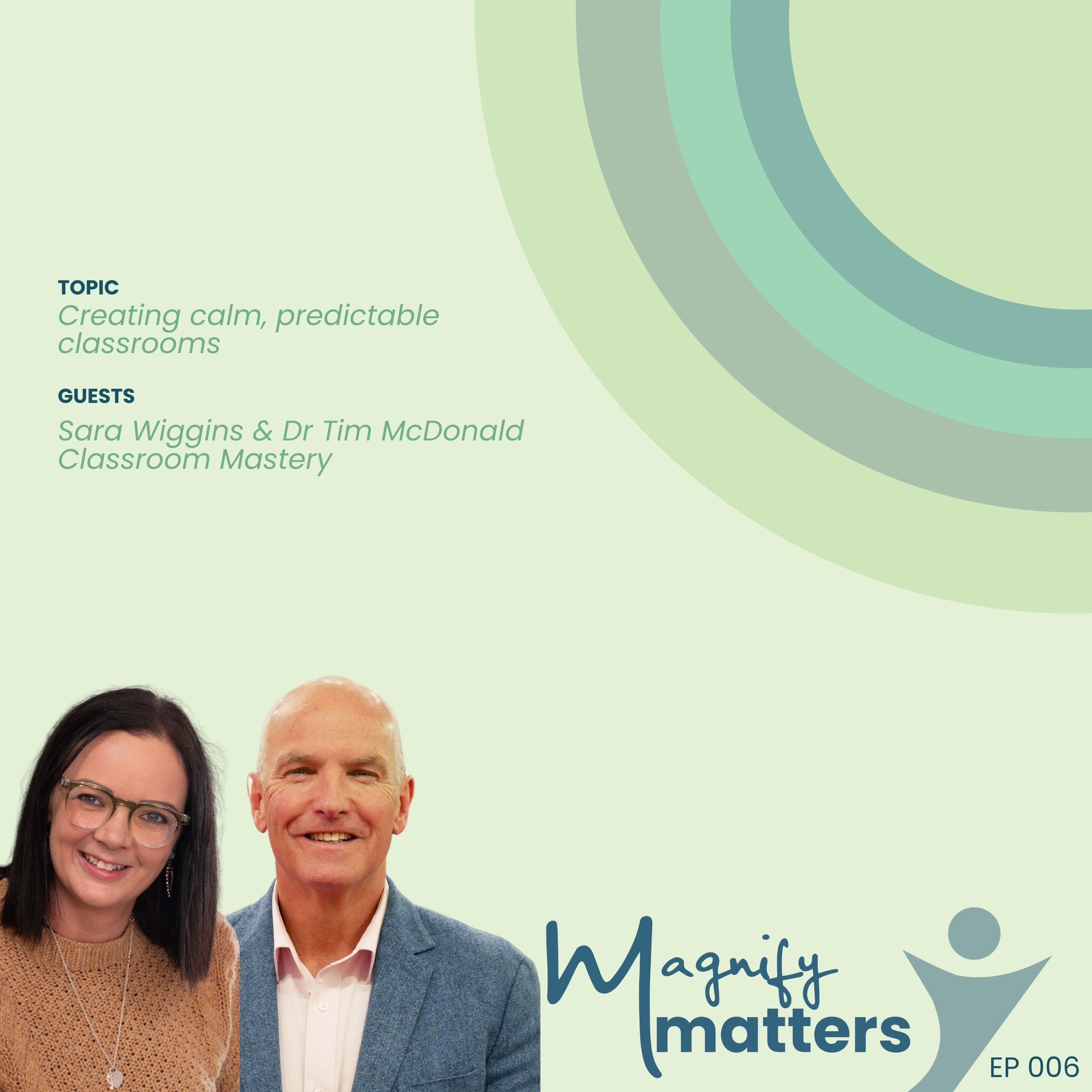
Creating calm, predictable classrooms with Classroom Mastery
37m 18s
This podcast episode features Dr. Tim McDonald and Sarah Wiggins from Classroom Mastery, who discuss strategies for building effective classroom environments. The program focuses on implementing consistent, school-wide behavior routines—such as structured entry, exit, and attention cues—to create calm and predictable classrooms that optimize learning. Developed from practical experience and educational research, Classroom Mastery shifts the focus from controlling students to fostering consistency, belonging, and engagement. The conversation highlights that successful adoption depends on committed leadership, a unified vision, and contextual adaptation by schools, supported by ongoing teacher coaching. Examples like Rosebud Secondary College demonstrate how fidelity to the program, combined with explicit teaching of routines and relentless leadership, can transform school culture. The hosts emphasize that these foundational routines are not a return to outdated methods but a revival of effective teaching practices, setting the necessary preconditions for high-impact instruction and improved student outcomes.
Catholic Education's Sandhurst acknowledges the traditional owners of the land and waters that this podcast is recorded on. Hello and welcome to Magnify Matters, a podcast proudly produced by Catholic Education Sandhurst. Great teaching starts with calm, predictable classrooms, and it doesn't happen by chance. In this episode of Magnify Matters, host Ashley Marsh is joined by Dr. Tim McDonald and Sarah Wiggins from Classroom Mastery to unpack the strategies, structures, and mindset shifts that create classrooms where learning thrives. With experience spanning classroom teaching, system leadership, research, and hands-on coaching, Tim and Sarah share what it takes to embed consistent evidence-informed behaviour routines across schools and why that work is foundational to teaching and learning. In this episode we explore how classroom mastery was developed and why it's resonating across Australia. What makes classroom routines like entry, exit, and cue to start so effective. Why this work isn't about control, it's about consistency, belonging, and the students, and the research behind behaviour and how low-level disruptions impact achievement. Whether you're an early career teacher, a seasoned leader, or curious parent, this episode offers practical insight, grounded expertise, and real strategies for creating the conditions that allows learning to stick. Now stay with us as we magnify. What truly matters? Hello and welcome to today's episode of Magnify Matters. I'm delighted to be joined by two experts in the field of classroom management, Dr. Tim McDonald and Sarah Wiggins. Welcome to the both of you and thanks for joining us. Thank you, Greg, to be here. Thank you. Good to be here. We're really looking forward to exploring your current work, especially with Classroom Mastery and Catholic Education centres. But before we do, let's find out a little bit more about the both of you. Tim, I'll start with you. Currently Chief Executive Officer of YMCA, Western Australia, and one of the creators of Classroom Mastery in partnership with the Knowledge Society. Can you tell our listeners a little bit more about your background? I had a background in teaching, came through teaching, and then had an opportunity to go to the UK to work over there and then worked in a behaviour unit. And while I was there, I did my doctorate at the same time, on the young people that we were working with in the behaviour unit, 14 to 16 year olds. And then that took me into academia with the doctorate. So we're to the university for a number of years, senior lecturer, finishers and associate professor. And then we wrote the book around classroom management and then really classroom mastery developed really out of it, desire from schools and teachers to have some practical skill-based models to deal with student behaviour. Tell us a little bit about your time as Executive Director of Catholic Education Western Australia. Yeah, wonderful learning experience phenomenal. A big system, 163 schools, 15,000 students, lots of staff. So what I enjoyed about it was the learning around just, how do you get systems to move when you have an idea or whether you know what's the best evidence? How do you convince people to come on board? And it's just hard work. As magnifiers, it's finding out to get everyone on the same page knowing what's best for young people. But for me, the learning was everyone in Catholic Education is committed to the young people. The child was always at the centre. And so you're working with this moral imperative of how do we make the learning and the lives of these young people better. And that's a privilege to be involved in. And Sarah, you're currently working with classroom mastery and have been one of the trainers that is engaged with our Centre of Schools. Tell us a little bit about your background. Yeah, sure. So before moving into the role with classroom mastery, I was a deputy principal at a primary school in per around 1200 students, quite a big school. I spent many years teaching in a range of contact from tiny little farming town in the wheat belt and the middle of the desert in the Pill Brawl in Western Australia and some metropolitan schools as well. And through that, I suppose it's always sort of been my passion around student engagement and behaviour. So I've held a lot of middle leadership roles where I've done coaching and professional learning and supported teachers to be able to manage classrooms and have the confidence and the skills to be able to do that. So tell us a little bit about your organisation, the work that you do and the development of classroom mastery. Where did that come from? A classroom mastery really came out of some consulting work that tells working with knowledge society and really working in the Canberra Goblin archdiocese. And we were thinking that we're looking at system one approach that eventually was a name catalyst. And part of the missing piece was around how do we bring in the behaviour part and how do we actually get the conditions for learning in the classroom. So they had two bowl goals, they had the high impact teaching practices. But there was just this extra piece say how do we support the teachers to enable that level of calm, predictable learning environments but also get that attention and the engagement from young people. And so really it came from that and using what we know about how students learn, what we know about what's effective for teachers, what are the skills the teachers need to do. And so we started to develop the program. And to want to tell us a little bit about the work that you did with Arrow in the classroom management space. Still working with Arrow, a phenomenal classroom management resources bit of a plug for them. So for a year and a half now we've been working around the developing of practical classroom management resources for Australian teachers. And the first set of 21 resources that was released before Christmas last year, really foundational skills. So there's a skills that teachers need to do. And there's also some guides on routines, rules, how do you develop the culture. And then they've developed another set of guides around any additional needs that young people have because people are saying, and I've got ecstudent in my class, they need this extra support. Where does that fit into is foundational resources. So now there's seven of those resources that are now out. They've then developed a whole school approach. How do you put a whole school approach into behavior? So there's a facilitation guide, there's observation guides. And that was part of the learning that we had in classroom mastery is that the key really is the coaching. I'm the key to shifting behavior and get teachers building capacity and capability is getting that real time feedback. So what we did at Air, I was to say, we've really got to bring that heart in to these resources. Now remember, that's pretty hard to do when everything sits on a website. So there's no one leading the professional learning. So the set of resources are really easy to use. And I do believe that they are very practical. They've been adopted by New South Wales Education Department of Victoria. Have them in there, their professional learning hub, other jurisdictions using for their early career teachers, etc. So they're usable and they're practical and they're not voluminous and it takes so much time. So for me, it's been an amazing learning on how do you take big concepts into a four-page guide that enables teachers to shift some practice. And the team, the team of me phenomenal, amazing people get together. Lots of good conversations and lots of tussles to end up with a couple of pages. But their result is really supportive of leaders as well as school teachers. And Sarah, we've been the beneficiary of your work in that space with our schools. Tell us a little bit about your role in the work that you've been doing with our schools in Centrest. I am one of the trainer and coaches for Classroom Mastery and I work alongside the school leaders and teachers to build their behaviour curriculum, which is essentially just a structured approach to teaching better behaviour in the same way that we would teach that you see on university. And so it's been exciting working with Sandhurst through the magnify program. I've had the opportunity to support leaders in embedding those consistent research and form behaviour routine across their schools. And I feel like there's a real sense, like there's a bit of a momentum across where there's a shared purpose and a real collective effort around those schools. It's not just about improving classroom management. It's about lifting the experience of learning and teaching across schools. And I think what's really exciting is that each of the schools are adapting the process to their contact but still holding to those real core principles and that shared vision as well. It's been really, really great. Thanks, Sarah. So even though the schools have been able to contextualise these routines to their individual schools and context and what they already have in place, just for our listeners who might not be as aware of the Classroom Mastery, what are some of the routines that you've been working with their schools through? Yeah, so all of the Sandhurst schools have adopted an entry routine, an exit routine and a queue to start. So that looks at having really calm, orderly safe movement of students into the classroom at the beginning of a lesson, out of the classroom at the end of a lesson. And what we know that that does is it sets the tone for learning. It sets the tone for learning to take place in a really calm way and we get into learning a lot quicker because they enter the room and they know exactly what's expected. So schools have contextualised that slightly depending on things like the building even really play a part in what an entry routine an exit routine might look like. But what's the same is that collective approach to the calm and ordered entry? Same with your queue to start, it's all about having something that every student in the school knows. When the teacher says this, I'm expected to stop and pay attention really quickly and it's about moving that into automaticity. So we want that to become a habit with the students so that we're getting students attention quicker and we can get on to learning a lot quicker as well. And I think it's been really evident as you've worked with the schools that initially this program was going to be a bit further back in our role out of magnifier sandhouse and was actually a school principal to give them credit who said no, we needed to bring this forward. We need to create environments of calm classrooms. In your opinion, was that a good move by us to bring this forward? Absolutely. I think you've got to have those pre-conditions for learning it. The behaviour and engagement two sides of the same coin and you need engaging lessons, you need expertise in all of those high impact teaching practices. But in order for that to be really effective, you need to actually have the attention of the students and you need to stay calm ordered classroom. So I think they are two sides of the same coin, but certainly it does sets the stage for learning to take place. So Tim, earlier you mentioned the archdiocese of Cambridge, and you also referenced Aero. Their names that would have come up in previous episodes of this podcast and the people in our centre schools will be very familiar with their work. Can you talk to us about some of the success stories of where classroom mastery has been implemented either by systems or by individual schools? Yeah, I love to. I think the probably the most well-known is because they made a 730 report on it. It's Rosebud Secondary College, but put that in perspective in the peninsula there. We were working with the primary school, Raya's a primary school, and then Rosebud as a secondary. So it's a theater school to it. So it was a collective. And I think why did Rosebud land so well? And it's probably no different than the key points to the magnify learning in your magnify, the vision, the document you've got. You've got to have leadership. The leadership have to be on board and they have to lead it all the way and that it has to be relentless. This is a morning briefings. This is at staff meetings. There has to be a constant reference to it. There has to be an unwavering desire to shift the learning culture within the school and knowing that this is one part of it and that everyone has to come on board. So for Rosebud there was you know a number of years before classroom mastery came where they were working on how do we shift the culture? How do we get teams working together? So there was an awful lot of preparation work done for classroom mastery to land. The other part, again there was no deviation from the professional learning. So we didn't throw in, let's do something on cooperative learning. Let's do something on resilience. Let's do something on you know grief, whatever might be in the school. Everything was around about classroom mastery, professional learning around the routines. Why are we doing it? Clear understanding of the why it's around the science of learning, it's around cognitive load. We need to teach it explicitly so that the students understand it. And the teaching explicitly and the role of scripts is for the student, not for the teacher, so that there's uniformity so we can build on existing habits. We can get to that automaticity quickly and Rosebud would just had a great fidelity. The leadership was involved, they gave up time. It's a very time intensive when the leadership get involved because they've got to do the coaching and that's the time intensive part in the program, not only for Sarah and the other coaches but also for the staff because they've got to get out of the classroom. Someone's got to take those classrooms, they've got to prepare lessons and they've got to go around and coach. So for me it was a good example of a whole school approach. They were clear about what they wanted to do. They had the leadership involved. All the staff knew that this was going to happen and then they got lots of support. Lots of support right through the professional learning but also time out and with coaching and it's the consistency of the coaching where we're going to shift the behaviours. So I think Rosebud was a good example of that and an exceptional principle that stuck to her guns. They said we're going to do it because not all staff are going to be on board, not all staff want to do this and you've got to battle the ideology. Sometimes there are different approaches in the classroom that teachers have compared to where the school wants to take them in relation to classroom mastery and that was just all done very openly and transparently. Thanks so much for that background and I know that from the 730 our report is one that has been viewed by our centres, principals and teachers and staff. Sarah, you've had the fortunate opportunity to work with nearly all of our leaders across the diocese and a number of our school staff as a masterclass has been rolled out. What's been your impression of the work that you've been doing with these people and with these schools? Yeah, I think it's been really positive. You know, whether it's the early career teachers within the schools or the season leaders, there's a real genuine openness to refining practice and building that consistency across classrooms and that's been really evident. Every masterclass that I've walked into, whether it's been with the leaders in developing the behaviour curriculum and the contextualising of those routines or with the teachers where we're further refining that and rehearsing it ready to teach it to the students. It's been really collaborative and everyone wants to just see a real positive impact for these routines with their students and I think it's been really exciting to see the schools working together across the region to get that. And what I'm looking forward to seeing is the fact that you've got all of these primary schools that are feeding into all of these secondary schools and you know, it might be a few years down the track that we start to see the impact of that but I think it's going to be brilliant to see students that are coming and have had this approach to routines and behaviour in primary school, going up to secondary school and seeing that follow through and follow them through their whole time through school. Yeah, absolutely right and I know that's something in particular that our secondary schools are looking forward to. By the time this episode drops, our cohort two of our primary schools will have engaged in their teacher master classes, aware that we're still in a bit of a honeymoon phase of rolling this program out. Based on your experience, what are some things that we just need to be aware of as we experience that normal learner dip of implementation? I would say I think it's normal when you introduce a routine, it's normal to have a time where you might go, oh, students aren't quite doing it for the standard that we expected and what we say to schools is that's really normal. It's an implementation dip that comes with any sort of new change and what it is, it's a reflection for the teacher to go, I need to re-teach this and we need to review it and it's about holding to, this is the bar, this is the standard and we're going to hold to that. So when we start to see things sort of dip a little bit, we take it back to basics and we're going, let's get the script out, let's re-teach, let's go over what we're expecting and then hold the students through that. I think that's really crucial. And as our schools implement their drop-ins, what are some things that they should really be looking out for as part of those visits to the classrooms? So I think for the drop-ins, for the leaders, there's a few sort of things that they're really handy for. They're really handy to provide support to individual teachers around their implementation of the routine. But what I find that leaders will take from those drop-in visits is you get a real understanding of what's actually going on across the school. And as a leadership team, when you're going in and you're doing those drop-ins, you can go, let's have an approach, let's all have a look at our cue to start because we've noticed there's a few inconsistencies across the school. So it's about getting big picture on consistency. I think that's a really crucial thing that the ongoing drop-ins brings for the schools. So now I'm going to come to some of the questions that have been coming up as we've implemented this program. So I'm sure these are questions that have come up in the past in other contexts. Tim, what do you say to people who might come to us and say that this approach is a return to the olden days? I think it's a return to good teaching. I think what it is is that we're going back to a time whereby teacher effectiveness, research, and understanding of what is crucial in the classroom is now coming back to the fore. And I think while people are saying it's back to the old ways or back to old habits, is that it hasn't been front and center of teacher education, hasn't been front and center of teacher professional learning for so long. Other ideas have come in that we need to do. And the art and the craft of teaching and the skills and identifying what excellent teachers do has dropped off. It's dropped off in a research line at universities. It's dropped off in the way that we do initial teacher education. So it's very rare to actually see a classroom management unit or a student behavior unit in a school of education. All they'll have positive learning environments or they'll have some other resilience, teaching young people, etc. And what happens is that there are no behavior specialists, a lot of the time in schools of education universities. So you've got this six hour time period in a week to this particular unit with a lecture and chutes and they'll give it to whoever might have some freedom on their timeline because they're all teachers. Therefore they must know how to do classroom management and that it's not actually true. It'd be like me going in there and saying because I'm English and I speak English, I'm going to take all your literacy. And I've done, I don't understand the science of reading and I don't understand the science of learning, but you know taught English in the schools that therefore Tim should be able to do it. We wouldn't allow it in an academic discipline. We can't allow it in universities now. People have got to have some skills and ability. And the great thing about the error as officers is that there's your textbook, there's your semester outline and there are videos and exemplars to go with it. So there's a ready-made source there. So I think while people say, but we're going back to the old days, we're going back to effective teaching that comes from what teachers observed as good teaching and that has impact on student learning. And that is a different conversation than we've had for the last, I'd say, 15, 20 years in teacher education. And I think an example of that is that when Sarah presents and the team presented around the teacher's skills, people go, "Oh yeah, I remember that. We used to do that in teachers' college. No one has ever disagreed with the teacher's skills because it resonates with all the teachers because that's what they do. But they're not taught. They're not commonly taught in universities, nor are they discussed. So when they say gone back to the old days, if they're gone back to a time whereby these are the skills that differentiate from the teacher that's working towards being good to the teacher that is already very, very good." Fantastic answer. And Sarah, for you, what about the teachers who might think that I've got strong behaviour management skills within my classroom? Why do I need to implement something this is for the other teachers? What would you say to them? I think we say it's not about the individual. Consistent routines aren't for the few who might be struggling. They're not for, you know, the individual, they're for everyone. And so what they do is they create shared language and they reduce anxiety and they make classrooms more predictable and more inclusive. So for students, it means everyone knows what to expect, no matter who's class they're in. And for teachers, it means we spend less time managing behaviour and more time teaching. So even if you feel like you don't need it, someone else in the room probably does. And that consistency helps lift the whole environment to create a positive school culture where all students have equal opportunity to feel safe and supported and then ultimately to learn and to flourish in the classroom. So what we say is it's not about one person. It's about consistency. But that's what we need. We need to change the processes to make it consistent for all. Some of the feedback actually to pick on that point is in the schools that I think is doing really well, they've often feedback is this is the most positive or affirming professional learning programme I've ever been involved in. And when you ask why is that the case, they'll say because I'm not the only one doing it, everyone's doing it together. And sometimes it can be quite lonely because people think that they're the only ones that check homework, they're the only ones that check uniform, they're the only ones that do follow through with lateness. And all of a sudden now you've lifted everyone to have the same norms, the same expectations and the same responses. There's a great comfort in that for teachers to know that this is us together and this is what we're doing. And that's why I think the power of a system-wide approach, like magnifying Santers, is that we are doing this together and this is how we are going to support young people. That's a great segue into the next question, which is magnifier Santers is a bold initiative and I like the language you use Sarah around lifting the expectations of learning and teaching across our schools. So in your knowledge around magnifier Santers and in the information that's shared, been shared with you, what excites you about this initiative? Oh look, I think it's brilliant. I think the collaboration of all of the sort of stakeholders that are working with magnifier, I think there's a real excitement around the change that's happening. And I think it all supports that nothing sort of working in isolation is all working together for the same common cause of wanting to lift, learning and support teachers and see students really thrive in the classroom. And I think that's what's really exciting about it is the collaboration. What about you Tim? Yeah, I think it's incredibly bold. There's no doubt about it. And I think the vision for the diocese over the next couple of years is a really bold vision. And I think the strength of leadership to say we need to do this based on our data is incredibly courageous. And I think for the principles to stand up and go, we're with you, we're willing to give it a go. I think it's also courageous individual leadership because the principles have got to sell this to their staff and that's not easy. So it's okay having been an executive director to come out with grandiose plans, but you've got little impact unless principles lead it and the teachers go, I'll buy into it and do it. And so I think that that's some quite incredible courageous to your leadership, not only at the the diocese level but also individual schools, both primary and secondary and early learning centres. I think that's courageous. I think also the reliance on evidence to carve up what magnify is that we actually need to partner around curriculum. We need to partner around what is high impact teaching. And we need to also look at what's the behaviour for young people at a time. And then underpinning that with a multi-tiered support system is a really good theoretical construct to hold it all together. I think there's some great thinking. And to have that great thinking there, you've got a religious self of arrogance, you've got a religious self on being self-centered that, hey, this is my idea, it's borrowing from a whole source of wonderful evidence and wonderful programs that are out there. But also vulnerability and leadership to say, do you know what? We can't do it ourselves. So we've got to work with other people to work with us. Now that's not easy to achieve because you know, leaders do have an ego and they love to be loved about their leadership. But here we're saying in this vulnerability that probably I'm going to move faster. I'm going to be more effective if I partner others for progress. And I think that's exemplified in magnify. And I think that's from the teachers perspective. They can look up and see that and go, yeah, we're part of something much bigger here that has the potential to be transformative to all the young people within the diocese. I mean, where do you get feeder schools working with other schools? And you're all on the same page. I mean, that is phenomenal. Just think over a number of years. And when the data hopefully comes in around the academic achievement as one measurable output with that, that's going to be incredible. And I think it's a wonderful case study that the leadership have started to develop. It has been so well received by our schools and our principals. Whether it's been at our principal leadership days, where you're presented to them around the what and the why, whether it's been the master classes with the leaders or with the teachers that Sarah's been an integral part of. It's really helped to feel that understanding as to why we're doing this. But also that sense of it is bigger than just one school, which is where for me, those master classes of getting schools together to work has been so important, regardless of size of school. So thank you for your work in that space. I want to put you on the spot a little bit here and Sarah, one of the pieces of feedback that's come from our schools when you've been working with them. They've been amazed at your ability to present the information throughout the presentations without the need to rely on notes. Some of the things that you speak around relate to some of the research that's been done in this area. Are there any pieces of research or any statistics that you could provide that you do as part of those presentations around students and the impact on their learning of behaviour interruptions in their classroom? Gosh, there's so many. You know, we share about the sort of what's going on nationally around behaviour. And I think I always ask schools for their contact to say I say what resonates with you and where you're at. And one of the things that teachers always say resonates with you is the pipeline study work that looked into what behaviours get in the way of academic growth or academic achievement. And through that study that was done by him and I need to tell an university, I think in 2009, what that study showed was that the number one behaviour that gets in the way is inattentiveness. So it's those behaviours like I can't find my pencil or my laptop's not charged or I can't focus or I'm distracted because I'm talking to others. It's those low level behaviours that get in the way. And we look at that in relation to, you know, what the work that John had he did and he sort of labelled this group of students. He called them the compliant disengaged students. And so it's those students who, you know, you say to them, can you give me a paragraph and they might give you a sentence. And actually what the pipeline study showed was that these students who are compliant disengaged are actually a year and a half behind peers in standardised tests. The 8% of students who they, who had he categorises as destructive or highly destructive also year and a half behind in standardised testing. And but what classroom mastery does, it levels the playing field. It's about putting in the support that's going to be there for everyone because we want to put support in for everyone and really raise the standard for all students. And I may have spoken to some of that a little bit. It's him knows it a lot better than I do. But teachers resonate. And actually a lot of teachers say we think we've got more students than that in our class that are compliant disengager and our school that are compliant disengaged and what can we do. And I think it's all about setting those conditions for learning, having calm orderly classroom where learning is prioritised. And because what we know is before we can get those bubbly behaviours under control and we've got those to hear one sort of interventions in place and routines in place. The teacher has a lot more capacity, a lot less stress than can actually support some of those students to lift those results. Can I also respond? I think it's a great question and it's a great challenge for Sanhurst. How do you know this is making a difference to the time on instruction? What are the students saying about do they feel safe, do they feel like it's impact in their learning and do they have a sense of belonging? And you could do that through your own three own, obviously, dices or surveys. It's something that we'd love to put into NAPLAN, similar to the UK Behaviour survey. We had a number of questions, all the piece of the climate index, question five, question five questions. If you could do that within NAPLAN, we would get a great understanding of behaviour across Australia, which we don't have at the moment. It's ad hoc people make things up and then we can flate engagement in learning with the number of young people saying Victoria, who are a school refusing, the number is astronomical, all those at a home school, one of the fastest growing sectors of education is home schooling. So there's something not right in the classrooms that are happening for these young people, but how do we know that? Some simple questions. That's where I believe, and we believe in classroom mastery, that's where you get student agency. Do you feel, or do you feel like this is helping you to learn better? Do you feel safer in the classroom? And this is safe. This is all lemma of stuff. You know, are you willing to risk an answer without fear of retribution from your colleagues? That psychological safety, that's agency in the class to learn as I can. And how do we know that across the diocese to do that? And certainly a challenge for classroom mastery need to do that as part of. The program now, what's the assessment that we're going to use to evaluate so that we know that there's impact? We do it informally, we all do focus groups in schools, and the students are very, very upfront telling us what they think about it, and it's great to feed that back to the staff, but they don't tell us anything we really don't know that's not in the literature. You know, they want to teach you that can teach. They want to teach you that can control them. They want someone who doesn't threaten, who doesn't follow through, and I don't want a friend. They exactly are quite from year eight, a couple of weeks ago. I just wish the teacher would stop trying to be friends with us and just teach. Isn't that fantastic? I love it. And so that's one that we do. We need to systematise that feedback across all of the interventions. Fortunately, our own school engagement survey data would reflect those exact figures around students and parents' perception of their students learning, and it isn't those escalator behaviours that we're talking about. It is those interruptions to learning the things that take them away from what they're trying to do in the classroom. Just piggybacking on what you said around the students. We've had some feedback from our senior students when this was first implemented in our secondary schools, including one student who sent an email to our executive director asking the question, so why do I need to line up before I go into classrooms? What would you say to that? I would say that it's around safety. I've got to get 25 to 32, depending on your class size of your 11s and 12s, who are big, into a small doorway and to sit down in the classroom. So it's their safety that I make sure everyone's there. I as the teacher, I can check to make sure that everyone has all their equipment. I have all the uniform done. These are my requirements within the school. And I can remind students if they don't have laptop or they don't have the correct textbook or whatever. So that doesn't interrupt their learning. I can do that outside. It's also a great way to be humans and to say good morning, hello and connect. It's great to see you back again. Oh, I've got the worksheets from yesterday. House things at home, whatever it might be. So there's a chance to connect. It's also a chance to know what are the instructions that I need them to know once they get into class. Once you get into the room, what I expect is, if it's different to the normal normal entrance routine, go straight in and do the activity on the board, or this time you'll notice that the stuff set up around the side of the class, or you'll notice it's set up in groups today or what I've got a private activity first up. It's just an opportunity to give instructions to the students to make that safe, calm and efficient as we lead in. And that doesn't matter if you are foundation or whether you are year 12. And also, these routines itself discipline are no different from the workforce. And I would say that once you get into the workforce, you're going to actually have to follow some of these things. So here's really good social training and social skilling that you do need to listen to instructions and follow them. The other thing we have been saying is that it might not be about you and it might not be for you, but what great leadership that you can demonstrate to other students who might need that before they enter into the classroom. And I think that's brilliant. And that's certainly a matter of school this afternoon, a Catholic school in Perth this afternoon. And that's exactly what the leadership said to their senior school students, 11 and 12, that you need to show leadership. You need to model the behaviour we expect from the year 7s all the way up. And that's our expectation of you in being in the senior school. I think that's fantastic. We know that the people who listen to these podcasts love to follow up with some professional reading. If there was one article or book or piece of research that you would recommend that our teachers read around this space, what would it be? I'd go to the error resources because they're just really simple. And so just and you can start anywhere. It's not linear. So start anywhere that's of interest and have a look at it. The other one is that because he writes so beautifully, I would have a look at the Centre for Independent Studies. The article which is probably already in the in the reading work is from Tom Bennett as to behaviour underpins every every success and every motivation at school, whether it be sporting music, he asks, etc. It's just a and he just writes so poetically and beautifully. It's just wonderful to read. That's where I'd go. What about for you Sarah? Yeah, I really enjoyed Tom Bennett's stuff too. I actually always say to people running the room is last time I checked anyway. If you've got fortified premium, you can listen to it. And he reads it with his lovely Scottish accent. Our final question, the way that we have been finishing off these podcasts is to ask people what matters most from what's been discussed. So we'll start with you Sarah. Based on what we've talked about today in the work that you're doing with centres, what do you think matters most? Look really simply, I think what matters most is that every child really deserves a calm, predictable classroom where they feel safe and they can learn and every teacher deserves the tools and the support and and the resources to be able to make that happen. So I think the work that Dan has been doing with classroom mastery are really setting up the students in the teacher's success. Thank you. And Tim, what do you think matters most? Student learning is at the heart of every school in Santerst and that learning is an adult responsibility. Excellent. Thank you so much. I'd like to thank the both of you for your time with us today but also for the work that you've been doing with Santerst throughout this journey and for the work that's to come. A privilege, thank you. Beautiful. Thanks. That's it for this episode of Magnify Matters. Make sure to follow the show and share it with someone who cares about great teaching and learning. You can also leave a review or connect with us online at Catholic Education Santerst. Until next time, stay with us as we magnify what truly matters.
Podcast Summary
Key Points:
The podcast discusses Classroom Mastery, a program developed to create calm, predictable classrooms through evidence-informed behavior routines like entry, exit, and cue-to-start procedures.
The approach emphasizes consistency, belonging, and student engagement over control, and is grounded in research showing low-level disruptions impact academic achievement.
Successful implementation requires strong leadership, a collective school-wide effort, contextual adaptation of routines, and ongoing coaching and feedback for teachers.
The program aims to establish foundational classroom conditions that enable effective teaching and learning, viewing behavior management and academic instruction as interconnected.
Summary:
This podcast episode features Dr. Tim McDonald and Sarah Wiggins from Classroom Mastery, who discuss strategies for building effective classroom environments. The program focuses on implementing consistent, school-wide behavior routines—such as structured entry, exit, and attention cues—to create calm and predictable classrooms that optimize learning.
Developed from practical experience and educational research, Classroom Mastery shifts the focus from controlling students to fostering consistency, belonging, and engagement. The conversation highlights that successful adoption depends on committed leadership, a unified vision, and contextual adaptation by schools, supported by ongoing teacher coaching. Examples like Rosebud Secondary College demonstrate how fidelity to the program, combined with explicit teaching of routines and relentless leadership, can transform school culture.
The hosts emphasize that these foundational routines are not a return to outdated methods but a revival of effective teaching practices, setting the necessary preconditions for high-impact instruction and improved student outcomes.
FAQs
Classroom Mastery is a program developed to provide practical, skill-based models for managing student behavior. It aims to create calm, predictable learning environments by embedding consistent, evidence-informed behavior routines, which are foundational for effective teaching and learning.
These routines set the tone for learning by ensuring calm, orderly, and safe movement. They help students know exactly what is expected, allowing learning to begin quickly and reducing disruptions, which supports better student engagement and achievement.
Classroom Mastery focuses on consistency, belonging, and student-centered approaches rather than control. It emphasizes teaching behavior explicitly, like academic content, to build habits and automaticity, fostering a positive learning culture.
Leadership is crucial for success; leaders must be fully committed, provide relentless support, and lead professional learning and coaching. Their involvement ensures consistency, fidelity to the program, and helps shift the school's learning culture effectively.
Coaching provides real-time feedback to teachers, helping them build capacity and refine their practice. It supports the shift in behavior management by offering ongoing guidance and ensuring routines are implemented consistently across classrooms.
Schools should anticipate an initial 'implementation dip' where routines may not meet expectations immediately. This is normal and requires re-teaching and reviewing the routines to maintain standards, emphasizing consistency and holding students accountable.
Chat with AI
Loading...
Pro features
Go deeper with this episode
Unlock creator-grade tools that turn any transcript into show notes and subtitle files.
 PodcastTranscript AI