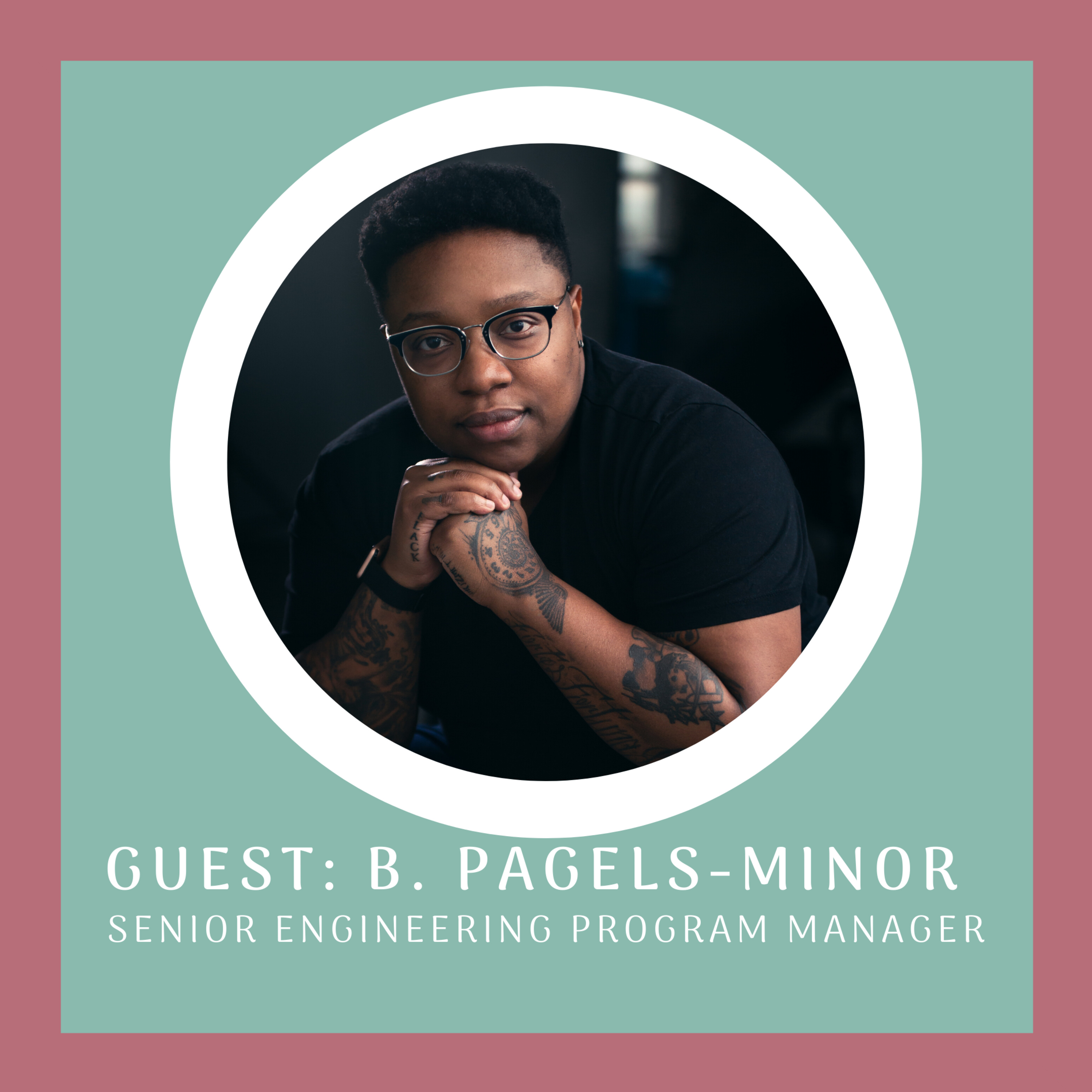
007. Courageously creating business value and flexing their courage muscle at the intersectionality of diversity as a person in tech.
from We Resolve to Win
47m 22s
This episode of "We Resolve to Win" opens with host Elizabeth Goh promoting a negotiation challenge to help women build courage and skills for conflict resolution, salary negotiations, entrepreneurship, and relationships. The main segment features an interview with Bee Pagels Minor, a senior engineering program manager in tech. Bee describes her path from a curious child who took things apart to a product-focused professional, shaped by the 2008 recession and a desire to work in technology. She discusses her diverse identity as a Black, LGBTQ+, trans non-binary person from the South, emphasizing how this background forces her to learn the "languages" of different groups to feel safe and build rapport at work. This skill aids her success but also burdens her with representing entire communities, often being the sole diverse voice in meetings. Bee highlights the emotional toll of this ambassador role, where she must educate colleagues on issues like gender-neutral default photos while managing her own projects. The conversation underscores how diverse perspectives can improve product development but also require significant personal effort. Elizabeth relates her own experience as an American in Singapore being seen as a representative of an entire country. The episode concludes by advocating for flexing the "courage muscle" to navigate conflict and negotiation effectively.
[MUSIC] You're listening to We Resolve to Win, the podcast for women who have resolved by women who seek to resolve conflict in their personal and professional lives and desire to negotiate no matter what. I'm your host, Elizabeth Goh, a lawyer, conflict resolution expert, and negotiation coach dedicated to helping women resolve conflict at work. Strengthen their relationships and negotiate with confidence. Ladies, let's go and be great. [MUSIC] Hey winners, thanks so much for listening to this week's episode. As you know, I release one or more episodes per week where we talk about all things related to conflict resolution, negotiations, relationships, communications, and speaking up more in your life as a woman. You know that I regularly advocate for people to exercise and flex their courage muscle. And so I want you to do the same. So please do me a favor by doing one or more of the following. One, please follow me on social media @WeResolveToWin. Two, take a screen grab of this episode and share on your Instagram or your Facebook stories. And please, please, please tag me in it. I'd love to see where you're listening from all around the world. And three, please sign up for email alerts so that you know when a new episode has been released. So you guys, we are officially live. Live, live, live. Our negotiation challenge is live and the We Resolve To Win Facebook Group. And the reason why you want to join this challenge is because it will give you clarity on so many different aspects that you didn't even recognize can impact you as an individual and impact how you resolve conflict in your life. The basis of any good negotiator is the ability to resolve conflict. Like if you don't regularly flex this courage muscle, if you don't regularly lift those weights of courage, you will not be able to flex that courage muscle when it comes time to standing up for yourself, negotiating your salary, being very clear about what your number is, and having the confidence necessary to go into that room and walk out successfully. So I want you to join this challenge. I want you to be successful in all the things that you attempt this year in 2020. So I ask you, I implore you, I beg you, please join me in this challenge. Thus far, we have about 150 women in the We Resolve To Win Group. And this is not just another Facebook group, it's not just another group for people to get together and share thoughts and share articles. I want to actually have you have the tangible skills that at the end of the year, you are able to look back and say, wow, 2020 was amazing because I was able to do something that I've never done before. If you are out of corporate America, that is okay. You can still participate in this challenge because we are also talking about negotiation skills for entrepreneurs. If you have a side hustle, if you work with different businesses, if you are a creator, you still need the ability to negotiate and you need to negotiate regularly. Let's say that you are content with your salary. Let's say that you don't have a side business, you don't have a side hustle or you really don't need to talk about negotiating as far as entrepreneurship is concerned. That is okay. We have something for you as well. We also will talk about negotiating within your relationships. There are certain things that you want to do in your relationship in order for your relationship to be successful, whether you are married, whether you have a partner, whether you are dating, you still can successfully negotiate in your relationship. Again, the basis of any good negotiator is the ability to resolve conflict. You have to have to have to exercise that courage muscle. I encourage you today to join the We Resolve to win negotiation challenge. Again, we are live January 6th is the first week. This week we are ecstatic that we are rolling things out. Remember, this is not just a video of you watching me talk about how I increase my salary by 100%. Rather, there are worksheets, there is homework, and this is an opportunity for you again to flex your courage muscle. Be sure to join us. On this episode, I am continuing with my diversity in tech series where we have courageous conversations with diverse individuals that work in tech. I am interviewing Bee Pagels Minor. Bee is a senior engineering program manager based in San Jose, California. In this interview, Bee explains how they intersect in many different diverse groups and how they have been able to overcome challenges and flex their courage muscle all the while working in large companies and on large product projects. I am super excited to have you listen to this episode. Here is Bee. My born name is Bethany Pagels Minor, but I go by Bee Pagels Minor. As you mentioned, I am now based in San Jose, but I am actually a southern or through. It is funny to me because I am so far away from my Mississippi roots at this point. I have to take multiple flights to get home and my family is a little concerned about that. I was born and nerd, but it took me a long time to figure out that that is what I wanted to do for a living. I started off in a little bit of everything. I was a stormier target. I was in consulting. I did sales fears. One day, a career counselor said to me, "Hey, FYI, it seems like you really like technology. Why don't you figure out how to do that?" I spent pretty much the last decade in technology and working in different technology companies as product manager, or just engineering program manager. Growing up, given that you found yourself really interested in technology, what was it that sparked that curiosity? Did someone give you a gift? Did it something that you just naturally gravitated to? Is it a show or someone that you looked up to that inspired you to enter into tech specifically? What is it that made you just always gravitate to tech specifically? What's really funny is I don't think there is anything that very specifically made me want to do it in facts. I wanted to be an attorney because I really wanted to be Claire Hux to go live. I thought she was the coolest, most sophisticated person in the whole world. I wanted to be here. In fact, when I applied to law school, I literally said I just want to be Claire Hux to go. When I was younger, and my wife and I were talking about this, I actually used to take things apart. I used to be messed up and I would go over and I would be like, "Let me see how I can do that." When it came to all the technology, things in our house, I was always the one who was programming the remote or who would figure out how our wife actually worked in things like that. I think the one thing I would say that was always very clear is that I was a very curious person. Even to this day, if I read something or hear a name, I will do full research on that whole person until I have a whole concept. Recently, Linda Ronsett was the Kennedy Center Honors. I was just like, "Who the heck is Linda Ronsett? Why is she getting honored this way?" I started doing research and I was like, "Oh my God, why did I not know about Linda Ronsett before? She's done so much stuff for Mexican people, for women." I should have really known about this beforehand. I think it just really came down to curiosity. It just became clear to me. I was very fortunate in some ways or unfortunate depending on how you look at it. I graduated in 2008. At the same time, it was the economic downturn. All the past that were traditional for myself and my classmates, graduating from college, going to consult at one of the big consulting firms, then going back to get your MBA. I was basically living happily ever after doing weird stuff. I called it Weird Down because I can imagine working in any job where I'd have to wear a suit or dress up every day. I really like being able to wear my jeans and my t-shirt every day. It was the typical path. Because of that, I didn't have a job. In fact, the job that I got, I actually was like, "Go, few months into it." Because of the various economic factors, it really helped me take a step back and go, "If I had to do something for living, then I thought I could have paid well less." What would that be? It always came back to, "Well, I really care about technology. I really care about the assets that are out there. I really care about the devices that are out there." I think I could probably figure out how to work in that industry and be pretty happy for a long time. And, fortunately, I was really right. Well, that's awesome. I love that you, regardless of the fact that you were laid off, and that is an awful experience. I've been laid off. It's for the pits. But despite that, and despite the fact that you recognize that you have this passion, but you didn't want to necessarily throw yourself into just any type of work, you resolved to get through it. And you took some time to actually think, "What is it that I can do that I actually love that I can get paid very well?" So a question for me.
you when I think about technology because I am in tech in a different way through law, I think of this massive web woven with different tracks and different types of skills and there are so much involved in trying to figure out what one will do in technology. So I'm curious why this specific path, what made it stand out to you. Yeah, so what's really interesting is so it's core regardless of what my title was, I'm a product person and you know one of the interesting things about being a product person is that your entire job is to figure out the business value of what we build and why we build it right and so what's really cool about that is that you become one of those pivotal people in the company and that's something that's very important to me. I like to be someone who's kind of involved in different aspects of the companies who kind of gets to have access to why we need to do something. So it's not so much as you know a CEO comes to me and goes, we need to build this thing. If a CEO comes to me and goes, hey Bethany, I have this problem and I need to build this thing to figure out how to solve that problem and I think the complexity of it is very, very fascinating and it goes back to the idea of curiosity, right? So you know if we're trying to figure out why a customer is or is not you know saving a car when I was at Carers.com because we found out that a leading indicator for you know creating a new lead was someone who would actually save or bookmark the car. How do we actually facilitate someone understanding they can do that and not only can they do that but they can actually compare these things so they can make a much more informed decision and so those are like really really interesting problems to solve and I think that that's what's really cool about product is that you get to do all those different things and then you also get to be this person where when people are saying, oh our company is doing so well, you can pet yourself on the back and go well as partially because like I'm doing the right job of researching and understanding and doing the work necessary to make sure the company's successful. I think that I love that and I recognize that as a country where we are in the United States that technology is advancing in a rapid way that we're looking at AI, we're having so many different conversations about how AI will positively impact our lives and there are some people that are very scared and nervous about the different tech products that will go out there but I think that I love technology as well and I think that technology will truly teach us so much about ourselves as well and I think that when we think about products and we think about diversity and diversity and inclusion and we think about different communities that would love to just create products as well, I think that we need to have more of an acknowledgement that there is an opportunity for different individuals in different diverse communities to really positively impact and bring their experiences to the table as it relates to creating products and so I'm wondering if you can share what your experience is as a diverse person, how you consider yourself diverse and how your experiences in your diverse communities have impacted your ability to create products. Yeah, so it's so funny. I think I always joke with folks because something that you'll always hear from like CPO's and CTO's and CEO's is our company needs to have diversity of thought and then you look around the space and you know it's heterosexual, cisgender, Caucasian, males and you're just like even if you know let's say 20% of those folks have ever experienced something that's complex and when I say complex it's let's say losing a loved one or having had a major accident or having a major you know health scare they still have not experienced even a tenth of the possibilities that can exist in this world right and so one of the things that I actually will say is that you know being someone who is you know I'm a cisgender female I'm trans non-binary I'm black I'm southern I've lived all over this country at this point it creates a very different experience and I always say you know one of the best thing about being a part of being black and also LGBTQ is that you learn how to speak different languages and what I mean by that is is that when you grow up in one group you don't really have any adversity you never really learn how to you know have empathy for others right like like what I actually clarify some people have a natural ability to empathize with other people but until you actually put in the position where you really need to be empathetic towards others you don't really work that skill right and so when I go through the world you know it's very interesting like I know uh some of my wife is white and we talk about how I have I know more about white culture sometimes than she does and she goes I don't understand that I was like well as a black person in America I needed to understand what was going on white people in order to feel safe and comfortable as I went through different spaces you know when you know when we talk about her sexual culture I'll go to a wedding and I'll go oh you know they're doing that thing because that's what they do in these types of weddings or whatever and you know she'll go why do you know that and I'm like well because as a LGBTQ person I'm like I need to know all the different ceremonies and rules that exist there too because I need to when I go to work I need to make folks feel comfortable around me and that's something that you don't necessarily get when you are someone who's a part of the majority party and you know that's also a secret skill right so it's to service that you know one of the reasons I think I've been so successful in my career is because people really like to work with me but the reason they really like to work with me is because I've learned all the different languages to kind of translate my experience to what they have so then they can feel comfortable so that we can actually be successful in in productive as a team but on the flip side of that it's very frustrating right because I'm always having to learn right I have to go watch James Thurham's right you know I need to understand what the big deal is so that I can make sure that you know I when I'm talking to the engineers we always talk about it that I can throw that in before I go hey by the way we need to make sure we build the same and so in terms of that I think that it's kind of it's kind of time you know I always tell folks that you know especially folks that I mentor you know when you are the diverse person the group you you have you often end up taking so many other titles in the group whether that's a person who has to organize we have a good time so for instance I'm the person who people are like we need to do something fun and they're like be what can we do and I'm just like but hey I actually have a big project here this week so like why don't you all figure that out this week and then I'm just gonna you know focus on actually doing work so that's like the little bit of the complexity is that you kind of become this person who is kind of the go-to and then on the flip side of it I'm often the only person who has my makeup right in my company or at least in my group person like that and so when something comes up you become you literally become the person they hold up and go hey we need to learn about this thing because we found out we're not good at it and that's a fear in a great company and I should say that I'm very fortunate that many of the companies have worked at care enough that they want to know about this information they may not be great at learning and adapting and becoming great at any five minutes but like they do care and so it becomes a lot of pressure right to represent these different groups to try to be respectful of them I remember you know obviously identifies trans and I'm meant to trans and I'm binary now but you know as I evolved in my own identity I was also being asked to represent this entire group of folks and I was like well it's very different being trans and I'm binary versus being a trans man versus being a trans woman I feel very differently than they do and so that I had to go out and start talking to you know trans folks being like okay so what is your experience like you know how can I make sure that my company understands that like you know we should make sure that and when we create when we have a default profile photo that it's gender neutral because it actually really does negatively impact you and so I need to make sure that I'm a good ambassador for you to make sure that my company is representing this in the right way so it's a little bit of it's a catch 22 because in some ways I think it's one of the best things that can ever happen to a person right I think I'm probably a much better person than I would have been if I had been someone who wasn't a part of so many different diverse communities on the flip side of it it's just like hey I think I want to take a day off someday yeah it's that that's very complex and I completely understand not exactly how you feel based on the fact that you exist in many different communities but I understand the experience of having to represent and be an ambassador for so many different communities I recall one time that I had a work assignment and Singapore which is a wonderful country with wonderful people and Singapore understands diversity very different because there are actual laws to bring people together there are four official countries there are four official races if you will and they're all treated equally and there are laws and regulations to ensure that that happens but you know one of the things that I experienced was that I I became the voice for all of America and I got asked questions such as why is it that Americans kiss their dogs on their mouths or why is it that
Americans tend to have so many different sizes or wise. And there are very fair questions because many of the individuals that I worked with did not experience Americans. So this was their chance, right? So this was their opportunity. But it was emotionally draining to have to represent the entire, you know, country and often it felt like sometimes the entire portion of North America, including Canada, because there are so many similarities between the country. So I'm wondering, do you find that based on your experiences and working with your colleagues that may not be as diverse or may not have as many diverse experiences? Do you find that when it comes to the drawing table of creating a product, if they create a product that is, for example, focused on women of color, do they look to you and say, hey, be what are your thoughts on this specifically or do they just hand over that aspect of the project and expect you to just take it over and without question and they don't even come in and question why you created an aspect of that in that particular way. So I would say that it depends, right? So my current company, I would say that the expectation is that they think about all aspects, right? So it's, you know, and it's really interesting. The one thing I will say though actually is really hard for them is thinking about poor people, right? Like they're not as good at like understanding what it's like as a poor person to utilize certain things. So in previous companies, I would say that again, it was a mixed back. So some companies would say, hey, be like, we are dealing with this element of white culture and we would love to have your opinion and help people would react to it. But other companies, they thought that they were inherently building a product that basically encompassed all people, which I thought was very interesting. I thought it was very, very bold, right? So you would think that you were encompassing, you were building a product that was encompassing all people. I actually think that for many folks who were diverse, I would probably say that we probably spend more time kind of trying to educate people. So like we might find out about something or we're building something and then we'll put our rules, stick our nose in and say, hey, FYI, I saw we're building this thing and I don't think we considered this, right? And so I don't think essentially the company always it's coming to you. I actually think a lot of times you're going to the company and saying, I think we should be better here. And again, I say that it's a little bit frustrating, right? Because it's much better when you're at a company that's already saying, these are our best practices. This is what we should do. You know, like my current company, they have a whole style guide. And in their style guide, it talks about, you know, for instance, for trans people, or actually says, how you should write a sentence period. It's like, if you write a sentence, every sentence to try not to have a pronoun in it. And they're like, this is just the best practice. It makes more sense to us than it is for us to try to be trans. Let's just make sure that we are 100% is doing best practice. We're not making any judgments over some some being that's using our product is male or female or trans. And I think that's much more logical. It's like, let me think of the most extreme example of what we should account for and then just account for that example. And that's where should that how that's how it shows us everywhere. But in most cases, companies don't think like that. It's much more you being an individual and you having to have the courage and the bravery to stand up and say, I really think we're doing a poor job in this thing. I'm perfectly fine leading this thing because, you know, this is the thing I'm upset about. How can we fix it? Have you ever experienced conflict or any pushback based on another person's inability to understand or inability to follow what you're trying to explain based on your experience. And you found that it sounds like your current company is amazing. But have you had in your professional experience individuals that outrightly disagree with you or individuals that have said, well, I appreciate your position, but we're not going to do that or have you just experienced conflict in general based on the fact that that you you transcend so many different diverse communities. And you're experiencing. Actually, it's really interesting. So there's two examples. I've had two different leaders actually, sister, female leaders who had a big issue with the fact that I was non binary. And so, for instance, I would say, hey, you know, like we're actually before I started a company, I usually reach out to the HR team and my hiring mayor, and say, please do me a favor and make sure everyone who I'm going to be working with knows that I'm non binary. These are my pronouns. And these are my boundaries right there. Let me pause you for for individuals that are listening that don't have a good understanding. Can you further explain? So I did. Yeah. So first I identify as trans non binary. So what that means is that identify both transgender and non binary not trans male or not trans woman. And so I basically, you know, I identify as being right in between the two and my pronouns are they them there. And I do take testosterone things like that to get to a more neutral place. And that's what, you know, kind of. And this is a reason I identify as trainers because I'm actually trying to transform my body to be more representative of how I actually identify. And then there's different terms for instance, and people might say in B or non binary or gender non conforming. So there's a whole group umbrella that is very different. Right. I like it to kind of the kind of the kinsy scale when it comes to LG to lesbian or gay right people know like, you know, on the non binary scale, you could be much more masculine representing much more feminine representing. But you know, you might still say I still identify as non binary. And there's different pronouns that can exist the pronouns I use are later there. And so what was really interesting is as I was kind of working on this, I was I was working in one company and in first, you know, I was the first time I started using non binary pronouns. And they were just like, this just seems so complicated. I don't know why you want to do this. And I was like, what? I was like, okay, I just, I'm just, I'm just going to ignore that. I'm just going to move on. But then it happened at another company. And this person who was having his debate for me was like a senior director. And it was so interesting to me that, you know, I felt like many of the men in my companies were too terrified to say anything. They were just like, Bethany, you have way too many diverse features. I'm not trying to get sued. Like I'm just going to, I'm just going to roll with it and do whatever you tell me to do. But like I had this woman come on to me and say, hey, FYI, like you're probably not going to give me for this company because you, because they them thing. And I was like, oh, so my entire identity, this thing I've struggled with my entire life, you're going to, you know, pull it down to a they them thing. And it was just really this really interesting conversation I had to have with, you know, that person in HR and other people, because you know, it's kind of like, so for instance, it's like, you know, being black. Right, let's, I hate to use a rate of dollars out. But it's like, to me, it's like, if you like, the rate of dollars, I'll be like, oh, I'm black. You can't just do that. Right, like you don't want to just like who would randomly just decide to be more diverse, right. Because it actually is easier not to be that diverse. It's easier to be whatever the stereotypical thing is that it was expected of you. And so it was just really this like, it was actually this moment where on one hand actually thought it helped me get more comfortable with my identity because I was just like, well, I obviously really feel this way. Right, because who would want to create these issues that come up in your workspace. I mean, I think another great example was since I work in tech. And I'm working tech with a lot of folks who are first generation coming to America. They they've never, you know, some of the folks I work with, they never really met any gay people. They never really, they definitely never met any trans people, you know, the bathroom becomes a whole complex conversation. I always go to the first bathroom that's available to me. And so sometimes when I go into bathroom, the way that, you know, especially folks who just came to this country, they get very, I mean, it's very uncomfortable for them. It's very comfortable for me. And then we have to have a whole conversation about it. Right. And so I definitely think that, um, conflict exists. And then, but it's not necessarily the big things. Right. And I'm just fairly like, oh my god, my rights are being abridged. Like I need to get out of here. It's more of those like in between moments where you're just like, why should this like, why does this even a big deal. Right. You know, this shouldn't be a big deal at all. You know, folks should probably just assume you chose the right bathroom. You understand your identity. You know why you were doing things that you're doing. And they should respect that. But it ended up having to have like these little conversations consistently with different types of people. You always get asked, right. I remember, um, even my current company, everyone's like, yeah, we knew we had to do it, but we didn't really understand it because we don't really, you're the first, you're my first. Actually, that's another thing. I'm often people's first. So, you know, it becomes a whole conversation about I'm like, okay, well, here's all the links. Read these.
And then after you read these, you can come back to me and ask me three questions. I'm going to give you three. If you ask more than three questions, you're going to fight because I want to do more than three. Okay. And then we'll have some whiskey and we'll be all good. Okay. So I want to go back because you said a lot. So what in those situations where you have that, in that one particular situation when you have the senior director say, you know, you may not get very far in the company based on the fact that you're making an issue or this is becoming a thing with them and their them and their, how did resolution look like in that situation? Did you just kind of silently let it go? Did you have to have a sit down? What did it look like? Well, so I'm very different. And this is why again, I often tell people, like, I don't even think I'm the best example of someone who's a part of the trans community because I basically came out as trans after I had a whole slew of experience in career, you know, you know, being productive in my career over many, many, many years. So when I came out, I was like, oh, I already got credentials. Like you're not going to treat me any kind of way, you know, because like I've already done all my work. And so I always challenge. And so one of my core attributes is that I challenge appropriately. So even in that moment, I corrected that person. But then later on, I sent an email to HR to my manager to different people saying, hey, this incident happened. This should never happen in our company. Like, you know, we are a modern technology company. This should not be a conversation. And she needs to have a certain level of professionalism to be able to say, like, this is something I've never, you know, dealt with before. But like, this is not the way I should deal with things moving forward. I mean, you know, because even from a lawsuit perspective, I remember just going like, oh, my God, if I got fired now, I have multiple witnesses to this incident. Like I could totally say, this is why I got fired. And I had that conversation with HR. I was like, to a certain extent, again, because as a product person, I need to think about the business value for my company. One of the business values is making sure that we don't have leaders who do a terrible job that make people leave our company that put our system position of being a target for, you know, lawsuits and things like that. Like, that's not acceptable, it is, actually. So I think that, you know, in my position, I've always done, I've always been the person who circles back and goes, this is, you know, the bucks. It stops here, essentially. But also specifically funny about that company is, it's one of the few companies I ever, so I have a tendency to know pretty quickly whether companies are right that are not for me. In that particular company, it's probably the shortest time I've ever studied a company. I was only there for six months. So it's just like, it was not only that person, but some other stuff. I was just like, there's just, there's some serious, interesting, culture problems here that go beyond my identity, that go beyond, you know, all these other things because fundamentally, it seems like your values are changing more rapidly than I can even comprehend. I probably shouldn't be here. Wow. So what do you think then given that you've had those awful experiences? But what do you think that companies should do in order to better their culture or in order to better their competency as it relates to working with different individuals from different diverse communities? Yes, I think it starts with core values, right? So I do think that, you know, first and foremost, companies to figure out what their core values are, right? Once you figure out your core values, you need to figure out what your core values, what your mission should be based on those core values. So if you're a technology company that says you want to create the best algorithm for facial recognition, your core values should go back to this idea of how do we make sure that we are using, we're building technology that meets individuals at a certain level, that we don't, you know, we're not biased in the ways that we build our technology, things like that. So I think that that's very important. And then once you do this exercise, figure out what your core values are and then haven't released your mission, you need to help people accountable to those things, right? Because one of the things I've always found fascinating is you'd be a company that has the best people in the world, like literally some of the most talents and those interesting people and then the leaders don't reflect at all the values that the company says they're about. And then it's always fascinating because there's two things you'll see first, then please will slowly start drifting away. Like all of a sudden, people start leaving the company or people start getting disengaged and the people that you were just like, oh, I'm so surprised that that person got disengaged. And then you'll start talking to them and they'll say things and they'll be key words like, oh, yeah, I joined this company because they said they valued excellence or they valued diversity. And then I've been here and it seems like they're not doing that, right? And then you just go, okay, well, I don't know if I'm going to want to work here. And then you have these leaders who again don't actually care about these same values. And so it just becomes this cycle of, in my opinion, mediocrity where these companies just aren't that great. They're not so bad, right? They can still make money. They probably still get interviews and stuff like that about whatever they're doing, but they never really become great. They never become the level of success they should become because they have such a bad mix of values and how they hold people accountable. And so I think that one of the things that's super fascinating to me is that it's actually made me a much better, it's made me much better at being stingy with my talent, right? When I think about companies now, I think, okay, I need to look at every executive in this company, right? I need to look at what they post on Twitter. I need to see what they're putting on LinkedIn. I want to see what the recommendations say about these people. They just start there, right? I'm looking at the companies and people are saying, "Oh, well, this person, the CEO person is really cool, but I heard they're kind of a dick, which has actually happened." I was literally looking at a company and it was like, "Oh, this guy is brilliant, but I would never want to have to hang out with him." And I was just like, "How do you become CEO of this company?" Then I was like, "Oh, he's a co-founder. That's totally how it happened." But it's these moments where you have to become a little bit more specific and how you evaluate people the way they do work. Then you have to choose not to participate. It's really interesting because I think that most people would assume that you should just go work for whatever the best company is and you can work for and then make as much money as possible. But to be truthful, it's too hard to do that. If the culture is terrible, so it's much easier to just choose to opt out at the very beginning in my opinion in that situation. Well, that's incredible. I think that you are better positioned based on the fact that you have much more experience. What would your advice be for someone who is just like you, someone who's starting out, someone who says, "You know what? I'm finally ready to put my resume out there. I'm graduating in May. I'm looking for internships. I'm looking for opportunities. I am black or I am a woman or I'm in B or I'm in the LGBTQ+ community. What would your advice be for an individual that is just starting out just like you?" Yeah. Well, so first of all, I would say there's a few different strategies. Obviously, you can go try to work at one of the large companies and get some experience. One thing I would say about working at large companies as an entry-level person, it's probably going to be one of the worst jobs you ever had in your career. And the reason for that, when I say worse, I don't mean it in like you're going to get abused or whatever type of way. I mean it as in like you may be doing thing-quist work that's not that interesting. That's just how large companies are. Those very entry-level roles, you're not solving the same level of complex, but problems as you are when you're more senior. So what I've actually been hurting a lot of my mentees is to look at those in-between companies. So startups to like less than 1,000 people companies because even from an entry-level perspective there, you know, you could go from day one doing a very entry-level work that may not seem very interesting to six months from, you know, starting doing much more complex work. And the number one thing you need to think about when you're starting off in your career is what type-what companies will allow me to grow as quickly as possible. Because that's the really secret slots. It's not about necessarily getting a job that pays a lot. It's not necessarily about working for the right brand of company. It's not really about that. It's about learning as quickly as possible so you can level up in that way. And in fact, one of the things I actually think is kind of funny because especially when I think about like the Googles and Facebooks and all those different places. A lot of the roles they hire, they really want very senior people, right? And in fact, even my current company, people reach out to me all the time. They're like, oh my gosh, this company is so great. I need to work there and blah, blah, blah, blah. And I'm just like, girl, you're not going to do anything fun. I'm just going to be truthful. I was like, you don't have the experience for
But you don't, you don't, you don't have it yet. In fact, I would suggest this company over here because you're interested in this. They're building this thing. They have a few million dollars in funding already. And you can probably get paid, it'll probably be like to only 10 or 15 grand less than what you get paid in my company. And you can make that work for a couple of years as you get the right skills. Because then in two years, when you get those right skills, you can go out to those larger companies and get those huge pay days that will really change things for you. And I should say something. So as a diverse person, I know that I'm in a group of people who many of us are responsible for our whole family. So what's our success, we need to be successful because we're bringing along our parents, our siblings, our cousins, our cousins, cousins, folks really depend on us for things later on. And whether it's helping with a light bill or helping with a mortgage payment, it's going to happen. I can't tell you how many times I've had folks reach out and say, I wouldn't ask you, but I'm desperate. It's very difficult to say no. And so you want to make as much money as possible, as quickly as possible. But the problem is, is that you also need to make sure you protect yourself, that you're safe, that you're getting everything you need to actually be successful. Because especially with recent controversies at Facebook, at YouTube, I was shocked to find out that some of the things, some of the stories that were reported were actually not even close to the worst thing that had happened, some black folks of those companies. And I just don't-- I think that when I talk to some of those individuals and some of the things that happened to them, they were at the end of their rope. And so one of the things you have to do is you have to protect your sanity, you have to protect yourself. Because that's another way that you're going to invest to make sure that you're going to make the most money possible later. And if you burn out now, working for a company that you're not initially getting the right skills for, that you're not being treated the right way for, then you're not getting the right overall package. Because it's not just the numerical package. It's everything else that goes with it so that you can be successful. And so I really, really highly encourage people to not necessarily look like I said, don't necessarily look at all of those really big companies. In fact, that's not how my career went. My very first tech company was a small company about share sale that I don't think-- even until they got acquired, they never had more than 30 people. It was a multi-multimillion dollar company. They made so much money. And because of that, our leadership was just like, hey, what do you want to do? I was like, oh, well, I kind of want to go to grad school. And they were like, OK, cool. I'll give you some money to go to grad school. I would say, hey, I want to go speak at this place. And they would be like, OK, cool. We've never done that before, but sure, we go do that. That's fine. I wanted them to donate to a local charity that I really liked. And they were like, well, we don't really know anything about that charity. And it's LGBTQ. So it's not really our core audience. But sure, we'll do that. And it's because it was a startup. And I had so much more influence over what they were thinking, what we built, why we built it. And so because of that, I actually feel like in some ways, I actually had way more influence there in terms of helping create a company that was a great citizen in addition to a great product than I do in my current company. And I also think that it gave me the ability to safely learn and to expand my horizons and get all these different skills. So I actually was able to have that light bulb moment where I was just like, oh, yeah. So I'm doing all this stuff. And it turns out I just really want to be a product manager. Right? That's like, oh, all these things I'm doing, there are related to this one thing, product manager. I'm going to go figure out how to be a product manager. But it's because I was able to figure that all out because it was such a safe place with such a great group of folks who cared deeply about me, who wanted me to be successful. And then that gave me that superpower to go out and actually be the success I wanted to be. Well, I love that you say that individuals that are starting out should find a place that will give them the skills they need, but also give them the safety that they need so that they can explore, that they can develop, and that they can really ascertain what makes sense for them as far as their person and as far as their career professionally is concerned. This is brilliant. I love speaking with you, but I want to make sure that our listeners know how to get in contact with you be. So can you educate us on how to reach you? Yeah. So again, I go by a B Pagels minor, but you can find me everyone on the internet at Bethany Pagels minor. So LinkedIn, Facebook, Twitter, I recently joined TikTok. It's not as scary as I thought, but also Bethany Pagels minor. And then I-- so folks always often ask me, they're like, oh, what can I reach out to you about one? I'm one of those weirdos who doesn't really matter if-- you just send me a message saying, hey, I just wanted to ask you one question about this thing. If you do that on LinkedIn, I'll respond. I try to be one of those people. I know when I was first getting started, I would send messages out to folks all the time about very basic things they wouldn't respond. So I try not to be that person. So feel free to reach out to me for advice. If you need someone to come speak at something, also, I could definitely do that. I talk about lots of things. I'm very opinionated. So I have an opinion about everything known as mankind, even whether Levi's really are better than very expensive jeans, which they are. In case you were wondering. You think so. Well, you know, so it's really funny. I used to buy these $250, $300 pair of jeans. And I would have to get them repaired two or three times a year, patches and stuff like that. And then Levi's. I'll spend 40 bucks on a black Friday so on a pair of Levi's. And they're still going strong five years later. So-- And people are just like, those jeans look so nice. And I'm like, it's the special collection for Levi's. Thank you. That was awesome. Well, thank you, Bee. I appreciate your time. And I will definitely link all of your contact information in the show notes for those that are listening. Thank you, Bee, Pagels, Miner. Thank you so much. [MUSIC PLAYING] Thanks for joining me on this week's episode of We Resolve To Win. But don't worry, the fun doesn't stop there. You can find me on Instagram or Twitter at We Resolve To Win. And you can join our free private Facebook group where we share success stories and strategies on negotiating and resolving conflict in all areas of your life. Until next time, be well. [MUSIC PLAYING]
Podcast Summary
Key Points:
The podcast "We Resolve to Win" focuses on conflict resolution, negotiation, and communication for women, hosted by Elizabeth Goh.
A negotiation challenge is announced, aimed at building courage and negotiation skills for personal and professional life, including salary, entrepreneurship, and relationships.
The main interview features Bee Pagels Minor, a senior engineering program manager, who shares her journey into tech, her diverse identity (Black, LGBTQ+, trans non-binary), and how it shapes her work.
Bee discusses the pressure of representing multiple diverse groups in the workplace, the need to "speak different languages" to navigate majority culture, and the emotional labor involved.
The episode highlights the importance of curiosity, empathy, and using diverse perspectives to create better tech products.
Summary:
This episode of "We Resolve to Win" opens with host Elizabeth Goh promoting a negotiation challenge to help women build courage and skills for conflict resolution, salary negotiations, entrepreneurship, and relationships. The main segment features an interview with Bee Pagels Minor, a senior engineering program manager in tech. Bee describes her path from a curious child who took things apart to a product-focused professional, shaped by the 2008 recession and a desire to work in technology.
She discusses her diverse identity as a Black, LGBTQ+, trans non-binary person from the South, emphasizing how this background forces her to learn the "languages" of different groups to feel safe and build rapport at work. This skill aids her success but also burdens her with representing entire communities, often being the sole diverse voice in meetings. Bee highlights the emotional toll of this ambassador role, where she must educate colleagues on issues like gender-neutral default photos while managing her own projects.
The conversation underscores how diverse perspectives can improve product development but also require significant personal effort. Elizabeth relates her own experience as an American in Singapore being seen as a representative of an entire country. The episode concludes by advocating for flexing the "courage muscle" to navigate conflict and negotiation effectively.
FAQs
It is a podcast for women focused on conflict resolution, negotiation, relationships, communication, and speaking up, hosted by Elizabeth Goh.
It is a challenge in the We Resolve To Win Facebook Group that provides worksheets, homework, and skills to improve negotiation and conflict resolution abilities.
Bee Pagels Minor is a senior engineering program manager based in San Jose, California, who identifies as Black, LGBTQ+, and trans non-binary.
After being laid off during the 2008 economic downturn, Bee realized a passion for technology and pursued a career in product management and engineering program management.
Bee identifies as a cisgender female, trans non-binary, Black, and Southern, and has lived across the United States.
Bee uses their experiences from diverse communities to build empathy, communicate effectively across groups, and create inclusive products, though it can be emotionally draining to represent multiple groups.
Chat with AI
Loading...
Pro features
Go deeper with this episode
Unlock creator-grade tools that turn any transcript into show notes and subtitle files.
 PodcastTranscript AI