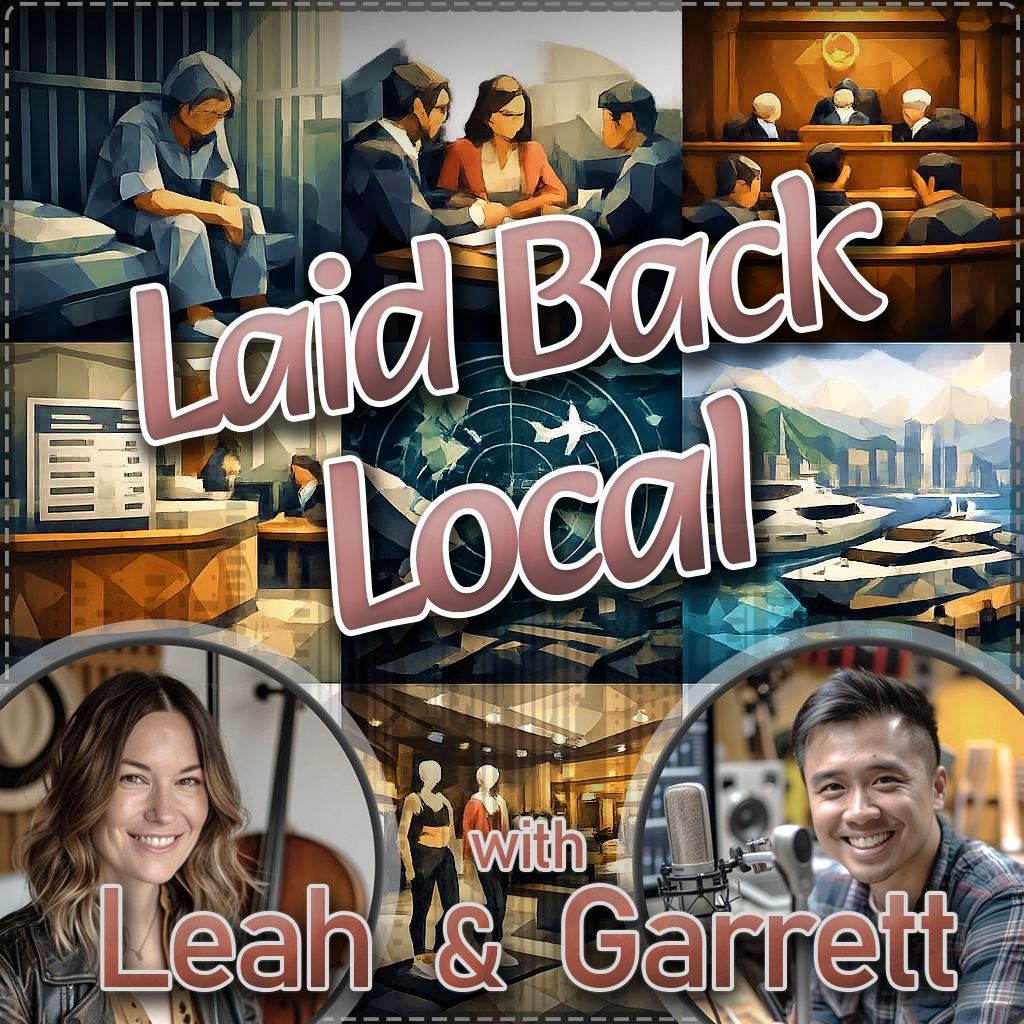
Could money disputes fuel murder motives? | Hong Kong | October 16
7m 49s
The Abby Choi murder trial has intensified due to a revealed $250,000 loan dispute with her ex-father-in-law, Kwong Kau, founder of the popular Tamjai Unan Mixian noodle chain. Prosecutors claim financial stress over a $72 million property sale fueled the conflict, emphasizing how property ownership and family trust can erupt into violence. Meanwhile, a 62-year-old woman, Yang Chao Kee, was sentenced to psychiatric treatment at Siulam for displaying pro-independence symbols, underscoring the strict application of Hong Kong’s national security laws and the potential chilling effect on free speech. Scientific advancements in China show that civilian flight data can be used to detect electronic warfare signals, revealing a concerning dual-use risk where everyday data supports military surveillance. In a separate development, a structural rebar scandal at a luxury estate in Stanley has prompted wider building inspections, highlighting safety flaws even in high-end housing. Lastly, new healthcare transparency rules, set to take effect in 2027, will require private clinics to publish bilingual prices, provide budget estimates, and explain bills over 20% above estimates—aiming to reduce financial shock and improve patient trust. These developments reflect deep tensions in Hong Kong over money, power, expression, and accountability across public and private sectors.
Today in Hong Kong, a high-profile murder trial takes a turn with a financial dispute
at its core, more on that in seconds.
Hi I'm Leah.
And I'm Garrett.
Welcome to "Lade Back Local," the news of the day with Leah and Garrett in Hong Kong.
First up, the Abby Choi murder trial now includes a revealed loan dispute with her ex-father-in-law.
The court heard that Kwong Kau, the founder of the Noodle Chain Tamjai Unan Mixian, allegedly
failed to repay a $250,000 Hong Kong loan from her partner's father.
Prosecutors say money tensions escalated after Abby tried to sell a $72 million Hong Kong
dollar flat registered under Kwong's name in 2023.
Abby, a well-known socialite and influencer, was killed in February 2023.
Long and his sons are now standing trial in connection with the murder and they maintain
the presumption of innocence while proceedings continue.
That's heavy and honestly surprising because of who's involved.
For anyone new to the name, Tamjai Unan Mixian is a hugely popular rice noodle chain here.
Seeing a prominent figure from the restaurant world tied to a case like this is, you know,
jarring.
The detail that really stands out is the family dimension, a relatively small loan by luxury
property standards, $250,000 Hong Kong dollars.
Paired with a $72 million Hong Kong dollar flat can be like a spark in a room full of fumes
when family trust breaks down.
It's a reminder that money conflicts, especially tied to property rights and who controls an
asset on paper, can twist relationships fast.
Why would that loan piece matter so much in the bigger picture, Garrett?
I mean, the way it sounds, the loan and the flat become pressure points.
If someone feels cornered about who controls a big-ticket asset like a $72 million Hong Kong
dollars flat, a smaller unpaid loan can become proof of bad faith or a bargaining chip.
That said, the court still has to sort motive from speculation, so for now it's a key thread
the prosecution is pulling on, but not a settled fact.
OK, let's move on.
Next up, a 62-year-old Hong Kong woman, Yang Chao Kee, was sentenced to three months
at Siulam Psychiatric Center for displaying pro-independent slogans and the colonial era flag
outside her flat.
West Calune court found her guilty of knowingly displaying publications with seditious intent
under Article 23, which is Hong Kong's local national security legislation addressing offenses
like treason and sedition.
One here means acts or publications that incite hatred or contempt against the authorities.
Siulam is a secure psychiatric facility for offenders who need assessment or treatment.
She pleaded not guilty, but the court still issued the order.
The case raises that ongoing tension we keep seeing between free expression and national
security, where symbolic displays, even a flag or a slogan, can trigger serious legal
consequences.
Not going to lie, that's surprising.
A psychiatric order for public displays is a pretty strong response.
I get that the court is applying the law as written, but this kind of outcome could
chill expression even for people who mean only to make a point.
Why psychiatric treatment instead of a standard sentence, do you think?
Courts sometimes use Siulam when they believe treatment or closer assessment is appropriate.
It's hard to read more into it without the full reasoning, but it signals the court saw
this as more than a simple fine or custodial case.
We'll watch whether there's any appeal or further detail released.
Alright, let's roll on.
Next up, Chinese scientists say they used civil aviation flight data to uncover signals
tied to Israeli electronic warfare.
Quick explainer, electronic warfare is the use of radio waves and signals to jam, deceive,
or locate opponents.
The researchers say they built an algorithm, meaning a step-by-step data processing method
to spot telltale patterns using civilian flight data like what planes broadcast for tracking.
That's striking because it shows how information meant for safety and navigation can be repurposed
to map military activity.
They claim the method can identify units behind so-called spoofing, which is when a system
sends fake signals to mislead sensors or GPS.
If accurate, it blurs lines between civilian and military tech and could complicate international
relations.
Countries might rethink how much civilian data they leave in the open.
That's fascinating and a little unsettling.
Innovative?
Yes, but it raises privacy and safety questions.
If everyday flight data can flag sensitive operations, then what else can be inferred
from public streams?
Also, why lean on civilian data in the first place?
Because it's abundant, global, and cheaper than running secret sensors.
Think of it like turning the city's street lights into a giant reflection pool.
If you read the ripples carefully, you can guess what moved through.
That dual-use risk is the headline.
Civilian data can be a quiet intelligence tool.
Switching gears just a little.
Next up, expanded inspections at one Stanley after a rebar scandal.
One Stanley is a luxury estate on the south side, and inspectors found structural lapses
at house number 35, including allegedly insufficient steel reinforcement.
Rebar, short for reinforcing bar, is the steel rod inside concrete that gives its strength.
The buildings department, which oversees building safety city-wide, has now ordered checks
on eight more houses, including one owned by a Mongolian mining family, and says it will
do random inspections across the estate.
To take away as simple, even high-end builds can have gaps.
When rebar is thin or missing, concrete can crack or sag much sooner than expected.
That's a safety and longevity issue, not just a paperwork problem.
Yeah, that checks out, but it's still wild to hear.
You pay premium prices and expect, you know, premium steel inside the walls.
This one says stricter oversight is not just for old walk-ups, it's for Glossier States,
too.
Check send a message.
If you cut corners, someone might eventually knock on the door with a probe drill.
I'm down for that kind of accountability.
Last up, new transparency rules are set to reform private healthcare fees.
Starting August 2027, private providers will need to publish bilingual price lists, give
budget estimates before care, and explain bills that run more than 20% over the estimate.
The health bureau first floated the plan in May 2023 and has now sent details to the
legislative council, or LEGCO, which is the city's lawmaking body.
The goal is to cut bill shock and help patients compare options in clear Chinese and English.
That's close to the heart of it.
Medical surprises can be scary, not just medically, but financially.
Publishing prices and requiring an explanation when costs jump by more than a fifth gives
people footing.
High 2027, though.
Probably to give clinics and hospitals time to standardize lists, update software and
train billing staff, all the unglamorous plumbing behind the scenes.
Longer runway, fewer excuses later.
All right, that ties it up nicely.
So there we have it, folks.
From us here in Hong Kong, have a good one today.
Stay safe on the roads, and tune in tomorrow for more.
And that's a wrap for this one.
See you tomorrow.
[MUSIC]
Podcast Summary
Key Points:
The Abby Choi murder trial revealed a $250,000 loan dispute with her ex-father-in-law Kwong Kau, founder of the popular Tamjai Unan Mixian noodle chain.
Prosecutors allege that financial tensions escalated when Abby attempted to sell a $72 million flat registered in Kwong’s name, highlighting property control and family conflict.
Long and his sons are on trial for the murder, maintaining innocence, while the loan becomes a key, though unproven, element in the prosecution’s motive narrative.
Yang Chao Kee, a 62-year-old woman, was sentenced to three months at Siulam Psychiatric Center for displaying pro-independence slogans and colonial-era flags, under Hong Kong’s Article 23 national security law.
The psychiatric order signals a broader tension between free expression and national security, raising concerns about chilling symbolic political speech.
Chinese scientists developed an algorithm using civilian flight data to detect electronic warfare signals, including spoofing, revealing the potential for civilian data to be repurposed for military intelligence.
A rebar scandal at One Stanley estate exposed structural deficiencies, prompting expanded building inspections and raising safety concerns in luxury developments.
Hong Kong will introduce private healthcare transparency rules by 2027, requiring price lists, budget estimates, and overage explanations to reduce financial surprises for patients.
Summary:
The Abby Choi murder trial has intensified due to a revealed $250,000 loan dispute with her ex-father-in-law, Kwong Kau, founder of the popular Tamjai Unan Mixian noodle chain. Prosecutors claim financial stress over a $72 million property sale fueled the conflict, emphasizing how property ownership and family trust can erupt into violence. Meanwhile, a 62-year-old woman, Yang Chao Kee, was sentenced to psychiatric treatment at Siulam for displaying pro-independence symbols, underscoring the strict application of Hong Kong’s national security laws and the potential chilling effect on free speech.
Scientific advancements in China show that civilian flight data can be used to detect electronic warfare signals, revealing a concerning dual-use risk where everyday data supports military surveillance. In a separate development, a structural rebar scandal at a luxury estate in Stanley has prompted wider building inspections, highlighting safety flaws even in high-end housing. Lastly, new healthcare transparency rules, set to take effect in 2027, will require private clinics to publish bilingual prices, provide budget estimates, and explain bills over 20% above estimates—aiming to reduce financial shock and improve patient trust.
These developments reflect deep tensions in Hong Kong over money, power, expression, and accountability across public and private sectors.
FAQs
The trial involves a $250,000 Hong Kong loan that her partner's father, Kwong Kau, allegedly failed to repay. Prosecutors say this financial dispute escalated after Abby tried to sell a $72 million flat registered under Kwong's name.
While the loan is small compared to the value of the property, it became a point of conflict that may indicate bad faith or financial pressure, especially when combined with disputes over property ownership.
The flat, registered under Kwong Kau’s name, represents a major asset tied to the family conflict. Its potential sale may have intensified tensions and contributed to the breakdown of trust between family members.
Long and his sons are standing trial and maintain their presumption of innocence. The court is still investigating motive, and the loan dispute is one of several factors being considered.
The court found her guilty under Article 23 for displaying pro-independent slogans and colonial-era flags. Psychiatric treatment was deemed appropriate for assessment and management of the behavior, though it raises concerns about free speech.
Scientists used civilian flight data to detect electronic warfare signals, including spoofing, by identifying patterns in radio transmissions, showing how civilian data can be repurposed for military intelligence.
Chat with AI
Loading...
Pro features
Go deeper with this episode
Unlock creator-grade tools that turn any transcript into show notes and subtitle files.
 PodcastTranscript AI