Convair: The Rise and Fall of an Aerospace Titan - Part 2
from Preferred Shares Podcast
55m 25s
This episode of the Preferred Shares podcast covers Part 2 of a series on Convair, focusing on founder Reuben Fleet's decision to sell Consolidated Aircraft in late 1941. Fleet sold due to punitive tax laws, loss of control amid rapid growth, labor union issues, and government interference. He cited Ecclesiastes ("a time to sell") and noted that after taxes, the risk outweighed potential gain. Despite President Roosevelt's initial refusal, Fleet sold his personal 34% stake to Vultee Aircraft for nearly $11 million, yielding a 141% annualized return. The merger created Convair. Post-WWII, Convair's revenues plummeted from $960 million in 1944 to $14 million in 1946, but rebounded through the B-36 long-range bomber and successful commercial transport planes (240/340/440 series). By 1952, controlling shareholder Floyd Odlum sold Convair to General Dynamics, which originated from Electric Boat Company (1899). Electric Boat, a submarine maker, struggled post-war due to limited civilian use, unlike aircraft companies that adapted to commercial markets. The podcast highlights Fleet's rational, unemotional approach to selling his business and the impact of tax policy on industrial decisions.
[Music] Preferred shares is a podcast started by three guys interested in business, history, and business history. We follow our interests and go down the rabbit holes of current and bygone topics. We'll talk about individual companies, product wars, famous founders, forgotten failures, and anything else that strikes our fancy. To find our episodes and show notes, please visit our website at preferredsharespodcast.com. The host for the podcast are Devon Lesar, Douglas Ott, and Lawrence Hamptle. Devon is a private investor with a background in design and brand development and is the author of the invariant newsletter. Douglas is a founder and chief investment officer at Anvari Associates, a registered investment advisor. Lawrence is a co-founder and principal at Fortune Financial Advisors. He's also a registered advisor. All opinions expressed by the podcast hosts and guests are solely their own opinions and do not reflect the opinions of their respective employers. This podcast is for informational purposes only and should not be relied upon as a basis for investment decisions. Clients of Anvari and Fortune Financial may have positions in any of the securities discussed in this podcast. [Music] Hello and welcome to episode 18 of the preferredshares podcast. Today we'll be covering part two of our series on Conver. Part one left off with announcing that Ruben Fleet was deciding to finally sell his business to explain why and talk through what happened after that. Doug is going to walk us through the story. Yeah, so it's late 1941 and major Ruben Fleet, the founder of Consolidated Aircraft. He founded it in 1923, IPO'd it in 1929, right at the height of a stock market bubble and before the Great Depression hit. And again, this is 1941. Business is booming. Consolidated has doubled if not quadrupled at this point in time to assist in the war effort. Another fortuitous moment of timing in many ways, but Fleet's decision process for selling consolidated were several. The first and most important factor in his mind was to simply tax matters. So with the new tax laws, the US government had effectively drafted business in America. And while so many young men were enlisting and being drafted to defend our allies into wage war, Fleet had accepted that it was his duty as a business owner to be drafted into service of country by sacrificing personal and business income. There's also the fact that Consolidated with its growth had changed rapidly and was no longer recognizable by Fleet. And it was really not a company that he could directly control anymore. He had always been accustomed to having direct oversight and management of a much smaller company. So that was another factor in his decision. And Fleet also now had to deal with increasingly thorny labor unions and government interference in nearly all parts of the business. And finally, there's also the potential that he and Consolidated might be competing with the auto industry when the war was over since the big car companies were assisting with the manufacture of so many warplanes. With all this in mind, the the Bible quoting Fleet often referred to ecclesiasties when he said there's a time to buy and a time to sell into him now was the time to sell. So he goes to FDR in November 1941. He tells him why wants to sell Consolidated and that he's got three good potential buyers for the business, but FDR will not allow it and he counters with the following offer. FDR says he'll eventually allow the sale and exchange for Fleet just continuing to help lead Consolidated for a few more years in addition to becoming a consultant to the government and the military and that both the army and Navy would get to select who buys all of Consolidated and Fleet agreed to that deal. So years later in his biography Ruben reflected on that decision to sell and in here's what he said he said quote I sold because federal taxes were so high that what I had left after paying them made the risk too great for the possibility of gain after all business is not a play thing to find briefly it is risk for gain. And whenever the possibility of gain is so remote that it exists only to an infinitesimal degree that are cashed in as a lesser of two evils and follow some other location and that's exactly what he did and would do. And just to give some more context on the extraordinary tax regime now facing all businessmen and American citizens just as a 23 year old Ruben had cleared 27,000 in a year and at age 54 in 1941 he was only going to net less than 10,000 on a 60,000 dollar salary after taxes so the tax rate was very extremely punitive and for good reason. So despite not being to sell all of Consolidated Fleet did sell his entire personal stake in the company which was about you know 34% of Consolidated shares and he was able to find Volty aircraft to acquire his personal stake. Now Volty was a much smaller business and it was majority owned by Victor and Manuel's aviation corporation and Victor is another very interesting character that I won't get into I've written about him on the and Vari sub stack and please go check that out if you want to learn more about Victor and Manuel. So the announcement comes that Volty would buy out fleets personal stake at the end of November 1941 they would pay him slightly less than $11 million for Rubens 440,000 shares of Consolidated and with this transaction it would give Volty effective working control over Consolidated and as a reminder Ruben put $15,000 of his own money into the business in 1923. And I did my best to calculate the annualized returns for this investment but not even counting dividends over an investment period of 18 years Ruben earned a 141% annualized return at least. Yeah it's pretty astounding. I looked at that figure. This is 1941 in today's dollars. That's that's a bit over 200 million in in 2025. Yeah thanks for doing that Devon and again I mentioned two remarkable moments of timing for fleet. I mean IPOing the business in 1929 was seemed incredibly lucky but when he sold his shares to Volty the share price had just returned to its prior all time high which was you know last seen in 1929 the year of its IPO. So I think this was another good bit of timing on the part of Ruben fleet. So with this combination Volty and Consolidated would employ over 40,000 people now and over 75% of those employees were on Consolidated Payroll and just a week after Ruben sold his shares to Volty the Japanese attacked Pearl Harbor on December 7, 1941. So about a year and a half later in March 1943 Consolidated sells the entire business to Volty they merged completely together as a result aviation corporation owned 30% of the combined business and the name now would be shortened to Conver in almost all publications a shortening of both Consolidated Aircraft and Volty Aircraft. So after this Ruben continues to consult to the military but eventually drops out of business and super serious stuff by the end of the war he continues to be an advocate for the need of air power as the best way to preserve the hard one piece that would eventually come. Alright so many decades later and again sharing this with his biographer fleet had become an investor in public stock market and he's got several really good quotes that I think most people listening to our show would agree with especially if they're in the business of investing but he said here's one of his quotes my policy has been to investing companies I have feel have good prospects and to manage those investments myself. To add to them and to sell them if they don't pan out now following up on this he tells a story about his brother-in-law dead bishop Ned Bishop said Ruben fleet operated on the general policy that America was going ahead and that anything you bought was bound to come out alright he invested in say 150 companies I told him Ned you can't ever watch the progress of 150 companies you need only 20 or fewer companies and then you can watch them. So I think that's something we all try to do to the best of our abilities in the investment business and Ruben last thing I wanted to share about him he just had a single page of paper with all 16 of his investments on that page of paper and he had invested in blue chip firms like ex on general motors do pot IBM all companies that he said he has followed for over three decades. And he's a dog that he's sort of unique if you look at the maybe like he's definitely under appreciated in terms of the pan
the on of American industrialists, but the way that you talk about his sort of sober dealings with the company, he didn't get overly attached to it was effectively his baby. Yeah. He was very clear-eyed about what he should do and took the emotions out of it and just let the logic of the numbers dictate his decisions. And I think that's something that's commendable and it seems to be sort of a rarity in the history of American business. Yes, but especially for a founder and although I think you could point to many instances showing that fleet was an emotional, hard-charging character when it came to how he ran and operated the business, but I think you're definitely unmistakably right that in the important moments of what to do with his personal shares in the business, he was very rational and unemotional. Yeah, and I think that sorry Devin, it's going to say I think that comment about the margin of safety or the risk reward when it came to his after-tax income and what to do with that, there's something interesting there which is kind of like unless you've got a fat pitch to swing at, you're better off just walking away from the opportunity and living to fight another day. And I think that's something that it's more maybe a little bit of a stretch to say that that applies to investors, but that's also a good way to look at things too when you're assessing a situation that's involved some risk and limit more downside than upside, so to speak. Definitely, and he certainly wasn't pressed for time for patiently waiting for fat pitches when you look at the perfect timing of his sale. I mean, he had the capital to kind of write out any storm. He was in no rush to necessarily grow it to any particular level above that. And yeah, very unique. The passion was clearly there. And perhaps one of the most uniquely underappreciated people in American history without his personal advocacy and determination for pushing US air power. Who knows, you know, how world wars would have shaken out? Yeah, and getting back to our prior episode, I mean, he was advocating even before World War 2, as a state legislator, if you remember, he passed a bill or he was threatening to pass a bill in the state of Washington to fund the state national guard to the tune of a quarter of a million dollars for military aviation and effectively embarrass the federal government into spending appropriately on behalf of the entire nation. Yeah, I think something else is kind of an aside too to point out, as this is the second episode we've had that I can think of where tax policy really shaped in industry. The other would be the aggregates we talked about in the Interstate Highway series with that. And much of the tax code was still prevailing after World War II into the 50s. And so you've got these founder-led companies and they think, well, I'm just going to walk away because there's not much juice left after the government takes more than 90% of it. So might as well pack it up and go home. Yep. All right. So getting to the post-World War II era, and this is kind of when we're going to reflect on the rapid growth of the industry during the war and the rapidly rapidly decline after the war. And one of the things I spent a lot of time on doing was putting together the financials of 10 of the largest aircraft or aviation-related companies during this time period. Some of the largest were Curtis Wright, Conveyr, Douglas Aircraft, Bendick's Aviation Boeing, etc., etc. But total revenues for this group of 10 that I chose, they went from 250 million in revenues in 1939 as a group and they peaked in 1944 at seven and a half billion. Total annual production of planes by number in the US peaked at over 96,000 in 1944. Compare this to 1939 when the annual number of planes produced was just less than 6,000. And again, it's just a remarkable, unbelievable period. So with the war now won on both the European and Pacific fronts, obviously revenues with decline precipitously and hit consolidated and virtually all the other plane makers as well. Conveyr, their revenues peaked in 1944 at 960 million and by 1946 they fell to 14 million. So going from 960 to 14 in just two years. But they're also basically on it with no operating profit, isn't that correct? Yes, likely, yes. Very similar declines in all the other aviation businesses. So it's 45, 1946 and Conveyr's share price dips from the mid-30s to the mid-teens. And this is when another guy steps into the mix. His name is Floyd Audlem and he is another interesting character I won't get into, but you can look him up online. And he was a pretty famous investor, started his own closed-end fund called Atlas Corporation that did quite well and specialized in kind of turnaround special situations. So Floyd and Atlas Corporation acquire a significant stake in Conveyr during this time. And then he buys out aviation corporation's interest in Conveyr and becomes the controlling shareholder. Conveyr's business would eventually rebound thanks to its commercial transport line of planes. And it also began producing the B-36 long-range bomber and also the war in Korea definitely helped grow revenues and increased the backlog once again. So we're going to talk a little bit about the transport, the commercial transport line and also a little bit about the B-36 bomber. Quick, quick fun fact regarding Audlem was good friends with a very well-known name that is Amelia Erhardt. Oh yeah, that's right. Well Floyd, if I remember correctly, he and his wife were both very much into aviation and he financed for himself and his wife a very nice lifestyle. And I think he's spent a lot of money getting her into airplanes and setting records for female pilots. It's another interesting side note. But anyways, the commercial transport line, this was the line of the 240, 340 and 440 planes. And this would be a pretty successful line of planes for Conveyr in the 1950s. The 340, I think, could carry up to 44 passengers. It was a propeller plane and it was well suited for trips that were 500 miles or less. And during the 50s, Conveyr was able to build up a very large backlog of these planes for the domestic American airline industry. And in late September 1952, Conveyr would be able to claim an industry record for orders of a single type of air transport. They had reached a billion worth of orders over a span of 18 months. And this series of aircraft from Conveyr would take a pretty solid third place of market share of planes used by airlines by the mid 50s. They had about 215 planes in a total commercial fleet of just over 1100 planes. Douglas was the top number one market share holder at this time. So getting to the B36 bomber, this is another quite amazing plane and you can find handful of great YouTube videos and you can look at the Wikipedia page for this plane. It was a super long range bomber that was in production for less than a decade between 1946 and 1954. About 384 planes were produced and the genesis of the idea for the plane began in the dark days of 1940. And this was near the time of the near defeat of England in the Battle of Britain, which forced the US Army Air Corps into developing an intercontinental bomber. Because if Hitler had taken England, the US would be next and the Air Corps would have to wage war from across a huge ocean. So they developed the B36 bomber. And this plane was simply massive in revolutionary at the time. It was the biggest piston-powered airplane ever produced. The bomber had to carry a 10,000 pound load to a target 5,000 miles away and return. It had to hold 72,000 pounds of bombs over a shorter range. It had travel at 300 to 400 miles per hour. It had a service healing of 40,000 feet. I was going to say if you're interested, there's an old Jimmy Stewart movie called Strategic Air Command. The B36 is featured prominently. So if you're in the mood to check out an old classic and Jimmy Stewart was a decorated World War II bomber pilot, by the way. It's good movie to check out and you can see all the B36 footage that you want. Yeah, it's just a fantastic aircraft. When you compare it to everything else that was in the skies at the time, just truly a mammoth. Right. I mean, it had a crew of up to 15 people. It had a tiny galley so that they could eat. And there were six bunks in the back of the plane for crew members just so they could take their shifts and get a little bit of rest while they were in the air for dozens. Well, probably not dozens, but I think the longest flight of this plane was like over 36 hours or over 40 hours in the air. And what makes it interesting is it was a piston engine plane, but it was a push design, not a pull design. In other words, the propellers were facing to the rear, pushing the plane along as opposed to pull
falling them. So that was a very kind of unique design as opposed to more conventional piston engine design. Yep. All right. So those are kind of the two more interesting newer lines of planes during the period of the 50s for Conver. All right. So getting back to the main story by 1952 Conver would earn revenues of 391 million dollars and again they had a backlog of over 1 billion worth of aircraft and Floyd, Adlem, the current controlling shareholder, thought it was a good time to find a buyer for the entire company. And the company found was general dynamics to acquire Conver. And just a really brief as I can make it history of general dynamics. So what was general dynamics doing up until its acquisition of Conver? The company that we know today as general dynamics was not called that at first. We can trace its roots all the way back to 1899 when it was started out as the electric boat company. And it made submarines and boats of almost every description hitting on some major years for electric boat like the plane makers and all other business in America. Its revenues grew at a rapid pace during World War II in 36 revenues were 8 million by 1942. They had almost 10x revenues for 42 were nearly 75 million revenues peaked at 91 million in 1944. Over the course of World War II electric boat produced 74 submarines and almost 400 PT boats. But like all the other businesses after the war, business shrunk a lot as victory was secured. And electric boat did not have as easy a transition path to the post-war time period as some of the airplane manufacturers or even the car auto companies for in GM were helping build the planes, but they could switch back to selling cars to the civilians. Even the aircraft companies could more easily get business by repurposing military aircraft or developing new variants for the civilian market. It's just not possible to repurpose up submarine for civilian use. Well, and I think I think listeners should be reminded too that the defense industry was nothing like it is today. I mean, it was very fragmented. You had probably dozens of not hundreds of different contractors. And so once the military contracts receded, you're thinking, okay, well, here's a period of peace. And how do I get into the civilian market, which is definitely going to have more growth? And as Doug pointed out, there's not too many civilians hankering to get on submarine rides. And air travel was kind of still in its infancy. And I think I'm not sure if it grew during the depression, but it was definitely on that way prior to World War II. So and of course, the ushering end of the jet age made that all the more apparent. So it's like, how do we get in on this? Yeah. So how do they get in on it? They get in by acquiring their way into it. So electric boat in 1946, they acquire canadaire from the Canadian government for $22 million. Canadaire during the war made flying boats and modified DC fours. So canadaire also after the war had a good business providing much needed commercial airliners. And they were just basically converting military C-47s to civilian DC-3s during that time period. So both electric boat and canadaire would get another boost in defense spending after the Soviets detonated a nuke in 1949. And after the war in Korea started in 1950. And by this time, canadaire would be doing better than electric boat. Another thing that electric boat was up to at this time was that they in 1951 had signed a contract to build the world's first nuclear powered submarine, the Nautilus. And there are a bunch of great books on this subject as well. One of them I've read and would highly recommend and you can actually find this for free on the internet. It's I think it's Rick Overs' nuclear navy and this is in reference to Admiral Rick Overs' kind of the man in charge for many decades of the Navy's nuclear program. But anyways, we have electric boat to thank for the world's first nuclear powered submarine. So with a good collection of slightly more diversified businesses, they're making boats, submarines, aircraft, rockets, now they decide to change their name. And in 1952, electric boat becomes general dynamics. Now, about a year after this, again, getting back to when Floyd Audlem wants to sell his conver, all of conver to someone, General Dynamics does it in two parts, a two-step process. First, they acquire 400,000 shares from Floyd Audlem and his Atlas Corporation, which was about 17% of the outstanding shares of Conver. In my reading, I found that Floyd had paid about 10 million for his investment for his stake in Conver. And I think he sold for about 20 million total. So he doubled his investment roughly during this time period. The year after that in 1954, news comes out of the long-expected merger of Conver into General Dynamics. And they do this in an all-share exchange transaction. And this roughly valued Conver at about 50 million, slightly less than 50 million total. And John J. Hopkins was then the chairman and president of General Dynamics. And he said this basically as a united group general dynamics in Conver will represent one of the strongest arms of the free world's defense effort. Doug, was this about the time that the general dynamics was, how does that tie in with Henry Crown? Crown had not yet gotten into Dynamics. I think that was in 56 or 57. He crowned Saul the Mercedes Gideon 59. All right. So after the acquisition by General Dynamics of Conver, we get to probably the most interesting part of this long story. And this is when Conver chooses to gamble with Howard Hughes. Now, like Laurence mentioned before, in the mid-50s, this is when the beginning of the jet age of commercial planes is getting started. Instead of using propeller engines, we're now going to put jet engines on civilian commercial transport planes. So Howard Hughes approached Conver first in late 1954 about designing a big commercial jetliner for TWA. And for those who don't know, Howard Hughes controlled TWA for a long period of time. I think he owned almost 80% of the business. This was also the time Conver was winding down production of its successful twin engine piston driven planes, the 240, 340 series. And they didn't have a jetliner yet. So this was a potentially good opportunity for them to develop one with a significant customer. They knew the risks of doing business with Hughes. He was a wealthy, eccentric, perhaps mentally unstable person known by many people in America and probably infamously known by business people in America. And also owner of the world's largest airplane, right? The Spruce Goose. It was the Spruce Goose, but he also had, I mean, we mentioned the B36, but he also made a one-off ginormous plane even bigger than the B36 that was flown once. I forget what the name of that plane was, but it was another boat plane. And it was enormous. I think it was a Hughes Hercules. Yeah, the Hercules. A fitting name for sure. Yeah, it flew once and not very far. This was the kind of thing that Howard Hughes spent his personal well-fought. So anyways, Convey knew the risks of doing business with Hughes, but again, it was a good way to get into the business. But Hughes kept delaying decisions despite the plans that Convey shared with him and then comes Boeing's announcement of its 707 jetliner in 1955. And then Hughes wants to have an even more advanced plane for TWA, something that was unique and even better than the 707. But by the fall of 1955, he still had not committed to any decision for the type of plane that he would order from Convey. Now it's October 1955. Pan Am commits to a fleet of 707s and DC-8s and within weeks United Airlines and American Airlines follows suit. Now all of TWA's rivals would get preferential delivery. It would be able to start jet service months before TWA can. And Hughes still did nothing. He continues to delay, continues to not choose to finalize a design in Conveyors and now in kind of a pickle. With these announcements from Boeing and Douglas for these long-range jetliners and with massive orders already being taken down, they were effectively blocked out of the long-range jetliner market. And now Hughes was truly Conveyors' only best hope to get into any of the other two segments of the jetliner business, the kind of the short range and the medium-range segments. Unfortunately, TWA's president at the time Ralph Damon was under severe pressure thanks to Hughes' inaction and decisiveness. He knew that TWA had to move fast to acquire some jets or it would be at a disadvantage in every way against its competitors. Damon died in January 1956. Apparently, this was the catalyst Hughes finally needed to make a decision on which planes to buy for TWA. So February 1956, Hughes resumed his flight.
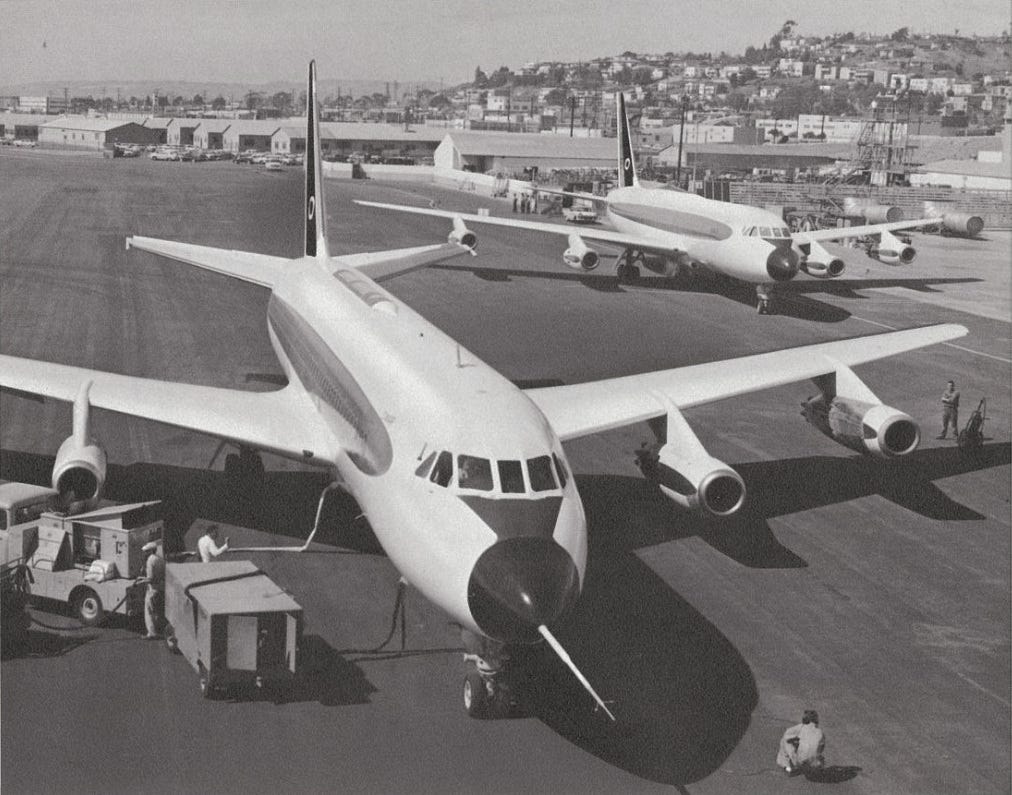
serves 33707s for $186 million with a 39 million down payment. And these long-range jetliners would be delivered three to four years later in 1959 and 1960. But TWA would still need some medium-range jets as it offered both long and medium routes to its customers. So with the long-range market abandoned, con there now shows hues in the spring of 1956, designed for a medium-range for engine jetliner that could see about 80 passengers. And this plane would eventually be known as the Con there, 880 jetliner. Hues loved the plan. He agreed to buy 30 of the new jets from Con there for $126 million. But Hues also knew that he had a lot of leverage and he got several key concessions. After the initial down payment, hues would only have to pay when the planes were actually delivered three years later in 1959. And this was very different from the ordinary practice of a plane maker receiving regular progress payments to defray the enormous upfront ongoing costs of research development and ordering materials and spinning up production. So the fact that Con there agreed to those terms shows how desperate they were, I think. Yeah, if you want to think about ways, you can really tie up a company's resources working capital. This is one of the best ways to do it, for sure. Yeah. So at this point, how are hues and now signed contracts for Boeing and Con there, plus engines, and it totaled more than $400 million. And this was the largest equipment order in aviation history at the time. Another unique thing to this deal structure for hues and TWA was that hues wanted to finance the planes using his hues tool company. Hues tool company was one of the, you could probably say most successful supplier of oil drilling equipment. And especially there, they had a special tricone drilling bit that was immensely profitable in what gave Howard Hues the majority of his wealth over time. So he wanted to use, he wanted to use hues tool company to buy the planes and lease the planes at TWA for a fee. So we could use the depreciation to offset the profits of hues tool. Again, this was another very different practice from standard most airlines at the time turn to banks or insurance companies to help finance plane orders. The managers at hues tool wanted to secure outside financing, but hues wouldn't allow it. And this would eventually put hues tool into a very precarious financial position a few years later. There are more delays because of hues. He starts meddling again in the designs and specs of the 880. And then he descends into kind of a period of mental illness in 1957 and 1958. A string of TWA presidents would be hired and then quit. And we're getting to 1958. At some point we got to do an episode on Howard Hues. I know. So much there. I know. Guarantee to be another multi part series. There's just so much ground to cover. All right. So 1958 it's going to be about a year before the first Boeing planes are going to be delivered. And each Boeing plane would require a payment of 4.5 million to 6 million each. And they would be receiving planes a month at a time thereafter. Hues is now in a very dangerous financial situation. He had been spending his own personal resources to fund these plane orders. And hues tool was at the time experiencing a downturn in worldwide oil drilling. TWA was not doing well in the first half of 1958. It had lost $10 million. So Hues did not have the resources to accept any of these in bending plane deliveries from either Boeing or Conveyor. So now he's basically using every opportunity to delay the delivery of these aircraft. He tries to get outside financing finally throughout 1958. But that doesn't work. It falls through. He tries a second time in 1959 and a third time. But he eventually is able to secure financing. And he had to give up control of TWA in the process. He had to put his ownership of TWA into a 10 year voting trust in order to get the financing he needed for these plane orders. Let's skip on ahead. So by late 1959, Conveyor would start delivering each of the planes that Hues had ordered. And each of the planes would require a payment of $3.5 million. We're now at the probably the craziest story I've ever read about in business history. I've already told you off the show. But this is when Hues can't pay for the Conveyor aircraft. He sends a force of armed guards to the Conveyor assembly plant in San Diego. And the guards are there to prevent any work from being done to complete the planes. And there's about 12 or 13 planes in various stages of completion. I mean, the guards physically seize the planes and tow two or three of them outside the Conveyor plant. And these planes had exposed engines. The salt air would corrode and damage them. And then Conveyor even just took the remaining planes off the assembly line and towed those outside to store them. And despite all this Conveyor ticked no action against Hues because he was still their only prime customer for these aircraft. Which really drives home the point of how desperate they were. We can go and do something as egregious as that. And they just decide to eat it. Yeah. The planes are delayed deliveries delayed by a year or so, but also compounding Conveyor's problems was that it also does agreed to develop a long range version of the 880 despite the fact that Boeing and Douglas had taken a large chunk of that long range market. And they agreed to an unfavorable contract with American airlines. And a bunch of stuff went wrong missteps by management over ambitious estimates of market size and cost of the plane. But I mean, in the end, this was a huge snaffoo for Conveyor. They basically doubled down and in two markets where they had little business being in. As a result of all these shenanigans, Conveyor's planes were delayed by a full year. Full orders were received from other airlines. Boeing had taken 50% of the commercial market and McDonald Douglas had most of the rest. The 880 production ended in 1962 with just 65 sold in the 990 long range variant ended production in 1963 with just 37 sold. And as a result, General Dynamics, the owner of Conveyor would book the largest loss in corporate history to date. They booked about 490 million in total of losses and charges against two programs that I mean, literally really didn't get off the ground into the air. So in the background, Devon, you mentioned this before about Henry Crown. Before all this, Henry Crown had sold his MSC business to General Dynamics. You said in 1950, what? 59. 59. So this was kind of before all the snaffos were happening. They had chosen to do business with Howard Hughes, but all the losses were not yet fully realized at that point. The losses were realized. Henry Crown owns 20% of General Dynamics. He essentially takes charge of the business. He becomes chairman of the executive committee to help write the ship of General Dynamics. He gets rid of most of the Conveyor executives. He gets rid of chairman and president of General Dynamics and installs new leadership. They do eventually turn things around at General Dynamics. And now we're finally into the later years of Conveyor and General Dynamics. So in the late '60s and 1970s and beyond after the Howard Hughes fiasco's converse shifts resources, intelligently, instead of choosing to try to compete in the Boeing and Douglas, they simply become a subcontractor to those bigger commercial jetliner companies. It also focused more of its attention on the rocket and missile businesses. And there helped develop the Atlas rocket, which was the booster for launching more than 100 satellites and other space missions over the decades, 70s, 80s, 90s. And skipping over a lot of time, by 1990, it was apparent that the defense contracting business was going to shrink significantly. And just for a short history lesson, the Berlin Wall had fallen. The USSR had been dissolved and the Cold War was basically won. The military contractors were going to have to consolidate and rationalize their businesses in order to remain profitable. There was a famous episode where I believe it was during the Clinton administration, the defense secretary invited all of the executives from the defense companies and it was referred to us the last supper. And he basically said, you have to consolidate and rationalize or risk dying because the governments not going to.
spend the kind of money that it has been. That was a so-called peace dividend. So they did what they set out to do. Northrop merged with Grumman, Lockheed merged with Martin and spun off the Martin Marietta materials. I believe make well eventually McDonald Douglas merged with Boeing. So here's the whole lot of things that shaped basically to where we have what five defense primes now I think. Yeah, and I forget the year the last supper happened. I think it was it was either 91 or 92, but I mean the writing was on the wall by 1990 for general dynamics and during 1990 the company reported its largest loss yet in its history. It recorded 1.33 billion in special charges during 1990. It had already started to downsize and like Laurence said the consolidation and rationalization would receive kind of an unofficial blessing by the US government military sometime in 1991-92. This is what general dynamics CEO of the time was Bill Anders. He said this in 1991 about the defense industry. He said quote, "The US defense industry's toughest challenge during the next few years will be simply to survive. Companies will be struggling to recover from the one two punch of debilitating fixed price development contracts awarded in the 80s and a steadily declining weapons acquisition budget. And just to give you an example, general dynamics share price had fallen at the time 70% from its 1986 all-time high. So people were very bearish on the industry after 89, 1990." In general dynamics did have several very successful weapons systems like the F-16, fighting Falcon is arguably the best firepower for the money contract that the defense department has ever spent on a war plane since modern war planes I would say. And some of the ground defense systems believe the Abrams tank is a general dynamics product. So they were not without success, but it was definitely going to be a harder path forward. Right, and they still had their electric boat business. They were still they were had specialties and submarines and rockets and missiles. And I think they were also I don't know if they were prime or subcontractor, but some very interesting stuff behind the development of the Tomahawk missile. Just a lot of interesting military history that we don't have time to go through. But getting back to the con-vare part of the story, this is when general dynamics begins to rationalize and they are mostly selling off pieces of their con-vare business to other people. Dynamics announced the sale of the missile systems division segment of con-vare to Hughes aircraft company in May of 1992. It sold its space systems division segment to Martin Marietta in 1994, which again, like Laurence said, Martin Marietta became part of Lockheed Martin and then materials business was spun out. Later in 1994 general dynamics and McDonald Douglas agreed to terminate con-vare's contract to provide fuselages for the 300 seat MD 11 airliner. Con-vare also sold their aircraft structures unit to McDonald, which is now part of Boeing. The Fort Worth Texas factory, the one that had the longest assembly line in the world during World War II. This was sold to Lockheed along with all intellectual property rights. And then finally in 1996 general dynamics deactivates all the remaining legal entities of the con-vare division and thus ends the story of con-vare. Yeah, I want to point out a couple things, Doug, and you did a masterful history of this interesting company. And I wanted to say two things kind of stand out in terms of the rise and in the beginning of the decline and the B36 peacemaker is a masterful work of art as far as like piston engine plans, but of course they couldn't have anticipated the jet engine, which pretty much rendered obsolete that entire concept. It's sort of funny how people, instead of thinking of a overall new technology, they just thought how could I build a bigger, much, I mean way bigger piston engine plane because that was the only technology that they knew. And of course the jet engine made that sort of mission 10,000 mile round trip with a huge payload that much more efficient with a smaller airframe and so on. And then the B58 hustler, they kind of missed a step in between. They went from like this really sophisticated piston engine plane to the supersonic jet bomber, which was almost too costly to produce, especially relative to the the risk of losing those airplanes to Soviet air defense systems. And so Boeing kind of took the middle ground where they adapted much better to the jet age, I think, for these these wide body large frame airplanes and they made them much more economical. And so it was just I think that kind of sealed the fate when when Conveir couldn't transition and compete effectively in this new era of efficient but highly technological jet airplanes for long range either air travel or strategic missions. With the broader question of can you point to the period and time where everyone, the big three airplane manufacturers, I think you could say they were Douglas Boeing and Conveir in the 50s, late 40s. Those are probably the most notable significant airplane companies in the passenger planes, right? Overall. Well, for military and passenger. And where was the misstep? I think Boeing at the time when they were able to introduce a commercial jetliner, I think they had definitely had the benefit of being able to convert. They were they were making the KC 135 transport plane and that was the design for the 707 was basically based off of that. So they had an advantage and ability to get to market a little more quicker relative to their competitors. In the case of Douglas, they didn't have a design a military design to base a civilian aircraft design off of but they according to my reading, they went for broke in designing a suitable civilian jetliner. They wasted no time. They went whole hog in on that project and they were able to those two companies were able to come out with two planes roughly at the same time collect most of the orders from the American airline market for those long range planes and Conveir was just too late to market to and then just from there they they continue to make several bad decisions after the next. Yeah, and just sealed their fate. Getting their hands tied by by Hughes and you know, biting off more than they could chew, more than they could chew at the 880 and 990 at that point, you're pretty damn stretched to be able to pivot and try to refocus on something that's maybe strategically more so. I did think it was irony is probably not the right word but a little bit of a coincidence that part of Conveir ended up as being part of Hughes aircraft. That obviously has its roots traced back to Howard Hughes. I mean, you think about it and it's probably no surprise at all in that somewhere in his mind he was looking to to make such a move anyways, right? He sensed a company with unique attractive assets and put in the screws to him so to speak and he likely would have liked to have made a similar deal maybe even sooner. Had had things shaken out, you know, slightly worse for Conveir earlier on. Yeah, well, I guess in the final analysis, neither Conveir nor Hughes or standalone indices anymore. Hughes is, I believe, part of Raytheon now. So eventually most of these older sort of darlings of the infancy of aviation were eventually gobbled up with a few exceptions. I think one other lesson and this is just my personal preference as a as an investor and somebody who studied the industry is if you look at the landscape of airplane manufacturing and it's become so complicated, it takes maybe decades to come out with a new concept and make sure that everything is all the problems are ironed out and so on. It's probably no no surprise that the passenger airline passenger industry has basically a do-oply now between Boeing and Airbus. It's just too difficult to come up with these things on a repeatable basis because the timeline from design to market and so on is just too long and there's just not enough. You have to have such huge economies of scale to make that work and so eventually there was going to be a loser and there's just kind of a lesson there when you study an industry that you have these large capital items that the first few are you're going to lose money on because all of your research and development and so on. That's a sunk cost up front but then you have to sell X number of units to make that money back on the on the back end and if you don't get those contracts all of that research and development that you've done it's just out the window and so it's just a brutal industry to try to compete in. Even more so when you look at the 40s and 50s and they didn't even have necessarily a far from a picture perfect idea of what the production cost all in for producing some of these programs would be and then you add in unforeseen delays on top of that. You run into a lot of issues when you talk about this high of a degree of capital intensity. It's almost an open-ended liability. Yeah and it turned out to be for Conver but I think another simple takeaway from this entire story is at least in the 50s, 60s like don't do business with a crazy person.
It's probably not going to work out well. But getting back to what Devon was talking about, well, you both were talking about capital intensity and difficulty in estimating costs and future orders. To talk a little bit more about the specifics of the contracts that Conver was signing. The basic rubric is they come up with a design, they do their best to estimate the total market estimate, then what kind of share can they reasonably take. Then they make another estimate, what do they think their break even cost is going to be. And then they get approval from the president or board of directors that will later give them a go ahead. We'll give you the go ahead if you receive 50% or 60% of the total expected orders. And what happened in the case of Conver, they the cost kept going up. The lays kept elongating. And the managers, they I think they increased the estimate of the share that they could take as well as lowering the number, the minimum number of planes that were going to be their break even to get the go ahead to start up production. And just all of those estimates together, you make the wrong estimates on just two of them. You're in for a world of hurt, but it seems like they made bad estimates and they had blinders on. They wanted to be in the market so bad that they made a lot of unfortunate decisions. Plus, at the same time, even if you somehow get within a reasonably accurate range for those types of estimates, you're dealing with this total of known of what is your competition in this fragmented industry doing at the same time, which is running their own estimates with their new iterations, anticipating how much share they can take. And you know, you introduce all these things into the market. Of course, nobody's internal estimates are going to pan out how they envisioned the world is not static. And that was another component of the Conver story was that the 880 was designed to be a short to medium range plane. But thanks to Howard Hughes, they wound up changing it so much that it turned into a medium to long range plane. And then competition doesn't stand still. And I think Boeing introduced a medium range variant of the 707. I think it was the 727. And now Conver thought they had a large portion of the medium range market. Oh, now Boeing's entered the picture and you're going to have less share of that market. And again, like I said before, then they make a decision to get into long range market again, despite Boeing and Douglas blocking them. Another lesson here, and this is my personal belief too, is the history of defense companies trying to venture out into the commercial space is not, it hasn't been very successful. If you look at McDonald Douglas, McDonald was known for making Navy fighters. Douglas was known for making passenger planes. It made obviously the C-47 or the slash DC-3 and so on. And so when McDonald and Douglas merged, that was that thinking that we'll have these defense contracts and then also have Douglas for the commercial market. Well, what really ended up happening is I understand it is the defense contracts for McDonald subsidize the Douglas side of things. And eventually when the cold war ended and the defense contracts dried up, Douglas was not able to compete effectively with Boeing. And so eventually Boeing acquired them. And Lockheed ventured out famously and I believe the 70s into the commercial market and had to be bailed out by the US government because it's a complicated story, but they kind of got over their skis trying to make a civilian airliner and Rolls-Royce was involved and it was a fiasco. So I guess the lesson there is stick to your knitting and be very good at one thing and going for growth in the civilian market where your customers, the airlines already have terrible economics. It's really kind of Fools gold. So that's my personal bias as an investor. I think we can end it there unless we have anything that we've forgotten. I think that was fantastic. We have some interesting upcoming episodes in the future going to be talking about the Royalties is a business model, a whaling so stay tuned for those future episodes and of course check out the show notes. Doug's got a lot of great charts and data points that he's compiled from Conveir and the aircraft industry over time so don't forget to check that out. Thanks for listening. If you enjoyed this episode head over to preferredsharespodcast.com. On the site there's a full list of resources and additional data for you to dig into and on the site you can subscribe to the podcast directly so all future episodes land directly in your inbox. If you want to support preferred shares the single most helpful thing you can do is to spread the word. And share preferred shares with others who love business history as much as you and we do.
Podcast Summary
Key Points:
Major Reuben Fleet sold Consolidated Aircraft in 1941 due to high taxes, loss of control, labor issues, and government interference, citing a poor risk-reward balance.
Fleet sold his personal 34% stake to Vultee Aircraft for nearly $11 million, earning a 141% annualized return; the merger formed Convair.
Post-WWII, Convair's revenues collapsed from $960 million in 1944 to $14 million in 1946, but recovered with the B-36 bomber and commercial transport planes (240/340/440 series).
Floyd Odlum's Atlas Corporation acquired Convair in the late 1940s, and in 1952, Convair was sold to General Dynamics, which originated from Electric Boat Company (1899).
Electric Boat struggled post-war due to limited civilian applications for submarines, contrasting with aircraft makers' easier transition to commercial markets.
Summary:
This episode of the Preferred Shares podcast covers Part 2 of a series on Convair, focusing on founder Reuben Fleet's decision to sell Consolidated Aircraft in late 1941. Fleet sold due to punitive tax laws, loss of control amid rapid growth, labor union issues, and government interference. He cited Ecclesiastes ("a time to sell") and noted that after taxes, the risk outweighed potential gain.
Despite President Roosevelt's initial refusal, Fleet sold his personal 34% stake to Vultee Aircraft for nearly $11 million, yielding a 141% annualized return. The merger created Convair. Post-WWII, Convair's revenues plummeted from $960 million in 1944 to $14 million in 1946, but rebounded through the B-36 long-range bomber and successful commercial transport planes (240/340/440 series).
By 1952, controlling shareholder Floyd Odlum sold Convair to General Dynamics, which originated from Electric Boat Company (1899). Electric Boat, a submarine maker, struggled post-war due to limited civilian use, unlike aircraft companies that adapted to commercial markets. The podcast highlights Fleet's rational, unemotional approach to selling his business and the impact of tax policy on industrial decisions.
FAQs
It is a podcast started by three guys interested in business, history, and business history, covering topics like companies, product wars, founders, and failures.
The hosts are Devon Lesar, Douglas Ott, and Lawrence Hamptle.
He sold due to high taxes, loss of control, labor union issues, government interference, and potential competition from the auto industry after the war.
He sold his 34% stake for slightly less than $11 million, earning an annualized return of 141% on his initial $15,000 investment over 18 years.
Revenues peaked at $960 million in 1944 but fell to $14 million by 1946 after the war ended.
Floyd Odlum was an investor who acquired a controlling stake in Convair through Atlas Corporation during its post-war decline.
Chat with AI
Loading...
Pro features
Go deeper with this episode
Unlock creator-grade tools that turn any transcript into show notes and subtitle files.
 PodcastTranscript AI