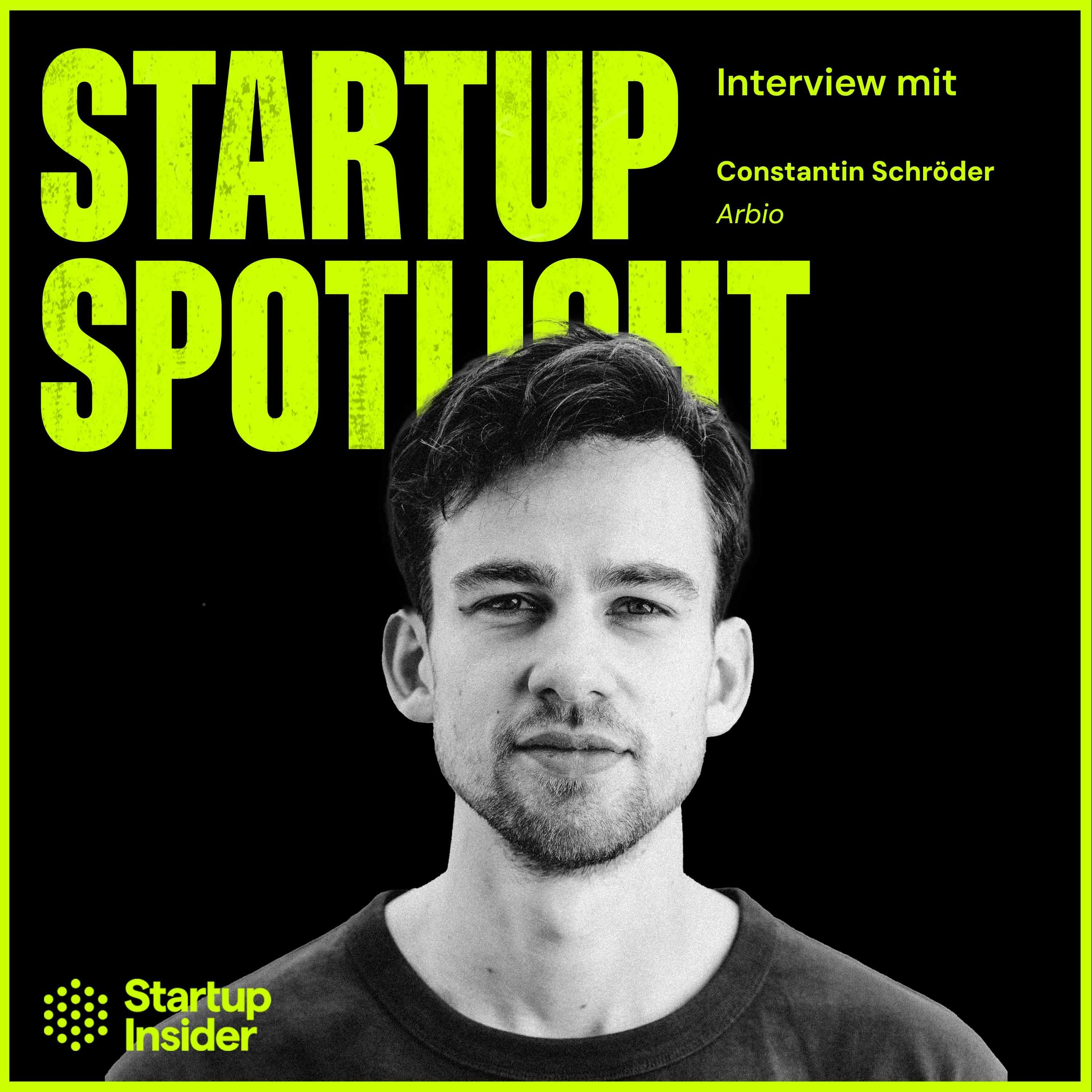
Constantin Schröder (Arbio) konkurriert nicht mit Airbnb. Er will der Motor sein.
39m 20s
In this interview with Konstantin Schröder, co-founder and CEO of Abio, the discussion revolves around Abio's recent $36 million financing round and the company's modern tool stack. The team emphasizes building minimum viable products (MVPs) using tools like Cursor, Loveable, and NNN. Abio's goal is to revolutionize property management by digitalizing processes through AI, offering a service-as-a-software solution. The company's approach involves automating tasks like guest communication and coordinating service providers to streamline operations. Abio's focus on innovative technology and a customer-centric approach sets it apart in the industry, positioning it as a leader in AI-driven property management solutions.
Transcription
6417 Words, 35460 Characters
[Music]
Welcome to Startup Insider Spotlight!
My name is Jan Thomas and today's guest is Konstantin Schröder.
He is the co-founder and CEO of Abio.
Now it will be really exciting, you will see that in a minute,
because we are talking about a 36 million dollar financing round in the background of a series A.
All in all, that is worth it, but we are also talking about a very modern company that has worked for three years under radar.
It uses a very modern tool stack.
We also talked about how, for example, you can get very far with Cursor, Loveable or NNN.
And it was also super exciting, I think we talked about it briefly,
how the whole, in the meantime, 50-year-old team of Abio has just set up a joint off-site.
And then learned how to build with Loveable MVPs, for example.
We talked a little longer about it, because I thought it was super fascinating.
I haven't heard of it before, but I have to say, there were also a whole series of other points that I haven't heard of.
It was a great conversation, so yes, stay tuned.
I think you can learn a lot, let yourself be inspired and then see the example, I think, quite well.
What's going on today, which markets may still be waiting to be kissed,
through the quasi-actual possibilities that you are very new to.
So yes, I think a great conversation, as I said, with Konstantin Schröder, the co-founder and CEO of Abio.
Have fun!
Interview.
Konstantin, hi, happy to meet you.
Hi, Jan.
Cool to talk to you.
And I don't know, can I say, congratulations?
You can say that the round has been raced a bit earlier,
you have known it a few weeks later.
So for us, it's a bit as usual.
But of course, a day like yesterday with the release, which I think went really well,
where we went out for the first time, announced a round,
is of course also cool to get feedback from the market, that you did something quite well.
Yes, and anyway, I also wish you luck, that you are now visible.
You told me in the previous interview that you have been aware of Radar all the time.
Exactly, as I said, we have been focusing on it for a long time,
to build in peace, not to leave us out of the outside.
And of course we also enjoyed that there was little competition on the acquisitions that we did.
But now, with more pressure and I think with the round, it's also a really good time to get out.
That means now a switch is around, basically from today to tomorrow.
It's also demanding, I think, because that's probably the case.
So I can imagine that it will bring you a bit of something together.
Or you have to introduce yourself to new situations that may not have been anticipated.
Definitely.
I'll tell you the truth.
For the first time in podcast, I made a LinkedIn post in the first place.
And for me...
How did you feel about it?
It was quite funny.
We made an audience where we were in a whole team with 50 people in a meeting.
And then I let everyone read it and made a live screen sharing.
And then we all gave a go and then I sent it out.
And it was really funny to do that with everyone, with the team.
I think what's important is that the team doesn't get distracted,
somehow from the outside and read something here and there,
but just stay focused.
For us, the time was good because we said that we wanted to use the software that we built
not only for us internally, but basically for our service as well.
So we also wanted to sell software and prepare our own teams,
or property managers who need it.
And that's why it was a good time to get out there.
And in the next few weeks, our full service will be available for our own teams from vacation homes.
Tell us something about the 50 people.
It's exciting that you've built up such a big team, even though you've been there.
You've already collected money for this round.
How were the last three years?
It was exciting. Of course, we learned a lot.
We started in January 2022.
Then we started the first pre-season of Atlantic Labs.
At that time, it was a time when Razer, SellerXD were asked questions.
That's why it was a difficult time for us at that time.
But since then, we've been very constant and focused in the direction we came today.
We have a headquarters here in Berlin.
We have a second office in Vienna.
Vienna was the second market in Austria.
We opened it three quarters of a year after we started.
Because we were very close to the Alps and found it very exciting in a wonderful fair region.
And as you can imagine, it was like sea-grays, venture-dead-grays.
We grew up fast, things broke down, things fell off the table.
But really, except that we didn't have these exposures outside,
it was a classic, I would say, Founder Roller Coaster or Startup Roller Coaster,
where we took everything and saw everything that you can imagine.
And you just played on this Razer or SellerX world,
but I actually thought more about Buena than I did.
Maybe you can arrange it for the listeners.
So, what you do exactly and then maybe what the challenges are right now.
Yes, I'd like to.
Exactly, it's a very, very good exhibition.
We started as a passion project in the past.
If you just want to be a part of it, I just took smaller Airbnb hosts in Berlin.
In fact, we just took over the business and carried it on ourselves.
It was absolutely painful.
Somehow seven days a week, operations, guests, communication, pricing,
we did everything ourselves.
It was really our full-time job to be host.
And in fact, we found out at that time that there were a lot of bigger problems.
We thought back then that the problem wasn't with the guest, so to speak.
That the guest doesn't have a cool check-in, that things are not reliable.
As we experienced it ourselves.
And we found out that there are a lot of bigger problems
with fairy-tales owners who want to leave their fairy-tales owner or manager on their own.
And so we looked at the market and saw that there are big administration companies
for fairy-tales administration that provide your fairy-tale apartment as a property owner for you.
We saw these companies starting from 50, 60 apartments
to struggle a lot, either to grow, to stay profitable,
had a little tech in it.
But we have a super sticky customer base of fairy-tales owners
who were relatively unhappy about what we found in a lot of NPS services.
And basically, we realized that there is a chance
to build a new kind of fairy-tale apartment developer, so to speak.
Which is absolutely tech and AI-first.
And basically, all the processes and all the services
that a property manager offers are digitalized.
Typically, it's really a classic pen and paper.
In order to really get into a fairy-tale apartment,
there is the cleaning bag on which apartment you have to clean.
We basically build a tech where all these things are automated
and see ourselves as an AI-native fairy-tale apartment developer.
That's why you're right, we're much closer to Brenner
because of this roll-up approach to buy a fairy-tale apartment.
Actually, only as a intermediate step.
As a go-to market with which we quickly get to a good customer base
with which we quickly get data.
Fairy-tale apartments have super exciting insights
over the years, how pricing is designed,
how operating processes work.
That helps us to build our tech.
But we want to grow more organically and our platform,
our, as we also call it, service as a software as a tool
to prepare properties that, at the end of the day,
only want the payment.
They don't want to deal with processes.
They don't want to work with check-ins that don't work.
They want to have a full service solution.
And then we set up an apartment.
Let's briefly talk about this term "service as a software"
because it's always been causing in the last weeks.
We've already talked about this in our format Investments and Access.
What is the difference between "service as a software"
and "software as a service" as you've known it so far?
Exactly, there's a lot of this AI-enabled service term
that flies around.
What's really exciting for me is that with the development of LLMs
and of GenAI in the last 12, 18 months,
I think it became very exciting to look at extremely
operative, heavy industries and to automate them.
So we see ourselves as an orchestrator.
We sit between an owner, we sit between a service provider.
That can be a cleaning power, a washing service provider.
And we sit between guests, in the end.
And we basically just have to see that the alignment
between these three stakeholders is incredibly good
and that they are always informed about what should happen.
And that used to happen with pen and paper,
with Google Sheets, with a few tools that happened automatically.
And now you can automate this with GenAI, I think,
almost 100% automatically.
That means we will come to the stadium in the next few months
where we can automate this very classic,
normal, manual, operative, heavy business
to almost 95% automatically.
And then a model that used to be operative
for software margin can be used for software margin.
And that changes the household situation.
When we look at it, it used to have 10%, 15% EBIT damage,
that we can raise it to 80% EBIT damage,
because we automate everything that happens in this business.
That's basically the service as a software for me.
And in the end, in the end, we set the owner,
set the service, but do it with software margin.
And that has changed in the last few months.
There are a few industries like insurance,
like tax advice, like classic household administration
or general administration tasks.
Super exciting because there are a lot of processes running in the back-end
and because a lot of communication has to take place.
I find it interesting that you still play this roll-up game.
Maybe we can show that again critically,
because you just said you are the orchestrator of different parties,
which is a super exciting position in the back-end.
Your position is the most valuable.
Nevertheless, you are now connecting assets to the leg.
That's not clear to me at all.
Because it makes you wear it under circumstances.
Yes, that's a good question.
And that's something that is often asked,
what we see and what is already dependent on the industry.
But we see that the customer base of a classic holiday house in Walter
is simply very sticky.
They have almost 100% net retention rate.
Because a typical owner of a holiday house
has maybe changed twice or three times,
because he was always unhappy with a developer.
In the end he says, I'll stay with him where I am.
I have a good contact partner.
But then the customer stays very, very sticky with the administration.
And that's exciting for us, because we get much faster scale
than when we really go out and do classic enterprise sales
or B2B sales.
And the second thing is that when we say,
we would sell the solution that we have in the household,
those are owners of this household,
they have been in the game for 20, 25 years.
They don't want to deal with a new text deck.
And that would be the sales cycle longer
than when we actually buy the business.
This is our hypothesis,
why we buy this administration,
that we get faster on scale
and that we can quickly buy a very sticky customer base.
And that we can make it cheaper twice or even cheaper
than when we do the sale,
because we have done 10-15% margin before,
where we can do the margin 3-4 times.
This is our approach.
But of course we also grow organically next to each other.
I think our business is also different
from the earlier roll-up cases,
where big assets were bought,
then maybe about 10-15% of the margin was taken away.
And we have bought this one stream where we
also show fair housing properties to each other
and say, we are managing a business for you
and thus also make our business a little bit deliverer
and more exciting.
That means, because you said earlier,
there is insurance, tax advice, house management,
and so on, where this has already happened,
is that a market that is completely taken away
and how do investors react
when it is presented with the term roll-up case?
It means that it is still a bit more capital intensive, right?
Yes, we are.
I would still say again, we are not a roll-up,
and I also see that we are a bit burnt out
from what happened 3-4 years ago.
But the logic that you just put in is different,
because you are at least taking away other margins in the end effect, right?
Exactly, even though we are in the end effect,
when you look at our business,
we can operate on software margins.
So we are no longer classical, so to speak,
whether it is heavy business,
but we are already an absolute tech business
and are running on software margins.
But exactly, I think, how do you see,
more and more people understand that this is an exciting field,
you can see that with the last investments in a few companies.
I think how they have needed it a bit
and will certainly still not be as easy as with a classical software business,
because we have this roll-up component with us,
because we have debt from managing,
and the complexity is also in a certain way higher
than in a classical organic growth model.
Nevertheless, we, if you compare it to other companies
that are currently going madly,
like in the Lovable of this world,
we have a zero-percent churn.
We have a very secure environment
and it makes our business, I think,
also exciting for VCs in the end effect,
because when we buy such an asset,
the environment is locked in for us for the next 10, 20 years.
And that is actually what I think VCs
find exciting on the other hand.
And then this idea of an obs-heavy industry
such as fair housing,
which is just too digitalized
and can be done absolutely seamless with AI,
I think that is just so conceptually exciting.
And there we have a wonderful chance in Europe
with a huge travel market,
with a lot of such fair housing,
which will still be in the last century,
which has just come out with the tactic of today.
Although such a comparison with Lovable,
I find it difficult to understand.
Can you take it out a little bit again?
Because if you say that the environment is locked in for you,
they have churn for it.
I mean, I think churn is part of the model.
I would almost say that that's part of it.
That you only need some things temporarily,
because you're producing a video right now
or you want to make music right now
or you just want to build an MVP right now.
Every time you have a need for an environment,
you say it's locked in,
but you have to deliver it.
Exactly. In any case,
we are completely different from Model S Lovable, no question.
We love tools like Lovable.
It's something that we use internally
to prototype each company in some way,
also a little bit vibe-coded.
Everyone in the company?
I would say everyone in the company.
We just made an off-site,
where we spent three or four days.
We brought everyone with us,
built a small MVP tool to solve his own problems.
We believe very strongly in this approach,
that we no longer run to a software
or to a tech team in the company
and build up a long product roadmap
where things are depreciated,
but each of us has 80% of the problems
that he can solve himself.
That means we are huge fans.
I don't think that despite that,
I can see a very high confidence
in the projections of the implementations.
If we look at other companies,
where there are just question marks on topics,
then it's exciting to know
that these companies that we buy,
they have been in books for 20 years,
where you can see how the business performs.
On the other hand, there is a high confidence
how the business performs in the future.
I would like to go to this point,
because I have never heard of it,
so I would like to talk about it again.
Maybe we can discuss this again.
When you said that the goal was
to solve the problems of 80% of your team,
how did you come to this decision
and how did you do it and what did you do?
Yes, these are good questions.
That was a thought-provoking approach,
where we sat together in management
and planned our off-site.
Then we found out that we have a team
that has established itself over the last few years
in very classic structures.
After all, we still have problems
on the operational side.
Our tech team simply does not follow.
Our tech team is super fast,
but we just saw bottlenecks.
The main bottleneck for us in the team
was not with the engineers,
but with the product.
The product was not able to build
enough quickly enough to cover
our tech team so quickly.
We then thought, how can we solve
this bottleneck?
In terms of tools like Lovable,
Cursor and N8N,
for me, he is an absolute acceleration
of product discovery.
A team member can tell us
that he has a problem,
because he doesn't have enough data
to see in a dashboard.
He can build a dashboard in half a day
where he sees the data
and can store it directly in a format,
in a superbase or in a database,
so that our development team
can go there and say,
"Pil, he's standing there, he's running,
he's going to use it".
That's how a team member is built,
how he wants to have it.
We can build it super fast,
because we don't have
this classic product cycle anymore.
That was the thought that came to us.
The team loved it.
At one time, everyone was able to
go around with AI
and didn't just read about AI,
but also had a feel for it
and started building it.
A few things led to nowhere.
But I think
that a lot of teams now have a understanding
of what it means to build a product
and somehow build a small tool
to help something.
And that has once again
a crazy momentum, you have to say.
That's why we are, I think,
much faster and much more focused
on the important topics in our tech.
Sounds like we can recommend it further, right?
Yes, I would definitely recommend it.
I would also like to...
We will do more formats there.
We also want a few hackathons with us
in the format of hosting.
It is also something that goes extremely far in Berlin.
But that is something that I can definitely
recommend to each team
and Love makes it super easy
to build the first MVP.
Yes, I think it's exciting
when you say your team has somehow
gradually attached to classical structures.
Because, as I said, you are now
out of the radar
and have been building for three years.
Can you, and I find it interesting,
because when you started with AI,
it also started with AI, with ChatchiPT
and so on. How has your company
and also the equipment of the company
changed in the last three years?
Exactly, I think the biggest change
took place in the last year,
when we saw how
incredibly impactful
GenAI was, it was ChatchiPT,
but it can be on our business,
especially.
And we have,
as you can see in the round,
we have headquarters here in Berlin,
but also local, so to speak,
people in the house of Waltung as
Classical Operations Manager.
As I said, they took care of
checking, communication,
coordination with service providers.
We saw that many of the tasks
that the team does,
are automatizable, so it is
like coordinating service providers.
And the first thing we did
was to see where the biggest
effort was in the whole business.
And that was mainly guest communication.
What we did was, in fact,
built a chat agent,
who at the time was based on OpenAI,
with which we
I think 60 percent of our
communication
with guests was automated.
And not as classic as a chat bot,
where you know, in the past,
it was on a website, then this pop-up came down
and then you wrote it down and the answers
were robot style.
And we really created a chat
agent to build that
extremely humanly, extremely close
somehow communicated with our guests.
And above all, all the data that we
had in our apartments,
could be used to answer
questions from guests.
And that had an incredible impact
on above all the complexities
of our business.
And we started these tools
to continue to prepare our team.
So that we, above all,
in the tasks that our team had,
could take away a lot of effort.
For us, it was that we
could scale, that we
could take over other companies,
or classic operations without
having to enlarge our headquarters.
And in fact, we were also partly
able to use staff from the local operations
to manage more units.
And basically,
last year, I think,
in the summer, we found the largest advancement
in our city, that we
had more and more AI
in our classic software
that we had built. We used to have
a back-office tool, where we just
had all the data streamed, we could
do a few actions there. But there we
always packed in more and more AI,
which helped our team a lot more
to manage units and to
have much less stress
in the classic day-to-day job.
What do you have to do when you listen to them?
That's a new way
to build your company. What do teams
have to do with the AI first?
What do they have to do with the thinking
and the skills?
On the one hand, you have Cursor and
what not N&N tells us.
So you probably have to have
a very clear tool openness
and want to learn it quickly. But overall,
the architect of the whole thing, what does he have to do with it?
That's an incredibly good question.
I think we find ourselves
a new one and always try
to let ourselves be inspired
by the market.
That's exactly what you say.
We need to think in a different way
about tech.
In the past, there was this
classic product development cycle, where
the product was like a gatekeeper
between the tech and the normal team.
I think what's extremely important
is that everyone can build an MVP
and you can even test MVPs
extremely quickly. You can
with email automations
or generally with outbound,
inbound automations, you can get
it done.
What I don't really believe
is that nowadays you get
an understanding of the market
through an understanding of the market.
That's unparalleled.
You have to understand
how the Zerferienwohnungsmarkt works,
how the insurance market works.
And I think there is a customer base
that's extremely dependent on you.
Because the speed
with which you develop a product
has become a commodity. You can
build a tool in which
our own customers are absolutely flashed
when we give a demo
in a sales call
and then automatically
customizations. So sometimes they say
"How do you want to have the color
of your dashboard? How do you want
to add it to the little features
and make it live in a demo?"
They are absolutely flashed
by what is possible today.
But you just have to understand
what they actually want.
It's a magic ingredient.
I think that's one thing.
How do you build a product?
And we are totally open
to using all the tools that are out there
and to say that we use NLN
and Cursor and
we speed up our MVP building
super fast.
In the end, we build
everything in-house and all by ourselves.
Our tech that we really use
and deploy. It's built in-house.
We believe in it very much.
And that should be the case.
I think otherwise
what I said about this industry
and understanding is extremely important.
That's what I would take with me
on this path.
Can we talk about the market for a moment?
It's a huge travel market.
There's a chance for Europe and so on.
Who do you disrupt?
Is that a bad news for
Airbnb, Home to Go
and booking, Wonder Flats
or who are you looking at?
First of all, I don't think so.
We find Airbnb and Home to Go
especially Airbnb, I think.
They are one of the most beautiful
shops where they have been
for the last 10, 20 years.
We see ourselves a bit, you have to imagine,
like Airbnb is up there
with the engine.
Because we really go into the shops
and the dirty business
that has to happen.
That's what we want to do.
We really see ourselves
as the competitor to a classic
fairytale management
or to a fairytale owner
who manages his own business.
And we also use Airbnb
for distribution.
Airbnb, booking, Home to Go.
They are very strong on the distribution side
on the platform side.
Extremely good in
connecting guests and owners.
And we are, I think,
very good in this operation
that has to happen.
That a stay
for a guest is really, really nice
and that a real owner
has a really good running business.
That we focus on that
as much as possible.
And we also want to stay in Europe
for the first time.
We have 80,000 fairytale residents
who are
among 150
residents.
Europe is
already a multi-billion dollar market
for us, only these residents.
And we want to stay in there
for the first time
and focus on that
until we take a closer look
at the distribution side.
That means for you, for example,
the cutting point is more important?
And we are
dependent on AirBnB and Booking.com
that they also
provide us with their APIs.
These are basically the only platforms
that we have to work with.
We have good relations
and a lot of exchanges with them.
Because you just said
AirBnB is one of the most beautiful business models
that have emerged in recent years.
Can you tell us from your point of view
what makes a beautiful business model?
Of course I always have one.
I think AirBnB is
our love for
things that are complicated
and are usually made easy.
We are big fans of
simplifying things.
For an end consumer
it is easy to clean,
to understand and then
to make sure that you become a repeat customer
and just stay there.
I think AirBnB
did an amazing job
in this field.
It is very understandable
and it is simply delightful
for the end consumers.
That is something we believe
as we are our product development.
We want this very messy,
very complicated environment
that is simply seamless
and easy to do and delightful.
That's the first thing.
I think AirBnB
has a really smart approach.
You know,
but a really smart approach
is to build a business model
where you are in the payments
and on the Fintech page.
I am not
an investor myself.
I am focused on my business
and look how we do it.
But I think that is something
that can be very exciting for us
that we have to step into
payments at some point.
There are a lot of payment streams
that happen between a client
and a customer.
I think that is an exciting point
to make it easier
for an owner to make funding
for a service provider
and also to go in there.
But that is something
that has solved AirBnB
very, very well over time.
We always talk about Nelly.
You probably know her from Berlin.
She is in the practice
environment.
And then we talk about funding.
For example, I don't know,
but I would like to talk about that
with you as well.
That is the first promise
and then the software will arrive
so that you can get this service.
Exactly. We do
something similar.
You can actually book as a guest
with us.
It is a non-refundable
sponsor in the industry.
The guest already books a few months
before he goes to the department
and pays for a discount.
That is of course
for our cashflow
or our working capital.
But we don't use it as an acquisition stream
to build the software afterwards.
We first have to
prepare the owner for a service
and say, "Hey, we have something
that works better than the traditional
hotel expansion." Plus, we can also help them
to manage your liquidity.
I imagine that a owner
can sometimes click on the button and say,
"I'm going to pay for something
in the future."
Or, "I'm taking credit
for financing the next hotel."
I think that is all
we will look at later.
They will be more regulated and more complicated.
What can be dangerous for you
or what are the challenges?
We just talked about N&N.
They just announced their huge round
and two days ago OpenAI
launched its agents.
OpenAI
is a kind of
demo.
It depends on
what you are talking about.
It is also a matter of
making sure that
one of the big ones,
whether there will be more companies
or less in the future.
We are running on the risk of
concentrating on things.
I think it is
an incredibly exciting time.
Things are developing
with so much more speed
and what I think
is the discovery
for you as a reader
will definitely be
the big meta-search platforms.
So, chat GPT
will also see if you can
read it directly in chat GPT.
There are chat or OpenAI-merchants
where you can now
prepare your inventory.
Basically, if you are looking for
how is the weather next week in Berlin
or when it is best to travel to Berlin,
you will be able to prepare an apartment
by ABIO. These are all things
that will be developing and exciting.
I think it is really
operationally difficult
and in this
branch and specific
areas that we are working on.
On the other hand, I don't think
that OpenAI will go into it first.
There were often questions
whether Airbnb will go into it.
They have never done it, so to speak.
The model of Airbnb is really so beautiful
that they don't have to go into this
complicated, what really happens
on the ground right now.
For us, I think there are other things.
Of course, in Covid
something that can happen
again and again where we
have to diversify ourselves, that we
expand in other countries, that we
go into countries where the seasonality
is the other way around. So, we have
a strong seasonality that the summer
is particularly asked and we want
to go to markets where winter is hot season.
These are things that we
look at, where we
want to plan the future.
And then I also think that
classical house development
will start to build on its own.
That's what I recently thought about.
Why shouldn't a house development
that is young and dynamic
start with less technology
but with tools like lovable,
like NADN, like OpenAI
just build it on its own.
I think that would be the danger
to make it on its own, but that
it would be so easy to operate.
I don't know what you are using now.
Maybe you can use it with less clicks,
70% of which you can build on your own
and then you would still want
to give up on you.
Exactly. So, I think for us
we are also an advantage
on the cost side with services.
We are an advantage with Airbnb
and booking.com.
There is a lot more access to information
with the API.
With scale, you get a lot more
data that you can use
to train AI,
what we do ourselves,
where we don't rely
on external services.
So, we really want
our, for example, chat agents
with data that we
feed from house developers
and that make it
more authentic, more specific.
I think the bigger you get,
the more this flywheel, this data flywheel
is generated.
And with this, we can
build more and more precise
technologies that work.
I think the lovebirds of this world
that are also relatively generic
in their use cases are not really
specific for this use case,
on which we are software builders.
And despite the other challenges,
you could be, you just said
that the aviation integration in OpenAI
is somehow relevant,
that you are then also
I feel that through all
the changes of the search
or the entries in the web,
the amount of results
is significantly less
that you get shown.
So, for you, there is a dependency
and then it could be that OpenAI
looks closely at where there are
which marches to achieve and who
offers me which kickback
on my left, right?
That's what we'll see, I think.
I don't want to scare you,
because you also look at the future
as you look at the market.
Exactly, what is clear to us
is that it is actually
our day one North Star
metric as a company are guest reviews.
We concentrate on
good reviews to achieve
for guests an opportunity
that makes fun, that is authentic,
that is different to a classic hotel
or a classic apartment.
And I think as long as we do that,
we are on a good track
to be listed at another platform.
That's what we'll see.
I think it's a great journey
that you have taken.
At the end of the day,
if you can stay there for three years
and build in front of yourself,
in principle, you don't have
a lot to do at the time.
How do you actually get that
against investors?
How do you make it so that they don't
say all the time, "Hey, we want to see
a kind of traction that is
in the internal roadmap?"
We actually
started from the beginning.
We made a deal.
We bought the business.
We raised venture debt
very early
and made acquisitions relatively quickly.
But business bought is not yet a deal, right?
That's more of a deal than a deal.
Exactly.
We actually built a profitable
business model with that.
And then we started more and more
in order to make this business
available.
But we started
quite quickly.
As I said, we started
as a classic aggregator
and in the last year, we started
more and more this transition
to a service as a software model.
We started to make organic growth.
There is a lot of trust
in the founding team.
I know it from
TradeRepublic.
And I think it's incredible.
But I mean, there is something
that can happen.
But I think the investors are convinced of this.
We are very happy that we have
very cool and experienced investors
on our side.
With the Atlantic Labs, we have
with Marc and Christoph
two partners who have seen
extremely many models.
And they, from the beginning,
I think our big vision was backed.
And then we also have experienced
people who took the road,
who had already built roll-ups,
who came from the travel industry
and who, I think, have already
participated in this very long
journey. And that means on this journey
we were very lucky that we
put together a team of people
who believed in us
and who also, I think,
just saw a lot.
Konstantin, did you have a lot of fun?
A good trip.
Then I look forward to the next
station when we meet again.
Thank you Jan, see you soon.
So, that's it for the moment.
I hope you enjoyed it. Thank you for
listening, thank you for your attention
and your time. If you like what you hear,
then please recommend us further
and/or leave a rating on Apple Podcast
or Spotify. That really helps us
to get to know this podcast most of all.
And maybe again the hint, this podcast
is financed by advertising.
Of course, we are happy that we
have advertising partners who support us.
You can find all these advertising partners
linked in the show notes or on
www.startupincenter.de/werbung.
Take a look at it and if you want to
turn on advertising yourself, the podcast
is really one of the best channels
to get to know each other
or to reach out to your target group.
Then please contact us.
You can find us on our platform www.startupincenter.de
on the top right of the button "Turn on advertising".
There you will get a really good impression,
but of course our team is open to
an advertising conversation at any time.
Please visit us at www.startupincenter.de
and then click on the button on the top right.
And yes, maybe it fits for you
or for someone you know, so please
recommend us further. Thank you very much
and otherwise have a great day and maybe
see you later or see you tomorrow.
[Music]
Podcast Summary
Key Points:
Konstantin Schröder, co-founder and CEO of Abio, discusses a $36 million financing round and the modern tools used by the company.
Abio's team focuses on building MVPs with tools like Cursor, Loveable, and NNN.
The company aims to digitalize property management processes through AI, providing a service-as-a-software solution.
Summary:
In this interview with Konstantin Schröder, co-founder and CEO of Abio, the discussion revolves around Abio's recent $36 million financing round and the company's modern tool stack. The team emphasizes building minimum viable products (MVPs) using tools like Cursor, Loveable, and NNN. Abio's goal is to revolutionize property management by digitalizing processes through AI, offering a service-as-a-software solution.
The company's approach involves automating tasks like guest communication and coordinating service providers to streamline operations. Abio's focus on innovative technology and a customer-centric approach sets it apart in the industry, positioning it as a leader in AI-driven property management solutions.
FAQs
Abio is a modern company that has worked under the radar for three years. It uses modern tools like Cursor, Loveable, and NNN.
Abio's team learned to build MVPs with Loveable during a joint off-site session.
Abio wanted to use the software they built not only internally but also externally for their service. They aim to sell software and prepare property managers with it.
Abio's team has gradually moved away from classical structures over the years to focus more on building products efficiently using tools like Lovable, Cursor, and N8N.
In the past year, Abio implemented a chat agent based on OpenAI to automate 60% of guest communication, making it more human-like and efficient.
Chat with AI
Loading...
Pro features
Go deeper with this episode
Unlock creator-grade tools that turn any transcript into show notes and subtitle files.
 PodcastTranscript AI