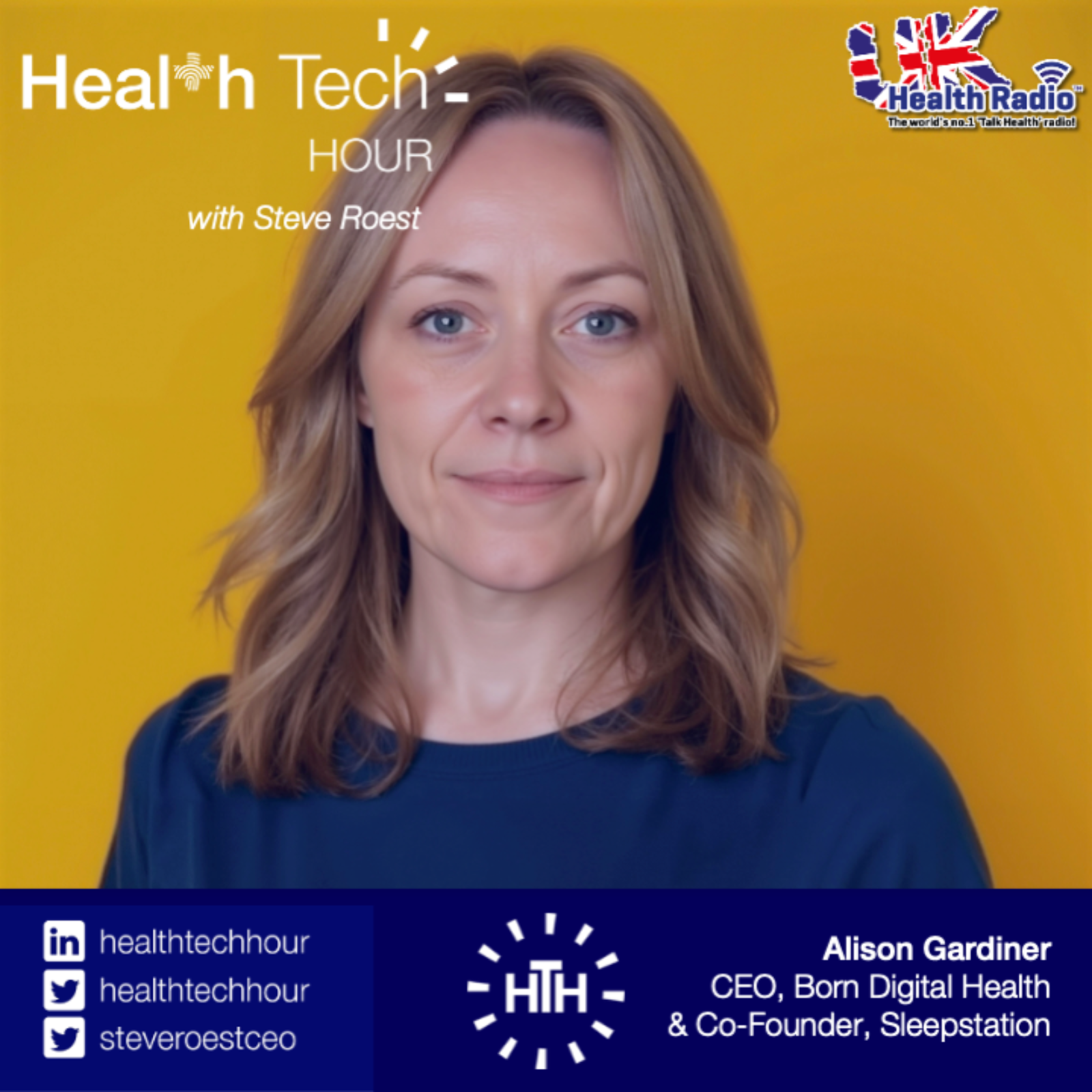
Conquering the NHS with the first digital insomnia treatment with Alison Gardiner, CEO of Sleepstation
57m 30s
This episode of the Health Tech Hour, hosted by Steve Roost, focuses on the issue of insomnia with guest Alison Gardina, CEO of Sleep Station. Insomnia is a significant and increasing problem in the UK, affecting an estimated one in three people, worsened by modern stressors and lifestyle. Traditional healthcare struggles with it due to minimal GP training on sleep and the historical over-prescription of short-term sleep medications, which are not suitable for chronic cases. The first-line recommended treatment is Cognitive Behavioral Therapy for Insomnia (CBT-I), but access was historically limited by few clinics and long waiting lists.
Sleep Station was created to solve this access problem by digitizing CBT-I. Developed from a collaboration between Gardina, a behavioral psychology expert, and sleep doctors, the platform combines human support with technology to deliver personalized therapy. Surprisingly, it proved more effective than traditional clinic-based methods, particularly for long-term sufferers, due to better patient engagement and immediate feedback loops. The service now works with over 80% of NHS integrated care systems and GP surgeries, representing a major digital health success story. The discussion also highlights how patient motivation differs between NHS referrals and private self-referrals, influencing treatment engagement.
Hi, this is Steve Roost and you're listening to Health Tech Hour on UK Health Radio. Each week we give you the best news, views and interviews from the health technology world. From CEOs and founders to entrepreneurs and clinicians, the companies and people that are shaping the future face of healthcare. All on the world's number one, talk health radio. Hello and welcome to this week's Health Tech Hour with me, Steve Roost. Each week we bring you the best news, views and interviews from the leaders, clinicians, politicians, journalists and founders that are changing the face of healthcare in the UK and beyond. As regular listeners know, I am a CEO and founder myself of a business called PopDoc. PopDoc's Health Tech allows you to give yourself the equivalent of an NHS health check at home anytime you want to. So if you want to go and find out more about that, you can go to PopDoc.co or you can go to any of the high street pharmacies or Amazon and we'd love to hear what you think about the Healthy Heart Check. Thank you as always to PopDoc for supporting the show. Thank you also, I say this at every show, but I really mean it. Thank you so much to UK Health Radio for providing the live platform. We love being the largest live health tech show in Europe, which is fantastic. And we also love the fact that UK Health Radio has got so many other shows and content and presenters all doing shows about things that they're really passionate about. So I can recommend taking a look at all of the other shows. Thank you if you're listening on any of the podcast channels, so Spotify, Apple, Google, etc. We're on all of them. Thank you for downloading it. Thank you for listening. We get downloads from people in over 50 countries a month now. So thank you everyone from Australia to Saudi Arabia to Venezuela. We love all of your listening. So thank you so much. And thank you if you're watching this on YouTube on a YouTube channel, which is the Health Tech Hour. Or if you're watching any of the best bits on Instagram on my Instagram @SteveRust or on LinkedIn. So that's all the thanks out the way. The last week show that we did with Rosara Roberts and wow, what story. If you are interested in a real kind of really uplifting journey of someone's sorrow left school at 14, due to bullying, she then managed to sort of bootstrap her way into the RAF and from there managed to bootstrap for separate health tech businesses, one of which was targeted by international mobsters and sort of frauded and all kinds of crazy things like that. So it's a wonderful story of perseverance and that was great show last week. But on to today's show, we are dealing with the topic that we've not dealt with before in the show. So I always like doing shows about stuff that we've not talked about before and it's insomnia. So insomnia affects, I think, well, there's different estimates I found during doing research, but between about one in three people, one in two to one in three people in the UK at some degree. I'm sure everyone listening has experienced some form of insomnia in some way, shape of form and we are we're very lucky to have the CEO and founder of I would say probably the UK's largest insomnia digital health insomnia platform sleep station. I guess they are the largest sort of by default because they work with 80% of all integrated care systems in the NHS and actually over 80% of all GP surgeries have actually referred patients into sleep station. So it's a combination, we'll hear more, it's a combination of humans and technology and it's an unbelievable NHS success story. And so it's great to have the CEO and founder here, Alison Gardina, how are you? Yeah, I'm good, thanks. Please be on. Nice to have me. Cool. So how big of a problem is insomnia? I know I threw some stats out there, but like what's the story behind the stats? It is massive, it's a huge issue, I think it's becoming more of a problem actually because of high society and pressures that we face and distractions that we have in our life have kind of changed how we live. So sleep was really designed to work, was a background process, you're busy and active during the day, you're out in the daylight. And when it becomes dark and a bit cooler, you should fall asleep, but there's lots of other things that are kind of impacting us in today's world, which make that more and more difficult from financial issues and stress and just general always on culture. And rather than it becoming something that's become a less of an issue as years go by, it actually feels like it's becoming much more of a problem and some of the stuff that's happening around how people try to control it actually is making the problem worse. Oh, well, let's get into that, but I'd love to understand because you started sleep station 10 issues, good, good. Nearly 15, no, 20, 15, 21, OK, but like in that period, just in that period of time, have you noticed things getting worse or the incidence level getting worse or or like over what period because I completely if you if you look back, I mean, let's be ridiculous, you look back to like, I don't know, pre industrial days, probably not sure in some near was, well, maybe it was, I don't know, depends on who you're looking at, but I guess what's the impact of the modern world and how things been made worse, I'd love to understand what you think that kind of looks like. Yeah, but there's definitely always been problems, so one of the kind of things that's really important for sleep is to think safe, so in any situation where there's some external stressors and those have obviously changed over time, your ability to kind of relax and and become unconscious for a period. And that's the bit that's difficult, right, the things that stress us have changed, in some cases, they've exacerbated, but then culture around the things that we feel we should control has also changed, so there's kind of two sides to it from our perspective, you know, we've got, we've got one of you of this right, we're seeing people that are coming presenting sick into the NHS, they're presenting with a problem, and we also support people in the workplace who were trying to help them to understand the benefits of good sleep, and they have a slightly different presentation, but they're still kind of seeing in some way as a problem. So that's the kind of lens at which we're looking through it, but it does feel like it's become more commonly understood as a problem, and that larger numbers of people seem to be coming forward with more severe issues than they would have seen since say 10 years ago. Is it any sleeplessness termed in Somnia, or is it in some areas specific term that we throw around a bit willingly? We do throw it around a bit willingly, so in some areas defined by its impact on the next day, that's part of the day, so a problem that's been around for months rather than days, weeks, that where you either have difficulty form sleep stay in a sleep where you wake feeling unrefreshed, that leads to next day impact, and it's that element of it that produces the diagnosis, and that's the bit that a lot of people miss, so stay in up late watching Netflix all night and not getting enough sleep, we're going to bed too late, so you're not giving yourself enough sleep. You're not giving yourself enough opportunity to get sleep is not in Somnia, but where you've got adequate opportunity to get the sleep that you need, but you're unable to get that sleep when it's affecting the next day, that is what would be classified as in Somnia disorder. That's super interesting, so I do feel like these things get thrown around a bit willingly, so at what point does traditionally has the healthcare system, which is free at the point of care? What is their role traditionally, or how they viewed this area of sleeplessness into diagnosis in Somnia and so forth? It's very light touch considering the impact that good sleep has on your whole health, so if you think about sleep as a kind of prevention thing, it's a poor sleep leads to cardiovascular risk to be vulnerable. There's lots of issues that poor sleep is known to create mental health conditions get worse when we sleep worse and it's a bit of a vicious cycle, so we know that when we promote good sleep health that it impacts our general health and will be significantly. But that kind of positive message maybe perhaps hasn't been there in the way that it should have been around the negative, the impact downstream, but what's been taught, so GPs get very little training on sleep, I think the current start is about 26 minutes and the entire training is what was taught on sleep. And actually they feel a bit less a loss when someone comes to them with a sleep problem about what to do because the mean message that they get is don't prescribe the pills and it's very difficult for them to have that conversation. Hold up. The answer is, go back a few steps there. There was a lot in there. Let's un-pick all the back. So it's super interesting. So GPs don't get any real training on sleep. Very little. On any hospital, just energy-resisting much or very much training. So and then you said something in there you kind of threw it in as like an aside where they they they get told not to prescribe the pills or something like that. What what's going on with that bit? So historically, so we've been running the hives. There's lots of different kinds of sleep meds.
come out over the years and ultimately they kind of, they're designed for short term use. They're initially promoted as being a good solution for this and after kind of long term use in the real world, issues are fine with those drugs and we kind of step away from them. So there's lots of deep-rescribing initiatives around historic sleep medication which was designed for short term use. More recently, there are some other drugs that have come out that are designed for chronic use but the messages that GPs have had over the years is don't prescribe these pills, they lead to addiction, they're not solving the real problem and then they're a bit stuck about what to do because they don't have that tool. - They technically, so listeners who aren't keen on geeking out onto NHS geek, geek here, but are they technically legally allowed to prescribe these things, but they're just somehow tried to discourage from doing so. Is it a bit of a weird kind of paradox in there? - Well, the recommendations, so the first line treatment is what we do at sleep station, it's cognitive behavioral therapy for insomnia, that's what's recommended to give a patient first. The problem historically has been, so before we set up sleep sessions, that was delivered in clinics, there was fewer than 10 clinics in the country, they had up to years, wait and lists, people couldn't access it. So the second line treatment would be medication but the medication is only designed for short term use. If the problem's long term, there's no other solution, often people have ended up on these meds for years, sometimes decades, and then it becomes difficult to help the person to come off that medication. - Okay, that makes a lot of sense. So how did you get into this whole area? How did you find yourself entering this wonderful world of tackling sleeplessness and insomnia? - So my background is in behavioral psychology, and I specialize in the development of persuasive technology. So that's the background that I came to it with. My goal was in, how do we help people to change the behavior? And I happened upon a sleep doctor in Newcastle through another piece of work, where we were chatting about what happened in the clinic in Newcastle, and what it sounded like is there's this longstanding first line treatment recommended, evidence approach that's largely formulaic, that people aren't getting access to, because there aren't enough people trained to deliver that. And the interesting thing in sleeplessness, it's actually because that thing isn't that interesting, if you're really interested in sleep. So kind of repeatedly telling somebody the same stuff that's been evidence-based for years, for a problem that's really common, is where a lot of sleep specialists end up specializing in, 'cause they're interested in more of the brain stuff than the rare sleep disorders, and things where there isn't a kind of known solution. So for whatever reason, this was her view of it, was that people don't tend to specialize in that, because that doesn't feel like the best area to specialize in. And then what happens is, while this is widely known as a great solution, access is one of the things that is a problem. And what was interesting for me is, following it was also something that people struggled with. So it's a behavior change program, and actually getting people to change their behavior is one of the hardest bits, so you can have the answer, but actually getting people to put that into practice is difficult. So we kind of joined together and said, well, let's see if we can build a program that doesn't just deliver the theory, but also actually gets people to engage and get them to believe in the fact that this is going to make a difference to make those changes and to get the results that they're looking for. And when you did that, did you, were you just interested in building the best program and you didn't really know that it was going to be a business or did you kind of build it with a business in mind to be able to distribute the program on genuinely curious? Yeah, so I often say I haven't had a real job ever because I started my first business in 2005 and never found a job since there was going to be a one-up as a went. So at the time that we were chatting, I was running a quite successful digital agency, which is one of my, I think, my third business. And she'd actually, her husband had come to us to build something at that time we were offering to build stuff for free if we were interested in it because so it started off as a project. We said, yeah, we'll build it like see if we can make a digital sleep doctor that's how we described it at the time that was the project. Let's see if we can build something that's just as good, gets close to as good as the planet. Yeah. Then we find it was actually more effective than the clinic and. How did you find out? How did you find that out? Because that's quite a big step to find that out, isn't it? Yeah, so it was a big shock to be honest. So I think what we thought initially was this program will be able to treat the kind of loss of air at eight cases, had it for a couple of months, a couple of years, not having any major impact on mental health, relatively isolated, and that's what we'll need to do is we'll need to sign us back to clinic for the more complex cases. What we find is it was effective across the broad spectrum and actually in some cases more effective with the people that had a problem for a very long time. They were more likely to buy into the following the advice. What we find in the early days is that one of the things that wasn't happening in clinic is you would come and sit with a doctor in that kind of dynamic where they know the answers and you're subservient to them. They would tell you what to do. You then had to remember that. Go away and apply that over a couple of weeks and then come back and report back. People either weren't able to follow the advice, didn't quite understand it, had done it a bit wrong in between and then had to come back and be told, "Oh, we've got a restart here," because you didn't quite do what we asked. They lost a lot of their faith in whether or not it was going to work. And we'll get into the, we're going to have a break in a minute and then I really want to get into exactly what the detail is. But is it kind of like a build? So you have to, if you don't move to the next stage, you go back a bit kind of thing and you have to repeat a bit. Because I can totally see why, if every time you enter the sleep clinic, you're getting no further forward, that would have a high drop off rate. I mean, I would get frustrated with that. Yeah, so it is that. And I think having that short feedback looked made it more effective. So there was delivery methods that made it more effective. It wasn't to say that we were doing it better than the doctors. There were just those things that weren't happening in the traditional way of delivering care that actually were maybe making it harder for people to get a good impact with this type of therapy. And were there, how did you find the patients in the first place? I had been stressed. How did you get to them? Hooker by Krog. Actually, there was a BBC show that we launched the original version of the back-off. So we got like a voice and people signed up in the first two days. It was a bit. Oh, nice. How did that come about? So the two doctors that we originally co-designed the programme with happened to be on this show on the BBC at the time. So we kind of coincided the launch of it with that, which worked really well. Oh, that's super cool. And so like after that point, when did you realise it was a thing that you wanted to then invest, you know, a decade and a half in? Or was that. Quickly actually, it was so interesting. I think what you hear from people about how this could problem affect them. It's different every time. You've got a real opportunity to really refine a model not just to work for patients, not just refine a programme that delivers this treatment effectively, but also refine the way that you interact with the health system. So as wherever you place this thing that it actually makes sense for people. So the problem solven bits that I'm really interested in and you get to solve a lot of problems with my brain service as well. Okay. And so how did you, did you categorise people? So you said, "Lone, intermediate and then severe." Like, what does that mean? Originally we did. So originally we had some kind of assessment questionnaires that were pretty standardised in the Somnian Care and we said at certain thresholds, these people wouldn't be supported by us. Then we found, because we ran in parallel a private service specifically because we know that when people self-present they're different to people who present in the NHS. And in that service we weren't doing that segmentation because we didn't have anywhere else to signpost them too. So what we find is actually we don't need the segmentation. So that was really interesting to run the two things in parallel and discover that you might not have discovered it if we just delivered it in the NHS. Oh, that's super interesting. How come they present differently? Sorry, usually people. So if someone, if someone's been referred by their doctor to do a thing, they're not always bought into it as a concept. And then CBT readiness to change is one of the biggest kind of determining factors of success. And those who self-refer and who buy the service for themselves are at that point before they come to you. Yeah, I guess if you reach into your pocket then you're very motivated. Yeah. Okay, super interesting. Right, we are going to go for our first commercial break now with Alison Gardina, who is the CEO and founder of Sleep Station, which is the UK's number one digital therapeutic tackling insomnia. We'll be right back after this break. Don't go anywhere. UK Health Radio. The station that makes you feel good. What if your healing journey could feel empowering, hopeful, even transformative? Welcome to the alkaline collective mastermind, a co-operator.
immunity for anyone facing cancer, staying cancer-free, or committed to prevention. No matter your stage, whether you've chosen conventional care, an integrative path, or a fully holistic approach, here, you're not alone. Here your healing journey becomes a journey of empowerment. We explore the science of oxygenation, metabolism and alkalinity, while strengthening your emotional, spiritual, and physical well-being. This is a mastermind with heart, accountability, connection, wisdom and real support. Because your journey isn't just about surviving. It's about thriving. Join us by clicking on the alkaline collective mastermind banner on the UK Health Radio homepage or directly at alkaline-collective.com, where self-belief grows, healing deepens, and transformation begins. Sarah wasn't bad at her job. She was stuck in hidden grief. After her dog died, she took her sales role just to stay busy, but every pitch felt empty. Her Cognom movement session uncovered that she was seeking the warmth of her dog rather than serving her clients. Using our patented movements and sensory patterns, she cleared the grief and rocketed to the top. What hidden emotion is holding you back? Try our Essentials program at the special UK Health Radio Rate. Visit cogna-movement.com/radio or click on the cogna-movement banner on the UK Health Radio homepage. Results vary. UK Health Radio. Hello and welcome back to this week's show with Alison Gardina, the CEO and founder of Sleep Station, the UK's number one digital therapeutic for sleeplessness and insomnia. Alison, I would love to understand a bit more about actually how the CBT actually works in this instance. Okay, CBT for insomnia is a bit different. I don't know if you've got an experience of CBT in other contexts. A little, yeah. For depression anxiety and another condition to often, we tend to say heavy on the sea. There's lots of cognitive restructuring, focused a lot on thoughts and beliefs. In insomnia, it is more heavy on the bay to start with. So there's behavioral things that we can do that can really help people to reset sleep patterns. And some of those behavioral techniques are the most kind of strongly evidence techniques within the cognitive behavioral therapy for insomnia. So you can think of it a bit like a toolkit. There's a mix of different techniques that are effective, some known to be more effective than others, some kind of core principles that if we get these things right then sleep, sleep should be able to be restored. And what we do is we work with people to understand their personal circumstances, what's going wrong with their sleep, to help them to kind of pick the right tools for their situation and put that theory into practice. Yeah. And this all goes back to some of that core research, I think that you mentioned earlier. But how have you sort of adapted it to the modern world? Because yours is a blended digital and in person, why not in person, but how do you describe it? It's digital and hybrid. I think we're actually struggle to describe it. It's a digital program that has integrated human support from sleep cultures. Okay. I'm glad you said that because I wouldn't have got that right. So how did you end up with that model? Because I'm guessing as you were evolving, there were probably pressures or thoughts about why don't we just do this digital only? Why do we need the humans? It's a fairly perennial discussion within digital health. So how did you resolve your model the way it is? So when we built this concept of being able to talk to somebody while you're going through the program in from the start, it wasn't sleep coaching at the beginning. It was actually built for us to understand if people were facing problems or there were parts of the theory that have been explained to them, they didn't understand. And it was in there because our background was in building systems and having user feedback in is a kind of constant thing that you're always looking at and refining from was a key part of it for us. So we needed that to be there. What we find is that while the theory can be explained to somebody, some of the techniques used in cognitive behavioral therapy for insomnia are a bit counterintuitive. The kind of initial stance for a large portion of people is to think that's not going to work for me and then to discount it. So being able to have that conversation we find was really important. If you can just get them, get those trust early and get them to believe in putting, making them kind of difficult changes to put these new techniques into practice, then actually they start to see that that's working for them and then it becomes a lot easier. And what are some of those counterintuitive things or the most counterintuitive? So the core technique in CBT for insomnia is a really terribly named technique called sleep restriction therapy. Now if you've got insomnia and you get told you need to do that, so the volume got to say no thanks. So it's badly named and in recent years the kind of consensus is we should call it something else and we call it sleep reschedulant in sleep station or sleep ration. But what you're asked to do is when you're already struggling to get enough sleep and feeling exhausted, the technique suggests that you should stay up later and feel even more tired. And people really don't buy into that. So you need to really have some time to explain the science to get them to… What is the science? So sleep, there's a bit of a myth about how much sleep any one people need but an average person needs to be awake for about 16 hours before they'll have enough kind of sleep control by two processes. But before those processes will be aligned to the extent that someone can fall asleep fairly easily and get a solid night sleep without any kind of perceived awakening during the night and wake up feeling refreshed. What tends to happen when someone hasn't slept is because they're not waking up feeling refreshed or they're waking up lots during the night, they start getting into that earlier and earlier. And that is often before those two things are kind of at that kind of golden peak to actually promote healthy sleep. So what you need to do is reset that little bit to go a bit beyond where it would normally be to make sure that the pressure is there and that sleep will come more easily and that starts to re-train the body and to help the person believe that their sleep can be restored. I can imagine that's very difficult for people to get their head around to become with. Yeah. And then they just don't follow that. So one of the things that they often get cited is that high drop out rates should be assumed to be the norm. Oh, you know, we deliver this and for people that do engage with it and follow it, they get great outcomes but there's high drop out. That's something that we've always resisted and said it doesn't need to be that way. If you can frame it properly and give people the proper support at the beginning, they don't need to drop out. Therefore actually what you're going to get is the much bigger group of people who get those good outcomes. Yeah. Yeah. So was it at what point in your journey and the evolution of the platform? Did you take it to the NHS? Did you begin your NHS journey? Day one, to be honest, because we did it. We built the first version of the programme in partnership with Newcastle House Bill. And that was just with some consultants who worked there. It wasn't a commissioning level. We delivered it and reviewed it in that context and did our initial pilot within about four or five months of building the programme. Oh, cool. And I know that you've got your scars from NHS scaling. But did you, what did you believe NHS scaling would look like at that point versus the reality? To be honest, I didn't know what it was going to look like because I hadn't worked in the NHS before. And in the early days, we were one of the first apps to be recommended in the NHS apps library. You know all that? Yeah, way back when. Yeah, way back when when digital was something that you had to convince people of. So the early journey was around convincing people that digital could be safe. It could be effective. It could be a solution. And you know, that's a very different story to what you're trying to talk to people about today. You know, everyone's kind of bought into the concept of what they're looking for now is safe delivery, you know, proper handling of data. You know, where do patients go after this? How does this, where does this sit in a pathway rather than just being something that sits on the outskirts? Yeah, that's an interesting point. Like what happens in the Antonio pathway? What is the, where does it go? That's really interesting. I've not told that before. Yeah, so I think that some, some of these kind of ideas that if you get, you know, if you tell someone to download an app that that's a solution, we know from real world practice over more than decade that that isn't a solution because there's a large group of people that don't understand how to do that still. So those people are already excluded. And then there's people who might download the app, but they, they don't engage, they don't follow the advice, they don't get the outcome. And one of the risks to the system now that there's new drugs available for chronic insomnia is that those drugs become available.
if somebody has tried CBTI and it hasn't worked. So what you want to do, you want to make sure that CBTI is actually delivered. If we've got a situation where we're not really delivered in the intervention, we're just getting somebody to download an app, then that has a really impact. - Interesting, I read something on your LinkedIn when we were doing research for the show about how that, that we have to be super careful not to introduce like a accidental law of unintended consequences here by having bad first line therapies or badly delivered therapies, which then effectively just punt more people into these chronic drugs, which have been sort of blessed, so to speak, as non-addictive or not harmful. So everyone feels okay, but you're basically just putting your investing money in poor CBTI therapies to just basically refer on to second mind from Seeds Core. - Yeah. - For a super interesting post. - Yeah, and I think that there's also the personal story there too, if someone believes that their problem isn't solvable and that there need to be on this medication for life, that affects their wider belief about what health problems they could control themselves. So one of the things we try to do in sleep position is empower people to self manage. If you can help them to understand that this big problem that they thought was unsolvable, they've had it for decades, they thought it was never gonna go away, it's almost become part of their identity. Then that solvable, and they did it themselves through changes that they made, we then get reports back with it saying, "And you know what, I put these same principles "and practice and stop smoking, I reduced my alcohol intake "because actually I was just drinking "because I thought it would help me get this." It's got all those kind of wider benefits that are. - That's really interesting. I couldn't really agree with you about that statement, about insomnia becoming part of someone's identity. I've experienced that a few times with sort of friends or co-workers over the years where it's like, I've gotten some of the air and it becomes a part of who they are. - Yeah. - And it becomes really difficult to get passed out for them. - Yeah, it becomes of kind of fixed belief, doesn't it? I'm a bad sleeper. - Yeah, exactly, I'm a bad sleeper, I'm a bad sleeper. Super interesting. So how, what, there's anything shifted over the last few years 'cause I know that nice, we're a broad church, so nice, just generally, I'm sure most people would have heard of nice, but nice is basically a sort of quasi-regulator in the UK that will then dictate what drugs and treatments the NHS should offer to patients effectively, right? I think it's more of like a, is that a fair sort of broad brush definition? - I wouldn't say it's a regular. I think a lot of people say nice or irregular, but they're not like, in for digital health, MHRI is the regular of the medical race. - Is the regular. - Yeah, and so it's the nice, produced guidelines, and in their guidelines, they've recommended CBTI as the first line treatment. They more recently have kind of moved into this kind of med tech pathway where they're looking at multi-tech assessments for technologies, but their recommendations, there are recommendations to say this is a cost-saving option, where they historically haven't been mandated, like TAs, you know, like if a medication gets reviewed by nice, there's a mandate there that says this medication is a cost effective and it should be used. - Yeah. - It's not the same for digital health, so I think that there is a lot of confusion around nice as a role in health care. - I really agree with that. - Yeah. - So did they just decide to review CBTI? CBTI, is that what you say? - Yeah. - CBTI in general, or was it sort of a cover for kind of looking at what you're doing, 'cause you were the only people really doing it, hopefully at scale. - So is there a funny story? So in, the sleep position have been around and commissioned and delivered across large portions of the NHS for a long, long time, and nice didn't review health technologies, so we had no, you know, we're not looking at a nice school, and what a nice student today. And in the background, they decided to review a, well, companies can put themselves forward to nice if they want their drug reviewed. - A bad drug. - Yeah, and his store, and as a one off, they also did a single technology assessment for a digital health product. So there, so nice previously assessed a single technology, not our technology, in isolation. And since that, we've said to them, well, this isn't really, you know, that's not really how things should be done. If you're gonna look at technology, you should actually open this up to the market and let every bad technology be assessed, because it's quite difficult for a provider, this is one of the challenges we've faced of a recent years, to never have been assessed by nice, but then to have to kind of defend the position of something else as the only product recommended. Well, if you're the only product that's been assessed, it's not difficult to be the only one recommended. - Well, and also it's not, so I know the companies are talking about Sleepier, I believe, you're afraid to, so they made a big splash, it was in the press and stuff about how, so this was one of the reasons why I really wanted to do the show, because I remembered that splash, right? And when I remember reading it at the time, not knowing anything about the sector, and I remember believing, oh, cool, this must be the first thing in this space, I can remember that. And so when we was talking to your team about coming on the show, it's why I really wanted to do it, because you've been doing this at scale in the NHS for like 13 years or something before that. Which I just thought was just a remarkable kind of turn of events and just a great story. So I just, yeah, that's one of the reasons why I wanted to do the show. - Yeah, so it was difficult for us. It was very difficult to see something, you know, PR campaign that puts forward that there has been no solution and now you're GP's work. What's it referred to this when you're getting thousands of referrals every month from GP's? That is very difficult. So we challenged NICE on that at the time, and they said, oh, sorry, we didn't know you existed. So that, you know, that's the, I think, horizon scammens should have happened. You know, there haven't been any kind of direct responses from NICE where they've said, oh, you know, we made a mistake there, but they, what they have done is they've decided to assess all products together for the first time, which is happening at the minute. And I think that, you know, that's welcome, because I think that it's very difficult for any provider to be in a space where there isn't kind of that level play in field. You can't, you can't, I mean, the one thing that the regulators or quasi regulators or central government funded instruments for one of the better work, they can't pick winners. No, yeah, they're, they're, they're, they're, everyone together. Yeah, yeah, because otherwise you're, you're just, you, those, those types of institutions can manipulate markets, basically. Yeah, and we've definitely seen market distortion happen as a result of that, you know, to be, to be the largest provider, you know, with significant real world evidence. And then for our commissioners to say to us all, our reading of this recommendation is that we have to use this product now and us having to say to them, that's not actually what that means. This isn't a nice TA. That, that kind of thing, you shouldn't have to be faced with that as a, as a provider. And I know I'm sure you've been there with challenges that you have to kind of manage that really shouldn't be happening. But I think for, for future, we need to make sure that we make it a fair. Well, I think, I want, I'm, so, you know, I'm lucky enough to sit on a couple of these NHS advisory board things and, and, and, and the national innovation accelerator and things like that. And, you know, I'm, I'm, my position on this stuff is super clear, which is, you have to create, like you say, a level, level playing field. And you either do it right or don't do it. So this idea that certain institutions, maybe nice, whatever, are going to start to move away. So I think nice does a really amazing job for pharmaceuticals from what I can tell. I'm not a drug guy. Don't, I'm sure big farmer might, or, farm, farm people might say different. But from the outside in, looks like a pretty decent job, right? They've got that process pretty tight. Like everyone knows they need to use it. The, the, the kind of follow on uptake, how, how those drugs actually then get prescribed and stuff like that. So the payoff is all very nice and neat and stuff. None of that exists for METTEK. Now, none of it. So, and, and the number of METTEK devices in the world is significantly more probably than drugs and new drugs entering the market. So I get really confused and slightly concerned. I don't know about you, where, where I hear that, nice is now going to start assessing METTEK and like, they're not that big an agency. So what are you going to do? Like, how are you going to ensure that it's not just randomly picking things to look at? How are you going to make it organized? And then also there's the big, so what factor, which is, okay, you get assessed by nice. And so what, like, happens, like, who cares, kind of? Yeah. Like, I mean, I don't know. So I think as a METTEK, I think it's really big to bake. Because I've heard stories about maybe they could do an assessment a year or something, you know, there's not even going to scratch the surface. No, exactly. And there are choosing topics that they're going to prioritize. And also you've got no say in whether or not you get engaged in that process. So the companies may not want to go through that process. because like us, they're already commissioned, they're already
to deliver in services they already have customers, they don't need a stamp from nice, but if you don't go through it, they will make a determination based on what they find about you in the public domain. Well that's a real risk for organizations that don't focus on PR and public presentation and randomised control trials. Personally I don't believe that randomised control trials have a big role in health tech because in the real world people are different, you don't get to select your cohort really closely. I also think that there's a big, I mean again I think one, if they choose your sector you have no choice unfortunately, but to engage because they risk your child life, but no choice you're in it, right? And who knows how much bandwidth your company has or financial resources you have. So you know we're in the sector so we know, we can serve it to believe it's a number of hires over a number of years to do a proper assessment and support that with nice properly. It's a big deal. So there's that element of it and then I think there's this other element of it which is you know the randomised control trials just for everyone listening in in Met tech like in farmer, some people are farmer they're expensive but in farmer, farmer companies have huge amounts of money, I mean like insane amounts of money because when you get through those trials and you get nice success than approved you know exactly how much money you're going to make after that because you go on the what's called the prescription framework so you know that you will get money so it's very very clear whereas in Met tech none of that stuff exists. So you're not going to invest in yeah. You know, go so you don't there's no guarantee at all that being nice approved makes anyone any more money ever period. And in fact the evidence would point to the opposite because what we find is anyone that has in digital health has got a nice recommendation they haven't got any contracts as a result of it. So you know that's been the story that's been you know put forward by those organisations they're saying or despite this positive nice recommendation we still this product still isn't available well that's because it wasn't supposed to make your product available the nice recommendation must be given commissioners confidence to buy and if they haven't got that confidence to buy them you know that isn't so this is something that I mean my my producer is going to get mad because we're going to have to stop for a break and say but this touches on something that I feel really passionately about which is like if the NHS isn't buying your product right that's your problem. Your problem. The NHS is given. Yeah. Like like it just because it's innovative and it may have got a nice recommendation it may have got all these different things but that doesn't mean that a commissioner has to buy it yeah that that helps you don't get me wrong. God Lord knows if you get nice recommended in theory that should help should help good Lord you know we know if we if we all got offered a nice recommendation I think we'll have to be honest we take it but you know but this idea that just because that then that removes any need for you to go and do customer discovery network engage solve problems you know. Generate real world evidence. Yeah like boots on the ground be scrappy to you know to deliver and so on and the thing that really gets me around this is that I suspect if I could be bothered to check which which I'm not going to but if I cross reference those companies that were complaining about the nice guidance they're probably the same companies complaining about how bad the NHS is adopting innovation and I think businesses like yours and you know humbly although we've not been going for anything like as long hot dark and there's a few others like Accurex and Darkler and a few other people though like what happens is the narrative becomes about the people that aren't succeeding. Yeah not about the one they're just getting the job. Like you see you're not like I don't think that's going very well at all for my account and now the narrative will be and is from from CPEO about how they've been let down by the system and that really muddies the water forever and else. Yeah and it makes people who would innovate in the system not want to try and what I'm trying to do is to get people in the sleep world who have got novel ideas to get involved and what we don't need is people saying oh we shouldn't get involved because the NHS isn't buying anything they are but they're just being careful about what they buy and testing it first and you know not jumping to national contracts based on a bank. National contracts are kind of they're not a myth necessarily but I just it I feel like that's just everyone's kind of get out which is like I'll start the company I'll go get a national contract and oh wait that's really hard and really impossible oh god the NHS sucks oh okay well I'll try and another country then. Yeah it's an investor story rather than a reality of how the NHS has ever really worked. Yeah I think there is talk of national reimbursement for certain you know certain products that are in high-priority areas and that that make certain criteria but it's not everything that joins you know every idea that you come up with suddenly should have national reimbursement because you say it's scalable that's just yeah thank you. Yeah hey we're going to go for my last the last commercial break with Alison Gardina the CEO and founder of Sleep Station we will be right back don't go yeah UK Health Radio at the station that makes you feel good imagine every day clients walk into your office with their concerns about intimacy, identity, desire and trauma questions that require more than basic training emotional and sexual dynamics are evolving and today's professionals must evolve with them we hear from parents unable to start conversations with their children around identity too often adolescents have learned their sexual ideas from the internet couples have difficulty communicating about sex with each other at the International Institute of Clinical Sexology you can gain the specialized skills and knowledge to address those issues with confidence whether you are a therapist coach educator or other healthcare professional our advanced certifications and PhD program empower you to become a highly skilled sought after sex therapist expand your expertise elevate your earning potential start your journey today with the International Institute of Clinical Sexology imagine making a difference in our world learn more at clinicalsexologyphd.org Apple's and pears beef and skittles cider with rosy common or garden and and deck fish and chips mum and dad UK Health Radio and Health Triangle magazine each is good by itself but enjoying both is always better at health triangle magazine to your monthly health regime check it out at uk health radio dot com stork risen cream UK Health Radio the station that makes you feel good hi welcome back to the final part of this week's show with my amazing guest Alison Gardina the CEO of sleep station which is the UK's largest digital therapeutic support platform for insomnia and sleeplessness so before we get back into kind of kicking around stuff about the NHS and things like that i want to make sure that everyone listening because i'm sure you know we got we get over 300,000 300,000 streams a month now if anyone anywex i know your international has is the is struggling with sleeplessness where can they go and how can sleep station help them so we do provide a global service to our wellness program so they can come to us if they want to our website sleepstation.org.uk but if you're really struggling depending on where you live with with your sleep i would always recommend chatting to your GP first so i think that making sure that there's not any other things to rule out is important that's something that we do in our NHS service so in the England people can come to us and we'll do all that for them but but internationally making sure that it is in insomnia and it's not something else is a good start and point okay cool and have you noticed any differences internationally about how people interact with this are they like cultural differences in you know nationality differences yeah absolutely so i think in the UK people are much more likely to follow the advice rather than question it so yeah we it's much easier in that regard but the yeah there's lots of cultural differences we all need to deliver a sleep session in English at the minute so obviously you know it's not full spectrum but it's interesting but do you believe that there's a international well i guess you do because you do it but how much of an international sort of play here do you think there is like are there sleep stations now in lots of countries not not your you know like people doing something similar or like no because they're certain cultural differences and it just doesn't fly yeah there are different programs all across the world so cbt for
and suddenly it's been around for more than 30 years, so we've gone in the 40 years. So there's lots of digital programs where people are trying to deliver it largely. In most cases, they deliver it as a kind of automated e-learning platform. Sling session is pretty unique in the fact that there is support, but there's more and more services like this coming up all the time. And I think great, because competition people thinking in new ways to approach things like that. - It's like being in a way. It sucks being the only one in a category. - Yes. - Because then it's easy to ignore the category. - Yes. - Which is what we think. - Taking the, like, with NHS commissioners and things like that, it's just easier if they're, you feel the only one, whereas if there are lots of people approaching them, then it becomes a bit of an easier conversation and it's about who's the best, as opposed to whether we should do this or not. - Yeah, definitely. - I'm super interesting. So where do you believe is the most likely next destination for you guys internationally, or within the UK? Like what's kind of next for sleep station, the next evolution development? - So we've just launched a kind of full service digital sleep clinic. So rather than we already have customers, we, some of the largest employers in the world are our customers. So we already serve decent corporate clients globally. And we have the kind of medical device, healthcare service in England, what we're looking today is broad in that service. So in summary is one of the most common sleep disorders, but it's not the only, there's about 96 different sleep disorders. - Oh well. - And sometimes when you don't know if you've got insomnia to begin with, then deliver and CBTI for insomnia and not getting a good result means that that person, might think, you know, their problem's not solved, but actually their problem's something else. - So we're looking to kind of extend into support for other sleep disorders. So as we can, - 96. - Yeah. - 96 sleep disorders. - I think it's 96, I'll check. It was one of our team. The last time I got this data was 96, yeah. - Wow. - Yeah, it's a huge amount. - Yeah. So some of them are super rare, but yeah, there's lots of different types of sleep. - Well, after insomnia, what are some of the more common ones? - To sleep that, near. - Oh, that's a big one. - Yeah. And there's different types of sleep that, near. - Restless leg syndrome is, is it, is it, is it, is it, is it, - Is restless leg syndrome in sleep? - I know, to be honest, I actually know that's a sleep disorder, but it, because it's a syndrome, but, you know, it's not, I'm not a clinician, it's not my area, I've never actually changed, but, but there's lots of common ones that we come up with, REM sleep behavior disorders, and when people kind of act out their dreams, though those, you know, that's a different, a very different problem. They're all circadian rhythm disorders. So some people, the timing of their sleep was just off at that, and it's difficult for them to sleep at what would be considered normal times. - Okay. - Lots of different types of disorders, and they have different types of treatments. - And, I mean, it kind of goes without saying, I would suspect that like, this must be really overwhelming for GPs. - Yes. - Right, they're a night, I mean, how do they even begin to try and determine what is going on? That's, that's crazy. - Well, this is the thing, and it's why we've, we've changed our NHS service, because 30% of our referrals are for things that we don't do. - So obviously we don't accept those referrals, but GPs are a fair and task of assuming that we can treat this problem when we can't, or, you know, maybe assuming that there's this issue and we can treat the comorbidity, but what we're looking to do now is to say, well, actually we'll, we'll assess that portion properly, and we'll provide a diagnosis, which we don't do in the app, and we'll get them access to the right type of care, because that's one of the kind of problems I see with point solutions is somebody might be told to download an app, it might not be appropriate for them, if there's no support in the app, and the user doesn't know, there, you know, there's no solution there, and then do they come back to the health system? At what point do they come back? Probably when things are really severe, what we want to do is catch them early, get them to the right care as quickly as possible, and support them to self-manage. - That makes a total sense, yeah. I mean, like if you, if we've got, you know, with the best of intentions, but still a misdiagnosis, and then you're told to download something that doesn't provide you with an ability to tell, to speak to somebody about what's going on, and it doesn't work, then you're going to be very frustrated, at the least. - And people feel like there are lost cause, and you don't want to make anyone feel like that. - No, no, right, so in the last couple of minutes of the show, I always ask the person that comes on to tell us how or what kind of motto or phrasing that they rely on when things get tough and difficult, and I'm sure that having had 15 years, selling into the NHS as well as building three or four other businesses, there's been some tough times. So what kind of things do you tell yourself or self-talk to you have that you might share with everyone listening that might help them? - My go to is you've solved bigger problems. - Okay, yeah. - Yeah. - Yeah. - But like, does that scale, if you see what I mean? Like how, you know what I mean? Like what happened? Is there some in your head? Do you know the biggest problem you've ever solved and it never comes close to that? Well, like, how do you kind of frame it? - Yeah, I think one of the reasons why I was interested in digital health is cause I have a chronic disease myself. And I think that when you've been through bigger problems, that actually, it's all solvable, isn't it? - So that's, yeah, that's what I tell myself. - Yeah, and do you feel as well, like, part of the founder role in any company is to be that calming influence, to try and help people understand that everything's solvable? - Yeah, hard, isn't it? But we try. (laughs) - Yeah, I do think it's really difficult, like, especially when something goes wrong. And particularly if it's something that like, either you didn't expect to go wrong or really shouldn't have gone wrong, you know? Because sometimes if you're doing something really, really, really difficult and it's experimental, results might not work out the way you want. But if it's cause someone, I don't know, left the lights on and left the door open, then that's a bit more frustrating. But I don't know what the equivalent would be in your world. But yeah, that stuff gets me. But you just have to take a step back, I think, and try and, like you said, I think you're, we've solved bigger problems as a really good one. - Yeah, and you're just one person as well. I think in our role, you often feel like you have to be able to have an answer for everything. And actually, yeah, you've got to kind of realize you're just one person as well. - Well, that's why I love this way, because I don't come from a healthcare background. Like you, but that's why I love health because of digital health or health tech. I literally can't solve these things because each area is so complex and requires really qualified people to do things. So that's quite freeing, actually, I find. - Yes. - You know, I'm not going to be very helpful if I taught in LabCode. Yeah, so, anyway, Alison, thank you so much for coming on the show. It's sleepstation.org.uk, is that correct? If you'd like to go ahead and go back. And brilliant to have you on the show. And thank you to everyone for listening. We'll be back here in next week with another show. - Thank you.
Podcast Summary
Key Points:
The Health Tech Hour is a weekly show on UK Health Radio featuring health technology news and interviews, hosted by Steve Roost, who also promotes his company PopDoc.
The episode focuses on insomnia, featuring Alison Gardina, CEO of Sleep Station, a digital therapeutic platform that provides cognitive behavioral therapy for insomnia (CBT-I) and is widely used within the NHS.
Insomnia is a widespread and growing problem, exacerbated by modern stressors and an "always-on" culture, yet it is often misunderstood and inadequately addressed in traditional healthcare due to limited GP training and over-reliance on short-term medications.
Sleep Station was developed to make evidence-based CBT-I more accessible and effective than traditional clinic-based methods by using digital tools to improve patient engagement and provide immediate feedback, proving more successful even for long-term cases.
The platform's success stems from solving access issues within the NHS and adapting to different patient motivations, whether through clinical referral or private self-referral.
Summary:
This episode of the Health Tech Hour, hosted by Steve Roost, focuses on the issue of insomnia with guest Alison Gardina, CEO of Sleep Station. Insomnia is a significant and increasing problem in the UK, affecting an estimated one in three people, worsened by modern stressors and lifestyle. Traditional healthcare struggles with it due to minimal GP training on sleep and the historical over-prescription of short-term sleep medications, which are not suitable for chronic cases. The first-line recommended treatment is Cognitive Behavioral Therapy for Insomnia (CBT-I), but access was historically limited by few clinics and long waiting lists.
Sleep Station was created to solve this access problem by digitizing CBT-I. Developed from a collaboration between Gardina, a behavioral psychology expert, and sleep doctors, the platform combines human support with technology to deliver personalized therapy. Surprisingly, it proved more effective than traditional clinic-based methods, particularly for long-term sufferers, due to better patient engagement and immediate feedback loops. The service now works with over 80% of NHS integrated care systems and GP surgeries, representing a major digital health success story. The discussion also highlights how patient motivation differs between NHS referrals and private self-referrals, influencing treatment engagement.
FAQs
The Health Tech Hour is a weekly show on UK Health Radio hosted by Steve Roost, featuring news, views, and interviews from leaders in health technology.
PopDoc is a health tech business founded by Steve Roost that allows users to perform an NHS-equivalent health check at home, available via PopDoc.co, high street pharmacies, or Amazon.
Sleep Station is a UK digital health platform for insomnia, founded by Alison Gardina, and it works with over 80% of NHS integrated care systems and GP surgeries.
Insomnia is defined as a long-term sleep problem (lasting months) where difficulty falling or staying asleep leads to next-day impacts, such as feeling unrefreshed, and it requires adequate sleep opportunity to be diagnosed.
Cognitive behavioral therapy for insomnia (CBT-I) is the recommended first-line treatment, which Sleep Station provides digitally, as traditional clinic access has been limited.
GPs are discouraged from prescribing sleep pills due to risks of addiction and short-term effectiveness, and they receive minimal training on sleep, making CBT-I a preferred but historically inaccessible option.
Chat with AI
Loading...
Pro features
Go deeper with this episode
Unlock creator-grade tools that turn any transcript into show notes and subtitle files.
 PodcastTranscript AI