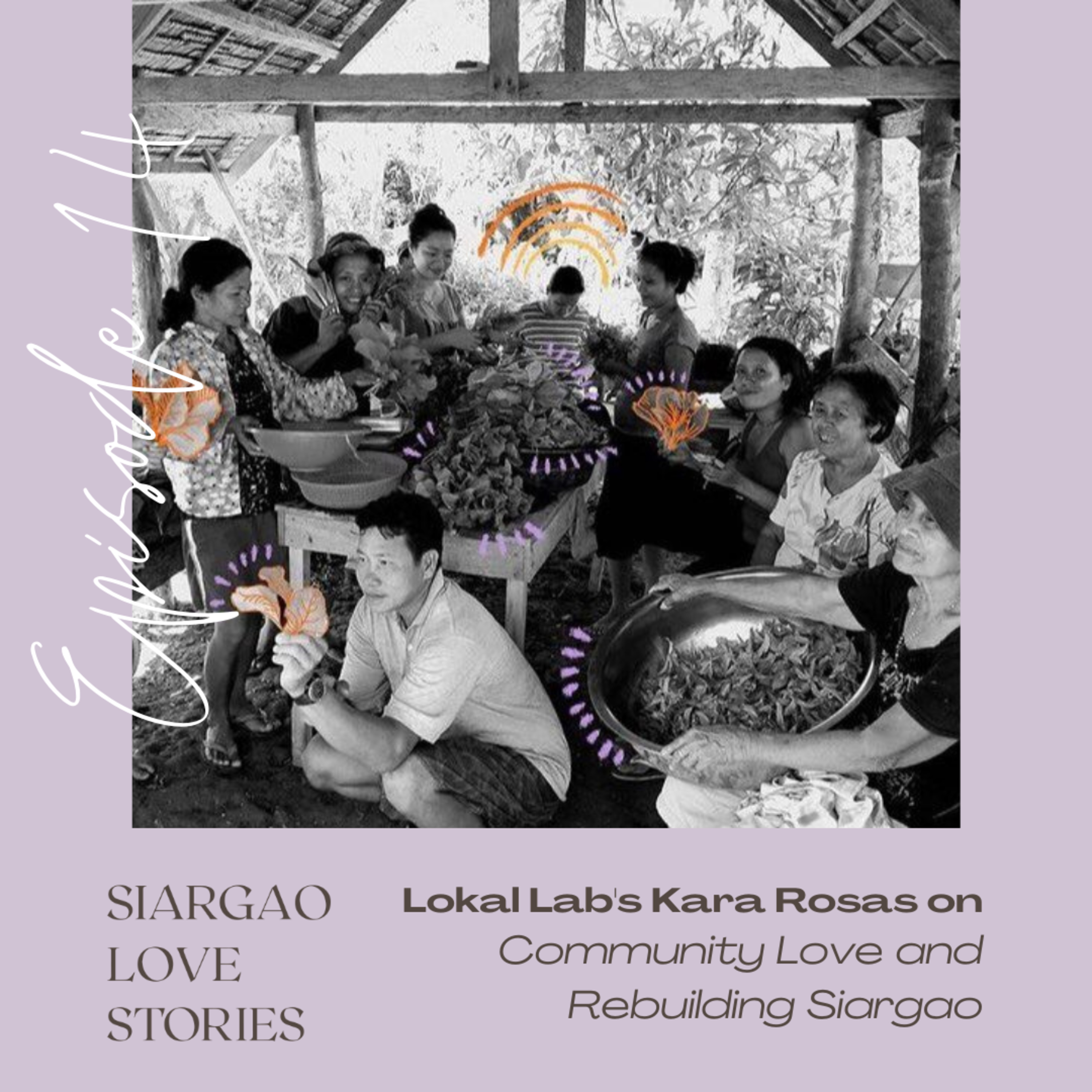
Community Love and Rebuilding Siargao with Lokal Lab's Kara Rosas
from Siargao Love Stories
41m 43s
Typhoon Odette devastated Shaga, destroying 95% of its infrastructure and leaving communities without power, communication, or basic supplies. In the immediate aftermath, Local Lab, a community-led nonprofit, swiftly mobilized from outside the island to coordinate emergency relief—delivering food, water, and shelter while maintaining a deep commitment to local autonomy. Rather than imposing solutions, Local Lab empowered residents by listening to their needs, such as through conditional cash transfers and community kitchens that served over 90,000 meals daily. The organization focused on rebuilding sustainable livelihoods by training farmers and fishermen in resilient farming and fishing practices. Central to their mission was preserving local culture and knowledge—like using fallen coconut trees for home rebuilding through their Coco Lab project. As the recovery phase continues, Local Lab’s work shifts from emergency response to long-term resilience, guided by community input. The story of Shaga reflects a powerful model of grassroots resilience, where local agency, emotional strength, and collective action transform trauma into hope. The island’s recovery is not just physical but cultural and societal—a testament to the power of community-led healing and sustainable development.
(upbeat music)
On December 16th, 2021, unimaginable happened.
Our small island of Shaga was hit by Typhoon Odette.
One of the strongest storms on Earth that year
and declared category five with winds that reached
over 260 kilometers per hour.
The result was catastrophic.
95% of Shaga was completely destroyed,
including the homes and businesses and livelihood
of the local communities.
With signal down for days and no communications
on the island, grassroots organizations
and individuals outside of Shaga
mobilized fast to send help to the island.
By now, you've probably already heard
of the nonprofit organization based in Shaga
called local lab who led the charge and took action fast,
raising funds to help get relief goods and shelter
to the island during that first week,
that very crucial week after the Typhoon.
In this episode, we speak with Kaira Roses,
co-founder and president of local lab,
and the main point of contact in Shaga's relief operations.
Kaira shares her experience as someone outside of Shaga
on the Typhoon hit and takes us behind the scenes
of the relief operations from her perspective,
how she felt at the time, some of the winds
and some of the challenges she and her team faced.
We learn everything there is to know about local lab,
its mission, its present and future projects
and ultimate dream of empowering the local community
to create a self-sustainable island.
We also hear about incredible stories on the ground
of local individuals finding smart and resourceful ways
to help as many people in their own communities.
At the time of recording it was exactly one month
after Typhoon Odette landed in Shagao.
The reality of this situation is that there is still
so much to be done and still so much pain
and trauma that lingers, especially from those
who experienced the storm firsthand.
But there is hope and it's incredibly inspiring
to see so much strength and so much love
in Shagao's community that there is no doubt
that we will rebuild from this
and only come back stronger.
Thanks so much for listening.
(upbeat music)
So this is actually our first time speaking to each other
in a while like since everything happened in the Typhoon
since even before the Typhoon.
I just wanna know how are you like what is happening
right now with you?
Yeah, no, like thanks for reaching out.
We're really so excited to have this episode
and like share our story.
But I'm like for me personally, like I'm doing well,
like I'm okay, but I guess for everyone also
from the island, like we've all been feeling
like a mix of emotions really.
Like from being so thankful and so shocked
there's so many people really helping out
and then frustrated because there's so many
logistical nightmares, communication, things going on
and also just like feeling so much sadness
that there's so people who don't have roofs,
who people who aren't getting any help at all
and some people are aspiring.
So I don't know what I'm feeling
but I'm feeling like just everything all at once.
But what I do know is like that I still feel confident
in knowing that sugar can be rebuilt
because of the community that we have.
Yeah, for sure.
And you know, like for people who don't know this,
you have just been working non-stop since it happened
and I just personally wanna say like thank you
for everything that you're doing.
I think you're just like some sort of super human robot
with human emotions or something
because you're able to do this and continuously do this
even after a full month after the typhoon.
So I'm just, I wanted to kind of check into you
and see how you were doing.
You were outside of the island
when it happened right you were in Manila.
Yeah, so I went home for the holidays
just a week before actually.
Yeah, same, same with me.
I literally landed in Canada
and then a week after the typhoon hit.
How did you feel when you heard what happened?
Do you remember what you were thinking?
Like I remember that the storm was coming
and that people were already being told to evacuate.
So it's early in the morning,
I couldn't get a hold of like anyone in burglars anymore
because they lost signal.
So I was kind of freaking out and saying like okay,
this might be worse than expected
and then we like everyone just kept checking windy
and we saw that the storm was gonna be a direct hit.
So and a storm hit she got like last December
and it kind of really affected like all her farms.
That wasn't even a signal number one storm.
It was just a storm, but and so I knew I had to act
right away and said okay,
if this is gonna be a category five typhoon,
I can't imagine what the damages are,
but we have to start like bringing awareness
for it and raising the nations.
So I think when we lost signal,
like complete signal, even with the people in general Luna,
this is around 12 o'clock or one.
With me and my marketing team,
I told them like okay, we have to prepare something.
Let's post the nations already
just so that we're sure that after the storm hits,
we have some money to help bring back our farmers.
And I think like during the whole day,
I was just talking to everyone like from who weren't residents
in the island who weren't in the island.
We were like all panicking,
wondering what was happening,
thinking that the signal or electricity
would come back like at night
and we could talk to our friends,
but we still didn't hear anything.
And I think like that night, I didn't sleep so well
and like neither did other people.
And the next day, I asked you like okay,
we have to do something.
So that's when we kind of organize itself.
Actually, no, even on the same day of the typhoon,
we already set up job of points
and found the logistics company
to help us deliver goods to the island.
It was just so hard for like the next three or four.
I'm not sure when we got signal again.
And like when we heard our first news,
but I think this was the third day
when we heard what really happened
and that person who escaped to but one
uploaded the first photos of what happened to Shagau.
And it was really just so nerve-wracking,
seeing like the devastation, right?
That it brought, and not knowing if our friends are alive,
if our families are alive, the communities are alive,
'cause always we're seeing us just photos first.
- Yeah, I tear up thinking about it
just because it was one of quite possibly
from me the worst feelings to not know, right?
But luckily, yeah, we, you know,
I mean, local I was one of the,
one of if not the first organizations
to take action immediately, you know,
from day one, you mobilized fast, like you said,
to raise funds together, relief goods, you know,
food, water, temporary shelter.
You were kind of the main touchpoint
for many of the efforts simultaneously going on
within the first couple days since the typhoon hit,
which was amazing, like for you to already think ahead
as to they will need help knowing that it's a category five.
You already knew before you had word back that they will need help.
Can you describe for us what those first few days were like
for you and your in and local lab trying to,
apart from also the emotions,
this is your home as well as, you know,
as many other people who were witnessing this outside
and just kind of on the edge of their seats, not knowing.
What were those first few days like trying to help
without any signal, without even knowing, like you mentioned,
what was actually going on?
- So I remember like, I had a hard time,
because I was the only person from my team
that was outside of the island.
So I had to make decisions on my own and I was like,
and this is like when I saw me feel like all the residents.
So like we were all just coming together and helping out
and seeing how we could help.
I remember the day after the storm,
I met up with Sam and Summer and Nicole
and we were just like planning our next steps.
What do we do?
I think we were even shocked because I think just the first day
we were able to like get way more than we expected.
And so we're like, okay, like let's mobilize this,
let's send help as fast as we can.
What we did was we really just like strategized, found people
who could do the logistics for the incline, the nation,
we were doing, 'cause at first we didn't know,
like we knew that we had to send things to Chicago
to the island because like we could even if we raised the money,
we had to find how could it get there,
who's gonna receive it and all that.
And I remember like we were just all like really just like
work mode, like non-stop trying to find solutions
to like answers we didn't know,
'cause we didn't know how bad the storm was.
We didn't know if people were alive,
if people were dying,
we didn't know if planes could even land,
if the boats could even land.
And I remember like one of the first days
that the plane left, I went to the house.
And that's when like I saw all the locals and like the residents who were stuck in another like fly back to Chicago
So Ike it was there and other people too who were trying to get help back to the island
And I remember just like seeing everyone's face. You could just see everyone's so worried
They don't know what's happening. They're just scared like scared about their family
And I think when I was in the hangar also that's when like I heard a rumor that oh there two hundred people that died in Burgos
And so my heart sank because that's where local's community is right like most of our farmers and these farmers for sure don't have stable homes
So I remember just like breaking down there and like also like the other people like we're crying with me
Because we didn't know what to feel and we didn't know what to do and like at this time
You didn't know what were rumors or what were real stories like you you would just believe anything that was totally you because
It was still ground zero
But it was nice to see like just to be around people who when they stand with your feeling and that
Everyone there like knew that they wanted to get help to the island
Like looking back at it is crazy like I can't believe that just been a month ago
I can't even imagine like what the people who were on the island were feeling
Because we wanted to like send help right away to them right and I think
We were able to send out goods on a relief plane really fast and you're like okay
Let's hope it arrives and that they'll find out somehow that the goods are there or someone's gonna distribute it
So we just kept sending goods like non-stop and I think like when we finally heard back from people in the fifth day
Like this is day five because I remember I wrote a
Leaf or help like from international organizations and we posted it all over but on day five
We heard that people weren't
People still didn't see any help coming like from the military or people
Didn't see any relief goods that we were sending in and you like
But we've been sending these stuff. So we are also really confused with what was happening logistically, right
But I think like that letter kind of helped because like I sent it out to people who had connections to like high up
People who had connections to like high international NGOs and I think just like really trying to get that awareness in that aspect that
It's been five days people still don't have food people still don't have shelter. We still don't have connection like get help to the island
fast and
Chicago's is only one of the islands and we're really badly affected like there's still so many islands
That need help as well, but I mean like
Chicago's really lucky that it has the community that it has
That everyone is trying to mobilize and get help
Right and it must have just been so challenging not having any communications
What were some of the other challenges you faced as
An organization especially during that first week and how did you get around it? I know you talked about logistics
I mean, I'm sure there was just so many things you were just trying to juggle with all at once
I remember like the first three days even
Or DMs and our emails blew up. We were probably getting like a thousand messages
People were asking looking for their family asking if we knew where they were
They were asking how they could help how they could donate
I remember like my number was also there and every five or ten minutes. I would get a phone call
Or like in all the messenger chats. I'm sure you've seen like all the group chats that people
Formed on messenger to get help like non-stop people would like like to just kept just kept flowing in
And like it was very overwhelming because like of course we want to get help
But then like I think like we had to take a step back to say okay
Like what's the most efficient way to do this and try to stop on emotion?
Because like if we just act in our emotion, it's just going to be so difficult right so
As much as I wanted to cry as much as I wanted to break down
I was like no what's important is that like we get help in the most efficient way and how could we do that as fast as possible
Wow
This is this is why I admire you too because I just remember being paralyzed for 48 hours
not
Know and just like devastated
But the fact that you were able to overcome that I know you were also overcome with emotion too
Um and everyone really mobilized fast
I want to take a step back and actually talk about local lab
Um and for those who don't know can you kind of describe the organization and what is it you did there before
The the typhoon hit what were your actual what was the kind of mission?
Of local lab and local
Actually, yeah, like local was never supposed to be like a humanitarian organization
And responding to disasters and I'm sure like every like all the other orgs on the island and all like all the private initiatives
Like none of us ever expected to do that
But like local has always been an org that was built for the local community
And
Our goal was really just to empower the locals to be a platform for them to reach their full potential
For us to help them shape sugar out and do the sustainable self
Self-sustainable island that we always imagined so some of our projects
We have to equalize on a call actually um livelihood culture and education
So for livelihood like we're really focused on farmers
We built the local tabo for them or farm market where we help the
Farmers sell their produce and connect them to the market and give them train training and seed seeds in exchange
For culture aspect we help weavers and local artisans
To be able to continue their legacy because like as you could see um like sugar out really progressing fast right
And we didn't want the locals culture to be taken away by that
Similarly to like what happened to other destinations in like Burakai
We didn't want commercialization to like affect the locals and their livelihoods because at the end of the day like
This is still their island and we're just lucky that they welcomed us in
And what we wanted them to feel is that this is still your island and we're gonna help you out
To reach the potential that you really want to do so sometimes um we invest in some local businesses
If we help start like a flower shop of one of our neighbors a carandaria
And um just really seeing how we could be a platform for them to reach their goals
And then for example for like our educational side like we started this journalism club called the salad journalism
Like during the pandemic and what we wanted here was for the kids and the youth of Burakai was to have a voice
And so there we would get people to come every Friday give them um give them classes on how they could do story telling
And we really seen like these kids involved and wanting to share their story and be a voice for the locals
Like if you've seen on our Instagram we actually shared some of the um the journal entries that they wrote
And it's just really so nice just to see it from a local's perspective and more for women and kids
And I remember like when um we were Mark and Iris came to Manila they brought with them like the diary entry
Of this girl named Karlet and it was like written down on paper
And like I just broke down reading it because like just seeing her emotions and seeing how it is
And I just wanted to share that with the public right like show them
This is what a local kid is going through and what they feel like their entire home is gone
Their families are affected they don't know what's gonna happen like sometimes I get messages from people
Um like for example like Karlet we told her right as much as you can we're gonna share it
We're gonna give you a voice and we also like we want to support her in terms of like
showing that journalism and storytelling is very impactful because story scan chain systems
We believe that and just having giving them a voice so that people understand what they're actually going through
It's really powerful and I think that's why like all the photos we've been posting all the stories that people have been sharing
Really helped us get the nations and awareness
I absolutely love that and I also remember that you
You kind of have your hands local has their hands and a lot of the things to you
You created a children's book that you know that was distributed that were given to our kids at Ava Club
Which they loved and exactly what you said I think what I love about your organization and why people trust and don't eat it
Don't eat to it is that you are truly local like you actually
Listen and involve the local community or discussions and decision-making and kind of empowering them to come up with solutions for the island and its future
Why do you think that this is such a crucial part to local lab and like kind of
Making sure out different from the rest. I think like to really
Have changed like you have to come up with like localized solutions that the community themselves want that change
And like how are you going to do that if they're not advocating for it or if they don't believe it
So like our ethos and locale also was always to work with the local community and make them understand and like here
They're insights because you want them to feel that they are part of the solution and that they're not the problem
Because sometimes like when we before like when we would talk to the locals and we would encourage them for example
Okay, like send your kids to this journalism club
It's gonna help them in the education, but somewhere like no, we're just gonna like we're just stuck in the cycle of poverty
If I join this club, how will it even help me?
That's what really gets us like that they've been stuck in this
Cycle where they think that they don't have potential anymore
But they do like when you talk to them when you like have conversations with them and when you just listen to them
Like they have so much dreams and hope and we want to be able to help them achieve that
So just being their platform and our goal of locale is like really like after a few years that we wouldn't be there anymore
Because the we were able to empower the local community enough that they're able to take on the roles and that's how
like how we can make it sustainable
because they're part of the solution, right?
You listen to them, you understand them,
and they want the change for themselves.
And I think like even during like our debt operations
where we assisted the locals, for example,
like one story that I really like
was when we helped the small barangay
in the yard called Cardan.
And I think we gave them like 150,000
and we said, okay, like you assisted by your leaf goods.
We were able to connect with this girl
and she was the cousin of one of our old volunteers in La Cal.
And she was the one who said,
I want to be able to help everyone and barangay
and my barangay, I think they were around 220 families.
And she said like, okay, if I buy a leaf pack,
I'm only gonna be able to help like a hundred.
But then if I give cash assistance to them,
then I could help everyone.
And for like an org also, we were like,
we've never gave out cash before.
I mean like we never give out like relief aids before,
but we never gave cash handouts.
And to us for a while, we were like, okay,
how do we go about this?
Like what's the ethical or moral reason?
Like why it's okay to be given out cash?
And then like we realized like,
these people completely lost everything, right?
Like you know that these locals keep their savings
under their bed and a tin can.
And when they evacuated, they didn't bring that with them
'cause they didn't expect that their homes will be lost.
But the reason like why we did this was because like
we listened to the local community,
we asked them what do you really need.
And the local was selling us like,
they're really asking for cash because they have to buy,
like different families have different needs.
Somehow babies, they have to buy milk right away,
somehow elderly that they have to buy this type of medicine.
And we were like, okay, like let's empower the locals too.
Though that they have control over their situation too.
And it's up to them how they could spend this money.
And so that was like the point of that conditional,
like that cash transfer assistance.
Another thing also is like whether community
kitchen that be formed, so we set up one also in Burgos.
And it's around 30 local women staff.
And we said, okay, this is your budget.
This is how much you guys could get a day.
And it was them who organized everything themselves.
Like they were the ones who would source their ingredients.
They're the ones who did the budgeting.
They're the ones who gathered women from the community
to say, hey, we need help in cooking.
And just seeing them organize by themselves
and just like empowering them saying like,
okay, you have this budget up to you guys,
how to use it.
And wow, they're actually serving like the biggest meals
out of our community kitchen.
2005 or 93,000 meals a day, like it's impressive.
And just seeing that we were able to make
the local community feel that they can bring about change
and their own community is just like so empowering for them.
And I think it's also giving them the trust.
Like the trust that they know what's best for their community.
And sometimes they aren't given that
by other individuals, right?
Because sometimes like we feel like we know better than them.
But in reality, like this is their community.
They know what's best.
They're the ones on the ground every day.
They're at the grassroots level,
understanding the root causes.
We're just like merely like visitors on here.
So just being able to create that whole dynamic with them
is something that really like look out has stood for
since we started our organization.
Oh, I love that, that is, it's really brilliant
because it's, you're not kind of this outside force
trying to save everyone, you know?
It's like, no, I want to take a step back
as an organization, like as part of the community
and listen to the local community and what they have to say
and help them kind of build towards that sustainable livelihood
so that and empower them to continue to do so.
Instead of just kind of having or thinking about
that short-term relief, which is amazing, wow.
So, you know, in the beginning,
focus was on immediate survival, right?
Providing access and distribution
for food, water, medical supplies.
A month after typhoon of debt, what's happening now?
What's, what is the main focus that you're trying to raise
funds for, any projects that you kind of want to speak about?
I think what disasters bring about,
that they unveil the real problems
that society's actually facing.
Like the problems that is wrong with the system
'cause if we were able to have these systems fixed
in place even after the disasters, by now,
we should like be slowly recovering already
but then you still see that people are homeless,
people aren't getting enough nutrition from their diets
and that's what we want to like understand.
And I think what really helped us was that
like as soon as the first or second week,
we already made their action plan,
just to be sure that we don't lose track of what their focus is.
And also like tying back everything
to the whole vision of locale,
which was to create this is self-sustainable island
that empowers the local community.
So all our projects, we ended on that.
Like, okay, like this is what we want to do.
So livelihood is gone.
So for the fishermen and the farmers.
For locale, like we work with a network of farmers
and now all their farms are gone.
How do we start bringing them back
and to produce for the community?
So for us to like, okay, we have to solve the immediate need
was just to first get roofs over their heads
so that they could at least get some sense of humanity back
and dignity, that they're not standing up while sleeping,
that they're not getting rained on while sleeping,
that they're not covered with a metal sheet
that they save just to protect them from the rain.
It's getting that dignity back
so that they're like, okay, you can't start working again.
The next step, now, actually we just got a grant for it
from Yacht Aid Global.
They gave us a grant to build a community farm in Burjvas.
So what we're doing here is that by the end of the year,
we hope to produce like five tons of food.
So like that ensures like food security.
But then of course, like livelihood aspect
is something we're thinking about.
Like now the farmers are starting from zero
and they don't know how to, they don't have the technology
to build back typhoon or resilient farms, right?
So what we did is like we've been connecting with experts,
we've been connecting with consultants of those people
that have built farms around this.
So I think by next week, our consultants are gonna fly in
and train the farmers on how to build back their farms
and at the same time like the farmers that we're training,
we want them to become teachers themselves
for them to train their community.
So really just like empowering them to become individuals
who could be like catalysts of change in their own town
and just giving them that knowledge, the knowledge
that we have combining it with the knowledge
that we already have from the old practices
and just evolving that into how they could really help out.
And like I'm sure you guys heard of Sam's project
also to help build back boats.
Dave Delro is also helping us prepare boats
for the fishermen in the North.
He already did some in general Luna,
but now his next phase is there.
So for these fishermen also what we want to do is
for them to get back to fishing as soon as possible
so that they could start fishing for their community,
but I know like the problem was for fishermen,
like the week after the storm was that
because of the storm surges,
fish wouldn't come back for a while,
but hopefully now I mean like nature
will always heal itself slowly, right?
So I hope by the time like they fish their boats
that some fish already come back
so that these fishermen really could start earning a livelihood.
And we just want to like restart
like the local economy of Chicago.
And like this also like once we're able to like produce food
and our farms, once the fishermen are able to catch food again,
they'll be able to provide this to the community kitchen
and the community kitchen, we hire local staff there
so that they're employed.
And then the community kitchen gives food to the locals.
And I'm nutrition and like just knowing that
like they're able to eat every day and like a healthy meal,
they're able to slowly get back into their routine
and start working in new livelihood opportunities
that will be now available in Thailand.
- Yeah, everything that you're doing is very thoughtful
and I think it's also that I've seen that you were collaborating
with a number of other organizations
and experts on things like coordinating humanitarian shelter.
You know what that entails?
You kind of give people a little bit of a template of,
you know, this is kind of how it could look
to build a stronger structure.
Can you tell us a bit about some of these learnings
from these meetings and how you're using it
for future projects?
- Yeah, so look out was really,
it's actually still like a really small like grassroots NGO
and before like we would always reach out
to these institutions asking for help for Shigau
like for our farms or other issues.
But now I mean like after the storm,
that's when they finally paid attention to us.
When they realized what's really happening on the ground
and that the community needs help
and that's when they started reaching out to us
for the first time.
They're like, oh, I heard that you're grassroots NGO
and the island we see your socials,
we see what you're doing and we wanna help you out.
So stuff like that and like so they started inviting
us to the UN meetings and it's really nice
'cause like you see like all these big NGOs
like those sort of experience really in disasters
and then just us, like the tiny player
and just us trying to learn from them.
And I think it's like they listened to us
because we have a voice on the ground.
Like we tell them what's happening
and like things that they don't really know
what's happening on the ground.
Like it's coming from us.
So it's really in real time and like acknowledging
the issues of the locals that they're facing now.
So for example, we're part of the shelter cluster
in the UN and that's where we like we posted the information
about like how to build back stronger
and even like what compost, like what's in a shelter kit
and like what's in a roof or per kit.
because we have no idea in construction materials, right?
Like how much do we have to buy
what are the materials that are good enough
and how could we get it to the most people?
And I think like just trying to share that information
to everyone else doing private,
like all their own initiatives
was something that we wanted to do.
Like we wanted to be in knowledge source
and like a thought leader in this aspect.
So being able to like lead people towards the right direction
show them what we're learning
and just embarking on them.
Everything becomes much more complicated
and nuance when we talk about the bigger issue at hand here,
which is climate change.
And I feel like when I think or talk about climate change,
admittedly, I feel so hopeless.
Like we as a society are working too slow
and individual efforts are not enough.
Like I don't eat meat, I reduce my plastic use
and global footprint, all this stuff.
But in my mind, I just feel like that won't do anything
and I have all of these conversations too with my friends
that the governments need to change.
All these global corporations aren't, you know,
we're as individuals, we're not really making a dent
to not use plastic straws or whatever,
in comparison to the big changes that corporations
and larger institutions need to see.
So I know on local labs, you know, Instagram,
you're very informative.
I love all of the information and the transparency reports
that you provide to a lot of the people who are following you.
But when you speak about climate change too,
what do you think about this?
And how can we sort of help to collectively deal with
or prevent the effects of climate change,
especially in the Philippines?
Knowing that also this might happen again, you know.
Climate change is such a complex topic
that we have to solve.
And we have to bring upon like accountability
for those institutions responsible
to help us solve the issue.
And how we can do that is by starting locally.
And like becoming catalysts of change in our own way.
So like even if your individual efforts,
you feel like it's not helping.
But then if you're able to influence
like your community around you
and then you're able to slowly change like their habits
and that's when we'll be able to at least solve
that issue a little bit.
I think like what I said a while ago also,
it's the stories that really affect us.
Like look, when we've seen that more than half of the trees
of Chicago now are gone.
And it's stuck that it had to like go all the way there
just for people to realize, oh shit, climate change is real.
But it's like now we're in the position to share that story
so that we could change the system of what's happening.
And we're very lucky in Chicago that we're very vocal about it.
And I think the fact that it's our hometown
that we're not gonna stop advocating for it
till Chicago finally is able to get back on its feet.
Like even for example, like usually after storms,
people forget about it like one or two months after it.
The hype now is down, people forget about it.
But I think what's gonna happen to Chicago's?
'Cause there's so many active people on the ground
that we're gonna continuously fight for our island.
And I think that could really position Chicago
as like this one island that was able to rebuild
back stronger after the food,
considering like the sustainability options
and how we're not just gonna do like temporary shelters
and it's gonna be gone the next year
'cause another storm comes.
Like we're thinking of long-term solutions
and this is what Chicago can be.
And this is what people have been saying also.
Like we have to take advantage of the position we're in
to be able to prove that we can become
that model island of change.
And this whole, and that other people
and other islands will look up to us when a disaster comes.
Like how do we rebuild back better?
How do we include the local community?
How do we include the livelihood aspect,
education for children, the culture that it doesn't get lost?
And this is what look how it really wants to push for.
That's incredible.
Yeah, I think like would sure go.
It's like a revolution will happen.
And like a good type 'cause like we're rebuilding back stronger.
And I think like you really can't change any society
unless we take responsibility for it.
And unless we all see ourselves as a part of the solution
and that we belong and what could be change.
And that we can be responsible for changing
this new narrative into something better, right?
And if we're all able to understand that
if we come as a collective,
we've seen the power of community,
everyone coming together towards one goal.
And then that's when we could like unite this voice
and shape sure go and rebuild back better.
No, I absolutely agree.
Like even in comparison to different islands,
you definitely see a lot of the local people
really wanting to create a better island.
Like even, you know, the beach clean ups
and the kids getting involved, the kids getting educated,
the bands on plastic bags, you know,
if we do it as a collective,
and we're only stronger by numbers
and by spreading that word in those stories,
it can just reach it even further.
'Cause if you look at it, like these are galnons
and the locals, they've been living by nature.
They grew up with nature and nature is rooted in their culture.
This is where they source their food.
This is where they get everything.
And they know these solutions already for climate change.
They've been implementing this
and it's by listening to them
that we're able to understand
how can we grow it back, right?
And that's the important thing.
By starting local and then we're able to digest
and understand the gravity of climate change.
By being able to show them what's happening at the front lines
and never giving up on that.
And that's something that we could help the locals do.
By making them realize that they do have a voice.
Since often, they don't think that their opinions are worth it
and it's also our responsibility.
Like even as residences to Ireland,
fighting so hard for their community to rebuild back better.
It's something that we could help them do, right?
And I guess like this also ties up
and you see it already happening in the community.
For example, how, once this time happened
and now we see around two million coconut trees
that actually fall into the ground.
And you see these locals harvesting the coconut trees
to be able to process it
and get chainsaw so that they could rebuild homes.
So something as simple as that.
Like they knew the solution of not to waste the fallen trees
on the ground and then reused it again.
And what local lab is doing with regards to that
is that we're giving them a platform to do this further.
So one of our projects called Coco Lab actually
is where we're utilizing the fallen trees
and using a three build rebuild homes for the locals.
And we've seen that this is something they're already doing.
But what we want to do that is to be able to help them
and expedite the process to make sure that
everyone could have access to this world
and do this facilities.
'Cause face it, like people don't have the money
to buy chainsaws, right?
But then if we're able to give them the power
to be able to use what they have on the ground already,
localizing that and then we're able to translate that further.
And this empowers the locals because they see
that they are part of the solution.
And by being able to give them the tools to elevate that
and to really empower them further,
then we learn all the solutions from them.
And it's by just connecting with the community
and acknowledging that together,
we're able to make the change.
And then that's when we could slowly
and slowly, by slowly, influence people
that they are instrumental changes in climate change.
- My heart, you're giving me so much hope.
There's this beautiful quote from Bellhooks that I love.
And she says, rarely if ever are any of us healed
in isolation, healing is an act of communion,
which I very much agree with.
And I say this almost every episode
in our past guests I've said it before,
that the community in Shargau is so strong.
And this time, this really tragic time
we're seeing that now more than ever.
How would you yourself describe community love in Shargau,
especially after all that you've experienced
and all that you've seen, you've kind of had this holistic
overview of what's been going on?
How do you describe the community in Shargau?
- I think, yeah, what makes Shargau Shargau
it's the community and its people, right?
Like all the love and the magic
really comes from the individuals who are there,
like the locals who reside there,
the residents who decided to move to the island
and all just like the tourists who come in and go.
Everyone, like they fall in love,
yeah, with the natural beauty of it,
but then it's the people really.
And just everyone coming together,
regardless of your background, your race, or anything,
like you could have a conversation with them,
you can connect with them,
and we're all united in that relationship
that we want to be there for our people,
and we want to be there for our community.
And I think that's what's pushing everyone
to really work hard for Shargau to be rebuilt.
'Cause I've just seen like everyone organizing together,
people really just wanting to get help
in the island, exhausting all their energy,
all the resources to make sure that we can do this.
This is gonna be a journey for the next five than years.
Like through all the heartaches that I know we will face
and that we have already faced,
like it's only gonna get more difficult really,
but I think it's just never given up on the community.
And I know people won't give up.
- I just wanted to say thank you so much for your time
and for taking the time to speak to us about local
and what has happened.
You're doing such an incredible job.
job and so impressed by you not just of your work but you as a human and your heart and your soul.
Thank you so much for everything. Well, thanks. That's really mean Salat and it's just nice to
like share what we're doing and what we're doing with Locale and like the credit's not just all of us.
Okay, like it's the whole community of Chicago, everyone else. I think like Locale just became
the front of that but like there's so so many individuals on the ground working hard, so many
private initiatives reaching out to us and it's just like everyone's just really coming together. So
I don't want Locale to be the only credit for the change happening in the island. Like it's all
of us and I want people to know that. Like it's a whole community who's bringing about this change.
A huge thank you to Kara for your time and for everything you do. It was honestly so uplifting to
hear about the work and the love being poured into Chicago and I'm so grateful
she was able to share her perspective so openly with us. If you have the means please consider
donating to Locale Lab. All their donation channels are listed on their Instagram at Locale Lab. That's
L-O-K-A-L-L-A-B and you'll be directly helping to find future projects for the rebuilding of
Shargau and its people. Thanks again for taking the time to listen. Shargau you have my heart
sending all of my light and love I for now.
Podcast Summary
Key Points:
Typhoon Odette devastated Shaga, destroying 95% of infrastructure and leaving communities without communication, shelter, or basic needs.
Local Lab, a community-driven nonprofit based in Shaga, rapidly mobilized after the typhoon to raise funds and deliver relief goods, becoming the primary coordination point for aid.
The organization prioritized dignity and local agency, avoiding top-down aid by instead empowering residents to make decisions about their recovery and livelihoods.
Key initiatives included community kitchens serving thousands of meals, conditional cash transfers to support local needs, and training farmers and fishermen to rebuild resilient, sustainable livelihoods.
Local Lab emphasized grassroots knowledge, collaborating with the community to build climate-resilient solutions like using fallen coconut trees to rebuild homes through Coco Lab.
The response highlighted strong community resilience, with locals organizing, sharing stories, and demonstrating innovative, sustainable recovery practices.
Local Lab shifted from emergency relief to long-term vision of a self-sustaining, climate-resilient island that values culture, education, and local ownership.
The organization gained trust by listening to residents, integrating their voices into planning, and fostering collective action that positions Shaga as a model for future disaster recovery.
Summary:
Typhoon Odette devastated Shaga, destroying 95% of its infrastructure and leaving communities without power, communication, or basic supplies. In the immediate aftermath, Local Lab, a community-led nonprofit, swiftly mobilized from outside the island to coordinate emergency relief—delivering food, water, and shelter while maintaining a deep commitment to local autonomy. Rather than imposing solutions, Local Lab empowered residents by listening to their needs, such as through conditional cash transfers and community kitchens that served over 90,000 meals daily.
The organization focused on rebuilding sustainable livelihoods by training farmers and fishermen in resilient farming and fishing practices. Central to their mission was preserving local culture and knowledge—like using fallen coconut trees for home rebuilding through their Coco Lab project. As the recovery phase continues, Local Lab’s work shifts from emergency response to long-term resilience, guided by community input.
The story of Shaga reflects a powerful model of grassroots resilience, where local agency, emotional strength, and collective action transform trauma into hope. The island’s recovery is not just physical but cultural and societal—a testament to the power of community-led healing and sustainable development.
FAQs
Typhoon Odette, a category five storm, caused catastrophic damage, destroying 95% of the island, including homes, businesses, and livelihoods of local communities.
Local lab mobilized within days, raising funds and organizing logistics to deliver relief goods like food, water, and shelter to affected areas on the island.
The team faced complete signal loss, poor communication, logistical nightmares, uncertainty about casualties, and the emotional strain of not knowing if people were safe or alive.
Local lab focuses on community-led solutions, such as training farmers, supporting artisans, and enabling local decision-making so that the community becomes self-sufficient and empowered.
The organization aims to build a self-sustaining, resilient island by restoring livelihoods, preserving culture, and creating long-term solutions that are rooted in local knowledge and needs.
Local lab promotes climate resilience by supporting initiatives like the Coco Lab, which repurposes fallen coconut trees to rebuild homes, and by highlighting local solutions that are already in place.
Chat with AI
Loading...
Pro features
Go deeper with this episode
Unlock creator-grade tools that turn any transcript into show notes and subtitle files.
 PodcastTranscript AI