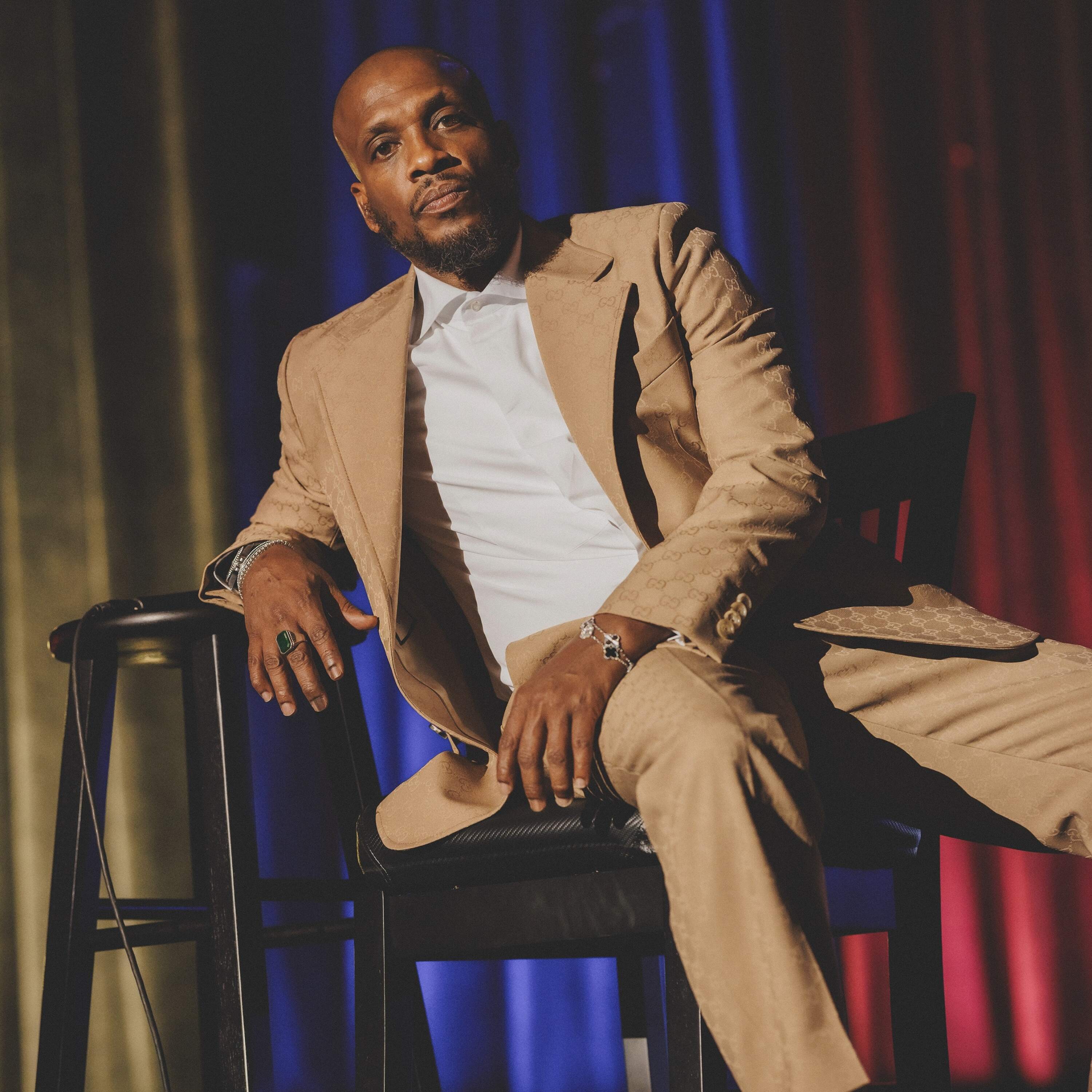
Comic Ali Siddiq on fatherhood, prison, and his biggest regret
44m 53s
Ali Sadeek, a comedian known for his autobiographical stand-up, discusses his new special "My Father" on Fresh Air. He explores his complex relationship with his dad, who left when he was three but later had him live with him at age 10. Sadeek recounts his father’s irresponsibility, such as putting cocaine on his sore wisdom tooth and leaving him alone overnight. Despite this, Sadeek credits his father for making him a "good man," vowing to be more present for his own kids. Sadeek also reflects on his six-year prison sentence for cocaine trafficking, starting at 19. He shares how he used sarcasm and humor to survive incarceration after initially being violent due to pain from his sister’s death and his son’s passing. Now, 29 years after release, he still remembers his inmate number, illustrating lasting psychological scars. Sadeek’s work includes performing in jails, where he talks to inmates about accountability and recidivism. He emphasizes that selling drugs caused community harm, which he feels he must repay. Through his comedy, Sadeek finds healing, transforming painful memories into stories that connect with audiences and help him process his past.
This is Fresh Air, I'm Tanya Mosley. And my guest today is Ali Sadeek. He's a comedian, but that word undersells it. What he really does is tell stories, true ones from his own life, and he's told so many of them that while watching his specials, I realized Sadeek is giving us a memoir, delivered one set at a time. For instance, a few years back, he went viral with the story about surviving a prison riot. Sadeek served six years for cocaine trafficking. Arrested four days after his 19th birthday. He started doing stand-up after he got out. And nearly 30 years later, he's got more than a dozen specials, most of them independent on YouTube with millions of views. In his 2022 series Domino Effect, he traces his life growing up in Houston, starting at 10. The year he went to live with his father, and first got into trouble, all the way through the choices that landed him in prison. This month, he has a new special called My Father. It's about everything that passed between Sadeek and his dad before his father died in 2018. It premieres on YouTube June 21st. Here's a clip. My dad had a thing about how he dress. My dad always wore his tailor-made suits. This is when he was on his note. Because he was a. it's not a lot of men can say how they felt about their pops. I really wanted to look like this man. He was tall, dark, jet-black, had a lot of charisma about himself. But he just wasn't an ideal father. My dad asked me one time, "I'm seeing at his house, and my dad is seeing it." "Man, why you don't never say nothing bad about your mama on stage?" I'll use Sadeek. Welcome to Fresh Air. Thank you for having me. Man, your timing is great. And I was thinking when I was watching this, that there is really nothing like remembering something funny about somebody after they're gone. It's like the truest way, the most purist way to grieve them. But I was just wondering, watching this, if your dad felt some kind of way about being in your act, what do you think he'd say about you doing this entire special about him? He never actually felt any type of way about being in my act. He just wanted to know when I was going to say something negative about somebody else. And that just him. I get a lot of views, but it's definitely 10 views, 15 views that I missed. Because my dad would go to the library, and he would look me up on the computer and watch all of my stuff. And he would call and tell me, "I just seen something." I watched about 15, 10, 15 times. So I'm always missing those 10 or 15 views that I know I would get from him. You say straight up, "I'm a responsible man because of my mother, but I'm a good man because of my daddy." Explain that. My mom, she would think that it was her, but it's really him. Because for some time, I felt a certain type of way about him not being there, or the thing that I would see from other people's fathers, or what I view from TV, I was judging him based upon that. And what I thought, and I had certain feelings towards him. And I didn't want my kids to ever feel like that about me. I don't want my kids to think that anything else was more important than them. Not all being in the streets, not women, not gambling, not hustling, not anything. I didn't want them to ever think that anything that I was doing was more important than them. And my father made me at times feel unimportant to him. I played sports. He went to one game. Out of all the sports that I played, he went to one game. He came to one basketball game. I don't remember ever doing anything father and son with my dad. So that's another thing I just knew becoming a father, I would never be like that. Like my kids are going to see me actively at their games, or at their recitals, or at their whatever they may be doing. I'm going to actively be there. If you need something, I want you to be able to call me. So I've always made myself available for that type of effort that I was making. I always made myself available for them. So they would never feel a type of way towards me like I felt for my father for a couple of years. More more than a couple of years. Your daddy, he left when you were three, but you'd see him every blue moon. But then around 10, he comes back into your life. You went to live with him. And it seems like he was very much due as I say, not as I do. When did you first understand that contradiction? Man, probably the first year I lived with him. My dad was, like I say, I don't think he was ready. I don't think he was ready to have his son with him. But yeah, he asked for you to live with him. He asked, but I don't think he was ready. You know, people ask for a lot of things they're not ready for. And then like not a human though. I didn't think a human was a part of that. But he definitely wasn't ready yet. Because he couldn't have been. Like when I look back at him, I'm like, "Yo, bro, it's no way that you was ready for me to come live with you." Because you hadn't calmed down yet. You know, just the story of him waking me up saying that he was getting ready to go to San Antonio. And I'm team and I got to go to school tomorrow. Like, "Yo, bro." Like, what am I supposed to do? Did you even go to San Antonio? You're like, "Do what you been doing." You just said, "Well, get ready to go to school." You know how to say, "Hey, bro, that's not how this go, man. I've never been in a house by myself before." Like, what's wrong with you? I mean, is it true that, okay, you tell this story about him putting cocaine on a sore wisdom tooth? And I was wondering, is this true or is this just for last? 100% true. 100% true. That's why I described this so vividly. See, that's the thing about when I tell a story, I want people to understand. I describe all the even little things. So people understand that this is a true story. Because you can't, it's hard to make up little things. You know, you can make up big things. But little intricate details about something. Like, you know who was there. James and Ivery. And James was the one that saw me sitting on the step. And he was like, what's up? Because my dad named his limber. And he called me "Liberr." "Liberr," what's going on? And I said, I told him about my tooth. And then my daddy called me over and said, "Let me see." And put that cocaine on my tooth. I said, "This man, I didn't even know that's what it was." I just know it was the stuff that was in the cool whip tub that was in the refrigerator. Wait, he kept the cocaine in a cool whip tub in the refrigerator. And the big, the big, cool whip thing. You know how cool it was coming in a little container, that big container. Oh yeah, and you reuse them. Yeah. And he put it in, that's what a cocaine was that inside the refrigerator. And then as I thought about that earlier, like I told the story and I never even realized how super irresponsible he was. I am 10. You don't think I like cool whip. But things that could have happened, you know? The things that could happen if I were to deal, because he always had strawberries. My daddy loves strawberries, right? So he always has strawberries in the house. And I was like, yo, what I thought about it, if I were to just took one of those strawberries and put it in that cool whip, both thing, it was cool whip. Because I still would have ate it even though I would have thought the cool whip was bad. I don't know how to cool it. It's fizzing out. And then I'm like, that's what it would have looked like to me. I said, he was so, so irresponsible. It's crazy. Okay, he dips a little cocaine on that sore wisdom tooth. What happened to you? Never had a problem with that wisdom tooth. Never even needed to have it taken out, huh? Never. I probably still got that tooth in my mouth right now. I never had a problem. I don't even remember getting my wisdom tooth taken out. Ever. Luckily, I don't have an addictive personality. I could just stop doing stuff like, hopefully that was it, because my dad was insane. And I had told that story before, before I ever, before I'd ever aired on anything. And I remember he was at the show when I did it. And he was like, I can't believe you remember that. Do you feel like you're working out that relationship on stage? I mean, I think the obvious is yes, but like, how are you working it out? what is it doing for you aside from just making us laugh?
I think that with the relationship with him or the relationship with my low sister or my things that I had problems with as a young person, I don't hold on to things. I release some the ups and downs of me and my dad are really molding of me and it's also healing for me to be able to say these stories. So I think that's the biggest part of it that I take the stories and me reliving them in front of people or revisiting them in front of people is a I can't even say a bit healing it's a lot healing it's a lot of healing that goes on with me with that. I want to ask you about something that you do on stage that is feels like maybe like a centering you know most comics when they go on stage like everybody does it different but most of them like kind of come out swinging they like run or walk in or they like take in the applause you sit in a chair you wait for the crowd to die down and then you always start with hey tell me what you're doing with that. I'm paying homage to the first time I was ever on stage first time so I went to this comedy club just joking comedy cafe is where I started 1997 December the 4th is the first time I was ever on stage I walked on stage and I said hey and the whole entire crowd boo me I didn't say nothing but hey no jokes no nothing and this is because I I started out Apollo night and they were instructed to boo the next person that was coming on stage so I happen to be that next person so I waited two weeks I came back to just joking comedy cafe after two weeks brought me up I did well they brought me I came and I started coming every week and then by February I started in December by February I was the co-host of that Apollo night and I always start with hey why do you think you need to be reminded of that particular night 30 years later and to understand that I had I made the right decision when I first went up I wasn't in the wrong for saying hey it's a lot of things that keep me grounded in this in this business I'm never too up and I'm never too down I'm always even kill and the the attention that I didn't get the first time I said hey is what people wait on now when I say hey the whole entire audience say hey back let's go back to to young Ali Sedic before the comedy you are 14 years old you start selling drugs you like to joke on stage you say I was a pharmaceutical sales rep by the time though that the Feds got you you were 19 you were in college at Texas Southern University and this is the ironic part you were actually planning to stop selling drugs when you were caught how close were you to quitting I had stopped actually I was done I was wrapped up and I got a phone call to come help assist you know and I went out of me feeling obligated to okay I you know I hold your back but I was I was done it was it would have become like man what am I doing you know because you started in the first place because you you wanted money you wanted to you wanted your own money yeah and I think I I fight so hard now to explain that it was a character flaw it was like no manhood a responsibility in that because I could have just worked for money you know I could have just did something else I could have it's so many things that I could have done versus being so destructive to a community and I remember being asked Ali when do you think that you're gonna blow up and my honest answer was when I pay back that I got I got a I owe this world something because you sold drugs like you owe owe back because of that harm you did that's interesting when I pay back society for the for the destruction and I think that when you are a person that has that has really done things and you have really changed your life and you you think back on these things you can't help but to have a heavy heart I remember I was in San Francisco the the homeless population is so crazy and I met this Comedy Central Festival is a comedy festival and and I'm walking from a hotel to the festival and I'm there for days and I keep trying to find different ways to get there not to run into homeless people and I didn't walk five blocks down 10 blocks down 10 blocks this way I walked every which way and couldn't and I remember it was in the morning and I was on my way to prayer and I just stopped in the streets and I just started sobbing and I remember saying how much of this is my fault because I have been so destructive and reckless in my behavior I just don't understand like obviously this is not the first generation this is the generation that was affected by the first generation of what I did like you can't conceive the magnitude of destruction that you do when you sell drugs in a community you know as people doing things that they would probably never do in order that's that's ruined their relationships that's that's what child didn't get fed because they they mom and they father decided to do this and what what uncle or aunt stole something like what did I do did you and your dad ever talk about this that because you know I mean he sold drugs and then you went on to sell drugs we never talked about it because my dad ended up using drugs that was the the the lick that society took back I remember a story that I told about some young guys I come on to come on the block and they're told me they're robbed these old guys and I looked at the stuff that they had and and I made them put it in the bag because I recognized the stuff and then I went and took my dad and his friend and stuff back and I said man what a what man what were you doing over there and my dad blamed on his friend to him I'm over there with him he got me robbed and my mom I told my mom about it later and my mom said he was probably using drugs and I said now he told me he wasn't using those drugs and that's what she told me about it put your dad in rehab twice since we've been apart and so I went back and told him I said hey I thought you said you wasn't just use the drugs and my mom and he said who told you that your mama man your mama um you want my life by my my hybrids man it's nuts like he's so even when he's doing something crazy he's still funny he's so crazy so the um unfortunately the room around my dad is going is is an overdose and I don't believe that I think that that's what people wanted to say but I don't not believe it either the rumor that he died because of an overdose yeah yeah was he at a heart attack and I know he hadn't been using so if you hadn't been doing something and then
You decide I'm going to do it one time, you know, you don't know what your heart can take on that. So my dad just had a heart attack out of nowhere. Our guest today is comedian Ali Sadik. We'll be right back after a short break. I'm Tony Mosley and this is Fresh Air. My guest today is comedian Ali Sadik. His new stand-up special, My Father, explores his relationship with his dad who died in 2018. Sadik has released more than a dozen specials on YouTube, including two filmed inside of Jail's. He himself was arrested at 19 for selling cocaine and served six years of a 15-year sentence. Part of his work includes talking with prisoners about accountability and the realities of recidivism. This past spring, he released Ali Sadik from Inside, shot in a county jail in Charlotte, North Carolina, where he talks to inmates for almost two hours straight about the experiences of being locked up and its lasting psychological effects. Here, he recalls his inmate number, which he calls a spin number. Ask the old heads that have been here before. Ask me do they remember they were original spin number? This the **** that haunts me. I've been out for 25 years, almost 26 years, 67, 93, 46. I can't forget this number. It's the grain in my head, like my social security number. That's my slavery number. 67, 93, 46. That's my guest, Ali Sadik and his YouTube special from Inside, a conversation with inmates. And what goes on to happen after you rattle off your number? The guys start flirting out their numbers too. What does this signify that you can remember your spin number 30 years after you are out of prison? That you did not get out of this situation unscathed. You may have survived it, but you still have wounds. I've been out 29 years at this point. Even if I'm at home by myself, I'm a locked the bedroom door. I still know this number. So it's still things that you may survive, but you don't get out unscathed. You're going to lose some skin in this game. And I think that these psychological wounds are different than my physical wounds. My physical wounds start to fade. Why haven't these wounds faded yet? There was this powerful thing you said during that talk with those inmates that also is kind of sticking with me. You were saying, when you get locked up, your people get locked up too. And I wanted you to explain what you meant by that. My mom, even though she wasn't physically there, she's there in mind. It wasn't no days that my mother didn't think about me. When you're inside, your sister is concerned, your mother is concerned, your dad is concerned, your grandmother is concerned. It is all of these people that's concerned about you because you're in a position of danger. You're in a dangerous place. And there's no guarantee that you will make it out of this place. There's no, you can get a year. It doesn't mean that you're coming home. You can get two years. It does not mean that you're coming home. Nothing about this place says, I'm going to survive. I want to know about, I think you call it your sarcastic nature because it's not like you started doing comedy in prison. But you did find that your humor could serve you well there. And I wonder what ways you used your sarcastic nature and comments when you were locked up. Because I was such a violent person from the beginning, the first two years I was insane. I was literally a mad man. Why? Because were you like that out of prison before you got here? I'm in the streets. What happens in the streets? And I'm still hurt from my sister. I'm very fond of her presence. And things that I never revealed to people that four months later that my first son passed as well. So I never, I'm dealing with a lot of pain at this time. And so my whole thing was to minister pain towards people who just was in my way. You just said my way. And I'm inviting this type of behavior. And I was like, hey, bruh, all this is going to be bad for you. And so then I got told, and it's always an older wise person that comes to you and say that really care about you. You know, just letting you know how life goes or see something in you. And man, you keep doing your talk like this. I'm like, I'm going to kill you. And they're going to kill you because they're scared of you. They don't know what you're going to do. They're going to set you up. Whether it's a group or whether it's one person, they're going to kill you. So you might want to do your time a little different. And plus you better than this. Like, like you could really be a different type of person. And you can get out of here. You know, you're not here forever. You know, but I'm doing my 15 years. Like I'm doing 15 years. Like I'm not thinking about the role of getting out early. Yeah. So then I became this Jovily sarcastic person about everything. Like anything that the person was going to do that was going to get them in trouble. I was going to say something about it. And I remember this dude about to do something. And I said, I thought you said that you didn't steal that stuff. Like that you that you was innocent. Because you're doing really guilty behavior. I'll be so sarcastic. And I remember this was one of my classic things that I was like, I guess I'm the only one who had guilty. Because it seemed like everybody else said, like this is a part of no accountability. But you don't have no accountability for nothing. And so if people was about to fight, I would just I would always say something like, oh, yeah, about to fight. Wow. That's interesting. You do know somebody going to lose his fight twice. Like what are you talking about? So one of y'all going to win. And then the CEO is going to come in and be both y'all. Like somebody got to be willing to lose his fight twice. Like y'all got to make a decision. And I would say so much sarcastically Jovily or things. They're like many I always got something to say. Like, yes, I do. I read that, you know, as you're doing your time, that's when you started to think when I get out of here, I could probably have my hand in comedy. And how I was wondering where there were there people that you were also like watching or studying or thinking about as you were thinking about what type of comic you wanted to be. Not at all. When I when I started doing stand-up, I actually didn't even know how to even start. It's like when I think about this journey, I literally started from a place of zero. Like I had zero information on how to become a comic, zero information on where to go. Zero, like I was at scratch. And so when I think about like I'm not, I don't ever not feel successful because I'm like, yo, I did what I said I was going to do. And I got out. I was going to become a comic, not knowing how to do it. When you get out of prison though, how do you make that lead to like truly making this a profession? What was your first stop? Just joking, comedy cafe, you know, just I learned a lot there. And I remember when I first got my first payment, it was $35 and it was in like $5 and 1s. And I thought it was a lot of money. I was like, boy, I came up. And the comedy cafe is in Houston. It's a place in Houston. It was it was on Richmond. And then I went through this dilemma of people not saying that you are, you know, a real comic because you don't do it for a living. And I remember asking Bruce Bruce about it. I said, man, Bruce Bruce is comedian of the comic. I asked Bruce Bruce. I said, hey, man, are you? And he was the host of comic view. I asked him, hey, people say that you know a real comic unless you doing it for a full time for a living. And he said, man, let me give you some advice brother. I worked for Frito Lay until my comedy started making more money for me consistently than my job. And once that happened, it. I quit my job and say don't quit your job until you're into your career store making more money consistently Then your job and I What were you doing like what was your job? I was selling on clothing I was working in the men's apparel store, you know in the mall and I worked at sunglasses I you know, I used to be a street forms to the grab then I went to being a sales rep Did you take the same amount of skill like the same amount of skill the same thing Hey, I need to find somebody who addicted to soups and shades and so To make my commission If you're just joining us my guest is comedian and storyteller Ali Sadiq his new stand-up special is called my father And it's about his relationship with his dad it premieres on YouTube June 21st We'll be right back after a break. This is fresh air. I Want to talk to you briefly about parenthood about you being a father you telling me earlier that you just want to not make the same mistakes that you're dead made with your children and I mean you joke about this a lot, but your kids are getting a very different father than you got which I Actually want to play a clip from your latest special where you talk about Taking your son Hassan to a concert to the elements earth wind and fire when he's 11. Let's listen I know that I am a better father than my father was and I'm supposed to be I'm supposed to be just by my son's first concert and My first concert with my father My son Hassan He's 11 His first concert was earth wind and fire and he asked to go He asked go my son came in to me and said father Because he's very up across He said I would like to attend the concert I said Hassan What concert would you like to attend? He said I would like to go see the elements And I teared up I teared up My son want to go see the elements and I said wait Who are the elements Hassan? Is it some low white internet group that you've been listening to? Hassan said no father They're firmly known as earth wind and fire I immediately ran and got them tickets. I Wanted to get them tickets from in my son me and my son going to see earth wind if I he is 11 He's 11 years old. We went to this first concert Me and him we going we get to the concert Hassan is the youngest person in His whole entire concert and I know that for facts because I am the second youngest person That was my guess today in his latest special my father and I'll leave that whole special you marveling at your bougie kid, you know You have built a soft life for him on purpose But I wonder this because I mean as a parent who also grew up a certain way do you ever look at your son and Worry that the thing that made you some of the positive things you know not all that that that challenging stuff you went through but like the positive stuff Might also be the thing like you're keeping from him too No, I don't I think that The soft the softness of his life now. I hope that he continues to desire that and You know he goes through his own certain struggles, you know because it's a certain struggle that happens in softness as well, but You know whether he won't oyster the crap, you know it's dilemma for him. So he You know you know choices choices, but yeah, he I Love how he's living. I love the way that he lives I applaud him and I just hope that you know He comes out on the other side and always is like this and and loves being a kid and then gives his children the opportunity to be a kid and always Have a softness for me. I need some might Roll me around when I get old. So hopefully hopefully he's there, you know taking me to go eat oysters and you know asking me do I want to go to a bone of James concert or something I just I just love him. I just love the softness of his life All right, you are a Houston boy born and bred do you feel like you might have ever Missed out or lost out or it taking you longer than Maybe it would have if you hadn't moved to a place like LA in New York and you know you could have taken your kids with you I don't think that that's a thing. I think there's There's no opportunity that has been lost You know it's on it's only all gained and it's a certain protection of being in your in your home spaces, you know my moms from I have what Maybe 40 relatives in California But who's to say I was gonna go to California and make something to myself because multiple comments have done that as well and never You know arrived in there in their perspective, you know same in New York same in Atlanta, you know, I think that What makes me unique is being home Oh, this has been such a pleasure Ali and Thank you so much and best wishes as you continue on your tour Are there particular cities that you love the most, you know, you're a Houston boy. So are there other places throughout the country where it's like Oh, yeah, they get me it feels like a homecoming So many places Chicago DC Baltimore Detroit New York Atlanta Philadelphia Appaluchus is too many places to even name. I'm so connected to the earth that when I'm when I come somewhere All of it feel like home. That's who's coming and that's who I have a connection with now was crazy is I don't think that Corpus Christi gets me That's right down the street Corpus Christi Texas is crazy is right down the street. I don't think Corpus really fool with me. They're a fishing town It's like is he talking about mass? Ali said he is been such a pleasure to talk with you. Thank you so much for this special and your time Pleasure is all mine. I thank you very very much Ali sediques new special is called my father it premieres on YouTube June 21st He's also currently on his international custom fit stand-up tour Coming up film critic Justin Chang reviews toy story five opening in theaters this week. This is fresh air More than 30 years after the first toy story launched the Pixar animation Renaissance Toy Story five is opening in theaters this week in this latest adventure Jesse the cow girl teams up with buzz light year and Woody to fend off the rise of digital devices Which are taking over the minds and attention spans of kids everywhere the movie was directed by Andrew Stanton of Wally and finding Nemo fame and features new voice work by Conan O'Brien Gretelie and Bad Bunny our film critic Justin Chang has this review a lot has happened since the first toy story in 1995 when a cowboy sheriff doll named Woody voiced by Tom Hanks Worried that a space ranger action figure named buzz light year voiced by Tim Allen would replace him in the affections of their young owner Andy Every toy story since has touched on similar themes about the fickleness of kids the inevitability of change and the To temic power of the toys we grew up playing with by the end of toy story four Woody himself had decided to move on Along with his beloved bow peep He set off into the wild and embraced the life of a lost toy Leaving buzz and their friends in the care of their new owner a sweet girl named Bonnie As someone who was pretty mixed on toy story four I can't say I was looking forward to yet another sequel Which just goes to show you should always keep an open mind Toy story five is a significant improvement and at its best a delight Things seem to be going well for Bonnie and her toys as the movie gets underway But of course it's only a matter of time before a new phase of childhood begins Bringing with it a fresh threat to the toys idyllic existence Bonnie's having trouble finding friends her age to play with and that's because the other kids in her neighborhood are all glued to their su-
screens. Nobody cares about toys anymore. It's all about digital tablets and other devices, with their games, group chats, and virtual worlds. Sure enough, when her parents buy her a frog-themed tablet named Lily Pad, Bonnie is immediately hooked. In this scene, Jesse the Cowgirl Ragdoll, voiced as ever by Joan Qsack, confronts Lily Pad, who's sharply voiced by Greta Lee from past lives. Hi! What the? Sorry, I didn't mean to scare you. Sleep mode, you know? No? Eh, forget it. It was just gonna huff on the charger. Battery could use a little refresh. I want to talk to you, device. Please, call me Lily. Now look here. Me and the toys have been working all summer to try and get Bonnie to make friends with the Jordan twins across the street. Yeah. But then you had to ruin it. Got it. With all your stupid, you're not even listening to me. No, I'm a slasening. I'm always listening. See? Now look here. Me and the toys have been working all summer to try and get Bonnie to make friends with the Jordan twins. No, in Spanish. No, as a wrap. Me and the toys have been working all summer trying to get Bonnie to find her. My first dance, honey. This concerns me ethically. The movie was directed and co-written by Andrew Stanton, who has mocked the perils of too much screen time before in his 2008 Pixar classic, Wally. I suspect that Toy Story 5 will struck a chord with any parent who, like me, has ever yelled at their kids to get off the iPad and read a book. Ingeniously, the film takes one of the foundational ideas of the Toy Story universe that inanimate objects can secretly think and move by themselves and uses it to tap into our paranoia about what our devices might be doing when we're not looking. Rest assured that this is still a Pixar movie, so there's a limit to just how dystopian things will get. Thankfully, Bonnie doesn't fall victim to an internet stalker, though she does learn a valuable lesson about bullying and peer pressure. Lili, eager to boost Bonnie's social standing, connects her with some other girls online, and even starts sending texts and images without Bonnie's knowledge. At one point, Lili, pretending to be Bonnie, arranges for all her old toys to be boxed up and stored in the garage. And so it's up to Jesse to save the day, with some help from Buzz and eventually Woody happily cutting his retirement short. Bonnie's toys wind up at another kid's house in the area where they meet a bunch of lower tech devices, none funnier than smarty pants, an electronic toy designed to help kids with toilet training. He's voiced by Conan O'Brien, gamely spouting more potty jokes than you could find in the past four Toy Story movies combined. It's here, though, that the story starts to go a little soft. After confronting the ways in which tech is taking over our lives, Toy Story 5 pulls back and suggests that devices and toys can coexist, and that devices themselves are no less susceptible to being neglected, forgotten, and tossed aside for the fancy new models. Maybe it's in the nature of Pixar movies to reassure us, to delve deeper into feelings of grief and impermanence than studio animated films typically do, but then offer us consolation in return. Toy Story 5 may look boldly forward, but it also peers lovingly backward. One funny subplot features an army of digitally souped up Buzz Lightyear action figures, a callback to the sight gag in Toy Story 2, when Buzz encountered multiple versions of himself on a store shelf. And although much has been made of the new Taylor Swift tune on the soundtrack, the most memorable musical bit here is a gentle refrain of Randy Newman's song "When She Loved Me," also from Toy Story 2, which told the heartbreaking story of Jesse separation from Emily, her original owner. Stanton beautifully revisits and deepens that story here, reminding us that loss is a part of life, and that we are never truly forgotten by those we love. Justin Chang is a critic for the New Yorker. He reviewed Toy Story 5. Fresh air's executive producer is Sam Brigger. Our technical director and engineer is Audrey Bentham. Our interviews and reviews are produced and edited by Phyllis Myers, Roberta Shorak, Anne Marie Baldenado, Lauren Crenzel, Theresa Madden, Monique Nazareth, Baya Chaliner, Anna Bauman, and Nico Gonzalez Whistler. Our digital media producer is Molly C.V. Nesper. Susan Gakundi directed today's show. With Jerry Gross, I'm Tanya Mosley.
Podcast Summary
Key Points:
Ali Sadeek is a comedian and storyteller whose specials form a memoir, including his new special "My Father" about his relationship with his dad, who died in 2018.
Sadeek served six years in prison for cocaine trafficking, arrested at age 19; he started stand-up after release and now has over a dozen YouTube specials.
His father was charismatic but irresponsible—putting cocaine on Sadeek’s sore tooth at age 10—and rarely present, shaping Sadeek’s determination to be a better father.
Sadeek uses comedy to heal from his past, including his father’s neglect and his own drug-dealing, which he now regrets for its harm to communities.
He still remembers his prison inmate number (67-93-46) after 29 years, highlighting lasting psychological wounds, and he engages with inmates in specials like "Ali Sadeek from Inside."
Summary:
Ali Sadeek, a comedian known for his autobiographical stand-up, discusses his new special "My Father" on Fresh Air. He explores his complex relationship with his dad, who left when he was three but later had him live with him at age 10. Sadeek recounts his father’s irresponsibility, such as putting cocaine on his sore wisdom tooth and leaving him alone overnight.
Despite this, Sadeek credits his father for making him a "good man," vowing to be more present for his own kids. Sadeek also reflects on his six-year prison sentence for cocaine trafficking, starting at 19. He shares how he used sarcasm and humor to survive incarceration after initially being violent due to pain from his sister’s death and his son’s passing.
Now, 29 years after release, he still remembers his inmate number, illustrating lasting psychological scars. Sadeek’s work includes performing in jails, where he talks to inmates about accountability and recidivism. He emphasizes that selling drugs caused community harm, which he feels he must repay.
Through his comedy, Sadeek finds healing, transforming painful memories into stories that connect with audiences and help him process his past.
FAQs
His new special is called 'My Father.' It explores his relationship with his dad, who passed away in 2018, and premieres on YouTube June 21st.
He started at the Just Joking Comedy Cafe in 1997. His first time on stage, the crowd booed him just for saying 'hey,' but he returned, improved, and became co-host of Apollo Night by February.
He was arrested at age 19 for cocaine trafficking and served six years of a 15-year sentence.
He talks with inmates about accountability, the realities of recidivism, and the lasting psychological effects of being locked up, as seen in 'Ali Sadeek from Inside.'
He regrets it deeply, feeling he owes society for the destruction caused to communities, and says he sobbed thinking about the harm he contributed to.
It's a tribute to his first stage experience where he was booed for saying 'hey.' Now, audiences respond back, and it keeps him grounded.
Chat with AI
Loading...
Pro features
Go deeper with this episode
Unlock creator-grade tools that turn any transcript into show notes and subtitle files.
 PodcastTranscript AI