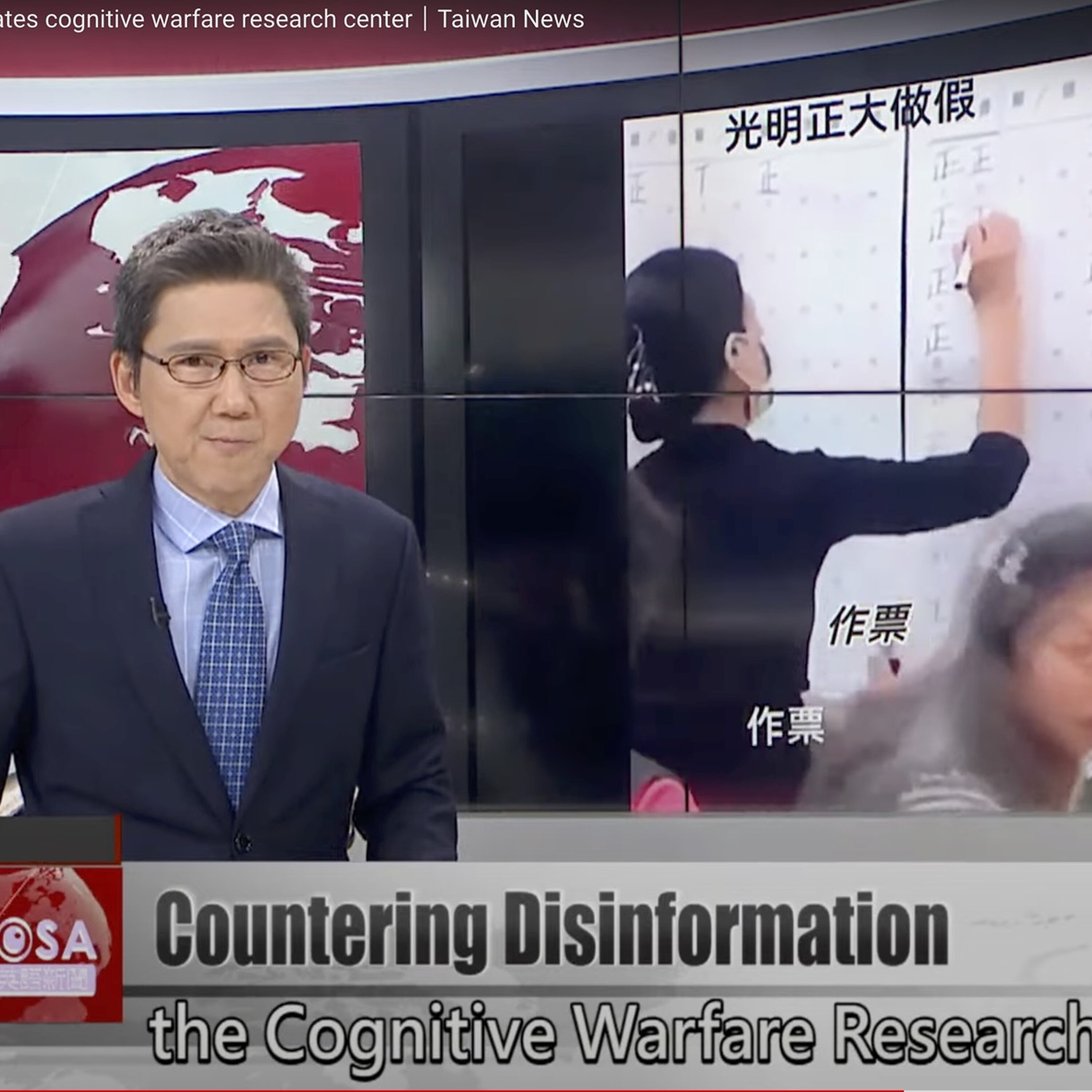
Cognitive hazing: The Disinformation War on Taiwan?
44m 22s
The Little Red podcast discusses disinformation in Taiwan post-election, focusing on rumors targeting candidates' personal characters. Taiwanese entertainers like May Day face disinformation, impacting national identity. The use of generative AI in disinformation production is noted, but its impact on sophistication remains limited. Instances of fake polls contribute to media distrust and potentially influence elections. Traditional media's role in amplifying narratives is highlighted. Disinformation aims to support KMT candidates and undermine the DPP government, potentially affecting national resistance in case of invasion. Efforts to combat disinformation include regulating media licenses, and the importance of awareness and counteractive strategies against cognitive warfare is emphasized.
Transcription
7777 Words, 45130 Characters
Welcome to the Little Red podcast, which brings you China from beyond the Beijing Beltway.
I'm Grant Smith from the Australian National University's Department of Pacific Affairs
and I'm joined by my co-host, Louisa Lim, former China correspondent for the BBC and
PR, now with the Centre for Advancing Journalism at Melbourne University. We're on air thanks
to support from the Australian Centre on China in the World.
This month we're going to the World Capital of Disinformation, Taiwan, which is apparently
the target of more disinformation than any other democracy, according to the University
of Gothenburg's Varieties of Democracy project, and having just been through an election, won
by the DPP's candidate, William Leiching Der. The island has been through something
of a cognitive hazing.
This month we're talking to two Taiwanese writers about cognitive warfare, disinformation,
and if there are lessons the world can learn from Taiwan. We're joined by independent writer
Min Chow, who ran the Ministry of Culture's Twitter account for years. And we're also
delighted to welcome Brian Hu from New Bloom Magazine, whose book Taipei at Daybreak is
due out next year. Brian, let's start with you. I believe there's a rumour that Leiching
Der had an illegitimate son. Can you talk us through the role of disinformation in spreading
that rumour?
Yeah, so it's quite interesting because that rumour then is reflective of one kind of disinformation,
and it's often targeting the personal character of a candidate. And often it's very outlandish
claims, for example, having a illegitimate son having killed somebody, various other wrongdoings.
There are, of course, candidates that do run for office and, in fact, have criminal backgrounds.
There is actually one candidate, for example, that did actually murder somebody decades
past and that did not prevent him from becoming the Meali County Commissioner. He had a record
of murder in connection to gang-related killings. But a lot of times then it's this kind of
focus on individual character, and this is definitely one genre of disinformation. Some
people believe it, but yeah, it's not a major narrative that occurs with individual candidates.
And at the presidential level, with a presidential candidate, of course it does occur.
And in the case of this rumour, like, where was it being pushed?
Oftentimes it's through these closed channel, I guess you would call them social media networks,
but they're more like WhatsApp, for example, line, which is used among the elderly. They're
often text in images or just text and it spreads. Sometimes you can trace the origin quite easily
if it turns out to be in simplified characters, but in past years it has become more complex.
So that is to say, it's harder to find the origin of things, and it's usually often
that you don't have a smoking gun showing it is from China, because there are political
opponents of such candidates, for example, that have an interest in creating disinformation
about them. And sometimes it does draw from some facts, such as some true biographical
details to create a very exaggerated picture of someone's life. But just starting an individual
candidate in their background is definitely one strain of disinformation. It's just not
one talked about, I think often, because it doesn't lead to a larger national narrative
about elections per se.
I was looking through the various rumours that have been spread this year, and there's
one about William Lai's running mate, Xiaobi Kim, being ineligible to run because of her
US citizenship, which also turned out to be not true. And I kind of, you know, I can get
what's going on with those. But the one that really stopped me short that I really struggled
with was this rumour about a Taiwanese band called May Day, and whether or not they had
been lip-syncing. Minxiao, can you unpack how, how is this a disinformation issue? Why was
this an election issue even?
Well, I mean, May Day is a major homegrown band from Taiwan. It's what people sing when
they go to karaoke here. So it's always been kind of a source of national pride. But over
the past decade or so, they've actually shifted their focus from the Taiwan market to the
China market. And like a lot of Taiwanese musicians or bands and artists who choose to go to work
in China, they actually have to follow by the CCP's rules. And oftentimes it means saying
out loud things like us Chinese or one China. So in this case, the lip-syncing rumour was
used to kind of discredit May Day saying kind of taking down Taiwan's international image
for pop culture, for good content. And so I kind of like, Oh, May Day just kind of faked
this act. But the funny thing is that didn't really take much of an effect because most
May Day fans are already quite aware that they've changed their allegiance. In fact,
the past couple of days, there's been a renewed anti-May Day sentiment in Taiwan because they're
holding a series of concerts in China right now. And then they're on stage again, proclaiming
to be part of China, just kind of effectively slapping their Taiwanese fans in the face.
Why is China then attacking May Day?
So May Day's positioning within the Chinese market is still this ban from Taiwan. So
May Day is still bashing on Taiwan.
Yeah, the CNN report about first, there was the lip-syncing allegations and CNN reported
that was because May Day refused to comply with the Chinese government in an unspecified
political service, which is probably making a statement saying that we view Taiwan as
part of China. And that occurred. And there's blowback politically. The KMT vice president
candidate, Zhao Xiaokong, who was also a media personality, claimed his fake news and threatened
to persecute the journalists responsible for that during the vice presidential debate.
And then after that, May Day, the lead singer, said in a concert, "Then we are Chinese."
And so then that was viewed as betrayal. And so that occurred after this kind of incident.
So it was kind of order of operations.
But also think that there are cases in which China targets Taiwanese entertainers that have
actually said something that would be perceived as pro-China in Taiwan because it doesn't
make sense to them, or is not viewed as pro-China enough, but also because the discourse just
differs. And so they misrecognize something. Even something like waving the ROC flag as
Dotsu of twice did before the 2016 presidential election would never be perceived as pro-dependence
in Taiwan. But in China, it was. And so it's there's often, it points to actually that
Taiwan and China are separate because the discourse is separate. And so China will misinterpret
sometimes discourse in Taiwan as pro-dependence when it really is not.
So it seems like a real misfire to attack them.
I think it might have been. But it's a good question.
But it's interesting to me that, that even they are a target of rumors. Brian, does this
say something about the way that rumors are being and disinformation is being used that,
you know, it's not just political candidates. It's all kinds of public figures.
Yeah, absolutely. So I think definitely one is Taiwanese entertainers working in the Chinese
market. And so, for example, after Lai's inauguration speech, we had a wave of times entertainers
expressing their view that Taiwan is part of China on social media platforms used in
China. And May Day, it's quite interesting because I think actually the fact that China
was so interested in May Day, maybe actually points to the sign of disconnect. Because as
was mentioned, May Day is not actually the most popular band with younger people. They've
been around quite a while. And I think they have actually kind of lost their foothold in
the Taiwanese market in some ways with the rise of particularly much younger indie rock,
which is often more overtly pro-Taiwan in sentiment. And so maybe there was a kind of pivot towards
the Chinese market. May Day is kind of iconic, though, because of its historical status.
And that then if it was seen as turning then to China, that is a kind of, it is a sign
of something 10 years ago, for example, on the time of the Sunfire movement, there was
a May Day member that expressed tentative support to the movement and then later retracted
this because of fear of what reaction in the Chinese market would be. And so it is quite
interesting. Before, for example, Taiwan was elected in 2016, there was an incident regarding
the Taiwanese member of TWICE, Zou Tzu, where she was made to apologize for waving the ROC
flag, the Republic of China flag, in a video. And so this was framed as pro-dependence,
which it would not be read as such in Taiwan. But that also became another incident involving
entertainers and views on Taiwan and China. And so entertainment becomes a flashpoint
for this contention about identity, but also disinformation and misinformation.
And I'm old enough to remember Zheng Hui-Mei, who was probably one of the very first people
to get caught up in this crossfire. But I mean, have the methods in Beijing changed in
recent years, you know, given you have generative AI, you have bots, you have things like that
you can draw on. Has disinformation got a lot more sophisticated?
It's a question, actually, because I think we have not yet seen the impact of AI on disinformation
on scale. That's a, well, maybe it does actually affect scale. It allows producing more disinformation.
But it has occurred not in a way that's fundamentally changed the ballgame because the disinformation
that is produced through AI is already occurring, actually. There was already kind of generative
mass production of disinformation before the current AI boom. However, I think it's often
about the quality of the disinformation as we produce the sophistication of the narrative.
And that doesn't seem to be something that AI is currently able to do right now. But it
can help, particularly with localization, because things that come off as very clearly
from China, such as use of terms or vocabulary that's not so easily used and not so often
used in Taiwan, that actually is something AI can help with, actually. So I guess we have
to see.
I mean, one problem with disinformation is it's often very hard to pin down, as Brian
was saying. It's hard to find the smoking gun. But after these presidential elections,
you did actually have one of your first cases of someone being indicted. I think it was
two people who were indicted for publishing fake polls before the presidential election.
I mean, do these sorts of things actually have an impact, though, to the point where it actually
constitutes a crime? How did you see that case?
I'm trying to find a way to frame it. Well, I think polling is interesting because there's
so many polls, and then they don't really look alike. This is why I think journalists,
especially international journalists, are good at citing the good ones. But there's
a lot of fringe ones, and especially with the rise of the internet, they're polling
done from just websites. That adds to the detrust of media in Taiwan, which is very detrimental.
And an irony is that we really enjoy a high degree of press freedom. In Taiwan, we're
ranked 27 out of 180 countries this year by reporter without borders. But we have such
a low degree of trust in media. Like this year, only 33% of the Taiwanese public trust
media, according to the 2024 digital news report from the Reuters Institute at the
University of Oxford. So I found that quite interesting. People could similar the news,
but they tend to not trust it. And it's because of things like fake polls that also contribute
to that distrust.
Brian, do you think the fake polls is a new kind of advance in disinformation? Or are
they just getting better at tracking this down?
Yeah, polls are interesting, because there's such a feature of the kind of electoral culture
that before the elections, all these different networks are releasing polls, but they tend
to favor the candidate that is preferred by that network in terms of its political leanings.
And so polls have long been a way to kind of impact political discourse. And even when
it is from real data, the way is found to kind of massage the data to get the result
that looks better for your political camp. And so I think that actually having this kind
of release of fake polls, it's not exactly new, but it does reflect knowledge of something
about Taiwan's political landscape that this is a means of disinformation that is then
released.
We have a blackout period, for example, imposed before voting on releasing polls. You cannot
release or talk about them in public discourse in terms of the media and so forth, because
the fear this will be used to affect the election and the outcome, it's an attempt to prevent
strategic voting in that sense to change the outcome of that.
And so the question, because I think particularly what is of concern is when Taiwanese people
then go to China for United Front training or media training, that is from Chinese disinformation
efforts, because that shows closer coordination. And where China has really struggled in the
past, it has been coming off as genuinely and authentically Taiwanese. A usage again, as
I mentioned, of vocabulary or terms are not used or not being very familiar with the kind
of intricacies of political discourse in Taiwan. But then when you do have people that receive
training that are Taiwanese, then they know better how the media landscape and the political
discourse works. And so it does sound much more natural if they're the ones that are
localizing or producing disinformation and misinformation.
Before we get to this amazing structure that Taiwan has to combat, cognitive warfare, I'm
wondering, a question made for both of you, is there a particular incident that has occurred
that made people in Taiwan go, huh, this is a real thing, we really are being targeted?
There's one incident I'm thinking of, in particular back in 2018, when there was a mayor from
Kaohsiung who ran and seemed to be backed by bots and fake accounts and got in on the
back of what seemed to be Chinese disinformation. Was that the aha moment, or have there been
other big ones?
So you're referring to the former Kaohsiung mayor, Hanguoyu, who is also the first mayor
to ever be recalled in Taiwan. It's interesting because he is for the reason why the pro-China
TV channel, Zhong Tian or CTI, lost his license. During Han's campaign, that one TV station
was spending 80% of its coverage discovering his stories. And on his day of the winning
of his elections, that even reported about suspicious clouds appearing in the sky.
And this is a TV station which is owned by the One One Group, right? The head of the
One One Group, which is a Chinese, headquartered in China, famous for those really quite delicious
snack crackers.
Yes. One One is quite interesting because it's actually a Taiwanese company, but it
had its roots in Taiwan. It worked with Japanese company to create its famous rice crackers.
So it's actually Japanese technology, but with Taiwanese rice. And then it made a series
of bad investment decisions, went bankrupt in Taiwan. So restarted its fortunes in China,
then came back to Taiwan and like bought up three major media, which includes one newspaper,
The China Times and two TV stations. All of them are known for basically running the
CCP's talking points.
Yeah, I actually do think that was a kind of turning point in terms of awareness of
disinformation, disinformation. I feel like that's also when this kind of attempt to go
all in on advancing as the candidates was very visible as in Angkor's sudden rise from
obscurity become the mayor of Kaohsiung, which is historically very DPP, and then running
as the presidential candidate for the KMT in 2020.
The interesting thing though, is that while we often discuss it in terms of disinformation,
in terms of spreading on social media, a lot of actually occurs through being magnified
by traditional media, such as television and newspapers in this case. And some of it is
not necessarily disinformation, but just very kind of romanticized coverage of a specific
candidate, a talk about everything in Han's life as though he's this great kind of figure
and then clouds appear above him and etc. Not necessarily the kind of creation of entirely
false narratives, but then exaggerating what is real to the point where it's more like
fanfiction about a candidate than reality or their day to day life reporting on that.
But then I think a lot of the focus is still on in terms of how we discussed information,
the kind of online phenomenon that spreads through social media. But then what often
happens is that it's television outlets or media outlets such as newspapers or statements
by politicians that then are what gets picked up on in social media. And so I think the
ecosystem for the way disinformation spreads is actually somewhat complex in a sense. But
I do think that's the moment in which people did start to notice this was a major issue
and there's much more discussion of that.
The day before the cable TV channel was formally closed, former president Ma'injo actually
dressed up in morning clothes in a press conference to argue that press freedom is dead in Taiwan
and a lot of his followers still believe him.
And has it made a difference closing that CTI TV station or has, you know, those narratives
still circulating from other means?
The narratives are definitely circulating through other means, but this one TV station
has kind of been like a rallying point for the blue cow saying that this is a tywin's
green terror. This is China was at or the DPP trying to control media, which is really
ironic because it was the KMT back in the days that controlled all the media.
And now here's a clicker. So right now as part of the blue bird protest, one of their
demands is to make sure that this license, this CTI doesn't get its license back because
right now KMT lawmakers are trying to push a new bill that will grant permanent licenses
to all satellite cable companies.
They're trying to remove current regulations that stipulate broadcasters need to be reviewed
every six years. So if this passes, CTI is going to get its license back forever.
Brian, if I can get your thoughts on like, what do you think the goal is of this, this
information originating from, from China?
I mean, is it just about getting pro-China candidates elected or is it become something
a bit broader now? Like is the goal more about, you know, fragmenting Taiwanese society, reducing
trust in Taiwanese institutions or is it still quite narrowly focused on getting KMT politicians
into power?
Yeah, I think it's a number of things. I mean, definitely there is the attempt to get
KMT politicians elected. At the same time, I think the attempt is to deal a blow to the
legitimacy of the DPP government, whichever one that is. So the attempt is to get people
to not trust the DPP and not rally behind it, because I think this is sometimes phrased
by government officials or disinformation experts as quote unquote "cognitive warfare."
I think the attempt is that then Taiwanese people will not resist China in the event
of an invasion, because that is the only way that invasion can be carried on in a way that
China could take care of that, actually, because of the enormous cost in lives that would occur
if there was such an invasion. China would like to take Taiwan without actually having
to really wage a bloody war. And so, so in doubt in the government, discouraging resistance
is definitely one part of that. And so I think it occurs on a few different aspects, but
I think also it can be strangely scattershot, because if there's anything, the Chinese
state is very bureaucratic and spread out. It's often these different local or central
level or municipal agencies that are responsible for these various attempts at outreaching Taiwan
or creating disinformation about Taiwan. And so it can be just a bit scattershot, I think.
So it's hard to say. I think it just occurs on all levels. Some of the disinformation
is actually not very helpful for China's own aims, particularly if it does cause alarm
among Taiwanese. If they come more across of China because they see what is clue disinformation
or something that actually just causes them to think, this doesn't make China look good.
I actually just want to be further away from China because of this.
I was really interested in the fact that the Ministry of Justice in Taiwan has set up
a cognitive warfare research center back in January. What does it actually do?
Yeah, it's a good question, because I think particularly it's a question how to incorporate
this into government efforts. A lot of the civil society organizations that work on disinformation
are at the end of the day civil society organizations, and so they are not part of government. The
various local parts of the Taiwanese government have means of tackling and addressing disinformation
because narratives do spread about things like COVID or even about random incidents
of crime and et cetera. So they want to counter those narratives, and that actually occurs
in both governments controlled by the Pan Blue, that is say the KMT, and the Pan Green
Camp, that's say the DPP. But then as to what the military side of things are, that's still
a bit unclear and how that interfaces with the civilian side of government is also a
bit unclear because, for example, in the past years, we did have a new ministry, the Ministry
of Digital Affairs, but that's much more focused on civilian efforts rather than disinformation.
At the same time, a recent DPP lawmaker that took office in the past set of elections is
Puma Shen, the disformation expert. He was very high up on the DPP party list for voting
on proportional representation, meaning he was guaranteed a seat in the legislature.
So having him as having this very high position on that list means the DPP really is trying
to signal its focus on disinformation as well as civil defense at this juncture.
Min, how do you see it? Is the Cognitive Warfare Unit mainly involved in sort of rebutting
rumors, or is Taiwan also creating its own sort of Cognitive Warfare tools?
A lot of the younger activists, part of the Bluebird Movement, have actually been using
AI to campaign for the Bluebird Movement, such as using AI to make music, kind of satirical
songs about unpopular KMT legislators. It's kind of like using humor to spread their messaging
instead of just using China's wolf warrior diplomacy approach.
This information, I would like to draw attention about kind of the soft disinformation that's
been seeping into Taiwan. So like a lot of China-backed media outlets, they tend to flood
the news with negative stories about Taiwan, especially before elections, but recently they've
been really ramping up just to fuel social discontent. So this includes like amplifying
any kind of disaster stories, fires, traffic accidents are really popular, consumer complaints
and food scandals. And the way they cover these stories is that even when it's the local
government at fault, they will still blame it on the DPP administration. Again, it's
to create social discontent and starting to make people just turn on itself.
My personal beef with such red media is that how they're polluting Taiwan's news ecosystem
with more Chinese material, like more and more coverage is given to materials pulled
from Chinese social media, for example. You see a lot more stuff from TikTok and Xiaohongsu,
the little rep book on both TV stations, as well as digital news. Like these are often
clickbait stories, like sob stories, influencer gossip, like fashion trends in China, a lot
of like cat and dog stories. So yeah, they're all really relatively harmless, but it takes
away coverage from local Taiwan news, and it gets like Taiwanese readers hooked on Chinese
apps. That's actually what I was going to ask. One of the trends that we see elsewhere
is not just having negative news about that country, but sort of filling, redrawing the
media landscape. So it's filled with positive stories about China. Brian, is that happening
in Taiwan? Yeah, I think that does occur. And the temp
is to pick China as having all these great things that Taiwan does not have. And so I
think long has been the attempt to frame China as just bigger than Taiwan and better about
everything. But I think particularly a lot of these small stories in Taiwan such as all
these different accidents or incidents of violent crime or et cetera, the stashcam footage
I see on the news constantly that feeds into this larger narrative where the attempt is
to paint Taiwan is very disorderly in the DPP government as having led to this almost
like kind of mandate of heaven thing that they have lost legitimacy, that all this chaos
is broken out. And that's a way in which all these stories then feed into this larger narrative
regarding Taiwan and China as though this never occurs in China, whereas I'm sure all
these accidents do and there's all these other incidents because that's every society is
like this. But I think also what's interesting is that the media in Taiwan, there's a cost
cutting that occurs in media. So that leads to poor fact checking practices in which fact
checking is viewed as extraneous rather than necessary. And that leads to reliance on social
media to grab sources for stories and so just all these random incidents that are filmed
post on social media then end up in the news. And that also then contributes to this turning
towards Chinese social media to get stories because there's a lot of stories being produced
out of China on social media. And so I think a lot of the cost cutting in Taiwanese media
is actually contributing to this issue regarding disinformation and misinformation that feeds
into this larger kind of cross straight issue regarding Taiwan and China.
Yeah, it seems that there's been I mean, just anecdotally, there seems to be a huge influx
of new people on X formerly Twitter, like Westerners in China who post these massive
long threads about how, you know, how advanced the cities are and how beautiful the parks
are and how nice the hotels are. And just, you know, people that I've never, ever heard
of before, but have got that blue mark beside them. I don't know if you've guys noticed that,
but within the last sort of, I'd say five to six months, so it seems to have really
ramped up a lot.
That kind of actually relates to some, to what's happening in Taiwan in the sense that
China has been recruiting a lot of Taiwanese YouTubers and live streamers. They're offering
them like, you know, basically free trips to China to even Xinjiang to do these pretty
stories saying this place is so great. And I find it kind of horrific that they're using
Taiwanese people to sell their talking points. And the idea, again, is to, to use Taiwan to
speak for China and these YouTubers, they, I guess they don't care.
Yeah, I think it's interesting because basically with the generation, YouTubers are celebrities
and so in the past, this would have taken place through celebrities. With May Day, we even
see this as well. And they went through a ban that time. But then that's, I think that's
the reason why there's attempt to recruit YouTubers because for Gen Z in particular,
maybe those are the celebrities they would look to.
And it seems to be quite a diverse social media landscape. I mean, I understand that WeChat
and Douyin or TikTok are banned within government agencies. So if you're working in government,
you can't have them on your phone and you certainly can't bring them into the building. Is that
the case? Yeah, that is the case.
When it comes to laws, Taiwan is often looking to other countries, particularly Western countries,
to set precedence. And so regarding legal regulation of TikTok, or even how to deal
with Chinese foreign interference, then the attempt is looked at the laws of other countries.
And so it's a discourse in Taiwan that's still happening. But then the KMT has framed it
as the DPP targeting media does not like the green terror, quote unquote, and that feeds
into this larger narrative, not only regarding, for example, Chinese apps, but also Chinese
over the top providers as a streaming platforms and attempts to regulate them. The KMT has
also framed that as just the DPP trying to interfere in media.
Yeah, but it's a really diverse landscape even, you know, given that ban on government
employees, which doesn't extend to the whole population just to be clear. Yeah. Yeah, that's
right. So I think it's a question because I think it's hard to know what exactly the
influence of these apps are sometimes. Is it actually affecting younger people? And I
actually think the blue bird within protests show that clearly not all young people are
affected as many are high schoolers or college students that are participating in these protests.
And it's a question if just watching videos of Chinese celebrities necessarily turns you
to become pro-China either. I think that's a very open question, but it might encourage
certain views of China that are more positive. And it's really hard to know. But what is
interesting is that, for example, ticktock/doeing has wanted to get more in with the fact checking
orcs in Taiwan. They've really tried to outreach and say, we're actually willing to talk with
you guys and work with you guys to address disinformation, misformation on our platform.
And the attempt is to better their image that way, but there's still a lot of distrust.
And so the civil society groups are not sure whether to respond to that or not. And for
that extent then, for example, the DPP is not on ticktock because of the fact that they
don't want to be on this platform, but it has maybe ceded the space to more pan blue
leading or more pro-China actors. And so does it actually remove a way to outreach to young
people of young people are on this platform?
And that kind of leaves them relying on, I guess, Facebook, X, YouTube. But there's also
another platform you mentioned, Line, which is the South Korean messaging app and also
some homegrown ones like PTT and Dcard. Are there any platforms that are particularly vulnerable
to disinformation that older people might be on, for example?
Well, that's definitely Line because I think the older generation kind of use Line messaging
in a way that people use to forward emails. And Line makes it really easy just to forward
it to all your contacts. So if one person gets one piece of this information, it spreads
really fast. You know, they're not trying to spread this information to them a lot of
times, it seems all right. And they're actually just sharing this with their friends to kind
of say hello. And then their friends share it with their friends to say hello, and it
gets out really fast. And this is where the fact-checking organizations in Taiwan do quite
a good job. They often fact-check really fast and they put the information out. And again,
they use Line to put out the report saying, this is why this message is false. And they
break it down. And oftentimes, I actually sent that report back to somebody who sent me a
piece of this information. And then no response.
I wanted to ask about all those fact-checking organizations because it just seems there's
such a plethora of fact-checking organizations in Taiwan. And I mean, I always remember when
we were working in the BBC Newsroom, people, I used to have a duty editor who used to say,
"Is it a rumor spreads across the world before the truth can get its boots on?" Which is
completely irrelevant. But I always loved that saying. I mean, how does that kind of competition
amongst fact-checking agencies work? And how does that intersect with the cognitive warfare
research center, either of you?
Yeah, I think it's quite interesting because the civil society organizations that work on
fact-checking, they often not necessarily directly collaborate, but they have a very open source
ethos in which their data is out there or the tools they put are out there and can be
used by other fact-checking organizations. And we have different models of fact-checking.
One is responding to news in real time through, for example, active fact-checking. For example,
in the middle of a presidential debate, you have someone fact-checking from Newsorg as
to what is being said and whether it's true or not. But then also what is spreading on
social media and sometimes using automated bots online that will then respond, for example,
in a closed chat room and post that, "Well, this is not true. It's misleading. This is
where this actually came from. This video is not what it claims to represent," et cetera.
And you have more the kind of think-tanky orbs that release reports once in a while on disinformation
and misinformation. And it's created this kind of ecosystem in that sense. It's a question
then I think how this then dovetails with the government. But the government, I think
sometimes there's the ethos historically of that, "Well, you just leave it to us. You
don't have to bother with this." And so how to find a way of interfacing civil society
and government, I think that's still a kind of question. And the current government is
maybe slightly closer to civil society groups working on fact-checking, whereas the KMT,
if it were in power, would probably be much more hostile. And there is that. And for example,
there is no actual pan-blue-leaning fact-checking org. All the fact-checking orgs maintain objective
neutrality or attempt to do so or claim to do so. But it's probably true that they are
a little more greenish somewhat, because the pan-blue orgs that may benefit from Chinese
information then have no interest in fact-checking in the sense. So then in term, they will accuse
the fact-checking orgs of being partisan.
So to get to the issue of what disinformation gets checked, obviously the pan-blue camp
has a focus on China. But in Australia, like a huge chunk of our disinformation comes straight
from America, whether it's vaccine conspiracies or whether it's the toxic masculinity in the
hemisphere of characters like Andrew Tate. Does that sort of disinformation get a bit
of a free pass in Taiwan because it's not coming from China? Or is this something people
are onto as well?
Yeah, I actually think American disformation and media discourse is often very globalized
because it spreads the rest of the world. And it can actually become incorporated into
Chinese disformation. So for example, with regards to Russia and Ukraine, there's a lot
of disinformation out there claiming, of course, then that Ukraine got too close to NATO or
that Ukraine is full of Nazis. And this was a provoked Russia. And then these narratives
find their way in Taiwan actually. In the framing then is that, well, Taiwan is getting
too close to the US. It'll happen to us then that China attacks because of these reasons.
And then you'll have, for example, when these far-right YouTubers say something, that is
maybe sometimes pro-China or pro-Russia gets amplified within a certain echo chamber in
social media in Taiwan and feeding into these narratives regarding China and Russia, etc.
And so this is actually quite interesting. So one has seen, for example, times in which
KMT lawmakers seem to reiterate these claims. There was a KMT lawmaker, Xu Xiaoxing, she
claimed that an American veteran's aid organization, Spirit of America, was something like creating
conflict everywhere they go in the world. And they have a secret plan to destroy all
these countries, very conspiratorial, but almost like these claims we saw in the past
about the Syrian White Helmets and so forth. And so I think it's a very globalized media
discourse and Chinese information and American disinformation can actually feed into each
other sometimes.
I mean, what are the lessons the rest of the world can take from Taiwan? If Taiwan really
is the world's center for disinformation, what should we learn from its experience?
Taiwan is really, a lot of the Taiwanese youth especially, are really good at just fact-checking
themselves. They're kind of born in this environment where they naturally seek out fact-checking
or other sources because they grew up under so much disinformation or opposing perspectives.
So this way, the bluebird movement itself can actually be seen as a counter disinformation
campaign. The protest hashtags are used to share the latest legislative news on social
media. The past couple of rallies were actually organized as educational talks with experts
invited to explain what our civil rights are and what made these proposed laws bad. So
it's kind of like the talks are kind of helping to prevent the spread of disinformation by
making sure that everybody knows what the truth is.
Yeah, I think in terms of the practice from Taiwan, the world can learn about. I think
the ecosystem of civil society organizations and how interlinked they are or their collaborative
ethos without sometimes directly working for each other of sharing tools, that can be something.
But then I also think it's true that when it comes to disinformation, it spreads way
faster than any kind of verification. So actually, I tend to be a bit pessimistic because I think
that the verification or clarification or fact checking of something never gets as far
as the original piece of disinformation. So I wonder there, but it has not affected the
outcomes in presidential elections, for example, in the past two years. And so maybe Taiwan
is successful in that sense. But I think maybe what Taiwan can offer is just that a healthy
degree of skepticism towards media or claims once he's online is actually what is necessary.
And that is what leads to literacy. And I think with the younger generations are better
at it, because they do grow up in this environment in which there are all these claims online,
and there's such partisanship in the media, and there are so many echo chambers and society
with different views. And so maybe that is what can contribute to fact checking or more
countering of disinformation.
I almost wonder whether we're looking almost in the wrong direction when we're looking
at the blockades and the planes and all of those sort of physical things that are targeting
Taiwan. And actually, the real threat is an information threat. What do you think, Brian?
I think so, because oftentimes we focus on these narratives about warfare. And for example,
even in terms of discussing like recent trends in Taiwan towards civil defense of people
taking up training in terms of what happens in warfare, what to do and how to provide
medical aid and those kind of things. A lot of the focus in those trainings is actually
on resisting Chinese narratives that are disformation intended to encourage people not to fight
and for their not to be resistance. So actually, it's quite interesting. I think a lot of
things that we think of can actually be put under this countering disinformation framework
actually. I do think that really the struggle at the end of the day, even if it comes to
something like kinetic warfare, it's over the hearts and minds of Chinese people. That's
the attempt by China to win over Taiwan and incorporate into it. At the end of the day,
you do need Taiwan to comply. And so I think this kind of battle for hearts and minds,
I think that's actually really key here, even if we do talk about these stories regarding
warfare and the potential of it.
Didn't you do some kind of training yourself?
Yeah, that's right. I did a civil defense training, the basic thing for Kuma Academy,
which is the organization that Pumashen was previously the head of. So various things
like that. And I pop up once in a while at various civil defense things, mostly just
to see what is going on actually, because I think it's good to keep a pulse of what
is occurring actually among people. And so it does surprise me when I do see family members
that are around my age taking up civil defense and ones that are not terribly political either.
And Min, what do you think the scale of the information threat is facing Taiwan?
I think it's escalating, but I also feel like the escalation itself makes it more easy
to identify sometimes, because then the narratives are so conflicting that it forces people to
actually look up more information before they can figure out what's actually going on.
So for example, with the legislative brawls, a lot of the footage was actually taken out
of context without specifying who landed the first punch. So I found it quite wild that
a lot of times the instigator claimed to be the victim. So supporters from both sides
would use these footage and have conflicting claims. And a lot of people had ended up going
to the parliament's own YouTube or live stream to look for themselves. And I think that was
a good sign that people stopped relying just on secondhand or legacy media or social media,
but actually going to the first hand source, because the parliamentary proceedings are
actually streamed live on TV as well as on YouTube.
You guys have been working in this space for a long time. Have you ever been personally
targeted as a result of your media efforts?
Yeah, I have. For example, the KMT has written letters denouncing my news reporting as fake
news. And that points to another part of it, which is that basically I think everyone is
sometimes weaponizing this claim then to often target journalists. As a journalist, I also
have to be very careful of lawsuits because the libel laws in Taiwan are very easy to abuse.
You call someone an idiot on the street and they can sue you for public insult laws. And
so if you're reporting on a major political party or corporation and one that may be involved
in pro-China efforts or have links to China, then you have to be a bit careful. And so
I haven't been on the end of a lawsuit from a major corporation or things of that nature
yet, but there are threats that do occur. And so that's a challenge, I think. And so I think
that is definitely something that journalists have to be careful of in Taiwan.
And I mean, finally, throwing forward, it does look, from what you were saying, it sounds
like the biggest victim of this is actually the press. Because right at the beginning of
our conversation, Min Yu was saying that trust in the press is really, really low. Do you
think the damage is kind of something that can be mended or moving forward? Do you think
that has been one of the successes of these waves of sort of information warfare is just
to eat away the credibility of the press?
Well, I think it's important to remember that a lot of Taiwanese legacy media has been
brought up by groups like Want Want. So they're considered red media and they don't actually
inspire a lot of faith among younger people, but they still retain a audience ship among
older circles who grew up reading or watching those avenues. But I think the new frontier
is definitely on online, whether that's through social media, whether that's through streaming,
and definitely through memes, actually. What means, like political means are oftentimes
the easiest things that people send to each other on private messenger apps, for example,
whether that's Line or Facebook Messenger.
And Brian, what do you see as the kind of worst case scenario moving forward?
Yeah, I think it's lack of trust in media. And so then if everything is taken as having
alternative facts, and you can just pick and choose, that is quite dangerous, I think,
to politics. And so it is a question, because I think there is a lot to improve in terms
of media. And so while media is a victim, it can also be the source of a lot of issues.
And I think social media, if there's not a kind of digital literacy that's being cultivated
as the speed of information being produced increases with new developments like AI and
so forth, then it might be in rather dangerous territory. And so I think it remains to be
seen how to deal with that.
Min, Brian, thanks for joining us.
Thank you.
Thanks so much.
You've been listening to Little Red Podcast, bringing you China from beyond the Beijing
Goldway. Many thanks to our guests and to my co-host, Louisa Lim. We're on air since
this was brought from the Australian Centre on China and the world. Our editing is by
Andy Hazel, background research by Wing Kong. Our music is by Susie Wilkins, and our cartoons
and gifts are courtesy of Serpent Hunter. Bye for now.
Podcast Summary
Key Points:
Discussion on disinformation in Taiwan following the recent election won by DPP's candidate.
Rumors and disinformation tactics targeting personal character of candidates.
Impact of disinformation on Taiwanese entertainers and public figures.
Use of generative AI but limited impact on sophistication of disinformation.
Incidents like fake polls leading to distrust in media and impact on elections.
Influence of traditional media in magnifying narratives and spreading disinformation.
Role of disinformation in supporting KMT candidates and undermining DPP government.
Summary:
The Little Red podcast discusses disinformation in Taiwan post-election, focusing on rumors targeting candidates' personal characters. Taiwanese entertainers like May Day face disinformation, impacting national identity. The use of generative AI in disinformation production is noted, but its impact on sophistication remains limited.
Instances of fake polls contribute to media distrust and potentially influence elections. Traditional media's role in amplifying narratives is highlighted. Disinformation aims to support KMT candidates and undermine the DPP government, potentially affecting national resistance in case of invasion.
Efforts to combat disinformation include regulating media licenses, and the importance of awareness and counteractive strategies against cognitive warfare is emphasized.
FAQs
Disinformation often targets the personal character of political candidates with outlandish claims to create negative narratives about them.
Disinformation about candidates often spreads through closed social media channels like WhatsApp or Line, sometimes originating from sources that are hard to trace.
The lip-syncing rumor aimed to discredit May Day for aligning with China, impacting Taiwan's international image and cultural pride.
Disinformation now targets various public figures, including entertainers and musicians, impacting cultural identity and public perception.
Fake polls contribute to media distrust in Taiwan, despite the country's high degree of press freedom, affecting public perception of political events.
The goal of disinformation includes influencing elections, undermining the legitimacy of the ruling party, and potentially discouraging resistance in the event of an invasion.
Chat with AI
Loading...
Pro features
Go deeper with this episode
Unlock creator-grade tools that turn any transcript into show notes and subtitle files.
 PodcastTranscript AI