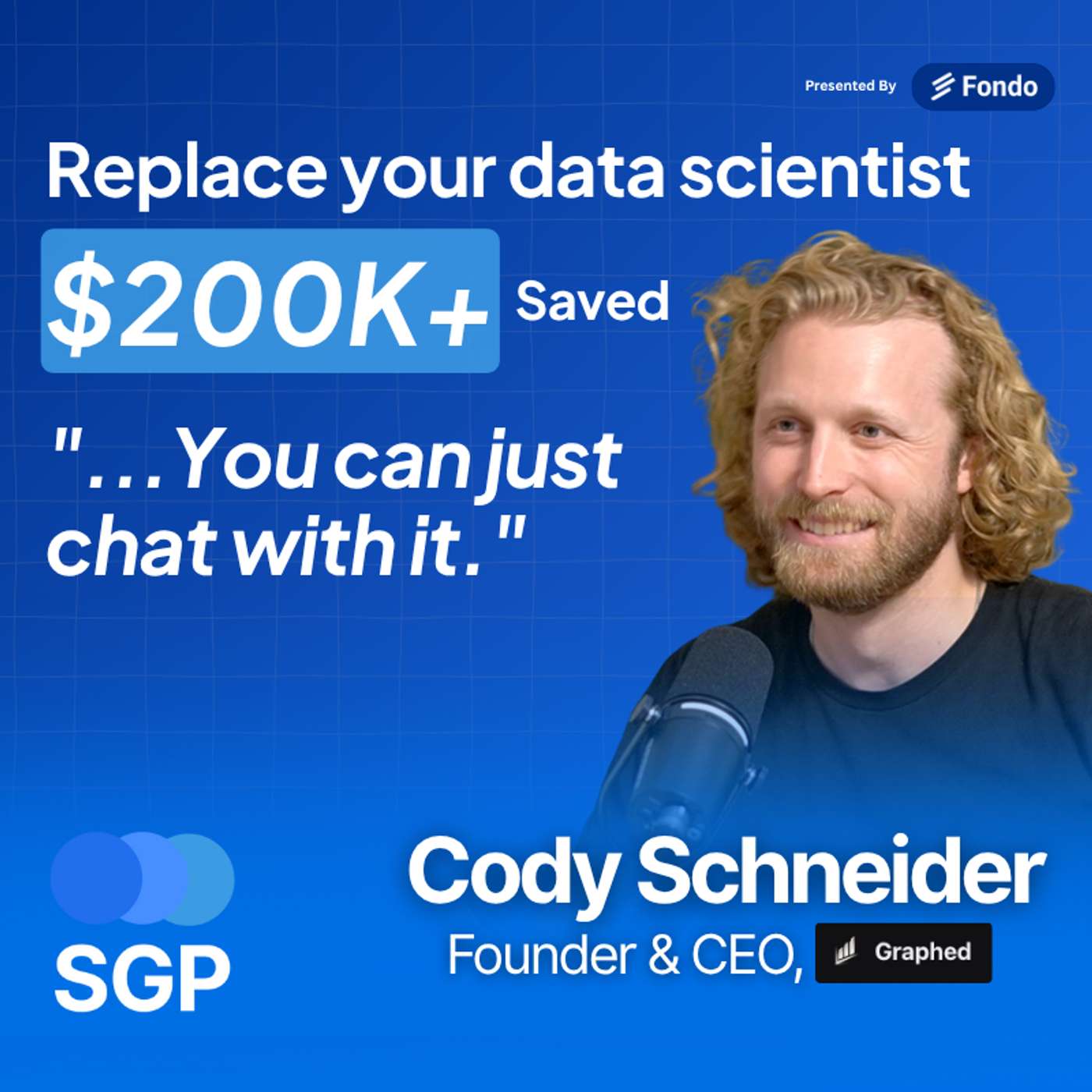
Cody Schneider | Growth Flywheels, Underpriced Attention & Building Graphed's AI Agent for Marketing Analytics
23m 55s
Graph.com is an AI-powered marketing analytics platform that simplifies data insights by automating tasks typically handled by data scientists, such as building data pipelines and creating visualizations. Its founder, Cody Schneider, discussed his background in growth at Rupa Health, where he scaled the company using a methodical approach of testing and layering marketing channels like content, webinars, and targeted Facebook ads. He emphasized that early-stage startups should prioritize transactional marketing tactics—such as paid ads and cold outreach—to generate immediate revenue before investing in long-term strategies like SEO. Additionally, he highlighted the importance of finding arbitrage opportunities in emerging or illiquid advertising channels, such as TV streaming ads, where costs are low and targeting is highly effective, to achieve efficient customer acquisition before market competition drives up prices.
It's brutal. I want to talk about graph.com. - Yeah, for sure. - Tell us what's graph.com and why do you start building it? - Yeah, so it's an AI agent for marketing analytics. Our goal is basically to replace the data scientists, right, that like you would hire. I literally just had a friend have this happen to, we're like, they hired a data scientist for 200K and basically it's like to answer these questions about their data that's like impossible to answer unless you basically like build a data pipeline, like build a data warehouse and then also understand how to use like data visualization tools to create like, you know, basically like the graphs that understand the insights are like, you know, answer the questions that you're looking for. It's brutal. It's like you literally have to use the software to get the insight. And so our whole thing is like, hey, let's take that whole problem and put it into a single package. It's like one click set up for all of your data connectors. We manage the data warehouse for you, optimizing that continuously. And then we're also building the like visualization software so you can just like chat with it, right? Imagine like a, you know, build a stacked bar chart showing a new users versus total users over time. - Created my graph to account earlier today. I'm excited to start getting some insights there. Like it is, I mean, data's a huge problem for so many companies and wrangling it and understanding it across different platforms. So I'm super excited to use graph. This is not your first company. You've built many companies before. How have you approached like building your finance stack this time around? - Yeah. - For graph. - And then we're using obviously you guys like, I found out for all of our accounting stuff is just plug and play. Like I want to focus on product and selling people. Like I don't want to think about the accounting component of the business. - Awesome, awesome stack. And work we find you online. - Yeah, yeah, yeah. You can find me on Twitter. It's Cody Schneider XX. I had Actim on LinkedIn YouTube. - Follow Cody. You can learn a lot from his Twitter and learn more about graph. - Oh, welcome Cody. So, all right. So welcome back to the startup growth podcast. We have a very special guest today. We've got the Cody Schneider, the founder and CEO of graph.com. Thanks for joining, man. - Thanks. - So, so Kobe Conrad, shout out to Cody. Kobe tweeted this yesterday. Cody was the first marketing hire on my team at Rupa and scaled us to 100 million in valuation. Everyone always asks, who's the best growth person? You know, I always say Cody, he's in SF fundraising for his new startup. I was his first check DM me for intro. So, Kobe connected us. So thank you, Kobe. - Yeah. - And it's awesome to have you, man. I've heard so many great things from Kobe about your days at Rupa and now, and building swell and now building graph. So, would love to jump into the early days of Rupa. Could you tell us like what Rupa Health was and your journey there in growth? - Yeah, yeah. So, Rupa Health was a three set of marketplace. Basically, like, aggregated all of this, especially labs that are like, you know, used a lot of the times in like functional medicine for chronic disease management. So, we basically onboarded all of these labs, put them in a single place and then we had the labs as a customer. I was once out of the marketplace, we had practitioners and then we had patients and we kind of sat in the middle of, you know, marketplace structure style business. So, I joined as the first growth hire. I knew Kobe from like a past life. We met in like a business law class at college. Both of us were very disengaged with everything related to it. We were both like, drop shipping at the time and totally different verticals. I was doing a lot of print on demand stuff and gaming like Etsy and Amazon and their algorithms at the time doing data mining and then he was doing, does the time on Facebook where you could get like free reach from Facebook pages? Like he would drive like two million clicks for free a month from a Facebook page like two million of the e-commerce store that he owned and was doing all this SEO stuff as well. But anyways, we became friends for that. He recruited me like origin stories. Like at the time I was living out of a van chasing snow or the winter, those were the buddy and yeah, called me up. He's like, what are you doing right now? And I'm like, nothing, like I'm not, like I'm, I don't want to be doing anything, you know? And he's like, well, I'm working at this company. Like you should come and I was like, absolutely not. Like I'm not doing that. So like let me send you the data. Let's take a look at just looking it over the weekend. I looked at it and it was like some of the most crazy just like growth metrics I had seen. Like the word of mouth, like month of our month that they were seeing was just unreasonable. - Right. - And so, but you knew what to look for 'cause you would have been doing growth for years at this totally. - Totally. - Yeah, so in the past like where I really come out of this boss, you went to YC. This is how I got indoctrinated. I went from e-commerce to working out a B2B marketing agency that specialized in like manufacturing companies. So they did like Imagine Doors, Windows, like the wood panels that go in buildings. Those types of companies that are like, you know, Fortune 500, Fortune 1000 that nobody knows the name of and they just print money. So my role there was doing digital strategy for them. So I basically kind of like came up under this guy who brainwashed me to think like about B2B. And like here's how to do this. And then it's all of that is really applicable to B2B software. So it's kind of in that world. But yeah, so anyway, looked at the data. I, you know, talked to him on a Thursday, looked at the data on Sunday. I was like, I'm in. I met Tara, the co-founder on Wednesday. Thursday I got the offer letter that Monday. I flew out to San Francisco with a double bag and had moved basically. So I lived on a friend's floor for two weeks, found a spot in the Marina. Just like it was an extra bed in a room like from a friend of a friend. And yeah, we just scaled it. That was how we ended up doing, you know, kind of the beginning of it all. Wow. And you 5X growth there like pretty quickly. That was crazy man. Yeah, we went from like, you know, 30 signups a month to like 280 and like five months. Larger it's just, you know, we just, growth like done really well was layering all of these different like flywheels together, right? So it's like you figure out a channel and you test five things. See traction with one of them. Focus all of your like mental energy money resources, like everything basically gets focused there until you start to see the ceiling occurring on that growth channel. And then as soon as you start to see like that inflection point, you know, the curve looks like this like S curve. As soon as you start to see that inflection point, you go and you layer on the next one. And that's how you create this like compounding, you know, hockey stick style thing. And so we just basically did that in this category. Content ended up being a huge driver of success for us there at Rupa. The like, you know, grew a podcast from zero to a top 20 medical podcast in six months. We grew an email list from zero to 400,000 subs in like a year, we're hosting a webinar on a weekly basis. We're like, you know, 5,000 people would tune in every Wednesday. We did a bunch of that. And so physicians are constantly sold to very hard to get in front of them because they have capital. They're typically like, well, see you're when you look at their like socioeconomic status. And so because of that, the inventory is way more expensive to get in front of them. So we realized we had to make content from day one. And so we just literally what we ended up finding is they don't care about business. They don't care about anything else except like patient outcomes. That's why they're in medicine. And so how do we like show like, you know, basically there's these ways to this patient outcome. So go on a tangent into the whole health space. It's crazy. But yeah. OK, let's dig into the webinar strategy. So was that the first one that really started working? Or like how many how many things did you try before one thing really worked? Yeah, yeah. So we started with ads because you know, easiest thing to spin up like you can go live in 24 hours typically with like Facebook ads, Google ads. And the strategy there is you go and you scrape your entire target audience's email addresses. So what we did is basically when it scraped all the directories, scraped all of Google maps. And then you use tools like Hunterio or any of these like look up tools. Another one that I've done data dumps from before is called Targetron. Really sketchy website. I have no idea where it's at somewhere in Southeast Asia. But basically what they do is you can just buy Valks on like, hey, I want to buy every nurse practitioner in the United States. I want to buy like all of their Google maps data. You take those URLs. And then we built an application that basically would scrape their websites because a lot of them ran on like Gmail's, right? It's just like Susie. Susie Cogren at gmail.com. So you basically we built a crawler that would scrape their entire site to find those emails and then pull, you know, take the business URL's put them into like Hunter, you know, any of these look up tools to extract emails. That way, take those emails and then you put them into like Facebook ads. This was in the past. You now you don't need to do this as much because the targeting has gotten so much better. But previously you would do that to a customer matchless. You'd only see about 30% of those like actually get matched because it's like a B2B, you know, it's a business email. But with that though, you could basically like get your initial traction, do a lookalike audience and you can basically like build this like exact target customer cohort. People don't use Facebook for some reason for like B2B. And I'm like, please, please, please continue not using it. So I have more interviewer because it's absolutely, especially right now just print money. - Wow. - Ridiculous. - So how do you, I mean, that's like a lot of steps, right? Like a lot of people think about, okay, I'm gonna stand up ads. Like what does that mean? Oh, I need to create an ad account and start putting together some copy and see what converts. But it sounds like it's not like that. Like it's, how did you learn, like you're like chaining together all these things. Like it's great for you to find your audience and doing this like how? - Yeah, you're not like, you know, 2025, like August, 2025, we're recording this today. The game is totally different. It's now the volume of creative that you make and the creative is actually the filter for finding the right audience. So say for example, you're trying to target small, you know, your local business owners, right? So you make creative that speaks directly to them. You target all the Facebook and then you set up a conversion event that like is a user action that you're trying to get them to do. For most companies that are like SaaS, which is what I spend a lot of my time in, all my time in, it's like a sign up event and then a payment event. So you're basically sending both of those events back to like Facebook ads. And then what it does, you're testing all of that creative against each other. So our strategy is like you build like a hundred pieces of creative.
You run those CPC campaigns to see which ones get the cheapest clicks. You spin those out into their own conversion campaign, and then you run them against each other. So say you find five that are outperforming the rest out of that hundred. You take those five, you run those as a conversion campaign, and then what you'll see is of those five, typically one to two of them, well, there's outperform on the actual conversion event that you're looking for, which is typically the payment. Then you can just back into that number where it's like, "Okay, cool, every dollar that we spend turns into five dollars of customer lifetime value. We have a pay-pack period of whatever three months, and I need to spend X amount to get to why revenue number and scale that up." The challenge with this for a lot of software companies is that they actually lose money off of that initial transaction. For example, these real numbers from a company I worked with in the past, the customer acquisition cost was about $89. The average revenue per customer per month was about $39, so our pay-back period was around two months. But the customer lifetime value was $600. So you'd basically pay the $89 to make $600, but you would lose money off of the first month. And for a lot of first-time founders, this is something that they, the unit economics, is something they have to figure out and understand that they're like, "Oh, I actually lose money on getting this customer," and that's okay. It's the value of the customer of the lifetime that ends up being more important. So interesting. And so at what point do you usually recommend companies? Explore Facebook ads for any paid at all. I think before you even had product personally, I was just talking to this young founders and they're between three ideas, and I'm like, "You guys don't build anything." Like literally stand up a landing page with Cloud Code, run ads to it, see which is you get the cheapest signups for. Or if somebody would even pay you to the flow or start a free trial, right? If you need somebody to give you a credit card, and you don't even have a product, you're just like screenshots of what it could be. You've got instant validation, go build that thing. I at least think about pursuing it. So before you even have it, but how I think about it for a lot of companies is you do, and when you're an early, early stage company, you focus on transactional marketing. So something that is going to make an action happen tomorrow. So revenue tomorrow, not revenue six months from now. I see this all the time with first-time founders, where they go and they start SEO, and all of these long-term investments, when they're like, you know, in month one. And in reality, like, you don't need to do that. What you need to focus on is like paydads, like cold DMs and cold email. And like get those three things locked in. One of them, you're going to see more traction with. But once you have that, and you have like, again, like, a better way to think about it is like, why am I investing in this long-term thing? If I am not going to potentially be there, who wouldn't that pay off? That happens, right? And it's like, I think about it as a financial portfolio. Like when you're a young person, like 80% of all the money that you make goes into surviving. And like maybe 20%, or like, you know, this is like an invested, best-type situation, is going to like, you know, investing or whatever. As you mature as an individual, that portfolio, it swaps, right? It's the 20 and the 80 swaps. So 80% goes in a little more long-term, 20% into the short-term. You're just doing the same thing as a company. Like, you don't start investing in that longer-term portfolio, but like a marketing channel perspective. Until you have those like pieces where it's like, okay, we're going to eat for the next 12 months because we've got, you know, these things that make great tomorrow. We can afford to do a long-term. Exactly. How do you think about early signal and like benchmarks? Like, let's say, so you mentioned paid, cold email and cold DMs. Cold DM, yep. So for ads, like, is there a click-through rate or a conversion rate that. I'm all just looking at it or what. Yeah, I'm just looking at the, the CAC number, right? Okay. On the paid ad side. So specifically, like, you know, if I put, again, that dollar in and I know that $4 to $5 a customer lifetime value can come out of that. And I know that our product's going to get better as time goes on. So that that number of customer lifetime value is going to increase. So a piece of this though is you have to think about like, there's this rule that called a law of shouldy click-throughs, right? It's this book Andrew Chen wrote on basically like the cold star problem. The idea is that when you start for most companies, it depends on the category that you're in. Like, we're in a category where ads will never work for us. Like, graph does a company like we'll like, it's going to be very hard to do ads. Like so we have to figure out really unique marketing strategies. We have talked about this offline. I won't probably not talk about it here. Just the not below the spot. But the, but the, the angle here is that like when you start out in the beginning, you typically see that CPCs are cheaper and less competitive. But as time goes on, it's more incumbents, or sorry, more competitors and incumbents enter the market. That arbitrage goes away. And so you basically have like a customer acquisition cost that increases over time. This is somewhat changing now. Like as new inventories come to market. So like for example, like in the early days of Facebook, you could give one dollar, you get one cent CPC clicks, right? Because there was just like so much inventory for you to bid on. That's how wish.com actually became a billion dollar company. Is because they were basically, you know, abusing this new channel. That was like, it's just underpriced media. And I know we're going to probably talk about this at some point on like, like specifically what's happening and happening in TV streaming ads. But anyway, yeah. Dude, let's jump into the TV streaming ads because that's really interesting. What is going on in programmatic TV? Yeah. Yeah. So I have a buddy that's in this space. He comes from the out of home like advertising. So if when I say that, think of like billboards or whatever, right? But ended up in digital out of home. And then from that, he got into basically this like TV streaming. And the thing that he, it's crazy, man, I've seen the data. They're getting like 80 cent CPMs on like local TV, right? So and you can target these individuals like off of like a customer match list, right? Which is nuts. And how they're tracking it is like directly attributable. Because an individual watches this ad, like say they're watching Hula or whatever. They watch this ad. And then they go and they Google something on the same like IP, right? And print that purchase and they can like directly attribute that to the house. It's crazy. And so it's like, this is like when I talk about arbitrage, like that's actually what you need to be focusing on as like a founder is like for every moment in time and for every product. There's like a product like like channel fit that exists. And the channel that is going to be fit, typically you're looking for an arbitrage that isn't being exploited currently. The best way to find those arbitrages is like look where people spend time online that like isn't really saturated yet. From like an advertising stamping or is hard to market in. This is like another piece of it. Like if there's like kind of this like cumbersome process to like get in there, that's actually like good. Like I look a lot of the times I think about it is like illiquid like places. I see this in influencer marketing a lot in particular. Like people are like, oh yeah, I go to this like influencer marketing hub. And like they have like the prices of like, you know what the individual like proposed costs and like, no, you don't want that. Like I want illiquid markets. You know, I'm going to pay you whatever 800 to 1000 for that. Get five of those working together simultaneously. What typically happens is you'll see an outlier occur with like every 10-ish to 20-ish posts that happen. That outlier format, you then take that, you give it to the rest of the creators and you're like, cool, this works. Now you go do a iteration of that. So it creates this like kind of like flywheel. And then you can scale that up or down as much as you want on the creator side of like a five, five, 10, I've 20. Wow. And do you pay hourly or per piece of content? It's really for posts. It's what ends up being. Yeah. So it's like that 900 for 30, like posts, right? Or something like that. I would do that. And then you just like cut the fat. Like they're going to find outlier creators that are better within your category. Be, you know, just super aggressive with like, oh, these are underperforming. And it's just a CPM number. So the reason that you do this rather than going to like paid ads, right? So going to like Instagram or TikTok. So the average CPM, right, or cost per 1000 views on like a TikTok or a Facebook ads is a TikTok is I think around $7 or Facebook's like $550. At least that's what they say. I think it's probably more. But anyway, so if you can get under that CPM by using these creators, then you're basically getting cheap. That's the arbitrage, right? That's the distribution arbitrage. You're getting cheaper CPMs than what you could pay the platforms for. And so what this ends up being is like a way for you to basically get this reach on this platform at a cheaper cost. So then, you know, just put numbers on it. Like if you get it around like $2 per 1000 views, that ends up being better. Also, we see like the organic content that will go viral. I mean, this all comes from the outlier, right? So like, you know, the 10% of posts will create 80% of or whatever, 90% of all the views that happen on that that creators account. And so you're just betting that that, you know, outlier is going to happen. And that's how you get that discounted CPM. So wow. Yeah, that's great. That's really helpful. Yeah. So tell us what's graph.com. Why do you start building it? Yeah. So it's an AI agent for marketing analytics. Like our goal is basically to replace the data scientists, right? That like you would hire for, I mean, I literally just had a friend to have this happen to him. We're like, the higher data scientists for 200 K, these like an X Uber that joined their team. And basically, it's like to answer these questions about their data. That's like impossible to answer unless you basically like build a data pipeline, like build a data warehouse and then also understand how to use like data visualizations. Tools to create like, you know, basically like the graphs that understood so you can understand the insights are like, you know, answer the questions that you're looking for. And so we're basically taking that problem that like every marketer is facing every person that wants a business is facing of like how do I understand the data and like, you know, get it to a format? Like, it, for example, if you try to learn Tableau or look a studio are like, you know, Power BI, like you're going to invest months to become competent. It's brutal. It's brutal. It's like, you You literally have to use this.
software to get the insight. So we handle like, it's like one click set up for all of your data connectors. And then we're also building the visualization software. So you can just like chat with it, right? So it's like, yeah, imagine like a UI where it's like chat on the side, dashboard in the center. And I can be like, you know, build a stacked bar chart showing a new users versus total users over time, create a line of best fit showing, you know, the slope of growth or decrease and make that as a week over week graph or a month over a month or a day over day. And you can just say that. So I created my graph account earlier today. I connected my Google Analytics, my HubSpot. Like it is, I mean, data is a huge problem for so many companies and wrangling it and understanding it across different platforms. I think the biggest thing that we're seeing too is like, everybody's trying to solve this right now, but like you just can't even do this because like you have, there's so much data like we had a beyond order to clients like they had like, no, 25 million rows of Facebook data alone. Like if you tried to plug that into like any AI solution, like there's no way, yeah, you just get you'd literally hit rate limits. So you have to solve this problem with the data warehousing piece to be able to solve the insights. And so how we're thinking about it is like we augment, you know, a data person to begin with. And then from there, like, you know, this is the value prop of, you know, what we're trying to do. Like augment the data person. Like can we replace the data person? And then we can we have it be like almost like God like where it's like, it's just looking at your data constantly. And like researching on the internet and like you wake up on a Tuesday and it's like, hey, the last week I've been doing this, like you get a Slack message and it tells you all this inside about your company and all the opportunities that are there. What you need to do to like, you know, grow as a company and like all this technology exists right now to handle this. And to do this, it's just going to take, you know, basically we're building the stack, you know, the innovation stack that's necessary to accomplish that. So I love it. I love it. You check it out graph.com. Yeah. Yeah. I love it, man. So okay, so you this is not your first company. Yeah. Yeah. Yeah. So we did we did Stripe Capital. It's so easy. Like, I mean, it's 500 bucks and they handle everything, which is amazing. We just did a Delaware C. And the biggest thing I think with like, sorry, sorry, not Stripe Capital, Stripe Alice. But the biggest thing with them is there's so many perks that comes from it. Like it's like instant in the card, instant into Mercury. Like we're super super early. So we don't even have like payroll or those other solutions. And like we know that that's there and like a part of it. So it which it just solves those problems. But those are kind of the core pieces. And then we're using obviously you guys like fond of for all of our accounting stuff. Just because it's like, it's just plug and play. Like I don't want to think about like this other piece, you know, the the accounting component of the business. Like, you know, understanding like our money flow is critical. But like, especially as like a startup like we need to be able to build product and sell it like those are like, you know, 90% of our energy needs to be that you're going there. So awesome, awesome stack. And I want to talk about the growth that graph has had and how you're getting all these customers. And I know we're out of time. So maybe you can come back. We'll come back next week. Yeah, yeah. We'll go to Cody back. Where can we find you online? Yeah, yeah, yeah. And then I'm at act among LinkedIn YouTube. If you just Google me, it should come up. If it doesn't, like I'm very bad at my job. So Cody is one of the best growth people in the world. I mean, you'll read about it all over Twitter. He's in SF just for a short period of time. I know your round is like over subscribed pretty much at this point. But you know, follow Cody. You can learn a lot from his Twitter and learn more about graphs. Thanks so much for joining. Thanks for hosting me, man.
Podcast Summary
Key Points:
Graph.com is an AI agent for marketing analytics designed to replace the need for hiring data scientists by automating data pipelines, warehousing, and visualization through a chat interface.
The founder, Cody Schneider, previously led growth at Rupa Health, scaling it significantly through layered marketing strategies like content, webinars, and targeted ads, emphasizing rapid experimentation and channel diversification.
Effective early-stage marketing focuses on transactional channels (e.g., paid ads, cold email/DMs) for immediate revenue, shifting to long-term strategies only after establishing sustainable short-term growth.
Identifying and exploiting arbitrage opportunities in underpriced or emerging advertising channels (e.g., TV streaming ads) is crucial for efficient customer acquisition before competition increases costs.
Summary:
com is an AI-powered marketing analytics platform that simplifies data insights by automating tasks typically handled by data scientists, such as building data pipelines and creating visualizations. Its founder, Cody Schneider, discussed his background in growth at Rupa Health, where he scaled the company using a methodical approach of testing and layering marketing channels like content, webinars, and targeted Facebook ads. He emphasized that early-stage startups should prioritize transactional marketing tactics—such as paid ads and cold outreach—to generate immediate revenue before investing in long-term strategies like SEO.
Additionally, he highlighted the importance of finding arbitrage opportunities in emerging or illiquid advertising channels, such as TV streaming ads, where costs are low and targeting is highly effective, to achieve efficient customer acquisition before market competition drives up prices.
FAQs
Graph.com is an AI agent for marketing analytics designed to replace the need for hiring data scientists. It automates data pipelines, manages data warehouses, and provides visualization tools so users can chat with it to generate insights and graphs.
He started Graph.com to simplify the complex and expensive process of hiring data scientists and building data infrastructure. The goal is to package everything into a one-click setup for data connectors, managed data warehousing, and intuitive visualization.
He was the first growth hire at Rupa Health, a three-sided marketplace for labs, practitioners, and patients in functional medicine. He helped scale the company significantly through various growth strategies.
He layered multiple growth channels, starting with ads and moving to content creation. Key tactics included scraping target audience emails, running targeted Facebook ads, growing a podcast, building an email list, and hosting weekly webinars.
He suggests focusing on transactional marketing like paid ads, cold DMs, and cold email to drive immediate revenue. Test creative extensively, track customer acquisition cost versus lifetime value, and prioritize channels with arbitrage opportunities.
It refers to the trend where customer acquisition costs rise over time as more competitors enter a market, reducing arbitrage opportunities. Early movers can exploit underpriced media, but costs increase as channels become saturated.
Chat with AI
Loading...
Pro features
Go deeper with this episode
Unlock creator-grade tools that turn any transcript into show notes and subtitle files.
 PodcastTranscript AI