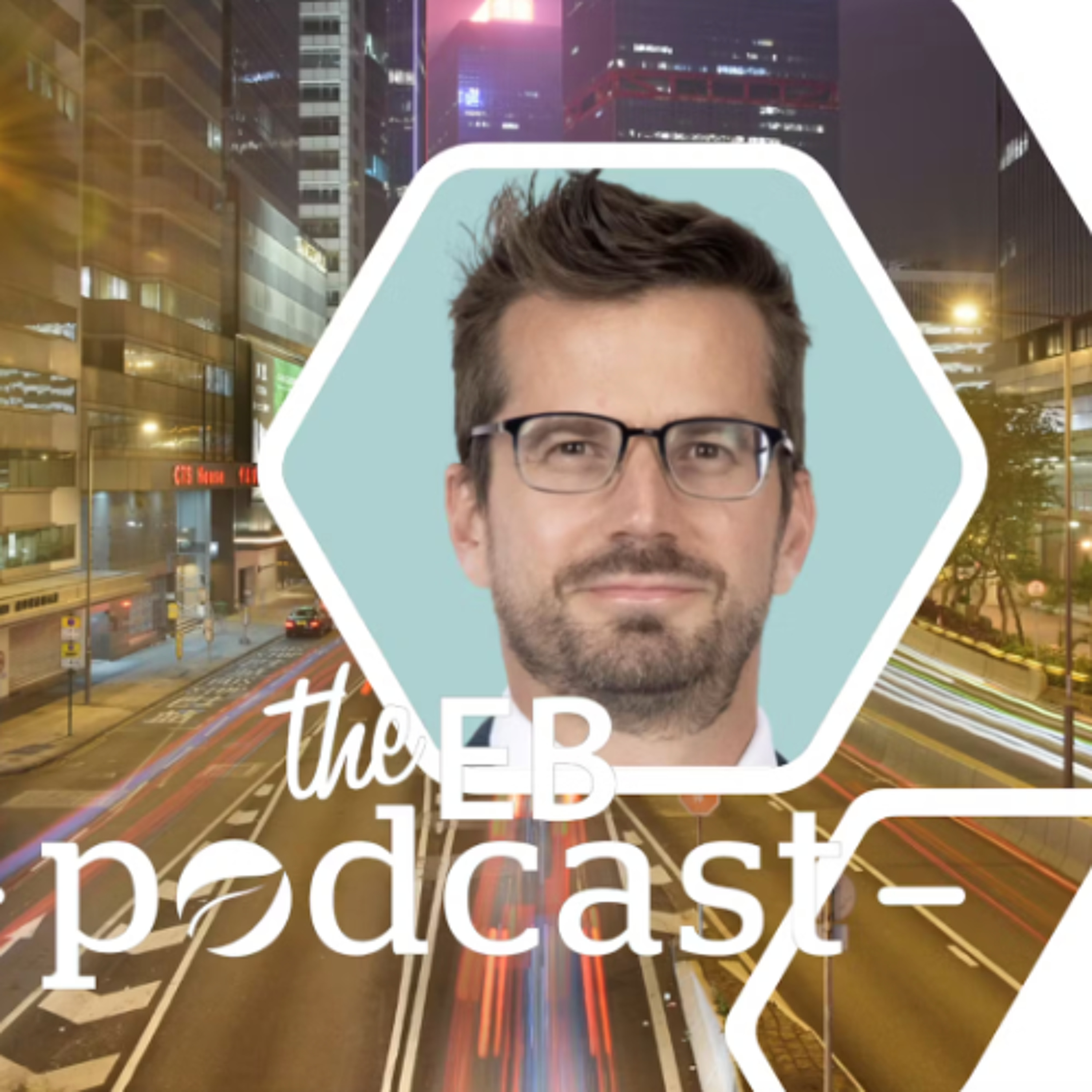
CLP Power's Hendrik Rosenthal on justifying sustainability in turbulent times
22m 5s
In this EcoBusiness Podcast interview, Hendrik Rosenthal, Group Sustainability Director of CLP, discusses advancing sustainability within a major power company. Based in Hong Kong but operating across Asia-Pacific, CLP faces the complex task of decarbonizing a portfolio still significantly reliant on fossil fuels, with goals to exit coal by 2040 and reach net-zero by 2050. Rosenthal explains that CLP embeds sustainability directly into its core business strategy through a governance structure involving executive and board committees, ensuring it influences operations rather than being a peripheral function. He emphasizes pragmatism, arguing that diverse energy sources, including nuclear—which supplies a quarter of Hong Kong's power—are essential for a reliable, low-carbon transition. Key challenges include justifying the sustainability function's value, managing extensive data for compliance, and practically executing the coal phase-out, which may involve divestment. Rosenthal advises aspiring sustainability professionals to be resilient, open-minded, and globally aware, rejecting dogmatic views in favor of practical, step-by-step progress.
How can the sustainability agenda be pushed through a power company? Particularly a company whose role is literally to keep the lights on in an energy thirsty fossil fuel dependent city like Hong Kong? Where should sustainability sit in the corporate structure at a time when ESG is under such scrutiny? This is the EcoBusiness Podcast. I'm Robin Hicks. In our new series on the front lines, which profiles change makers on the hard-edged sustainable business, we have a conversation with Hendrick Rosenthal, group sustainability director of Hong Kong headquartered power company CLP. Rosenthal leads the sustainability function for a power company that runs coal, nuclear natural gas, and renewables plants in India, Australia, Southeast Asia, mainland China, as well as Hong Kong. A key part of his job is decarbonising a company that is still significantly exposed to fossil fuels. One of CLP's main sustainability targets is to exit coal completely by 2040, as it aims for net zero across its value chain by 2050. So Rosenthal's job involves steering a carbon-heavy business towards cleaner energy sources, including nuclear, which he argues is an essential part of the energy mix. To simply say we shouldn't have nuclear power, that it's a bad thing, is a bit naive in my view, he says. Rosenthal believes that as the sustainability function comes under growing pressure, it's important that practitioners keep an open mind. He says, don't get stuck into thinking that there is only one way to save the planet, only A is good, and B through to Z are bad. The world doesn't work that way. We need to be much more practical. From school to university to work, Rosenthal has spent all of his life in some sort of environmental or sustainability field. Born and raised in Germany, he lived and worked in Canada too, and has spent the last 17 years in Hong Kong, the last six-and-a-half with CLP. Welcome to the podcast. Great to have you on. Thanks for having me. I'd like to start off, Hendrick, by asking you a bit about yourself, what drove you to sustainability? It goes back a long way. It's something I was always quite passionate about. I did grow up in Germany, actually, and it was quite passionate about recycling and bringing materials to the recycling bin. I did grow up at the time when Chernobyl happened, so nuclear power was high on the agenda. The Green Party in Germany was high on the agenda. It really did influence me in terms of some of the thinking about what we need to do to have clean water, don't create so much waste, and be conscious of your footprint. I guess I just went into my choices in terms of schooling and what I wanted to study. So, the thinking around nuclear back then presumably was about, obviously, it has an energy source, but also the dangers of nuclear, right? Absolutely. I was a small kid at the time, but I distinctly remember I wasn't allowed to go out and play, especially when it rains. We're quite far away from the site and from Ukraine, but that was definitely a fear that spread amongst the community in terms of having radiation exposure from this nuclear incident. If you go back to what happened in Germany in the last 10 years with the phase out of nuclear power post Fukushima, there's a real sentiment that nuclear power is not safe, but then when you look at it in terms of the likelihood of incidents happening and how much has happened in the past and what sort of measures have been taken to making sure this doesn't happen again versus the climate considerations we have and how do we generate electricity and the requirements we have to run our economies, keep their lights on, to simply say we shouldn't have nuclear power, that's a bad thing. It's a bit naive, in my view. Yeah, I mean, nuclear is very much back in the conversation, isn't it? It's a viable energy option, particularly in countries that are struggling to decarbonize the nation-Pacific. So take us back and what eventually brought you to Hong Kong and CLP? Right, I chose an environmental program for my graduate studies at the University of Waterloo, Environment and Resource Studies. This was very early days. There was not many programs like that around. This was essentially a sustainability degree. What does sustainability in practice actually mean? Following that, I got a job at the Ontario Ministry of Environment and Toronto. That brought me on to this whole career path and for various reasons, I decided to take a leave of absence and explore Hong Kong with my family at the time and got a foothold here. This was 17 years ago now, where I first came to Hong Kong and ended up doing consulting work and sustainability back in those days. In 2008, sustainability consulting wasn't really a thing either. It was very niche. It was like, okay, so what are we going to do with that? How are clients going to pay for this? Then actually switch to more investor side here in Hong Kong, where I joined an association on sustainable and responsible investment. We weren't even talking about ESG back then. SRI was the key theme. We went around the region to knock on doors. I was climate change relevant to your investment. How are you managing that from a risk perspective? So you've much always been in sustainability, right? Ultimately, you've landed it at CLP, a power company, which is pretty much the most difficult not to crack in terms of transition. So in your role as director of sustainability, where does sustainability sit within the corporate structure that allows you to push the sustainability agenda in the right direction? It's a very important part of the puzzle actually. It's all about the governance at the end of the day. How do we have ability to influence? My team, the sustainability group sits within CLP, reporting directly to a sustainability executive committee as we call it. So that's essentially our group executive team that includes our C-suite, as well as the MDs from the various businesses that are part of the group. That's really a form where we deliberate some of the challenging questions and some of them relate now to compliance matters, some relates to data management, because we need that from a compliance perspective. Some of it relates more to our transition plan, how do we change our business? How does sustainability actually manifest it within CLP? That's really the fundamental question. You don't have a sustainability strategy that sits within the sustainability team and that's something my team needs to look after. We have a business strategy where sustainability is built in. So my team is responsible for making sure that sustainability elements are reflected within that business strategy. That's a really important distinction to make across any business that takes sustainability serious. It's not something that can happen in a silo by a team. It has to be embedded across various parts of the operations and how you make your product. So from that forum, the sustainability executive committee, we then bring forward issues to the board level sustainability committee. And that's where decisions are made in terms of updating our targets, approving our disclosures, reviewing our decarvisation pathway, looking at issues like human rights and nature and how we are managing that. The committee that has foresight that's embedded within the terms of reference. It's not looking at current operational problems, per se, but trying to be a few steps ahead. And if necessary, anything after that would require board level approval only on rare occasions when we have biggest ticket items like updating our targets in public commitments. So that's how we work up. But then we're also working down across the organization. And we have what we call the sustainability forum. That's where all the different practitioners that have a sustainability touch points across the business units come together on a regular basis to at least share what are we all working on and how do we find synergies in that space. At the end of the day, it's the business units that have to make it happen. There's only very limited direct influence we have on the business units to make things happen. It's more about providing guidance, setting standards and setting expectations about what should we do in practice. It's only thing you can say about how sustainability is incentivized for those business units. That's a very important piece in terms of how do you actually make this happen? We have two levels on that. One is the public commitments we have and showcase performance on. And inherently within that, there's a question of how do we actually do this, right? So there has to be some level of comfort and certainty from our part at group level that we can make this happen to meet these performance expectations. And the biggest one for us is greenhouse gas emissions. In particular, the intensity of the electricity that we send to our customers. That's our key metric. And what my team looks after in terms of understanding the group portfolio and how do we collectively come to this intensity figure? What are the different parts of the business that are shifting from now until 2050? New assets coming in. Old ones facing out. Do we have any closure potential? It can be diverse. Should be diverse. How can we accelerate any of this? So that's very much a group view. But at the end of the day, there needs to be the dialogue with the different business units. What is your plans for these various assets? And when they tell us, well, we're going to keep this until 2050 because that's our business plan. That's what the conversations then start. Like no, we are facing out coal by 2040 at the very latest. You need to make it happen before 2040. And this is a work stream now that you need to start getting your head around and how to make that happen. Coal plants don't just move overnight in terms of even selling or closing them. It's a long-term exercise to bring them online or off the portfolio. So that's the certain level of communication that happens in that process. But increasingly, each one of the business units also have their own KPIs on an annual basis. So when we come to a point for a particular year where this particular need to accelerate, that's when it actually pops up in an annual KPI. You need to have this done this year in order to get to 2028 when that happened. Understood. So let's talk a bit about the hardest things about your job, Hendrick. What's up? Can you keep it up at night? Inherited challenges in terms of why do we need a sustainability function actually? And isn't it just another cost center? And especially in this current environment that we're in now with tariffs and geopolitics and big changes happening economically, are we still in a position to maintain such a function and should be maintained such a function? So there's an ongoing process and fairly regular review in terms of what is the nice to have bits of what the team delivers and what does the must have? What has happened and it is so so different from 2008 when I first arrived in Hong Kong where there was no compliance obligations, we now have a very clear compliance regime for listed companies in Hong Kong in terms of providing a certain level of transparency for the business and showcasing to the market simple things like greenhouse gas emission. It's a compliance question now just to have that information and having a transition plan. The disclosure standards with ISSB and then the Hong Kong version that the Hong Kong Institute of Certified Public Accountants has published HKFRS as one and as two is very clear that this will be the accounting standard for sustainability and every company in Hong Kong will have to have this reporting by 2028. That requires a team and a process to make it happen. This is compliance. This is not nice to have. This is not just writing a fluffy sustainability report with some marketing slogans that many companies have done in the past and some actually do to this day. It's much more what is decision-useful information related to sustainability that we need to showcase to the market that investors should know to make sound investment decisions. This is really the system that we have now and that in itself creates challenges in terms of making sure we have the right resources, the capabilities and also data on hand to provide that level of transparency and disclosure. One thing is compliance in the second part is data and data management and how do you set up a system that collects in our case which maybe is quite modest 70 different assets and performance data that is not just financial but every non-financial metric you could think of in terms of environmental and social performance needs to come back to headquarters at group level because that's the listed entity to understand what that performance is for our portfolio because we need to disclose that. So you need to have that system that data flow set up. There needs to be approvals. A lot of people need to do a job to get that information back to group so we can have aggregated figures. That's challenging. I've never imagined when I was a little boy running around trying to collect waste that data management would be so fundamental to this endeavor of sustainability. You need to have that understanding. Has there been any pushback though, Hendrick, about the importance of sustainability internally? There's the idea for example of a chief anti-sustainability officer. Well, your job is opposed by others who find sustainability to be a hindrance to their job or their P&L, right? How do you manage that resistance if there is anything? Well, I guess I'm quite lucky in the sense in the type of organization I work at. I think a lot of it is cultural. Every organization has their own corporate culture and their ways of doing things and the outlook we have at CLP is much more long-term. We're here for the long-term. We have a view where it's not just about making a buck for the next quarter. It's about being part of the community, delivering an essential service, and all in that creating shareholder value, but also value in terms of sustainability and mitigating our impacts. It's not so clear cut in terms of phasing out certain things because they're costly or why we bother doing certain things because that's just a waste of effort. I think the important part to remember in a sustainability function is to be pragmatic. You can't change things overnight. If you have a machine that has a certain high level of energy consumption that could be much better if you bought a new one, but that machine you currently have has a lifespan of another 10 years, it would be uneconomical to slightly shut it down and buy a new one. How do you make that argument that you should then buy something much more efficient and something better for an environmental perspective? You need to prioritize and for a sustainability perspective, there's just so many things you could cover, right? How do you zoom in on the big ticket items that you can do now, that you can have a real influence on and a real impact? It's a matter of making choices, I think. How about the broader challenges that CLP is working towards and how realistic they are on the current climate? Moving away from Colf example, it's pretty ambitious. How realistic is that? Plus developing renewables, how realistic are those targets in your view? Those are real business ambitions so that they are very realistic in terms of our own internal planning processes, our business growth objectives. Facing out Colf, I think it's a really interesting question for us, our priority is to no longer have Colf in the CLP portfolio. Now, we have investments that were made many years ago, in some instances, where we built new Colf power plants. Some of those are maybe 15 years old at this point. They're not ripe for closure, A, because, for example, the machine is quite new for a power plant. There are certain regulatory constraints about operating these and having an obligation to deliver power for an extended period of time. There's a contract for this plant to deliver power until well into the late 30s. In terms of our ambition, do we keep this in our portfolio? What's the actual real choice we would have with such a plant? I'm really talking about India as a market, right? There's such a demand for power in that market that closure is not an option of some of these facilities, especially the newer ones. The government wouldn't allow it. There's so much demand growth that Colf will be a real provider of electricity for the foreseeable future in that country. So, in our case, what do we do with that? Well, perhaps we can sell the plant. Perhaps we can have some divestment and recapitalize, get money into India business so we can then reinvest that into renewables. We're trying to build a business that is based on non-carbon energy sources, provides energy services, transmission distribution, energy storage, and really facilitates decarbonization of electrification. For that, we don't really want Colf. Divestment is a realistic choice as part of that process. But if you look at it, it's from a greenhouse gas or climate change perspective, fully appreciate it. It doesn't solve the planet's problems, right? But we will be building a business that will support decarbonization and that at least from our perspective, we are on the right path. Can you tell us a bit about nuclear? The reason I ask is because of your comments earlier on about Chernobyl and how that shaped your thinking around this as an energy source and where it fits into CLP's plans? Well, I mean, we already invested in nuclear power at CLP. We have been for 30 years, it provides about a quarter of Hong Kong's electricity. So that's a given. And it's been, it was one of the first investments that were made in nuclear power in China. And CLP is part of that legacy. We have since made additional investments. And if there's new opportunities to continue to grow on nuclear portfolio, we will be supportive of that. We see it as a fundamental source of base load energy that is required and necessary in a grid. It mixes decarbonization objectives. It's reliable. It's cost effective. And if you were to say, which is the choices that were made say in Germany that nuclear power is bad, let's get it out of portfolio. Let's burn cold instead. Or buy from our neighbors nuclear power because we don't have enough energy. It's a bit of nonsensical. What happened over there was a political decision that appeased the community for fears that were fundamentally unfounded from my personal perspective. And that's me also saying that as a German. Final question is whether you have any advice for young sustainability professionals wanting to get into the area? Any survival tips? What does a young person need to survive in a sustainability role these days? Resilience is a key word here. You need, keep your options open, keep an open mind. Don't get stuck on the only way to save the planet is A. That's not to be through Z because that's bad. It's a step-by-step battle that we fight here in terms of getting us on the right path. And it's maybe not always perfect. And that's okay. From a learning perspective, what has shaped me as well, having grown up not just in Germany, but also in Canada, it just shaped me in such a way in terms of being able to see the world as it is from a global perspective and not being so narrow-mindedly focused only on your own backyard. And then having this opportunity for the last 17 years of my life to explore Asia and be part of this community here, I think it's just so important for people to see the world. And how we actually are all so similar and have such similar challenges. That's really a fundamental mindset. I think any sustainability practitioner should have. Great stuff. Hendrik Rosenthal, thank you so much. Wonderful. Thank you, Robin, for having it. This podcast was hosted by ECO Business, Asia's leading media company serving the region's sustainability community. Join the conversation by visiting ECO-Listness.com, follow us on social media and subscribe to our newsletters. Thanks for listening.
Podcast Summary
Key Points:
Hendrik Rosenthal leads sustainability at CLP, a major power company operating across Asia-Pacific with a diverse portfolio including coal, nuclear, natural gas, and renewables.
A core challenge is decarbonizing the company, with key targets to exit coal by 2040 and achieve net-zero across its value chain by 205
Sustainability is integrated into CLP's business strategy through a structured governance model involving executive and board-level committees, rather than operating in a silo.
Rosenthal advocates for a pragmatic, open-minded approach to the energy transition, emphasizing that nuclear power is an essential, reliable part of the decarbonization mix.
Major challenges include managing internal and external pressures on the sustainability function, ensuring robust data management for compliance, and navigating the practical realities of phasing out assets like coal plants.
Advice for sustainability professionals includes maintaining resilience, keeping an open mind to diverse solutions, and gaining a global perspective on environmental challenges.
Summary:
In this EcoBusiness Podcast interview, Hendrik Rosenthal, Group Sustainability Director of CLP, discusses advancing sustainability within a major power company. Based in Hong Kong but operating across Asia-Pacific, CLP faces the complex task of decarbonizing a portfolio still significantly reliant on fossil fuels, with goals to exit coal by 2040 and reach net-zero by 2050. Rosenthal explains that CLP embeds sustainability directly into its core business strategy through a governance structure involving executive and board committees, ensuring it influences operations rather than being a peripheral function.
He emphasizes pragmatism, arguing that diverse energy sources, including nuclear—which supplies a quarter of Hong Kong's power—are essential for a reliable, low-carbon transition. Key challenges include justifying the sustainability function's value, managing extensive data for compliance, and practically executing the coal phase-out, which may involve divestment. Rosenthal advises aspiring sustainability professionals to be resilient, open-minded, and globally aware, rejecting dogmatic views in favor of practical, step-by-step progress.
FAQs
By embedding sustainability into the core business strategy, not treating it as a separate function. This involves setting clear decarbonization targets, such as exiting coal by 2040, and integrating sustainability across all operations and decision-making processes.
It should report directly to a senior executive committee and have a direct line to the board-level sustainability committee. This ensures sustainability is integrated into business strategy and has the governance support to influence key decisions and targets.
CLP aims to exit coal by 2040 through strategies like divestment of coal assets and reinvesting in renewables. In markets like India, where coal remains essential, the focus is on transitioning the portfolio over time while supporting decarbonization through other energy services.
CLP sees nuclear power as a reliable, cost-effective, and low-carbon source essential for base load energy. The company has invested in nuclear for decades and considers it a key part of meeting decarbonization goals, arguing that dismissing it outright is impractical.
Key challenges include managing resistance due to cost concerns, ensuring compliance with evolving disclosure standards, and handling data collection across diverse assets. Balancing long-term sustainability goals with short-term economic pressures is also critical.
Through a combination of group-level oversight, regular dialogue with business units, and incorporating sustainability KPIs into annual performance metrics. This ensures alignment with targets like reducing greenhouse gas intensity and accelerating the coal phase-out.
Chat with AI
Loading...
Pro features
Go deeper with this episode
Unlock creator-grade tools that turn any transcript into show notes and subtitle files.
 PodcastTranscript AI