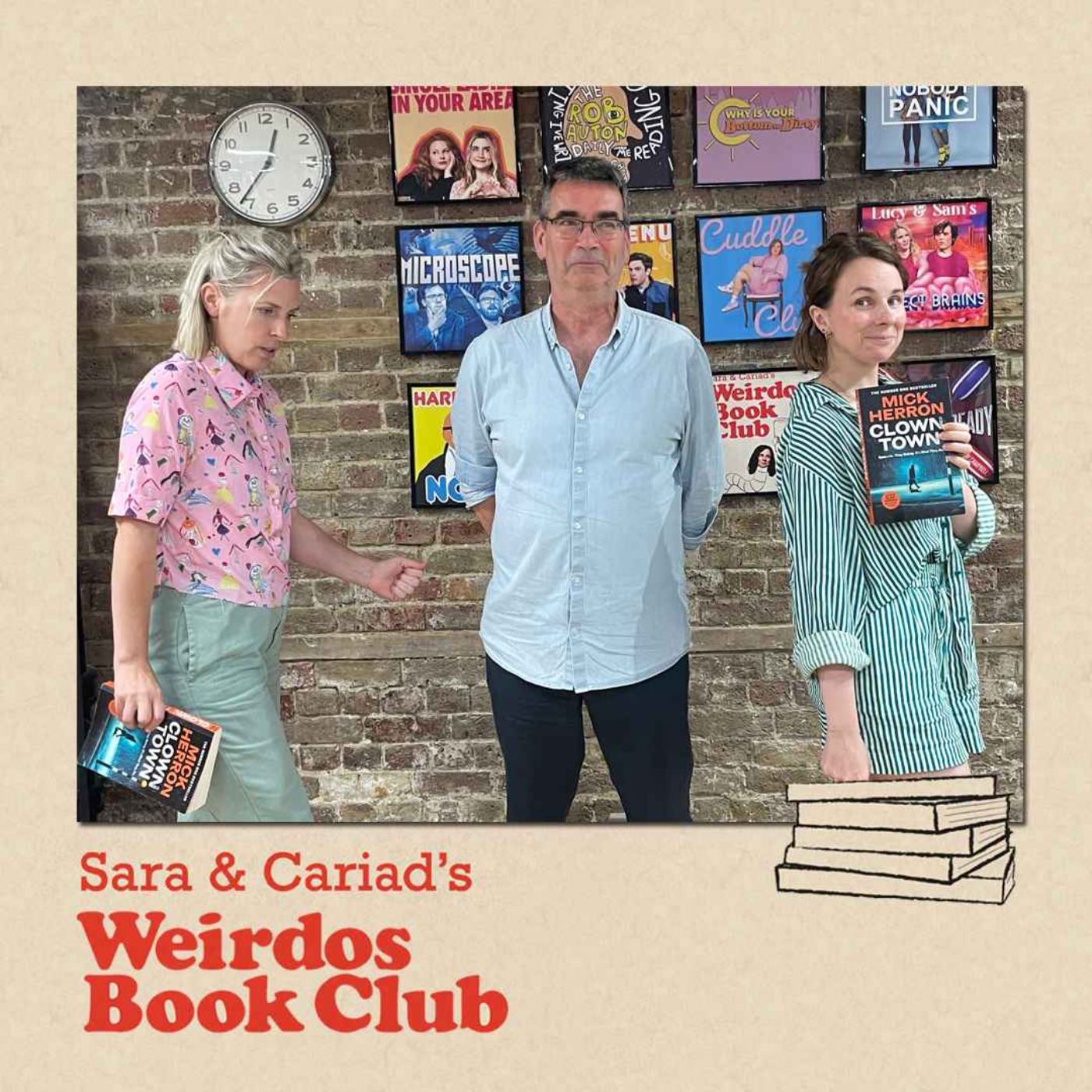
The transcription introduces the "Weirdo's Book Club" podcast, hosted by Sarah Pasco and Carrie Adloy, which creates a welcoming space for outsiders to discuss bizarre books. This episode features author Mick Heron, famous for his Slough House series, including the book "Clown Town" and the Apple TV adaptation "Slow Horses." Heron shares his background, starting with poetry before turning to prose fiction, and emphasizes that reading is more crucial than writing practice for development. He discusses how his characters, especially the iconic Jackson Lamb, evolve through dialogue rather than pre-planning. Lamb is portrayed as a morally complex anti-hero: crude, rude, and flatulent, yet protective of his team as his "troops" rather than as individuals. Heron notes that Lamb's actions are driven by a duty to shield those under him from higher-ups, not by personal affection. The conversation also explores how Heron plots character deaths as key plot points from the outset, avoiding sentimentality. Overall, the episode delves into writing processes, character creation, and the relatable theme of workplace hierarchy and loyalty.
[Music] Hello, I'm Sarah Pasco, and I'm Carrie Adloy. And we're weird about books. We love to read. We read too much. We talk too much. About the too much that we've read. Which is why we created the Weirdo's Book Club, a space for the lonely outsider to feel accepted and appreciated. Each week we're joined by amazing comedian guests and writer guests to discuss some wonderfully and crispy weird books, writing, reading, and just generally being a weirdo. You don't even need to have read the books to join in. It will be a really interesting, wide-raging conversation. And maybe you'll want to read the book afterwards. We will share all the upcoming books we're going to be discussing on our Instagram, Sarah and Carrie Ad's Weirdo's Book Club. Thank you for reading with us. We like reading with you. This week's book guest is Clown Town by Mick Heron. What's it about? The spies at Slao House and their continued catastrophes. What qualifies it for the Weirdo's Book Club? Well, Jackson Lamb is a one-of-a-kind man. Thank God. In this episode we discuss Gary Oldman, Gaffer Tape, Gagwriting, MI5 and Fart. And joining us this week is Mick Heron. Mick Heron is a mystery and thriller novelist. He's written many books. The most famous of which is the Slao House series which we've been adapted by Apple TV. You might know it as slow horses. Welcome to the podcast, Mick Heron. Woo! We're excited. So am I. Thank you very much for inviting me. Oh, thank you for being here. It's very exciting. What on my not birth day? On your not birth day, yes, we still about this. Fake news on the internet. Wikipedia says that your birth day is today. And so I bought you a cake on the way in, because I thought, poor man is coming to do a book podcast. She's birth day. I had a message to the WhatsApp group. Yeah, panicking. It's, it's, it's, it's, it's birth day. Spending it with us. Should we sing as he comes in? I'm waiting for it. Should we get punching? Yeah. But then someone is lying on Wikipedia. I know. My face and the internet is absolutely. I wonder whether there's any other misinformation that I think is just this. Have you ever heard any fake information carried out? Oh, I don't know. I can't think of any. Yeah, I mean, sure. I have. For a while, Wikipedia said that I was married to a comedian called John Richardson. He's very successful comedian. And he's very handsome, aren't mind. I mean, I'm not saying. But he had an actual wife at the time. But she was also blonde. A lot of blonde comedian. Yeah. So I think they were just like, oh, you must be busy. Yeah, but I just, I left it for a year. Yeah. Because I thought if you're going there for your facts and inverted commas, well, it's just a. It's just an added address. A conversion of the world. Yeah. There's something. They told me this one. I was on, they dropped QI, that their Wikipedia, actually, the majority of it is done by very few people. And there was one boy in my Arkansas that was responsible for about like 25% of the articles. And he was making them up. He was like a teenager in his bedroom. This was his video games. He was just making up so much stuff that because it was so prolific. And then people were linking to it. And then they believed it. They were like, oh, these things became facts. And then eventually they had to realize, oh, this is one. But everything has to have a source. So it sort of disappears from there, doesn't it? Yeah, but if you're like that involved in it, you just keep putting up a page saying. I suppose you become your own source after a while. Yeah, exactly. That's what I mean. Things get linked back to other pages that he'd lied about for different things. And he was lying about some different things. So it just became like, oh, these must be facts because they've been there for years. Yeah. And then eventually they were like, quite a significant amount of this is. Why would you? I'm just glad I never do any research, then. Because if I did, would you be able to do my first stuff? Well, yeah. What brings us to your writing? Because I. One of the. Actually, we should talk about how you go into writing first. But then we should talk about how you find out so much about spies because you think that would be difficult to research. I was thinking, it must be a spy. It must be a spy. Well, I get that a lot. Yeah. I was like, come on. It didn't John the Carrey used to get accused of that as well. Or he was somehow. He did actually work for both Emma and Michael and Emma Six. That was fair enough. That was fair enough, isn't it? With me, no. I do make it all up. I mean, I like this guy in Arkansas. Yeah, are you him? It's my cover identity. Yeah. No, I've never worked for the intelligence services in any way, shape or form. But I've read a lot of books. I've seen a lot of films. And I just. A good imagination. I'm not in a way. I'm not really writing that spies. I'm writing about working in an office, which I have to. Yeah. Yeah. And that's where most of it comes from. So tell us about your journey into writing. Was it a childhood episode? It was a journey into work. So tell us how you got here today. Because I read that you started in poetry. That you started writing poetry first. I wrote first before I wrote prose fiction. Yeah. Since it's going back a long time when I was at. Or just after, really. Just after I was at university. And did that for a few years. And it just kind of stopped for me. I did. I never published a collection at all. I published in small magazines. They're all small poetry magazines. And then it just kind of stopped happening, which. I kind of know why now. I didn't at the time. And so writing prose fiction became a kind of substitute for that. I needed some kind of outload for the creative energy that I had got that was pretty much isn't it? No, no. And you did just start with the "Slow House" ones. Did you. No. The "Zoey". How'd you say that? Bowen? I wish I knew. Bowen is good, yeah. So we bowen. So we bowen. So we bowen. Oxford ones were your first phrase. That's right. I lived there. And that's where I said the first novel, "Zillow Road". Yes, they were four of them. There were five novels I think before I wrote the first of the "Slow House" novels. And four of them were about Zoe. Was there a moment during that sort of Zoe period that you thought, "Oh, I'm going to carry on or I'm happy with this?" Or, you know, I mean, like what allowed you to keep going as a writer when you're not experiencing the level of success you have now? Or any at all. I find fulfillment in writing. And as a say, I took up writing prose fiction because the poetry dried up. So it's something that I had to do. And I, you know, always being published. I wasn't being read particularly, but the books are in libraries, which is nice. And it satisfied that need in me to do something. I mean, that's the best way to write. I mean, for yourself. Yeah, I'd never applied myself to a career, really. I mean, I didn't have enough job, but it wasn't what you'd call a career. But this was what I wanted to do. You know, the job was putting food on the table, putting a roof over my head. And the writing was satisfying everything else within me that needed satisfying, if you. If that doesn't sound awful. And in terms of creating a new set of characters, did that happen where you felt, and did they sort of start existing in your peripheral brain? Or did you think, okay, Zoe, this world has sort of exhausted itself a little bit? I'll find a new one. How conscious was that? I had written three of the Zoe books. I call them Zoe books. Actually, there's a character called Sarah, who's much more important, certainly in the first novel. First novel is about time. That's right. Sarah's not a common name. Then Zoe came into her own in the following books. And then I wrote a sort of standalone thriller, which I had thought, okay, if I'm going to ever become successful, this is it. Oh, yeah, yeah. Do a big one. So I did, and it disappeared without trace. Very glad I wrote it. It's still there, but it wasn't a success. So I thought, okay, that's where I am. I've been shown my place, as it were. So I'll carry on. And I wrote another Zoe book. And then the idea for Sarah House came into my mind. While I was writing that fourth Zoe book, I haven't had a very good career planning. But the one decision that I'm proud of having made is that when this idea for Snow Horses came to mind, the temptation was to put the book I was writing aside and just dive straight in. But I didn't. I spent a year finishing that book. And during that year, I think it all started to come together. I'm getting much more coherence than it would be. Yeah. If I just lawn straight into it. So when I wrote Snow Horses, I was ready to write it. You know, I'd been building up for a while. I was that so nice to think it was just brewing in the background. But you were still writing and expressing yourself creatively and learning and improving yourself as a writer. But, Slough House was just brewing. It felt like having something in the bank. Yeah, and his heading ways writing advice was always to stop. I mean, usually I think because he was too pissed. But to always stop when you knew the next thing that was going to happen. Never, never stop half-do you'd written that thing. Because then you started the next day with something already ready. Like desperate to play that. I see. I think holding off. And that's daily advice goes, I think that's very good. Yes. If you know what you're going to do tomorrow, that's a good place to start. Yeah. And then also part of you, your brain is still working it over. So by the time you get to them with Peter, it probably has enriched itself a little bit. One of the problems of discussing how writing works is it so much of it, what's going on is going on right to the back of your head, is when you're not actually involved in the process of writing. So I'll stop, have my evening, go to sleep, wake up, start again. And then the back of my brain has been working on starting lots of work. So at the time I've got no idea what it's doing. Yeah. So describe it though. But I know exactly what you mean, that kind of like, like, Cogs were wearing at the back. And you kind of have to have this ability to write it to let that happen. But do you think, is it something you had from the very beginning? Or do you think you learned to trust? I suspected something that you learn. But I think that as with most aspects of writing, you'll learn more from reading than you do from actually the practice of writing. Yeah. Obviously you learned from both, but reading is more important. Were you a big reader as a child? Oh yeah. What were you reading when you were younger? What was like? I suppose it comes out to everything I could lay my hands on. Oh really? I was someone of which, you know, read the back of the cereal packet at the record store. The usual stuff, I mean, in a brighten was the huge one, also when I was young. And I mean, she gets a bad press these days for reasons some good, some, you know, unnecessary. But the fact is she was a, like, a never-ending fount of story. And I think when you're when you're a young reader, what do you want is story. You're not that bothered about the quality. You just want the quantity. And she had the quantity that was it was never-ending. So there were all the different series to read, you know, from the famous five and the find-outes and secrets seven, yeah.
of that stuff. And they were page turning, plot-y. They're quite spy like. Yes, I guess. I once let myself, this is one of the students school, I once managed to get back into the house not having my key trick. With the key trick? With the paper underneath. Oh my god. Yes, it works. When I read my dad used to be a secret servant, I didn't do famous five. And that key trick, I just blew my mind that you haven't listened, as no, this trick. You put a piece of paper, you slide it under the door and then you get wire and wiggle the key, the key falls down, and you can slide it under, you do need a door. You need the door. You need a gap under the door. You need the key to be on the other side of the door. You've got that hairy skirt-- Thick carpet. Oh, yeah. The hairy skirt, the draft is good, the draft is good. Yeah, yeah, yeah. I had a lock on my bedroom door. So I used to lock it and then do that dream. To get into my own room. I was-- Not to get out, you weren't locked into. No, no, I was pretty much excited going to bear. Yeah, just to be like, oh, I've done this trick from the 7, but yeah, did you get trouble for doing it? Did you say or not? No, no, no. I see you. I've got yourself back in the house. Yeah, I should have gone to the window. I could have done that. Yeah, yeah. Me and my sister used to lose our keys all the time. My mum worked, so we broke on purpose the upstairs bar from window so that we could just use a ladder and get in and out as we pleased. She was furious. Yeah, I can actually actually see her point of view. Yeah, sometimes we leave the ladder there next to a loop in window. Can we jump to talking about the character of Lam? Sure. Because he is-- he shouldn't be as lovable as he is. I find him very lovable. I don't know. I'm sure that's what lots of readers. So we should say Jackson Lam is in the Sloughhouse series which begins with Slow Hourses and the book we are talking about. Say it's Clown Town, which is the most recent of the Sloughhouse series. Just in case people haven't caught up with the whole series. Yeah, and TV series. Jackson Lam is played by Gary Oldman. Yeah, so he's become this kind of like anti-hero, hasn't he? But I think he's a hero here in my opinion. Maybe that's what we can discuss, Mick. How do you feel about him? I never tried to put him in a box when I started. I was simply writing the character as it occurred. And you mentioned before asking how the characters came into being. I mean, they kind of vague shapes until I actually started writing. I mean, for me, the characters only really start to develop when they're in essentially when they're talking to other characters. I mean, it's the dialogue that really, that really matters. So I knew that Lam was going to be an overbearing boss, shall we say, because of the general situation. These people are in Sloughhouse because they've messed up in one way or another. So they're all feeling very thwarted and frustrated. But the whole point of Sloughhouse is to encourage them to give up to make their lives as unhappy as possible. So obviously, whoever is in charge of them was going to be somebody who was there to make their situation worse. So I knew who's going to be a bully and treat them unfairly. So he seems very harsh on the surface. He's very rude to people. He hasn't got good manners. He makes fun of them. Yeah. He sort of filthy dirty. Well, that's a lot. There's lots of farting and just general smoking in the doors. It's a very old school like that, I guess you would say. It doesn't seem to have caught up with the 21st century. Indeed, I mean, it couldn't possibly happen in any actual workplace. But what I discovered, I mean, this is a few books in really as I started to get to know him. It was important not to let the readers know how much of what he does is an act and how much he does is real. Because if we knew, if readers knew what he was thinking and feeling, they would know that either it is an act, and he's not really as bad as that, or it's all true. And that would make him horrendous. You cannot be lovable if what he was saying he genuinely felt so much better. If he genuinely didn't care about it. Because he says it's a pretty boring thing. Well, it's a bit like a will they won't they in a rom-com. If you're looking at a male character going, he does like her really, but he just can't ever show it because he's protecting his feelings. And I guess the audience or the reader projects lots of hopeful romance there, judging from sort of behavior, small actions. And that's what happens with them. Is a centrally Mr. Rochester? Yeah, he's sort of lovable. I will forever. I'm farting Mr. Rochester. Sure, Mr. Rochester. His actions make us believe again and again, he does care. He actually has a really, he has a morality. There is a very consistent logic to how he behaves, which is that he will protect them. But obviously he is very dismissive of this. And it's because they're so rubbish he has to come in and save them, not because he cares about them in any way. He does, I feel, have a moral code, you're quite right. And the purpose of most of the plots of the book, ought to put him in a situation where he has to act on it, because he would much rather just be in his office smoking, drinking and farting. Yeah. Having horrible takeaways. Horrible, horrible. But convenient. But I shy away from the notion that he does all this because he cares for his crew. He cares for the fact that they are his crew. So it's more like you don't mess with his stuff. He is, and I've often said this at events, he's like, he's shop floor, but he's been promoted to management, but his heart is still on the shop floor. He supports them because of the job that they do, not because of the people that they are. He doesn't care about the people, but he does think that people, those who are doing the jobs that they are in do need protection. And he will protect them largely from what, when he calls the suits, those higher up the chain. What happens as a result of that general machination? Because that in particular, that's what happens in this book is that you've got someone, and we're not going to give too many spoilers because people read these books to find out what happens. And your books obviously are well ahead of the TV show. So people when they are like, where's series four? Where's series five? They can come back to the books as I have to sort of find out what happens next. In this book, there is a plan, a plot put in place by someone very high up at the park. And there are ramifications to the slow horses. And the slow horses are, they're used, aren't they? As collateral damage. Which is their usual role, it has to be said, that usually are in the receiving end of whatever's going on. It's giving very like trench vibes, you know, like a kind of like, that's what Lam reminds me of, of like World War One commander that's like, people above just send these troops over the wall. I do go over the top of the Lord in a certain way. Yeah. And you know, this low horses are like, you said, I think what's so interesting about Lam is that he cares about them because they're in this institution, not because of who they are. So they're his troops, but it doesn't give a shit about like individual troops. But yeah, it has that very sort of, I guess, universal feel that we can all understand that people above don't always treat people below as people, it's collateral. Again, as I said, this is comes from office life, from the military. But it's a big deal. A lot of situations, I mean, they do say, I don't know who they are, but they do say that any group of people that you're writing about fall into a family dynamic sooner or later. And I mean, that's easily done with the slow house crew. You as a writer, do you get attached to the characters because you have to kill off quite a lot, or you choose to kill off quite a lot? I try not to be sentimental about them. But yes, what, if I kill the character off and it does happen quite a lot, that's one of the plot points that I have in mind before I start writing a book. I would never halfway through a book think this needs something dramatic to happen. I'm going to kill X. It's always there, along with the vague plot trigger and usually the kind of destination. I know where I'm heading with the book, but the death of a character, her main character, will always be one of those plot points. And I do, I don't take it lightly and readers don't either, I have to say. But this is for me it's larger because, although, I mean, I don't believe that any of these people are real, you know, I'm playing with words on a page. But they each represent, hopefully, a different viewpoint. They each have a voice that none of the other characters has. So whenever I kill one of them off, I can no longer use that voice. There are several characters who I miss in that respect. I can no longer inhabit their characteristics, their personality and verticalness and express myself through their voice. I can't do that only once they're dead. So I do, I do miss them and I don't take it lightly. But it's almost as if I'd be untrue to the book I'm trying to write, if I have that as one of the triggers for the novel and then say, I'm not actually going to use it. I think I might express itself in the novel. Yeah. Not that I'd be a bit woo-woo about so I feel like that. So, and obviously, then once there is a space vacated in Slau House, you get to bring in a new character or new characters. So with choosing those, is it about voice perspective that you're sort of starting with? I do have something revolving door-policing. Well, the handy thing about the overall scenario is that somebody's coming into Slau House. We know that there's a backstory there because it's so true. So in the creation of the backstory inevitably, a personality starts to accrue around that. But as I say, until I've actually put them there and got them in dialogue with other characters, I don't really, they're not really there until they're in the library. Yeah, yeah. That's so interesting, isn't it? I found it really interesting, especially knowing that we were going to get to speak to you and reading Clown Town that the characters all have very different styles of jokes. So you have to write jokes in very different ways for lamb, for surely, for instance, or for Roddy Ho, who I can't help being very sorry for. I just feel very sorry for them. You will be offender, Patrick. No, no, no, no, no. That's what makes me feel so sorry for him. So how does that go? Is that is that something that?
is part of the, because obviously you're thinking of so many things at once, I'm imagining that when you're first writing it must be so plot driven. So is it something that comes in later in an edit, we think, oh, that's a lamb joke in the wrong character's mouth, or it's very distinct for you. Very occasionally, I realize that I put the joke in the mouth of the wrong character. But that's, I mean, I'm not thinking of the plot overall when I'm writing, you know, I deal with a paragraph at a time, a sentence at a time. Because I write, as many, many writers do, from the point of view of the character that I'm writing about, I mean, all the scenes tend to be in the head if you like, a one given character. Then it's their voice that I'm using. And I don't overthink, I hope, the notion of what kind of things they would say. But it's kind of obvious. I mean, Shirley and Roddy, for instance, I'm quite extreme character. Yes. So I know the viewpoint that Shirley is going to have, basically she's going to be pissed off with everybody, and she's going to be grumpy. Roddy thinks he's the centre of the universe, and that's always going to come out in what he thinks and what he says. So it's, you know, I'm nine books in now. I wouldn't say it's natural. I mean, there's a lot of hard work in one. But with the main characters there and adopting their points of view, I kind of know where I am with them. How, I mean, I'm sure you've been asked this a lot, but like having an adaptation of your book is one thing. Having it become so hugely globally successful. How is it writing after Gary Oldman exists? And that's who people are thinking of. Do you have to struggle to hold onto your jokes if you're happening in your hair? Yeah, that's why I was wondering. He isn't. I think I was very fortunate in two ways. I mean, partly that has become very, very successful. But also that that didn't happen until a relatively late stage. Yeah. I was seven novels in. I think I was writing bad actors. I was writing bad actors when I was watching the first season being shot. And that's where a lot of that imagery comes from in the book. There's a lot of film and TV and a dramatic imagery of one sort or another. And so they were all, I was kind of well established in my own head. I mean, routines in my own processes by that time. And I've never written to pictures in my head. I really. Well, I say that. I'm pretty sure that I don't in general. I write to vocabulary. I write to put in words on a page. And that's my medium, the page. It's very rare that I do have something in my head, you know, a scene in my head that I'm trying to translate into prose. Generally, the prose comes first. And that kind of dictates how the scene is going to run. That's not 100% the case. There are occasions where I do have where it happens the other way around. And but that happened, you know, before it was on TV and it happens occasionally now. But I don't generally have the actors in mind. Also, I don't think it would matter that much. I think that all the the cast are all fantastic. Have brought the page to the screen. It's about they've all to wander again. They've all been reading the books. Some of them have been reading them series by series. Sasuke has read all of them by three times over them. And they've all become very involved in the characters and how they portray them. So they're not simply going by the script and sort of bringing themselves to the. Yeah. And the screenwriters have. They've wanted to bring your books to life. They haven't made huge changes, have they? The changes that they've made have tended to be the necessary plot changes. Because you can't put a book onto the screen as it is. As we've established, now I write like many, many writers do. With a lot of interiority. And a lot of what I'm writing is saying this is how the character is. What are the characters thinking? This is where she's feeling. And you can't simply. And actually, on a voiceover, you can't put that on the screen. So changes have to be made in order to illustrate. It's a matter of illustrating the text, putting it up on the screen. Do you feel grateful that it was seven books in, like you said before? This happened. Do you feel like it gives these. You had time for these characters to breathe and you to find their story? Oh, absolutely. One of the reasons it was so long is simply the amount of time it takes, as I'm sure, to put something on the television. With the first conversations I had with the producer, the exact producer at C-Saw. There were only two books in print at that point. And by the time we saw it on screen, there were, I think, seven of them out. That's what you've been made. So there's a long process of getting something made. So for a lot of that time, not all of that time, I knew that they were going to end up on TV sooner or later. But I was. What about. That was going on back in my mind. It was just something you thought you better not. It means that the actors who were acting in series one, some of them did know when they were going to get killed off. In later series, they knew, "Okay, I'm only in a couple of these." And some of the existing actors must be really, really hoping. Because I think you're. I feel like Game of Thrones. Yeah, we had friends in Game of Thrones. And when they got the job, they were coming to our slightly more sci-fi fantasy friends. And being like, "What happens to my character?" And people being able to go, "Oh, it's not good." "Oh, it's all being able to go, "Don't wait, you're in all of them. You're a character, sales through." But like, yeah, as an actor, this world already existing that you're walking into. And of course, they have that strange situation now where the ending in the books might differ from the TV screen. TV screen, I don't know if that's happened before. Has it been. Yeah, I know. Well, they overtooked, didn't they? The TV show overtook him writing it, which is. Yeah, it's weird. And the Zoe books, as I'm calling them, are about to be. Have being. Are being adapted with Emma Thompson and Ruth Wilson. They will be shown reasonably soon. Oh, that's exciting. I don't think I'm allowed to say when. Yeah, but they're already filmed it. Yeah, they filmed it. It's been filmed it. I haven't seen it yet. I've seen little bits. Got a cameo. Hi, great! My partner and I have been in three of the slow horses we're in "Were in Time" cemetery as well. That's cool. That's exciting, right? We can miss us. Yeah, we love that. Are you a writer who wants to be there as much as they'll let you or do you like to sort of have some distance? Distance, I think, on the whole. I mean, I do like to be there and see how it's going on. It's always fun. It's always exciting. If you're. I mean, you're much more used to the TV world than I am. If you're a visitor, then it is fascinating. Even the boring stuff is fascinating. Watching them do the same thing over and over again. You know, I can do that for a day. Yeah. I don't think I could do it for a long time. Yeah, it is boring. So you're saying that you're not particularly. You weren't particularly obsessed with spies. But it's become, obviously, what you're writing about. Have you found yourself drawn to others? By writing, since writing. This or? I mean, to some degree, I've always read other spy writers. I read "La Carre" when I was a teenager and always admired him. Right, so I lend Dayton as well. Oh, yeah. I reread "Lend Dayton" a couple of years ago. I hadn't read them since the very early books I've read since I was there. It was a teenager. The ones that were written in the '60s, '70s. And I reread them to. I was reviewing. I was to review them. They were reissued as Penguin Classics or something. And I read the first four. And I thought, I have taken so much from these books. You know, I realized that you know the stuff that I. Yeah. Because they were all office set. And there's a lot of humor in them. And a lot of class stuff in there as well. And I had not realized quite how much of an influence he had been. And what I was writing, it's been at least 30 years later. Or aspects of creativity I'll take about in a dialogue, aren't they? It's not. Yeah. ears pressing a monologue that you've created entirely out of your own being. Well, there may be some, you know, complete outliers who are able to do that. Well, Samuel Beckett said that if you were using language, then you had learned that somewhere. And that's everything was plagiarism. I think some people. Because it's my discovery. You don't think it's. Yeah, you still don't play plagiarism. But the minute you put it into language, that is a learned symbol system. So you're borrowing on other things that other people have told you. Can we look at joke formation in your book? Would you find this. Joke formation, absolutely. Because I. You're doing a little PhD on jokes in my character. I would, I would, actually. Because actually also your narrator makes jokes and has a different style to any of the characters again. So let's look at some characters in their joke formation. This isn't so much a joke as this is a really gorgeous observation about holding a gun. Only an amateur strikes up a conversation with an armed man while standing behind him, which was precisely what CC was now, because that's what a gun does. And I loved this. Turns a loved one into an armed man, except when it does the other thing it does, which is turn a loved one into a draft excluder. That is so callous. Yeah, I never like a taste to get in the world. But so there's a. What do you call it? It's sort of a lack of empathy that exists very strongly in lamb. And sometimes exists in their other characters. But it feels so, of course it is, because this is the world that they live in, which is a world of dead bodies and guns. And it's like talking to nurses or like palliative care doctors, like like Gallo's humorists. Gallo's humor is obviously the refuge of the emergency services. Yeah. Yeah, I would say that the narrative voice in the books is not me, it is another character. Because it is a far more cynical tone of voice than I would recognise as being my actual self. You know, it was finding that tone of voice right at the beginning of slow horses. That's when I knew that I was in territory that would be pleased to call me. And I knew I could work there. And it was, as it was, whenever it was the sixth book that it started, that I found that I'd come through writing those old books. Well, there's a lot of humor in it, but it's not quite like that. Yeah. And I'd found a tone of voice that I thought I can work with this. I can write these books with this voice. Yeah, so I mean, yeah, so it's a kind of. It is a kind of acting or improvising in a character. Yeah, yes. Yes. In the same way that writing from a character's point of view, I tried to pretend I am that character to all extent. Yeah. To some extent. The same thing with the narrative voice, adopting that kind of detached, often detached tone. Do you remember the moment you came up with the, like, the slow horses inality? Do you remember thinking, "Oh, that's good." The actual phrase. Yeah, like the thing. Yeah, because I found it in another book. I mean, that was a direct steal. [BLANK_AUDIO]
It's a Don Winslow novel called The Winter of Frankie Machined. You know, Winslow's work. American thriller, I think, is very, very good. And totally his extraordinary. He can write very, very charming, very lovable novels and really, really black ones. He's written about the drugs business, the cartels in the States now, which is extraordinary. He's a work that are three of them. The power of the dog, the cartel, and the builder. He's written amazingly about that. But there's a-- but his thriller The Winter of Frankie Machined, he describes a gambler, the reason why he's so unsuccessful is that he has fondness for slow horses. And I've been working on the series at the time. The idea-- I hadn't started writing it. And I just saw the phrase slow horses, and I thought, great, I'm having that. So the whole business of Slauhaus was invented. The term was invented to provide the excuse for them to be called slow horses. I mean, the book can sail the way around. You know, that's Slauhaus, because it might as well be in Slau. And therefore, they're called slow horses, because it kind of rhymes. But in fact, slow horses came first. But when I met Don a few years ago, I was able to tell him something he's pleased to be able to do. I wasn't a said in public, but to be able to tell him about it. Yeah, yeah, yeah. We'll see OK about it. Oh, yeah. [MUSIC PLAYING] I'll paraphrase it. So I'm remembering it badly. So I'm really sorry to do this to your face. He says that person should take a runny dump. And stand-ish correct him, the phrase, you know, they were looking forward and running jump. And he went, no, I'm in what I'm about to do in the toilet. Because so often it's wordplay. It's him getting a word wrong on purpose to do quite a genius level joke. And it's often disgusting. But this one, I loved so much. Because yeah, his getting words wrong, you might think with a character, is a sign of subintelligence. But actually, he knows what he's saying. He's having fun with language. And it's so enjoyable. And I imagine it must be very enjoyable to write, which is a yes, my question. He looks-- so this is lamb. He looks down at standard shoes and says, nice boots. And stand-ish says, all these years-- and I don't believe I've ever heard you comment. Anything I've been wearing. Are you developing a footwear fetish? Because all of the characters have their own spiky sense of humour. So-- And then he goes, is that when you get a shoehorn? I mean, just round of applause. Just round of applause. I remember that was one of the jokes they do happen where I have the joke and I write it down. And then I just find a place. She worn it in. She worn it in. But that makes me feel better about it. Because a someone who works in comedy for a living, it's very hard. And you don't want to believe that someone's just writing. It just sort of comes out of their fingers. And you go, oh, yeah, that's a joke. So it's a really good joke. And you find a place that's shelf for it. Yeah. And there essentially, they just mallopropisms. I mean, it goes way, way back. I suppose the added bit is that he always knows what he's doing. And there's a reason for it. So when they occur-- it's a lovely moment when one of those occurs to me. They don't normally happen in the flow of writing. They are things that will occur to me when I'm out and about. And at the mind is doing what it does. And you see a phrase written down somewhere and jumped to the next level. And I have to drop them down. The one line of comedians, quite often, they'll have books of idioms. Because when you're dry, that's what will help. It's like you take something like a bird in the hand is worse, two in the bush. And you just keep turning it backwards and forwards. And so-- Yes. --because we all know those things. And it's so enjoyable to have them messed around with. Yeah. It's taking something that's very well known. And if you can just shift a letter or transpose two of the words, it becomes something entirely different. That's where-- that's a rich seam to mind. [MUSIC PLAYING] So you don't enjoy reading? I don't know. I do what I'm working on them. Yeah. I'm working on them. Editing the book-- I mean, doing my own self-adidating is fun. I love that bit. Putting something down on a blank page-- that's hard. Taking something that's already been written and trying to make it better-- that's fun. Yeah. And that's the craft. I mean, art-- the art is the first draft. And that's the only point, I think, where you are going to really come to the end of it. The rest of it is craft. It's refashioning what you've done. Working out how to make it better. Looking at the jokes-- I mean, a joke-- you'll know far better than I do-- is far funnier. The fewer syllables it's going to do. If you can do a punchline and in five syllables, that's great. If the same punchline takes 10 syllables, then it's got half the impact. And so all that sort of stuff is the craft. And I enjoy that part of it. Yeah. I enjoyed all of it. There's a certain amount of information that the listener or here needs to have to make a joke make sense. But if it's too much, it's not a joke. It's on panel shows quite often. If they're news-based, you have to tell people the news story before you can say the joke. And quite often, usually, what would happen is one person gets the boring job of, oh, so the queen was in Ireland this week because it's her 75th birthday. And then by the time you've done that, the audience will fed up of you two. And then someone else does a gag. Someone has to, first of all, set up. Yeah, the set up. What's your writing day like? Are you very disciplined? You get up and get straight to that desk. Yes and no. I have a routine. I aim to be-- my working day is sort of 9 to 5, but it's really more like 10 to 4. Oh, lovely. And that's-- That's ideal. In that space, any work I do will be done in that space. And I work in a place that I don't have my phone and my writing place. So I don't get distracted by doing emails or anything like that. But I will read. I mean, that's my reading time as well as my writing time. It's my napping time. Oh, god, you're making it sound absolutely brilliant. Yeah. And I listen to music while I'm working. So-- Yeah, it still sounds great, Mick. Yeah, I mean, when I was working, when I had an actual job per living and I was commuting into London and back, I would get home-- I started early in the day. I tried to get to my office at 8 in the morning, so I had a very early start. I'd be home by about 6. I had about an hour and a quarter of energy in me before I had to go to bed and do it all over again. During that hour and a quarter, I would aim to write 350 words. And that was fine because I'd had two train journeys, plus in having a day on my desk, to think about what I was going to be doing, my real stuff when I got home. So I always knew what those-- Always. I mean, I mostly knew what those 350 words are going to involve. Now I've got all the time in the world, but of course, I have to incorporate the brooding time, the thing that I think is about that day. I'm perfectly happy to get 500 words a day done now, even though I theoretically have much more time. I get that's having ways, aim. It was 500 words a day. I'm going to do it. Yeah, I think-- Because some people can, they are real, sort of, you know, wordsmiths about it. Again, that craft thing. Like the plodding of like, you just put it one in front of the other, and then you've got something to edit the next day. Some people can do 2,000, but 500 every day, or-- It feels much more-- It adds up. Yeah, that adds up, doesn't it? It's a bit like exercise, doesn't it? If you do 10 minutes a day, rather than like two hours every week. This is what I tell myself. It's like a 15 minute session in the morning. Yeah, yeah. It's better than not doing anything. Not working brilliant, but it doesn't do enough. [MUSIC PLAYING] So to come back to Farts-- Oh, yeah. There's something here. I mean, whether it's research, it must be-- if you made it up, be very naughty. Because this is-- I was on a train, and I was going to read it out to people. OK. Apparently, when the door is opened on a long haul flight, anyone standing outside, waiting to greet a passenger, gets two tons of fart in their face. Several hundred people's worth of body-out-a-bad breath and belly aches. I was told this by the director of one of the series, Saul. And he was delighted that I put it in the book. Yes. And I mean, it has the ring of truth. It may wear. I want to know that. They don't open windows on their own. So very good reasons for that. Of course, they don't. There's a sort of a system which makes the-- The recycling was there. Sickly cool. So yes. There was a good recording on this. But it's so gradual that if you're there on the flight, you don't notice. No, just feel it's up, doesn't it? Yeah, yeah, yeah. But if you're there waiting, and then you're getting this like-- And so did you know what the director's source was? Has he ever greeted anyone? Or was she? He was told it by a grita, I believe. Grita. I didn't care about his source to be honest. Since I heard it, I thought I'm having that. Yeah, it's brilliant. So something sort of like I know Medieval or Shakespearean about his ability to weaponize his father. In the same way that someone might use their words to end a sentence, he can like-- Or percussionist would go to do-- Yeah. Do do do do. Yeah. Your mind's with like gastramancy. Did you ever hear about gastramancy? Oh, Ken Campbell, you're still about this about-- I'm going to get this wrong now from what time period. But it was people who could like, would say that they could conjure spirits up their arse. And they would like far. And it would sound like ghosts. So it was all kind of this. It was like an old skill in the way, like ventriloquism or gastronome. And it was like-- there was a time when people believed it was spirits. And it was a very magical way to communicate with the debt was through your arse. And he was trying to get people in the 20th century to rekindle the joy of gastramancy. He was only about 15 years ago. It would have been there in the-- Yeah, yeah, yeah, yeah. Ken Campbell was-- So like the most famous person, I guess, is Nina Conti, who he suggested to do ventriloquism. Yes. But a lot of the school of night could do like-- They were citing-- They do the sonnets in threes and doing sonnets. So it's what Marlow is supposed to have done that he counted backwards in sevens from, I think, 777, whilst composing a sonnet. So there were improvisers who used to do this. Sean McCann was one of the ones who I sold her repeatedly. And had to stop doing it because it would break his brain after a show. But the idea is you're using the left side and the right side of your brain at the same time, which is what Marlow believed was the ultimate test. I didn't know about it. But so I was imagining that as well as that, he was showing up. And then if you can just learn to fart-- But it was very linked with ventriloquism because they would also make noises with their stomach. And it would-- So people would go on stage and do this in like-- The possibility that he made all this up just to make a mistake. I mean, I would, but it passed him. He was like--
I think there are records of people using gastroamansi to conjure spirits. I think it's Victorian, it's a time of believing that there's another world, and we can contact them for Ouija boards or mediums or our stomach gases. Well, I'm relieved. I sometimes think that I might have overused them. Obviously, underused. You, Jackson Lamb, would have been a gastroamanser. Do you have a favourite lamb joke? I often find that the jokes I like are the ones that I suspect a lot of readers won't necessarily get. Not because it would go over their heads, but because it is. It's just something below that level, I suppose. There's a line in, I think it's in real tigers, where. Lamb is having a conversation with Ingrid Turnie. In Ingrid Turnie is tasking the slow horses with some mission or other, and she says, "I think the phrase I'm looking for is horses for courses." And Lan says, "Yes, I know they do." Now, both my American and British proofreaders questioned this. They said, "It's a completely non-sequitur." Is there a line missing or something? I thought, "No, if you say horses for courses over again a few times, quite fast." Horses for courses. You get very succulent from it. I would hope most people wouldn't. I mean, my mother in C's books. Most people don't get it. But what happens sometimes is that you then go or hang on. I know he's made a joke. OK, yeah. When he's done those kind of non-sequiturs, I wondered how fun that was for you to imagine, because there's a couple of scenes in this book where he's fixing his socks with duct tape. That's not spoiler. Is that fun to imagine at what would Lan. No, that's great. What happened was that. I think I may be able to tell the story of him to around. Gary, Gary Oben sent me a photograph of his. It's like, "Try the North socks." And his father-in-law had to mend his socks with a piece of duct tape. So it wasn't that fantastic and again, I thought, "Yeah, now it's in the book." That's a little tribute to him. Brilliant. Because I was imagining you sort of sitting there thinking, "OK, so how can I bring him to life here? What haven't we seen him do before?" But God, that's sort of so meta-textual. Indeed. The relative of the actor, played acts in love, was in play with him. Yeah, then putting things back into a book for things his character hasn't done yet. Wow. And you heard it here first. It was a thesis here, so I'm going to try and definitely there is. Mick, thank you so much. Thank you so much. So, "Cloud Town" is the ninth of the "Slow House." "Sat on September 11th." That might be out now. And "Fans of the TV Show." Well, number one, if people listening haven't watched the TV show, you must watch the TV show. But you also must read the books. The books, because I watched the TV show and then went back to the books. And so it doesn't stop you enjoying them. Yeah. The books exist in their own right. And they're a good gap to fill when you want something to binge. Yeah. And your TV's off. [LAUGHS] And then the news, everyone's full. Oh, I'm about to watch "Sood" and then you can read them before it's even come out. Yeah. It just constantly be absorbing Mick here in content. That's what you want, right Mick? Up to your point. Karen, Sarah, thank you both so much for giving us. Thank you. Thank you so much. [MUSIC PLAYING] Thank you for listening to the Weirdo's Book Club. "Cloud Town" is out on the 11th of September. Well, and get it. My new children's book, "Where did she go?" The picture book about grief for children is also available to buy now. And I'm on tour. I'm coming to a town near you, don't you dare not come. Dickets from my show, "I Am a Strange Glupper On Sale" from SarahPascow.co.uk. You can find out all about the upcoming books we're going to be discussing this series on our Instagram @sara and Carrie as Weirdo's Book Club. We love recommendations. Send them our way. And please do join our Patreon. You know we like to gossip. You know we like to chat. On the Patreon, it's more gossip and more chat behind the scenes videos when we go to book events and then we don't want to be there and we do videos there. If you listen to the podcast, you think, oh my god, they've gone off on a tangent. Imagine how-- imagine how tangents on it will have to be to be cut out and put on the Patreon. Yeah, imagine the tangent. Tangent. It's not a tangent. We're fed up with it. It's got nothing to do with books. Join us. Join us. We like reading with you.
Podcast Summary
Key Points:
Sarah Pasco and Carrie Adloy host the "Weirdo's Book Club," a podcast for outsiders discussing unusual books with comedian and writer guests.
The episode features author Mick Heron, discussing his book "Clown Town" from the Slough House series, known for the TV adaptation "Slow Horses."
Heron explains his writing journey from poetry to prose, emphasizing reading's importance and the subconscious creative process.
Jackson Lamb, the series' anti-hero, is a rude, flatulent boss with a protective moral code toward his team, though he claims it's about their role, not personal care.
The discussion touches on workplace dynamics, character development through dialogue, and Heron's planned plot points, including character deaths.
Summary:
The transcription introduces the "Weirdo's Book Club" podcast, hosted by Sarah Pasco and Carrie Adloy, which creates a welcoming space for outsiders to discuss bizarre books. " Heron shares his background, starting with poetry before turning to prose fiction, and emphasizes that reading is more crucial than writing practice for development. He discusses how his characters, especially the iconic Jackson Lamb, evolve through dialogue rather than pre-planning.
Lamb is portrayed as a morally complex anti-hero: crude, rude, and flatulent, yet protective of his team as his "troops" rather than as individuals. Heron notes that Lamb's actions are driven by a duty to shield those under him from higher-ups, not by personal affection. The conversation also explores how Heron plots character deaths as key plot points from the outset, avoiding sentimentality.
Overall, the episode delves into writing processes, character creation, and the relatable theme of workplace hierarchy and loyalty.
FAQs
It's a podcast hosted by Sarah Pasco and Carrie Adloy, where they discuss weird books with comedian and writer guests. You don't need to have read the books to join in.
The guest is Mick Herron, a mystery and thriller novelist. The book discussed is 'Clown Town' from his Slough House series.
He began with poetry, publishing in small magazines, then moved to prose fiction when poetry stopped working for him. His first novels were the 'Zoë' books, set in Oxford.
The idea came while Herron was writing his fourth Zoë book. He finished that book first, letting the Slough House concept develop over a year, before writing 'Slow Horses'.
Lamb's actions show he protects his team, even though he dismisses them. His moral code and loyalty to his 'crew' make readers project kindness onto him, similar to a rom-com anti-hero.
No, he makes it all up. He reads books, watches films, and uses his imagination, focusing more on office dynamics than actual spy work.
Chat with AI
Loading...
Pro features
Go deeper with this episode
Unlock creator-grade tools that turn any transcript into show notes and subtitle files.
 PodcastTranscript AI