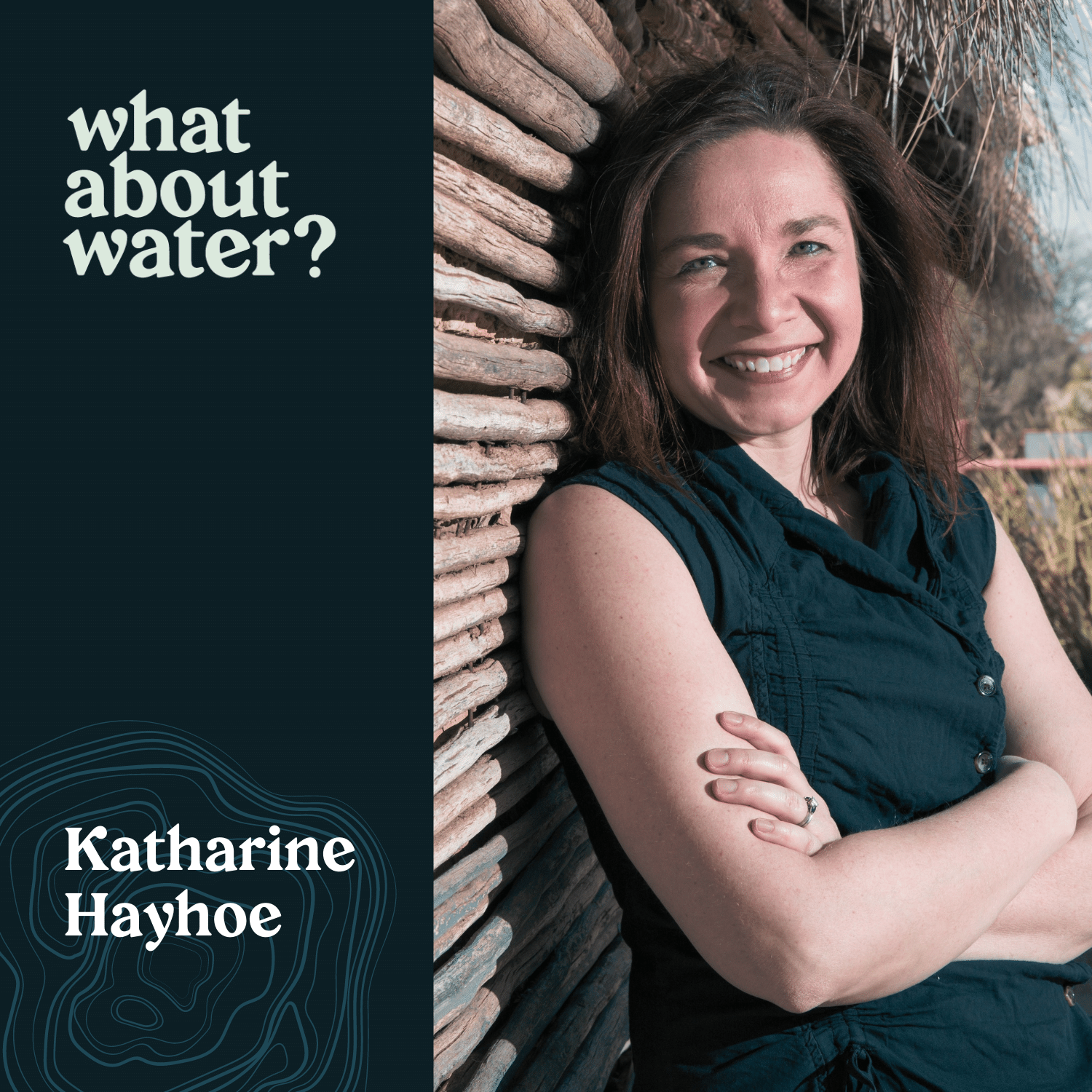
The discussion emphasizes moving climate change conversations beyond alarmism to foster hope and action. It highlights that while scientific facts are established, effective communication requires linking climate impacts to what people already care about, using relatable language and avoiding politically charged terms. Most individuals are not deniers; the core issue is the perception that climate change is a distant problem. As climate effects, particularly water-related disasters, become more immediate, this gap narrows. Strategies include using humor, engaging through shared interests like knitting to personalize the issue, and integrating insights from social sciences to make the science resonate. The conversation underscores that everyone, by discussing climate change in relatable ways, can help initiate positive change and build a more resilient future.
Having these conversations, it's completely different than the doom and gloom. We're talking about what's happening, we're talking about why it matters to us, and what we're doing is we're actually, incredibly, by doing so, knocking over the first domino in the long chain that ultimately leads us to that better future. At a time when headlines are painting a bleak picture of climate change, how do you convince people there's still hope that there's something they can do, something we can all do to make a difference? I'm Jay Family Eti, Executive Director of the Global Institute for Water Security at the University of Saskatchewan. I like to say that water is the messenger that delivers the bad news about climate change to your town, to your neighborhood, and to your front door. Later on in the podcast, we sit down with author Catherine Hayho, whose new book makes the case for climate hope during a time when climate change can feel well pretty darn hopeless. You may have noticed our podcast has gotten a bit of a makeover this season. We felt a refresh was in order, so we're now, what about water? Same great content, just different packaging. We'll continue to bring you the most compelling stories percolating in the water world, but we'll also be speaking to some of the brightest minds who are bringing real solutions to deep water issues to the surface. You might have been following the news out of the United Nations. The Intergovernmental Panel on Climate Change released its annual report this summer, and it wasn't good. Then the first-ever water shortage was declared on the Colorado River in the Western United States, and that wasn't good. We are officially in a climate crisis, and we've caused so much damage, there's really no going back. Such a dire message, it's hard to believe there's any hope, but giving hope to people is exactly something that my next guest is doing. Dr. Catherine Hayho is the chief scientist at the Nature Conservancy, which is known as Nature United in Canada. She is an award-winning science communicator, and she is author of the new book, "Saving Us," a climate scientist case for hope and healing in a divided world just published on September 21st. Catherine joins us from her studio in Lubbock, Texas. Catherine, welcome to what about water? Thank you for having me. Wow, you have been really busy with the new book and communicating the messages in that book. I heard your great interview on CBC's The Current, and then I wish you're very fun and funny conversation with Jimmy Kimmel on YouTube. So we're quite thankful that we could get you on the podcast, and it's really exciting to have you as the first guest of our third season. Well, it's such a pleasure to speak with you, Jay, because just like water connects everything and delivers climate change to your door, like you said, and that is a great line that I may need to steal if you give me permission. You have my permission, please. In the same way, climate change is this overarching issue that affects everything we already care about. So no matter who we are, no matter where we live, no matter what is at the top of our priority list today, I can guarantee you that climate change is affecting those things in ways that might surprise you, and that in turn makes who we already are the perfect person to care. So let me follow up on that a little bit. You in a handful of our scientist colleagues are committed to translating and communicating our findings about climate change. What do you think we need to go that extra mile, though really in your case it's been more like a never-ending marathon? Yeah, I feel like I've been across Canada a few times on foot. I'm Canada's big. Yes. It's because the facts alone are not enough, and that is something that has finely dawned on us after over 150 years of recognizing that digging up and burning coal back then, and now of course more oil and gas and burning it, is producing heat trapping gases that are wrapping an extra blanket around the planet, causing it to warm. You know, scientists were worried enough about the risks of climate change impacts to formally warn a US president of the facts in 1965. That was Lyndon B. Johnson for those of us who did not take American history in high school, which includes me. And that's how long we've been beating the drums. So you know, the first IPCC report came out in 1990, and now we're on number six in 2021, and at this point it's like that old cartoon where the IPCC scientists are tapping the mic saying hello is this on. Well, part of it is because we haven't spent as much attention recognizing that we need to bridge the gap between how people think about and react to issues, the social sciences of how we as humans respond to information. It's been studied very thoroughly in psychology and neuroscience and social science and beyond, but we physical scientists, that's not what we do. And so it isn't until recently that we figured out that there is this gap and it needs to be bridged with the help from the people who do that type of work, so that this information connects directly with what people already care about. I know that you're, you know, very big and I think this is really important, very big on just people talking about it. Just, just talk about it. Just have those, have those conversations. And since you were just on Jimmy Kimmel's show, he's a comedian. Do you think that humor helps in delivering these difficult messages? Oh, for sure. Because most of the reason why we shirk these conversations on climate change is either because we're afraid we're going to get into an argument and most of us don't really enjoy that, especially, you know, for Canadian. And or we think it's just going to end up being doom and gloom and who wants to talk about more bad news. So that's why we just give it a total pass. We're worried about it, but we don't want to talk about it. And that's why we have to change the way we talk about it. And humor absolutely helps because sometimes things are so bad, you just have to laugh at them. And once you've laughed, they don't seem quite as bad as they did before. I try. I'm just not very good at it. A lot of my jokes just just land flat. So and that will probably happen. That will probably happen today. So let's keep in mind for that. Okay. So climate change is now the most politically polarizing issue in the United States. Can we even see that in parts of Canada, especially where we live in the Central Park and in the in the prairies? Very conservative. In the US, though, it's right up there with abortion and gun rights and health care. But surprisingly, as you've told us in your in your book, the number of people alarmed by its impact has actually tripled in recent years. What do you think that tells us? It tells us that the impacts are here and now and we can no longer deny the evidence of what our own eyes are telling us. I mean, just look at this past summer. The crazy heat wave out west that we know is at least 150 more times more likely because of climate change. The wildfires that choked the air with smoke as far east as Ontario, hurricane after hurricane, pummeling the Gulf Coast, ratcheting up from a tropical storm to category three or four are seemingly almost overnight. I mean, the litany of disasters just goes on and on to the point where to not recognize that something is going on, you literally have to be living in a cave. So let's bring this to water. The UN, and you and I all say that water is the way in which we'll feel the effects and already are feeling the effects of climate change. I want to ask you a couple of things about that. First, in the book, you talk about making the link between water and climate and climate and carbon. Can you explain that to us? I was giving a presentation. I tell the story in the book to the Water Managers Association. And I, there were two state politicians before me, each of whom explicitly rejects the science of climate change, not implicitly, but explicitly and frequently. So there was number politician, number one, politician, number two, and then up comes the climate scientist. So I decided I was going to conduct an experiment. I was going to give an entire presentation showing observed trends, future projections from climate models, you know, the different pathways the world could follow and how we could prepare and adapt and build resilience without ever mentioning the words, climate, and change and sequence. So that's what I did. Nicely done. Nicely done. Well, first of all, nobody threw any rotten tomatoes. That is always a concern. It didn't happen. People applauded and it looked like they were pleased. But what really stunned me was this woman who ran up to me afterwards and she was so enthusiastic. She grabbed my hand and she pumped it. She said, "That was great. I agree with everything you said." And then she continued, "Those people who talk about global warming, I don't agree with them at all." But this, this makes sense. And my mind just boggled because of course that's exactly what I was talking about. But because I didn't use the trigger words, she was able to follow what I said. She was able to connect it with her lived experience. She had lived through these trends and it totally makes sense. And that's I think I truly believe what all of us can do. Well, so that's a real eye-opener. Avoiding the triggers I think is part of your advice. Is it possible if the issues we're confronting with water today? From scarcity, flooding, more severe storms, sea level rise? Are these things that are helping people appreciate and understand climate change? Oh yes, because the biggest problem that we currently have with climate change is not the number of people who reject the science. And believe me, I know they're loud and they're definitely on social media. I probably encountered about 30 of them today. But they are not the biggest problem. The seven percenters of dismissives, loud as they may be, as big as their signal may be banged if I buy social media, they're not what's holding us back. What's holding us back is the fact that most people in the United States and Canada agree that climate is changing. They agree it will affect plants and animals. People in the future
and people who live in developing countries, but we don't think it will affect me. That is the biggest problem, because you could say I 100% agree with the science. I agree with everything the IPCC says. But if I don't think it matters to me, I'm never going to do anything to fix it. That is the biggest gap we have and unfortunately, Jay, that gap is starting to close as climate impacts, manifests themselves, increasing with increasing severity here and now. But as you also know, as a fellow scientist, we have to close that gap sooner rather than later. We have to close it before it closes itself. If it closes itself, when disasters are overwhelmed, it's too late. So it reminds me of something I just heard on the radio and it was about the drought. So the drought was terrible here in the prairies up in Saskatchewan and again, the fields, the productivity went to zero and it was a radio host in the host was asking, I can't remember which politician it was, but same question, like you've seen the drought, don't you think climate change is a problem? And this person admitted that the drought was a problem and the lack of agricultural productivity was a problem. But they couldn't actually say that climate change was a problem. So I have a hard time listening to that, but I know this is the space that you work in. So I want to drill into this notion of the different categories that you talk about in the book that people fall into based on how concerned they are about climate change. So as you said, we've got people who are alarmed about climate change and then people at the opposite end of the dismissives who deny that it's even happening and we all know a few of them. But then there's that everyone in between and you are you that it is that in between group, that's that that's where the opportunity is. Could you expand on that? Yes. So often when it comes to climate change, we feel like there's two groups, them and us. And we feel like that no matter who we are and what we believe about it. And we often tend to slap labels on it. We tend to call those people believers or often sheep, I hear that too. And then the other group tends to be deniers. But what that does is it obscures where we really fall in this issue and the fact that there's a lot more nuance on it. So the Yale program and climate communication has this great sort of framework of six different categories that people can fall into. Category number one is alarmed and category number two is concerned. And alarmed and concerned are well over 50% of the United States. Crazy, well over 50% and definitely over 50% in Canada. Then the next biggest group is cautious. And when you add cautious in, you're over 75%. Over 75% are alarmed, concerned or cautious. Cautious people tend to lead with their doubts. So cautious people might say, well, I heard or I mean, I read an article or somebody said. And when we automatically slap a denier label on them, that just pushes them further away rather than engaging in a respectful conversation. So typically, you know, as long as somebody isn't calling me a horror on social media, which sadly happens pretty frequently. But as long as you're not doing that, my response generally is, that's a great point. Good question. And you know what we have an answer to the question here it is. Now, we may have asked and answered that question 200 years ago. But it was still a good question 200 years ago. So by acknowledging the question and saying, hey, that's a great question. Here's an answer. We're respecting what they're saying and they might be like, oh, so that she thought that was okay. Well, maybe I can ask another question. And so cautious people really can be engaged. So then we have the three smaller groups. We have disengaged people who have literally, like we said, you know, been living in a cave because that's the only place you could possibly be and not see what's happening. Then we have about 12% who are highly doubtful. They are the ones who are really hardcore ideologues. Their political identity is their party. They are to the right of the conservative party or their PPC increasingly in Canada. And in the US, they are absolutely Republican and they're not moderate Republicans. They are Trump or Republicans. So doubtful people, it's really hard for them to change their mind because they feel like they would be giving up a lot of their identity. The last group are the dismissive. The ones who claim that climate change is a hoax, they bring it up any chance they have. They can't leave it alone, like a sore tooth. And they're always posting online. And honestly, I think it would take a miracle to convince them. And I'm not in the miracle business. So I don't try. That's really interesting. So what I want to ask you about is, you know, you talk a lot about sort of finding common ground with people and maybe you have knitting in common. So like you're talking to some knitters. Like, how does that conversation go? Well, do not knock it, Jay, because I literally had somebody email me today and they're like, I heard you talk about knitting. I knit too. Yes. So I was first asked that question by a young woman who had attended one of my talks on communication. She said, I really want to talk about climate change with my grandma. But I just can't figure out how to bring it up. So I said, well, and this is key. I started with the question. I didn't tell her how to do it because I didn't know how to do it. I said, what do you and your grandma enjoy doing together? And she said, we knit together. That's what we do together. So of course, since I'm a knitter, the light bulb immediately went off. And I'm like, aha, I said, have you seen these awesome knitting patterns called the warming stripes where you have one row for every year. And this concept was developed by Ed Hawkins, who's a fellow scientist from the UK, who's just great with visualizations. So there's one stripe for every year. And if it was colder than average, it's blue and darker blue means a lot colder. If it was warmer than average, it's red and darker red means a lot red and then average means white. So what if you got one of these patterns for the place where your grandma grew up? And you knitted a scarf or a blanket together and you asked her about all the years. Like, oh, grandma, we're knitting this year right now. It's really dark blue. Do you remember? Oh, yes, I was only about eight years old, but I remember. So talk through the stories of your grandma's history as you knit your way up until the present day. And then you can be like, wow, grandma, look at the last 10 years. Have you ever seen years that warm as long as you have lived in the grandma be like, no, I have not. And she's the authority there, right? So you've already established hers the authority, you're respecting her experience and wisdom. And then she can actually speak herself to how what's happening is not normal. And she hasn't seen this before. And then that opens the door right there to say, how is it affecting the place where we live? How is it affecting people that we care about and the home that you grew up in and the place that we love? And what can we do about it? Katherine, you're an evangelical Christian. You own often associate evangelicals being at the forefront of the climate change movement, but, but here you are. How do your own values as a Christian inform your perspectives on climate change? Well, the reason I'm a climate scientist is because of my Christian. I was studying astronomy and physics at University of Toronto, and that's what I was planning on doing. And I'd already picked out a few grad schools to apply to you. I was studying galaxy clustering around quasars. And in fact, my first five papers are already in that field. So I was planning to continue studying that when I needed an extra course to finish my undergraduate degree. And I looked around and there was a new class over in the geography department on climate science. So I thought, well, that looks interesting. Why not take it? But in that class, I learned, first of all, that climate change is incredibly urgent. It's right here right now. And I also learned that it affects everything, most of all poverty and water scarcity and hunger and lack of access to basic health care and education. Climate change is profoundly a justice issue. It disproportionately affects the poorest people, the 3.5 billion people on the planet who have contributed to 10 percent of heat trapping gas emissions. Those are the ones who are most impacted. And I'm sure you see that yourself through water, right? Absolutely. Yes. So when I found that out, I thought to myself, well, here I am. I'm somebody who believes that we're supposed to love others and care for others, especially the poorest, most vulnerable, most marginalized people in the world. That I believe is a foundational tenant of the Christian faith. It literally says, Jesus literally says in the Bible, you're supposed to be recognized by your love for others. How loving is it to put your fingers in your ears and cover your eyes and pretend that you don't see the suffering that our lifestyle is causing? So that's when I decided to become a climate scientist. And I can't end the story there because I actually tell this in the book a number of years later, a colleague of ours asked, could I meet him for lunch when we're at a conference together? I said, sure. So we had just barely met up when he just burst out. He said, well, I'm not a Christian, but I care too. And I said, well, of course, I mean, you've dedicated your life to this. This is what you do. And he said, well, I'm a humanist and I care because climate change isn't fair. It affects the poorest and most marginalized people on the planet. I was like, yes, of course, to care about that, all you have to be is a human being living on this planet who cares about other people. And I care because of my Christian, he cared because he's a humanist. Somebody else might care because they're a Buddhist or because they're a Muslim or because they're nothing, but all you have to be is a human who cares. That is it. That's why we all care. That is a profound message. As part of your work, you travel around the country speaking to all sorts of people. And as I mentioned, a lot of these folks might have pretty different perspectives on climate change. I've been really intrigued by an initiative that you and some colleagues launched called science moms. Can you please tell me a little bit about what science moms is and what prompted you to focus on mothers to make a difference with climate change awareness? One of the reasons I care is because I'm a mom. And you know, if you're a parent, if you're a grandparent, if you're an aunt, your uncle or god parent, or if you have any children in your life, you would do anything for them. You just, you know, you know that. And so that's a big part of what motivates me now too. I wasn't a mom when I became a climate scientist, but I am now. And that's huge. So for a long time, you know, that was what motivated me. And I started
to connect with other colleagues who were also mothers who felt the same. And at the same time, there was this great organization called Potential Energy, which includes a lot of people who come from big ad agencies in Canada, as well as in the US. I'm happy to say. And they were doing some polling of people because they were really worried that people weren't acting on climate. And they're like, "Okay, who is most concerned, but not activated?" What group of people is most concerned, but they're just sort of frozen or paralyzed? And they found out it's moms. 86% of moms in the US, Republican or Democrat, doesn't matter, are very worried about climate change. But they're not doing anything, because they don't feel like they understand it and they don't know what to do about it. So we sort of came together and have this meeting of minds and we're like, "We feel the same way. You have the data and resources and smarts to help us tell people things." We actually, we understand the science and we're moms and we're in it too. So we created science moms and I had to tell you, Jay, I mean, the response to that has been like, "Nothing I've ever seen." When I give an interview specifically about being a science mom, the camera switches off and then the person interviewing me if she's a woman, she's like, "Can I join?" I'm like, "Yeah, of course you can join." And every single person I've talked to wants to join. In fact, I have to be honest, there are, I know that there's some dads and uncles and grandpas and godparents too, they're joined. Absolutely. Yeah, I want to be an honest dad. You need to join. For sure. You've been pretty adamant about climate change, not needed to be on our personal priorities list. Can you? And of course that's really provocative. People who don't have it high on their list, it isn't because they aren't worried about it. It's because they have other things that they see as more important priorities. And if we wait until climate change is at number two or three or even one on everybody's list to fix it, it's going to be way too late. But what I've realized, and this is this is provocative, so stay with me here. And you know, I am a scientist and I study this. I don't think climate change should be on anybody's list at all, not even mine. Because if the only thing that were happening was that we were burning fossil fuels and they were producing heat-trapping gases and they were wrapping an extra blanket around the planet and they were causing the average temperature of the planet to warm, but nothing else was happening. Nothing. It would be a scientific curiosity. We care about it because that warming is affecting everything we already care about. What's at the top of your list? Your health. Climate change affects the air we breathe, the quality of the water we drink, and the nutritional quality of the food we eat. What about your kids? Climate change is going to make their future less safe, less secure, and much less healthier. What if you care about the home that you live in? Well, depending on where you live, it could be under threat from wildfires, from floods. If you are somebody who loves outdoor activities like, you know, skiing that requires snow, you like beer and wine or coffee or chocolate, whatever you like, I can connect climate change to probably at least four of those five things. And what that does is it shows us that who we already are is the perfect person to care because we already have every reason at the top of our list. So we're not forcing climate change up. We're actually respecting what's already at the top of our list and we're being an even more genuine expression of concern for those things we care about. Katherine, thanks so much for taking the time out of your very busy schedule to be on what about water. Dr. Katherine Hayho is author of the new book, "Saving Us," a climate scientist case for hope and healing in a divided world. You can find it at your local independent bookstore, online, and at most retail bookstores. Thanks, Katherine. Such a pleasure. Well, as Katherine says, sometimes it really boils down to helping people see just how climate change is affecting their lives in very real ways. But once they've made that connection, then what? Well, a program run by the University of British Columbia called Cool Hood Champs is helping ordinary citizens develop the knowledge and the confidence to take action on climate change starting right where they live. My name is Cheryl Ung, communications and engagement coordinator at UVC Forestry's Collaborative for Advanced Landscape Planning. We realized that a lot of climate action takes place at the policy level and a lot of times citizens themselves don't really know how to connect their individual or their household level actions back to the policy level. So my name is Chris. I'm a mom and a teacher and I have two daughters. It's too hard when you're staring at me like that. We're going to give my stuff. I'm Sam. I'm Chris's daughter. It's all right. My mom came in to talk. I can't. See, we talk highly to each other. We were also close enough to snap a little. It was 100% heard that got me involved with Cool Hood Champs. I was quite hesitant because I think I was just overwhelmed with all of the climate change news hearing that there was, you know, no hope. But then when she brought me, I was so excited because it was just so applicable. And it was just sort of looking at the resources that we have as a household and what we could do, hands-on work, mapping out our areas, going for walks, talking to other people. So it was very action-focused. I'm not a political person by nature. I'm probably not going to go to a lot of demonstrations or get into political arguments with people. So I was really glad to be able to just shovels into the ground and start digging things up. Any action, just as simple as my mom wanting to use her reusable bag, to me, it really inspired me because I could see her standing her ground and saying in her own special quiet way, I don't want to be a part of the problem. I have to act because worrying about it, being concerned about it, being sad by the overwhelming is not helping anything. And maybe my actions won't have any results, but at least I've tried my best. And I think it's something that we all want to do for our children. Thank you to the Cool Hood champs, Cheryl Oom, Chris Chang, and Sam U and Van Coover. If you're a parent like Chris and you're concerned about climate change, you are not alone. The potential energy coalition found that 83% of American moms are concerned about climate change, regardless of their political stripe. Find out more at sciencemoms.com. Well, that's it for this episode of What About Water. We record and produce this podcast on Treaty Six Territory. We live and work on this, the homeland of First Nations and Métis people, and we respect that relationship. What about water is produced by the Walverse Lab, and the Global Institute for Water Security at the University of Saskatchewan. Check out WhataboutWater.org as we continue to post water-related stories, content, and resources. Our crew here at What About Water is Mark Ferguson, Aaron Stevens, Laura McFarlane, Fred Reuben, Jesse Widow, Sean Ahmed, and Andrea Roe. Thanks to Wayne Keysbrecked, our studio technician, and to Farah Oktar and Jen Kanell at Cascade Communications, who put it all together. I'm Jay Femoyetti. Thanks for listening to What About Water. Available on Spotify, Apple, or wherever you download your favorite podcasts.
Podcast Summary
Key Points:
Climate change communication should shift from doom-and-gloom to hopeful, actionable conversations that empower individuals.
Effective communication involves connecting climate issues to personal values and lived experiences, avoiding polarizing "trigger" words.
Most people are not dismissive; the main challenge is convincing them that climate change personally affects them and their priorities.
Using humor, finding common ground (like shared hobbies), and bridging science with social understanding are key strategies.
Climate impacts, especially through water (droughts, floods), are making the crisis more tangible, helping close the perception gap.
Summary:
The discussion emphasizes moving climate change conversations beyond alarmism to foster hope and action. It highlights that while scientific facts are established, effective communication requires linking climate impacts to what people already care about, using relatable language and avoiding politically charged terms. Most individuals are not deniers; the core issue is the perception that climate change is a distant problem.
As climate effects, particularly water-related disasters, become more immediate, this gap narrows. Strategies include using humor, engaging through shared interests like knitting to personalize the issue, and integrating insights from social sciences to make the science resonate. The conversation underscores that everyone, by discussing climate change in relatable ways, can help initiate positive change and build a more resilient future.
FAQs
By focusing on actionable conversations and solutions, we can initiate positive change, like knocking over the first domino toward a better future. Engaging in discussions about what's happening and why it matters helps shift the narrative from doom to hope.
Water delivers the impacts of climate change directly to communities through events like droughts, floods, and storms. It makes the effects tangible, showing how climate change affects local areas and daily life.
Humor makes difficult conversations less intimidating and can reduce the sense of doom and gloom. It helps people engage with the topic without fear of arguments, making the issue more approachable.
The main barrier is not denial of science, but the belief that climate change won't personally affect individuals. Many agree it's real but don't see it as relevant to their own lives, which hinders motivation to act.
Avoid using polarizing terms like 'climate change' and instead connect the issue to lived experiences, such as local weather trends. This approach helps people relate to the information without feeling defensive.
People fall into categories from 'alarmed' to 'dismissive,' with over 75% being alarmed, concerned, or cautious. The cautious group is key because they are open to dialogue and can be engaged through respectful conversations that address their doubts.
Chat with AI
Loading...
Pro features
Go deeper with this episode
Unlock creator-grade tools that turn any transcript into show notes and subtitle files.
 PodcastTranscript AI