Welcome to Afterlives of Ancient Egypt, in which we discuss ancient history and relevant
current events.
I'm Kara Kuni, and I love to take deep dives into history that are not always possible in
academic formats.
So let's get started.
Hello everyone, welcome to another episode of Afterlives of Ancient Egypt.
I am your host Kara Kuni, and I am joined by my trusty sidekick Amber Meyers, and we
are going to get going with a really interesting discussion about honor and the death of Cleopatra.
So we have to set up this discussion, and I think the first place to go would be a really
basic understanding of the end of Cleopatra, because this is about her death.
And so let's start with that, but first, let's let Amber say hi, and then we'll jump
on in.
How are you doing Amber?
I'm good.
I'm very curious to see how this discussion is going to turn out.
I think it's going to be really interesting, but I think there are going to be some curves.
Because we never know where these things go.
So we come up with a scaffolding, and then it's like, I haven't thought of that before.
And we come up with it through the discussion.
So dear listeners, listen to us think, that's very interesting work through this.
But I think the history of Cleopatra, the broad strokes of the history of Cleopatra are
well known to everyone.
She is, as I always say, the female leader whose name, if you mentioned it, at a bus stop
would be known by all and all people would know the name of Cleopatra.
They might not know the name of Hatshepsut.
Nefertiti is a close second, but she might be remembered as a beauty, not as a ruler.
Cleopatra, with all of the stage plays and mini series and films made about her, all
the novels written about her, is very well known.
She is the cautionary tale we continue to tell about women and power, and what happens
to them when they seize that power in a way that is considered inappropriate.
And I've made this point that we retell this story because she failed.
That's why we were so attracted to it.
But how about we go through a little history?
What do you think?
Yeah.
Yeah.
This is a good place to start.
And I want to also say I think the story survives because Roman propaganda is very attractive.
Yeah.
And the story survives in a way that you have to completely unravel.
You have no idea where the truth is.
You know that it's not necessarily what's being told to you by Octavian.
It's not necessarily what's being declared by Cleopatra and Antony themselves, sometimes
separately, sometimes together.
It's hard.
It's hard to piece out how this works.
So I just went through a couple of history books and piece together some basic things.
But if we start at the second of September, 31 BCE, we have the Battle of Actium, which
of course, Antony and Cleopatra, but really Antony, she's there with him, they lost.
And you think, oh, well, then she dies right after that.
And things take a little while.
We have at least a year before things really devolve into her death, which is of course
presented as a suicide, which of course, I'm going to mess with here.
But we have a whole bunch of things that happen.
So she makes her son as one of the Febby in September, on September 30, in later September
in 31 BCE.
This has been interpreted as her positioning, Caesarian, or Talami, the 15th, as he would
be known in his Egyptian form, as the future sole leader of Egypt after her death.
There's all this letter writing then after that between Octavian, who finds himself with
his forces, his naval forces on the island of Rhodes between Marcus Antonius and Cleopatra.
Apparently, he only writes back to Cleopatra, whether that's true or not, we don't know.
And then we start to get a lot of the propaganda about Cleopatra, holding up in her mausoleum
or with vast amounts of her treasure and threatening to burn herself, right?
What do you think of these stories, Amber?
I think they make for great storytelling.
It sounds very dramatic.
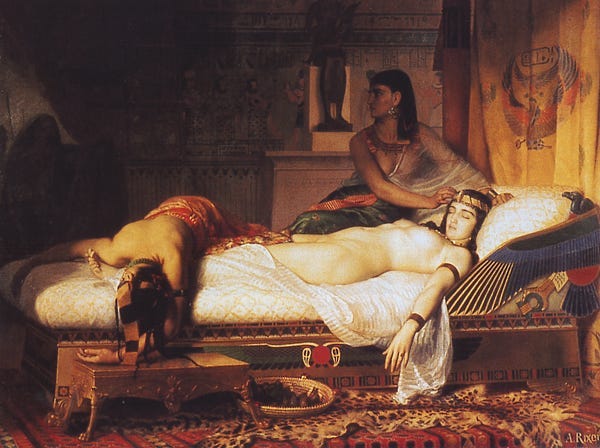
It sounds very. Orientalizing, yeah. Exactly, Orientalizing, and so, yeah, you conjure
immediately those 19th century paintings of Antony and Cleopatra and their ultimate demise.
So yeah, compelling storytelling.
And I want to bring up here that, you know, she's writing these letters and threatening
these things.
It brings up for us right off the bat this idea of money, of a debt that needs to be paid
or money that is owed, that the drama that ensues is, oh my God, she's going to take
herself out with all of her stuff, right?
So the worry on the Roman side of things is very much about the treasure, it's very much
about the materials, and her being able to remove all of these materials is, oh, we have
to act.
This is something we absolutely need to do.
So, you know, I've thought about this a lot.
This idea of her, these stories, these propagandistic Roman stories of her surrounding herself
and some sort of weird Orientalizing depiction of a mausoleum-type space, this notion of,
you know, the ancient savage who surrounds themselves with treasures they themselves cannot
understand the value of and are willing to destroy them just because.
And a hundred years later, we're going to have, I can't remember which scholar it is,
or which source it is, but the earring of the pearl earring that is dissolved in vinegar
to win a bet, right?
That kind of fast and loose treatment of precious goods, it allows the Romans to come in and say,
you don't know what you have, you're not able to deal with it responsibly, and so we need
to step in so that it's kind of a set up in a sense.
And isn't it also Egypt had legitimate wealth that the Romans were interested in?
And they, like, and imagine were concerned or worried that she was going to shave some
value off of their acquisition, you know, because they were looking to take over.
And indeed, Cleopatra's whole reign in Egypt starts out on the back foot within debt.
So she is in debt to Rome.
Her father told me that 12 has had Cyprus taken away from him because of the great debts
that he owes to Rome.
She's, she's had to raise money, she's, she's been expected to pay for certain military
campaigns for the triumvirate when it, when it suits Octavian and company, Marcantini
II.
So there, there is this debt that is hanging over Egypt and Cleopatra the seventh in particular.
And this idea that she owes something to her protectors, it's so mafia-like to me that
she has to somehow pay them off so that she can maintain her position as head of household
position of, as, as ruler of Egypt.
So the idea of, of her taking that debt and not paying it with the removal of herself,
with that, in that threat that she's apparently or supposedly written to Octavian is very
interesting.
Yeah.
Yeah.
Okay.
So then, then we have Octavian senses diplomat, a fierce source because she's threatening
to burn herself in the vast amounts of treasure.
And then we have more fighting.
So in 30 BC, a year after, we have more fighting with different Roman contingents and, and
Marcantini and he loses in 30 BC.
He has a little bit of a win later on, but it doesn't really matter in, on first, the
first of August 30 BC, we have a Julian calendar so we can, we can date these things with months
and everything.
Of course, August, I don't think exists yet.
So I'm not sure exactly how we have the exact, how we have the exact months.
We're going to go with it.
First of August 30 BC, the, the naval fleet of Marcus Antonius is formally surrendered to
Octavian and then he surrenders his cavalry.
And it's this point that we, we get this Romeo and Juliet type story where we're told
that Cleopatra is hiding herself and her mausoleum with her attendance.
And then she has a message sent that she's killed herself.
And then he freaks out and is in great despair.
And then he stabs himself and then they bring him to her and she sees him in his last
dying breaths.
It's so Romeo and Juliet, right?
And then, and then she's like, Oh, this is horrible and then she then, then dies as well.
But him killing himself is the honorable way to die for a Roman soldier.
And what do you think of that?
My question is exactly why is Antony killing himself?
Is it this Roman concept of honor?
Is it the devastation of thinking that Cleopatra has gone?
What's his actual motivation?
So you're pointing to the Roman concept of honor.
He has lost and he just needs to take himself off the board completely.
Yeah, it's an interesting patriarchal device.
We're going to get into the details of this and try to parse it out a little bit more carefully using David Graver's book on debt.
But it's an interesting patriarchal device, this honor in which you remove yourself.
As you say, take yourself off the board completely.
If you've lost the game of hoarding more power, taking more power, if you've lost completely, then you just eliminate yourself.
And that's considered a removal of your debt in a sense.
Graver would tell us, well, we'll get more into that.
But it's just interesting to think of this idea of honor and how Antony fulfills that.
According to the story.
But it also helped Octavian too, right?
Because then Octavian doesn't have to look like the bad guy who took Antony out himself.
Yeah, yeah.
So it gives a, it's an honorable thing to do because you don't make your opponent do it.
You do it to yourself as you're saying.
Yeah, yes, yeah.
Okay.
So then we learn that that Cleopatra is able to bury Antony.
There's all kinds of weird discussions about this mausoleum or tomb or how it works.
Discussions about being at high up place, you can only reach with a ladder.
I have no idea what this would look like.
But she's apparently holed up in this place and not allowing anyone to come in,
except for her own attendance.
And Octavian then enters Alexandria.
He's accepted the defeat of Marcus Antonius.
He's, he's now occupying the place.
He's occupying the palace.
He's occupying Alexandria.
He's taking Egypt as a province of Rome.
This is the first time that Egypt will be thus taken.
But he has still to deal with Cleopatra.
Cleopatra's got her own body and self.
And then she has, she has many children, right?
She has four children.
She has three with Marc Antony.
And she has Cesarean, otherwise known as Ptolemy the 15th.
It seems that she sends Ptolemy the 15th down to upper Egypt.
That's its own story.
We won't be touching upon that.
Here he's hunted down and killed from, from what we can understand.
And then the, the other children,
the daughter survived, the other son is killed.
But there seems to be dealings between Octavian and Cleopatra
about what will happen to her children.
And it does not seem that he is truly honorable in, in how this,
from my perspective, is a historian,
not the way the Romans are presenting it.
But it doesn't seem he's truly honorable
in following through on his word, right?
Yeah, of course, of course.
Yeah.
Elkism also taking this idea of Cleopatra being holed up somewhere.
Of course she is.
She's like putting on zoom with all of his people.
He doesn't want to be around anybody, right?
Because there's potential threats everywhere.
And also being around in the Ptolemy period,
growing up as she did, I'm assuming that she realizes
if she is not completely secure physically,
somebody at some point is going to take her out.
Right, right.
And so she's trying to secure the lives of her children.
And less, she's trying to secure the life of herself potentially,
maybe, maybe not.
But we start to get this discussion of,
and apparently we have a direct quote from Livy,
where she says, "I will not be led in a triumph."
So that's something that the Romans are presenting
as a motivating factor for her,
as she looks forward to her last days.
That she will not be led in a triumph.
That part I could buy.
She doesn't want to be dragged back to Rome and paraded down the streets
in this ultimate public humiliation, not just for her,
but for Egypt.
Yeah, I could buy that as a thought that she might have for you.
Mm-hmm, mm-hmm, and one could imagine that when there are triumphs,
when there were triumphs in Rome and a state leader,
a tribal leader from Britain or a state leader from Syria or whatever,
was paraded through the streets of Rome and chains.
I imagine that the men steeped in patriarchy and notions of honor thought,
"Wow, that man wasn't able to kill himself first, and here he is."
He is now degraded and meant to be paraded for our consumption,
right, for our enjoyment.
But the way out of that would have been to kill oneself, I suppose.
So these--
Yeah, and for a woman to be put in that kind of position,
who knows what they might have done, Tara?
Yeah.
Because having a man led in a triumph like that,
in defeat is one thing, but for it to be a woman, I mean--
Mm-hmm, but see that this is where it gets interesting,
because within a patriarchal society,
to do such things to a woman then can bring dishonor to a man,
to degrade a woman like Cleopatra and public can create martyrdom,
can create public sympathy,
because everyone knows that the patriarch is more powerful than the matriarch,
that the man is more powerful than the woman in a patriarchal society,
that the sexual dimorphism of male body is more powerful than the female.
And if that punishment is needed out in public,
it could easily backfire.
So agreed, agreed for the rulers,
but what if it's an oops year in public and look at these masses,
they just overpowered the guards or whatever?
No, but they put it off on someone else.
Yes, but if you allow that situation to happen,
then people are like, oh, they set her up,
they allowed this to happen, this is horrible.
So you're saying, Octavian would have kept it under wraps like it would have been controlled?
I don't think a-- her sister was walked in triumph,
and there is a living memory of her sister being walked in triumph in Rome,
and I don't think it worked out well.
I think it created more public sympathy.
I don't think this is discussed openly in the records or by the propagandists,
but I think this is the kind of thing that they're thinking about strategically.
This will not necessarily work out well for them,
but it is presented in the propaganda after the fact
as she doesn't want to be walked in Rome in triumph because her sister had been.
But really, remember how we say today when we're dealing with propaganda on the daily
that every accusation is it in mission?
Every accusation is a projection.
So when you accuse somebody of child sex abuse,
you may be the one who's actually perpetrated it, right?
So we have the Trump Epstein situation,
and they're saying, oh, all these people committed child sex abuse
when it turns out they're the ones who actually did it.
So in short, I'm saying that when the propagandists are saying,
oh, Cleopatra doesn't want to be walked in a triumph,
and she's going to kill herself before being walked in a triumph,
this is the projection of what they fear.
They fear walking her in a triumph,
and they fear the perspective that that will create amongst their own people,
and thus this idea of suicide and honor, death removal is brought into it,
but in a different kind of way.
I find it extraordinary that people haven't pieced this together,
and they haven't unraveled this propaganda, but there we are.
This is an interesting thing to think about,
because you can imagine Octavian and his advisors sitting around,
like, okay, we need to get rid of her.
Potentially, how do we do it?
And as you say, how do we do it and preserve this sense of honor
that we're so concerned about?
Right, right, stay clean.
They have to stay clean, and Octavian, soon to be Augustus,
is all about staying clean, right?
He's got his wife set up as one of the most honored.
She gets a statue in the forum,
I mean, and the Urswile wife, Octavia of his sister of Mark Antony.
She also gets a statue, but they're presented as these
pious, pristine women who are untouchable.
That's what he's going for.
That's the ideological power of his regime.
None of this, like, you know, I can sleep with as many women as I want,
kind of, imperial strategy that we'll see later,
or that we might have seen earlier among certain senators.
This isn't the kind of image that he wants to present.
He wants to present a very clean, tidy persona.
Well, that's an interesting point, so,
helps to clean up his record a little bit before he goes full Augustus.
And let's just be very frank with our listeners here.
And for those of you who've read my book When Women Rule the World,
I dispute the notion that Cleopatra killed herself.
No, we weren't in the room where it happened.
I don't believe the Romans who say they were in the room.
where it happened. It doesn't serve Octavian to claim to have killed her, but it
serves him to have her gone. And it serves his clean reputation to claim that
she did it to herself. So that's where we're going with this. If you can't
figure that out, we are going with the idea that Cleopatra did not do
herself in but was instead done in. But the story, the propaganda that
follows that is told to the Roman people told to the classical world that we
then inherit and retell is a lie. But it's a lie embedded so deeply in
patriarchy, the water in which we swim that we can barely see it. And so I want
to unravel it from that from that perspective. Yeah. Yeah, exactly. Yeah, okay. So
then then moving on, we have we are told that a spy has told Cleopatra that
Octavian is going to to relocate her and her children to Rome in a few days
time. And so she starts to prepare her suicide then we are told. And we have
all kinds of stories about how she tries out some authors tell us how she
tries out different methods of suicide like poison on some of her enslaved
people to find out which one is less painful which really puts her into the
position of being that that decadent ruler who's who just treats human life
extraordinarily cheaply. It's a it's a really wonderful story to present her
as a selfish just a selfish woman who doesn't want any pain doesn't want the
the degradation of the triumph doesn't want the pain of death.
We already start out by taking her honor away. So if suicide is an honorable
thing to do her practicing different methods on on certain
men is a dishonorable thing to do. Her scheming in this way when she hears about
these plans is a dishonorable thing to do in a patriarchal method. So they're
really laying the foundation for this story of her being dishonorable in
within an honorable masculine practice of suicide. Yeah okay so this is what I don't
think about as you're talking because we're kind of threading the needle here
because suicide for Antony honorable. Yeah. Straight up. Yeah. Suicide for a female
Patra dishonorable. So and she's being dishonorable in her process
of doing the dishonorable thing. Right. And how she goes about it. Yes. Yes. Okay.
Okay. So like a double whammy. Right. And and even when they present the
our sineway the fourth triumph and she we're told that she even thinks about
that and she's like oh I don't want to be presented in that way. Again remember
that this is also in my opinion a projection of the Romans. Like they they
have no intention of repeating that mistake in a sense. If she has no intention
of being that that prize within the chains of Rome. But so then we're told on
the 12th of August 30 BC at the age of 39 she kills herself in her tomb and takes out
some servants with her. Talk about decadent. Talk about the the orientalizing
rule of the the tyrant right the person who who's taken too much power. Not only
if she'd taken herself out but in the manner of that that decadent primitive
ruler they've also forced others to come with them and and kind of like a
sacrificial burial like the kings of old right. So that part is there too.
No value for one life just take take others with you. Just take take and we all know
that when you stand in front of the pyramids to this day you will hear people
saying oh he he murdered his wives to accompany him like he ops or kufu
right. He he murdered his wives to accompany him into the tomb. That is not
true for the fourth dynasty. But it is for the first right. But I was about to say that
I bet you perhaps in the Roman mindset that there might have been that
association in the Roman mind with ancient Egyptian rulers. So this kind of
would have played into their ideas. Of course you would have done that because
that's what these ancient Egyptian rulers did. Right and so everything is
here set up to separate Octavian and his honorable ways from the Eastern
ways. And then I'm not you know what you guys. I'm not even going to go
through all the different kinds of ways that she has said to have killed
herself except to list them. So there's the idea that she allowed herself to be
bitten by an asp or a cobra and many follow through with this. Some people
think she used some sort of a spine to stab herself. Some people say that
she used a kind of needle to to inject poison.
One author says that she uses a poisoned cream
of some kind like an ointment. So there's there's all kinds of discussions. We
do not know and thou doth protest too much. You know if we really don't know how
she did it. And they're coming up with more they're confabulating these
extraordinary ways that she supposedly killed herself. One more
extraordinary than the next. It seems that something else is
is going on. I think that she's removed but anyway it doesn't
doesn't really matter. She's dead and now Octavian can truly take the most
powerful and richest province into the Roman Empire
and and reopen those gold mines. Get all of those mineral
those minerals to Rome. He's he's really able to just pour those
that wealth and those riches into Egypt. But he has to do so with honor.
Right. So it's it's important to remember and this is my last point in the
history before we jump into all of the David Graper stuff.
Is that this taking Egypt is something that senators
during the civil wars have been trying to do for centuries
arguably. And no one was able to do it because by pulling that
power to oneself then you will effectively make yourself into a king.
And you destroy the Roman Republic. People are very upset and threatened
by this and and it's not something that works. And we know what happens to
Julius Caesar when he tries to do it. He's killed on the steps of the Senate
for putting his men in Egypt occupying that place
having a baby with the queen and effectively creating a lineage that makes him
like a king. Right. So people are are very upset about this and threatened so much
so that they remove him. Mark Antony tries the same and people are so upset
they remove him in a military fashion, but they remove him.
Now Octavian's staring down that the barrel of that gun and is like wait a minute
will the same happen to me. So he has to walk into this
eyes wide open saying I am just here to make this right.
This Egypt has ruined at least two of our good Roman men and I'm going to make
sure it doesn't happen at third time. And so he must
create an enemy out of Cleopatra that in a
profligate sad like a demented which like figure out of her so that he can
come in as the savior of all of it.
Yeah absolutely and I think that maybe a lot of people aren't quite aware
what kind of a game piece Egypt was on the board. But as you say it was so
important that for centuries it was difficult for Roman politicians to go
near it without potentially endangering their political careers and
perhaps their own safety. Yeah. Okay so that's that's the basic history.
Obviously there's a whole lot more to it and a lot more detail
and names and people and other things battles and such but we're going to keep
it simple. And now let's jump into this idea of
honor which is which is very closely connected to
debt and we want to bring the David Graber. But let's let's start with
because suicide associated with honor we want to really parse this out in
terms of male versus female bodies and what that
means but how do we define honor?
Well we can go to our Miriam Webster. What have you got Amber?
What have you got? For definitions of honor we have a good name
or public esteem, a showing of usually merited respect,
a person of superior standing, one who's worth brings respect or fame.
Just scrolling down here a little bit. Honored or honoring as a
verb to regard or treat someone with admiration and respect
to give special recognition to to love up to or fulfill the terms of
to accept his payment and as we learned earlier to salute with a bow in
square dancing. We're talking about this because both of us were
forced to do square dancing and PE. It's it's one of my least fond memories
of growing up in Houston, Texas but I remember
honor your partner Dosey Doe I remember this. It's very true what you said that
which completely triggered me. I know because I needed that.
I don't know what the hell they were trying to do except get us to honor our patriots of the past, but oh God it was horrible.
And imagine being six feet tall and square dancing in the eighth grade, like I can't think of anything worse than that.
But anyway, okay, let's move that trauma to the side.
And so I like these ideas of honor to, to have respect, to have a good name and you have in there accept payment, right?
Yes.
So, you know, I thought let's look up some Egyptian words there, you know, if you do an English search for the word honor, there's nothing there.
However, if you, if you look up like debt and paying off a debt, you get this word, hetem, with the, the chord, the dotted age, hetem, and you have the meaning pay off a debt.
It also has a number of other meanings depending on the, the context, and it's a very interesting word, and it's something that one could really do an etymological and lexicographical dive into, I think.
Because it means to provide, that's very patriarchal, right?
This idea of provision of, of giving your, your payment, it means to settle up to, to make things even in square, right?
Like if you have a good name, that means you settle up, you, you are known for paying off your debts, you're not somebody who leaves people hanging.
Interestingly, it also means to, to destroy slightly different spelling, with a duck at the end, but it's not that different in its spelling, and, and it has the negative arm, so to destroy an enemy, I mean, it's to settle a debt, right?
So if somebody's wronged you, and you, and you need to destroy them, then you'll remove them, and, and it creates honor for you to settle that debt. So that, that was really surprising and interesting, that destroy, annihilate, overwhelm in different contexts.
So, yeah, and it can also be, to perish, or to be destroyed, so somebody who's destroyed, again, I would connect it to this idea of, of settling a debt in a sense.
And, yeah, so that's, that's pretty cool. So this is our idea of honor, connecting it with suicide, connecting it with the value of a human life, right?
Yeah, so, so it's, there's a transactional aspect to it, right? Like an evening of the transactional scales.
Okay, so now let's jump to David Graber, and for those of you who don't know who he is, he was an anthropologist who died, think in 2020, and in his 50s, way too young, but thankfully has had produced a number of wonderful volumes, some people hate them, some people love them.
He was a known radical communist, he grew up in a commune in, I think New York City, and did not famously did not get tenure at, I hope I believe it's Yale, and then ended up at University College London.
And his book on debt is, has been very formative to me and my work on reuse, my work on how one reuses a coffin of a king with honor, how do you pay off the debt of the ancestor when you're also simultaneously taking from them? How do you give back in a ritual form?
So I've used his work quite a bit, and it's an interesting segue then to think about the honorable suicide, the honorable removal of oneself from the game, and Cleopatra.
So let's start with a discussion of honor as defined by David Graber. So I think you, did you pull this one up?
Or do I have it? Is this page 166?
Yeah, yeah, I think I've got it.
Okay, so head to, if you've got your David Graber debt, just, you know, at the ready, head to page, what page is it?
Yeah, 165, yeah, but no, I want to start at 166, sorry, sorry, sorry.
Okay, so go to your David Graber's debt and go to page 166.
And then he says the best way, and he's talking about solving the certain problem to do so I believe is to start from a single odd, vexed concept, the concept of honor, which can be treated as a kind of artifact or even as a hieroglyphic, a fragment preserved from history that seems to compress into itself the answer to almost everything we've been trying to understand.
On the one hand, violence, men who live by violence, whether soldiers or gangsters are almost invariably obsessed with honor and assaults on honor are considered the most obvious justification for acts of violence.
On the other debt, we speak both of debts of honor and honoring one's debts. In fact, the transition from one to the other provides the best clue to how debts emerge from obligations, even as the notion of honor seemed to echo a defiant insistence that financial debts are not really the most important ones.
An echo here of arguments that like those in the Vedas and the Bible go back to the very dawn of the market itself, even more disturbingly since the notion of honor makes no sense without the possibility of degradation, reconstructing this history reveals how much our basic concepts of freedom and morality took shape within institutions, notably, but not only slavery that we'd sooner not have to think about at all.
So like gazillion concepts packed into that one long paragraph, where do you want to start?
Yeah, that was my thought exactly. He's got so much, he's got a multidimensional way of thinking about this concept of honor and it actually in some ways reminds me of the way that Egyptologists sometimes discuss Ma'at or Isfet, things that are very difficult to actually put a solid definition to, but like pornography, you know it when you see it.
Yes, according to our American Supreme Court that has lost its honor very much so, very much so interesting, right? Everyone knows they've lost their honor, they've just been paid off, we talk about it, but then that's its own discussion, you know, they've become degradated.
Yeah, well, but I think that this is why this gets at I think what you're wanting to talk about honor and its connection to ideology because in many ways ideology is more something you feel or you recognize versus strictly define right because it evolves and it changes depending on the situation and your ideological needs.
And it feeds into the water in which you swim such that you can't even recognize it, it's just a part of your embedded world, it's not, or the world in which you are embedded, it's not something that you can pull apart, that's why history is so very important is you're coming at it from thousands of years later.
So you can, and here we are on the cusp of an anti-patriarchal revolution, so we can, we can look at patriarchy in a different way than you arguably could in Cleopatra's Egypt here, here we are with the privilege of being able to say, oh look, look at what Octavian was doing, look at how Cleopatra was set up.
She speaks narrow word, except I will not walk in triumph, if she said that or not, we don't know, but they're putting that into her mouth, that's what's being represented, but we are now having a discussion of what it even means to be honorable and somehow she needs to pay a debt, she owes a debt is is rather what we're being told.
Yeah, and, and I also think that this idea of honor being difficult to pin down as far as a definition also serves patriarchal framework, right, because then it can be somewhat fluid and whoever's making the calls at the time can decide what is truly honorable versus what is not.
And what's the most brutal thing that humans can do to one another, violence, murder, the removal of a life, and if you have the ideology to support that as being honorable and necessary, then you have everything you need, you're, you're able to move forward with your propagandistic ideology and keep clean.
So the fact that he mentions hieroglyphic, I think is amazing that that's in in this that he, he mentions violence that men who live by violence are attracted and need this idea, this femoris idea of honor, right.
It allows you to organize your violence with certain rules that you don't step beyond certain boundaries and Cleopatra removing herself with her wealth and thus not paying her debt is dishonorable and set up as such.
So yeah, and anything you want to add to that from this definition.
Yeah, just this idea you brought up can
gangsters, and so I just keep thinking of Godfather, you want to make the best fucking gangsters
of course, right?
Yeah, they do, but yeah, you're right, this concept of honor and what is honorable somewhat
provides a kind of a scaffold or a framework for the game, right?
And without it, it could be something of an anarchy, sort of a violent, free-for-all, without
this sort of guiding concept that everybody is so invested in maintaining and keeping
for themselves and displaying for others to see.
So you know what, and we may name the episode this, but I like thinking of honor as a trap.
It's a trap that's set by the patriarchy for competing patriarics, it's a trap set for
anyone who's trying to disrupt patriarchal hoarding and power plays, it's a trap particularly
for women and girls because they cannot play by the games of patriarchal honor because
they're not a part of the, they're not players with professions in the ideological, economic,
military, or political world if we use a Michael Mann rubric, right?
Well, they don't get to have that say.
Now even Cleopatra who is in charge of the ideology, economics, military, and political
goings-on of Egypt is somehow made dishonorable with this trap.
So even if you are able to be an elite woman who intersectionally gains this position
of power, she can still fall into it and not-and then we just assume she committed suicide.
We assume that the story that we're told is true and that's what we're unraveling here.
Yeah, so again, Antony commits suicide honorable, Cleopatra does the same thing and it's dishonorable.
Would there have been a way for her to exit honorably, like certainly not through suicide,
right, just because of the very point that you just made as a woman she wouldn't have had
access to be able to do that, right, to take that honor to herself in the way that Antony
did?
Well, and let me hit an important point here that you're bringing up, which is that many
people listening to this will be like, well, why is Cleopatra's suicide dishonorable?
I don't understand what you're saying.
And this is where we get to perception of a woman committing suicide versus a man that
we barely touch upon that we don't talk about, but it's just there haunting the discourse.
And the perception of a woman committing suicide is of a mother abandoning her children,
of a queen abandoning her people, of a selfish woman who's so self-involved that she can't
be walked in the triumph, that she's willing to just let everyone walk all over these
innocents and let her son be hunted down and killed, let her other son be murdered
in ways that are much more shadowy, but that, it's like, let's rip something from the
headlines.
You know, let's take the, in the United States, we read every day about a patriarch, small
time patriarch, but still a leader of his family, killing his family, his wife, his children,
and then killing himself.
And the perception of that versus the mother doing the same to herself and her children,
and she usually is not able to murder the husband just herself, is very different.
I would argue, in the media, the way it's presented, the way we feel about it, we understand
that when the patriarch does that, we're like, oh, he was, he was in a fit of despondency,
she was trying to leave him, and thus he decided to take her and take himself.
This is all too common story, right?
When the woman does this, it's, it's not despondency and grief and fear of loss.
It's extraordinary hysteria, mental illness, a mother who's abandoned the idea of what motherhood
even is and is presented in that way.
So I think that we also need to realize that the way Cleopatra's suicide, as a suicide
is represented, for a woman is very different than the way it would be for a man, and that
the Romans knew that it would be perceived in that way.
What do you, what do you think of that?
Yeah, it's the ultimate illustration of why a woman can't be trusted.
She's, she's going to tap out at the exact moment that you need her.
Also this idea of women can just take themselves out.
It's very dangerous to patriarchal society, right? Because you need them around in order
to serve these roles that they're playing.
But something else I was thinking about when you were talking is, a lot of times, as well,
when a man commits suicide or murder suicide in today's society, it's blamed on society
in some way.
Society failed this person, this man, and oh, don't we feel sorry for him, and how beaten
down and how difficult and what a struggle his life must have been.
Unless, of course, it's a man of color, and then in the United States, and then he's
degradation.
Exactly.
Exactly.
Exactly.
So it just depends on the demographics of who you're talking about, what kind of culture
and society that they're living in.
Right.
But either way, it's a great illustration of how this concept of honor as an ideology just
isn't something that everyone has equal access to in any way.
You know, I just thought of something that the way we treat abortion via the sexes is
also similar, such that when a woman has an abortion, she is presented as someone who
is lacking morality, who is doing an evil deed, who is killing her unborn child.
When?
Yes.
Putting herself first, exactly, she's selfish, she wants to have a life, who does she think
she is, her body should be for this baby, right?
But when it's found out that a man has paid for an abortion of a woman, he's not married
to a mistress, something like that, it's usually thought of in terms of patriarchal honor.
People say, oh, yeah, I shouldn't have done that, but you don't have the same immorality
connected to it.
There's not the same murder of his child.
It's a dishonorable thing to have a baby out of wedlock.
It's a dishonorable thing to disrespect his wife and family in that way.
So paying for that abortion is completely understood.
So you can have the same act performed by two people, one male, one female, but because
it's her body, the honorable thing, it's honorable for him, but completely immoral and even considered
an act of murder for her.
So I think we should think of it, we should think of Cleopatra in that way and this suicide,
is taking of a life not as an unborn child, but of oneself in that in that very similar
way.
You're starting to touch on something.
I don't know if you want to talk about it now, or if we want to push it a little bit,
but this idea of honor and bodies.
Well, let's, let's read the other David Graber quote, and then let's go to that because
I think you're, you're right, we're going to want to jump into that.
So we, this quote helps me to understand how we apply patriarchal ideals to women and
how it demonizes them in, in so doing.
So this is on pages 171, 171 of his book debt and I shall read quote, it seems to me that
this is precisely what gives honor, it's notoriously fragile quality.
Men of honor tend to combine a sense of total ease and self assurance, which comes with
the habit of command with a notorious jumpiness, a heightened sensitivity to slights and insults.
The feeling that a man and it is almost always a man is somehow reduced, humiliated if
any debt of honor is allowed to go unpaid.
This is because honor is not the same as dignity.
One might even say honor is surplus dignity.
It is that heightened consciousness of power and its dangers that comes from having stripped
away the power and dignity of others, or at the very least from the knowledge that one
is capable of doing so.
At its simplest, honor is that excess dignity that must be defended with the knife or sword.
Violent men as we all know are almost invariably obsessed with honor.
Hence the warriors ethos were almost anything that could possibly be seen as a sign of disrespect
and inappropriate word and inappropriate glance is considered a challenge or can be treated
as such, yet even where overt violence has largely been put out of the picture, wherever
honor is at issue, it comes with a sense that dignity can be lost and therefore must be
constantly defended.
Yeah, there's a lot in there.
And it sums up today's politics, like perfectly, it's rather scary, the amount of
umbrage and outrage that people say certain things about one of the kinds of things that
would make a politician upset and speak out to defend their honor, it's pretty extraordinary.
So, yeah, it's a fragile thing, it's the warriors ethos, so why can't a person with a woman's
body?
Great. And we are.
understand. And I'll just say this out here. This podcast is not a turf podcast. We understand that
bodies that sexuality is a is a gradient in the human species and homo sapiens sapiens that if
if we did sexuality tests, we would not get a binary male female answer. It would be a very
complicated answer within our genetic makeup. But patriarchy works in the binary. So we're going
to be discussing it from that perspective. So those bodies, according to patriarchs that can
be exploited, impregnated, penetrated, controlled, they don't get to participate arguably in this
patriarchal ideal of honor. That when they do, it ends up demonizing them unless they play it
very carefully. We could compare a Buddhica or a xenobia to a Cleopatra and note how she is
dishonorable whereas those women were much more able to keep their honor. And they have the same
body. So I don't think it's just having a female body. I think it's what you do with it. It's how
you, it's how you go out, how you remove yourself. xenobia, of course, was was displayed in triumph. But
what do you think? I think that you're getting close to the point that you were making and when
women rule the world. In other words, these female bodies are okay with the concept of honor as long
as they're exhibiting it in a way that is in line with the way the patriarchy wants them to behave.
And if it's not, then it becomes dishonorable. Or and so if you have to act the way the patriarchy
wants you to behave, then you have to be like a man. Right, exactly. Yeah, yeah. Remove lovers,
remove lineage, remove sexual activity. I think one of the things, which is so strange because
that's how the patriarchy replicates itself, right? What Cleopatra was doing was the closest
in terms of her bodily engagement with the game of power to what a man would do. She brought, she
didn't get married to Julius Caesar or Mark Antony. She used both of them as lovers, as sperm donors,
as men in her harem, if you like, though sequentially and and had children with each of them and created
a lineage that she could then use to populate different parts of an of a growing empire. And it was
arguably when she did that that Octavian sits up and goes, wait, no, I shall now go to the Senate,
declare you an immoral witch and a destroyer of good Roman men. And I will now declare war on you.
And that's what starts off the road to the battle of Actium and their, their doom, right?
But it's the fact that she's acting more like a man that threatens that patriarchy, all of those
children, all of that potential offspring. And even the open threat that her son Tollamy the 15th
is the true heir of Julius Caesar if we think of this as a kingship, right? And we all know the,
we all know, of course, that Mark Antony's will, he had it read, you know, publicly, and apparently
Mark Antony said that Tollamy the 15th Siserion was the true heir of Julius Caesar, which Octavian
presented as an affront to his honor. And thus a need to go and, and behave violently with these
people. So it's, it's a, it's a trap for a woman. She can't behave like a man, and she can't
behave like a woman. So what's somebody like Zenobi or Abutaka to do? There, there meant to be a woman
past child bearing age who doesn't take on a lover who just fights as a warrior and, and has no sex
and no procreation. And that's, that's the easier way to go about it, but then you're not going to
have any longevity. Yeah, yeah. So I completely understand what you're saying here, but I'm also
trying to reconcile what a woman can do, what kind of honor does she have access to, right? Because
they're, they're definitely, there's definitely a concept of an honorable woman in a true,
honorable society. But in thinking about it, it seems to me a different kind of honor. There,
there's what you might call the economy of honor or something that is a more male centric
way of operating with honor. And then there's something different for women, because they do have
access to honor, but it's, it's, it's gained differently. It's spent differently. That kind of
capital, you know, yeah, yeah. I mean, if honor is about debt, and, and we, you know, I think of
Freedl, what's what's her first name? Elspeth Freedl, the anthropologist who who looked at all of
the different hunter-gatherers. And, and it's escaping me. No, me too. It's, it's okay, but it's
F-R-I-E-D-L and it's all of the, the different hunter-gatherers that she was able to
connect with and the scarce resources brought into the community and how much power women had
in a given hunter-gatherer society. It was always connected to the scarce resources they brought in.
So, if you're in the Inuit hunter-gatherer community, women brought in none of the scarce
resources. A pregnant breastfeeding, menstruating, and or menstruating woman could not go on the
rickety whale skin boat for months at a time to go on the big whale hunt. And so, was left at home
and was made to, in her community, had no power, was not a part of an elder's council and was actually
treated quite poorly. El, I think it's Elspeth. Oh my goodness. Ernestine got it. Ernestine, sorry,
Ernestine, Friedel. But if you compare that to the Tonga or the Tumash people of Southern California,
but she mentions the Tonga in particular, where you, your scarce resources are fished from a river,
and a woman who's got a baby on her back who's breastfeeding, who's menstruating, or pregnant,
is able to catch just about as many fish as the guy next to her, even with all of that reproductive
labor. She has a seed in the elder's council. It's, it's like a 45 to 55 percent amongst the,
the Tonga. And so, in, in many ways, I think it depends on where your scarce resources come from
in society. In patriarchal society, in a, whether that's pastoral domestication of animals,
you move from place to place, but you own your sheep and goat, or it's an agricultural domesticated
society, and you're farming. Women are not bringing in the scarce resources. The man is perceived
as bringing in the scarce resources, and the women are bound to husbands in legal arrangements.
And if they break out of those legal arrangements, we have the same double,
double standard, right? Just like abortion. The woman who, just look at Leviticus, just look at
the, the law code of homorabi, a woman who strays from her marriage is so dishonorable that she
can be murdered, can be killed with, with all the honor that that demands, right? It must be done
to maintain honor, whereas a man who strays outside of his marriage might have to take on a second
wife, or pay a debt, or, or something, right? So, the, you can see that within patriarchy, it's very
much about money. It's very much about debts. It's, it's, it's, um, there's, it's brutal. Yes,
there's, there's all of that. There is that aspect to it. Absolutely. But what I'm also thinking
about is that this idea of honor, as you were, we discussed earlier as honoring a debt, or
evening the scales, pay it off. So for men, honor is in a way, a right to that compensation,
right? A right to be able to even the score, right? A little bit. Whereas for women, certain aspects
of being an honorable woman, quote unquote, in a patriarchal society is, it is honorable for women
to forego that compensation, to completely give it up, to not ask for it, to not want it, that is
honorable for women, right? To give, give, give, give of your body, your time, your labor,
and that is honorable. I have the word not be compensated to that. I have the word submission written
down, right? Submission, yeah, yeah, to, to just release it, to not expect it, to not fight for it,
to not attempt to, to gain for yourself or to pull anything to yourself. But do you see what
I'm saying? I do have a different side of the same coin. So the grand conclusion of this discussion
is that the woman or girl is, she, she is born into a patriarchy as debt, with debt. She has the
sins of Eve. She is there spending her whole life and never will, but she's spending her whole
life paying off the debt. The debt of the scarce resources being given to her, the debt of the home
that is put over her head, the roof that's over your head, like think of when a man beats his wife
or mistreats his wife or reminds his wife of her place.
I brought in all these resources.
I make this paycheck.
I do this for you.
You have to give me love, care, whatever.
So the patriarchy, then, the way it sets it up
is that anybody who is in charge
then ideologically manufactures debt
for those who are under his control,
from whom he parasitically exploits.
But how brilliant, how brilliant ideologically
that it's set up as a debt to be repaid.
Yeah, and you don't actively engage that debt.
You just exist within this system.
And your virtue of your status, whether that's
because of gender, race, ethnicity, whatever,
you just possess that debt.
You pay it off with your very body.
With the babies you produce, with the labor you perform,
with the caretaking you give and the love
and care that you give, that your body is a performance
of debt payment that will never be repaid.
So that if we return to Cleopatra, then,
when her suicide is presented and performatively presented
in this propaganda, it's that she's by taking herself out
and not allowing herself to be put into the triumph,
she has not paid off her debt.
She is not submitted.
She's not-- this is the story that's being told, right?
I still think he's murdered her, right,
or ordered her to be murdered, whatever it is.
But the story that's being told is that she's
removed herself from the game, and thus
is not submitted to allowing her body to pay off the debt
as she should.
Yeah, or to continue to serve her people,
or however you want to look at it.
Yeah.
And her daughters are given places of honor
to live despite, we might say, their mother's
dishonorable removal of herself.
And one becomes queen of Namidia.
And this is a different discussion that one can follow down.
But it's-- yeah, it's a super interesting topic.
It's a fascinating discussion, but very convoluted.
In many ways, just because I think that's the nature.
It doesn't make sense.
It's not supposed to.
Well, because ideology doesn't make sense.
And when you've been steeped in it being morality,
then you can hardly see it.
You can hardly see how this actually works,
and how it might work for Cleopatra.
But I do think that applying anti-patriarchal thinking
to history, as it is told to us, is essential.
It's essential.
Or you're not going to be able to see anything.
You'll just believe what Plutarch tells you, what Livy tells you.
It'll all just be accepted as fact.
Oh, Octavian did this, and then this guy did that.
And she did this, and that's why.
And if you don't apply some sort of anti-patriarchal thought,
we are nowhere.
Are we confused by it still?
Yeah, because you and I, we're still living honorable lives
in our ways, that we consider honorable.
And it's not that women don't--
it's part of anti-patriarchy now, or women
having joined the workforce.
We also need to keep our word.
We also need to pay off our debts.
We also need to be a part of this.
But we don't do so in a violent, thug-like manner.
But we still do it.
So how do you create a post-patriarchal sense of honor
or morality?
And that's something I think society is dealing with.
Every day, right now.
Yeah, and how can you do it if you still essentially
have all of that patriarchal framework?
Just thinking of Grabers' work itself,
he wrote a lot about economies.
And he very much questioned that typical capitalist
patriarchal type of economy.
And I think that that's why he was able to get this concept
and to just bring it up as, look at this.
And I'm just trying to at least question debt in societies.
Right.
And then it makes sense when you look back at Hatshepsut,
and you're like, oh, no wonder she had to masculinize.
That was her way of manufacturing honor as a man,
rather than a woman.
And if Nefertiti-- and I do believe she did--
was a leader of Egypt as co-king and then soulking as Ankepru
Rae, then she had to masculinize and rename herself so much
that we can hardly see her as Nefertiti as was.
She had to become something different.
And that it really is the burden placed on the woman
that to be a leader within the man's world,
she has to become that, which is controlling her,
that which is parasitically exploiting her.
But then she has to somehow become that,
and yet not become that, and good luck to you.
It's whitenism right there, right?
When women get access to that more male formula of honor,
it is when they put themselves into that mold,
that framework, and operate within those very strict parameters.
So yeah, like I said, it's a fascinating discussion,
and I just don't--
I don't see the end of it.
I can go round and round with it,
and put it in the context of different cultures,
different times, and you get a completely different discussion
in many ways.
Well, I shall put an end to it.
And the end-- this shall be the end.
But I'm so grateful that you're able to come and talk to me
about this topic, because it's something
I've been thinking about for a while,
and to actually be able to discuss it and see where it went.
That was really fun.
I hope you guys enjoyed it, too.
And if you did, do make sure that you check us out on Substack.
Just put in my name, Karakuni, or you
can find us under Ancient Now.
And that's where Afterlives in Ancient Egypt lives.
And we also do written pieces that accompany the podcast
there.
If you're listening to us on Apple or Spotify,
just make sure you like and follow,
like and subscribe all of those things that helps us out a lot.
And we are completely free.
All of our data and information and writing and podcasts
are available for everyone to read and hear all the time.
So given that, if you could be a paid subscriber,
we would really appreciate it.
It would help to pay Jordan and Amber.
I receive no recompense from these endeavors.
That would be great.
And if you do become a paid subscriber,
then you get to be a part of our quarterly meetings
and our chat on the Substack, which is pretty fun.
And I just put some video of us making wine
from the Merlot grapes in our backyard
that are growing on the side of the garage.
And you can see my son smashing grapes
with a potato masher, which is pretty cool.
So get onto Substack, join that.
And you can follow the conversation there.
Yes, please follow, subscribe.
Share with a friend, share with a friend, all those things.
So thanks for helping us to make this academic work
reach the public.
It's what we love to do.
And until next time on this podcast called "Afterlives
of Ancient Egypt."
Oh, you've got it this time.
Good job.
Take care, you guys.
Bye.
[MUSIC PLAYING]
Thank you to our listeners for your support.
And please subscribe.
If you enjoyed this show, share it with all your friends.
And most importantly, leave us a five-star review.
Send all those ancient world questions and topic
suggestions for future episodes to
[email protected].
We actually do read them all.
You can find info on all my books, articles, and upcoming
lectures on my website.
Just head to caracuni-egyptologist.com.
Amber puts all of that together.
Oh my god, thank you, Amber.
Check out our substack
[email protected]
where we share perspectives on all of that history
and archeology news every week and continue
the conversations that happen after the podcast mic
is turned off.
Support the show by becoming a paid subscriber
at our substack ancientnow community.
This keeps the show free for everyone.
And paid status gives you access to our archives.
Thank you to our current supporters.
I'm at all the social medias look for @caracuni.
Thanks to the team at Petina Productions
for this podcast, which I must point out
is wholly separate from my academic work at UCLA.
See you next time on Afterlives of Ancient Egypt.
 PodcastTranscript AI