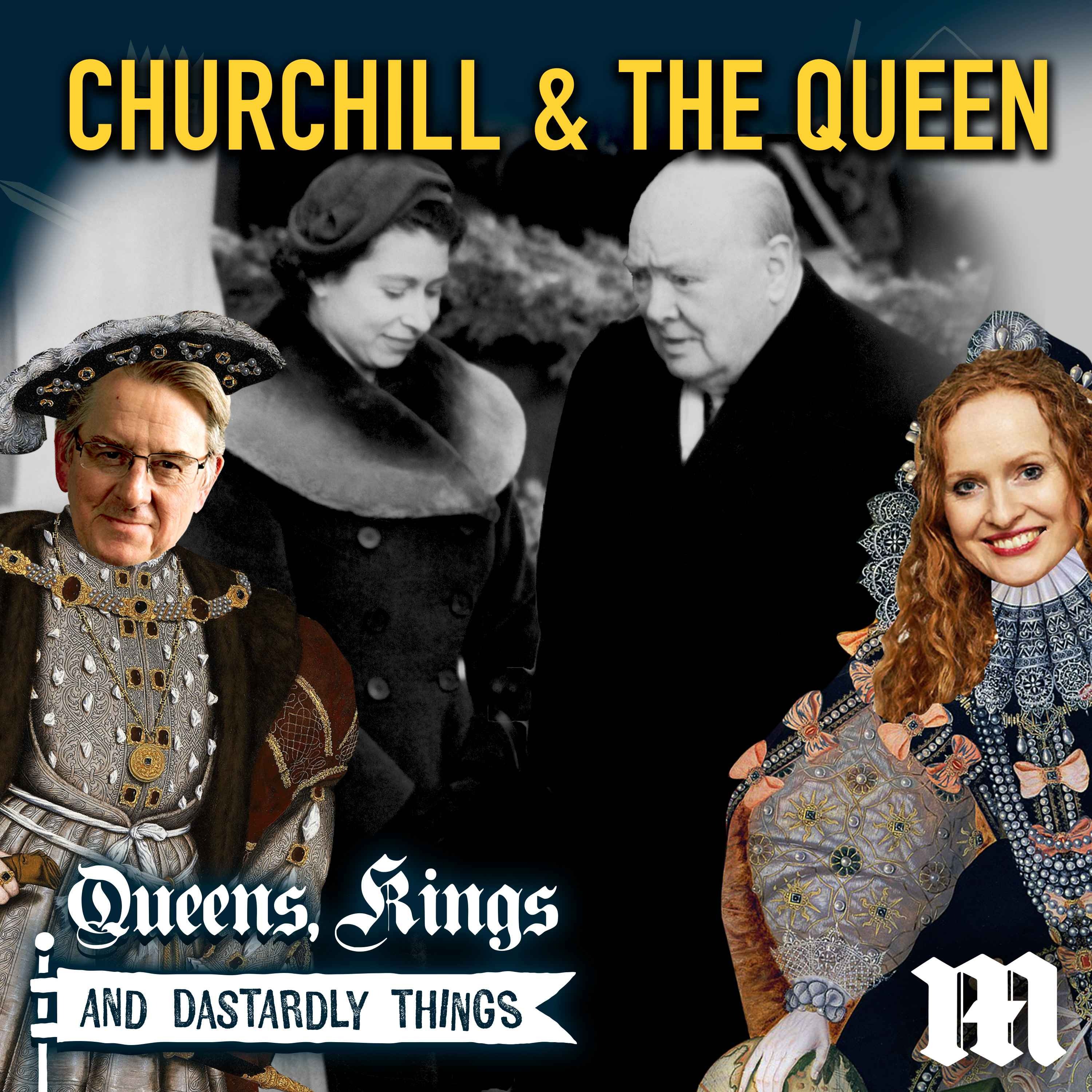
The transcription delves into the relationship between Elizabeth II and Winston Churchill, highlighting their longstanding connection and how Churchill shaped the royal dynasty. It further explores the dynamics between the Queen and various prime ministers over the decades, such as Harold Macmillan, Harold Wilson, Margaret Thatcher, Tony Blair, and more recent leaders like David Cameron and Boris Johnson. The text touches on significant events, including crises, political reforms, and moments of collaboration or tension between the monarch and her prime ministers. The discussion provides insights into how different personalities, backgrounds, and political contexts influenced the Queen's interactions with the heads of government during her reign.
Transcription
4277 Words, 23771 Characters
So what have we got on the show today?
Well, we've got the two biggest figures of the 20th century and their relationship with
one another.
Elizabeth II, Winston Churchill, it doesn't really get more Titanic than that.
Hello, and welcome to another episode of Queens, Kings and Dastardly Things.
I'm Robert Hardman, Daily Mail columnist and royal biographer, and today I am not joined
as usual by Professor Kate Williams.
Kate can't be here, but I'm joined instead by the very eminent fellow royal biographer
Andrew Morton.
Andrew, hello.
Nice to see you.
I'm sorry.
I'm not taking Kate's place, I don't think.
Well, it is very timely because you today, or just as we speak anyway, have a new book
out.
You're obviously famous for your Diana book back in 1992, which I think the word bombshell
doesn't even begin to come close, but you've obviously written many books since and you've
got a new book out called Winston and the Windsors, How Churchill Shaped a Royal Dynasty.
So I thought we'd use that as our excuse really today to have a look at that and try
and answer that question that so many people answered, sort of parlour game, if you like,
of who was Elizabeth II's favourite prime minister, and maybe we could just kick off
by pre-empting the obvious answer, which was, was Churchill her favourite prime minister?
Well, you're not going to get me to say no.
After this, no.
I think that he came into her life at a point where the royal family itself was in crisis.
The Queen Mother wanted to retreat to her place in Scotland.
Princess Margaret was totally shell-shocked and was having an affair with the King's
former inquiry, group cats in Peter Townsend. Prince Philip was totally fed up.
He thought that the King George VI would live for a lot longer, and he had the sense of
moving up the ranks in the Royal Navy, and then you have the Queen herself, who was having
to undergo these burdens, but also to reign and enter Churchill, a man that she's known
for many years.
He first saw her when she was aged just two years ago.
Well, let's start there, because you're describing the events of February 1952.
I mean, that extraordinary news, the King is dead, the Queen flies back from Kenya, and
there he is on the runway to greet her.
But when do you think they actually met for the first time?
It's probably when she was a very small girl.
Well, they met when she was aged two, at Balmoral, and Churchill called her the Queen Elizabeth,
when she was still just Princess Elizabeth, and said that she was remarkably equitable
in demeanour and her character.
So he was impressed by her age just two.
And that shows us that Churchill was in the Royal Loop, I mean, long before her reign.
When he was the grandson of a Duke, he'd been a substantial public figure right through
the 20th century.
So, I mean, he'd met her in the 20s.
He was in Royal Circles in the 20s.
Absolutely.
He was in Royal Circles before the 20s.
I mean, Edward VII took him under his wing, and they enjoyed a very interesting back
and forth, letter-writing competition.
In many respects, I mean, Churchill was born in a palace, blending palace.
The Queen wasn't born in a palace.
Interesting point, yes.
So Churchill was very grand.
He was the grandson of the Duke of Marlborough.
And of course, she'd have seen a lot of Churchill during the Second World War.
But what sense do you have of how the war and Churchill's role in the war kind of shaped
Elizabeth's view of being a monarch when the time came?
She'd seen him and her father basically save the world.
I think Elizabeth could see that, you know, her father was undergoing terrible stress,
and he really felt that the burden of the worlds were on his shoulders.
And the fact that Churchill was there to help ease that burden for both of them, really,
I think Elizabeth will have absorbed the fact that a sovereign can't just do it all on
their own.
They've got to rely on their first minister.
Let's move on to – she becomes Queen in February '52.
He's her first prime minister.
What's that relationship like to start with?
Because suddenly it sort of flipped from her being this sort of young princess in a war
of this sort of grand statesman of the age.
Suddenly she is effectively his boss and she's just 25.
I mean, how does she – is there a sort of sudden sea change in their relationship?
Nothing, nothing but a girl, as Churchill said, yes.
I mean, there was a sea change.
It would have been great to be a fly on the wall at that first meeting.
The new queen nervous herself about, you know, taking on this great burden.
Churchill, as you mentioned, a war leader, Nobel Prize winner, recognised around –
For literature that was, isn't it?
For literature not for peace.
After that first meeting, Churchill came away impressed by this young woman.
Just of her sagacity and the fact that she was prepared to listen.
And he was very prone to emotion, to crying, wasn't he, I think, that he could win it
and he had a nickname for him.
Calling crybaby.
Crybaby.
So I'm sure it's somewhere – I'm sure, I think maybe in your book, but at that very
first audience, I mean, the queen didn't really know what to say and Churchill kept
bursting into tears.
I mean, it must have been a fairly awkward first session.
But in later meetings, he's still bursting into tears, not of sadness or anything, but
of humour, because they used to talk about their joint passion for horse racing and horse
breeding.
Churchill would come out of the room.
Churchill would come out, tears streaming down his cheeks and saying, you know, she's
such a wonderful woman, and develops a really strong bond, as much a family bond as a political
bond, because as I mentioned, the royal family itself was in crisis when Churchill came
into the lives as First Minister.
Philip felt at times there were three of them in the marriage, so it was a bit crowded.
Phil and Philip clashed heads on numerous occasions, probably most notably over the coronation,
over the televising of the coronation.
Philip, the great moderniser, into technology wanted that to take –
I mean, definitely the queen didn't want the TV cameras in there, and Churchill therefore
didn't, and certainly the Archbishop didn't – they were all terrified of looking like
idiots if they got it wrong.
But I think Philip was – he was sort of – I think he was sort of agnostic.
But he was, you're right, I mean, he was always keen to push the boundaries.
Well, to test the limits.
I mean, you can imagine this, for the queen, she'd seen what happened to her father at
his coronation.
You know, they put the crown on the wrong way around, and all kinds of mishaps.
The last thing the queen wanted to do was get it wrong, and she practised like mad, as
we know.
Yeah.
Well, when coronations do go wrong, it is usually the Archbishop of Canterbury.
I interviewed Justin Welby after the coronation of the king, and he'd been terrified that
he was going to put the crown on the wrong way around, and he'd sort of practised in
his mind, you know, weeks before which way around to get it, make sure he didn't get
it wrong, because –
Didn't he put some little sticking –
No, they didn't, actually.
They did.
They put a bit of thread on it at the coronation of Elizabeth II, and then someone tidied away
the thread just before the coronation.
So that was a bit of a nervousness, but Justin Welby told me that he knew there was a square
green jewel at the front of the crown, and an oval one at the back.
That was the way you could tell the front of the back, and he had this sort of mantra
– he would tell himself all the time, "Square front, oval back, square front, oval back!"
And that's how he knew, but anyway, we got to the – there's the coronation.
That's this seismic moment.
Let's move on from Churchill, because, okay, '55, he finally goes – the queen tentatively
offers him a dukedom, which he doesn't accept, but he accepts a knighthood – knighthood
of the garter.
He becomes Sir Winston Churchill, and then he's this sort of grand old man of politics
in his retirement.
But then the queen gets Anthony Eden.
That was not a success, obviously, because of Suez, and he then goes.
So I mean, let's look at that sort of first – maybe the first half of the reign.
I think one can sort of divide it to sort of pre and post Margaret Thatcher, because
Margaret Thatcher is roughly the same age as the queen, up to that point.
Everyone's sort of either older or her age.
Suddenly, John Major is the first younger PM.
The one who got on best with her was the one who didn't last that long, Sir Alex Douglas
Hume.
He owned a land very near to the queen, and he helped her to name some of her horses.
So they were very friendly, even though he was the subject of corresponding caricatures
on TV, in that TV show called That Was The Week That Was, probably before your time.
It was one of the original satires.
I've read and written about it, because TV in satire, I think, played a big part in
sort of bringing him down.
Bringing him down and changing the pace of Britain into the swinging sixties.
So we have – so we go Churchill, and Eden doesn't last long because of Suez.
He goes, there's a sort of – the queen's in that terrible position of who does she
appoint, and she – and back then we have to remember that's when it was her job.
It wasn't that the Tory party didn't elect its own leader.
It was down to the queen to appoint a prime minister that she chose, Harold McMillan.
That was –
She was also guided by the magic circle of a few –
Tory Toffs.
Tory Toffs, yeah.
Bobbety, Salisbury, and a few others.
So yes, we also – just to remind our viewers and listeners, obviously, Eden had been behind
this botched plan to try an annex of Suez Canal.
It was all involved in a tissue of lies.
It all collapsed.
That's why he went.
And it's McMillan, as you say, that was a pretty successful premiership that takes us
through to the early sixties.
He's then ill, and the queen appoints her friends, Sir Alec Douglas-Hume, and as you
say, everyone is slightly – well, the sort of TV satirists make a lot of the fact that
the country is still being led by an earl.
I mean, he's actually – a hereditary peer has disclaimed his –
He's actually given up his seat in the House of Lords.
Yeah.
I mean, by everyone who I've ever – and I did actually meet him once when he was a
very old man.
But I mean, everyone ever met him.
He said he was absolutely charming and thoroughly honorable, but didn't last long, as you say.
And then in came Harold Wilson, whose first premiership was '64, he came in, white heat
of technology and all that stuff, the sort of sense of modernizing.
He's the queen's first labor prime minister.
How did they get on?
Because everything would suggest they got on really rather well.
Well, initially, he was a little bit choppy.
For his first audience, he brought Mary, his wife, along, and his children to Buckingham
Palace.
And that wasn't done in those days, was it?
And that wasn't done.
He didn't bring the whole family.
But also, as Mary recalled, the conversation was always all about horses.
We didn't really have horses.
The son of a chemist from –
Othersfield, wasn't it?
Othersfield, yeah.
But they developed a real rapport.
He was there to help and to guide her as well, as much as anything.
And after the Aberfan disaster, '66, they were very – they became a lot closer.
And so, he was in post up until 1970, then there was that surprise election win by Edward
Heath.
No one was expecting it.
Incomes Heath.
And that's quite a sticky, dare one say, chilly relationship between Queen and Prime
Minister, I think, because Heath was not a fan of the Commonwealth.
He wasn't a fan of the Commonwealth.
He had no small talk.
He was interested in sailing, playing the organ.
Didn't have much in common with the Queen.
Well, he stopped her from going to the Commonwealth Summit in Singapore in 1971, I know, and
that, she was furious about that.
That never happened again.
He never missed another one after that.
And he was going to make a missed one in Canada as well, I think, in Ottawa, but she got round
that one.
She did.
She had a cunning plan with Pierre Trudeau, the Canadian Prime Minister, who invited her
as Queen of Canada, to which said, yes, Heath could do nothing about it.
But then that brings us, obviously, on to – well, then Harold Wilson, sorry, Harold
Wilson comes back, Heath goes in '74, Harold Wilson, Mark II.
That's a sort of rather full-on twilight premiership, isn't it, because he's not
very well.
He's not well.
He even realises he's got – basically dementia, early onset, I think.
I don't know what they call it at the time.
He confided in her long before he announced his resignation, didn't he?
I mean, he said, I'm going to go, and I want it known that I've told you that so that
nobody can ever say I was pushed.
And she kept that confidence, but so he finally steps aside, and we're into 1976, and it's
Jim Callahan, isn't it?
How did she get on with Sonny Jim, as he was –
Well, she got on very well with Sonny Jim.
Sonny Jim, I think he's six-foot-one, tall man.
She used to walk around the gardens at Buckingham Palace discussing world events and gossip
and political gossip, and he came out with the great phrase about all the prime ministers
and their relationship with the Queen, that she offered friendliness, but not friendship.
And that, I thought, was a very telling description of that relationship, and she was very fond
of him.
On one of their walks around the palace gardens, she picked a flower and put it in his buttonhole.
Well, then, of course, Margaret Thatcher arrives in '79, her first female prime minister,
very close in age, completely different backgrounds, obviously.
And temperaments, I think safe to say the Queen was not naturally combative, not one
for confrontation, whereas Mrs. Thatcher was quite happy to have confrontations with anyone
who was standing in her way.
That was her – hence, everyone called her the Iron Lady, but she had huge respect for
the Queen, didn't she?
I mean, I think it's overblown this idea that they were – and that the crown gets
it all wrong, the way that they put them at loggerheads.
I don't think they were ever at loggerheads.
I don't think they were at loggerheads, but at the same time, I don't think Mrs. Thatcher
or Dennis for that matter were particularly enamoured with going to Balmoral.
There's a story that she insisted on wearing high heels to go for a walk in the grounds
and ended up having to give up because of the mud and the stones.
And one of the aides came back with a pair of Wellington boots, which had been offered
initially and turned down.
And I think one of the elements of the crown, which I think find very funny, is when Margaret
and Dennis appear in Ball gown and black tie, and the rest of the royal family are in their
tweeds and plus balls.
I just thought that totally jumped the shark that moment because there's no way at Balmoral
you never know what you're supposed to be wearing at any given moment.
Well, at Balmoral, you've got four changes of clothes.
That relationship was – I mean, it was probably tested most harshly in 1986 when you had the
Sunday Times story saying the Queen was dismayed by Mrs. Thatcher's policies on vis-a-vis
the miners' strike, supporting U.S. attacks on Libya, Mrs. Thatcher being at odds with
the Commonwealth.
And there was that Sunday Times story that – I mean, it really was an extraordinary
allegation.
Again, I think the crown get it wrong, they make out that the Queen is actively subverting
her prime minister and wants this story out there.
I think it was the press secretary, Michael Shea.
Michael Shea spoke to the journalist Simon Freeman, a former mirror group trainee as
was I, and he wrote this story, and he was very quickly pinpointed that the origin of
the briefing was the press secretary, Michael Shea.
And within a few months he departed, so he wasn't blamed in the sense of being sacked,
but he was urged to move on, look elsewhere, which was a shame.
I liked Michael.
He was a very, very decent, private press secretary.
And he wrote books as well, didn't he?
Thrillers.
Face Margaret Thatcher.
There are still a long list of prime ministers.
We don't really have time to go through all of them.
I mean, obviously, we'll pick out the ones at key moments of her life and reign, of the
Queen's life and reign.
You've got John Major, who's in post through the trauma of the Anna Cerebilis.
And then after that, Tony Blair is a very interesting relationship, because obviously
he's bringing about lots of constitutional reform.
But more than he's remembered for talking about the mourning of Diana's death.
He's talking about the people's princess.
And there's a lot of controversy there about the fact that the royal families stay at Balmoral,
don't come down to London, and there's this tension between Downing Street and Buckingham
Palace about how and when the Queen should return to London.
And I think it's generally agreed that Blair helped to shape her response in a way that
did credit to herself and to the Crown.
They both, Buckingham Palace and Downing Street, grew much closer during that week.
They didn't really know each other at that point.
I mean, Blair had only been in Downing Street as prime minister for a few months.
That was a real sort of coming together under duress.
And also, they had organised a big funeral before that, with the death of John Smith,
the Labour leader.
So the Labour Party and the Labour infrastructure was geared up for that.
So they were able to help the palace organise this funeral, which took place only a week
after that.
Only a week after that.
I'd quibble with that, actually, because I remember interviewing Lord Ehrli and Malcolm
Ralston and a lot of the people who organised that.
And they pretty much got the framework for the Diana's funeral ironed out before the
first Monday meeting, where the Downing Street lot came in.
And I think later there was sort of certain unhappiness, the way that the new Labour machine
kind of claimed the credit for Diana's funeral when they would say, and we probably won't
know until the archives are opened up, but I've certainly told that Downing Street were
supportive, but their role was secondary.
So we'll see, but let's move on, because after Blair and Blair, it's a long innings.
Gordon Brown, he's not around for long.
Then we get what is very interesting in 2010, when David Cameron comes in, because that's
actually the Queen's first coalition.
And she seems quite happy with coalition government.
Do you think that sort of suited her temperament?
It's suited her temperament, but at the same time, I think Cameron introduced some much
needed refreshment, reform of the monarchy, getting rid of the civil list, changing the
law regarding the fact that the elder sister could take it.
Yeah, male primogeniture is now over, thanks to Cameron years.
So that was a great change, and it starts to bring the monarchy back into the 21st century.
And so I think she appreciated that because he used his political muscle to get those
changes in.
And then we get a rapid succession of fairly chaotic premierships, which we won't necessarily
dwell too much on.
And then there's a sort of cavalcade of Theresa May, then there's Boris Johnson, then there's
Rishi Sunak, and for the last three days of her life, Liz Truss.
So Andrew, looking back on them all, and let's set Winston Churchill to one side, apart from
Winston Churchill, who do you think was her favourite prime minister?
Well, I think when I reflect on it, he's got to be John Major.
I mean, he was there, the most difficult part of her reign to that date, the Annas Heribles.
When your book came out?
When my book, "Dine Her True Story", came out, and he was the one who announced in Parliament
the separation of the Prince and Princes of Wales, saying that they have no plans for
divorce.
And he was a great support for the Queen at that time, in terms of advice, constitutional
advice and so on.
And then after Dinah's death, he was asked by the Queen to be the guardian of William
and Harry.
And in the sense of organising their money, organising their lives and being their protectors.
I mean, obviously, their father was a devoted dad, single parent, and was there looking
after them.
But as you say, there was a need to sort of protect their interests from the royal machine,
if you like, and he was the man entrusted to do that.
And to sort out the Princess Dinah's will and these kind of tricky financial questions
that were thrown out by her premature death.
Okay.
So that's interesting.
You, okay.
Winston aside, you're going for John Major, I'm going to go for Alec Douglas-Hume.
As discussed earlier, I think they were peas in a pod.
They were Scottish landowners.
They'd grown up together.
They could just talk about stuff that seemed perfectly normal, whether it was grousey ills,
racehorses, highland dancing, I don't know.
That would be my punt with a sort of strong runners-up, maybe for – could we give Harold
Wilson a sort of runners-up position?
I mean, I would give Jim Callahan a run around.
Okay.
That's interesting.
That then brings us around to the other question that is asked less often, but I think is equally
intriguing is who was her least favourite Prime Minister?
I mean, obviously, she was famous for playing her cards very close to her chest and all
things.
Reading between the lines, who do you think was the one that she – and maybe we have
to set – having set Churchill aside with the first question, maybe we set Liz Truss
aside with the last one because she barely knew her, but who would be the one that she
was most pleased to see the back of, should we say?
I think Edward Heath, because she's such a – I mean, she devoted her life to the
Commonwealth and to see your First Minister's utter indifference to that institution and
his focus on the European – and joining the European Union, and where everything,
including the Queen, was told to buckle up and join him for the ride, to join the EU.
I would say that she felt kicked to the curb, as it were, by the Prime Minister.
That's very interesting.
Although, I suppose, one footnote, which I always enjoy, is that many years later when
John Major was in Downing Street, he organised a birthday dinner for Ted Heath, I think it
was Heath's 80th or 90th or whatever, and invited the Queen as a guest of honour, and
she came and obviously was sitting next to Heath, and Heath actually fell asleep sitting
at the dinner, and everyone looked slightly awkward, and I think – didn't the Queen
say to John Major, "Oh, don't worry, he'll wake up again in a minute," and he did.
So, well, Andrew, it's been a pleasure.
Thanks so much for joining us.
As I say, Andrew's new book is Winston and the Windsors, and it chronicles that extraordinary
relationship between, well, really, the two kind of titans of the 20th century.
I mean, you know, who's bigger than Elizabeth II and Winston Churchill?
There it is.
So, Andrew Malm, thank you very much, and I hope you enjoyed this episode of Queen's
Kings and Dastardly Things, which, as you know, you can get wherever you get your podcasts,
and we'll be back again in a week's time when Professor Kate Williams will resume seat
next to me.
But for now, Andrew Morton, thank you very much, I'm Robert Hardman, goodbye.
Podcast Summary
Key Points:
Discussion about the relationship between Elizabeth II and Winston Churchill.
Overview of various prime ministers throughout Elizabeth II's reign.
Notable interactions and dynamics between the Queen and different prime ministers.
Summary:
The transcription delves into the relationship between Elizabeth II and Winston Churchill, highlighting their longstanding connection and how Churchill shaped the royal dynasty. It further explores the dynamics between the Queen and various prime ministers over the decades, such as Harold Macmillan, Harold Wilson, Margaret Thatcher, Tony Blair, and more recent leaders like David Cameron and Boris Johnson. The text touches on significant events, including crises, political reforms, and moments of collaboration or tension between the monarch and her prime ministers.
The discussion provides insights into how different personalities, backgrounds, and political contexts influenced the Queen's interactions with the heads of government during her reign.
FAQs
Elizabeth II and Winston Churchill.
Winston and the Windsors, How Churchill Shaped a Royal Dynasty.
When she was aged two at Balmoral.
She saw him and her father save the world, realizing a sovereign can't do it all alone.
Winston Churchill.
They were very friendly, and he helped her name some of her horses.
Chat with AI
Loading...
Pro features
Go deeper with this episode
Unlock creator-grade tools that turn any transcript into show notes and subtitle files.
 PodcastTranscript AI